I still remember the first day of my college life and can't believe my graduation day is coming. But I can truly say that the period between the first and last day at university has given me a great deal of knowledge about translation studies. First of all, I would like to thank my lovely mother, who always supports me with her kind words and best wishes.
I would also like to thank my brother, who encourages me and reminds me how valuable I am. Finally, I would like to especially thank all my dear teachers, Nilüfer ALİMEN, Tamilla AKTAŞ and Sevcan YILMAZ KUTLAY. Finally, I would like to thank my dear thesis supervisor Sinan Okan ÇAVUŞ and the owner of the article I translated, dear Aslı KALEM BAKKAL, for their support.
INTRODUCTION
COMMENTARY
- Source text selection
- Theoretical perspective
- Pre-Translation Phase
- Terminology management process
- CAT tools used for translation
- Translation phase
- Problems of the source text
- Problems occured during the translation process
- Consulting the writer of the source text
- Post-Translation process
Therefore, the translation of the literary texts is often exposed to manipulation by the ideologies of the target culture. After receiving approval from my dissertation advisor Sinan Okan Çavuş, I sent an email to the author of the article, Aslı Kalem Bakkal. When it comes to the problems with the source text, there was only one thing that stood out to me.
However, my thesis advisor noticed a difference in the left indentations of the quoted parts of Atalay's book. At the end of my research, I could not find the pdf version of the book. So, I read the back cover of the book and realized that the quote was there.
CONCLUSION
When it comes to this article, written by Aslı Kalem Bakkal, I would like to support our teacher's opinions by giving a quote from the book called "Translation, rewriting and the manipulation of literary fame" written by André Lefevere. Rewritings can introduce new concepts, new genres, new devices and the history of translation is also the history of literary innovation, of the formative power of one culture on another. But rewriting can also suppress, distort, and contain innovation, and in an age of ever-increasing manipulation of all kinds, the study of the manipulation process of literature, as exemplified by translation, can help us become more aware of the world in which we live. to live, to achieve.
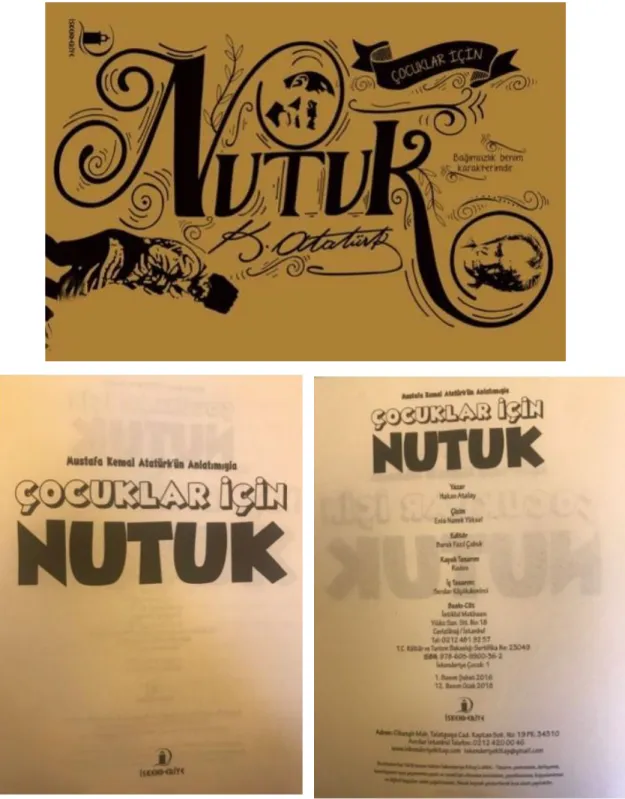
Taking this statement as a starting point, we can say that Atalay's intention in rewriting the Nutuk book seems at first sight to appeal to the intended readers. However, when we analyze the book, as Kalem Bakkal says, some words in the book need an explanation from an adult, and even adults may need to look in the dictionary for their meanings. What Atalay did in "his" book is a kind of distortion by giving Ataturk's signature and his photo on the cover and declaring himself (Hakan Atalay) as the author of the book.
In this diagram, the translator is first positioned as the real reader of the source text. It is after this stage that O'Sullivan's diagram differs from Chatman's because the translation comes to the fore and the translator as the real reader of the source text turns into its real translator. While the target text runs parallel to the source text, the translator as creator of the translation runs parallel to the actual author of the source text (201).
Whereas in the source text the implied author creates his own implied reader, the target text's implied reader is created by a similar agency, the “implied translator” (201; original emphasis). The cover bears Mustafa Kemal Atatürk's signature next to the title Nutuk, and the copyright page lists the book's "author" as Hakan Atalay, the person who did the intralingual translation. If, on the other hand, we refer to O'Sullivan's extended diagram based on Chatman's, Atalay would first be the "true reader" of the source text, then he would change to.
APPENDICIES
APPENDIX I. SOURCE TEXT
This edition, among many others, was selected for research because the edition's copyright page presented Atalay as the 'author' of the book and children as the target group on the cover. The Great Treatise is in a sense a first-rate first-hand diary of the stages of the National War of Independence and the Turkish Revolution.”7. O'Sullivan (2003) defines the narrative text as 'the message conveyed from the real author to the real reader', where the real author is 'the one who physically wrote the text of the book' and the real reader is 'the one is who physically wrote the text of the book'. someone who holds it in his/her hands and reads it (or has it read to him/her)” (199; original emphasis).
As someone who knows the source language and the conventions and norms of that culture, he is in a position to slip into the role of implicit reader of the source text” (O’Sullivan 2003, 201). According to O'Sullivan, the implied reader of the translation will never be the same as the implied reader of the source text, since their generators are different. Atalay, who assumes the position of a true translator, "transmits the source text through the intratextual agency of the implicit translator" and creates his own "narrator," "narrator," and "implied reader" (O'Sullivan) through his implicit translator. original emphasis).
With additional sections not included in the original text, it must have been intended to present a comprehensive picture of Atatürk's ideas and the Turkish War of Independence. Thinking of the crew and soldiers accompanying me, I pretended not to be aware of the situation. Fortunately, due to the stormy weather of the Black Sea, we managed to get lost.29 (17-19).
She refers to van Leuven-Zwart's (1990) term "translation's narrator" (quoted in 7) and the ambiguity it creates: "It [translation's narrator] can either be taken to mean the 'narrator contained in the translated text' or 'the narrator of the translation,' that is, another representative of the same school, Theo Hermans (1985) notes that "all translation implies some manipulation of the source text for a certain purpose" (11). O'Sullivan (2003), in her article, approaches the subject from the perspective of change in relation to the "agent of the translation, the translator" and the level of his/her presence in the target text; in her communicative model of translation, the implied translator is the one who determines which important changes will take place.
The field of narratology meets the field of translation studies in O'Sullivan's model and the subject of study in the present article appears to be an example of manipulation in translation where narratology used as the translation strategy has created its implied translator who claims that he 'the author' of the target text and who claims to have 'children' as his target reader. Atalay's work can be said to be simply inconsistent in terms of the identities, both of the author and the reader. Regardless of how loud or low the translator's voice is, it is not manipulative to present the translator as the author on the copyright page while the cover bears the name of the source text and the signature of the author.

APPENDIX II. TARGET TEXT
O tarihten bu yana Mustafa Kemal Atatürk'ün bu konuşması birçok kez yayımlanmış ve tarihi, sosyal ve kültürel yapısı nedeniyle hem yurt içinde hem de yurt dışında her zaman büyük ilgi görmüştür. Bu çalışmanın yazarının (hedef kitlesi çocuklar olan) incelediği baskıların hiçbirinde bu süreç 'çeviri' olarak tanımlanmasa ve baskıların hiçbir yerinde bundan bahsedilmese de, hepsi Atatürk'ün konuşmasını veya bazı dil içi çevirilerini bir metin olarak içermektedir. başlangıç noktası. dönem, yani yalnızca kaynak metin olarak. Bunun başlıkla bile ortaya çıkan ve kolaylıkla tanımlanabilecek bir gerçek olduğunu varsaymak yanlış olmaz. Üstelik bazı kapaklarda Atatürk'ün ünlü sözleri kullanılmış ve Atatürk'ün konuşmasının kapağı da bir istisna değil.
Sadece Atatürk'ün yaptığı konuşmada "yazar" kelimesi kullanılıyor ancak bu kullanım Atatürk'e ait değil ve kapaktan da anlaşılmıyor. Kapakta Nutuk'un başlığında Mustafa Kemal Atatürk'ün imzası yer alırken, kitabın "yazar"ı telif hakkı sayfasında dil içi tercümeyi yapan Hakan Atalay olarak belirtiliyor. 8 Bu başlık, Mustafa Kemal Atatürk'ün çocuklara yönelik bir konuşması olarak kapakta değil, iç kısımda verilmiştir.
Orijinal Nutuk'u bir anlatı olarak değerlendirip şemasına yerleştirmek için Chatman'ın tanımlarına döndüğümüzde, "gerçek yazar"ın yanına mutlaka Mustafa Kemal Atatürk'ün adını yazacağız. Bu özel durumda çevirmenin böyle bir ilişkiyi nasıl kurduğunu anlamak için Atatürk'ün Nutuk'unu bölüm başlıkları, eklemeler, çıkarmalar ve üslup açısından inceleyeceğiz. Amaç, orijinal metinde yer almayan ek eserlerle Atatürk'ün fikirleri ve Türk Kurtuluş Savaşı'nın kapsamlı bir resmini oluşturmaktı.
Nutuk'ta Atatürk'ün Samsun gezisi sadece kısa bir paragrafta verilirken, bu paragrafın tercüme metindeki sunuluş şekli kitabın anlatısal karakterini vurgulayan belki de en belirgin örnektir. Atatürk'ün Nutuk'unun kaynak metni, çocuklara yönelik birçok baskının tercih ettiği gibi, dolaylı anlatımda 'hikâye biçiminde'dir. Atalay, Atatürk'ün Nutuk'undan esinlenerek yeni bir kitap yazdığını iddia ediyor gibi görünse ve bu nedenle telif hakkı sayfasında bu yeni kitabın yazarı olarak anılsa da, kapakta başlık olarak Nutuk'u ve Atatürk'ün imzasını görüyoruz.
Ayrıca Chatman ve O'Sullivan'ın şemalarına göre kaynak metin konuşmadır ve asıl yazar ise Mustafa Kemal Atatürk'tür. Atatürk'ün Anlattığı Nutuk, çevirmenin örtülü çevirmen aracılığıyla anlatım çerçevesini bir çeviri stratejisi olarak kullanması, öncelikle yetişkinler için yazılmış bir tarihi kitabı çocuklar için bir anlatı yaratarak türler arasında çevirmekle kalmayıp, aynı zamanda dil içi çevirisinde de tüm anlatı öğeleri ve “değişim” temsilcisidir. Mustafa Kemal Atatürk'ten gençliğe: Çocuklar için büyük konuşma.

APPENDIX III. TERM LIST
34;Değişimin aracısı'" Değişimin konusu Çevirilerin anlatıcı Çevirinin anlatıcı Çevirinin aracısı Çevirinin aracısı(?) Anlatısal çerçeve Anlatısal çerçeve.
APPENDIX IV. TECHNOLOGIES USED