Breathing Space
Response to the Treasury’s call for evidence on a
breathing space and statutory debt
management plan scheme
Contents
Contents 1
Background 3
Overview of Response 4
The Breathing Space Scheme 5
A. Access to Breathing Space 5
Question 1: How should eligibility be determined for a breathing space? 5 Question 2: What should be the trigger point for a breathing space? 6 Question 11: Who would be responsible for notifying creditors that a customer has
entered a breathing space? 7
B. What will the Breathing Space Scheme cover? 7
Question 3: Should all debts be eligible for a breathing space? 7 Question 4: Should all interest, fees and charges be frozen throughout the breathing
space period? 9
Question 7: Should breathing space protections only cover debts existing at the outset, or also include new debts arising during the six-week period? 10 Question 17: Should a breathing space be extended to Wales and Northern Ireland as
well as England? 10
C. Conditions of participation and exit 11
Question 5: What activities must the breathing space participant continue with to remain
eligible? 11
Question 6: Are there circumstances in which a breathing space period could end before six weeks, such as if an appropriate solution is found? Who could be responsible for
enforcing this? 11
Question 8: Should a breathing space be noted on a person’s credit file? 11 Question 9: How frequently should a debtor be able to access a breathing space, and
what criteria should control the frequency of access? 11
D. How could the government ensure that a breathing space works with and adds value to
existing support structures? 12
Statutory Debt Management Plans 14
A. Access to and administration of statutory debt management plans 14 Question 18: How could a statutory debt repayment plan be administered? 14 Question 19: What challenges would be faced in administering a statutory repayment
plan? 15
Question 26: What should happen if one or more creditors disagree with the plan? 16 Question 21: For whom and for what debt solutions will a statutory repayment plan be
most appropriate? 16
B. What will a statutory debt management plan cover? 17
Question 20: What protections should apply during the statutory repayment plan? 17 Question 24: Should the repayment plan apply to all debt? 18 Question 25: For the included debts, should some debts be prioritised for repayment? 19 Question 31: Should a statutory debt management plan be extended to Wales and
Northern Ireland as well as England? 20
C. Conditions of entry, participation and exit 21 Question 27: What activities must the statutory debt repayment plan participant continue with to remain eligible? Must they simply meet agreed repayments to remain eligible? 21 Question 28: How should changes in income be dealt with? Should it be possible to suspend a plan, or have reduced payments for a period of time? 21 Question 29: What happens if a plan fails? Should creditors be able to apply any interest, fees or charges that they were prevented from charging during the plan? 22
Impact 23
Question 32: For each of (1) a six-week breathing space, and (2) a statutory debt
management plan, please describe in detail, and with supporting evidence, the positive
impact expected through: 23
Improved access: How will it would encourage more people to seek debt advice
earlier? 23
Better support: How will it improve outcomes for customers who are already in
problem debt? 24
Background
Each year, Citizens Advice helps over 340,000 people with more than 1.5 million debt issues. 8 million people use the debt pages on our website. Our service has helped 1 people who are struggling with debts since its foundation and it lies at the very heart of our organisation’s mission. At present, we help solve 7 out of 10 of our client’s debt problems, and 84% say they couldn’t do without us. 2
From our advice, we know that people in debt are unable to access the help they need.
Existing statutory solutions have strict eligibility criteria and tend to be appropriate for people who have high debts and a high surplus income, or very little in the way of assets. On average, our clients have £1,990 of priority debts which falls below the amount considered appropriate for adopting an Individual Voluntary Arrangement (£10,000). This average level of debt also means that bankruptcy and debt relief orders - which can threaten assets - are excessive. 3
Existing debt solutions tend to involve fees, which can deter participation. The £90 fee for debt relief orders is substantial enough to deter a client’s participation, let alone the
£680 necessary to enter bankruptcy or the ongoing fees associated with IVAs. This is particularly problematic since clients with debt problems tend to be in a weaker financial position than other Citizens Advice clients. They are more likely to be
unemployed or be in part-time or insecure work - and they are less likely to be home owners. 4
The duration of existing statutory solutions also makes them inappropriate for a significant number of our clients. People’s financial difficulties often emerge from temporary or short term changes in their lives. Of our debt clients, 9 in 10 have experienced a major life event in the last year, and these changing circumstances are strongly associated with falls in income. As a result, debt problems are often short term.
Around half of people in problem debt in 2015, for example, were no longer in problem debt a year later. 5
For many people, a period of recovery or breathing space - in order to stabilise their financial position after such events - would help them to avoid problem debt and get their finances back on track.
For those who need further help to repay their debts, a flexible, statutory debt management plan would help close some of the gaps between current insolvency
solutions and overcome the medium term effects of changes in their circumstances. The flexibility of these solutions is of central importance; it will ensure that a broad range of clients can repay what they owe, without risking their home or damaging their ability to borrow in the longer term.
1 All figures in this response are based on our client data from 2016-17 unless otherwise stated.
2 Citizens Advice, (2017) Outcomes and Impact Research, 2017
3 Data from around 86,000 cases recorded as part of Citizens Advice’s Money Advice Service Debt Advice Project (MASDAP) since 2015.
4 Only 5% of debt clients own their own homes, as opposed to 15% of our usual clients and 33%
of the UK’s adult population.
5 Citizens Advice, 2017 Stuck in Debt, August 2017
Overview of Response
We welcome the government’s proposal to introduce a breathing space and statutory debt management plan for people who face financial difficulties.
The six week breathing space will relieve people of the urgent financial worries which affect their lives - allowing people who face financial difficulties to seek advice whilst interest, charges, and enforcement are paused. It is vital that this six week period acts as a gateway to a longer term debt solution. This could be a statutory debt management plan, an informal debt management plan or an existing insolvency solution, such as an individual voluntary arrangement or debt relief order.
The breathing space and subsequent solutions should be ‘joined up’ - enabling clients who have activated the breathing space to continue receiving protection from creditors if they agree to a manageable repayment plan. We have found that periods where clients are not protected, or are referred from one agency to another, can leave people feeling disengaged or disheartened about their financial difficulties. 6
The statutory debt management plan should be flexible. This flexibility should be
promoted by allowing clients who face financial uncertainty to make token payments for up to a year. Furthermore, if there is insufficient debt advice capacity to finalise a long term debt solution within six weeks, the advice provider should be able to roll over the breathing space for a further six weeks.
Both the breathing space and statutory debt management plan should include the majority of debts held by clients at the inception of the scheme. These debts
should then be prioritised according to existing debt advice best practice. One third of all debt issues seen by Citizens Advice are from public sector creditors, with almost half of these (220,000) associated with council tax. Enforcement action around council tax is a major problem for our clients, and 70,000 problems with council tax collection were brought to Citizens Advice in the last year alone. Effective protection from enforcement action, fees and charges must therefore include public sector, household and consumer credit, debts.
The breathing space and the statutory debt management scheme must be free to clients. The charges levied upon clients in existing insolvency solutions act as a deterrent from entry. They also increase the time it takes for clients to become debt free.
Debt advice organisations will be vital to the success of a scheme such as this. It is likely, however, that the scheme will increase demand for their services. To ensure that
significant numbers of people participate in the scheme, it will be necessary to ensure funding for debt advice is sufficient and sustainable.
6 Citizens Advice has in recent years sought to promote a more joined up approach to clients through its Debt Management Service pilot. This pilot provides clients with a single point of contact throughout their experience of debt advice, ensuring that information is shared between clients and creditors. This information sharing helps to keep payment plans on track and can ensure that changes in client circumstances are effectively communicated to creditors.
The Breathing Space Scheme
A. Access to Breathing Space
Question 1: How should eligibility be determined for a breathing space?
The system of identifying clients’ eligibility for a breathing space (based on the ability to pay debts as they fall due) would be integrated within initial client
assessment procedures as part of the debt advice process. The assessment would determine, through an interview, whether a client is capable of meeting their ongoing financial obligations (including regular expenditure and debt repayments). If clients are unable to pay their debts as they fall due, they should be eligible for a six week
breathing space. In the context of the Citizens Advice debt advice, this process would take place through the Common Initial Assessment.
Citizens Advice helps over 340,000 people with money and debt problems every year.
Sometimes these clients have issues which are exclusively financial concerns. At other times clients are supported for a range of issues alongside their debts, including welfare, housing or employment support. The Common Initial Assessment enables advisers to assess client need for money advice and guide people to the appropriate channel of advice.
The Common Initial Assessment is a Money Advice Service recognised process for assessing financial need. It follows a standardised format, with a series of approved questions, and does not need to be undertaken by a regulated debt adviser. The assessment asks clients about their financial circumstances; the number of debts held by the client, whether they are in arrears, and the financial management techniques that clients are currently using. A central question in the assessment of need is ‘Can you pay your debts as they fall due?’ This question captures the definition of problem debt we use in our wider research, which is defined by the combined factors of; being in arrears, struggling to meet debt repayments and finding debts to be a heavy burden. 7 This process could be used to identify eligibility for breathing space. For instance, within the Citizens Advice process, when a client is identified as not being able to repay their debts as they fall due, they could be deemed eligible for breathing space.
The adviser would then discuss with the client the breathing space scheme to determine client interest. The adviser would inform the client of the conditions of participation - to agree to a meeting with a specialist debt adviser to consider a longer term solution to their financial difficulties. In addition to this, clients would be made aware that it is only possible to enter into breathing space once in a 12 month period.
7 For a more detailed elaboration of Citizens Advice’s definition of problem debt, please see our report ‘Stuck in Debt’ published in August 2017. By our estimation, nearly 3 million UK adults would be considered to be in severe problem debt by this definition. We believe however, that a significant proportion of those in severe problem debt already access debt advice to some degree - with nearly 1.5 million people being supported by debt advice each year.
Question 2: What should be the trigger point for a breathing space?
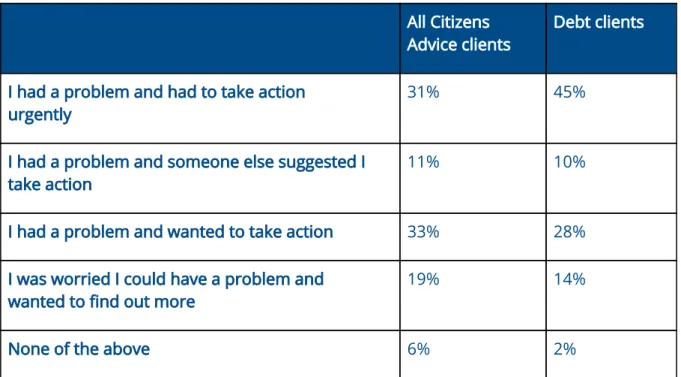
The respite provided through the breathing space needs to be triggered quickly and with administrative ease to ensure that clients are not overwhelmed by the urgent problems that they face. Our data suggests that, to a greater extent than with Citizens Advice’s other clients, clients turn to debt advice as a matter of urgency.
Table 1: When do people seek advice? 8
All Citizens
Advice clients Debt clients I had a problem and had to take action
urgently 31% 45%
I had a problem and someone else suggested I take action
11% 10%
I had a problem and wanted to take action 33% 28%
I was worried I could have a problem and
wanted to find out more 19% 14%
None of the above 6% 2%
The urgency of these problems relates to a combination of factors. They include, but are not limited to, the accumulation of fees or charges, the threat of court action and the activities of enforcement agents. The time constrained nature of these difficulties exposes how important respite is for people in debt, yet it also highlights the
importance of making the scheme easily accessible. This ease of access will ensure that clients’ debt problems are not permitted to spiral any further.
The breathing space should be triggered when an applicant, having indicated their eligibility and understood the terms of participation, consents to enter the
scheme following the Common Initial Assessment. The adviser would then enter the client data into the breathing space case management system, confirming client consent to participate in the scheme - thus activating the six week breathing space. Most 9
Citizens Advice clients are able to access a Common Initial Assessment quickly. 57% of our advisers state that clients are usually able to secure one on the same day as their first visit to a Citizens Advice office and 91% say that an assessment is likely to take place within a week of their first visit.
Individuals should not need to prove that they have already taken steps to manage their debts. Their participation in the Common Initial Assessment will be seen as evidence of
8 Citizens Advice, 2017 Outcomes and Impact Research, 2017
9 Survey of Citizens Advice Debt Advisers, December 2017 - January 2018, 93 respondents.
this. But participants should show willingness to consider a longer term solution to manage their repayments going forward.
Question 11: Who would be responsible for notifying creditors that a customer has entered a breathing space?
Creditors should be notified through an automated case management system. The activation of the breathing space will inform the creditor that, from the point of
notification, the client is protected from interest, fees, charges, and enforcement action.
Creditors who have a large number of clients entering the breathing space or a debt management plan should be registered on a central system. As discussed below, the same system should be used to administer statutory debt management plans. The system should be linked to the Standard Financial Statement process and enable debt advice providers to distribute payments to creditors directly.
An automated case management system would limit costs for both debt advice providers and creditors and allow breathing space to be enacted quickly. For small creditors, the existing process of direct communication should continue.
B. What will the Breathing Space Scheme cover?
Question 3: Should all debts be eligible for a breathing space?
The majority of debts, including government, household and consumer debt
should be eligible for a breathing space. The financial problems faced by our clients tend to be complex and involve multiple forms of debt - on average, our clients have five different debt issues when they come to Citizens Advice for support. Whilst debt
management solutions have typically sought to address consumer credit debts, our data suggests it is vital that household debt and government debts are also included.
Recently, there has been concern about the growing levels of consumer credit debt.
People’s finances in the UK are stretched. A real-term reduction in welfare payments and a fall in the value of earnings have put pressure on consumers’ incomes. At the 10 same time, and partly as a result of this squeeze, people are turning to credit to buy goods and services. Debt from overdrafts, credit cards and personal loans is growing at a rate of more than 10% per year - its fastest annual growth since 2005. And there is now £200 billion owed in these consumer debts. Yet, this account of consumer debt 11 only shows part of the picture. Household debts and debts to government are common for millions of people, and in particular, amongst those who are on low incomes. 12 One example of the growth of household debts can be seen in the issue of council tax arrears, which is the single biggest debt problem faced by our clients. In the last year, 95,000 clients with 220,000 issues visited Citizens Advice offices to seek support in this area. Yet these arrears are just one part of a wider context of straitened household
10Citizens Advice, Stuck in Debt, August 2017
11Office for National Statistics, UK Economic Accounts time series (UKEA), June 2017
12 Recent Citizens Advice research found that there is £14.4 billion ‘hidden debt’ owed by people who have fallen behind on their bills - a figure that’s missing from discussions about effective debt advice and assistance.
budgets. In 2011-12, 44% of debt issues were caused by problems with products such as credit cards, personal loans and overdrafts. And just 24% of issues were caused by problems with paying household bills like council tax, rent, and energy bills. This relationship has now reversed. In 2015-16, only 30% debt issues seen by advisers were related to consumer credit, whereas 43% of problems were related to paying household bills.
Case study
Amy lost her job in August and struggled to find a new one until October. This left her with no income over two months, since she was not eligible for benefits but her prior salary was not
sufficient to carry her over for this period. During this period, she got into arrears on her bills, and in particular missed a council tax payment. After being asked to pay the full amount, Amy used a credit card to pay the council tax bill, which incurred a high rate of interest. To address this, she took out a personal loan which she will now be repaying for the next 3 years. A breathing space would have allowed Amy time to find a solution to paying her council tax and would have stopped interest accruing on her existing debts - enabling her to find a shorter term solution to her problems.
In addition to consumer and government debts, debts on housing payments should be included within the scheme. This would include arrears on rent and
mortgage payments which might have built up in the period before the commencement of the breathing space. Ongoing rent and mortgage payments should be considered as ongoing liabilities so would not be included. Debts on these payments which accrue 13 after the commencement of the scheme would not be included.
The clients’ participation in the breathing space scheme should be viewed as an
indication of their willingness to seek a long term debt solution to address these arrears.
Clients should not therefore be subject to eviction or unfair refusal to renew private rental contracts during the six week period. If clients later enter into a statutory debt management plan, these household debts should be prioritised for repayment. 14 The high number of debts owed by each client, and the tendency for these debts to be owed to multiple sources, demonstrates the need for a breathing space which would allow people to halt all interest, fees, charges and enforcement across government, consumer and household debts.
Should some types of debt be exempt? In particular, where the debt is the late payment of a fine or penalty?
Fees for the late payment of fines or penalties should not be exempt from the breathing space. Parking fines, in particular, are a source of ongoing difficulty for a large number of people, and their tendency to mount exponentially can cause both financial hardship and emotional damage for people who are already struggling. In the last year, 25,000 issues relating to the late payment of parking penalties were brought to our local offices. This problem appears to be growing, with this figure a 19% increase on the previous year. The accumulation of these fines leaves people feeling swamped and unable to manage, often pushing them in turn towards borrowing from high risk sources, such as illegal money lenders.
13 For our definition of ‘ongoing liabilities’, see question 7.
14 See question 25.
There are, however, four types of debt which we believe should be completely exempt both from the breathing space and debt management plans:
● Magistrates Courts fines
● Debts arising from benefit fraud 15
● Child support
● Student loans
Question 4: Should all interest, fees and charges be frozen throughout the breathing space period?
All interest, fees and charges should be frozen throughout the breathing space
period. The combination of interest, fees and charges further destabilises the financial situation of people with severe debts. In the last year, more than a quarter (28%) of people in problem debt have paid credit card interest or late fee charges compared with 16% of all UK adults. These additional costs are not acting as an incentive to pay off debts. Instead, they are forcing those who are already in financial difficulty to incur greater costs. Furthermore, we often find that late payment charges can cause clients to ignore their debts or seek alternative, financially burdensome ways of paying them.
Enforcement action should also be suspended during the breathing space. The
protection that a breathing space would offer from enforcement would be particularly important with regards to certain household and government debts. We have raised the increasing number of issues that are clients have with council tax arrears. The increase in council tax arrears has been matched by increasing problems of enforcement action to collect these arrears. In the last year, our debt advisors saw 61,000 bailiff
enforcement issues for their clients. Clients who have difficulty paying their council tax tend to be amongst the most vulnerable people who use Citizens Advice’s services; 29%
are single parents as opposed to 15% of our usual clients, and more than 50% live in housing association or council owned housing.
Enforcement action not only tends to be a deeply unpleasant experience for clients, but can also push people towards more risky financial behaviours. In particular, our advisers regularly encounter clients who use high cost credit, such as payday loans, or illegal money lenders, to stave off the threat of enforcement action. These activities push clients into even more straitened financial circumstances. Including all interest, fees, charges and enforcement action into the breathing space would bring clarity and create an effective pause allowing people the time to seek debt advice.
During the breathing space, debt collection action and enforcement action to recover debts cannot be taken. This includes the following protections:
● Creditors cannot present a bankruptcy petition in respect of a debt in the scheme.
● Creditors cannot register defaults on clients’ credit records or serve a default on the client.
● Creditors cannot pursue any remedy for the recovery of a qualifying debt.
● Any existing County Court proceedings will be stayed.
15 Benefit fraud in this context would be defined in accordance with the Housing Benefit and Council Tax Benefit General Information Bulletin published in March 2009.
● Providers of gas and electricity are prevented from disconnecting gas or electricity supply or forcibly fitting a pre-payment meter in respect of a debt included in the scheme. This protection does not extend to any utility debts accrued at a later date as these would be continuing liabilities (see below).
● A creditor may not make a demand for payment in respect of a qualifying debt.
● A creditor may not charge a person additional interest, fees or other charges in respect of a debt (this would apply to arrears on ‘continuing liabilities’ – see below).
● Creditors should not sell a debt on, pass debts to debt collector/bailiffs and/or make any contact with the client with the intent of encouraging payment towards outstanding debt.
In addition to this, the protections extended to clients should include protection from unfair eviction. Clients’ participation in the breathing space scheme should be viewed as an indication of their willingness to seek a long term debt solution to address these arrears.
Question 7: Should breathing space protections only cover debts existing at the outset, or also include new debts arising during the six-week period?
Breathing space should cover all debts which exist at the start of the six week period. It should not cover continuing liabilities or debts built up following entry into breathing space.
There are certain continuing liabilities which it will not be possible to include within a breathing space scheme. We propose that the scheme should broadly follow the Debt Arrangement Scheme definition of continuing liabilities. These are as follows: 16
● Ongoing mortgage or secured loan payments
● Rent
● An insurance premium
● A duty, tax or rate (local or general)
● A domestic water or sewerage charge
● The supply of electricity, gas, broadband, or fixed telephone line services
● Heating oil or fuel oil
● A court fine
Question 17: Should a breathing space be extended to Wales and Northern Ireland as well as England?
We propose that a breathing space should be available to all eligible candidates in England and Wales as opposed to England only. This would ensure people across Great
16 The Scottish Debt Arrangement Scheme (DAS) is a statutory debt management scheme run by the Accountant in Bankruptcy in Scotland. This scheme provides vital support to people in
financial difficulty. Our research however, suggests that the scheme could be improved upon in a series of ways, in particular by allowing clients to prioritise their payments (see question 25) and by taking a more proactive approach to encourage participants to engage with debt advisers. We have however, considered the DAS scheme to provide helpful principles through which to consider the systems by which the breathing space and statutory debt management plan could be organised.
Britain are able to benefit from the protections provided by the breathing space. We also have no objection to the scope of the scheme being extended to Northern Ireland.
C. Conditions of participation and exit
Question 5: What activities must the breathing space participant continue with to remain eligible?
In order to be eligible for the breathing space, the participant must consent to a meeting with a regulated debt advice provider at the Common Initial Assessment. If an
appointment can be made within a six week period, the participant will consider the options of a suitable debt management solution, including the possibility of entering a flexible statutory debt management plan. If, due to pressure upon debt adviser
resources, a longer term solution is under development but cannot be finalised within the six week timeframe, the debt advice provider should be permitted to ‘roll over’ the breathing space for an additional six weeks. 17
The resource pressure on debt advice providers means that it is not feasible to expect advice agencies to provide ongoing monitoring of breathing space participants for the six weeks whilst they are on the scheme.
Question 6: Are there circumstances in which a breathing space period could end before six weeks, such as if an appropriate solution is found? Who could be responsible for enforcing this?
The administrative costs of having an exit process would likely outweigh the
benefits of being able to end breathing space before six weeks. The average period of engagement between an adviser and a client is ten weeks, in which they are likely to have had one or, at most two, advice sessions. This shortage of resources means that it is not possible for advice providers to review the breathing space within the six week period and bring it to a premature end.
Question 8: Should a breathing space be noted on a person’s credit file?
A breathing space should be noted on participants credit files in accordance with current practices around payment holidays. This system should remain under review in case the notation system dissuades clients from participating in the scheme. Similarly, a statutory debt management plan should appear on a person’s file in accordance with current practice with regards to debt management plans.
Question 9: How frequently should a debtor be able to access a breathing space, and what criteria should control the frequency of access?
Debtors should be able to initiate a breathing space, with the help of an adviser, once in 12 month period. The criteria of access to the breathing space should remain 18
17 One in four (26%) of advisers said clients are sometimes or often unable to arrange a meeting with a specialist debt adviser within six weeks. It is crucial that participants who encounter under resourced debt advice providers are not penalised for this. Survey of Citizens Advice Debt
Advisers, December 2017 - January 2018, 93 respondents.
18 This frequency of access is aligned with the principles of the Debt Arrangement Scheme in Scotland.
identical in each application, if clients are ‘unable to pay their debts when they fall due’
according to the Common Initial Assessment.
D. How could the government ensure that a breathing space works with and adds value to existing support structures?
At present, there are a range of statutory debt solutions available to people in financial difficulty. These debt solutions can be resource intensive to establish and involve participation fees (see background). The pause created by the breathing space, and its effect in incentivising people to enter into specialist debt advice, suggest that the value of the breathing space will not only be in allowing people to enter into the new
statutory debt management plans, but also into existing statutory debt solutions, such as bankruptcy, individual voluntary arrangements (IVAs) or debt relief orders (DROs).
Crucially, the breathing space will allow clients time to organise and review their finances alongside a debt adviser. This advice will give people a chance to oversee their financial position as a whole. The process of review however, both for the client and the debt adviser, can take some time - involving contacting creditors or recovering appropriate (and often previously misplaced) documents. The breathing space will enable clients to have a better opportunity to review and understand their financial position, whilst feeling temporarily protected from the penalties or enforcement activity which might accompany their financial position.
The breathing space will provide people with the opportunity to make some small steps towards financial recovery and protect them from incurring additional fines.
The fees for insolvency solutions, ranging from £90 for a DRO to £680 for bankruptcy, can act as a barrier to clients in extreme financial difficulty. Six weeks free of interest and charges, though insufficient to achieve a more fundamental financial stability, might give clients time to acquire funds for an existing insolvency solution.
It is vital that the breathing space period allows debt advice clients to enter into a long term debt solution which is appropriate for their existing circumstances. The
protection provided by the breathing space must, therefore, be ‘joined up’ to ensure clients are not left unprotected whilst attempting to manage their debts.
Fees, charges and enforcement activity at this time, when clients are attempting to resolve their financial difficulties, can undermine their trust in the debt advice process or in the possibility of finding a long term solution. This risk should be mitigated by allowing advisers to ‘roll over’ the breathing space for a further six weeks, if resource pressure means that a sustainable plan cannot be developed within the respite period.
Below is a customer journey which models how a breathing space and statutory debt management plan could be implemented. This customer journey seeks to highlight how the breathing space might protect clients who seek alternate insolvency solutions, as well as how existing debt advice procedures could support the implementation of this programme.
Statutory Debt Management Plans
A. Access to and administration of statutory debt management plans
Question 18: How could a statutory debt repayment plan be administered?
A statutory debt repayment plan should be administered through regulated debt advisors. The statutory debt repayment plan should extend the protections initiated by the breathing space. After activation of the breathing space, the
participant will be expected to make arrangements for a meeting with a specialist debt adviser. This meeting will be used to review the participant’s finances and determine the most appropriate long term debt solution for them.
The debt repayment plan should be free for the participant at the point of use.
There have been a number of studies on the quality of debt advice for free and paid for services. Whilst paid for services can be a helpful solution for people who have high incomes, paying for debt repayment plans discourages a significant number of people from participating in a debt repayment scheme. It also risks extending the period which it takes for them to pay off their debts.
A standard statutory repayment plan would be planned between the client and a regulated debt advisor using the standard financial statement (SFS). The SFS would provide a commonly agreed level of repayment to creditors, as well as budgeting personal costs for the client.
Creditors should be notified of a client’s participation through an automated case management system. When a statutory debt repayment plan is agreed between debt 19 advisers and their clients, this would be entered into a case management system which would automatically notify creditors of the client’s participation. Since the repayment sums would be agreed through the standard financial statement, creditors would be expected to accept the terms of this agreement.
The statutory debt repayment plan must be flexible. Our data suggests the six weeks of respite provided by the breathing space scheme, whilst welcome, will not provide the majority of clients with sufficient time to stabilise their financial position. In a recent survey with Citizens Advice debt advisers, 53% proposed that should be 10 weeks or more to give clients an opportunity to recover from heavy debts. In 20 recognition of these figures, we propose that, if the client was unable to afford
repayments by the standards of the SFS, then the statutory debt repayment plan should commence as a flexible plan. This would allow clients to commence by making token payments of £1 per creditor per month. The token payments would be an indicator of the client’s willingness to reach a sustainable debt solution and to repay the creditor the
19 See our response to Question 11 for more detail on an automated case management system.
20 Survey of Citizens Advice Debt Advisers, December 2017 - January 2018, 93 respondents.
majority of the debts owed. The token payment period would last between 6 and 12 21 months, with a review at two six monthly intervals to establish whether clients can afford to commence a statutory repayment plan calculated from the SFS.
If, at the end of the 12 month period of the flexible plan, clients are still unable to
commence a repayment plan along the terms of the standard financial statement, it will be necessary for them to discuss an alternate solution with their adviser. This might be an existing statutory insolvency solution or a different informal arrangement with their creditors.
We propose that, in accordance with common practice in the debt advice industry, the administration of statutory debt repayment plans be paid for through a levy upon the creditors who use its services. This levy would be tiered according to the amount of monthly repayments received by creditors. The levy would have a minimum threshold of payment to ensure that small businesses or creditors who could not afford it would not be subject to being charged.
Question 19: What challenges would be faced in administering a statutory repayment plan?
The statutory repayment plan would bring new challenges to debt advice provision and highlight some of the difficulties that the debt advice sector already faces.
The primary issue facing the administration of the statutory debt management plan would be addressing the additional pressure it would place upon advice provider resources. Our debt advice service is currently under significant resource pressure. In a recent survey of debt advisers, 89% felt that the service where they worked was oversubscribed. Advisers not only reported difficulties meeting the 22 demands of new clients or referrals, but also of supporting existing clients to deal fully with their problems. In addition to the challenges faced by our debt advisers at a local level, we find that tens of thousands people with debt problems are currently unable to get through to our AdviceLine because it is over capacity. In order to meet the 23
expansion in demand, that the breathing space and statutory debt management plans are likely to introduce, a focus on encouraging people to access advice earlier needs to be matched by more resources to meet increasing demand.
There are also a number of problems which are already encountered within debt management plan administration. Around 400,000 people currently have a debt management plan (DMP). While DMPs can work for many clients, DMPs have 24
21 91% (n=85) of debt advisers who responded to our survey thought this to be an appropriate amount per month. Survey of Citizens Advice Debt Advisers, August - October 2015, 94
respondents.
22 Survey of Citizens Advice Debt Advisers, December 2017 - January 2018, 93 respondents.
23 Last year we helped 360,000 people through Advice Line, 16% (55,000) of which were debt issues. The overflow service hosted by the National Debtline helped an additional 130,000 people. Assuming 16% of the calls to Advice Line we’re unable to answer are regarding debt issues there will be tens of thousands of people missing out on debt advice due to over demand.
24 Financial Conduct Authority, March 2016
presented problems. Recent research we conducted with 272 Citizens Advice advisers highlights two major problems with the current administration of DMPs. 25
Ensuring interest, fees, charges and enforcement action are entirely stopped. One in five advisers told us they had helped clients who were still being charged interest and other fees by creditors despite having a DMP in place. 38% had helped people with a DMP who were still having debts enforced against them. Since the statutory debt 26 repayment plan will be legally binding, some of this problem will be mitigated. It is essential however, that creditors are notified through automated avenues and maintain due process to suspend charges or enforcement action against repayment plan
participants.
Ensuring the repayment plan meets the needs of the client. At present, many DMPs don’t help people move out of debt. Of the advisers we surveyed, three in four (74%) had helped people whose DMP was unaffordable. It is vital therefore, that statutory 27 debt management plans are flexible, subject to rearrangement, and include possibilities for payment holidays on the part of clients.
Question 26: What should happen if one or more creditors disagree with the plan?
Creditors will be notified of clients’ participation in statutory debt management plans automatically and will be expected to agree to the terms dictated by the standard financial statement.
There would be certain grounds for creditor appeal. However, these would be limited to;
● Instances of fraud
● Cause of personal hardship for the creditor
● Expenditure above SFS guidelines that cannot be justified
These appeals would be deliberated upon by the administrative body which implements the scheme.
Question 21: For whom and for what debt solutions will a statutory repayment plan be most appropriate?
A statutory debt repayment plan would be a flexible debt solution. It would not have confined entry criteria, but would be open to a wide range of people in financial difficulty. It would enable clients with different levels of debt and low incomes to secure protection from interest, fees, charges and enforcement action whilst supporting them to commence repayment.
Crucially, it needs to provide support for people who face financial difficulties, which whilst significant, do not threaten their existing assets. As such, it will need
to be available to people who own their own home (with or without a mortgage) without threatening the long term tenure of those assets.
25 These statistics come from surveys answered by 272 advisers who attended a Citizens Advice Money Conference in London, Leeds or Bristol in November 2016.
26 Citizens Advice, Stuck in Debt, August 2017
27 Citizens Advice, Stuck in Debt, August 2017
A statutory debt repayment plan would be configured around supporting clients to commence repayments. Entering into a statutory debt repayment plan, through 6-12 months on a token payment plan, would be dependent on advisers identifying a foreseeable improvement in financial circumstances over the next one year. We do not propose that entering into a statutory debt management plan through token payments be introduced for people who are likely to experience a long term and irrecoverable depreciation in income.
The statutory debt management plan will be recommended for people who can become debt free in a period between 5-8 years. This assessment is based on other insolvency solutions and the recommendations of Citizens Advice debt advisors. At present, Individual Voluntary Arrangements are available to clients to pay off over a period of five or six years. The level at which an IVA is set, however, tends to assume that clients have a disposable income of at least £100 per month. A significant portion of our debt clients are unable to make contributions of this size towards their debts, as a number of them hold very low incomes. As such, we propose a longer period over which smaller repayments can be made. In a recent survey of our advisers, 52% recommended this as an appropriate period for repayment. 28
The upper ceiling for participation in a statutory debt management plan should be paying off over a period of 10 years. We propose that if clients have made payments over 10 years, or paid off 90% of the debts owed, then the rest of the debt should be cleared. We are conscious that this arrangement would lock people into an agreement 29 for a very long time, and would recommend a statutory debt management plan of this length only in exceptional circumstances, such as where clients are seeking to maintain ownership of a significant asset such as a house.
B. What will a statutory debt management plan cover?
Question 20: What protections should apply during the statutory repayment plan?
The statutory debt management plan will continue the protection from interest, charges, fees and enforcement activities built into the breathing space period.
During the period of protection, debt collection action and enforcement action to recover debts cannot be taken. This includes the following protections:
● Creditors cannot present a bankruptcy petition in respect of a debt in the scheme.
● Creditors cannot pursue any remedy for the recovery of a qualifying debt.
● Any existing County Court proceedings will be stayed.
● Providers of gas and electricity are prevented from disconnecting gas or electricity supply or forcibly fitting a pre-payment meter in respect of a debt included in the scheme. This protection does not extend to any utility debts accrued at a later date as these would be continuing liabilities (see below).
● A creditor may not make a demand for payment in respect of a qualifying debt.
28 Survey of Citizens Advice Debt Advisers, December 2017 - January 2018, 95 respondents.
29 This is aligned with existing debt advice practice in England and Wales which recommend a 10 year maximum for DMPS. DAS legislation in suggests 12 years and writing off the debts at this point, or when payments have reached 90% of the total amount owed.
● A creditor may not charge a person additional interest, fees or other charges in respect of a debt (this would apply to arrears on ‘continuing liabilities’ – see below).
● Creditors should not sell a debt on, pass a debt to debt collector/bailiffs and/or make any contact with the client with the intent of encouraging payment towards outstanding debts.
The statutory repayment plan will provide legal protection for participants from these activities, with provision to complain to an ombudsman in instances of violation.
In addition to this, the protections extended to clients should include protection from unfair eviction. This protection should endure throughout the Statutory Debt
Management Plan. Current insolvency solutions do not provide protection from eviction, as a result clients often leave repayment of rent and mortgage arrears outside of the scheme. This can leave them struggling to meet other commitments. The SDMP offers a chance to formalise the repayment of priority debts for the first time. This not only protects clients, but returns funds to creditors in the right order, and is therefore consistent with debt advice best practice. 30
Importantly, these protections will build upon the limited protections currently available to participants in debt management plans who often find themselves subject to ongoing contact from their creditors. Our research revealed that two in five debt advisers had encountered clients who still experienced enforcement activities, interest, fees and charges, despite the client’s participation in a debt management plan. 31
Question 24: Should the repayment plan apply to all debt?
The repayment plan should apply to all debt. As we have shown in section A of this paper, household and government debts form a very significant proportion of the debt problems faced by our clients. In addition to this, household and government debts can be as difficult, or more difficult, for clients and debt advisers to negotiate repayment. In a recent survey with debt advisers we asked how difficult it was to negotiate with a series of different types of creditor. We found that, both in terms of repayment and stopping enforcement action, debts owed to HMRC were the most difficult for advisers to secure protection for their clients.
Table: Percentage of advisers who described negotiating with creditors as difficult or very difficult 32
Type of creditor Difficulty of securing holding action or
suspending enforcement action
Difficulty of negotiating repayment plans
30 Whilst this will mark a departure from prior insolvency solutions, informally the non-inclusion of priority debts in existing schemes mirrors this effect, whilst in this instance clients would enjoy greater security from eviction.
31 Citizens Advice, Stuck in Debt, August 2017
32 Survey of Citizens Advice Debt Advisers, December 2017 - January 2018, 93 respondents.
HMRC 76% 81%
Payday lenders 55% 60%
Hire purchase/rent to own 61% 53%
Local authorities 40% 34%
Home credit 27% 32%
Mortgage providers 45% 26%
Store credit providers 18% 22%
Credit card providers 13% 13%
This data suggests the importance of including consumer, government and household debts within both the breathing space and the statutory debt management plans. The difficulty faced by advisers, both in securing holding actions and in negotiating
repayment plans, highlights the value of a statutory repayment plan which determines levels of repayment through the SFS, and provides legal protection from enforcement activity.
As mentioned in question 3, there are however four types of debt which we believe should be completely exempt both from the breathing space and debt management plans:
● Magistrates Courts fines
● Debts arising from benefit fraud 33
● Child support
● Student loans
Question 25: For the included debts, should some debts be prioritised for repayment?
The statutory debt repayment plan should prioritise council tax and rent arrears for priority payment. Whilst the DAS scheme in Scotland distributes debt repayments on a pro rata basis, evidence from Citizens Advice Scotland suggests this has two negative effects:
● If plans fail, the protections supporting the scheme are no longer in place, and can leave former participants vulnerable to eviction by landlords or enforcement action and prosecution by local authorities.
● The breathing space and SDMP should provide protection from unfair eviction and the non-renewal of private rental contracts. Distributing debts on a pro rata basis however, would still leave clients exposed to private rental contracts being refused when they face renewal if significant arrears remain on rent payments.
33 Benefit fraud in this context would be defined in accordance with the Housing Benefit and Council Tax Benefit General Information Bulletin published in March 2009.
Effective prioritisation of debts should therefore be integrated into the principles of the statutory debt repayment plan. This would both increase client safety and support clients to habituate themselves to debt management best practice.
Citizens Advice supports the promotion of prioritising debts as an aspect of improving clients’ financial capability, whether they are participating in a debt management plan or not.
Our data shows our clients owe £1,900 of priority debts alongside £5,955 of non-priority debts. The difference between these figures suggests that effective prioritisation will 34 allow clients to pay off priority debts - placing them in a more secure position as early as possible within their repayment process.
Question 31: Should a statutory debt management plan be extended to Wales and Northern Ireland as well as England?
We believe a statutory debt repayment plan should be extended to Wales, as well as England.
34 Data from around 86,000 cases recorded as part of Citizens Advice’s Money Advice Service Debt Advice Project (MASDAP) since 2015.
C. Conditions of entry, participation and exit
Question 27: What activities must the statutory debt repayment plan participant continue with to remain eligible? Must they simply meet agreed repayments to remain eligible?
There are certain activities that statutory debt repayment plan participants must conform to in order to remain eligible to the scheme;
● Applicants must cooperate with scheme providers and respond to a minimum level of communications.
● Applicants will need to provide proof of debt - and any proof of income and outgoings required by the scheme provider.
● Applicants in the scheme have a duty to report any relevant change of circumstances to the scheme provider.
● Applicants will only enjoy the protection of the scheme if they remain engaged and maintain payments that have been assessed as affordable and sustainable.
● Applicants must take part in scheduled annual reviews or reasonable requests for review. People will be expected to be proactive in contacting the advice provider at the agreed time for review.
Conditions of sanction;
● If an applicant does not make contact at agreed times, does not respond to requests for contact, or fails to cooperate with the advice provider, they will be given notice to comply within one month.
● If the applicant still does not respond to the notice in that time period, they will be given a final notice of a specified period.
● After this notice expires the applicant will be removed from the protection of the scheme.
● The applicant can be readmitted to the scheme only at the scheme provider’s discretion where there is good reason for previous non- engagement.
Question 28: How should changes in income be dealt with? Should it be possible to suspend a plan, or have reduced payments for a period of time?
Data from our advisors suggests that the statutory debt repayment plan should be reviewed annually, with clients expected to adapt their plans according to
changes in income. If participants receive an increase in income of £50 or more per month over a three month period, they must inform their debt management plan provider. Similarly, if participants find their income falls by £30 or more per month, they must also contact their advisor to rearrange their payment levels. 35
35 The divergence between the £50 increase in income and £30 decrease is an attempt to lower the risk that clients experience falls in their monthly disposable income, but sustain unaffordable debt management plans. The higher threshold for increases in income is also an attempt to prevent small or fluctuating incomes necessitating regular adviser-client contact, which would further increase pressure on debt adviser resources.
Payment holidays are at the discretion of the scheme provider where an unexpected short term cash flow issue, such as an item of expenditure, has occurred for the applicant. The reasons must be recorded. Payment holidays cannot, however, be used to alter the fundamental criteria for inclusion in the scheme according to the SFS. 36 Question 29: What happens if a plan fails? Should creditors be able to apply any interest, fees or charges that they were prevented from charging during the plan?
If a plan fails, we propose that there would be a six weeks cool off period - providing respite from interest, fees and charges, as well as enforcement action.
During this period participants will be contacted by the debt advice agency with whom they have been collaborating, with an invitation to develop an alternate debt solution.
If participants are unresponsive or unwilling to participate in such a scheme, the protection will end after a period of six weeks and they will be subject to usual fees or charges associated with their debts from the point of scheme termination. The case management system through which the scheme will be administered will automatically notify creditors of the participant’s upcoming termination of the scheme.
Creditors should not be able to apply interest, fees or charges that they were
prevented from charging during the plan. A significant number of DMPs are currently not paid over the full terms of the plan. Rather, as participants experience an
improvement in their financial circumstances, the plan is stopped short of completion and participants pay off their remaining debts in a couple of larger payments. If interest, fees or charges were recoverable on exiting the plan, clients would be discouraged from taking such an action and freeing both themselves and their creditor from the
relationship of indebtedness.
36 This would resemble the established system for granting payment breaks through insolvency practitioners under individual voluntary arrangements (IVAs).
Impact
Question 32: For each of (1) a six-week breathing space, and (2) a statutory debt management plan, please describe in detail, and with supporting evidence, the positive impact expected through:
Improved access: How will it would encourage more people to seek debt advice earlier?
The offer of breathing space and statutory debt management plans will support more of the clients who enter into debt advice. At present, only a small proportion of Citizens Advice debt clients enter into a statutory solution. Whilst non-statutory 37
solutions, such as debt management plans, are more adaptable and easy to access, they lack the strong protections of insolvency solutions. The introduction of the breathing space and the statutory debt management plan will increase the support available to clients - enabling a significantly larger number of clients to experience legal protection from enforcement.
There will need to be increased awareness of the breathing space and statutory debt management plans to encourage earlier intervention. At present debt advice reaches approximately 1.5 million people each year. But 2.9 million people are 38
estimated to be in severe problem debt. The offer provided by the breathing space - of 39 greater protection from interest, fees, charges and enforcement, alongside debt advice - will only encourage people to seek debt advice earlier if it is accompanied by greater awareness. This increased awareness is needed for the scheme itself, as well as for the support which debt advisers can provide more generally.
In order for the breathing space scheme and statutory debt management plans to support earlier intervention, debt advice will need to be better resourced. As we have mentioned, the greatest challenge for debt advice providers is meeting existing demand.The majority of people who get into some financial difficulty are unlikely to get into crisis debt later down the line, so encouraging people to get help with their debts 40 earlier - while positive - is simply appealing to a larger proportion of the population. This is likely to result in increased demand overall. Debt advice providers should then
encourage people to seek debt advice earlier, but this is not necessarily an answer to the challenge of resourcing debt advice for people in a debt crisis. Rather, debt advice providers need to be provided with additional resource in order to support clients to engage with these new debt solutions.
37 The exact numbers of our clients who enter into statutory solutions is hard to record, as this often involves referring them to another service. We estimate however, drawing from clients who receive advice from our Money Advice Service Debt Advice Partnership that this figure lies
around 1 in 10 of our clients.
38 Money Advice Service, 2016.
39 These statistics come from analysis of the raw data of the Bank of England 2016 NMG Consulting Survey. Citizens Advice, Stuck in Debt, August 2017.
40Around half of people in problem debt in 2015, for example, were no longer in problem debt a year later. Citizens Advice, Stuck in Debt, August 2017.
Better support: How will it improve outcomes for customers who are already in problem debt?
The breathing space will provide an opportunity for clients to seek advice - this advice is effective in improving outcomes for clients. Our service helps 7 in 10
clients to solve their problem, but we do more than fix the immediate problem. 4 in 5 people say our advice improved their life in other ways:
● 3 in 4 felt less stressed, depressed or anxious following advice
● More than 1 in 2 said that they had more money or control over their finances
● 2 in 5 had a more secure housing situation
● 1 in 3 found it easier to do or find a job
● 1 in 2 had felt they had better relationships with other people 41
Breathing space will give people time to reflect on their financial circumstances
and take action. We surveyed our debt advisers about the impact of a breathing space.
One typical answer was as follows;
‘It will give them more time to get appointments and to deal with their problems. Many have a lot of paperwork to sort out and find it overwhelming but just knowing that they have breathing time to deal with this would encourage them to take control.’ 42
The opportunity for clients to review their financial situation alongside a debt adviser is often a transformative moment as it highlights their need to actively manage their debts. Furthermore, advisers have emphasised that the six week period will give clients a choice about the type of solution which they adopt. A trend repeatedly encountered by debt advisers is clients who are desperate to avoid enforcement action, so enter into a debt solution without time to consider its implications. As we have mentioned, a large number of advisers encounter debt management plans which clients cannot afford - this is often the result of hasty decision making in the face of financial pressures.
The breathing space and statutory debt management plan will provide legal protection from enforcement, interest and charges. Our advisers often encounter clients who continue to face requests for payment from creditors even after seeking or implementing a debt solution. These requests for payment undermine confidence in debt solutions and can leave clients feeling that the problems are not going to be
resolved. The offer of the breathing space and statutory debt management plan is likely to increase confidence in the efficacy of debt advice in resolving clients problems.
Early intervention is likely to achieve better outcomes for clients. Whilst we have acknowledged that there will need to be greater awareness of the changes, and increased financial support for debt advice organisations, our data does suggest that people who seek advice earlier achieve better outcomes. For all Citizens Advice clients, those who come in when they are ‘worried’ that they might have a problem (13%) are less likely to need to receive casework than someone coming in with an ‘urgent’ issue
41 Citizens Advice, (2017) Outcomes and Impact Research.
42 Survey of Citizens Advice Debt Advisers, December 2017 - January 2018, 93 respondents.
(42%). Those that come in earlier are also more often helped to solve their problem (76%) than those with an urgent issue (71%). 43
In addition to this we believe additional practical support for people with financial difficulties will ease other aspects of their lives.
Problem debt is widely recognised to have a detrimental effect on mental health.
We recently conducted qualitative interviews to develop a better understanding of the forms this takes. The interview participants highlighted how the accumulation of fees, interest and charges over time left them feeling out of control. In particular, the people we spoke to struggled with feeling ‘constantly behind’ on their payments due to interest and charges, with any income coming in through spent instantly on catching up with missed debt repayments. This feeling is perpetuated by a sense that at any moment something further could go wrong, and the struggle is simply to ‘keep your head above water’. One client described her debts and the fees which continued to mount on them as ‘a ball and chain around your ankle and it's going to drag you down’.
Problem debt leaves people in physical hardship. Debt has repercussions for clients’
physical health as well as their mental health. In our interviews we found people were falling into extreme forms of deprivation in order to avoid incurring additional debts. As one client described ‘I would rather go a few days without eating than have the stress of [debt]." Amongst clients who receive advice, 3 in 5 report experiencing an improvement in their physical health. 44
Debt advice also reduces the need for additional support from public services, should a situation escalate. For example:
● Keeping people in employment reduces the need for out-of-work benefits.
● Improving mental or physical health reduces demand for mental health and GP services.
● Stabilising someone’s housing can prevent eviction and homelessness.
43 Citizens Advice, (2017) Outcomes and Impact Research.
44 Citizens Advice, (2017) Outcomes and Impact Research.
Contact us
For more information please contact:
Marini Thorne / [email protected] Joe Lane / [email protected]
Free, confidential advice.
Whoever you are.
We help people overcome their problems and campaign on big issues when their voices need to be heard.
We value diversity, champion equality, and challenge discrimination and harassment.
We’re here for everyone.
citizensadvice.org.uk
Published January 2018
Citizens Advice is an operating name of The National Association of Citizens Advice Bureaux.
Registered charity number 279057.