F UNO A
ç
Ã
O
GETULIO VARGAS
EPGE
Escola de Pós-Graduação
em Economia
Ensaios Econômicos
Escola de
Pós-Graduação
em Economia
da Fundação
Getulio Vargas
N° 430 ISSN 0104-8910
Endogenous Transactions Costs
InMulti-Seller Model
Flavio Marques Menezes, Rohan Pitchford
Os artigos publicados são de inteira responsabilidade de seus autores. As
opiniões neles emitidas não exprimem, necessariamente, o ponto de vista da
Fundação Getulio Vargas.
ESCOLA DE PÓS-GRADUAÇÃO EM ECONOMIA Diretor Geral: Renato Fragelli Cardoso
Diretor de Ensino: Luis Henrique Bertolino Braido Diretor de Pesquisa: João Victor Issler
Diretor de Publicações Científicas: Ricardo de Oliveira Cavalcanti
Marques Menezes, Flavio
Endogenous Transactions Costs in Multi-Seller Model/ Flavio Marques Menezes, Rohan Pitchford - Rio de Janeiro : FGV,EPGE, 2010
(Ensaios Econômicos; 430)
Inclui bibliografia.
Endogenous Transactions Costs in Multi-Seller
Model
Flavio M. Menezes
EPGE/FGV and
School of Economics
Australian National University
Canberra, ACT, 0200, Australia
Email: [email protected]
Rohan Pitchford
NCDS, Asia Pacific School of Economics and Management
Australian National University
Canberra, ACT, 0200, Australia
Email: [email protected]
July 2001
Abstract
vVe examine the problem of a buyer who wishes to purehase and eombine
ti. objeets owned by n individual owners to realize a higher V'illue. The owners
are able to delay their entry into the sale proeess: They ean either seU now
01' seU later. Among other assumptions, the simple assumptions of compef'i-f'irnl, · .. that the presenee of more owners at point of sale reduees their surplus .. · and di..,(Jyun,fúl,g lead to interesting results: There is eostly delay in equilib-dum. rvIoreover, with suffidently strong eompetition, the probability of delay inereases with n. Thus, buyers who diseount the future \\i11 faee inereased eosts as the number of owners inereases. The souree of transaetions eosts is the owners' desire to dis-eoordinate in the presenee of eompetition. These eosts are unrelated to transaetions eosts eurrently identified in the literature, spedfieally those due to asymmetrie information, 01' publie goods problems where players
1
Introduction
Consider a situation where a buyer wishes to combine many objects that are
sep-arately owned by different sel!ers. These objects could be patents, land, property
rights over pol!ution, labor contracts, or any objects that can be combined to yield
greater value to a buyer than the sum of values of the individual sel!ers. Such surplus
value presents a potential problem from the buyer's perspective: Owners may
per-ceive a strategic advantage from delaying entry into the sale processo For example, if
owners wait until their object is one of the few remaining to be sold, then they might
perceive an opportunity to extract a greater share of the buyer's surplus. We cal!
this situation the holdout problem, and the purpose of our paper is to analyze this
problem.
We show that the relatively mild assumption of competition that the payoff to a
player from sale is decreasing in the number of fel!ow players who are present (along
with a weak additional assumption) is sufficient to lead to a positive probability of
equilibrium delay (see Proposition 3). Moreover, we demonstrate that if competition
at point of sale becomes severe with sufficiently large numbers of players, then an
increase in the number of players leads to an increase in the probability that parties
wil! delay sale (see Theorem 8). Our theory therefore derives a new source of
trans-actions costs as an endogenous phenomena: With discounting, the buyer faces costly
and increasing delay as the number of sel!ers increases.
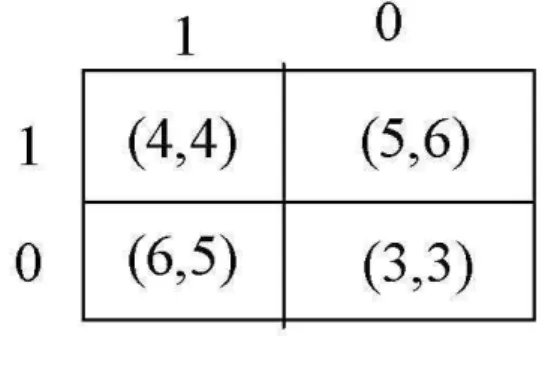
Competition at point of sale is captured in a simple way in our mode!. Consider
Figure 1, which represents what might be cal!ed a 'dis-coordination' game. I Players
1 and 2 independently make a binary choicej either 1 to seI! now, or O to seI!
later. If both players end up selling now, they receive 4 each, thus undermining
their payoff relative to the situation where they make separate deals with the buyer.
1 BinrI10TP (1992) rPÍprs to a sirnilar kind of gauIP a,,') thp "Australian Battle of Uw sークpウIセN@ In this gauIP thp coopPTativp anel ョッョ」ッッーpt。エゥカイセ@ payoff n:gions are Bオーウゥ、M、o|vtャIセ@ VPTsioI18 of thosp for
1
o
1
(4,4)
(5,6)
o
(6,5)
(3,3)
Figure 1: Competition at Point of Sale
Being away from the other player is beneficiaI, because it reduces the number of
others who strike a deal with the buyer at any one time. There are two pure strategy
Nash equilibria, (0,1) and (1,0), and a mixed strategy Nash equilibrium p* = セN@ Pure
strategy equilibria have the seller's joint payoff increase from 8 to 11 by avoiding (1,1)
in the example, and the buyer's payoff is reduced accordingly. Our main contribution
is to show that with discounting and competition, an increase in the number of players
in such a game can lead to an increase in the equilibrium probability of delay, and
hence an increased cost to the buyer.
Our model might appear at first to be analogous to the literature on the public
goods contribution problem (Bergstrom, Blume and Varian (1986)), the problem of
the commons (Comes and Sandler (1982)), or indeed the corporate takeover problem
(Grossman and Hart (1980)). While the inefficiency result for large n has a similar
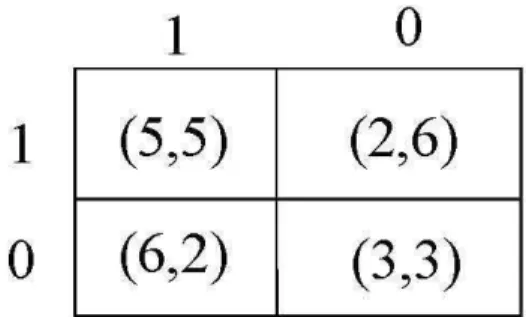
fiavor, our analysis is quite different to those problems. Figure 2 illustrates a sim pIe
'public goods contribution', or 'problem of the commons' game. Choice 1 represents a
high contribution, and choice
°
a lower contribution. The dominant strategyequilib-rium (0,0) is jointly inefficient as players do not account for the negative externality
they impose on each-other through their choice of O. In contrast, the equilibria in
the inter-temporal coordination game of Figure 1 yield sellers the highest possible
joint payoff. Instead, it is the buyer who suffers a reduction in utility, because the
1
O
1
(5,5)
(6,2)
o
(2,6)
(3,3)
Figure 2: Public Goods Contribution Game
which delay increases with the number of sellers to the detriment of the buyer who
has a preference for consumption today. The efficient coordination between sellers
is in stark contrast to the inefficiencies generated between players who donate funds
towards public goods, or between farmers who share a common.
The paper by Segal (1999) provides an excellent benchmark against which to
distinguish our contribution from the literature on free riding in the public goods
problem. Among other things, Segal examines a very general setting that nests
a large set of papers in this area. He examines a situation in which a principal
makes bilateral contracts with N agents. The agent's payoffs are affected by other
agents trade with the principal regardless of whether or not they contract with the
principal. For example, the agents might own land that is to be sold to a principal who
wishes to build a shopping centre. If an agent does not contract with the principal,
then her utility might be increased or decreased due to her proximity to the shopping
centre, depending on her tastes. In Segal's framework, the buyer in our model is the
principal, and the agents are the sellers. However, we examine a situation in which
the principal is not able to make an initial contract offer to the sellers. That is, the
sellers are able to avoid dealing with the buyer in order to gain a strategic advantage
in later contracting. Our contracting environment is harsher than Segal's. Our buyer
cannot write contingent contracts, nor can our buyer make initial contract offers.
the sales processo Thus, the focus of our paper is pre-contractual strategic behavior,
rather than behavior within a contracting framework.
In their seminal paper, Mailath and Postlewaite (1990) consider a public goods
contribution game with private values and show that as the number of players
in-creases it becomes asymptotically impossible to implement the first best.2 The
inef-ficiency is derived from the private information nature of the problem. In our model,
however, decreased efficiency due to delay arises from the greater difficulty that sellers
face in "dis-coordinating" their actions when the number of sellers increases.
Although the holdout problem that we analyze is related to the literature on
coor-dination games, the questions we examine are different. The coorcoor-dination literaturé
examines games that exhibit multiple Nash equilibria which are Pareto-rankable (see
for example, Schelling (1960), Harsanyi and Selten (1988), Katz and Shapiro (1985),
Kohlberg and Mertens (1986)). The goal of this literature has been to examine how
players will select among the equilibria. In our model, simple competition at the
bargaining table is sufficient for the existence of a unique symmetric mixed-strategy
equilibrium in the n player (dis)coordination game (see Proposition 4). This result
is very useful, since it avoids the multiplicity problem of the coordination literature,
and allows us to focus instead on comparative statics as a point of departure from
this literature.
:2 The 1'<:a,'5on i8 a,,'S follO\vs. For provisioIl, it i8 necessary that SOInp agents contribute rI10rp than
their peT-capita cost of provision. An ageut, hO\VPVPT) \vill not contribute truthfully according to heI' valuation オョォセXウ@ this ageut i8 pivotaL In a large pcoIlorny, the probability of au individual ageut being pivotal i8 very sII1all anel therPÍoTP, aU ageuts Iwt utilitips rHust be Iwarly cOI1stant, \vhich irnplies Uw PTobability of provision gm:s to zpro.
:,"\ The tenI1 \Wh'S COiTWd by ThoIIHh'S Schdling (1960, chA) to rPÍPT to gauIPs \vith nmltiple N a,,-sh
equilibria yirüding id.üutical payoffs. A standard exarnple ゥョ」オHォセウ@ t\VO 。オエoiョッ「ゥォセウ@ approaehiug ou
2
Madel
There are n
+
1 players. Player 0, the buyer, is interested in purchasing n objects,and realizing value from the entire set. The objects could be, for example, blocks of
land, patents, other firms, labor contracts or property rights over pollution among
other things. The objects are owned by n players (or owners) i = 1,2, ... , n. Ideally,
the buyer would like to engage each of the sellers together, make a take-or-leave-it
offer, and realize the full value of the combination. However, an owner may find it in
her interests to avoid selling to player 0, and perhaps delaying sale for strategic
ad-vantage. Thus, each player i = 1,2, ... , n simultaneously (and independently) chooses
her probability p.; E
[0,11
of selling at dateA.
With probability1-
p.;, player i delayssale until date B. We assume that the buyer is passive in this process, and cannot
inf1uence the probability that a player sells at date
A.
In other words, the buyer isnot strategic in this model; we leave such considerations for future work. In addition,
each player ends up selling either at date
A
or dateB
for certain. This captures theassumption that it is not credible for player
°
to refuse to buy an item that deliverspositive value.
We make a key simplifying assumption throughout the paper: The buyer is not
able to write contracts that are contingent on the sale of any of the objects. We do
not make this assumption because we believe that it always holds. Rather, we make
it because there is an important class of circumstances in which there is at least a
subset of objects where such contracts will not be feasible. ,I
Let t; E {O, 1} denote whether player i sells her object at date
A.
The value t; = 1indicates that the player sells at date A, and
°
indicates that the player sells at dateB. The notation is chosen so that 1 indicates presence at date A, and
°
indicates4FoT exarnplp, supposP Uw buyer offeTS to pay au O\VTlPT $P for object X, if the O\VTlPT of object Y accepts $Q. Tlw actual trausfeT of fund.s bet\VpeIl the buyer and each X、ォセt@ cannot be ObSPTvpd, 80 Uw contract 011 transfeT price rnight not ャIHセ@ piQヲotc・。「ォセN@ Sirnilarly, supposP the buyer O±FPTS to pllTcluh"'JP only in the event that both ali O\YlIPTS agree to sdl tlwir objects. This IHay not be 」t・、ゥ「ォセ@ \vh<:1'<: the objects are cOInplex anel difficult to (1<:scribe; for exarnple, sueh difficulties could be eIlcounteTed
absence at date
A,
and therefore presence at dateB.
Thus,ti
is the outcome of i'S
choice P; of the probability of selling at date A. Since we assume that players must
sell at either of the two focal dates A or B, a player could end up selling at the same
time as a multitude of other sellers. To capture this, the payoff to player i from
sale when the outcome is
t
==
(t], t2,
... ,
tn)
isSi
:
{O,l}n
f--7 lE.. Thus, for example,Si
(1, 1, ... , 1) is the payoff when ali players present their objects for sale at date A,and
Si
(0,0, ... , O) is the payoff when ali players sell their objects at dateB.
Let 1fi : {O,
l}n
x [O,l]n
f--7 lE. denote player i's expected payoff. Therefore1fi
L
[(1 -td
(1 -pd
+
t]pd
.
[(1 -t2)
(1 -P2)
+
t2P2]
IE{O.]}"
.. ·[(1-
tn)
(1 -
Pn)
+
tnPn]' Si (t], t2,
... ,
tn).
The expressions [(1 -
t;)
(1 -p;)
+
t;p;],
j = 1, ... , n are the probabilities of outcomest], t2,
... ,
tn
respectively, andSi(t],
... ,
t"J
is the corresponding payoff. For example withprobabilitYP]'P2"'Pn, outcome (1, 1, ... ,1) occurs, andplayer i receives
Si
(1, 1, ... ,1).Similarly, outcome
(t],
... ,
tn)
= (1,0,1, ... , 1) delivers payoffSi
(1,0,1, ... , 1) withprob-ability
p]
.
(1 -P2)
.
P:l
...
Pn
etc.A Nash equilibrium of the game is a vector of probabilities
(P;,P2' ... ,P;'J
thatsatisfies P; E argmax1fi(P;,P*-J for ali i. Assuming an identical payoff function S for
each i, the set of symmetric Nash equilibria are given by consideration of the zeros
and comer solutions of the derivative of expected profit with respect an agent's choice
of probability:
L
[(1 -t2)
(1 -p)
+
t2P]
.
[(1 -t2)
(1 -p)
+
t2P]
(1)
エセャeサoLャスャエセ ャ@
.. ·[(1-
tn)
(1-p)
+
tnP]
.
[s
(1,t2,
... ,
tn)
-
S
(O,t2,
... ,
tn)].
Note that this expression is the difference in expected payoff to the player from
probability-weighted sum of payoff differences over ali states). Clearly if the
expres-sion is positive, then p = 1; if it is negative p = 0, and the roots of (1) yield interior
solutions. In the appendix we demonstrate the existence of a symmetric Nash
equilib-rium to this general problem. This paper examines the determinants of the symmetric
Nash equilibrium p*. In particular, we wish to solve the problem of how p* changes as
the number of players increases. The highly stylized specific examples immediately
below help us understand the structure of this problem.
2.1 Examples
The following two examples (Extreme Co-operation and Extreme Competition) are
very stylized, and are for illustrative purposes only. The third case (Aggregate Count
Payoffs) is more general, and is the model we adopt to explore the question of holdout
more generally.
2.1.1 Extreme Cooperation
Suppose that whenever ali of the players are present at sale, at any one time, each
individual player can extract the value VA of her block of land at date A, and Vil at
date B. This captures in reduced form the idea that sellers are somehow able to
collude on the sale price. When less than the full number of players are present, the
payoff is v
<
max(VA, Vil) per player. From equation (1) p* = 1, and p* =
°
couldbe pure strategy Nash equilibria.5 This is straightforward, since
{
VA - v for tJ = 1, j
>
1s (1, t2 , ... ,
t",l -
s (O, t2 , ... ,t",l
= v -Vil
for tJ = 0, j>
1 ,°
otherwisewhich yields !pu)..
>
°
for p* = 1, and fP"'-)"<
°
for p* = O. We might expect players(P l (P l
coordinate on the Pareto dominant equilibrium. For example, if
V
A>
Vil
due todiscounting, then this would be p* = 1. With this kind of extreme cooperation at
point of sale, the model predicts that there will be no holdout problem.
2.1.2 Extreme Competition
An extreme form of competition is captured by the assumption that the presence of
at least one other player at point of sale limits a player's return to zero. It is extreme
in the sense that payoffs could come from a reduced form in which players compete
vigorously. Again note that this example is for illustrative purposes onlYi we do not
claim that such severe competition is necessarily applicable in practice.
Suppose that if a seller is alone with the buyer at the date
A
sale, then she getspayoff SA
>
O at date A, and payoff Sll>
O at date B. Substitution of these payoffsinto equation (1) yields
(2)
We get the following result:
Proposition 1 With extreme competition, the symmetric equilibrium probability of
holdout is
Thus holdout occurs with positive probability for all n. Moreover,
(i)
if SA> Sll,
then h is increasing in n,(ii)
if SA< Sll,
then h is decreasing in n, and(m)
h converges to セ@ as n ---t !Xl.In part (i) SA
> Sll
which is probably the leading case if players discount thepayoff from sale at the later date
B
compared to date A. Here, holdout gets worsewith n, despite the favorable payoff from date A. The intuition for this result comes
a fixed probability p. Now add another player, who also chooses this level. The
payoff to player 1 from sale at date
A
falls to (1 - p)" SA from (1 - p)"-l SA, and thepayoff to player 1 from sale at date
B
falls to p"BIl from pn-l SIl. However, SA>
SIlimplies that p
>
セN@ Therefore the expected payoff from dateA
falls proportionatelymore than its counter-part for date B. As a result, player 1 finds it in her interests
to deviate from p and choose a lower value. In equilibrium ali players will therefore
reduce p, leading to an increase in holdout. Result (ii) is analogous. Part (iii) follows
from a related thought experimento Fix the choice of p by the other players. As n
increases, the probabilities (1 - p)"-l and pn-l that a player is alone at point of sale
both shrink towards zero, and this dominates any difference in the relative payoff at
each date.
The implication of (iii) is that the value-per-object to the buyer falls. That is,
there is an increased transactions cost with the number of sellers. To see why, suppose
that the buyer gets value
W
per object that is combined, and only realizes the totalvalue
nW
after ali objects are soldo Therefore, the buyer's expected payoff per-objectwith discount factor
8
is W· Ipn+
(1-
pn)81.
For case (i), p falls with n. This leadsto a reduction in the buyer's payoff per object an increase in the transactions costs
due to increased delay as the number of sellers increases. Note that the more general
case where the buyer gets some value from objects purchased at date A, but must
discount the benefits gives similar results: As long as there is delay, the buyer's payoff
is lower than otherwise.
One objection to the analysis of this case, is that there are pure strategy Nash
equilibria of the game that yield a higher joint surplus to the sellers. For example, if
player i chooses Pi = 1, and ali other players j choose PJ = 0, this Nash equilibrium
gives SA as joint surplus of the sellers. Under the mixed strategy, the joint surplus
which is less than SA 6 However, note that such pure strategy equilibria do not Pareto
dominate the mixed strategy symmetric equilibrium of proposition 1, nor would any
non-symmetric mixed strategy equilibrium. Each player would prefer to be the one
earning the highest expected payoff, which strengthens the prediction that the mixed
strategy symmetric equilibrium will be the outcome of such a game.
2.2 Aggregate Count Payoffs
Here, we consider a more realistic simplification of the mode!. We assume that the
payoff to player i from bargaining when the outcome is
(tI,
t
2 , ... ,tn)
depends onlyon the count of the number of players present with player i, and the date of i' s sale.
Thus,
s(
k) is the payoff from sale when only k other players are present at date A,and
8s (k)
is the present value payoff in this situation from dateB,
where 8 E[0,11
is the discount factor. With this notation, equation (1) becomes(3)
where
!:lk
==
s(k) -8s(n- k-1)
is the gain that the player makes from being present at date
A
as compared to dateB, taking the participation outcomes (k present at date A, and n - 1 - k present at
date
B)
of other players as given.Throughout the paper, we assume that there is discounting:
Discounting The buyer and sellers discount date
B
payoffs by 8 E(0,1).
Of course, discounting means that players have a preference for income today.
This assumption ensures that any equilibrium delay will generate inefficiency. Since
our goal is to examine how seller's payoffs at point of sale affects sellers behavior, we
examine two alternatives. The first is competition:
r ) To srx: \V ly, I notp t I w.,t arg UH1Xp . n 1 { ( ) U } .... ]J ']J ri) t 1 I w.,t t I 1{: V,1 I 11<: at t I· 118 rnaxmnnn . 18 . HQセョIBM[@ ri"·; <
Competition s
(k)
is decreasing ink
Competition is the assumption that an increase in the number of players selling at
any one time, leads to a decrease in each player's payoff. Implicit in this assumption
is that there is at least a degree of substitutability between the items being soldo The
opposite assumption is collusion:
Collusion s
(k)
is increasing ink
When there are more players who collude, they are able to collectively extract a
larger per-owner surplus from player O.
Finally, we admit any profile of our (non-strategic) buyer's benefit from sale
consis-tent with discounting. A simple case mentioned in the extreme competition example
had the buyer realize no value until ali units were purchased. However we could
as-sume, for example, that the buyer receives WA per object combined at date A, and
W
ll<
W
A per object combined at dateB;
delay would costW
A -W
ll per object(due to discounting).
Note that any form of discounting implies that the first- best outcome must involve
sale of ali the objects at date A. The following result is immediate:
Proposition 2 p = 1 is the Pareto Dominant Nash equilibrium under Collusion,
and yields the first-best outcome.
Proof. This is easily proved by substitution of p = 1 into equation (3), and
noting that expected surplus per seller falls with p as p falls below unity. There is
no delay in this equilibrium. _
As in the illustrative example of extreme collusion considered above, a more
mod-erate collusion assumption leads to efficiency. The results below show that the
situ-ation is quite different when there is competition at point of sale.
Understanding of the behavior of the zeros of equation (3), is crucial for
this expression are monotonic decreasing: By definition f'lk =
s( k)
-
8s (n
-
k
-
1)and f'lk+l =
s(k
+
1) -8s (n
-
k
-
2). Competition impliess(k)
>
s(k
+
1) ands (n - k - 2)
>
s (n - k - 1). Hence f'lk>
f'lk+l' The next result demonstratesthat relatively weak assumptions are needed to ensure that there is costly delay in
equilibrium:
Proposition 3 Assume discounting, competition and f'ln-l
<
O. Then neither p = Onor p = 1 can be a symmetric Nash equilibrium, and the first-best is not attained.
Proof. Substitute p = 1 into (3). This yields
X;;:
= f'ln-l<
O, so that player1 will deviate from Pl = 1. Substitution of P = O into (3) gives i!"l. '1 = f'lo which is
( P1
positive by competition, and player 1 will deviate from Pl = O. Since P = 1 is not an
equilibrium, the discounting assumption means the first best is not attained. _
The assumption f'ln-l
<
O has a straightforward economic interpretation as aweak additional competition assumption. The term f'ln-l equals
s (n
-
1) -8s
(O); ifit is negative7, then players get a higher return selling alone at date B, than selling
in the presence of ali other players at date A. This mIes out P = 1 as an equilibrium.
Competition ensures that the payoff from selling today when every other player sells
tomorrow is positive. This mIes out P = O. Since P E (0,1), and there is discounting,
the joint surplus of buyer and sellers is lowered.
While competition-like assumptions and discounting ensure that symmetric
equi-libria are inefficient, the goal of our paper is to examine not only the phenomenon
of costly delay, but to examine comparative statics, such as behavior as the number
of players increases, or behavior due to changes in the discount factor. Such analysis
is problematic if there are multiple symmetric equilibria. However, as the
follow-ing result shows, existfollow-ing assumptions are sufficient for a uni que symmetric Nash
equilibrium.
I Notp that thp a .. -ssurnption is au irnplicit TPstriction 011 thp natuTP of cOlnpptition anel Uw discount
f · XHョセQI@ ('
Theorem 4 lf
t.
n- I<
O, and competition holds, then there exists a uni que positiveand real symmetric Nash equilibrium probability.
Proof. Since both p = O, and p = 1 are ruled out as symmetric Nash equilibria
(SNE), we can divide equation
(3)
by(1 -
p)"-I. Defining p = セ@ this implies thatSNE are found from
セ@
( n - 1 ) pkt.
k = Ok=O k
(4)
If the sequence
t.
n - I ,t.
n - 2 , ... ,t.
o changes sign only once, then by Descarte's ruleof signs, there is a unique positive real root of the polynomial in
(4)
(Kostrikin(1982), p. 310-331). New York: NY.). Since
t.
n - I<
O, this sequence begins with anegative sign, and since
t.
o>
O by competition, the sequence changes sign at leastonce. However, competition also implies that
t.
n - I ,t.
n - 2 , ... ,t.
o is strictly increasing.Therefore, the sequence only changes sign once and there is a unique positive real
SNE. •
The assumptions of competition and
t.
n - I<
O are fairly weak, and yet they leadto the very strong conclusion of a unique symmetric Nash equilibrium. As mentioned,
the advantage of this result, is that it makes comparative statics predictions much
stronger than when there are multiple equilibria. In addition, for 8 = 1 (i.e., no
discounting) we can show that the equilibrium probability is セL@ and that when 8
<
1, the equilibrium probability ・ク」・・、ウセN@ These two results are important in the
construction of our results concerning the effect on p of an increase in n:
Proposition 5 When
8
=1,
the unique SNE is given by p* = セN@Proof. Define
8
8;:
n-I ( 1 )=
t;
nセ@
pk(l - p)n- I-k[s(k)
-
8s
(n -k
-
1)1
==
f(p,8,
n)(5)
(1 )
(l)n-ln-1
(
1)
f
"2,8,n="2
t;
ョセ@
[s(k)-s(n-k-1)]=O.Since
( n-1)=( n-1 k n-1-k ),
telescoping guarantees that indeed
lセ]セ@
(
n
セ@
1 )[s
(k)
-
s (n
-
k
-
1)] = O. •Below, we show that when p = -2] and 8
<
1 the derivative !i=)" is greater than( Pl
zero. That is, the next corollary shows that for a fixed n, the equilibrium probability
of immediate sale is strictly greater than セN@
Proposition 6 When O
<
8<
I, the unique SNE is given by p*>
セ@ for any finiten.
Proof. First we demonstrate that fp
<
o.
Differentiating (5) with respect to pyields
f
(
1) (1 )n-2 A ( n - 1 ) (1 )n-2 A p - n - - p '-'O+
1 - P '-']_ ( n
セ@
1 ) (n _ 2) p (1 _ p)"-1 6.]
+ (
n ; 1 ) 2p (1 - p)"-1 6.2
_ ( n ; 1 ) (n _ 3) p2 (1 _ p
)"-1 6.2
+ (
n; 1 ) 3p2 (1 _ p)"-1 6.
1+ ...
( n-1) ·.1 ·.1 (n-1) ·1
- n-3 pn-·4(1-p)· 6.n-:1
+
n-2 (n-2)pn-. (1-p)6.n- 2( n -
1)
n-2 A (1)
n-2 A- n _ 2 P '-'n-2
+
n - p '-'n-]·The first two terms of fp reduce to (n - 1) (1- p)"-2
(6.
1 -6.
0 ) which is negative,which is negative. Ali such pairs of terms are negative, for example consider the next
to last pair ofterms, which reduces to
(n
-
1)(n
-
2)p,,-:l
(1 -p)
[t."-2
-
t."-:l]<
O.Thus, fp
<
O.Now consider the case of n even. It can be shown that
.!!:-I
f(p,
8,
n)
=セ@
(n
セ@
1 )
{s(k)[pk(l
_
p)"-l-k
_
8p,,-1-k(1
-
p)k]
+s(n
-
1 -k)[p"-l-k(l_ p)k
_
8pk(1
_
p)"-l-k]}
Therefore we have
1 (1)"-1
!i-
1( 1)
f('2,n,8)=
'2
(1-8)t;
ョセ@
{s(k)+s(n-1-k)}>0.
Since fp
<
O, fG, 8, n)>
O ensures thatp
= セ@ lies below the solution to f(p,
8, n) = O.The argument for n odd is similar. Thus, p* ^セN@
•
These set of results above demonstrate that delay is an important feature of
equi-librium under competition. Delay occurs because of sellers' desire to dis-coodinate,
that is, to minimize the impact competition has on their surplus. Under our
assump-tion of discounting, these results demonstrate that equilibrium delay is a source of
endogenous transactions cost that the buyer must face. Below, we demonstrate that
such costs are increase with the discount rate 8, as might be expected.
Proposition 7 A rise in the discaunt factar leads ta an increase in haldaut.
Proof. Recall the definition of
f(p,
8,n)
in equation (5) and note that for aliequilibrium values of
p
=p
(8),f (p
(8) ,8,n)
==
O. Differentiating this identity withrespect to 8 yields
Thus we seek to find the sign of f8 from (3), since fp
<
O from the proof ofProposition(6). Differentiating
f
with respect to 8 yieldsn-l ( 1 )
f8 = -
t;
n
セ@ pk(1 - p)"-l-k. S(n
-
k - 1)<
O.Substitution in the expression for fp yields p' (8)
<
O . •The direct effect of a rise in 8 is to reduce the marginal profitability of Pl (f8
<
O).
Competition ensures that "I is concave in Pl (i.e. fp
<
O as shown in the proof ofProposition 6. Therefore, in equilibrium, P must fali. Intuitively, when 8 rises, each
player discounts the future payoff from delay by less: If no other players were to change
their strategy, an individual player would wish to delay sale. However, every player
is aware that this incentive exists and that there is a higher likelihood of competition
from delaying sale. This diminishes the marginal profitability of holdout, although it
is still positive. Thus (1 -
p)
must still rise.The main contribution of this paper is to analyze what can happen to the holdout
probability as n increases. A-priori theorizing does not suggest a strong case either
way. One might argue that the increased competition following from a rise in the
total number of players will diminish the gains from delay. If there is discounting and
the number of layers increases, it may be less likely that an individual will be alone
at point of sale today, than if that individual delays. This would suggest a fali in the
probability of holdout. However, some reflection (based on the extreme competition
example above) suggests that as the number of players increases, it will only be the
payoffs in the extreme ends of the distribution that motivate players. The result
below shows that weak conditions lead to an increase in holdout.
Theorem 8 An increase in the number of owners increases h
==
1 - p, and hap-proaches セ@ from above as the number of owners approaches infinity, if all of the
following conditions hold:
(ii)
s (-) and 8 E (0,1) satisfy,6."-1
==
s (n - 1) - 8s (O)<
Oi and(m)
Strong Competition: s(k) diminishes sufficiently mpidly after n = M(specifi-cally, ャゥュLLセ]@ セセ[[[セQウHォI@ ::; c, some small c
>
O)Proof. From competition and Proposition (3), for a fixed n, the equilibrium price
belongs to the interval
G,
1). Thus, we need only consider p EG,
1).Noting that ( n
セ@
1 ) = ( nセ@セ@セ@
k ),f
from equation (3) can be re-writtenas the sum oftwo terms by matching arguments in s (-) starting from k = O upwards,
and from
k
= n -1 downwards. Specifically, s (O), s (1), ... , s(M
-
1) can be derivedfrom s(k) for k =
O, ... ,M,
and from s(n-1- k) for k = n -l,n -2, ...
,n -M.
The sequence s
(M),
s(M
+
1), ... , s (n - 1) is derived similarly. Thus,f(p,8,n) =
ゥセ@
( nセ@
1 ) s (k) [pk (1 _ p)"-I-k _ 8p,,-I-k (1 - p)k1
+
%1 (
nセ@
1 ) s (k) [pk(l - p),,-I-k - 8p,,-I-k (1-p)kl.
Consider the second of these sums. By strong competition for n
2:
M, lim,,_= セセ[[[セQウHォI@::; c. (This is satisfied, for example, if s(k) = Àrk with O
<
r<
1, since the sumconverges to À times a finite positive number.) Note that ( n
セ@
1 ) pk (1-p)"-I-kand ( n
セ@
1 ) p,,-I-k(l_ p)k are each weights of a binomial probability distribution.The sum of each of these terms from M to n - 1 is therefore less than unity, and the
weights themselves are between zero and unity. Therefore, by choosing c sufficiently
small, the second sum can be made arbitrarily small. Thus for sufficiently large n,
we can rewrite
f
asNow define
k( ) - k
(1
)n-I-k8
n-I-k(1
)k9 p =p -p - p - p ,
and note that for a fixed k,
l(p)
<
O Ç} pk (1 _ p)"-I-k<
8
pn-l-k (1 _ p)kThat is,
1
p> 1
=Pk·
1+8"- 1-2k
mッイ・ッカ・イLセ@
>
O, gk(pk+
E)<
O and gJ(Pk+
E)<
O Vk>
j. Therefore we canconclude that
(8)
Replacing (8) into (7) we obtain
!(PM_I,n, M) <O.
Since !p
<
O from proposition 7, this indicates that the equilibrium price belongs tothe interval
G,PM-d.
However,1
Pl\4-1 = 1
1
+
8,,-Mso that as n gets larger, the interval
G,PM-d
must shrink. In particular, as n - t 00,- I
Pl\4-1 ---t '2" •
This is the main result of the paper. The assumption of strong competition
ensures that the states of nature in which there are many other players present have
a negligible weight in a player's choice of p. Only states in which there are less
than M - 1 other players present determine players' decisions. Following the thought
experiment from the extreme competition example in section 2.1.2, fix the choice of
p by ali other players, and add an additional identical player. Consider the term
in equation (7) for fixed k. With 8
<
1, p>
k.
Therefore the termpk (1 - p)"-l-k fallsbya proportionately smaller amount than the term 8pn-l-k (1 - p)k for ali k. In other
words, in the comparison between the expected payoff from sale now and sale later,
the latter falls by proportionately less. The best response of the player is therefore to
choose a lower leveI of Pi an increase in holdout. Moreover, the probability of holdout
approaches セ@ because both terms in (9) converge to zero, and hence approach
each-other as n increases. If the buyer's payoff suffers because of delay, then our result
can be interpreted directly as endogenous transactions costs faced by such a player
as the number of sellers increases.
3
Concluding Comments
We have modeled a situation in which a buyer wishes to purchase n objects from n
independent owners. Each owner is able to delay selling her object. If the presence
of other owners at point of sale improves the sale price, then there is no delay in
equilibrium, and hence the buyer does not face any transactions costs. This case can
be thought of as collusion at point of sale. However, if the presence of other owners
leads to a reduced sale price competition at point of sale then there is delay in
equilibrium. Thus, competition at point of sale imposes transactions costs on the
buyeri with discounting, the symmetric equilibrium probability of immediate sale is
pEG,l).
The model developed is very tractable. Existence of a unique symmetric
equilib-rium is guaranteed by the relatively weak competition assumptionsi that sale price
declines in the number of players, and that the sale price obtained being alone but
at a later date dominates the immediate sale price with ali other players present.
The uniqueness result makes the model very amenable to comparative-statics
anal-ysis. An increase in discounting reduces the probability of delay. The main result
of the paper is to show that with sufficiently strong competition and a sufficiently
symmetric equilibrium probability of delay. This provides a novel explanation for the
transactions costs that a buyer can face when purchasing from multi pIe owners. The
owners end up dis-coordinating in equilibrium that is, to engage in a divide and
conquer strategy so as to reduce the competition they generate at the two periods
in which sale takes place. But this behavior leads to an increase in equilibrium delay:
As n increases, the probability that a given player has relatively few fellow sellers
present immediately, falls more rapidly than the counter-part probability for sale in
the later period, leading each player to increase her probability of holdout.
The transactions costs identified in our paper are quite different to those present in
current literature. Our model has symmetric information, so that private information
is not a source of transactions costs. The public goods contribution problem leads to
increased costs as the number of players increases, because of a worsening negative
externality. In contrast our problem has players taking actions that are beneficiaI to
their fellow sellers. We do not claim that our source of transactions costs is more or
less relevant than these other sources. Rather, the aim of this paper is to develop a
formal model that explores equilibrium delay as a source of such costs.
Several areas of future research suggest themselves. The buyer in our model is
non-strategic. In practice (particularly with smaller numbers of sellers) the buyer
could take actions to increase the likelihood that an owner is present early on in the
sale processo Contractual solutions may partially solve the problem. For example, in
some circumstances the buyer may be able to make contingent-sale contracts. This
raises the more general comment that the buyer's action of purchasing early could
affect the surplus that sellers earn in the later period.
4
Appendix
We now show that a symmetric Nash equilibrium for the general problem stated in
section 1 always exists. Note that the first order condition given by (1) is clearly a
L
[(1 - t2 ) (1 - tl ) ... (1 - tn)] . [s (1, t2 , ... , tn) - S (O, t2 , ... , tn)](t2, .. j h Ie サ oLャス ャエ セ ャ@
This expression is either zero or equal to
[s
(1, O, ... , O) -s
(O, O, ... , O)]>
O.In addition,we can evaluate the first-order condition at p = 1:
L
[t
2t:l ... tn] . [s(1,
t2 , ... , tn) - S(O,
t2 , ... , tn)](t2, .. Lエ iエ Ie サ oLャス ャエ セ ャ@
This expression is either zero or equal to
[s
(1, 1, ... , 1) -s
(O, 1, ... , I)]<
O. Therefore,there exists a solution by the Intermediate Value Theorem.
References
[I] Bergstrom, T., Blume L., and Varian, H., "On the Private Provision of Public
Goods" Joumal of Public Economics, (1986), 29(1), 25-49.
[2] Binmore, K. (1992). Fun and Cames: A Text on Came Theory. Lexington: D.
e.
Heath & Company.[3] Bryant, J. (1983), "A Simple Rational Expectations Keynes-Type Model,"
Quar-terly Joumal of Economics 98, 525-559.
[4] Cooper,
R.
W., D. V. DeJong,R.
Forsythe and T. W. Ross. (1990),"Selec-tion Criteria in Coordina"Selec-tion Games: Some Experimental Results, " American
Economic Review 80(1), 218-233.
[5] Cooper,
R.
W. and A. John. (1988), "Coordinating Coordination Failures in[6] Cooper, R W. and T. Ross. (1985). "Product Warranties and Double Moral
Hazard," Rand Journal of Economics 16, 103-113.
[7] Comes, R, and Sandler, T., "On Commons and Ttagedies", American
Economic-Review, (1983), 73(4), 787-92.
[8] Crawford, V. P. (1990) "An 'Evolutionary' Interpretation of Van Huyck,
Bat-talio, and Beil's Experimental Results on Coordination" University of California,
San Diego Department of Economics Working Paper: 89-28R
[9] Grossman, S.
J.
and O. D. Hart (1980), "Takeover bids, the free-rider problem and the theory of the corporation," Bell Journal of Economics, pp.42-64.[lO]
Harsanyi,J.
C.
and R Selten. (1988). A General Theory of Equilibrium Selectionin Games, Cambridge: MIT Press.
[11] Katz, M. and C. Shapiro. (1985). "Network Externalities, Competition and
Com-patibility," American Economic Review 75, 424-440.
[12] Kohlberg, E. and
J.F.
Mertens. (1986). "On the Strategic Stability ofEquilibria."Econometrica
54,
1003-1038.[13] Kostrikin, A. L, (1982), Introduction to Algebra, Springer-Verlag, New York:
NY.
[14] Mailath, G.
J.,
and Postlewaite, A., (1990) "Asymmetric Information and Bar-gaining Problems with Many Agents," Review of Economic Studies 57, 351- 367.[15] Schelling, T. (1960). The Strategy of Conflict, Cambridge: Harvard University
Press.
[16] Schelling, T. (1978). Micromotives and Macrobehavior, New York: Norton &
[171 Sega!,!. (1999), "Contracting with Externalities," Quarterly Journal of
Eco-nomics 114(2), 337-388.
[181 Van Huyck,