DOI: 10.2298/SOS0503173S
UDK 616-002.4:539.217:679.872:549.613.4
Influences of Composition of Starting Powders and Sintering
Temperature on the Pore Size Distribution of Porous
Corundum-Mullite Ceramics
Shujing Li
*), Nan Li
Hubei Province Key Laboratory of Refractories and Ceramics,
Wuhan University of Science and Technology, Wuhan, Hubei 430081, PR China
Abstract:
Porous corundum-mullite ceramics were prepared by an in-situ decomposition
pore-forming technique. Starting powders were mixtures of milled Al(OH)3 and microsilica and
were formed into oblong samples with a length of 100mm and a square cross-section with edge size of 20mm. The samples were heated at 1300°C, 1400°C, 1500°C or 1600°C for 3h in air atmosphere, respectively. Apparent porosity was detected by Archimedes’ Principle with water as a medium. Pore size distribution and the volume percentage of micropores were measured by mercury intrusion porosimetry. The results show that the pore morphology parameters in the samples depend on four factors: particle size distribution of starting
powders, decomposition of Al(OH)3, the expansion caused by mullite and sintering. The
optimum mode which has a higher apparent porosity up to 42.3%, well-distributed pores and more microsize pores up to 16.3% is sample No.3 and the most apposite sintering temperature of this sample is 1500°C.
Keywords: in-situ decomposition; pore forming; Al(OH)3; porosity; corundum-mullite
1. Introduction
Recently, there has been an increasing interest in the applications of porous ceramics as filters, desiccants, insulators, catalyst supports, bone replacement, acoustic absorbers, sensors and membrane reactors [1-6].
Porous ceramics can be made by adding pore-forming agents such as sawdust, starch, graphite or organic particulates [7] into the starting powers, or by injection molding [8], or by gelcasting [1]. Zhen-Yan Deng, et al. made porous alumina ceramics by the decomposition of Al(OH)3 [9,10]. In their study, the pores in the samples were formed in-situ by the
decomposition of Al(OH)3 powder. This pore forming in-situ technique exploiting the
decomposition of starting powders is a good way to prepare porous ceramics with well-distributed pores.
Mullite has a lower thermal-expansion coefficient11,12 than alumina. Introducing mullite to corundum ceramics can increase their thermal-shock resistance as well as their mechanical and chemical stability [13,14]. This article described the preparation of porous
_____________________________
corundum-mullite ceramics, using Al(OH)3 powder and microsilica. The decomposition of
Al(OH)3 creates a series of transitional Al2O3 phases, which ultimately transform to a stable α-Al2O3 phase at ~1200°C. Because Al(OH)3 experiences a 60% volume contraction during
decomposition [9], porous corundum-mullite ceramics with high porosity should be obtainable.
When the in-situ decomposition pore-forming technique was used to prepare porous corundum, the pore morphology and size distribution were found to be related to the shape and size of the original Al(OH)3 particles [10]. However, when this technique was used to
prepare porous corundum-mullite ceramics the effects of the expansion resulting from mullite formation should be considered. In this paper the open porosity and pore size distribution of porous corundum-mullite ceramics were investigated as a function of the composition of the starting powders and the sintering temperature.
2
.
Experimental Procedure
Al(OH)3 powder was wet milled for 3h in a planetary mill using alumina balls. The
particle size distribution of milled Al(OH)3 powder(Dv50=5.2µm) is given in Fig.1. The
starting powders were mixtures of milled Al(OH)3 and microsilica (Elkem Microsilica, Grade
983, whose compositions are shown in Table I).
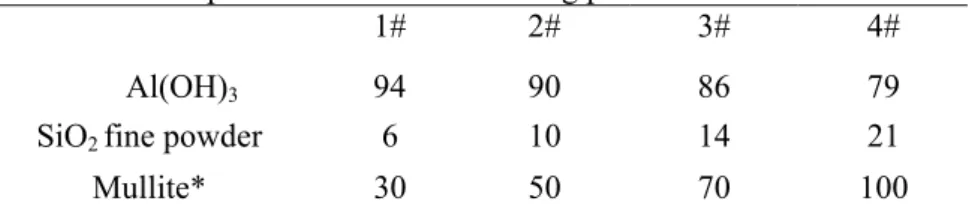
Tab. I Main composition of different starting powders / wt%
1# 2# 3# 4#
Al(OH)3 94 90 86 79
SiO2 fine powder 6 10 14 21
Mullite* 30 50 70 100
(Mullite*: the mullite content calculated from the starting powders.)
The oblong samples with a length of 100mm and a square cross-section with edge size of 20mm were dried at 110°C for 24h, and then heated at 300°C for 3h to decompose Al(OH)3,
then raised to an elevated temperature with a heating rate of 3°C/min to 1300°C, 1400°C, 1500°C or 1600°C for 3h, respectively .
0 10 20 30 40 50 60
? 2. 0
2.0-10. 0 10. 0-15.0 15. 0-33. 0 33. 0-44.0
Particle size (µm)
pe
rc
en
tage
(%)
Fig. 1 The particle size distribution of milled Al(OH)3 powder
Tab. II Chemical composition of the raw material / wt%
SiO2 Al2O3 Fe2O3 CaO MgO K2O Na2O IL
SiO2 fine powder 98.01 0.51 0.13 0.16 0.26 0.22 0.01 0.35
Al(OH)3 0.002 66.85 0.041 0.15 0.04 0.013 0.039 32.60
The particle size distribution was measured by a laser particle size analyzer (Matersizer 2000). X-ray diffractometry (Philips X’pert TMP) was used to analyze the phase composition in the sintered specimens prepared at different temperatures. The apparent porosity was detected by Archimedes’ Principle with water as a medium. The pore size distribution was measured by mercury intrusion porosimetry (AutoPore IV 9500, Micromeritics Instrument Corporation).
3. Results and Discussion
3.1 Effect of the composition of the starting powders on the porosity and the pore
size distribution of the specimen
As shown in Fig. 2, the apparent porosity of the sintered specimens increases with the Al(OH)3 content in the starting powders. Pores in the samples are formed by the
decomposition of the Al(OH)3 particles producing 60% volume contraction and leaving space
around Al2O3 particles.
0 10 20 30 40 50 60
1# 2# 3# 4#
Sample Number A p pa re nt P o ro si ty (% ) 0 0.2 0.4 0.6 0.8 1 1.2
0 200 400 600 800 1000
Pore Size (nm)
L og di ff er ent ia l por e vol um e ( m l/ g ) 1# 2# 3# 4#
Fig. 2 Variation of the apparent porosities in sintered specimens sintered at 1500°C for 3h with the composition of starting powders
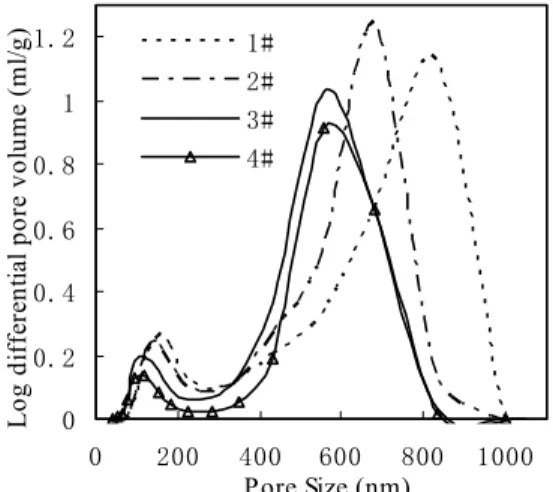
Fig. 3 Variation of the pore size distributions of the porous specimens with different starting powders sintered at 1500°C for 3h
The pore size distributions of the specimens prepared from different starting powders sintered at 1500°C are shown in Fig. 3. They are bimodal. One pore group is representative of micropores whose size is less than 200nm and the other is formed by bigger pores whose size is in the range from 400nm to 1000nm. It was found from Fig. 3 that with increasing Al(OH)3
content in the start powder mixtures, the pore size increased, but when the calculated mullite content in the samples was more than 70% the influence of the Al(OH)3 content became
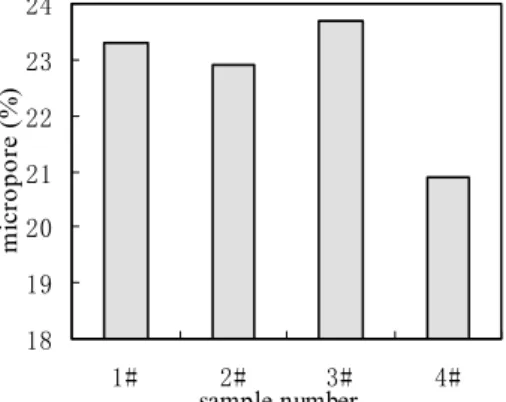
Fig. 4 shows the percentage of the volume of pores in the first range (<200nm) of the total pore volume. It was found that with decreasing Al(OH)3 content the ratio of micropore
volume to total pore volume decreased, but sample No.3 had the maximum micropore volume.
18 19 20 21 22 23 24
1# 2# 3# 4#
sample number
m
ic
rop
or
e
(
%
)
Fig. 4 Variation in the volume percentage of micropores in total pore volume with different starting powders sintered at 1500°C for 3h
Based on the results we may consider that sample No.3 is the best in our study because it has the highest porosity and the most micropores. On the other hand sample No.3 has a mullite content of 70% which is very close to the apposite content of mullite in mullite-corundum ceramics[14-16], so that sample No.3 is well-suited to prepare porous mullite- corundum-mullite ceramics.
3.2. Effect of Sintering Temperature on the porosity and the pore size
distributions of the specimen
Fig. 5 shows the apparent porosities of corundum-mullite ceramics sintered at different temperatures. As shown, the porosity decreased slightly from 49.1% to 42.4% with sintering temperature from 1300°C to 1400°C, and maintained stably with sintering temperature from 1400°C to 1500°C, but decreased abruptly to 18.5% with further increase in sintering temperature to 1600°C.
0 10 20 30 40 50 60
1200 1300 1400 1500 1600 1700 Sintering T emperat ure(°C)
Apparent Porosity (%)
Fig. 5 Dependence of apparent porosity of sintered 3# specimen on sintering
temperature
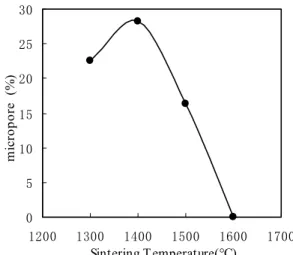
temperature is shown in Fig. 7. It was found that the pore size in the samples decreased and the micropore volume percentage increased when the sintering temperature rose from 1300°C to 1400°C.
0 0.2 0.4 0.6 0.8 1 1.2
0 200 400 600 800 1000
Pore Size (nm)
L
o
g
d
if
fe
re
n
tia
l P
o
re
V
o
lu
m
e
(m
l/g
) 1300°C
1400°C 1500°C 1600°C
0 5 10 15 20 25 30
1200 1300 1400 1500 1600 1700
Sintering T emperature(°C)
mi
c
ropor
e
(
%
)
Fig. 6 Variations in pore size distribution with sintering temperature for the specimens prepared from the 3# starting powders
Fig. 7 Variation in the volume percentage of micropores in total pore volume with sintering temperature in the 3# specimen
When the sintering temperature rose from 1400°C to 1500°C, the curve of pore size distribution moved toward larger pore size, and the percentage of microsize pores decreased. In the sample sintered at 1600°C, the pore size increased and the microsize pores disappeared.
3.3 Discussion
The porosity and pore size distribution in the samples depended on four factors:
1) Porosity and pore size distribution of green compacts. They depended on the particle size distribution of Al(OH)3 and microsilica.
2) Pores formed by the decomposition of Al(OH)3.
3) Influence of expansion caused by the formation of mullite. 4) Sintering.
Fig. 8 SEM image of the 3# specimen, sintered at 1500°C for 3h.
During reaction sintering of corundum-mullite materials the expansion caused by mullite formation plays important roles on porosity and pore size distribution in the samples. The roles can be divided into two kinds. As shown in Fig. 9, a pore is surrounded by grains and reaction areas marked RA in Fig. 9. During heating the expansion resulting from mullite formation reaction may give two different kinds of influences on the pore size. When the expansion is larger and the bond between the grains is weaker the expansion makes the grains separate with pore growth, as shown in Fig. 9A. However, in the case when expansion is smaller and the bonds between grains are very strong, the grains can not be separated by expansion and the expansion volume will enter into the pore to make the pore size and volume decrease.
A) B)
Fig. 9 Schematics of the change of pore morphology during reaction sintering
XRD pattens of sample No.3 heated at different temperatures are shown in Fig. 10. With rising sintering temperature the mullite content increases. When the sintering temperature rises from 1300°C to 1400°C, the expansion resulting from mullite formation is smaller. Both sintering and expansion can reduce the porosity and pore size of the samples, as shown in Fig. 5 and Fig. 6 respectively.
10 20 30 40 50 60 70 80 90
★
△
1600℃
1500℃
1400℃
1300℃
2θ/degree
★ ★ ★ ★
△
★
△
★ ★
★ ★
★
△ △
△
★ ★
★ ★
★-- mullite
△-corundum △
★
Fig. 10 XRD analyses of
mullite for the specimen sintered from 3# powders at different sintering temperatures
heated at 1400°C and 1500°C almost the same (Fig. 5) because the expansion cancels out of the shrinkage of sintering, but the pore size increases when the sintering temperature rises from 1400°C to 1500°C. When the sintering temperature rises to 1600°C, sintering pays an important role because the mullite formation reaction has almost finished at lower temperatures. The porosity of the samples is very low.
The same reason may explain the results shown in Fig. 4 Sample No.3 heated at 1500°C has the most apposite expansion volume to enter into pores to increase the percent of microsize pore volume.
4. Conclusions
The in-situ decomposition pore-forming technique has been successfully employed to fabricate porous corundum-mullite ceramics. The porosity and the size distribution of pores are determined by the content of Al(OH)3, the particle size of starting powders, the expansion
of mullite formation and the sintering temperature. The optimum mode is sample No.3 which has higher apparent porosity, well-distributed pores and more microsize pores. The most apposite sintering temperature of sample No.3 is 1500°C.
References
1. YaFei Liu, XingQin Liu, Hui Wei, Guang-Yao Meng, Porous mullite ceramics from national clay produced by gelcasting, Ceramics International. 27(2001) 1-7 2. Z.R. Ismagilov, R.A. Shkrabina, N.A. Koryabkina et al., Porous alumina as a
support for catalysts and membranes. Preparation and study, React. Kinet. Catal. Lett. 60 (2) (1997) 225-231
3. S. Kwon, et al., Constrained densification in boehmite-alumina mixtures for the fabrication of porous alumina ceramics, Journal of Materials Science. 33 (1998) 913-921
4. Y.M. Jo, Characterization of ceramic composite membrane filters for hot gas cleaning, Power Technol. 91 (1) (1997)55-62
5. M. Bennasar, D.rouleau, R. Mayer et al., Ultrafiltration of milk on mineral membranes: improve performance, J. Soc. Dairy Technol. 35 (2) (1982) 43-49 6. J. Coronas, M. Menendez, J. Santamaria, Methane oxidative coupling using porous
ceramic membrane reactors, Chem. Eng. Sci. 49 (12) (1994) 2005-2013 7. J.H. She, T. Ohji, Fabrication and characterization of highly porous mullite
ceramics, Materials Chemistry and Physics. 80 (2003) 610-614
8. Xie Zhipeng, et al., Study on binder removal process of ceramics injection molding, Journal of the Chinese Ceramic Bullitin. 2 (1998) 18-21
9. Zhen-Yan Deng, Takayuki Fukasawa, Motohide Ando, Microstructure and
mechanical properties of porous alumina ceramics fabricated by the decomposition of aluminum hydroxide, J. Am. Ceram. Soc. 84 (11) (2001) 2638-2644
10. Zhen-Yan Deng, Takayuki Fukasawa, Motohide Ando, High-surface-area alumina ceramics fabricated by the decomposition of Al(OH)3, J. Am. Ceram. Soc. 84 (3)
(2001) 485-491
11. Torrecillas.R, Calderon J M, Moya J S. Suitability of mullite for high-temperature applications J. Eur. Ceram. Soc., 1999,19(8): 2519-2527
13. Aksel C., The role of fine alumina and mullite particles on the thermomechanical behavior of alumina-mullite refractory materials. Mater letters, 2002,57(3): 708-714
14. Kong Deyu, Yang Hui, Wang Jiabang, Chen Guihua, Thermal fracture of
mullite/corundum deplete ceramics. Bull. of Chinese Ceram. Soc., 2004,24(5): 32-35
15. Li Tingshou, Sun Gengcheng, Zhong Xiangchong. A study of high temperature mechanical properties of sintered mullite-corundum system materials. Naihuo Cailiao, 1989, 2 (28): 9-12
16. Li Tingshou, Zhong Xiangchong, Sun Gengcheng. High temperature creep
properties of mullite-corundum materials. Bull. of Chinese Ceram. Soc., 1989,3(8): 1-8
ю :
in situ.
Al(OH)3 ,
100 , 20 .
1300, 1400, 1500 1600 , 3 . К
А .
. ,
:
, , Al(OH)3,
- . , 42,3%,
16,3%, 3.
1500 .
К юч вы ва: in situ,
Al(OH)
3,
,
-
.
а а:
in situ. Al(OH)3
100 mm
20 mm. У 1300, 1400, 1500 1600 3
. А
.
.
:
, Al(OH)3,
.
42,3%, ђ 16,3% . 3.
1500 .
К уч ч : Д in situ