Transactions of the VŠB – Technical University of Ostrava, Mechanical Series No. 3, 2010, vol. LVI
article No. 1816
Frantisek KAVICKA*, Josef STETINA**, Bohumil SEKANINA***, Tomas MAUDER****
THE IMPORTANCE OF THERMOPHYSICAL PROPERTIES OF STEELS FOR THE NUMERICAL SIMULATION OF A CONCASTING PROCESS
VÝZNAM TERMOFYZIKÁLNÍCH VLASTNOSTÍ OCELÍ PRO NUMERICKOU SIMULACI PROCESU KONTINUÁLNÍHO LITÍ
Abstract
The thermophysical properties of steels have significant influence on the actual concasting process, and on the accuracy of its numerical simulation and optimization. The determination of these properties (heat conductivity, specific heat capacity and density in the solid and liquid states) often requires more time than the actual numerical calculation of the temperature fields of a continuously cast steel billet, cylinder or slab (generally a concasting). The influence of individual properties should be neither under- nor over-estimated. Therefore, an analysis/parametric study of these thermophysical properties was conducted. The order of importance within the actual process and the accuracy of simulation and optimization were also determined. Individual properties, which, in some cases, were obtained from tables, and in others experimentally, were substituted by an approximation using orthogonal polynomials. The accuracy of each polynomial is dependent on the precision of individual values. The order of significance of individual thermophysical properties was determined with respect to the metallurgical length. The analysis was performed by means of a so-called calculation experiment, i.e. by means of the original and universal numerical concasting model developed by the authors of this paper. It is convenient to conduct such an analysis in order to facilitate the simulation of each individual case of concasting, thus enhancing the process of optimization.
Abstrakt
Termofyzikální vlastnosti ocelí mají významný vliv na reálný proces kontinuálního lití a na přesnost jeho numerické simulace a optimalizace. Určení těchto vlastností (tepelná vodivost, měrná tepelná kapacita a hustota v tuhé a kapalné fázi) často vyžaduje více času než vlastní numerický výpočet teplotních polí plynule odlitého ocelového sochoru, válce nebo bramy (obecně předlitku). Vliv individuálních vlastností by neměl být podceňován ani přeceňován. Proto byla uskutečněna analyza/parametrická studie těchto termofyzikálních vlastností. Bylo rovněž určeno pořadí významu v průběhu skutečného procesu a přesnost simulace a optimalizace. Individuální vlastnosti, které v některých případech byly získány z tabulek, v jiných experimentálně, byly nahrazeny aproximací za použití ortogonálních polynomů. Přesnost každého polynomu je závislá na přesnosti jednotlivých vlastností. Pořadí významu jednotlivých termofyzikálních vlastností byla stanovena vzhledem k metalurgické délce. Analyza byla prováděna pomocí t.zv. výpočtového experimentu, t.j. pomocí
*
prof., Ing, CSc, Brno University of Technology, FME BUT Brno, Dept.of Thermodynamics and Environmental Engineering, Technicka 2, 616 69 Brno, +420 54 114 3267, [email protected]
**
doc., Ing, CSc, Brno University of Technology, FME BUT Brno, Dept.of Thermodynamics and Environmental Engineering, Technicka 2, 616 69 Brno, +420 54 114 3269 [email protected]
***
Ing, CSc, Brno University of Technology, FME BUT Brno, Dept.of Thermodynamics and Environmental Engineering, Technicka 2, 616 69 Brno, +420 54 114 3270 [email protected]
****
originálního a univerzálního numerického modelu plynulého odlévání vyvinutého autory tohoto
článku. Je potřebné provádět takovou analyzu pro usnadnění simulace každého konkretního případu plynulého lití a tak zlepšit proces optimalizace.
1 SIMULATION OF THE TEMPERATURE FIELD OF A CONCAST SLAB The analysis of influence of the main thermophysical properties of slab material on calculation accuracy of temperature field in the system comprising the slab, crystallizer and surroundings, or slab and surroundings has been performed on a 1530x250 mm cast steel slab. As a comparing datum of accuracy, the metallurgical length has been selected (Figure 1). The conditions of slab pouring were characterized by these parameters: the temperature in tundish 1550°C, the temperature of the liquid 1521°C, the difference of temperatures in the tundish 29°C, the shift rate 0.71 m.min-1.
Fig. 1 The longitudinal section of the CCM for radial pouring
The chemical composition of the slab steel [wt.%]: 0.11 C, 0.49 Mn, 0.27 Si, 0.019 P, 0.009 S, 0.07 Cr, 0.04 Ni, 0.01 Mo, 0.06 Cu, 0.038 Altotal,0.01 Nb, 0.01 V, 0.01 Ti. The steel does not contain any alloying elements and the concentration of attendant elements Mn and Si is relatively low, as well as the concentration of additives P and S.
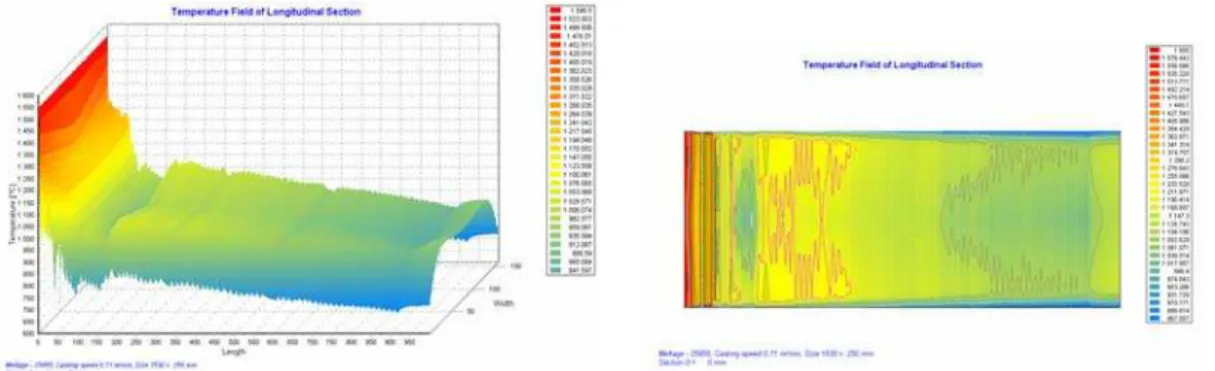
The model allows the user to enter or change parameters of the concasting machine, the dimensions of a slab, as well as the size of the defined network element. Furthermore, the thermophysical properties and boundary conditions can also be entered. After the simulation, it is possible to obtain the temperatures at each node of the network, and at any time of the process. Figure 2 shows for example 3D and 2D graphs of the temperature field along the longitudinal section of the slab ( surface of large radius). The calculated metallurgical length was set as 16.7 m.
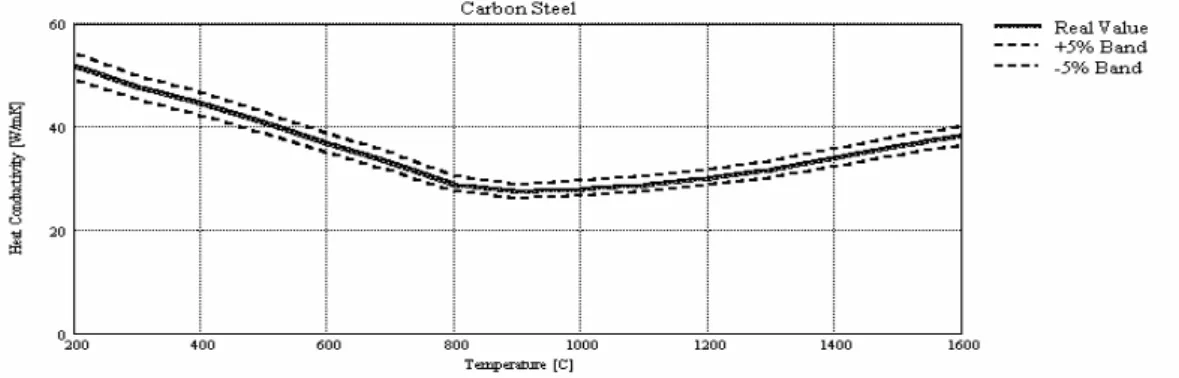
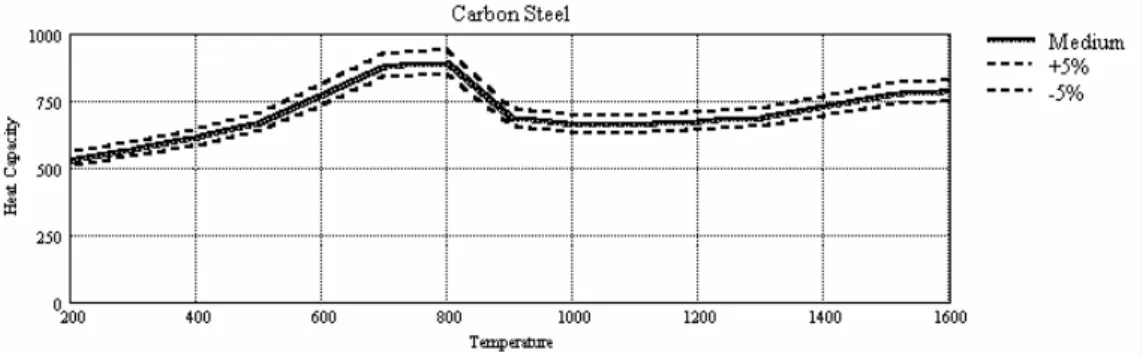
2 ANALYSIS OF THE INFLUENCE OF THERMOPHYSICAL PROPERTIES The main properties are heat conductivity λ, density ρ and specific heat capacity c, for the cast material in the liquid and in the solid state. These properties are dependent on temperature. Their determination often requires more time than the actual numerical calculation of the temperature fields. The fourth property is latent heat of the phase change L. The real values of heat conductivity, density and heat capacity of the concast steel, and their dependence on temperature, are in Figure 3-5. These properties can be set either via a table, or with the help of coefficients of approximation polynomials describing the curve.
Fig. 3 The steel heat conductivity and its dependence on temperature
Fig. 5 The steel specific heat capacity and its dependence on temperature
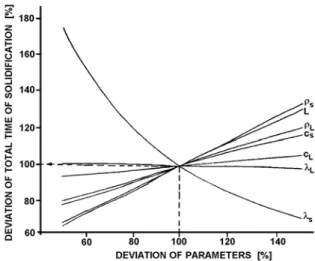
Latent heat of the phase change is 2.67.102 [kJ.kg-1]. The thermophysical properties of steels have a significant influence on the actual concasting process, and on the accuracy of its numerical simulation and optimization. The analysis of the effect of each parameter was conducted separately. The remaining properties were considered with their real values. The influence of each property has been studied within the range 70-130 % of its real value and shown graphically (Figure 6).
The deviation of each parameter from its real value (100%) is plotted on the x-axis. The deviation of the metallurgical length from its real value 16.7 m is plotted on the y-axis. The order of the influence of the parameters on the accuracy of the calculation of the total solidification time is obvious in this graph. The influence of is most significant. To summarize the dependencies of material properties, it could be stated that the tangent to the curves has a different slope for each parameter. There is even a different slope for the same parameter to the left of its real value, and a different slope to the right. Interesting is the negative slope of heat conductivity λ, when comparing other parameters of concast steel which have a positive slope.
Fig. 6 The influence of the thermophysical properties of concast steel slab
estimated, the region of the curve with a reduced slope is chosen and, according to this, the given property is either under- or over-estimated toward the hypothetical real value, in order to obtain more accurate results. If a requirement of an accuracy of solidification, thermokinetically controlled by the metallurgical length (for example within a range of ± 30%), will be given in advance, it is possible to estimate from the obtained graphs what error can affect the used thermophysical properties. It will be useful to analyze also the influence of the same main properties of a crystallizer material.
3 ANALYSIS OF THE INFLUENCE OF THERMOPHYSICAL PROPERTIES OF THE GRAVITATIONAL CAST STEEL
On a steel sample casting of cylindrical shape (Figure 7) that was cast in a fireclay or cast iron cylindrical mold, the analysis of the influence of the main thermophysical properties of the gravitational cast steel on calculation accuracy of temperature field in the system of casting-mold-surroundings has been performed by the authors before. As a comparing datum of accuracy the total time of solidification (crystallization). In addition, an analysis of the influence of thermophysical parameters of molding material on solution accuracy of the thermokinetics of solidification has been performed.
For the cast steel, the influence of thermal conductivity , heat capacity c, density , and namely in the liquid (index l) or in the solid phase (index s), in addition to latent heat of phase change L also has been analyzed. The analysis of the effect of each parameter was also conducted separately. The remaining properties were considered with their real values. The influence of each property has been studied within the range 50-150 % of its real value and shown graphically. The deviation of each themophysical parameter from its real value (100%) is plotted on the x-axis. The deviation of the total solidification time from its real value (100%) is plotted on the y-axis. The order of the influence of the parameters on the accuracy of the calculation of the total solidification time is obvious in Figure 8.
The influence of sis now most significant. It is possible to state also that the tangent to the curves has a different slope for each parameter. Also a different slope for the same parameter is to the left of its real value, and a different slope to the right. Analogical is also the negative slope of heat conductivity λ(here separately of l and s) when comparing other parameters of gravitational cast steel.
Fig. 7 Longitudinal-axis section of the system
4 CONCLUSIONS
The paper presents the original numerical model of the 3-D transient temperature field of the concast slab. This model was used also for the influence analysis of the properties of the concast material (steel) on the concasting process, and on the accuracy of its calculated temperature field. The order of the significance of these properties, was determined with respect to the metallurgical length. The analogical dependencies were analyzed when the influence of the properties of the gravitational cast steel cylinder was studied before.
The analysis shows that it is suitable, prior to the calculation of solidification thermokinetics, to perform the calculation analysis of the influence of thermophysical properties entering the system, and the analysis of the boundary conditions. Only then, a qualified decision on how accurate the determination of the properties and boundary conditions will be necessary for the calculation of the proper operating problem, in order to achieve the required accuracy of the results of the solution of the temperature field.
Acknowledgements. This analysis was conducted using a program devised within the
framework of the GA CR projects No. 106/08/0606 and 106/09/0940.
REFERENCES
[1] NETTO, P.O. Mathematical Models for Near-Net-Shape Casting Processes, ISIJ International,1996, Vol.36, pp.175-178. ISSN 0915-1559.
[2] BIRAT, J. P. Modelling and Process Control in the Steel Industry, La Revue de Métallurgie – CIT, 1997, 94, pp. 1347-1367. ISSN 1156-3141.