Plácido Antônio de Souza Neto
A Methodology for Building Service-Oriented
Applications in the Presence of Non-Functional
Properties
Natal-RN / Brasil
Plácido Antônio de Souza Neto
A Methodology for Building Service-Oriented
Applications in the Presence of Non-Functional
Properties
Tese submetida ao Programa de Pós-Graduação em Sistemas e Computação do Departamento de Informática e Matemática Aplicada da Uni-versidade Federal do Rio Grande do Norte (UFRN), como requisito para a obtenção do grau de Doutor em Ciência da Computação.
Advisor:
Martin A. Musicante (UFRN-Brazil)
Co-Advisor:
Genoveva Vargas-Solar (CNRS-France)
Natal-RN / Brasil
Catalogação da Publicação na Fonte. UFRN / SISBI / Biblioteca Setorial Especializada do Centro de Ciências Exatas e da Terra – CCET.
Souza Neto, Plácido Antônio de.
A methodology for building service-oriented applications in the presence of non-functional properties / Plácido Antônio de Souza Neto. – Natal, RN, 2012. 190 f. : il.
Orientador: Prof. Dr. Martin A. Musicante.
Co-orientadora: Profa. Dra. Genoveva Vargas-Solar
Tese (Doutorado) – Universidade Federal do Rio Grande do Norte. Centro de Ciências Exatas e da Terra. Departamento de Informática e Matemática Aplicada. Programa de Pós-Graduação em Sistemas e Computação.
1. Engenharia de software – Tese. 2. Serviços web – Tese. 3. Desenvolvimento dirigido a modelos – Tese. 4. Metodologia – Tese. I. Musicante, Martin A. II. Vargas-Solar, Genoveva. III. Título.
A
CKNOWLEDGEMENTSWhen I started my Ph.D. studies back in 2008, I couldn’t imagine how to write a thesis. For me it seemed to be an impossible endeavor. However, thanks to the will of God I finished the text of this thesis. So, I want to express my gratitude to God for this gift, because without him it would not be possible.
Now I have the opportunity to thank many people who helped me in some way, so, I can’t forget anyone of them. I will try to do that. During my Ph.D. I had really nice and lovely people around me, and I thank for the “gifts” (mainly that ones you feel) and unforgetable moments were passed near them. I found new friends and rediscovered old ones. These things, only a God that loves you can provide.
I’m grateful to my supervisor Prof. Martin Musicante, not only for the ongoing support but also for believing in me during this time and for the opportunities he provided for my growth as a researcher. I deeply thank my co-supervisor Prof. Genoveva Vargas-Solar for the time and effort spent on my thesis and for the feedback and support when I was in Mexico and France, and even by many emails and meetings by conference when I came back to Brazil. I also would like to thank Prof. Valeria de Castro for the patience and suggestions given for my work and for the friendship during the short time we had contact. I hope to cooperate with everyone for a long time, because I know that many fruits can be harvested yet.
I also would like to thank the committee members (Prof. Nelson Souto Rosa (UFPE), Prof. Silvia Virgílio (UFPR), Prof. Márcia Lucena (UFRN) and Prof. Valeria de Casto (URJC)) who agreed to read, analyze and comment this thesis. Thank you very much for your contributions!
I was pleased to be part of the HADAS team for 9 months and meet people who I will always remember with nostalgia and affection, in particular Juan Carlos, Mohamad Othman, Epal Orleans, Carlos Manuel (Manolo), Lourdez Martinez, Christiane Kamdem, Leon Fopa and Javier Espinosa. Thanks for the friendship. I hope to have the opportunity to meet everyone again in some place of the world.
I am deeply grateful to Marinas Praia Sul Presbyterian Church (IPMPS) members for their support, prayers and love of each one. They are always by my side, I thank the church members and its amiable council. Likewise, I thank my father-in-law Luiz Machado, my mother-in-law Maria de Lourdez, my sister-in-law Ana Tereza and my brother-in-law Heliomar Dias, for being always ready to help with your prayers and actions.
My family has been my greatest supporter over the last 29 years. My mother Ana Sueli is the better and coolest mother I can imagine and I am deeply grateful for everything she did for me. I hope be like her as a father. I also thank my father Francisco Ednaldo and my sister Tatyanny Nascimento that always took care and pray for me. Thanks for being there!
Last but not least, I am very happy to have my own little family that strongly supported me in my Ph.D. studies. My beloved wife Ana Flávia always supporting me, even during the countless weekends in the office, and the 9 months I spent in Grenoble for the Ph.D. stage. I am very thankful for her love, help and support in many dificult times. My son Lucas Kauai has been the sunshine in my life for the last 2 years. I am not able to measure the love I feel for them, not only for what they have done for me, but for what they are and represent in my life. I love you two with all my heart.
Resumo
Esta tese apresentaπSOD-M (Policy-based Service Oriented Development Methodology), uma metodologia para a modelagem de aplicações orientadas a serviços a qual usaPolíticasde qualidade. O trabalho propõe um método orientado a modelos para desenvolvimento de apli-cações confiáveis. πSOD-M consiste de: (i) um conjunto de meta-modelos para representação de requisitos não-funcionais associados a serviços nos diferentes níveis de modelagem, a partir de um modelo de caso de uso até um modelo de composição de serviço, (ii) um meta-modelo de plataforma específica que representa a especificação das composiçoes e as políticas, (iii) regras de transformação model-to-model e model-to-text para semi-automatizar a implementação de composiçoes de serviços confiáveis, e (iv) um ambiente que implementa estes meta-modelos e regras, representando assim aspectos transversais e limitações associadas a serviços, que devem ser respeitados. Esta tese também apresenta uma classificação e nomenclatura de requisitos não-funcionais para o desenvolvimento de aplicações orientadas a serviços. Nossa abordagem visa agregar valor ao desenvolvimento de aplicações orientadas a serviços que têm necessidades de garantias de requisitos de qualidade. Este trabalho utiliza conceitos das áreas de desenvolvi-mento orientado a serviços, design de requisitos não-funcionais e desenvolvidesenvolvi-mento dirigido a modelos para propor uma solução que minimiza o problema de modelagem de serviços web confiáveis.
Área de Concentração: Engenharia de Software
Palavras-chave: serviços confiáveis, políticas, desenvolvimento dirigido a modelos,
Abstract
This thesis presentsπSOD-M(Policy-based Service Oriented Development Methodology), a methodology for modeling reliable service-based applications usingpolicies. It proposes a model driven method with: (i) a set of meta-models for representing non-functional constraints associated to service-based applications, starting from an use case model until a service com-position model; (ii) a platform providing guidelines for expressing the comcom-position and the policies; (iii) model-to-model and model-to-text transformation rules for semi-automatizing the implementation of reliable service-based applications; and (iv) an environment that im-plements these meta-models and rules, and enables the application of πSOD-M. This thesis also presents a classification and nomenclature for non-functional requirements for developing service-oriented applications. Our approach is intended to add value to the development of service-oriented applications that have quality requirements needs. This work uses concepts from the service-oriented development, non-functional requirements design and model-driven delevopment areas to propose a solution that minimizes the problem of reliable service model-ing. Some examples are developed as proof of concepts.
Area of Concentration: Software Engineering
Contents
List of Figures
List of Tables
1 Introduction p. 16
1.1 Motivation and Problem Statement . . . p. 18
1.2 Objectives and Main Results . . . p. 21
1.2.1 Hypothesis . . . p. 21
1.2.2 Objectives . . . p. 22
1.2.3 Contributions . . . p. 23
1.3 Document Organization . . . p. 24
2 State of the Art p. 26
2.1 Background . . . p. 28
2.1.1 Model-Driven Development . . . p. 28
Computational Independent Model: . . . p. 28
Platform Independent Model: . . . p. 29
Computational Specific Model: . . . p. 29
2.1.2 Service-Oriented Applications . . . p. 29
2.1.3 Non-Functional Requirements . . . p. 30
2.1.4 Design by Contract . . . p. 31
2.2 Non-Functional Requirements for Service-Based Applications . . . p. 32
2.2.2 Analysis . . . p. 35
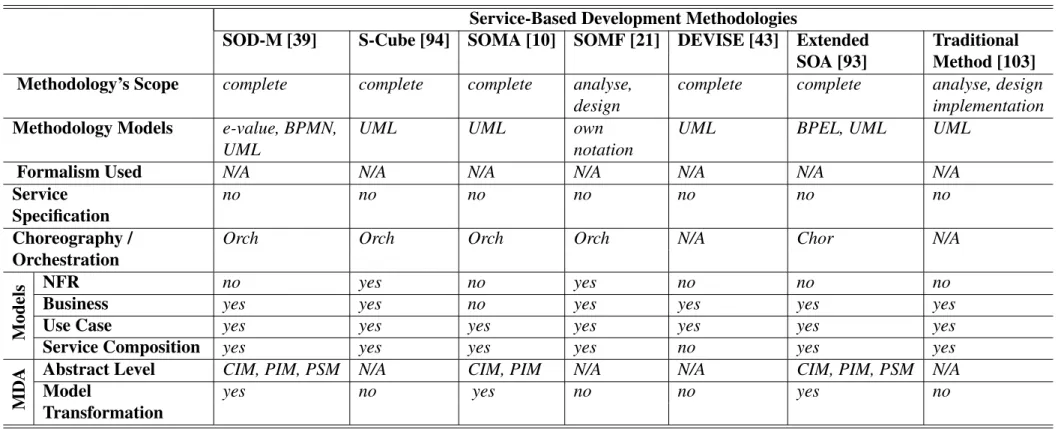
2.3 Methodologies for Service Oriented Development . . . p. 40
2.3.1 Concepts and Works . . . p. 41
2.3.2 Analysis . . . p. 45
2.4 Classification of Non-Functional Requirements for Service-Based Applications p. 48
2.4.1 NFR Meta-Model . . . p. 48
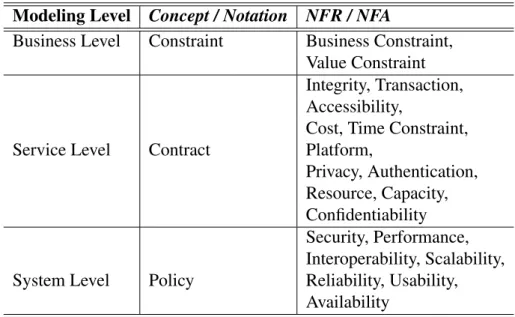
2.4.2 NFR Classification . . . p. 49
2.5 Conclusions . . . p. 53
3 πSOD-M: A Methodology for Building Reliable Service Based Applications p. 56
3.1 πSOD-M . . . p. 57
3.1.1 General Overview . . . p. 58
3.1.2 Development Process . . . p. 59
3.1.3 Methodology Concepts . . . p. 60
3.1.4 Case Study . . . p. 64
3.2 Platform Independent Models . . . p. 66
3.2.1 π-UseCaseModel . . . p. 66 3.2.1.1 π-UseCaseDiagram, Terms and Concepts . . . p. 68 3.2.1.2 Meta-model . . . p. 70
3.2.1.3 UML Concepts Representation . . . p. 71
3.2.1.4 To Publish MusicUse Case . . . p. 75 3.2.2 π-ServiceProcessModel . . . p. 76 3.2.2.1 π-ServiceProcessDiagram, Terms and Concepts . . . p. 77 3.2.2.2 Meta-model . . . p. 79
3.2.2.3 UML Concepts Representation . . . p. 80
3.2.3.1 π-ServiceCompositionDiagram, Terms and Concepts . . . p. 85 3.2.3.2 Meta-model . . . p. 86
3.2.3.3 UML Concepts Representation . . . p. 88
3.2.3.4 Publish MusicService Composition . . . p. 90 3.3 π-PEWS Platform Specific Models . . . p. 91
3.3.1 π-PEWS Specification, Terms and Concepts . . . p. 92
3.3.2 Meta-model . . . p. 93
3.4 Model Transformations . . . p. 96
3.4.1 Fromπ-UseCase toπ-ServiceProcess . . . p. 97
3.4.2 Fromπ-ServiceProcess toπ-ServiceComposition . . . p. 102
3.4.3 Fromπ-ServiceComposition toπ-PEWS . . . p. 105
3.5 Conclusions . . . p. 107
4 πSOD-MEnvironment p. 109
4.1 General Architecture . . . p. 110
4.1.1 Ecore Meta-models (Models Plugin Module) . . . p. 111 4.1.2 Model Transformation (Mapping Plugin Module) . . . p. 112 4.1.2.1 π-UseCase2πServiceProcessTransformation Rules . . . . p. 114 4.1.2.2 π-ServiceProcess2π-ServiceComposition Transformation
Rules . . . p. 116
4.1.2.3 π-ServiceComposition2π-PEWSTransformation Rules . . p. 117 4.1.3 Code Generation (Code Generation Module) . . . p. 117 4.2 Defining Reliable Service Based Applications . . . p. 122
4.3 Extending the Environment . . . p. 130
4.4 Conclusion . . . p. 131
5 Evaluation p. 132
5.1 Example 1: To Publish Music . . . p. 133
5.1.1 π-UseCase Model . . . p. 133
5.1.2 π-ServiceProcess Model . . . p. 134
5.1.3 π-ServiceComposition Model . . . p. 137
5.2 Example 2: Crime Map . . . p. 138
5.2.1 π-UseCase Model . . . p. 139
5.2.2 π-ServiceProcess Model . . . p. 142
5.2.3 π-ServiceComposition Model . . . p. 145
5.3 Example 3: GesIMED Application . . . p. 149
5.3.1 π-UseCaseModel . . . p. 152 5.3.2 π-ServiceProcessModel . . . p. 153 5.3.3 π-ServiceCompositionModel . . . p. 154 5.4 Lessons Learned . . . p. 155
5.4.1 Example 1: To Publish Music . . . p. 155
5.4.2 Example 2: Crime Map . . . p. 155
5.4.3 Example 3: GesIMED . . . p. 156
5.5 Measurement and Evaluation of theπSOD-M Methodology . . . p. 158
Generate a set of goals: . . . p. 159
Set of questions of interest which quantify the goals: . . . p. 160
Set of data metrics and distributions: . . . p. 160
Collecting the data: . . . p. 160
Evaluation of the data: . . . p. 161
5.5.1 Comparison of the SOD-M andπSOD-M approaches . . . p. 162
5.6 Conclusions . . . p. 165
6 Conclusions p. 167
6.1 Main Contributions . . . p. 168
6.2 Future Work . . . p. 169
References p. 171
Appendix A -- Source Selection and Analysis Method: Non-Functional
Require-ments for Service-Based Applications p. 180
Appendix B -- Service-Based Non-Functional Requirement Concepts p. 183
Appendix C --π-PEWSLanguage p. 185
List of Figures
1 Service-Based Non-Functional Requirement Model. . . p. 49
2 Relationship of the NFR Concepts. . . p. 53
3 SOD-M andπSOD-M Extension Models. . . p. 58
4 πSOD-M Development Process and Models. . . p. 60
5 πSOD-M Concepts. . . p. 61
6 Use Case Model “To Publish Music” - Spotify Music Service. . . p. 65 7 Service Process Model “To Publish Music”. . . p. 66 8 Traditional UML Concepts. . . p. 67
9 π-UseCase model Example. . . p. 68
10 Constraint Representation. . . p. 68
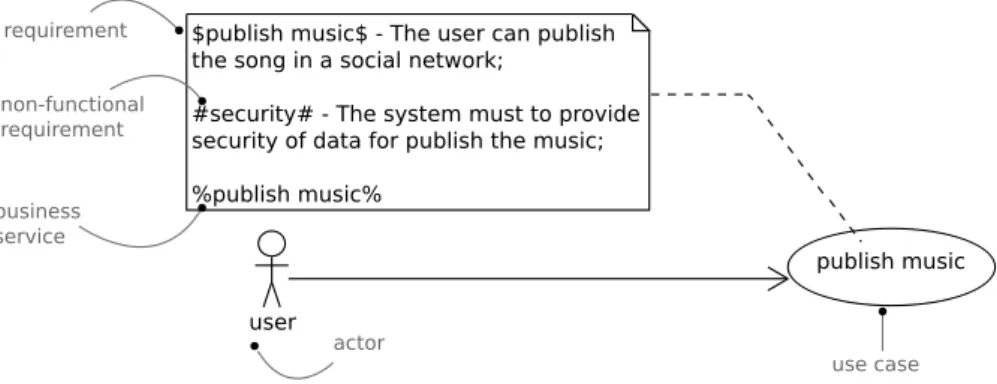
11 Non-functional Requirement Representation. . . p. 69
12 Non-functional Attribute Representation. . . p. 69
13 π-UseCase Concepts (Meta-model). . . p. 70
14 Business Collaborator / Package Representation. . . p. 71
15 π-UseCaseConcepts Represented as UML Elements. . . p. 72 16 π-UseCaseModel Representation. . . p. 73 17 π-UseCaseModel Representation (2). . . p. 74 18 Use Case Model With Constraint Definition - Scenario Example Refined. . . p. 77
19 Assertion Representation. . . p. 78
20 Contract Representation. . . p. 78
21 Node, Activity Edge and Contract Representation. . . p. 79
23 π-ServiceProcessModel Representation. . . p. 81 24 π-ServiceProcessModel Representation (2). . . p. 82 25 Service Process Model with Contract Definition - Complete Example. . . p. 84
26 Business Collaborator Representation. . . p. 86
27 Policy Representation. . . p. 87
28 π-ServiceCompositionConcepts (Meta-model). . . p. 88 29 π-ServiceCompositionRepresentation Models. . . p. 89 30 Service Composition Model with Policy Definition - Spotify Music Service. . p. 90
31 π-PEWS Specification Representation. . . p. 93
32 π-PEWS Contract Representation. . . p. 94
33 π-PEWS Meta-model. . . p. 95
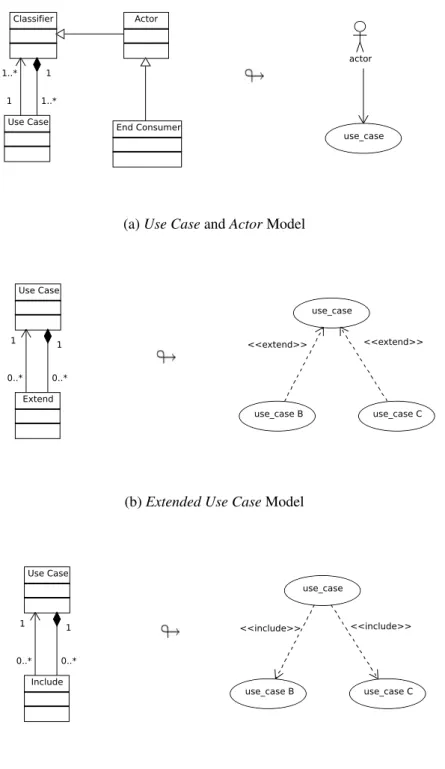
34 Entities’ Model Transformation Rules. . . p. 97
35 π-UseCase2π-ServiceProcess Model Transformation Rules. . . p. 100
36 π-UseCase2π-ServiceProcess Model Transformation Rules (2). . . p. 101
37 Extended Transformation Examples. . . p. 102
38 Include Transformation Example. . . p. 102
39 π-ServiceProcess2π-ServiceComposition Model Transformation Rules. . . . p. 104
40 πSOD-M Development Environment. . . p. 110
41 Environment Components. . . p. 111
42 ATL Model to Model Transformation inπSOD-M. . . p. 113
43 Acceleo Model to Text Transformation inπSOD-M. . . p. 113
44 ATL Configuration forπSOD-M Transformation. . . p. 114
45 Acceleo Specification forπ-PEWSCode Generation. . . p. 118 46 Model Transformation Process. . . p. 121
47 πSOD-M Eclipse Plugin Environment. . . p. 122
49 π-UseCaseProperties inπSOD-M Eclipse Plugin. . . p. 124 50 π-ServiceProcessModel Definition inπSOD-M Eclipse Plugin. . . p. 126 51 π-ServiceProcessProperties inπSOD-M Eclipse Plugin. . . p. 127 52 π-ServiceCompositionModel Definition inπSOD-M Eclipse Plugin. . . p. 128 53 π-PEWSModel Definition inπSOD-M Eclipse Plugin. . . p. 129 54 π-PEWSModel Properties inπSOD-M Eclipse Plugin. . . p. 130 55 To Publish Musicπ-UseCase. . . p. 134 56 To Publish Musicπ-UseCase Environment Detail. . . p. 135 57 To Publish Musicπ-UseCase Environment Detail. . . p. 135 58 To Publish Music Services. . . p. 136
59 To Publish Musicπ-ServiceProcess. . . p. 136 60 To Publish Musicπ-ServiceComposition Model. . . p. 138 61 Crime Mapπ-UseCase. . . p. 140
62 Search crimeπ-UseCase Detail. . . p. 141 63 See crime informationπ-UseCase Detail. . . p. 142 64 Crime Map Services. . . p. 143
65 Crime informationπ-ServiceProcess. . . p. 143 66 Crime informationπ-ServiceProcess Environment. . . p. 144 67 See crime statistic and share informationπ-ServiceProcess Detail. . . p. 145 68 Crime statistic and share informationπ-ServiceComposition Environment. . p. 146 69 Crime informationπ-ServiceComposition. . . p. 147 70 Crime informationπ-ServiceComposition Environment. . . p. 148 71 Crime statistic and share informationπ-ServiceComposition. . . p. 149 72 See crime statistic and share information π-ServiceComposition
Environ-ment Detail. . . p. 150
74 π-ServiceProcess: Perform Image Processing. . . p. 152
75 π-ServiceComposition: Perform Image Processing. . . p. 153
76 Use Case Model [39]. . . p. 157
77 Extended Use Case Model [39]. . . p. 157
78 Image Processing - Service Process Diagram [39]. . . p. 157
79 Image Processing - Service Composition Diagram [39]. . . p. 158
80 Publications per year. . . p. 182
List of Tables
1 Research question results -RQ1,RQ2,RQ3,RQ4. . . p. 38 2 Research question results -RQ5,RQ6,RQ7. . . p. 39 3 Methodologies’ Analysis. . . p. 46
4 Non-Functional Requirements Classification. . . p. 50
5 Transformation Rules: Fromπ-UseCase toπ-ServiceProcess. . . p. 99
6 Transformation Rules: Fromπ-ServiceProcess toπ-ServiceComposition. . . p. 103
7 Transformation Rules: Fromπ-ServiceComposition toπ-PEWS. . . p. 106
8 πSOD-M’s Goals and Questions . . . p. 160
9 πSOD-M’s Metrics/Distributions . . . p. 161
10 Results:πSOD-M’s Metrics/Distributions . . . p. 161
11 Comparison: SOD-M andπSOD-M . . . p. 163
16
1
Introduction
“The greatest enemy of knowledge is not
ignorance, it is the illusion of
knowledge.”
Stephen Hawking
A Web service is a logically atomic component that provides operations through a stan-dardized interface and is accessible on the Internet. The most important features of a Web service platform is the use of the Internet high-level protocols for making software compo-nents interact among each other. Web services use three major standard technologies, namely: a communication protocol (SOAP -Simple Object Access Protocol)[24]), an interface descrip-tion language for describing services (WSDL -Web Service Definition Language [30]) and a specification for publishing and finding services (UDDI -Universal Description, Discovery and Integration[59]). These technologies are organized within a reference architecture that defines how they are used for using services as components that can exchange messages for implement-ing specific application logics.
Furthermore, it is possible to create new services (i.e., composite services) by composing existing ones. Service composition is defined by a process consisting of activities implemented by other services .
Some composition processes require to define more complex interactions among services. For this, it is necessary an adequate description of the interface that can describe composite services. Since WSDL descriptions specify only static aspects, some proposals specify services and its compositions by adding behavioral characteristics, such as PEWS [13], BPEL4WS [8], XLANG [107], WSCI [9]eOWL-S [19].
us-1 Introduction 17
ing the WS-Coordination, WS-Transaction, WS-BussinessActivity and WS-AtomicTransaction standards. The selection of the adequate protocols for adding a specific non-functional con-straint to a service composition (e.g., security, transactional behaviour and adaptability) is com-pletely left to the programmer. As a consequence, the development of an application based on a service composition is a complex and a time-consuming task. This is opposed to the philoso-phy of service-based software engineering that aims at facilitating the integration of distributed applications.
Non-functional properties of service oriented applications has been addressed in academic works and standards and it is based on the characteristics of standards used to describe services API, for instance WSDL [30], or in the characteristics of REST architectures where methods are part of the communication protocol, and also used to express service coordination like BPEL [89].
Non-functional properties are in general not considered when a service-oriented application is modeled. Methodologies in general focus on the application logic and then rely on program-mers for implementing non-functional properties either by coding them directly (e.g., handling exceptions) or by configuring the services provided by the middleware (e.g., persistence or transactional properties).
Not respecting a non-functional property expressed in a specification in the design phase, implies an exceptional behavior of the application. These exceptions are dealt according to predefined actions also expressed in the design phase, oriented to tolerate these exceptions. In consequence, a reliable service coordination is the one that conforms to a specification and that is exception tolerant, where exceptions concern the violation of constraints and business rules defined in the specification. Different to existing works, our approach supposes autonomous services 1 and does not associate these properties to services but to an application logic
im-plemented as a coordination. Of course, when non-functional properties associated to a ser-vice coordination depend on the properties of participating serser-vices, the programmer should be aware of that and provide non-functional properties partially, model compensating strategies for ensuring them or at least program recovery actions that can signal an exception when a non-functional property is violated.
In general, software engineering techniques have been conceived for supporting the de-velopment of applications, and service-based applications should not be the exception. The evolution of the software engineering field has led to the proposal of the MDA (Model Driven
1
1.1 Motivation and Problem Statement 18
Architecture) approach. MDA [80] is an important approach for the alignment between high-level information modelling, non-functional requirements and service-based development, be-cause it provides a conceptual structure that extends from the models used by system analysts to different models used by software developers.
The challenge to the use of MDA in modeling of cross-cutting aspects of the application from the more abstract level of design is the ability to use different types of models for differ-ent purposes and understand the differences between the terminologies for the non-functional properties [120].
MDA allows the specification of a system as an abstract model, which may be realized as a concrete implementation (e.g. WSDL, BPEL or PEWS). Using a MDA specification it is possible to generate the source code for implementing the software system from an abstract model. The MDA methods provide a skeleton of the program source code, implemented as a source code template where predefined tokens are then replaced with code. MDA methods separate design from architecture. The design addresses the functional requirements while ar-chitecture provides the non-functional requirements like scalability, reliability and performance are realized.
1.1 Motivation and Problem Statement
Software construction is moving towards the use of methodologies for controlling the soft-ware development process and facilitating the specification of functional and non-functional requirements (NFRs), and its maintenance and evolution for integrating new functionalities. There exist several methodologies, methods and new approaches [40, 93, 103, 51, 21, 79] for software engineering, improving software development and modeling non-functional require-ments. These methods can help to ensure the coherence between functional and non-functional properties necessary to the system, particularly when information systems include complex business processes calling web services or legacy applications exported as services. The chal-lenge is to ensure reliability2 properties for the complete application. There are still a number
of problems to be solved in the development of systems, specially for service-based develop-ment,e.g., automatic composition, NFRs specification and modelling, or specific development methodologies for service-based applications.
Service oriented computing is at the origin of an evolution in the field of software
devel-2 The concept of reliability of service-oriented applications used in our work is associated to the concepts of
1.1 Motivation and Problem Statement 19
opment. An important challenge of service oriented development is to ensure the alignment between IT systems and the business logic. Thus, organizations are exploring new mechanisms to bridge the gap between the developed systems and business needs [21]. The literature stresses the need for methodologies and techniques for service oriented analysis and design, claiming that they are the cornerstone in the development of meaningful service-based applications [91]. In this context, some authors argue that the convergence of model-driven software development, service orientation and better techniques for documenting and improving business processes are the key to make real the idea of rapid, accurate development of software that serves, rather than dictates, software users’ goals [115].
Service oriented development methodologies providing models, best practices, and ref-erence architectures to build service based applications mainly address functional aspects [11, 25, 41, 93]. Non-functional aspects concerning service and application’s semantics, of-ten expressed as requirements and constraints in general purpose methodologies, are not fully considered or they are added once the application has been implemented in order to ensure some level of reliability (e.g., data privacy, exception handling, atomicity, data persistence). This leads to service based applications that are partially specified and that are thereby partially compliant with application requirements.
The use of many different platforms and APIs for the development of Web applications raises the need for an infrastructure that allows an organized execution of the analysis activities, design and implementation, enabling the design, implementation and development of reliable applications.
Even with the growing interest in developing higher-level models and design paradigms, current technology seems limited for expressing constraints as non-functional requirements (NFRs) and associating them to service-oriented applications [31, 33]. NFRs specify global constraints that must be satisfied by the software [99].
1.1 Motivation and Problem Statement 20
• the designer must make the difference between requirements that concern the application logic and the non-functional requirements;
• the non-functional requirements specified in an abstract way (e.g., as business rules) must provide enough information to be translated into the specification of technical aspects implementing a concrete non-functional property. For example, saying that the payment, the authorization of delivering a package and the modification of the stock must be all together successful otherwise they must be undone, can be translated into an atomicity property associated to these operations (i.e., either the three of them are executed or none of them);
• the methodology must provide general enough concepts for modeling quite different non-functional requirements and strategies to ensure that their abstract specification will lead to the implementation of protocols that will ensure these properties while the application is executed.
In the case of service-oriented applications it is particularly difficult to add non-functional properties because in general the existing protocols and models implementing some of them assume that (i) it is possible to have a global control of the artifacts implementing the application or (ii) at least they export interfaces in order to have information about their execution state, the messages exchanged with others, the conditions in which messages are transmitted on the network.
In the case of service-oriented applications, the services used as construction units are au-tonomous, they do not share information about the state and data they manage and there are few engagements with respect to their availability and evolution. This aspect calls for flex-ible protocols and models that can accept a best effort approach for ensuring non-functional properties. For example, to provide security, all services of the composition should be safe; to ensure satisfactory response time, all services of the composition must provide the results obeying restrictions of the client. These assumptions cannot be made, and thus in some cases non-functional properties cannot be completely ensured. The methodology should take into consideration this situation in order to reflect it along the different construction phases.
1.2 Objectives and Main Results 21
Our approach combines service-based development, non-functional aspects and model driven architecture (MDA) so that reliable service-based systems may be developed by reducing time delays and increasing results, such as compliance and quality.
1.2 Objectives and Main Results
The main goal of this thesis is to provide a methodology for developing reliable web ser-vice applications. Addressing the (i) modelling of functional requirements that can be imple-mented by service compositions and (ii) non-functional requirements expressed as constraints associated to services and policies to ensure the enforcement of business rules that define the semantics of the application.
1.2.1 Hypothesis
We adopted the following hypothesis for defining the methodology:
1. Business rules and constraints specified as application requirements can be translated into non-functional properties that can be associated to a service composition that implements the application logic of a service-oriented application.
2. We believe that it is possible to model non-functional properties during the early stages of applications development process and that this can be done using an MDD approach. Therefore, we assume that, at least in the context of service-oriented applications, it is possible to propose meta-models that can be specialized for expressing non-functional properties and that can be associated to concepts used for modeling the application logic.
3. We use the notion of service in a general way without necessarily associating it to the Web. A service is a software element implemented by a service provider that exports an interface for calling the service and that is accessible through a network.
1.2 Objectives and Main Results 22
1.2.2 Objectives
Our work proposes the MDA based methodology πSOD-M (Policy based Software Ori-ented Development Methodology) that (i) extends the SOD-M [41] method with the notion of
Policy[47] for representing non-functional constraints associated to service based applications; (ii) defines theπ-PEWSmeta-model [105] providing guidelines for expressing the composition and the Policies; and finally, (iii) defines model to model transformation rules for generating the
π-PEWSmodel of a reliable service composition starting from the extended service composition model; and, model to text transformations to generate the corresponding implementation.
This work proposes also an environment that provides tools for using the methodology and implementing reliable services based applications. By defining theπSOD-M model a program-mer can design and implement cross-cutting aspects (e.g., exception handling for describing what to do when a service is not available, recovery, persistence aspects) and constraints asso-ciated to services, that must be respected for using them (e.g., the fact that a service requires an authentication protocol for executing a method).
π-SOD-M supports the construction of service-oriented applications that implement busi-ness processes. Therefore, it proposes a development process based on the definition of models (instances of the meta-modes) and transformations for semi-automatically generating different levels of abstraction that describe a service-oriented application from abstract platform indepen-dent views (CIM and PIM level) to platform depenindepen-dent views and the PSM and implementation levels. We extended the Business and Service views of the SOD-M method [40]. The Business view defines the concepts for modeling a business process, while the Service view defines the concepts for designing services compositions. Our methodology introduces concepts (e.g. NF-requirement, constraint, assertion, contract, policy) in the Policy view for describing constraints associated to services and non-functional properties associated to service processes.
The organization into different levels of abstraction of non-functional properties proposed byπ-SOD-M relies on its concept of non-functional Requirement (NFR) defined as a group of semantically correlated non-functional attributes (NFA). For example,securityis an NFR that comprises attributes such as confidentialityand integrity. NFR are used for modeling global constraints, NFAs model non-fuctional characteristics that can be precisely measured, such as performance [99]. This kind of characteristics are closer to implementation. Then, the concept non-functional property proposed by [99, 32, 33] is used for modeling different types of software constraints. Thus, it generalizes the concepts NFR and NFA of our methodology. InπSOD-M, NFR and NFA are modelled along the different modeling levels asCONSTRAINT
1.2 Objectives and Main Results 23
intoPOLICY TYPES. A constraint type is used for representing a non-functional property.
The objective is to provide a conceptual structure (called framework) and associated envi-ronment to:
• Capture the system requirements and specification using high-level abstraction models (represented as computation independent models, CIMs). The objective is to provide concepts for supporting the specification and representation of a business process includ-ing its application logic and business rules.
• Semi-automatize the generation of the Platform Independent Models (PIMs) from the specification given by the CIMs. The PIMs specify the business process as a service process and its associated business rules and constraints as policies. A policy expresses actions to do (recovery) if business rules and constraints are not respected.
• Transform such models into platform specific models (PSMs). The PSMs in π-SOD-M meta-model the π-PEWS language3 [105] that will serve as intermediate language for
generating executable code in the final phase of the methodology process. The reason is thatπ-SOD-M was developed in the context of a project where it is used for declaratively implementing service compositions. We defined theπ-PEWS meta-model, based on the
π-PEWS syntaxis, and then the mapping rules between PIM and PSM.
• Serialize PSMs into the executable-code that implements the system.
1.2.3 Contributions
The main contributions of our work are:
• Classification of non-functional requirements for web services: This classification is
based on an analysis of the key features in the development of service-based applica-tions. Associating non-functional requirements to a service composition partially ensures that the resulting application will comply to the user requirements as well as with the characteristics of services user for implementing it.
• The definition of non-functional requirements meta-models: πSOD-M defines
non-functional requirements meta-models for representing concepts associated to services properties and constraints, and business rules and thereby providing a framework for modelling reliable service-based applications.
3
1.3 Document Organization 24
• MDA based methodology for modelling and implementing reliable service-based
ap-plications: πSOD-M defines a set of concepts organized according to three points of
view: (i) policy view, focusing on the non-functional requirements expressed by poli-cies, (ii) business view, focusing on the features and the requirements of the business, and (iii) the system view, concentrating on the functionalities and processes that need to be implemented in order to satisfy the business requirements. The modelling process of
πSOD-M includes models that are in correspondence with the three different abstraction levels considered by MDA (CIM, PIM and PSM).
• πSOD-M environment: We theπSOD-M environment implemented as Eclipse plugins
that enables the use of the proposed methodology for specifying functional and non-functional requirements of a reliable service-based application and for semi-automatizing the transformation processes from CIM to PIM and PIM to PSM levels, and then gener-ating executable code.
1.3 Document Organization
The remainder of this document is organized as follows:
• Chapter 2 presents a systematic review of approaches associating non-functional proper-ties to services and service-based applications. It introduces the main concepts used for describing and modeling non-functional requirements in the different phases of service-based methodologies;
• Chapter 3 introduces the πSOD-M methodology proposed in this thesis, used for build-ing reliable service-based applications. The chapter describes the main phases of the methodology which is based on an MDA approach, and the meta-models associated to the CIM, PIM and PSM levels. Developing a service-based system consists ins instantiat-ing such meta-models and transforminstantiat-ing them along the different levels. This chapter also describes the transformation rules among the meta-models of theπSOD-M methodology, that includes model-to-model and model-to-text transformations.
• Chapter 4 describes theπSOD-M environment for developing service-based systems us-ing this methodology. The chapter describes the architecture of the environment, its main components and functions and the tools for implementing it;
complex-1.3 Document Organization 25
ity, some focusing on complex application logics and few non-functional requirements, and others having in contrast simple application logics, but complex non-functional re-quirements. The πSOD-M methodology is systematically used for developing the case studies. Then, a discussion is conducted for presenting lessons learned and for comparing this methodology with a methodology of reference.
• Chapter 6 concludes this document. It enumerates the main results of this work underlin-ing the main contributions and then it discusses future perspectives.
• Some details about our work are described in the appendices:
– Appendix A describes the method used for source selection and analysis of related
works with non-functional requirements for service-based applications;
– Appendix B presents a list of service-based non-functional requirement concepts
and definitions proposed in this thesis;
26
2
State of the Art
“Computer science is no more about
computers than astronomy is about
telescopes.”
Edsger W. Dijkstra
Service oriented development methodologies providing models, best practices, and refer-ence architectures to build service-based applications mainly address functional aspects [103]. Non-functional aspects concerning services and applications semantics are often expressed as requirements and constraints. It is common that these aspects are not fully considered during the development of applications. In many cases, they are considered once the application has been implemented, in order to ensure some level of reliability (e.g., data privacy, exception han-dling, atomicity, data persistence). This situation leads to service-based applications that are partially specified and that are partially compliant with initial application requirements.
In systems and requirements engineering, a non-functional requirement (NFR) specifies criteria about the behaviour of a system. These criteria may be not related to the results pro-duced by the system, but to other conditions of its performance and execution. Non-functional requirements are often called qualities of a system. They are also referred as “constraints”, “quality attributes”, “quality goals”, “quality of service requirements” or “non-behavioural re-quirements” [106]. In the case of service-based applications, non-functional requirements con-cern the application itself as well as its component services.
In the case of service-based applications, non-functional requirements concern the applica-tion itself, as well as constraints imposed by the services. Associating non-funcapplica-tional require-ments to services composition can help to ensure that the resulting application is compliant to the user requirements and also with the characteristics of the services it uses. As services are independent components, ensuring non-functional properties is a challenge.
2 State of the Art 27
approaches. Although they are used as synonyms in most NFR approaches [67], we distinguish the concepts of non-functional requirements and non-functional attributes. NFRs are defined as a group of semantically correlated non-functional attributes (NFA). For example,securityis an non-functional requirement that comprises attributes such asconfidentialityandintegrity. A non-functional attribute describes the characteristics of a functional requirement [99, 33] .
This chapter (i)presents the background concepts of this thesis, (ii) presents the state of the art of Web service based methodologies and non-functional requirements for web service based applications, and (ii) analyses the principal methodological concepts for web service development.
Considering the analysis, it will be conducted through a systematic review1 [62]. The
result of this review can be useful to summarize the existing evidence concerning a treatment or technology, to identify gaps in current research in order to suggest areas for further investigation, and to provide a background for new research activities. The bibliography will be analyzed in order to present the different existing concepts, proposals, problems and solutions related with each area.
The analysis is organized in 2 parts to facilitate the understanding of the areas and related works and what their importance in the context of service-based development. Our goal is to identify a common nomenclature for existing NFR and web service based methodologies and propose a specification of these concepts in the context of reliable web services development.
Since the focus of this work is the development of reliable service-based applications, we analyzewhat,where and hownon-functional requirements are modeled in the development of this type of application. Allied to this, we analyze which methodologies address development of service-based applications and if they model non-functional aspects.
This chapter is organized as follows. Section 2.1 presents the background concepts of this thesis, considering the following domains: model-driven development, service-oriented applications, non-functional requirements and design by contract. Section 2.2 presents the main concepts and works related with non-functional requirements for web service application. Section 2.3 presents the main concepts and works related with methodologies for web service development. Section 2.4 present a non-functional requirements model for service-based devel-opment and a classification of the main terms used, divided into levels. Section 2.5 concludes for this chapter.
1A systematic review provides means of identifying, evaluating, and interpreting the literature relevant to a
2.1 Background 28
2.1 Background
The background of this work consists of the works addressing (i) model driven devel-opment, (ii) service-oriented applications and (iii) non-functional requirements. A number of approaches, models and solutions proposed in these domains were studied, integrated and adapted for addressing the construction of service-oriented applications in the presence of non-functional requirements. We underline in the following the key concepts that we used from each of the domains of the background of our work.
2.1.1 Model-Driven Development
Model-driven development (MDD) approaches, specially the model-driven architecture ap-proaches provides a set of guidelines for the structuring of specifications, which are expressed as models.
The MDA approach gives the facility to understand complex and real world systems while providing an abstraction of the physical system. This abstract view of the system is represented through the OMGâs modeling standards namely the Unified Modeling Language (UML) [88], the Meta-Object Facility (MOF) [80] and the XML Metadata Interchange (XMI).
The Model-driven approach does not reinvent another software development process but it regroups the knowledge of software engineering concepts to express architectures. The MDA approach is mainly based on the Model Driven Development (MDD) [115, 80] which suggests that a system must be first modeled before it can be transformed to suit the final execution platforms.
A MDA-based approach establishes a specific set of layers and transformations. The Com-putational Independent Model (CIM), the Platform Independent Model (PIM) and the Platform Specific Model (PSM) are the three MDA model types. Considering this concepts, a system can be expressed as the specification of an execution environment for a set of models, the relation-ships between models, meta-models and platforms.
Computational Independent Model: CIM is a view of a system without any knowledge of
2.1 Background 29
Platform Independent Model: PIM is a view of a system without any knowledge of the
im-plementation details. The PIM model requires that model elements contain enough information to represent the system independent of platform.
Computational Specific Model: PSM is a view of a system with specific knowledge of the
implementation platform. After the platform independent model has been accurately defined, the platform specific details can be handled in the PSM.
Another important aspect of the MDA approach is the transformation between models. Models transformation relies on a set of mapping rules between models that inform the trans-former tool about the patterns it needs to follow to output the target model. Then, consistency and validation of models can be automated during this transformation process, improving the efficiency of generated applications.
2.1.2 Service-Oriented Applications
Service-Oriented Applications are defined based on the Service-Oriented Architecture (SOA) [25, 100, 21] paradigm for organizing and use of distributed computing resources that may be under the control of different domains, providing a uniform meaning for discovery, in-teraction and use of these resources. SOA is a set of principles and methodologies for designing and developing software in the form of interoperable services.
he use of SOA makes possible the integration of applications that are web based and make use of multiple platforms for its implementation. SOA also defines a interface in terms of protocols and functionality.
As an architecture, SOA relies on principles of service-orientation (Web services). This is motivated by the hypothesis that, if a service provides a simple interface that abstracts its com-plexity, users can access the services independently, without know the development platform on which it was implemented. So, service-orientation requires loose coupling of services with operating systems and other technologies that underlie applications.
discov-2.1 Background 30
ery, description and invocation of services. An example of another initiative that uses service-oriented technology is the Business Process Execution Language for Web Service (BPEL4WS) [86, 87, 61], where a composition of web services can be described through representation of business processes.
Considering composition of services in general, two paradigms guide the compositions: the choreography and orchestration [101]. The orchestration is concerned with the flow of inter-actions between services (business logic and execution order of services, such as a workflow). The orchestration requires an engine that coordinates the composition execution. The chore-ography describes the order in which messages are ordered for using the methods exported by one or several services. The choreography is used for expressing the conversations that an ap-plication can have with a service. A conversation specifies the sequence of valid messages that a service con receive. These sequences correspond to the protocols for exchanging messages with a service.
2.1.3 Non-Functional Requirements
A non-functional requirement (NFR) is a requirement that specifies criteria that can be used to judge the operation of a system, rather than specific behaviors. Non-functional requirements are often called qualities of a system. However, for [33] there is not a formal definition or a complete list of non-functional requirements. NFRs are classified into consumer-oriented and technically-oriented attributes [85].
Based on [85], during the design process goals are decomposed design alternatives are analyzed with respect to their tradeoff design decisions are rationalized goal achievement is evaluated and a selection is made In this approach NFR-related knowledge is codied into meth-ods and correlation rules. This way a body of codied NFR-related knowledge offers the needed subject matter and vocabulary and is made available and reusable throughout the process [31].
In the area of software requirements, the term non-functional requirements has been used to refer to concerns not related to the functionality of the software. However, different authors characterize this difference in informal and unequal definitions, such as “Requirements which are not specifically concerned with the functionality of a system. They place restrictions on the product being developed and the development process, and they specify external constraints that the product must meet” [32].
pro-2.1 Background 31
viding middleware services. For example in object oriented solutions like CORBA, and com-ponent oriented solutions like EJB. Models and protocols have been defined in the distributed systems and the database domains for dealing with non-functional requirements that concern for example, security , tolerance to failure (e.g, transaction monitors, synchronization protocols like 2PC), persistence. Lately service-oriented applications, call for approaches that can in-clude these aspects trying to be loyal to the facility of construction philosophy. Some solutions leave this task to the middleware infrastructure (e.g., the service bus petals2offers some
non-functional services), to the engines that execute them. Other approaches like [42] include the code that implements non-functional properties, as protocols within the coordination code that implements the application logic of service-oriented applications or within the communication protocol used for calling services methods (e.g. data encryption of SOAP messages). This later approach is particular to works stemming from the Business Process domain (BPM [87]) and also to WS-* standards.
2.1.4 Design by Contract
We used the notion of reliability in order to have a common approach for dealing with non-functional requirements (i.e., ensuring that the system respects them and defining actions when they are not respected). The concept of reliability of service-oriented applications used in our work is associated to the concepts ofcorrectness, robustnessand reliabilityintroduced in (i)Design by Contract[71, 74, 73], (ii) referred by [71, 73] and (iii) defined in the database domain.
Design by Contract is a method for developing software. Design by Contract is the principle by which interfaces between software modules should be designed using precise specifications. The principle behind Design by Contract is a class and its client have a contract with each other. Contracts define mutual benefits and obligations (pre-conditions and post-conditions, respec-tively), and constraints (invariant). Contracts are defined in program code through comments of their own programming language and is translated into executable code by the compiler. The properties (predicates) of the contract are known as assertions (assertions).
Assertions are representations of states. Expressions are true at certain points of a code [71], becomes important when one wants to prove the correctness a program. To be able to prove the correctness of a given program or a piece of code, it is necessary to define logical expressions that represent desired states. If one of the conditions is not satisfied, there was something wrong with either, the defined assertion or the definition of the program.
2
2.2 Non-Functional Requirements for Service-Based Applications 32
Design by Contract defines reliability as a concern that integrates the ability of a software element to perform the tasks as defined in its specification (correctness) and that reacts appro-priately to abnormal conditions (robustness). Furthermore, the notion of contract proposed by [71, 74, 73] enables the specification of actions to take when one of these properties is not re-spected by a service. [71, 73] associate the notion of reliability to the conformance between the requirements specification of a software component and its implementation with the objec-tives to avoid possible bugs. Thus, reliability is associated to the absence of bugs of a software component with respect to its specification (during the design phase).
In the database domain, reliability is often related to a kind of failure tolerance in the sense that a database application is reliable if it handles exception and it ensures that data consistency will be maintained despite possible physical and logic failures [5, 69].
Based on this background concepts, the challenge was to analyze approaches concerning the non-functional properties and generalize them into the meta-models that are core components for a service-oriented methodology.
2.2 Non-Functional Requirements for Service-Based
Appli-cations
This section presents a systematic review of the non-functional requirements and properties used in the context of service-oriented development. The purpose of our analysis is:
• to identify the concepts, properties and notations used in the service-based systems de-velopment;
• to find if there is any pattern or relationship between non-functional requirement concepts in different modelling levels.
The functional and non-functional requirements are refined in each phase of the develop-ment. As a result, the granularity of the requirement becomes tiner and more precise.
2.2 Non-Functional Requirements for Service-Based Applications 33
• RQ1: How are NFR modelled by existing methodologies for developing Web services applications?
– Answer is specific to each proposal
• RQ2: Which are the NFR that are more frequently used by developing web services?
– Possible answers: security / availability / portability / . . . / reliability / performance
• RQ3:What is the software development approach used in the work?
– Possible answers: Model driven approach (*MDD) / Ontology (*Ont) / Formal method (*FM) / Artificial intelligence (*AI) / Business Process Modeling (*BP) Tra-ditional (*TDT)
• RQ43: What is the discipline of the “non-functional requirements” / “non-functional
properties” used in the work?
– Possible answers: Software architecture / QoS model / Language definition / Methodology / etc
• RQ5: Does the paper propose a (meta)model describing and analyzing NFR? Is there any relationship between the proposed non-functional requirements (meta)model and business services4?
– Possible answers: yes / no–yes / no
• RQ6:Are the non-functional aspects treated in an independent way?
– Possible answers: single / composition
• RQ7:Which is the publication year of the paper?
– Possible answers: Year of publication
The research questions identify characteristics of the service-oriented application devel-opment, especially the modelling of non-functional requirements/properties, how they are ad-dressed and if they are classified.
3Since the objective of our work was to develop a methodology for supporting the service-oriented application
development process, the goal of RQ4was to look for a “standard” or a classification of non-functional
require-ments for service-oriented development. As any research question, it can be too particular and can leave some works outside its scope (e.g., KAOS [111] and i-star [118] were not part of the result).
4
Note that the term business services is used to make the difference between the services that participate in the implementation of an application logic from the services used for implementing non-functional aspects. For instance, CORBA domain services are those equivalent to business services. BPMN [87] defines a similar term
2.2 Non-Functional Requirements for Service-Based Applications 34
2.2.1 Concepts and Works
In order to classify the available works using the research questions, we proceed with a systematic selection of the published papers in our field of interest.
We used the approach described in Appendix A for searching, collecting and selecting some works related with non-functional requirements for developing service-based applications. This approach selects published articles from known sources, such as IEEE, ACM and Science Direct, to be considered for inclusion in our study. Based on these data we analyzed concepts used in each work for the description of NFRs and the differences between them. The notation used to refer non-functional requirements will be highlighted initalic, including the set of values that can be associated to each concept. For example, a notation used by a work can bequality property or non-functional concern, and the values associated with its notation are security,
reliability, transaction, etc. Thus, considering each research question, we analyze a set of works in order to identify any pattern or divergence between the analyzed literature.
Babamir et al.[15] ranks servicesquality propertiesin three categories (business level, ser-vice level, system level). Quality properties are associated with quality constraints, that are defined as assertions or propositional logic formulas. Non-functional attributes, composition model entityand model entity are the notations used by Xiao et al. [116] for classifying the different concepts for non-functional requirements modeling. Non-functional attributes (NFAs) describe the non-functional aspects in the abstract process models. The framework to model NFRs proposes to annotate composition models with NFAs.
D’Ambrogio [37] uses the termquality characteristicsto group similar characteristics into
quality categories. Each quality characteristic is quantified by quality dimensions. Quality characteristicis a quantified QoS aspect, for examplelatency, throughput, reliability, availabil-ity, etc. Quality characteristics of a common subject are grouped into abstract quality cate-gories, for exampleperformance(for latency and throughput characteristics) anddependability
(for reliability and availability characteristics).
proper-2.2 Non-Functional Requirements for Service-Based Applications 35
ties with services, they are: activityandquality property. Each activity represents a functional property that can be divided in sub-activities, depending on its granularity. For non-functional requirements, the work in [29] describes the possibility of creating different meta-models for eachquality property, and then relate them with activities.
Schmeling et al.[102] uses thenon-functional concerns (NFC) notation to describe NFRs. This term encompasses two aspects: the specification of NFCs and their realization. [102] defines that afunctional concern (FC)is a consistent piece of functionality that is part of a soft-ware system. Non-functional concern (NFC) is a general term describing a matter of interest or importance that does correspond to a non-functional requirement of a system, for exam-ple, security, reliability, transactional behavior, etc. Anon-functional actionrepresents some behavior that results in anon-functional attribute. An example ofnon-functional actionis en-cryption, which realizes thenon-functional attribute,confidentiality. Anon-functional activity
is also used as a term, which means to encapsulate the control flow ofnon-functional actionthat apply to the same subject. The term is used in analogy to activity and action in UML2 [102] .
Ceri et al.[28] uses the termspolicy, rule, conditionandaction modelto specify NFRs, and in a similar way, Agarwal et al.[6] also uses the concept ofservice policyassociated with the concept of service. Each service is also associated with aservice property, which may have a specific value (security, reliability, and so on). Each service is also associated with a unit function, that represents one or more requirements.
Ovaska et al.[90] usesquality attribute, category, conceptual layerandimportanceto orga-nize and classify the NFRs, Pastrana et al.[95] uses the termcontractto describe non-functional requirements. In acontract it is possible to define pre-conditions, post-conditions and invari-ants. Aweb servicecan have manycontracts, that defines manyassertionsand are associated withquality properties.
Some related papers do not have any nomenclature to classify non-functional requirements. However, some of them uses the attribute notation [119, 18, 60], other use properties [48],
factors[81, 56],characteristics[45],quality level[44] orvalues[108, 18].
2.2.2 Analysis
An-2.2 Non-Functional Requirements for Service-Based Applications 36
other interesting factor is that each work uses different approaches to model these requirements. Thus, there are different kinds of notations for non-functional requirements.
A number of approaches use [37, 29, 102, 18, 48, 90] MDD (Model Driven Development) for designing and developing systems. Fabraet al. [48] presents a complete methodology that does not focus on non-functional requirements. Fabraet al. [48] describes the importance of the use of MDD in the development of service-oriented applications. [108, 119] use formal methods to define a development process based on NFR for web services, [6, 95] use ontologies for the definitions and modeling of non-functional requirements and [116, 56] use Business Process Modeling (BPM) for system specification, including NFR. Most works focus on composition service modeling while others define requirements models for representing the properties they use.
In [15, 117] non-functional properties for web services are classified into three views such as service level, system level and business level. In the business level the quality properties are: service charge, compensation rate, penalty rate and reputation; at the service level the quality properties are: performanceandstability; and at thesystemlevel the quality properties are classified into: manageability, interoperability, business processingandsecurity.
In the method defined in [116], each task in the process model is annotated with the NFAs (non-functional attributes). During the design phase, the service composition and the definition of NFAs are separated. Then, each task in the process model is annotated with the corresponding NFA. The attributes are related with tasks or data item. For data, the NFAs are:valueandrange; and for tasks the NFAs are: cost, time, resourcesandexpression.
D’Ambrogio [37] presents a WSDL extension for describing the QoS of web services. The process is based on MDA. The work presents a catalog ofQoS characteristicsfor the web ser-vice domain and the Q-WSDL (Quality WSDL) meta-model for modeling QoS properties in web services. The properties presented are: availability, reliability and access control. [29] presents a security meta-model for web service composition. The non-functional requirements considered areauthentication, integrityandconfidentiality. Each property is related with a ser-vice activity. In [102], authors present an approach and a toolset for specifying and implement-ing the composition of several non-functional properties of Web services. The non-functional attributes described in [102] are:confidentiality, integrity (security concern)andresponse time (performance concern).
compo-2.2 Non-Functional Requirements for Service-Based Applications 37
sition patterns and QoS aggregation rules for these patterns; and(iii) definition of a selection mechanism of service candidates. As QoS properties considered in [108] are: performance, cost, reliabilityandavailability.
Among the properties presented we highlightsecurityandperformance. Users usually need to access data securely and quickly. Most studies have both properties as the most important non-functional requirements. Reliabilityis also an important non-functional requirement pre-sented in some works and required by end users.
We can now relate the research questions presented in section 2.2, with the works described above. Tables 1 and 2 show the results.
The vocabulary used for naming and characterizing NFR is not stable, 5 works out 360 (1.6%). 19 of the total of works chosen (26.31%) propose a classification of non-functional requirements (see appendix A).
There are other works [1, 35, 34, 52, 103] that consider and propose non-functional re-quirements classifications. A number of software attributes are defined as rere-quirements in [103, 1]. According to [1], the most common non-functional properties are: performance; interface; operational; resource; verification; acceptance; maintainability; documentation; se-curity;portability; quality;reliability;usability; andsafety. Wehighlightthose that are used in most analyzed classifications. [1] proposes an NFR specification and a template for specifying requirements, considering both, functional and non-functional properties.
The NFRs are classified in 4 main concepts by [35]. The classification usesquality proper-ties. These properties are: performance; security; cost; andusability. Pastrana [95] describes an ontology based methodology and uses a NFR classification based in some properties, most already described in other works. However that work is the only one to usescalability, capac-ityand precision properties. Considering web services development, these properties are not very frequently used, however, considering data processing, these properties can be important in cases of large data processing requests through services.
Sommerville [103] classifies requirements, either functional or non-functional, in three main blocks: process, product and external. [103] also defines a sub-classification consider-ing the system domain. Software requirements are classified as: usability, reliability, safety, efficiency, performanceandcapacity.
2.2 Non-Functional Requirements for Service-Based Applications 38
Reference RQ1:NFR concepts RQ2:NFR values RQ3:Approach RQ4:Domain / Scope
Babamir et al. [15] property / responsiveness / availability TDT Software architecture
category / performance / sla properties
constraint
Yeom et al. [117] category / business value / performance / TDT QoS model
sub-category / stability /manageability /
property security / business processing
interoperability
Xiao et al. [116] NF attribute time / cost / resource BP Business processes
modeling
D’Ambrogio [37] characteristics / availability / reliability / MDD WSDL
category / access control extension
dimension
Chollet et al. [29] activity / security MDD Orchestration Framework
NF attribute
Schmeling et al. [102] NF concern / security MDD Web service
NF attribute / composition process
NF action / NF activity
Thißen et al. [108] NF value performance / reliability FM Software architecture
cost / availability
Zhang et al. [119] attribute / security FM Access control
predicate
Basin et al. [18] attribute security MDD System architecture
Ceri et al. [28] police / rule n.a. TDT Context-aware applications
condition / action
Fabra et al. [48] property storage / processing MDD Web service methodology
(*case study)
Modica et al. [44] quality level sla properties TDT Service oriented
architecture
Ovaska et al. [90] attribute security / reliability MDD Model development
category
Agarwa et al. [6] property / not explicitly defined Ont Policy language
policy / function
operation cost /
performance / availability /
Jeong et al. [60] NF attribute accessibility / security / AI Service oriented
interoperability / usability /
user satisfaction architecture
performance / reliability /
NF property / scalability / capacity /
Pastrana et al. [95] contract / robustness / precision / Ont Web service methodology
assertion / accessibility / availability /
NF behaviour interoperability / security
Diamadopoulou et al. [45] NF characteristic user’ subjective TDT Web service selection
perception
Gutierrez et al. [56] NF factor Security BP Web service
NF sub-factor development process
Mohanty et al. [81] NF attribute or reliability / performance / Artificial intelligent /
NF factor integrity / usability AI Web services classification
response time / documentation
Table 1: Research question results -RQ1,RQ2,RQ3,RQ4.
These examples are related with some NFR concepts as:security, reliabilityandavailability. In the service-based development there is a clear difference between the business, service and system levels. Quality requirements are treated differently in each of these levels. Despite the different nomenclatures, they can be described in general as non-functional concerns/re-quirementsandnon-functional attributes.