EMPIRICAL STUDY REGARDING THE DETERMINING FACTORS OF THE ROMANIAN COMPANIES COMPETITIVENESS
Moldovan Nicoleta-Claudia, LobonțOana-Ramona, Nicolescu Cristina-Ana West University of Timisoara, Faculty of Economics and Business Administration, Timisoara, Romania
[email protected] [email protected]
Abstract: The complexity of the concept of competitiveness lies in the fact that the term is used in various levels of aggregation, allowing the generation of its different meanings at microeconomic, mezzo-economic and macroeconomic level.
This study is focused on the concept of company competitiveness, on the relevant factors in order to analyze and explain the advantage of competitiveness for a company in regard to another, as well as the dimension and intensity which it uses the sponsors’ capital, the organizational capital, the human capital, the innovational capital and the capital represented by the customers portfolio. Secondly, using the questionnaire method as a research method, the objective of this paper is to provide some empirical evidences designed to assess the factors determining the Romanian company competitiveness on the competitive market. By using an initial dataset of 300 companies, which are part of the 14 fields of activity provided in the activity classification of the national economy, Reviewed NACE 2, we have made their classification on size classes, taking into account as classification criteria the number of employees, the annual net turnover and the value of the total assets held, then testing the opinions of the managers from the selected sample concerning the factors determining the competitiveness of the companies they manage. According to the results, the analysis of the sample structure reflects the control of microenterprises followed by the small and medium sized enterprises. The manner of administration and organization and the quality of the employed human factor are influenced by the company dimension and position held on the market. We consider that the managers of the small size companies, as well as the ones from the provided sample, rely on a preponderant intuitive management, they deal the administered businesses based on the spur of the moment inspiration, make decisions subjectively not starting from objective economic criteria, being concerned only with the management of the current problems. Since they aren’t the beneficiaries of a managerial education, they don’t possess the necessary competences to focus on the elaboration of certain strategies by which to provide competitiveness and performance on the long-term. However, the managers’ training and competence influence on the identification and use of the factors which are able to provide the company development.
Keywords: company competitiveness; sponsors’ capital; organizational capital; human capital; innovational capital; capital represented by the customers portfolio.
1. Theoretical Background
Given the fact that competitiveness reflects the comparative advantage which a company holds in regard to the other competitors at a certain moment on the competitive market, which changes in time and space, then, in their turn, the determining factors of competitiveness are differentiated with respect to the selected analysis reference, respectively the international, national, field and microeconomic references.
Gelei (2003) has used the definition of company competitiveness as „the basic capability of perceiving changes in both the external and internal environment and the capability of adapting to these changes in a way that the profit flow generated guarantees the long term operation of the company. As to him, company competitiveness is basically a function of two factors. First, it is determined by the extent a company can identify those value dimensions that are important for their customers. These are the main features of the companies’ complex product and service package a customer expects. The second factor of company competitiveness is the sum of resources and capabilities that make a company capable to create and deliver the identified important value dimensions for the customer.
In the opinion of Asian Development Bank (2003), a company competitiveness can thus be examined as a function of factors such as: its own resources, its market power, its behavior toward rivals and other economic agents, its capability to adapt to changing circumstances, its capability to create new markets and the institutional environment, largely provided by the government, including physical infrastructure and the quality of government policies.
Different other authors have also tried to identify the determining factors of competitiveness at the company level, which they took into account in the elaborated analysis models. Thus, Schmuck (2008) builds a measurement index for the relative regional competitiveness of the companies in the South Trans-Danube Region, including in the model as variables: the workforce fluctuation as competitiveness destabilizing factor, the participation to alliances, the adaptation to changes and the alteration of the held market share. On his turn, Markus (2008) suggests a measurement possibility of the company competitiveness, starting from Porter’s Diamond Model, identifying as influence variables of company competitiveness: the number of years since the company foundation, the financial perspectives, the lack of skilled experts, the cooperation with other organizations, the demand index, the trend of sale incomes and innovative activities.
We consider that the factors synthesized by Ternisien and Diguet (2001) for the company competitiveness assessment, respectively the dimension and intensity which it uses the sponsors’ capital, the organizational capital, the human capital, the innovational capital and the capital represented by the customers portfolio, are relevant to analyze and explain the competitiveness advantage of a company in regard to another.
Thus, the company competitiveness is influenced by the diversification of the financing sources, by the sponsors’ loyalty and availability to contribute to the support of development strategies, but also by the access to the less expensive financing resources.
autonomy of the responsibility centres which operate coordinately to achieve the pre-established competitiveness objectives provides the flexibilization of the decisional act. The flexibility of the organizational capital influence on the company capacity to react quickly to structural changes but also conjunctural changes arisen on the market.
The quality of the goods and services offered by companies is influenced by the level of training and social-cultural values characterizing the used human capital. It provides the competitiveness differential and is reflected in the performance increase in regard to the other competitor companies, contributing to the creation of added value and finally to the profit increase.
In order to respond to the change of the consumers’ preferences andthe predictable dynamics of the demand structure, the companies must develop and take advantage of the innovational capital they possess. The research –development activities are those which provide the existing technologies’ improvement, the building of new technologies, the offer of new goods and services. But the existence of these activities depends on the capacity of attracting creative human capital and with spirit of initiative.
Capitalization of the market supply depends on the customer portfolio of the companies, on its loyalty but also the attraction of new customers. The competitive companies are those which manage to anticipate and respond to the customers’ demand before others whom they compete on the market. Companies must attract customers with a good position on the market and to welcome their needs.
2.Empirical study regarding the determining factors of the Romanian companies competitiveness
In order to identify and assess the factors determining the company competitiveness on the competitive market we have used the questionnaire method as method of research. The object of the applied questions was to test the managers’ opinions regarding the factors determining the competitiveness of the companies they manage.
The competitiveness determining factors which made the object of the questionnaire explorative questions are synthesized by Ternisien and Diguet (2001) for the company competitiveness assessment, respectively the sponsors’ capital, the organizational capital, the human capital, the innovation capital and the capital represented by the customer portfolio.
The assessment of the factors’ impact on competitiveness was made based on the answers received from the respondent managers, by giving certain marks, such as: 1 = no influence; 3 = reduced influence; 5 = medium influence; 8 = strong influence; 10 = very strong influence. The time interval taken into consideration is 2008-2012. The initial sample of companies which we took into consideration consisted of a number of 300 Romanian companies. 127 managers answered to the applied questionnaires but because of the significant number of non-answers existing in their content, the sample was reduced to 85 companies which are part of 14 fields of activity provided in the NACE Rev. 2 classification.
According to this criterion, the distribution of answers shows that from the total of 85 companies: 63 companies representing 72,12% of the sample are classified in the microenterprises’ category, 14 companies representing 16,47% of the sample are classified in the small enterprises’ category; 8 companies representing 9,41% of the sample areclassified in the medium enterprises’ category. The data was processed at the level of the entire sample and according to fields of activity, and the answers assessed through marks were transformed in relative sizes.
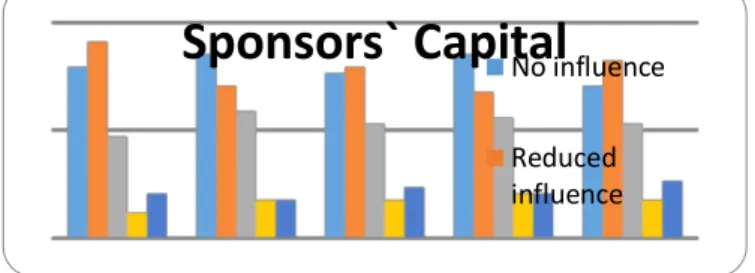
At the level of the entire sample, the influence of the sponsors’ capital on competitiveness reflects an almost similar distribution of the respondents’ opinions for the full analyzed period. The companies estimating that it has a reduced influence (31,29%) and no influence (29,94%) are preponderant. Only for an average of 21,41% of the companies, the influence of the sponsors’ capital is a medium one and even more reduced is the number of those for which the influence is strong (6,83%) or even very strong (8,70%).
Figure 1:The influence of the sponsors’ capital on the company competitiveness Source: data processed by the authors, according to the questionnaire
The analysis refinement at the level of the economy fields in which companies activate emphasizes differentiations between them regarding the influence exercised by the sponsors’ capital on competitiveness. Thus, from the total companies activating in themanufacturing industryalmost half of them (41,82%) confer to this factor a reduced influence while 29,09% estimate a medium influence. However, 18,18% of them consider that the influence is very strong and only 1,82% estimate that this factor exercises a strong influence, while 9,09% estimate that the sponsors’ capital doesn’t exercise any influence on their competitiveness.
Regarding the companies activating inbuildings, almost half of them (43,33%) don’t attach importance to the influence of sponsors’ capital on competitiveness and a quarter of them (25%) attach a reduced importance. While 8,33% of the field sample estimate a very strong influence and 16,66% a strong importance , 6,68% of the companies estimate a medium influence.
The analysis of the answers received from the companies in field of transport and storage allows us to notice that for 23,64% of them the sponsors’ capital has no influence on their competitiveness, for 40% of them it has a reduced influence and for 27,27% it has a medium influence. From the total companies of the sample, which activate inwholesale trade or retail trade, 27,36% estimate that sponsors’ capital doesn’t exercise any influence on their competitiveness, 34,73% estimate that it has a reduced influence and 24,22% a medium influence. Only 6,32% of the companies estimate the sponsors’ capital as being a factor with a strong influence on competitiveness, while 7,37% of them confer a very strong influence to this factor.
Sponsors` Capital
No influenceWe can notice a similar behaviour of the majority of companies developing activities of administrative services and activities of support services, shows, cultural and recreational activities, as well as those in the fields of information and communications, real estate transactions and education, these estimating that sponsors’ capital doesn’t exercise any influence on their competitiveness. As opposed to them, the dominant value of the companies developing professional, scientific or technical activities, as well as the financial brokerage activities, confer a reduced influence to this factor. The majority of the companies activating in the field of health and social welfare, as well as in the field of production and supply of electricity and thermal energy, gas, hot water and conditioned air estimate the sponsors’ capital asbeing a factor with a medium influence on competitiveness while the majority of the companies in the field of hotels and restaurants confer a strong influence to this factor.
At the level of the entire sample, the influence of the organizational capital on competitiveness reflects a similar distribution in the first and the last two analyzed years, in comparison with the second and third year. Only 5,88% of the companies consider that the influence is very strong and 6,82% estimate that influence is strong. We notice the prevalence of the answers attaching a medium importance of 35,29%, followed by those for which, with an average of 30,82%, the influence is reduced and for 20,93% the influence doesn’t exist.
Figure 2: The influence of the organizational capital on the company competitiveness
Source: data processed by the authors, according to the questionnaire
Analyzing this influence at the field level, we notice that in the manufacturing industry,more than a half of the companies (56,36%) confer a reduced influence to this factor and a quarter of them (25,46%) a medium influence.
If the analysis reference is represented by the companies which activate inbuildings, the majority of them (36,66%) doesn’t attach importance to the influence of organizational capital on their competitiveness, and a quarter (25%) attach a medium importance. The companies attaching a reduced influence of the organizational capital on the competitiveness or confer a very strong influence to this factor, have equal values (16,67%).
The analysis of the answers received from the companies in field of transport and storageallows us to notice that for 25,46 % of them the organizational capital has no influence on their competitiveness, for 29,09% of them it has a reduced influence and for 36,36 % it has a medium influence. From the total companies activating in wholesale trade or retail trade, 18,95% estimate that organizational capital doesn’t
exercise any influence on their competitiveness, the companies estimating in equal values (37,89%) either a reduced or a medium influence of this factor.
Regarding the majority of companies developingactivities of administrative services and activities of support services, professional, scientific or technical activities, as well as those in the field ofhotels and restaurants, information and communications, the production and supply of electricity and thermal energy, gas, hot water and conditioned air, health and social welfare, we can notice a similar behaviour, these attaching a medium importance to the influence of the organizational capital on competitiveness.
At the level of the entire sample, the influence of the human capital on competitiveness reflects an almost similar distribution of the respondents’ opinions for the entire analyzed period. The companies estimating that it has a medium influence dominate with an average of 34,35%, followed with an average of 24,46% by those considering that the influence is reduced, while 21,87% consider that there is no influence. Only 11,77% of the respondents consider that the influence of the human capital on competitiveness is strong and even smaller is the number of those for which influence is very strong (7,53%).
Figure 3:The influence of the human capital on the company competitiveness Source: data processed by the authors, according to the questionnaire
At the field level, we observe the existence of certain differences regarding the influence exercised by the human capital on the company competitiveness. Thus, in themanufacturing industry, 41,82% of the companies confer a reduced influence to this factor, 30,90% of them confer a medium influence and 14,55% consider that there is a very strong influence.
The analysis of the companies in the field of buildings allows us to notice that for 30% of them the human capital has no influence on their competitiveness, for 11,66% of them it has a reduced influence and for 23,34% it has a medium influence. Relatively similar values hold companies attaching a strong importance to the influence of human capital on competitiveness (18,33%) or they confer a very strong influence to this factor (16,67%).
Regarding the companies activating in the field oftransport and storage, almost half of them (40 %) attach a medium importance to the influence of human capital on their competitiveness, 21,82% of them attach a reduced importance and 27,77% of them don’t attach any importance. For 10,91% of the companies the influence ofthe human capital is strong and at the field level there’s no company in whose opinion the influence is very strong.
From the total companies of the sample which activate inwholesale trade or retail trade, 17,89% of the companies estimate that the humancapital doesn’t exercise
Human Capital
No influenceany influence on their competitiveness, 33,68% of them confer a reduced influence to this factor and the majority (37,89%) a medium influence. The companies conferring to this factor a strong influence or even a very strong influence on their competitiveness, have equal values (5,27%).
The dominant value of the companies developingshows, cultural and recreational activities, professional, scientific or technical activitiesbut also the companies in the fields of information and communications, the production and supply of electricity and thermal energy, gas, hot water and conditioned air, health and social welfare, attach a medium importance to the influence of the human capital on competitiveness.
At the level of the entire sample, the influence of the innovational capital on competitiveness reflects a different distribution of the respondents’ opinions in the first two years in comparison with the last two years of the analyzed period. With an average of 32,94% the estimation of a reduced influence is predominant and it is followed by an average of 25,41% referring to the lack of a influence on competitiveness. For 24,23% of the companies the influence of innovational capital is a medium one and even more reduced being the number of those for which the influence is strong (12,70%) or even very strong (4,70%).
Figure 4:The influence of the innovational capital on the company competitiveness Source: data processed by the authors, according to the questionnaire
The analysis refinement at the level of the fields emphasizes differentiations between them. In the manufacturing industry almost three quarters of the companies (74,55%) confer to this factor a reduced influence and 10,90% of them estimate that this factor has no relevance for their competitiveness. For 3,65% of the companies the influence of the innovational capital is a medium one and even more reduced is the number of those for which the influence is strong (1,81%). The analysis of the companies in the field of buildingsallows us to notice that for 38,33% of them the innovational capital has no influence on their competitiveness, for 5% of them it has a reduced influence and for 13,33% it has a medium influence. In this field, 26,67% of the companies estimate a strong influence of this factor on their competitiveness and 16,67% of them estimate it has a very strong influence.
From the total companies activating in the field of transport and storage, 29,09% of them estimate that the innovational capital doesn’t exercise any influence on their competitiveness, and the majority (38.18%) consider there is a reduced influence of this factor. In equal values (16,36%) the companies estimate either a medium influence or a strong influence. None of these companies activating in this field estimates that this factor exercises a very strong influence on competitiveness.
Innovational Capital
No influence Reduced influenceRegarding the sample companies which activate in the wholesale trade or retail trade, 25,26% of them estimate that the innovational capital doesn’t exercise any influence on their competitiveness, the majority (34,74%) confer a reduced influence to this factor and 32,63% a medium influence. The companies conferring to this factor a strong influence (2,10%) or even a very strong influence (5,27%) on their competitiveness, have lower values.
Regarding the majority of the companies which developactivities of administrative services and activities of support services, professional, scientific or technical activities, as well as those belonging to the fields of hotels and restaurants, information and communications, production and supply of electricity and thermal energy, gas, hot water and conditioned air, we can notice a similar behaviour, these attaching a medium importance to the influence of innovational capital on competitiveness. The dominant value of the companies developingshows, cultural and recreational activities or activities in the fields of education, real estate transactions, health and social welfare estimates that their competitiveness is not affected by the innovational capital, while most of the companies in the field of the financial brokerage consider that the innovational capital exercises a reduced influence on their competitiveness.
At the level of the entire sample, the influence of the capital represented by the customers portfolioon competitiveness reflects an almost similar distribution of the respondents’ opinions for the full analyzed period. We notice the prevalence of the companies attaching a medium influence of this factor (with an average of 27,05%) followed by those for which the influence of this factor is strong (with an average of 22,82%) and then, by those for which the influence is reduced (with an average of 20,94%). Only for 12,23% of the total sample companies, the capital represented by the customers portfolio doesn’t exercise any influence on their competitiveness, while for an average of 16,70% of them the influence of this factor is very strong.
Figure 5:The influence of the capital represented by the customers portfolio on the company competitiveness
Source: data processed by the authors, according to the questionnaire
The analysis at the field level emphasizes the existing differences concerning the influence exercised by the capital which is represented by the customers portfolio on the company competitiveness. Therefore, in the manufacturing industry there haven’t been identified any companies estimating that this factor has no influence on their competitiveness. Most of the companies in this field (38,18%) confer a reduced influence to this factor and about a quarter of them (25,46%) confer a strong influence. In equal proportions (18,18%) the companies in the manufacturing
The capital represented
by the customers portfolio No influence
industry estimate either a medium influence or a very strong one for the capital represented by the customers portfolio on their competitiveness.
The analysis of the companies in the field of buildings allows us to notice that for 25% of them the capital represented by the customers portfolio has no influence on their competitiveness, the same value having as well those attaching a strong importance to the influence of this factor, The companies of this field which estimate a very strong influence of the capital represented by the customers portfolio on competitiveness represent 23,34%.
From the total companies activating in the field of transport and storage, 18,18% estimate that the capital represented by the customers portfolio doesn’t exercise any influence on their competitiveness, 23,66% consider that it has a reduced influence and the majority (32,71%) estimate that this factor has a medium influence. None of the companies activating in this field estimates that this factor exercises a very strong influence on competitiveness.
Regarding the sample companies which activate in the wholesale trade or retail trade, 6,32% of them estimate that the capital represented by the customers portfolio doesn’t exercise any influence on their competitiveness, 26,32% of them confer a reduced influence to this factor and the majority (33,68%) a medium influence. The companies conferring to this factor a strong or even very strong influence on their competitiveness, have equal values (16,84%).
We can notice a similar behaviour of the majority of companies developingactivities of administrative services and activities of support services, shows, cultural and recreational activities, or professional, scientific or technical activities, these estimating that the capital represented by the customers portfolio exercises a strong influence on their competitiveness. Taking into consideration the relatively reduced number of the sample companies, we estimate that the results cannot be extrapolated / generalized but we consider that they are relevant as a tendency for the microenterprises, small and medium enterprises from certain analyzed economic fields, namely trade, buildings, manufacturing industry, transport and storage, where the samples of received answers are more significant quantitatively. We observe that most companies consider that the influence of the analyzed factors on competitiveness is medium and respectively reduced, while a small number of questioned factors estimate that these exercise a strong and very strong influence. Among the analyzed factors, the organizational, human capital and the customers portfolio are considered by the respondents, in a more significant extent, to influence the market competitiveness of the managed companies. The estimation concerning the lack of the sponsors’ capital influence is surprising because without it neither the company existence and obviously nor the enforcement of certain policies in order to encourage competitiveness are possible. Such an answer determines us to consider that there is a dangerous deficiency of professional competence at the managers’ level.
3.Conclusions
concerned only with the management of the current problems. Since they aren’t the beneficiaries of a managerial education, they don’t possess the necessary competences to focus on the elaboration of certain strategies by which to provide competitiveness and performance on the long-term. The managers’ competence influences on the designing, promotion and application of a strategic vision which is capable to provide the economic competitiveness and the financial performance of the companies. Practically, the human capital is the one which identifies and activates the others determining factors of competitiveness.
In conclusion, we estimate that the maintenance and consolidation of the company position on the market are influenced by the structure optimization of the capitals derived from external shareholders and sponsors, but also by the way in which these are targeted for the fulfillment of research–development activities which generate new technologies and products creating a big added value, the fulfillment of strategic, development and updating investments, but also by the training level of the employed human capital. As a matter of fact, the flexibility of adaptation to the changes appeared in the demand structure depends on the innovational act. On its turn, the market share depends in the first place on the degree in which the offer of goods and services corresponds to the customers’ consume preferences, so on the offer diversification and adaptation capacity, and on the companies’ reaction to the signals transmitted by the market.
References
1. Asian Development Bank (2003) Asian Development Outlook, Competitiveness in Developing Asia: Taking Advantage of Globalization, Technology, and Competition in Part 3, Manila.
2. Burange, L.G. and Yamini, S. (2008) Competitiveness of Firms in Indian Automobile Industry, Working Paper UDE(CAS) 23/(8)/1
3. Gelei, A. (2003) Competitiveness: A Match between Value Drivers and Competencies In The Hungarian Automotive Supply Chain, Budapest University of Economic Sciences and Public Administration, Hungary.
4.Markus, G., (2008) Measuring company level competitiveness in Porter's Diamond model framework, FIKUSZ 2008 Business Sciences - Symposium for Young Researchers: Proceedings, pp.149-158, Budapest Tech, Keleti Faculty of Economics.
5. Schmuck, R. (2008)Measuring Company Competitiveness, in: László Áron Kóczy (ed.), FIKUSZ 2008 Business Sciences - Symposium for Young Researchers: Proceedings, pp. 199-208, Budapest Tech, Keleti Faculty of Economics.