Memory T Cell Responses to
Burkholderia pseudomallei
Patcharaporn Tippayawat1, Wipawee Saenwongsa1, Jirawan Mahawantung1, Duangchan
Suwannasaen1, Ploenchan Chetchotisakd2, Direk Limmathurotsakul3, Sharon J. Peacock3, Philip L. Felgner4, Helen S. Atkins5, Richard W. Titball6, Gregory J. Bancroft7, Ganjana Lertmemongkolchai1*
1The Centre for Research & Development of Medical Diagnostic Laboratories, Faculty of Associated Medical Sciences, Khon Kaen University, Khon Kaen, Thailand, 2Department of Medicine, Faculty of Medicine, Khon Kaen University, Khon Kaen, Thailand,3Mahidol-Oxford Tropical Medicine Research Unit, Faculty of Tropical Medicine, Mahidol University, Bangkok, Thailand,4Department of Medicine/Division of Infectious Diseases, University of California Irvine, Irvine, California, United States of America,5Defence Science and Technology Laboratory, Porton Down, United Kingdom, 6School of Biosciences, University of Exeter, Exeter, United Kingdom, 7Immunology Unit, London School of Hygiene and Tropical Medicine, London, United Kingdom
Abstract
Background:Infection with the Gram-negative bacteriumBurkholderia pseudomalleiis an important cause of community-acquired lethal sepsis in endemic regions in southeast Asia and northern Australia and is increasingly reported in other tropical areas. In animal models, production of interferon-gamma (IFN-c) is critical for resistance, but in humans the
characteristics of IFN-cproduction and the bacterial antigens that are recognized by the cell-mediated immune response
have not been defined.
Methods:Peripheral blood from 133 healthy individuals who lived in the endemic area and had no history of melioidosis, 60 patients who had recovered from melioidosis, and 31 other patient control subjects were stimulated by whole bacteria or purified bacterial proteins in vitro, and IFN-cresponses were analyzed by ELISPOT and flow cytometry.
Findings:B. pseudomalleiwas a potent activator of human peripheral blood NK cells for innate production of IFN-c. In
addition, healthy individuals with serological evidence of exposure toB. pseudomalleiand patients recovered from active melioidosis developed CD4+(and CD8+) T cells that recognized whole bacteria and purified proteins LolC, OppA, and PotF, members of theB. pseudomalleiABC transporter family. This response was primarily mediated by terminally differentiated T cells of the effector–memory (TEMRA) phenotype and correlated with the titer of anti-B. pseudomalleiantibodies in the serum.
Conclusions:Individuals living in a melioidosis-endemic region show clear evidence of T cell priming for the ability to make IFN-cthat correlates with their serological status. The ability to detect T cell responses to definedB. pseudomalleiproteins in
large numbers of individuals now provides the opportunity to screen candidate antigens for inclusion in protein or polysaccharide–conjugate subunit vaccines against this important but neglected disease.
Citation:Tippayawat P, Saenwongsa W, Mahawantung J, Suwannasaen D, Chetchotisakd P, et al. (2009) Phenotypic and Functional Characterization of Human Memory T Cell Responses toBurkholderia pseudomallei. PLoS Negl Trop Dis 3(4): e407. doi:10.1371/journal.pntd.0000407
Editor:Albert I. Ko, Weill Medical College of Cornell University, United States of America
ReceivedDecember 19, 2008;AcceptedMarch 6, 2009;PublishedApril 7, 2009
Copyright:ß2009 Tippayawat et al. This is an open-access article distributed under the terms of the Creative Commons Attribution License, which permits unrestricted use, distribution, and reproduction in any medium, provided the original author and source are credited.
Funding:This work was supported by the Wellcome Trust, UK, grant number AL-069426 and Public Health Service Grants U01 AI061363 and U54 AI065359 (PLF) from the National Institute of Allergy and Infectious Diseases, USA. PT is supported by the Commission on Higher Education, Ministry of Education, Thailand. The funders had no role in study design, data collection and analysis, decision to publish, or preparation of the manuscript.
Competing Interests:The authors have declared that no competing interests exist.
* E-mail: [email protected]
Introduction
Melioidosis is a serious infectious disease in Southeast Asia and Northern Australia caused by the soil-dwelling Gram-negative bacterium,Burkholderia pseudomallei[1]. In Northeast Thailand, the mortality rate for acute melioidosis remains high, approximately 50%, despite recent advances in antibiotic treatments. Serological evidence, based on the indirect hemagglutination assay (IHA), suggests that 80% of people living in endemic areas have been exposed toB. pseudomallei, without showing clinical symptoms [1– 3]. Recurrent melioidosis can also occur either as relapse after antibiotic treatment or re-infection [3,4].B. pseudomalleiis classified as a NIAID category B potential agent for biological terrorism [5]. The mechanism that enables the organism to avoid the
bactericidal effects of the host immune response has never been fully understood, and there are no licensed vaccines.
B. pseudomallei is able to disseminate throughout the body, invades non-phagocytic cells and replicates in phagocytes [6,7]. In mice, B. pseudomallei is a potent inducer of IFN-c and IFN-c
inducing cytokines such as IL-12, IL-18 and TNFin vitroand
IFN-cis essential for resistancein vivovia the activation of macrophages for both oxygen dependent and independent killing mechanisms [8]. In mice, NK cells and bystander CD8+
T cells provide innate production of IFN-c [9], while IFN-csecreting, antigen-specific
presence of CpG oligodeoxynucleotides showed significant levels of protection [12] suggesting the role of specific T cells in host protection.
In contrast, the mechanisms of cell-mediated immunity to B. pseudomalleiin humans are poorly understood. IFN-c, IL-12, IL-18
and TNF are found in plasma samples from acute, septic melioidosis but the IFN-c producing cells have not been well characterized [13]. Previous studies in small numbers of patients in northern Australia and Papua New Guinea who recovered from melioidosis have demonstrated evidence of T cell priming to B. pseudomallei, but the characteristics of the responding cell populations and the antigens recognized have not been defined [14,15].
Here, we analyzed a large cohort of individuals from the melioidosis endemic region of Thailand to identify the cellular sources of IFN-c in response to whole B. pseudomallei and the bacterial ABC transporter proteins LolC, OppA and PotF which are T cell immunogens in mice and candidate vaccine antigens [16,17]. Peripheral blood cells from healthy individuals with serological evidence of exposure toB. pseudomalleiand recovered melioidosis patients (but not seronegative control subjects) showed evidence of CD4 and CD8 T cell priming to both whole bacteria and purifiedB. pseudomallei antigens. Together with a prominent IFN-c response from NK cells, these sources of IFN-c may
contribute to host resistance against melioidosis in the endemic setting.
Materials and Methods
The study and the consent forms were approved by the Khon Kaen University Ethics Committee for Human Research (Project number HE470506). Informed consent was obtained from all the subjects recruited into the study.
Blood samples
Blood samples from 133 healthy donors who had no clinical history of melioidosis were collected at the Blood Bank, Khon
Kaen University, Thailand. Another set of blood samples was obtained from patients and control subjects at Sappasithiprasong Hospital, Thailand for cellular studies by ELISPOT assay. Patients were defined as those who had recovered from melioidosis (previously diagnosed by isolation of B. pseudomallei from blood or tissues) and completed antibiotic treatment (n = 36). Non infected control subjects (n = 21) were those who attended the hospital for non infectious reasons at the diabetic clinic and had no history of clinical melioidosis, and were matched for age, sex, occupation, the presence of diabetes as an underlying condition and lived in the same endemic area. In addition, 24 recovered melioidosis patients and 10 healthy control subjects were enrolled, using the same criteria, at Srinagarind Hospital, Thailand for cellular sources of IFN-c, kinetics and memory cells assayed by flow cytometry. The subjects who had antibodies toB. pseudomallei
at a titer of 1:40 or greater by IHA were considered seropositive [15,18]. None of the subjects had any clinical sign or symptoms of any infection including HIV/AIDS at the time of blood collection.
In vitrocell stimulation
B. pseudomalleistrain K96243 is a clinical isolate from Thailand and is the prototype genome sequence strain [19]. Whole heat-killedB. pseudomallei(hkBp) was prepared by heating the bacteria at 100uC for 20 minutes, washed twice with PBS pH 7.4, aliquoted and stored at 280uC. The number of viable bacteria was determined by forming counts and defined as colony-forming units (CFU) prior to heating. RecombinantB. pseudomallei
ABC transporter proteins (LolC, OppA and PotF) were prepared as previously described [16,17] and used as test stimulators in this study. Phytohemagglutinin (PHA) (Biochrom AG, Germany), human recombinant IL-12, and IL-15 (BD Biosciences, USA) and a MHC class I-restricted T cell epitope control of pooled peptides of cytomegalovirus, Epstein Barr virus and influenza virus (CEF) were used as positive controls (Mabtech, AB, Sweden). Recombinant protein fromFrancisella tularensis, FT1823 [20] was included as a non related protein/negative control.
Enzyme-linked immunospot assay (ELISPOT) for human IFN-c
Peripheral blood mononuclear cells (PBMCs) from each subject were isolated from heparinized blood samples by density centrifugation on Ficoll-Hypaque and adjusted the number of cells as required prior to stimulation. In brief, 96-well PVDF-plates (MSIP, Millipore) were previously coated overnight with 15mg/ml 1D1K anti-human IFN-cat 4uC. Fresh PBMCs were added in
duplicate wells at 56105 PBMCs/well and each stimulator was added at the optimal concentration. After 42 hours, secreted
IFN-cwas detected by adding 1mg/ml biotinylated mAb 7-B6-1-biotin for IFN-c for 3 hours and followed by 1mg/ml streptavidin-alkaline phosphatase (Mabtech, AB, Sweden) prior to enumeration under a stereomicroscope. The responses were compared in the absence or presence of 0.3mg/ml cyclosporin A (CsA, Sigma, USA).
Intracellular cytokine staining assay by flow cytometry Whole blood samples were firstly analyzed for complete blood count using an automatic machine (Sysmex, Germany). The number of absolute lymphocytes was then adjusted to 96105 lymphocytes/ml by diluting with completed RPMI medium (10% FBS supplement). The adjusted cells in 100ml were added into 96 well culture plates and added up by another 100ml of 26 concentration of stimulators and incubated at 37uC with 5% CO2.
Cultured cells were blocked with 10mg/ml brefeldin A (Sigma, Author Summary
The Gram-negative bacterium, Burkholderia pseudomallei, is a public health problem in southeast Asia and northern Australia and a Centers for Disease Control and Prevention listed Category B potential bioterrorism agent. It is the causative agent of melioidosis, and clinical manifestations vary from acute sepsis to chronic localized and latent infection, which can reactivate decades later. B. pseudo-mallei is the major cause of community-acquired pneu-monia and septicemia in northeast Thailand. In spite of the
medical importance of B. pseudomallei, little is known
about the mechanisms of pathogenicity and the immu-nological pathways of host defense. There is no available vaccine, and the mortality rate in acute cases can exceed 40% with 10–15% of survivors relapsing or being reinfected despite prolonged and complete treatments. In this article, we describe cell-mediated immune
respons-es to B. pseudomallei in humans living in northeast
Thailand and demonstrate clear evidence of T cell priming in healthy seropositive individuals and patients who recovered from melioidosis. This is the most detailed study yet performed on the cell types that produce
interferon-gamma to B. pseudomalleiin humans and the
USA) for 3 hours prior to the end of the incubation time. Then washed and blocked with anti-CD16 (BD Biosciences). The following antibodies were used for immune cell surface staining: FITC anti-CD4, PE anti-CD8 or PE anti-CD56 (BD Biosciences) and Tricolor anti-CD3 (Invitrogen, USA). In addition, cell surface markers for memory T cell phenotypes were included: FITC anti-CCR7 (R&D systems, USA), PE anti-CD45RA (Invitrogen) and Tricolor anti-CD4 or CD8 (Invitrogen). Isotype-matched control antibodies were used in each analysis. After 30 min of staining, followed by fixation with 10% paraformaldehyde-PBS overnight at room temperature, cells were then permeabilized by 0.12% saponin (Sigma, USA) for 15 min followed by APC anti-IFN-c
(Invitrogen, USA) for 30 min prior to analysis by FACScalibur with CELLQuest software (BD Biosciences, USA).
Statistical analysis
Statistical analysis (one way-ANOVA, unpaired and paired t-test) was performed using Graphpad Prism version 5 software (GraphPad, San Diego, CA, USA). A P-value,0.05 was considered statistically significant.
Results
Cellular immune responses toB. pseudomalleiof healthy individuals living in an endemic area of melioidosis
To examine the cellular immune response toB. pseudomalleiof healthy individuals living in Northeast Thailand, PBMCs of 133 donors from the Blood Bank at Khon Kaen University, Thailand were cultured with whole bacteria, recombinant B. pseudomallei
ABC transporter proteins (LolC, OppA and PotF) or control stimulators and 42 hours later assayed for IFN-cproduction by
ELISPOT. We have previously shown in mice that several different cell types contribute to IFN-cresponses toB. pseudomallei
in vitro; NK cells and bystander T cells produce IFN-cindirectly via a cytokine mediated pathway which is not blocked by cyclosporin A (CsA), whereas specific B. pseudomallei primed T cells respond via a CsA sensitive T cell receptor (TCR) dependent
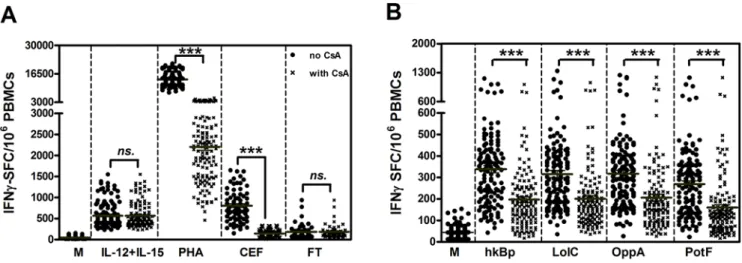
process [9,11]. To validate this approach in human peripheral blood, we initially compared the CsA sensitivity of cytokine (IL-12+IL-15), mitogen (PHA) or antigen specific IFN-cresponses in vitro in the presence or absence of CsA. Compared to medium alone controls, cells incubated with PHA or a pooled cocktail of established T cell reactive peptides from pathogens known to be present in the Thai population (CMV, EBV and influenza) showed strong IFN-cresponses which were inhibited in the presence of
CsA (Figure 1A;P,0.0001, paired t-test). In contrast, the IFN-c
response to IL-12/IL-15 or the low but detectable background response observed in cells incubated with an irrelevantFrancisella tularensiscontrol protein were not CsA susceptible. Moreover, the results revealed that wholeB. pseudomallei (hkBp) and three Bp-derived ABC transporter proteins (LolC, OppA and PotF) could induce IFN-c responses via TCR independent (innate) and dependent (specific) pathways in healthy individuals in vitro (Figure 1B).These IFN-c responses were in a dose dependent
manner ranging between 16104–16107CFU/ml hkBp and 0.1– 3.0mg/ml of the 3 proteins (data not shown).
Specific T cell responses toB. pseudomalleicorrelate with serological evidence of exposure to the bacterium
IHA has been widely used as routine serologic test for melioidosis with the threshold titer of 1:40 in the endemic area indicating previous exposure to B. pseudomallei [15,18]. To investigate whether the magnitude of the cellular immune response correlated with evidence of exposure to B. pseudomallei
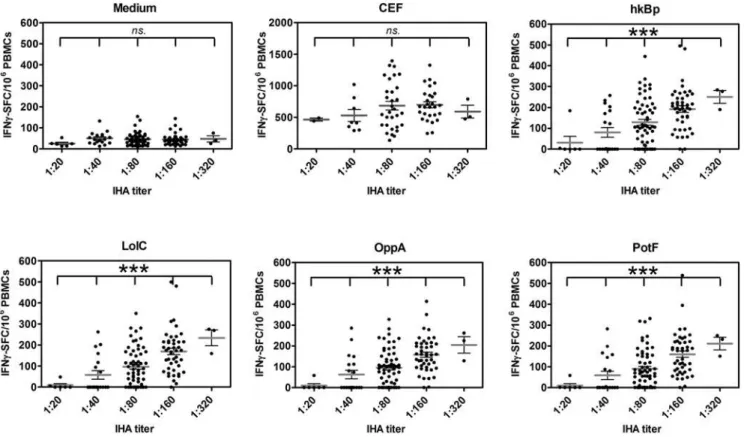
by serology, 133 healthy donors were classified into five groups based on theirB. pseudomallei antibody IHA titers (as 1:20, 1:40, 1:180, 1:160 and 1:320 (n = 6, 19, 60, 45 and 3, respectively; Figure 2). The results revealed that the continual increase of the average values of specific (CsA sensitive) IFN-cspots in response to B. pseudomallei and its proteins was significantly correlated with increasing antibody titers (P,0.0001, one way ANOVA). No such correlation was observed in the response to CEF vs. medium controls or for the innate (CsA resistant) IFN-c spots to B. pseudomallei (P.0.05, one way ANOVA). Thus environmental
Figure 1. IFN-cresponses toB. pseudomalleiof 133 healthy individuals living in Northeast Thailand.PBMCs of healthy blood donors
were stimulated with whole bacteria, recombinant Bp proteins and control stimulators for 42 hours in vitro and IFN-c secreting cells were
enumerated by ELISPOT. IFN-cspot forming cells (SFC) per 16106PBMCs in response to (A) control stimulators including medium alone (M),
cytokines (1mg/ml IL-12 plus IL-15), 1.25mg/ml PHA, 2mg/ml pooled viral peptides (CEF) and 1mg/ml non related protein ofF. tularensis(FT) and (B) IFN-cresponses to 36106CFU/ml heat killedB. pseudomallei(hkBp), 1mg/ml ABC transporter proteins ofB. pseudomallei(LolC, OppA and PotF). IFN-c
spots were enumerated in the absence (closed circles) and presence (crossed) of 0.3mg/ml cyclosporin A (CsA). Horizontal lines represent the mean value of each group, ***P,0.0001, ns-non statistical significance (paired t-test).
exposure toB. pseudomalleiin the endemic region of NE Thailand generates both T cell and B cell responses to B. pseudomallei in healthy individuals even in the absence of disease.
Cellular immune responses toB. pseudomalleiin patients recovered from melioidosis
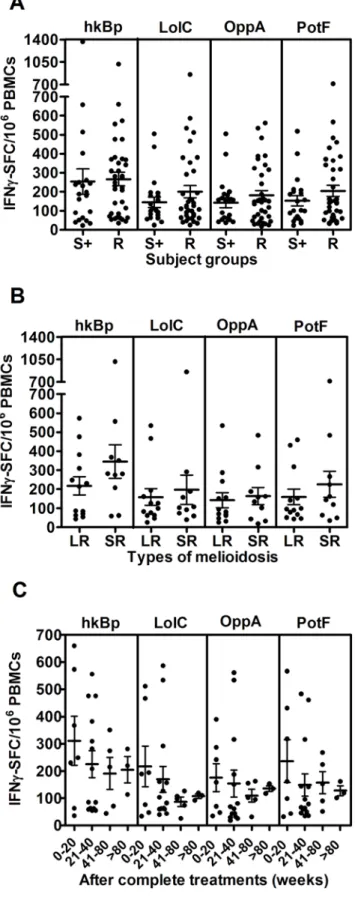
To assess the extent of T cell priming in patients who had survived active infection, specific T cell responses to whole bacteria and recombinant proteins ofB. pseudomalleiwere studied in 36 recovered melioidosis cases and 21 other patient control subjects from the same endemic region chosen on the basis of same age, sex and occupation with no history of clinical melioidosis but who were seropositive forB. pseudomalleiexposure. The frequency of IFN-cproducing cells was significantly increased in recovered patients compared to seronegative control subjects (data not shown) but was similar to that observed in seropositive healthy individuals (Figure 3A) (P.0.05, unpaired t-test). However, there were some individuals who had no specific IFN-cproducing cells toB. pseudomalleiabove the background of medium control in both groups. Of note, IFN-c levels as quantified by ELISA were significantly higher in recovered melioidosis patients than seropositive individuals (Figure S1). According to Figure 3B, the comparison of IFN-cresponses between patients who recovered from melioidosis with a history of localized infection (n = 13) and severe sepsis (n = 11) did not show any significant difference. These specific T cell responses declined over the time but remained detectable after 80 weeks (Figure 3C). These results indicated that
either wholeB. pseudomalleior its proteins could trigger the cellular immune response following re-exposure to the microorganism in vitro up to 80 weeks post admission.
Diabetes mellitus (DM) is a major risk factor for human melioidosis [21], and only 4 cases of recovered melioidosis without DM were found in this study. Even though we observed no difference between IFN-c responses of these groups, it remains
inconclusive for the effect of diabetic condition on host T cell responses (data not shown). In addition, recovered melioidosis patients with a history of recurrent infection (n = 6) compared to those with a single disease episode (n = 30) also showed no statistically significant difference (data not shown); suggesting that under these conditions IFN-c responses do not differentiate
between primary and recurrent melioidosis.
Cellular sources and kinetics of IFN-cin response to B. pseudomallei
To identify the cellular sources of IFN-c responses to B. pseudomallei, whole blood samples from six seropositive healthy individuals and ten recovered melioidosis cases (all with IHA antibodies 1:40 or greater) were restimulated withB. pseudomalleiin the absence of CsA and analyzed by four-color flow cytometry. As shown from one representative of seropositive group, the small lymphocyte area was gated (Figure 4A) and analysis of IFN-c+cells
showed that NK cells (CD32CD56+ ), CD4+
T (CD3+ CD4+
) and CD8+
T (CD3+ CD8+
) cells all contributed to IFN-cproduction to
hkBp (Figure 4B). A dominant contribution of CD4+
and CD8+ T
Figure 2. Distribution of specific T cell responses to wholeB. pseudomalleiand three ABC transporter proteins.PBMCs from 133 healthy blood donors as described in Figure 1 were classified according to plasma IHA antibody titers; 1:20, 1:40, 1:80, 1:160 and 1:320 (n = 6, 19, 60, 45 and 3, respectively) and analyzed for specific (CsA sensitive) IFN-csecreting spots assayed by ELISPOT in response to medium alone, 2mg/ml pool viral
peptides (CEF), wholeB. pseudomallei(hk Bp) and Bp derived ABC transporter proteins (LolC, OppA and PotF). ***P,0.0001, ns-non statistical significance (one way ANOVA).
cells on IFN-cproduction was confirmed by significant reduction of specific IFN-c(CsA sensitive) spots following depletion of CD3, CD4 and/or CD8 cells (Figure S2). In addition, the mean fluorescent intensities (MFI) of intracellular IFN-gamma staining of CD3+
and CD32 (NK) cells of 4 recovered melioidosis cases were analyzed and revealed that the average MFI of IFN-gamma gated on CD3+
cells was significantly higher than CD32(NK) cells (P,0.05, paired t-test) (Figure S3). Together with our finding that the ELISPOT size of remaining IFN-c+cells after T cell depletion was very small suggests that innate (CsA resistant) cells produce less of this cytokine compared to specific T cells.
The analysis of blood samples from 6 seropositive individuals and 10 recovered melioidosis cases showed background staining of total IFN-cproducing cells in medium alone at 0.0360.01 and 0.360.09% (mean6SE), respectively. The relative contribution of each cell type to the IFN-cresponse toB. pseudomalleialso varied according to the time point examined in culture after addition of the bacteria. NK cells appeared to respond more rapidly than T cells and significantly contributed to the production of rapid IFN-c
at 4 hours and decreased over time in both groups (Figure 5). On the one hand, the frequency of IFN-cproducing NK cells were significantly higher in seropositive healthy individuals than recovered melioidosis at 4 and 12 hours (P,0.05, unpaired t-test). On the other hand, there was a statistically significant difference of IFN-c producing CD4+ T cells being higher in
recovered melioidosis than the seropositive individuals at both time points and all three time points for IFN-cproducing CD8+T
cells. These results demonstrated the increasing contribution to IFN-cproduction over the time from T cell subsets, particularly in
the recovered melioidosis group.
Rapid responses of memory phenotype T cells to whole B. pseudomallei
To investigate whether the rapid IFN-cproducing T cells in
response to B. pseudomallei were memory T-cell phenotypes, immune subsets of human memory T cells were identified based on the cell surface expression of CD45RA and CCR7 [22] in 16 recovered melioidosis cases and 7 seropositive control subjects. The results demonstrated the percentages of IFN-c producing
memory T cells and the majority of memory CD4+
and CD8+ T cells of both groups were revealed as terminally differentiated T effector memory (TEMRA) cells which was significantly higher than
the other memory phenotypes of effector memory (TEM) and
central memory (TCM) cells of CD4+and CD8+T cells (P,0.0001,
unpaired t-test) (Figure 6A).
When the clinical histories of these 16 recovered melioidosis subjects were analyzed, distinctive patterns of memory T cell phenotypes were revealed. The memory T cells of the septicemic melioidosis group (n = 12) were TEMRAsignificantly greater than
TEM and TCM of both CD4+ and CD8+ subsets (P,0.0001,
unpaired t-test). Interestingly, there was a trend of localized melioidosis group (n = 4) showed stronger responses of TEMRA
with small contribution of TCMcells and TEMcells, but it was not
statistically significant (Figure 6B).
Figure 3. Specific T cell responses to B. pseudomallei of recovered melioidosis cases vs. seropositive control subjects.
(A) Specific (CsA sensitive) IFN-csecreting spots in response to medium
alone, wholeB. pseudomalleiand Bp-derived ABC transporter proteins, LolC, OppA and PotF were analyzed from 36 recovered melioidosis cases (R) and 21 seropositive control subjects (S+). (B) Of these 36 recovered melioidosis cases, only 24 cases were analyzed according to
the previous history of localized melioidosis (LR, n = 13) and septicemic melioidosis (SR, n = 11) and (C) the time of sample collection (weeks) after completion of antibiotic treatments of recovered melioidosis cases. Horizontal lines represent mean6SE value of each group. Medium alone of recovered melioidosis and seropositive control groups was less than 5 IFN-cSFC/106PBMCs.
Discussion
Burkholderia pseudomallei is an important cause of community acquired sepsis and death in endemic regions of SE Asia and Northern Australia and is listed as potential bioterrorism threat. Yet despite its current and potential impact on public health our understanding of immune defenses against this pathogen are incomplete. B. pseudomallei is capable of extensive extracellular growth and abscess formation, but is also genetically adapted to survive and replicate within host cells [6,23]. It is killed by IFN-c
activated macrophages in vitro [24], making cell mediated immunity a potentially important component of resistance. Here, a total of 224 individuals living in the endemic area of NE Thailand of varying immunological and clinical history for exposure toB. pseudomalleiwere examined for the magnitude and characteristics of their IFN-cresponses following restimulation of
whole blood with whole bacteria orB. pseudomalleiderived antigens in vitro.
Northeast Thailand is the primary endemic focus of melioidosis in SE Asia and the majority of individuals show evidence of
Figure 4. Identification of IFN-csecreting T cells responding to wholeB. pseudomalleiby four-color flow cytometry.Whole blood
samples from eight recovered melioidosis cases and six seropositive control subjects were incubated with wholeB. pseudomalleifor 12 hours and stained for intracellular IFN-cvs. three immune cell surface markers (Tri-color anti-CD3, FITC-anti-CD4 and PE-anti-CD8 or PE-anti-CD56). The profile
from one representative donor of seropositive control subjects, (A) gated on lymphocyte cells, and (B) gated on IFN-c+cells.
seroconversion from an early age [2]. To obtain an initial estimate of the diversity of the IFN-cresponse in this setting, blood samples
from 133 randomly selected individuals who had no clinical history of melioidosis were tested for reactivity toB. pseudomalleiby IFN-cELISPOT. The majority showed clear induction of IFN-c
positive cells above that of medium alone controls in the presence of whole bacteria. Addition of cyclosporin A (CsA) which specifically inhibits T cell receptor-mediated but not cytokine mediated lymphocyte activation [9,11,25] showed this response was made up of both innate and adaptive IFN-c responses. To
further define the adaptive IFN-ccomponent, we compared the
frequency of CsA sensitive IFN-c producing cells against the
antibody titer of each individual. Serological evidence of exposure to B. pseudomallei is clinically determined by an indirect hemagglutination (IHA) assay which mostly detects antibodies to conserved lipopolysaccharides and/or capsular polysaccharides and is useful in diagnosis of melioidosis particularly in non or low endemic areas [1]. Although the threshold IHA titer for serodiagnosis varies in different countries, in the Northeast Thai population; an IHA titer 1:40 is considered to be indicative of previous exposure toB. pseudomalleiin healthy individuals [15,18]. The frequency of specific, B. pseudomallei induced IFN-c cells
closely correlated with the serological status of the donor, whereas no such correlation was observed with control antigens derived
from viruses known to be prevalent in the Thai population. Thus environmental exposure to B. pseudomallei induces concordant adaptive T and B cell responses as also seen in other examples of infection or vaccination [26,27].
In mice, IFN-cis critical for survival of the infected host and
NK cells, as well as both CD4+and CD8+T cells contribute to its production [9,10]. Using intracellular cytokine staining and specific cell depletion we found a similar situation in humans in which all three cell types produced IFN-c in vitro, with their relative contribution differing according to the serological status of the host. An initial finding was that human NK cells were prominent producers of IFN-cin vitro, providing some 80% of the
IFN-cpositive cells in the first few hours of the culture period. This
response was observed in both seronegative and seropositive individuals, was not inhibited by CsA and most likely represents an innate response to the bacterium presumably driven via the generation of IFN-cinducing cytokines such as IL-12, IL-15 and
IL-18 in culture [9,28]. This observation may also explain the previous findings by Lauw et al of a rapid IFN-c dependent
induction of the chemokines Mig and IP-10 in whole blood cultures of healthy individuals in the presence of dead B. pseudomallei[29].
In seropositive individuals, this innate response was supple-mented by the presence of IFN-cpositive CD4+
T cells and CD8+ Figure 5. Kinetics of IFN-cproducing cells from ten recovered melioidosis cases and six seropositive control subjects in response to B. pseudomalleiin vitro.Whole blood samples were incubated with wholeB. pseudomalleifor 4, 12 and 24 hours and stained for intracellular IFN-c
vs. three immune cell surface markers (Tri-color anti-CD3, FITC-anti-CD4 and PE-anti-CD8 or PE-anti-CD56). (A) Distribution of individual responses, horizontal lines indicate mean6SE values of the group and (B) the relative contribution of CD4, CD8 and NK cells to produce IFN-cof ten recovered
T cells in both recovered melioidosis patients and asymptomatic healthy control subjects. A predominance of CD4+
T cells was observed from the peripheral blood of recovered melioidosis subjects. Haque A,et al.also reported that antigen-specific CD4+ T cells were important for the resistance against B. pseudomallei
during the later phase of primary infection [10]. Clear evidence of priming of CD8+
T cells was also observed, presumably reflecting the cytoplasmic habitat of the bacterium within host cells [14]. These antigen specific T cells provided the majority of the total IFN-c generated in culture as evidenced by their higher mean fluorescent intensities (MFI) of IFN-cstaining (Figure S3), larger ELISPOT sizes (data not shown) and by the significant effect of T cell depletion on the IFN-cELISPOT response. Of note, we have
compared T cell responses by the production of IFN-c vs.
granzyme B by ELISPOT and the results showed high correlation of these 2 indicators in response to B. pseudomalleisuggesting the importance of cytotoxic T cell response in melioidosis (Figure S4). However, the role of these cells to combat this intracellular pathogen requires further studies.
We then used differential expression of CD45RA and CCR7 to characterize the IFN-cproducing T cells as either central memory
(CM), effector memory (EM) or a more recently described effector memory RA (EMRA) populations [30–32]. By these criteria, .80% of IFN-c+CD4+T cells and.90% of IFN-c+CD8+T cells
reacting toB. pseudomalleiwere TEMRAcells, with the remaining
minority being TCM and TEM cells. Thus, B. pseudomallei
predominately induces ‘effector memory RA’ T cells in the peripheral blood that respond rapidly to repeated exposure to the microorganism as also reported with other pathogens such as human cytomegalovirus and human immunodeficiency virus [31,33]. There was a trend towards a greater contribution of TEM and TCM cells in patients with a history of septicemia
compared to localized melioidosis but this did not attain statistical significance and further studies using larger cohort sizes are needed to confirm this.
Several earlier reports established that exposure toB. pseudomallei
primed human T cells for proliferation and secretion of the macrophage activating cytokine IFN-cin vitro. However, these studies were restricted to small numbers of individuals in Northern Australia and Papua New Guinea and did not define the frequencies, memory phenotypes of the responding cell popula-tions or the antigen specificity of these responses. The results presented here confirm and extend these findings to a larger sample size in the endemic region of Thailand. A consistent finding in all studies are that T cell responses were greater in seropositive versus seronegative individuals. With the larger group sizes provided in the Thai population we can go further and show that this also correlates with antibody titer, and not simply between antibody positive versus negative status. What is less clear is the relative strength of the cell mediated responses between seropositive healthy donors and recovered patients. Barneset al
found that lymphocyte proliferation and IFN-c production was
greater in seropositive healthy donors (n = 8) than those recovered from infection (n = 5), arguing as in the case of tuberculosis, of impaired immunity in those who experienced clinical disease [13]. However, our results in the Thai population showed no difference in the frequencies of IFN-c producing cells in the recovered
melioidosis group versus seropositive healthy donors, although both were clearly greater than seronegative control subjects. In contrast, the amount of IFN-csecreted (as determined by ELISA) and the frequency of high IFN-cresponders was greater in the recovered group suggesting an increased immune priming following a significant bacterial burden compared to healthy exposed control subjects. Of note, even with the larger sample sizes used here, IFN-cresponses were similar between individuals with and without diabetes, in patients with septicemic versus localized disease or in cases of recurrent versus single episodes of disease [4].
Given the high mortality of acute melioidosis and the problems of treatment, the development of an effective vaccine is an
Figure 6. Memory phenotypes of IFN-cproducing cells from recovered melioidosis cases vs. seropositive healthy control subjects
in response toB. pseudomalleiin vitro.Whole blood samples were incubated with wholeB. pseudomalleifor 12 hours and stained for intracellular IFN-cvs. three immune cell surface markers (Tri-color anti-CD4 or CD8, FITC-anti-CCR7 and PE-anti-CD45RA), gated on IFN-c+cells. The distribution of
memory phenotype subsets i.e., central memory (TCM, CD45RA2CCR7+), effector memory (TEM, CD45RA-CCR72) and terminally differentiated T
effector memory (TEMRA, CD45RA+CCR72) of (A) 16 recovered melioidosis (R) vs. 7 seropositive individuals (S+), (B) recovered melioidosis with the
important but difficult task. This is needed to protect individuals living in endemic areas as well as in situations of accidental or purposeful exposure following a bioterrorism scenario. Experi-mental strategies using wild type bacteria of reduced virulence [34], live attenuated mutants ofB. pseudomallei[23,35] and killed whole cells [12] have all been attempted with varying success. However, one important approach requires identification of individual B. pseudomallei specific proteins, which are both immunogenic and protective, for inclusion in protein and/or polysaccharide sub-unit based vaccines [36–38]. To date, the number ofB. pseudomalleiproteins which have been defined as T cell immunogens in mice or humans is very limited [38–40]. In other pathogenic bacteria, ABC transporter proteins have roles in bacterial survival, virulence and pathogenicity, are immunogenic in humans and an increasing number are being considered as candidate vaccine antigens [41–43]. We have previously shown that three members of the bacterial ABC transporter family, LolC, PotF and OppA are immunogenic in mice and particularly in the case of LolC provide at least partial protection against lethal challenge withB. pseudomalleifollowing immunization in adjuvant [17]. We now show that all three proteins are recognized by T cells from seropositive individuals and could be considered for future vaccine development. No T cell response was observed inB. pseudomallei seronegative individuals, arguing that these antigens are relatively specific for B. pseudomallei and priming is not the result of cross reactivity against other common bacterial infections in the community.
In conclusion, we provide here the most extensive study to date of the human cell mediated immune response toB. pseudomalleiand the first to define this aspect of immunity in Thailand, the major endemic focus of melioidosis in the world. Our data demonstrate that B. pseudomallei specific CD4+ T cells secreting
IFN-c are
generated following exposure to the bacterium in the environment and the magnitude of this cellular response correlates with the serological status of the individual. Our findings that NK cells and CD8+
T cells also provide a potential source of IFN-c, may help to
explain the apparent lack of impact of HIV/AIDS on the incidence of melioidosis in Thailand. Our ability to detect specific T cell responses to defined B. pseudomallei proteins in large numbers of individuals now provides the opportunity to screen candidate antigens for inclusion in protein or protein-polysaccharide conju-gate subunit vaccines against this important and emerging infection.
Supporting Information
Alternative Language Abstract S1 Translation of the Abstract into Thai by Jirawan Mahawantung and Ganjana Lertmemong-kolchai
Found at: doi:10.1371/journal.pntd.0000407.s001 (0.09 MB PDF)
Figure S1 Quantification of IFN-cproduction from recovered melioidosis cases vs. seropositive healthy control subjects in
response toB. pseudomalleiin vitro. Whole blood samples from 14 seronegative (S2), 29 seropositive (S+) healthy and 29 recovered melioidosis (R) individuals were incubated with medium alone, 16106CFU/ml wholeB. pseudomallei, 10 ng/ml IL-12+IL-15 and 1.25mg/ml PHA for 42 hours and collected cultured supernatants for quantitative IFN-c analysis by ELISA. Horizontal lines
indicate mean6SE values of the group, * P,0.05, ns-non significant (unpaired t-test).
Found at: doi:10.1371/journal.pntd.0000407.s002 (0.10 MB PDF)
Figure S2 Immune cell depletion and specific IFN-c secreting spots in response to hkBp and its ABC transporter proteins. CD3, CD4 and/or CD8 cells were depleted from PBMCs of a seropositive healthy donor by immunomagnetic beads prior to stimulation (ELISPOT details as in Figure 1). Percentage (%) of specific (CsA sensitive) IFN-c response after depletion was
compared to the response of total PBMCs. Data show mean6S.E. Found at: doi:10.1371/journal.pntd.0000407.s003 (0.09 MB PDF)
Figure S3 Mean fluorescent intensities of IFN-c produced by
CD3+
vs. NK cells in response to B. pseudomallei. Whole blood samples of 4 recovered melioidosis were incubated with hkBp for 12 hours and stained for intracellular IFN-c vs. immune cell
surface markers, details as in Figure 4. (A) The mean fluorescent intensity of IFN-cstaining cells analyzed by histograms of medium (grey) overlayered with hkBp (black line) stimulated CD3+
vs. NK cells, (B) distribution and mean6S.E of MFI of 4 recovered melioidosis (panel B). *P,0.05 (paired t-test).
Found at: doi:10.1371/journal.pntd.0000407.s004 (0.08 MB PDF)
Figure S4 Correlation of IFN-cvs. granzyme B production by specific T cells in responses to wholeB. pseudomalleiand three ABC transporter proteins. PBMCs from 54 healthy blood donors were determined for IFN-cvs. granzyme B by ELISPOT as described
in Figure 1 (r2= correlation coefficient).
Found at: doi:10.1371/journal.pntd.0000407.s005 (0.10 MB PDF)
Acknowledgments
We thank Dr Catherine Hawrylowicz, King’s College London, for her critical comments and reviewing the manuscript and Dr David Harland for his technical contribution to this work. We are grateful to Professor Wipada Chaowagul, Sappasithiprasong Hospital, for valuable suggestions and Office of Disease Prevention and Control Region 7, Ubonratchathani, Department of Disease Control, Ministry of Public Health, Thailand for facilitating part of the study.
Author Contributions
Conceived and designed the experiments: PLF RWT GJB GL. Performed the experiments: PT WS JM DS. Analyzed the data: PT WS JM DS GJB GL. Contributed reagents/materials/analysis tools: PC DL SJP PLF HSA RWT GL. Wrote the paper: PT GJB GL.
References
1. White NJ (2003) Melioidosis. Lancet 361: 1715–1722.
2. Charoenwong P, Lumbiganon P, Puapermpoonsiri S (1992) The prevalence of the indirect hemagglutination test for melioidosis in children in an endemic area. Southeast Asian J Trop Med Public Health 23: 698–701.
3. Peacock SJ (2006) Melioidosis. Curr Opin Infect Dis 19: 421–428.
4. Limmathurotsakul D, Chaowagul W, Chierakul W, Stepniewska K, Maharjan B, et al. (2006) Risk factors for recurrent melioidosis in northeast Thailand. Clin Infect Dis 43: 979–986.
5. Rotz LD, Khan AS, Lillibridge SR, Ostroff SM, Hughes JM (2002) Public health assessment of potential biological terrorism agents. Emerg Infect Dis 8: 225–230. 6. Jones AL, Beveridge TJ, Woods DE (1996) Intracellular survival ofBurkholderia
pseudomallei. Infect Immun 64: 782–790.
7. Stevens MP, Wood MW, Taylor LA, Monaghan P, Hawes P, et al. (2002) An Inv/Mxi-Spa-like type III protein secretion system inBurkholderia pseudomallei
modulates intracellular behaviour of the pathogen. Mol Microbiol 46: 649–659. 8. Santanirand P, Harley VS, Dance DA, Drasar BS, Bancroft GJ (1999) Obligatory role of gamma interferon for host survival in a murine model of infection withBurkholderia pseudomallei. Infect Immun 67: 3593–3600. 9. Lertmemongkolchai G, Cai G, Hunter CA, Bancroft GJ (2001) Bystander
activation of CD8+T cells contributes to the rapid production of IFN-gamma in response to bacterial pathogens. J Immunol 166: 1097–1105.
10. Haque A, Easton A, Smith D, O’Garra A, Van Rooijen N, et al. (2006) Role of T cells in innate and adaptive immunity against murineBurkholderia pseudomallei
11. Haque A, Chu K, Easton A, Stevens MP, Galyov EE, et al. (2006) A live experimental vaccine against Burkholderia pseudomallei elicits CD4+ T cell-mediated immunity, priming T cells specific for 2 type III secretion system proteins. J Infect Dis 194: 1241–1248.
12. Elvin SJ, Healey GD, Westwood A, Knight SC, Eyles JE, et al. (2006) Protection against heterologousBurkholderia pseudomalleistrains by dendritic cell immuniza-tion. Infect Immun 74: 1706–1711.
13. Lauw FN, Simpson AJ, Prins JM, Smith MD, Kurimoto M, et al. (1999) Elevated plasma concentrations of interferon (IFN)-gamma and the IFN-gamma-inducing cytokines interleukin (IL)-18, IL-12, and IL-15 in severe melioidosis. J Infect Dis 180: 1878–1885.
14. Ketheesan N, Barnes JL, Ulett GC, VanGessel HJ, Norton RE, et al. (2002) Demonstration of a cell-mediated immune response in melioidosis. J Infect Dis 186: 286–289.
15. Barnes JL, Warner J, Melrose W, Durrheim D, Speare R, et al. (2004) Adaptive immunity in melioidosis: a possible role for T cells in determining outcome of infection withBurkholderia pseudomallei. Clin Immunol 113: 22–28.
16. Harland DN, Dassa E, Titball RW, Brown KA, Atkins HS (2007) ATP-binding cassette systems inBurkholderia pseudomalleiandBurkholderia mallei. BMC Genomics 8: 83.
17. Harland DN, Chu K, Haque A, Nelson M, Walker NJ, et al. (2007) Identification of a LolC homologue inBurkholderia pseudomallei, a novel protective antigen for melioidosis. Infect Immun 75: 4173–4180.
18. Cheng AC, O’Brien M, Freeman K, Lum G, Currie BJ (2006) Indirect hemagglutination assay in patients with melioidosis in northern Australia. Am J Trop Med Hyg 74: 330–334.
19. Holden MT, Titball RW, Peacock SJ, Cerdeno-Tarraga AM, Atkins T, et al. (2004) Genomic plasticity of the causative agent of melioidosis, Burkholderia pseudomallei. Proc Natl Acad Sci U S A 101: 14240–14245.
20. Eyles JE, Unal B, Hartley MG, Newstead SL, Flick-Smith H, et al. (2007) Immunodominant Francisella tularensis antigens identified using proteome microarray. Proteomics 7: 2172–2183.
21. Suputtamongkol Y, Chaowagul W, Chetchotisakd P, Lertpatanasuwun N, Intaranongpai S, et al. (1999) Risk factors for melioidosis and bacteremic melioidosis. Clin Infect Dis 29: 408–413.
22. Berard M, Tough DF (2002) Qualitative differences between naive and memory T cells. Immunology 106: 127–138.
23. Pilatz S, Breitbach K, Hein N, Fehlhaber B, Schulze J, et al. (2006) Identification ofBurkholderia pseudomalleigenes required for the intracellular life cycle and in vivo virulence. Infect Immun 74: 3576–3586.
24. Miyagi K, Kawakami K, Saito A (1997) Role of reactive nitrogen and oxygen intermediates in gamma interferon-stimulated murine macrophage bactericidal activity againstBurkholderia pseudomallei. Infect Immun 65: 4108–4113. 25. Yang J, Murphy TL, Ouyang W, Murphy KM (1999) Induction of
interferon-gamma production in Th1 CD4+T cells: evidence for two distinct pathways for promoter activation. Eur J Immunol 29: 548–555.
26. Jing L, Davies DH, Chong TM, Chun S, McClurkan CL, et al. (2008) An extremely diverse CD4 response to vaccinia virus in humans is revealed by proteome-wide T-cell profiling. J Virol 82: 7120–7134.
27. Benhnia MR, McCausland MM, Su HP, Singh K, Hoffmann J, et al. (2008) Redundancy and plasticity of neutralizing antibody responses are cornerstone attributes of the human immune response to the smallpox vaccine. J Virol 82: 3751–3768.
28. Wiersinga WJ, Dessing MC, van der Poll T (2008) Gene-expression profiles in murine melioidosis. Microbes Infect 10: 868–877.
29. Lauw FN, Simpson AJ, Prins JM, van Deventer SJ, Chaowagul W, et al. (2000) The CXC chemokines gamma interferon (IFN-gamma)-inducible protein 10 and monokine induced by IFN-gamma are released during severe melioidosis. Infect Immun 68: 3888–3893.
30. Geginat J, Lanzavecchia A, Sallusto F (2003) Proliferation and differentiation potential of human CD8+memory T-cell subsets in response to antigen or homeostatic cytokines. Blood 101: 4260–4266.
31. Weekes MP, Wills MR, Sissons JG, Carmichael AJ (2004) Long-term stable expanded human CD4+T cell clones specific for human cytomegalovirus are distributed in both CD45RAhigh and CD45ROhigh populations. J Immunol 173: 5843–5851.
32. Caccamo N, Meraviglia S, La Mendola C, Guggino G, Dieli F, et al. (2006) Phenotypical and functional analysis of memory and effector human CD8 T cells specific for mycobacterial antigens. J Immunol 177: 1780–1785. 33. Oswald-Richter K, Grill SM, Leelawong M, Tseng M, Kalams SA, et al. (2007)
Identification of a CCR5-expressing T cell subset that is resistant to R5-tropic HIV infection. PLoS Pathog 3: e58. doi:10.1371/journal.ppat.0030058. 34. Dannenberg AM Jr, Scott EM (1958) Melioidosis: pathogenesis and immunity in
mice and hamsters. II. Studies with avirulent strains ofMalleomyces pseudomallei. Am J Pathol 34: 1099–1121.
35. Atkins T, Prior RG, Mack K, Russell P, Nelson M, et al. (2002) A mutant of
Burkholderia pseudomallei, auxotrophic in the branched chain amino acid biosynthetic pathway, is attenuated and protective in a murine model of melioidosis. Infect Immun 70: 5290–5294.
36. Brett PJ, Woods DE (1996) Structural and immunological characterization of
Burkholderia pseudomallei O-polysaccharide-flagellin protein conjugates. Infect Immun 64: 2824–2828.
37. Nelson M, Prior JL, Lever MS, Jones HE, Atkins TP, et al. (2004) Evaluation of lipopolysaccharide and capsular polysaccharide as subunit vaccines against experimental melioidosis. J Med Microbiol 53: 1177–1182.
38. Chen YS, Hsiao YS, Lin HH, Liu Y, Chen YL (2006) CpG-modified plasmid DNA encoding flagellin improves immunogenicity and provides protection against Burkholderia pseudomalleiinfection in BALB/c mice. Infect Immun 74: 1699–1705.
39. Suparak S, Kespichayawattana W, Haque A, Easton A, Damnin S, et al. (2005) Multinucleated giant cell formation and apoptosis in infected host cells is mediated byBurkholderia pseudomalleitype III secretion protein BipB. J Bacteriol 187: 6556–6560.
40. Druar C, Yu F, Barnes JL, Okinaka RT, Chantratita N, et al. (2008) Evaluating
Burkholderia pseudomalleiBip proteins as vaccines and Bip antibodies as detection agents. FEMS Immunol Med Microbiol 52: 78–87.
41. Brown JS, Ogunniyi AD, Woodrow MC, Holden DW, Paton JC (2001) Immunization with components of two iron uptake ABC transporters protects mice against systemic Streptococcus pneumoniae infection. Infect Immun 69: 6702–6706.
42. Garmory HS, Titball RW (2004) ATP-binding cassette transporters are targets for the development of antibacterial vaccines and therapies. Infect Immun 72: 6757–6763.
43. Tanabe M, Atkins HS, Harland DN, Elvin SJ, Stagg AJ, et al. (2006) The ABC transporter protein OppA provides protection against experimentalYersinia pestis