www.geosci-model-dev.net/8/115/2015/ doi:10.5194/gmd-8-115-2015
© Author(s) 2015. CC Attribution 3.0 License.
Assessing the nonlinear response of fine particles to precursor
emissions: development and application of an extended response
surface modeling technique v1.0
B. Zhao1, S. X. Wang1,2, J. Xing3, K. Fu1, J. S. Fu4, C. Jang3, Y. Zhu5, X. Y. Dong4, Y. Gao4,6, W. J. Wu1, J. D. Wang1, and J. M. Hao1,2
1State Key Joint Laboratory of Environment Simulation and Pollution Control, School of Environment, Tsinghua University,
Beijing 100084, China
2State Environmental Protection Key Laboratory of Sources and Control of Air Pollution Complex, Beijing 100084, China 3US Environmental Protection Agency, Research Triangle Park, North Carolina 27711, USA
4Department of Civil and Environmental Engineering, University of Tennessee, Knoxville, Tennessee 37996, USA 5School of Environmental Science and Engineering, South China University of Technology, Guangzhou 510006, China 6Atmospheric Science and Global Change Division, Pacific Northwest National Laboratory, Richland, Washington
99352, USA
Correspondence to:S. X. Wang (shxwang@ tsinghua.edu.cn)
Received: 13 July 2014 – Published in Geosci. Model Dev. Discuss.: 5 August 2014 Revised: 6 December 2014 – Accepted: 22 December 2014 – Published: 30 January 2015
Abstract. An innovative extended response surface model-ing technique (ERSM v1.0) is developed to characterize the nonlinear response of fine particles (PM2.5)to large and
si-multaneous changes of multiple precursor emissions from multiple regions and sectors. The ERSM technique is devel-oped based on the conventional response surface modeling (RSM) technique; it first quantifies the relationship between PM2.5concentrations and the emissions of gaseous
precur-sors from each single region using the conventional RSM technique, and then assesses the effects of inter-regional transport of PM2.5and its gaseous precursors on PM2.5
con-centrations in the target region. We apply this novel tech-nique with a widely used regional chemical transport model (CTM) over the Yangtze River delta (YRD) region of China, and evaluate the response of PM2.5and its inorganic
compo-nents to the emissions of 36 pollutant–region–sector combi-nations. The predicted PM2.5concentrations agree well with
independent CTM simulations; the correlation coefficients are larger than 0.98 and 0.99, and the mean normalized er-rors (MNEs) are less than 1 and 2 % for January and August, respectively. It is also demonstrated that the ERSM technique could reproduce fairly well the response of PM2.5to
contin-uous changes of precursor emission levels between zero and
150 %. Employing this new technique, we identify the ma-jor sources contributing to PM2.5and its inorganic
compo-nents in the YRD region. The nonlinearity in the response of PM2.5to emission changes is characterized and the
underly-ing chemical processes are illustrated.
1 Introduction
Fine particles, i.e., particulate matter less than or equal to 2.5 µm (PM2.5), worsen visibility (Zhang et al., 2012), pose
serious health risks (Nel, 2005; Walsh, 2014) and affect the Earth’s climate significantly (Stocker et al., 2013). For de-veloping countries like China and India, the attainment of stringent ambient PM2.5standards requires large reductions
of both primary particles and gaseous precursors (Wang and Hao, 2012). Cost-effective control policies need to consider the impact of emission reductions of multiple pollutants from multiple regions and sectors, and over a wide range of strin-gency levels. Therefore, it is strategically important to assess the response of PM2.5 to its precursor emissions from
Chemical transport models (CTMs) are the only viable tools for evaluating the response of atmospheric concentra-tions to different control measures (Hakami et al., 2003). The most widely used technique to evaluate these responses is sensitivity analysis, i.e., the computation of derivatives of modeled concentrations with respect to emission rates. The brute force method (Russell et al., 1995; Y. Zhang et al., 2009; Zhao et al., 2011, 2013c; Dong et al., 2014), the most frequently used method for sensitivity analysis, involves one-at-a-time variable perturbation and repeated solution of the model. It is straightforward but becomes inefficient for deci-sion making when cost-effective emisdeci-sion controls need to optimize over various pollutants from multiple sources. A number of mathematic techniques embedded in CTMs have been developed to simultaneously calculate the sensitivities of the modeled concentrations to multiple variables, includ-ing the Green’s function method (GFM) and its variations (Hwang et al., 1978), automatic differentiation in Fortran (ADIFOR; Carmichael et al., 1997), direct method (Dicker-son et al., 1982), decoupled direct method (DDM; Yang et al., 1997), and adjoint sensitivity analysis (Sandu et al., 2005; Hakami et al., 2006). These methods are used for the calcula-tion of first-order sensitivities, and are therefore not applica-ble for large emission changes since the nonlinearity in atmo-spheric responses is not captured by first-order sensitivities. Improved techniques incorporating second-order or higher sensitivity analysis, e.g., high-order decoupled direct method (HDDM; Hakami et al., 2003), and discrete second-order ad-joints (Sandu and Zhang, 2008), are capable of capturing the nonlinearity for a perturbation of the emissions of the base case. But as methods for local sensitivity analysis, they are theoretically not reliable for predicting the response of at-mospheric concentrations to considerably large (e.g.,>50– 60 %) emission reductions (Yarwood et al., 2013), which are nevertheless very common in air quality policy-making of developing countries such as China (Zhao et al., 2013b; Wang et al., 2014). Recent studies (Yarwood et al., 2013; Si-mon et al., 2013) tried to run HDDM at several emission lev-els and used a piecewise function to predict the atmospheric concentrations over a large emission range, but this modi-fied method is only suitable for two to three variables. More importantly, this group of methods could hardly predict the response of atmospheric concentrations when multiple (>3) variables of precursor emissions change simultaneously.
Another group of methods involves building the relation-ship between the modeled concentrations and emission rates using statistical techniques. This type of method is appli-cable for various CTMs regardless of the chemical mech-anisms, user friendly for decision makers, and particularly suitable for assessing the atmospheric response to large emis-sion changes. Milford et al. (1989) and Fu et al. (2006) simulated the ozone concentrations for a number of non-methane volatile organic compound (NMVOC) and NOx
reduction combinations, and derived a set of EKMA-like (Empirical Kinetics Modeling Approach) control isopleths,
but this method is only suitable for two to three variables. Some other studies (Heyes et al., 1996; Wang and Milford, 2001; Amann et al., 2007) empirically established analytic equations for the relationship between atmospheric concen-trations and emission rates, and determined the parameters based on relatively small numbers of model simulations. However, Xing (2011) indicated that the nonlinearity in at-mospheric responses could not be captured in metropolitan regions unless fourth-order equations or higher were used, which restricted the feasibility and accuracy of analytic equa-tions (see details in the Supplement). The response surface modeling (RSM) technique (denoted by the conventional RSM technique in the following text to distinguish from the extended response surface modeling (ERSM) technique developed in this study), has been developed by using ad-vanced statistical techniques to characterize the relationship between model outputs and inputs. The number of scenar-ios required to build RSM depends on the family of models chosen. Recently, the conventional RSM technique has been applied to O3- and PM2.5-related studies or policy making
in the United States (US Environmental Protection Agency, 2006a, b) and China (Xing et al., 2011; Wang et al., 2011). In those applications, the relationships between air pollutant concentrations and precursor emissions were established us-ing the maximum likelihood estimation - empirical best lin-ear unbiased predictors (MLE-EBLUPs) developed by Sant-ner et al. (2003). Using this group of model, the number of model scenarios required to build the RSM depends on the variable number via a fourth-order equation or higher, even if the preferable sampling method and model configu-rations proposed by previous studies (Santner et al., 2003) are used (see details in the Supplement). Therefore, the re-quired scenario number would be tens of thousands for over 15 variables and even hundreds of thousands for over 25 vari-ables, which is computationally impossible for most three-dimensional CTMs. This proves a major limitation for the conventional RSM technique. When considering the emis-sions of multiple pollutants from multiple sectors in multiple regions, assessing the nonlinear response of PM2.5to
emis-sion changes presents a big challenge.
In response to this challenge, we developed a novel ex-tended response surface modeling technique (ERSM v1.0) in this study. Compared with the previous methods reviewed above, this technique could characterize the nonlinear re-sponse of PM2.5and its chemical components to large and
simultaneous changes of multiple precursor emissions from multiple regions and sectors with a reasonable number of model scenarios. In particular, compared with the conven-tional RSM technique, ERSM is applicable with an increased number of variables and geographical regions. This tech-nique is applied with the community multi-scale air quality (CMAQ) model to evaluate the response of PM2.5and its
inor-ganic components in the YRD are identified and the nonlin-earity in the response of PM2.5to emission changes is
char-acterized.
2 Methodology
2.1 Development of the ERSM Technique
The ERSM technique is developed starting from the conven-tional RSM technique; the latter characterizes the relation-ships between a response variable (e.g., PM2.5concentration)
and a set of control variables (i.e., emissions of particular precursors from particular sources) following the procedures described in our previous paper (Xing et al., 2011). First, a number of emission control scenarios are generated with the Latin hypercube sample (LHS) method (Iman et al., 1980), a widely used sampling method which ensures that the en-semble of random samples is representative of actual vari-ability. Then the PM2.5concentration for each emission
sce-nario is calculated with a regional CTM, and finally the RSM prediction system is developed using a MPerK (MATLAB® Parametric Empirical Kriging) program (Santner et al., 2003) based on MLE-EBLUPs. The robustness of the conventional RSM technique has been validated through leave-one-out cross validation, out-of-sample validation, and 2-D isopleths validation, as documented in our previous papers (Xing et al., 2011; Wang et al., 2011).
The ERSM technique first quantifies the relationship be-tween PM2.5 concentrations and the emissions of gaseous
precursors from each single region with the conventional RSM technique following the procedures described in the last paragraph, and then assesses the effects of inter-regional transport of PM2.5and its gaseous precursors on PM2.5
con-centration in the target region. In order to quantify the in-teraction among regions, we make a key assumption that the emissions of gaseous precursors in the source region affect PM2.5concentrations in the target region through two major
processes: (1) the inter-regional transport of gaseous precur-sors enhancing the chemical formation of secondary PM2.5
in the target region; (2) the formation of secondary PM2.5in
the source region followed by transport to the target region. We quantify the contribution of these two processes to the interactions between any two regions, and assess the inter-regional influences among multiple regions by integrating the contributions of each process. Then, a particular approach was implemented to improve the accuracy of the response surface when the gaseous emissions from multiple regions experience quite large reductions simultaneously.
Finally, PM2.5 concentrations are linearly dependent on
primary PM2.5emissions; therefore, we predict the changes
of PM2.5 concentrations owing to the changes of primary
PM2.5 emissions by simply interpolating between the base
case and a sensitivity scenario, where one control variable of
primary PM2.5is disturbed and the other variables stay
con-stant.
Since the method to develop the relationship between PM2.5 concentrations and primary PM2.5 emissions is
straightforward, we will focus on the response of PM2.5and
its chemical species to the emissions of gaseous precursors in the following texts. To facilitate the explanation, we assume a simplified but general case which involves three regions, defined as A, B, and C, and three control variables in each region, i.e., NOx emissions of sector 1, NOx emissions of
sector 2, and total NH3emissions. The response variable is
PM2.5concentration in the urban area of Region A. Although
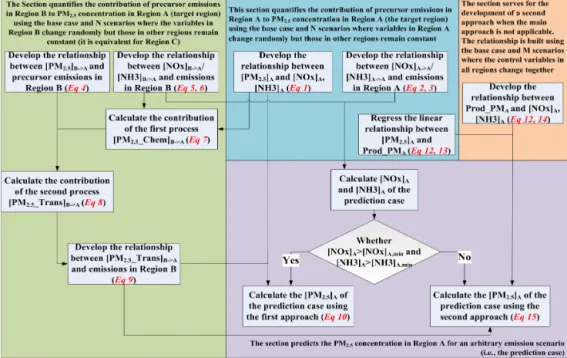
the technique is illustrated for this simplified case, it is also applicable for different response variable (e.g., NO−3, SO24−, and NH+4), and different numbers of regions, pollutants, or sectors. A detailed description of the ERSM technique using the simplified case is given below, and a flowchart illustrating this technique is shown in Fig. 1.
The emission control scenarios required to construct ERSM include (1) the base case, (2)N scenarios generated by applying the LHS method for the control variables in each single region, and (3) M scenarios generated by applying the LHS method for the total emissions of gaseous precur-sors (NOx and NH3 for this case) in all regions. The
sce-nario numbersN andMare determined to ensure that they are sufficient to accurately construct the relationship between the response variable and randomly changing control vari-ables using conventional RSM technique. Specifically, we gradually increase the scenario number and build the con-ventional RSM repeatedly until the prediction performance is good enough based on the results of out-of-sample vali-dation (Xing et al., 2011; Wang et al., 2011). The mean nor-malized error (MNE) and correlation coefficients are selected as indices of prediction performance. In our previous paper (Xing et al., 2011), we showed that the normalized mean er-ror first decreases and then gradually remains stable, with the increase of scenario number. In contrast, the correlation coefficient first increases and then gradually becomes sta-ble. We used a criterion that MNE <1 % and correlation coefficient >0.99, and determined that 30 and 50 scenar-ios were required to construct the conventional RSM for two and three variables, respectively. Therefore, for the simplified case,N=50 andM=30. The required scenario number for the simplified case is therefore 1 (the base case)+50 (scenar-ios for each single region)·3 (number of regions)+30 (sce-narios for the total precursor emissions in all regions)=181. Employing conventional RSM technique, we build the re-sponse surface of PM2.5 concentration in Region A to the
concentrations of precursors in Region A using the base case and the 50 scenarios where the variables in Region A change randomly but those in other regions remain constant: [PM2.5]A=[PM2.5]A0+RSM
PM2.5
Figure 1.A flowchart illustrating the ERSM technique using the simplified case described in Sect. 2.1. Different background colors represent the procedures conducted using different groups of emission scenarios, as indicated on the top/bottom of the colored areas.
where [PM2.5]A, [NOx]A, and [NH3]A are the
concentra-tions of PM2.5, NOx, and NH3 in Region A, respectively.
[PM2.5]A0 is the PM2.5 concentration in Region A in the
base case. RSM represents the response surface we build with conventional RSM technique; the superscript (PM2.5in
this case) represents the response variable; the letters before and after the arrow in the subscript (both are A in this case) represent the source and receptor regions, respectively. Fur-ther, we develop the relationship between precursor concen-trations and the changes of precursor emissions in Region A with the same 51 scenarios (we use NOx concentration as
example, and it is equivalent for NH3):
[NOx]A→A= (2)
RSMNOxA→A(Emis_NOx_1A,Emis_NOx_2A,Emis_NH3A) ,
where Emis_NOx_1A, Emis_NOx2A, and Emis_NH3A are
NOxemissions of sector 1, NOxemissions of sector 2, and
total NH3 emissions in Region A, respectively. [NOx]A→A,
representing the changes of NOx concentration in Region
A compared with the base case in response to the emission changes in the same region, is defined as
[NOx]A→A=[NOx]A−[NOx]A0, (3)
where [NOx]A0is the NOxconcentration in Region A in the
base case.
Following similar procedures, the response of the concen-trations of PM2.5and its gaseous precursors in Region A to
the changes of precursor emissions in Region B (the same method applies for Region C) can be developed using the
base case and the 50 scenarios where the variables in Re-gion B change randomly but those in other reRe-gions remain constant:
[PM2.5]B→A= (4)
RSMPM2.5
B→A(Emis_NOx_1B,Emis_NOx_2B,Emis_NH3B) ,
[NOx]B→A= (5)
RSMNOxB→A(Emis_NOx_1B,Emis_NOx_2B,Emis_NH3B) ,
[NH3]B→A= (6)
RSMNH3
B→A(Emis_NOx_1B,Emis_NOx_2B,Emis_NH3B) ,
where [PM2.5]B→A, [NOx]B→A, and [NH3]B→A are the
changes of PM2.5, NOx, and NH3concentrations in Region A
compared with the base case in response to the emission changes in Region B. Emis_NOx_1B, Emis_NOx_2B, and
Emis_NH3B are NOxemissions of sector 1, NOxemissions
of sector 2, and total NH3emissions in Region B,
respec-tively.
As described above, the influence of gaseous precursor emissions in Region B on PM2.5concentration in Region A,
as expressed by Eq. (4), can be broken down into two ma-jor processes: (1) the transport of gaseous precursors from Region B to Region A that enhances the chemical formation of secondary PM2.5 in Region A; (2) the formation of
sec-ondary PM2.5in Region B followed by transport to Region A.
firstly use Eqs. (5) and (6) to quantify the effect of the trans-port of gaseous precursors from Region B to Region A on the precursor concentrations in Region A. How much does the change of precursor concentrations in Region A enhance the chemical formation of secondary PM2.5 in Region A?
To answer this question, we introduce a straightforward as-sumption that the changes of PM2.5 concentration owing to
changes of precursor concentrations in the same region (de-scribed by Eq. 1) are solely attributable to changes of local chemical formation. Strictly speaking, the changes of pre-cursor concentration in Region A might affect the prepre-cursor concentrations/PM2.5concentrations in other regions, which
might in turn affect the PM2.5concentrations in Region A;
nevertheless, this indirect pathway is neglected in this study. For the case study over the YRD region (see details of the case study in Sect. 2.2), we estimate that, when the concen-trations of NOx, SO2, and NH3in a specific region
(Shang-hai, Jiangsu, or Zhejiang) are all reduced 50 %, the indirect pathway could only account for less than 2 % of the total PM2.5 reduction (see details in the Supplement). This
con-firms our assumption that the indirect pathway is negligible. Based on this assumption, the contribution of the first pro-cess to PM2.5concentrations in Region A is expressed as
[PM2.5_Chem]B→A= (7)
RSMPM2.5
A→A([NOx]A0+[NOx]B→A,[NH3]A0+[NH3]B→A) ,
where [PM2.5_Chem]B→A is the change of PM2.5
concen-tration in Region A affected by the changes of precursor emissions in Region B through the inter-regional transport of gaseous precursors (the first process). The contribution of the second process to PM2.5concentration in Region A (denoted
by [PM2.5_Trans]B→A defined below) is then calculated by
extracting the contribution of the first process from the total, as expressed by Eq. (8):
[PM2.5_Trans]B→A=[PM2.5]B→A−[PM2.5_Chem]B→A,
(8) where [PM2.5_Trans]B→Ais the change of PM2.5
concentra-tion in Region A affected by the changes of precursor emis-sions in Region B through the transport of secondary PM2.5
(the second process).
We also need to know the relationship between [PM2.5_Trans]B→Aand the precursor emissions in Region B.
Therefore, we quantify this relationship using conventional RSM technique, as described by Eq. (9).
[PM2.5_Trans]B→A=RSMPM2B→A.5_Trans (9)
(Emis_NOx_1B,Emis_NOx_2B,Emis_NH3B)
For the emission scenario whose PM2.5 concentration is to
be predicted, we presume that its emissions of gaseous pre-cursors in all the three regions are arbitrary. In this case, the change of PM2.5 is expressed as an integrated effect of
the changes of local precursor emissions, the inter-regional transport of precursors enhancing local chemical reactions, and the inter-regional transport of secondary PM2.5:
[PM2.5]A=[PM2.5]A0+RSMPM2A→.A5([NOx]A0 (10) +[NOx]A→A+[NOx]B→A+[NOx]C→A,
[NH3]A0+[NH3]A→A+[NH3]B→A+[NH3]C→A) +[PM2.5_Trans]B→A+[PM2.5_Trans]C→A,
where [PM2.5_Trans]B→A is calculated using Eq. (9),
and [PM2.5_Trans]C→A is calculated using an
equiva-lent equation for which the independent variables are the gaseous emissions in Region C. It should be noted that [PM2.5_Trans]B→A cannot be calculated using Eq. (8)
be-cause Eq. (8) holds only if the emissions in the regions other than Region B remain at the base-case levels.
Strictly speaking, [PM2.5_Trans]B→A and
[PM2.5_Trans]C→A could interact with each other. In
other words, the changes of precursor emissions in Re-gion C might affect the formation of secondary PM2.5
in Region B, which further affects the transport of sec-ondary PM2.5 from Region B to Region A. Equations (9)
and (10) imply an assumption that [PM2.5_Trans]B→A
depends only on the precursor emissions in Region B, and is independent of precursor emissions in other regions. That is, the interaction between [PM2.5_Trans]B→A and
[PM2.5_Trans]C→A is neglected. For the case study over the
YRD region, we estimate that the reduction of precursor emissions in Jiangsu and Others by 50 % could only change [PM2.5_Trans]Zhejiang→Shanghai (i.e., the change of PM2.5
concentration in Shanghai affected by the changes of precur-sor emissions in Zhejiang through the transport of secondary PM2.5)by less than 1 % (see details in the Supplement). This
confirms the above-mentioned assumption.
It should be noted that Eq. (1), which relates the changes of PM2.5concentration in Region A (equivalent to the changes
of local chemical formation of PM2.5as discussed above) to
local precursor concentrations, is established using the base case and the 50 scenarios where the variables in Region A change randomly but those in other regions remain constant. This means Eq. (1) is only applicable for the concentration range below (we use NOx as example, it is equivalent for
NH3):
[NOx]A≥[NOx]A,min=[NOx]A0+[NOx]A→A,min (11) =[NOx]A0+RSMNOxA→A(0,0,0) ,
where [NOx]A,minis defined as the minimum NOx
concen-tration in Region A when the emissions from Region A change arbitrarily and those in other regions remain the base-case levels.
Equation (10) relies on Eq. (1) but might exceed its available range, i.e., [NOx]A<[NOx]A,min, or [NH3]A<
[NH3]A,min, when the precursor emissions in multiple
we quantify the changes of PM2.5concentrations owing to
local chemical formation through a different approach. First, the local chemical formation of PM2.5 can be tracked
eas-ily in widely used three-dimensional CTMs. For example, a module named process analysis has already been imple-mented in CMAQ, which outputs the contribution of major physical and chemical processes to air pollutant concentra-tions. The chemical formation of PM2.5in Region A is
esti-mated as
Prod_PMA=AERO_PMA+CLDS_PMA, (12)
where AERO_PMAand CLDS_PMAare the contribution of
aerosol process and in-cloud process to PM2.5concentration
in Region A, extracted from CMAQ using the module pro-cess analysis. When the ERSM technique is applied with other CTMs, the chemical formation of PM2.5can be readily
extracted in a similar way. In addition, the chemical forma-tion of PM2.5in Region A and the resulting PM2.5
concentra-tions present a linear relaconcentra-tionship, which can be established using the base case and the 50 scenarios where the variables in Region A change randomly but those in other regions re-main constant:
[PM2.5]A=k·Prod_PMA+b, (13)
wherekandbare parameters determined through regression, and the correlation coefficient is approximately 0.99. Then we develop the relationship between the local chemical for-mation of PM2.5in Region A and local precursor
concentra-tions using the base case and the 30 scenarios, where con-trol variables in all regions change together and the variables for the same pollutant (e.g., Emis_NH3A, Emis_NH3B, and
Emis_NH3C) equal each other:
Prod_PMA=RSMProd_PMA→A ([NOx]A,[NH3]A) . (14)
Combining Eqs. (13) and (14), and considering the effect of inter-regional transport of PM2.5(calculated using Eq. 9), we
derive
[PM2.5]A=k·RSMProd_PMA→A ([NOx]A0 (15) +[NOx]A→A+[NOx]B→A+[NOx]C→A,
[NH3]A0+[NH3]A→A+[NH3]B→A+[NH3]C→A)+b +[PM2.5_Trans]B→A+[PM2.5_Trans]C→A
applicable for[NOx]A<[NOx]A,min, or
[NH3]A<[NH3]A,min
.
It should be noted that the process analysis module could also be used within the first approach (Eq. 10) to distinguish the contributions of chemical formation and physical trans-port. However, in the first approach, we could distinguish the chemical and transport contributions even without this diag-nostic module (see Eqs. 7 and 8). If this module was used, we would need to develop the relationship between the chemi-cally formed PM2.5and the PM2.5concentration, which was
an extra step compared with the first approach and added to the complexity.
To assure the consistency between Eqs. (10) and (15), we introduce transition intervals of([NOx]A,min,[NOx]A,min+
δNOx)and([NH3]A,min,[NH3]A,min+δNH3), whereδNOx=
0.1·[NOx]A0 and δNH3=0.1·[NH3]A0. Equation (10) is
applied for [NOx]A≥[NOx]A,min+δNOx and [NH3]A≥
[NH3]A,min+δNH3, and we linearly interpolate between
Eqs. (10) and (15) for the transitional range. Based on the case study in the YRD region (see Sect. 2.2), the discrepancy between the two approaches is 1–8 % in the transition inter-val.
2.2 Case study of the YRD region
The ERSM technique was applied with CMAQ version 4.7.1 over the YRD region of China. One-way, triple nesting sim-ulation domains are used, as shown in Fig. 2. Domain 1 cov-ers most of China and part of East Asia with a grid resolu-tion of 36 km×36 km; domain 2 covers the eastern China with a grid resolution of 12 km×12 km; domain 3 cov-ers the YRD region with a grid resolution of 4 km×4 km. The Weather Research and Forecasting Model (WRF, ver-sion 3.3) was used to generate the meteorological fields. The physical and chemical options of CMAQ and WRF, the ge-ographical projection, the vertical resolution, and the initial and boundary conditions are consistent with our previous pa-pers (Zhao et al., 2013a, c). A high-resolution anthropogenic emission inventory for the YRD region developed by Fu et al. (2013) was used. The anthropogenic emissions for other regions in East Asia were from Zhao et al. (2013a, c) and Wang et al. (2014), and emissions for other Asian countries were taken from the INDEX-B inventory (Q. Zhang et al., 2009). The biogenic emissions were calculated by the Model of Emissions of Gases and Aerosols from Nature (MEGAN; Guenther et al., 2006). The ERSM technique is applicable for various timescales, ranging from a single day to several years. The simulation period for this case study is January and August in 2010, representing winter and summer, respec-tively. One may want to extend the analysis to a full year. The most rigorous way is to finish the CMAQ simulations for a full year and build the response surfaces following the same procedure. Alternatively, the relationship for a full year can be roughly estimated using the average values of January and August. Another approach is to finish the simulations for an additional month in Spring and Autumn, and represent the situation of a full year with the average values of the four typ-ical months. The simulated meteorologtyp-ical parameters, and concentrations of PM10, PM2.5, and their chemical
compo-nents agree fairly well with observation data, as described in detail in the Supplement (Tables S3–S4; Figs. S3–S5).
Domain 1 Domain 2 Domain 3 Shanghai Southern Jiangsu Northern Zhejiang Others
Figure 2.Triple nesting domains used in CMAQ simulation (left) and the definition of four regions in the innermost domain, denoted by different colors (right). The black lines in the left figure represent provincial boundaries; the thick black lines and the thin grey lines in the right figure represent the provincial boundaries and city bound-aries, respectively. The dark blue grids in the right figure represent the urban areas of major cities.
response variables for both of them are the concentrations of PM2.5, SO24−, and NO−3 over the urban areas of major cities
(see Fig. 2) in these four regions. The first prediction sys-tem used the conventional RSM technique and 101 emission control scenarios generated by the LHS method to map atmo-spheric concentrations versus total emissions of NOx, SO2,
NH3, NMVOC, and PM2.5in domain 3. For the second
pre-diction system, the emissions of gaseous PM2.5 precursors
and primary PM2.5 in each of the four regions are
catego-rized into six and three control variables, respectively (see Table 1), resulting in 36 control variables in total. Note that we did not consider NMVOC emissions in the second predic-tion system, because the contribupredic-tion of NMVOC to PM2.5
concentrations is small in the current CMAQ model, mainly due to the significant underestimation of secondary organic aerosol (SOA) formation (Carlton et al., 2010). We gener-ated 663 scenarios (see Table 1) to build the response sur-face, following the method to create emission scenarios for the ERSM technique (see Sect. 2.1). In detail, the scenarios include (1) 1 CMAQ base case; (2)N=150 scenarios gen-erated by applying LHS method for the control variables of gaseous precursors in Shanghai, 150 scenarios generated in the same way for Jiangsu, 150 scenarios for Zhejiang, and 150 scenarios for Others; (3)M=50 scenarios generated by applying LHS method for the total emissions of NOx, SO2,
and NH3in all regions; and (4) 12 scenarios where one of
the control variables of primary PM2.5 emissions is set to
0.25 for each scenario. Here the valuesN=150 andM=50 are determined according to the numerical experiments con-ducted in our previous studies (Xing et al., 2011; Wang et al., 2011), which showed that the response surface for six and three variables could be built with good prediction per-formance (MNE <1 %; correlation coefficient >0.99) us-ing 150 and 50 scenarios, respectively. Finally, we generated 40 independent scenarios for out-of-sample validation, as de-scribed in detail in Sect. 3.1.
January August
35 45 55 65 75 85
35 45 55 65 75 85
E R S M pr e di c ti ons /( µ g /m 3)
CMAQ simulations/(µg/m3)
Shanghai Jiangsu Zhejiang 15 25 35 45 55 65
15 25 35 45 55 65
E R S M pr e di c ti ons /( µ g /m 3)
CMAQ simulations/(µg/m3)
Shanghai Jiangsu Zhejiang
Figure 3.Comparison of PM2.5concentrations predicted by the ERSM technique with out-of-sample CMAQ simulations. The dashed line is the one-to-one line indicating perfect agreement.
3 Results and discussion
3.1 Validation of ERSM performance
The performance of the conventional RSM technique has been well evaluated in our previous studies (Xing et al., 2011; Wang et al., 2011). In this study we focus on the validation of the ERSM technique. Using the prediction system built with the ERSM technique, we predicted the PM2.5
concen-trations for 40 out-of-sample control scenarios, i.e., scenarios independent from those used to build the ERSM prediction system, and compared with the corresponding CMAQ sim-ulations. These 40 out-of-sample scenarios include 32 cases (case 1–32) where the control variables of gaseous precur-sors change but those of primary PM2.5stay the same as the
base case, four cases (case 33–36) the other way around, and four cases (case 37–40) where control variables of gaseous precursors and primary PM2.5change simultaneously. Most
cases are generated randomly with the LHS method (case 4– 6, 10–12, 16–18, 22–24, 28–40), and some cases are de-signed where all control variables are subject to large emis-sion changes (case 1–3, 7–9, 13–15, 19–21, 25–27). A more detailed description of the out-of-sample control scenarios is given in Table S5. Two statistical indices, the normalized er-ror (NE) and MNE are defined as follows:
NE= |Pi−Si|/Si, (16)
MNE= 1
Ns
Ns
X
i=1
|Pi−Si|/Si, (17)
where Pi and Si are the ERSM-predicted and CMAQ-simulated value of the ith out-of-sample scenario; Ns is
the number of out-of-sample scenarios. Figure 3 compares the ERSM-predicted and CMAQ-simulated PM2.5
Table 1.Description of the RSM/ERSM prediction systems developed in this study.
Variable Scenario
Method number Control variables number Scenario details
Conventional
RSM technique
5 total emissions of NOx, SO2, NH3,
NMVOC, and PM2.5
101 one CMAQ base case;
100∗ scenarios generated by applying LHS method for the five variables.
ERSM technique
36 nine variables in each of the four regions, including six gaseous variables, i.e., (1) NOx/power plants
(2) NOx/industrial and residential
(3) NOx/transportation
(4) SO2/power plants
(5) SO2/industrial and residential (6) NH3/all sectors,
and three primary PM2.5variables, i.e., (7) PM2.5/power plants
(8) PM2.5/industrial and residential
(9) PM2.5/transportation.
663 one CMAQ base case;
600 scenarios, including 150∗ scenarios generated by applying LHS method for the gaseous control variables in Shanghai, 150 scenarios generated in the same way for Jiangsu, 150 scenarios for Zhejiang, 150 scenarios for Others;
50∗scenarios generated by applying LHS method for the total NOx, SO2and NH3
emissions;
12 scenarios where one primary PM2.5
control variable is set to 0.25 for each sce-nario.
∗100, 150 and 50 scenarios are needed for the response surfaces for 5, 6 and 3 variables, respectively (Xing et al., 2011; Wang et al., 2011).
can be seen that the ERSM predictions and CMAQ simula-tions agree well with each other. The correlation coefficients are larger than 0.98 and 0.99, and the MNEs are less than 1 and 2 % for January and August, respectively. The maximum NEs could be as large as 6 and 10 % in January and August, respectively, but the NEs for 95 % of all out-of-sample sce-narios fall below 3.5 %. NEs exceeding 3.5 % happen only for the scenario where all control variables are reduced by 90 % (case 25). In addition, the maximum NEs for case 33– 36 are all within 0.2 %, indicating a perfect linear relation-ship between PM2.5concentrations and primary PM2.5
emis-sions.
We further evaluated the performance of the ERSM technique by comparing the 2-D isopleths of PM2.5
con-centrations in response to the simultaneous changes of NOx/SO2/NH3emissions in all regions derived from both
the conventional RSM and the ERSM technique. Figures 4, S6, and S7 show the isopleths of PM2.5 concentrations in
Shanghai, Jiangsu, and Zhejiang, respectively. The x and
y axes of the figures show the emission ratio, defined as the ratios of the changed emissions to the emissions in the base case. For example, an emission ratio of 1.5 means the emissions of a particular control variable increase by 50 % from the base case. The different colors represent different PM2.5concentrations. The comparison shows that the shapes
of isopleths derived from both prediction systems agree fairly well with each other, although the isopleths predicted by the ERSM technique are not as smooth as those predicted by the conventional RSM technique owing to a much larger variable number. The consistency between the conventional RSM and ERSM prediction systems indicates that the ERSM technique
could reproduce fairly well the response of PM2.5to
contin-uous changes of precursor emission levels between zero and 150 %. Although model simulations definitely have numeri-cal errors, the success in capturing the atmospheric responses to continuous emission changes over a full range of control levels ensures that these errors could not challenge the major conclusions about the effectiveness of air pollution control measures.
3.2 Response of PM2.5to precursor emissions
The ERSM prediction system could instantly evaluate the re-sponse of PM2.5 and its chemical components to the
inde-pendent or simultaneous changes of the precursor emissions from multiple sectors and regions, over a full range of con-trol levels. Therefore, it improves the identification of major precursors, regions, and sectors contributing to PM2.5
pollu-tion. This unique capability distinguishes the ERSM from the previous sensitivity analysis methods.
Following previous sensitivity studies, we define PM2.5
sensitivity as the change ratio of PM2.5concentration divided
by the reduction ratio of emissions:
SaX= C∗−Ca/C∗/ (1−a) , (18) whereSXa is the PM2.5 sensitivity to emission sourceX at
its emission ratioa,Ca is the concentration of PM2.5when
the emission ratio ofX isa, andC∗is the concentration of PM2.5in the base case (when emission ratio ofXis 1).
Fig-ure 5 shows the PM2.5sensitivity to the stepped control of
in-dividual air pollutants, and Fig. 6 shows the PM2.5sensitivity
indi-January August
Conventional RSM ERSM Conventional RSM ERSM
NOX
vs NH3
NOX
vs SO2
SO2
vs NH3
Figure 4. Comparison of the 2-D isopleths of PM2.5concentrations in Shanghai in response to the simultaneous changes of precursor
emissions in all regions derived from the conventional RSM technique and the ERSM technique. Thexandyaxes shows the emission ratio, defined as the ratios of the changed emissions to the emissions in the base case. The different colors represent different PM2.5concentrations
(unit: µg m−3).
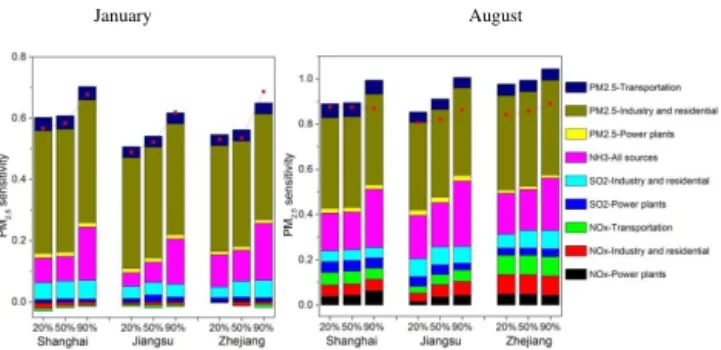
Figure 5.Sensitivity of PM2.5concentrations to the stepped
con-trol of individual air pollutants. Thexaxis shows the reduction ratio (i.e., 1−emission ratio). Thexaxis shows PM2.5sensitivity, which
is defined as the change ratio of concentration divided by the re-duction ratio of emissions. The colored bars denote the PM2.5
sen-sitivities when a particular pollutant is controlled, while the others stay the same as the base case; the red dotted line denotes the PM2.5
sensitivity when all emission sources are controlled simultaneously.
vidual sectors. Figure 5 can be derived from the prediction systems built with both the conventional RSM and ERSM technique, except that the latter did not evaluate the effects of the changes of NMVOC emissions. The results derived from both systems are consistent, and we present those de-rived from the conventional technique to include the effects of NMVOC. Figure 6 is derived from the ERSM technique.
In January, PM2.5 concentrations are sensitive to the
pri-mary PM2.5emissions, followed by NH3, and relatively
in-sensitive to NOxand SO2. The contribution of primary PM2.5
is dominated by the emissions from industrial and residential sources. During August, gaseous precursors make larger con-tributions to PM2.5concentrations than primary PM2.5, with
similar contributions from NH3, SO2, and NOx. The NOx
emissions from power plants, the industrial and residential sector, and the transportation sector play similar roles; the SO2emissions from the industrial and residential sector have
larger effects on PM2.5than those from power plants due to
larger emissions and lower stack heights. NMVOC emissions have minor effect on PM2.5concentrations, mainly due to the
significant underestimation of SOA in the current version of CMAQ, which is also a common issue for most widely used CTMs (Robinson et al., 2007).
The PM2.5 sensitivities to primary PM2.5 emissions are
approximately the same at various control levels. However, the PM2.5 sensitivity to gaseous precursors increases
no-tably when more control efforts are taken, mainly attributable to transition between NH3-rich and NH3-poor conditions.
Specifically, a particular pollutant (SO2, NOx, or NH3), when
subject to larger reductions compared with others, will be-come the limiting factor for inorganic aerosol chemistry. In January, the response of PM2.5 to NOx emissions is
nega-tive for relanega-tively small reductions (<40–70 %), but becomes positive for large reductions (>40–70 %). This strong non-linearity has also been confirmed by the previous studies (Zhao et al., 2013c; Dong et al., 2014). Relatively small re-ductions of NOx emissions lead to the increase of O3 and
HOx radicals due to a NMVOC-limited regime for
January August
Figure 6.Sensitivity of PM2.5concentrations to the stepped con-trol of individual air pollutants from individual sectors. Thexaxis shows the reduction ratio (i.e., 1−emission ratio). Theyaxis shows PM2.5sensitivity, which is defined as the change ratio of
concen-tration divided by the reduction ratio of emissions. The colored bars denote the PM2.5sensitivities when a particular emission source is
controlled, while the others stay the same as the base case; the red dotted line denotes the PM2.5sensitivity when all emission sources are controlled simultaneously.
addition, the increase of O3and HOxradicals also
acceler-ates the nighttime formation of N2O5and HNO3through the
NO2+O3reaction, thereby enhancing the formation of
ni-trate aerosols (see Fig. 7). As an integrated effect, the PM2.5
concentrations increase with relatively small reductions of NOXemissions. Under large reductions of NOX, PM2.5
con-centrations decrease, resulting from the simultaneous decline of NO2, O3 and HOX radical concentrations (NOx-limited
regime for photochemistry). These chemical processes also explain why the reduction of NOxemissions of a single
emis-sion sector has negative effects on PM2.5even at a large
re-duction ratio (see Fig. 6). Simultaneous rere-ductions of NOx
emissions from multiple sectors are essential for reducing PM2.5concentrations. If all pollutants are controlled
simulta-neously, the sensitivity of PM2.5concentrations to emission
reductions also generally becomes larger when more control effort is taken, especially in January (see red dotted line in Figs. 5 and 6). Note that the effects of reducing individual pollutants (from individual sectors) and reducing all of them together are different. In most cases the combined effect is lower than the sum of individual effects, which can be ex-plained by the overlap effects of reductions in both species involved in the formation of ammonium sulfate and ammo-nium nitrate. However, it is sometimes the other way around in January, as shown in Fig. 6. As mentioned above, in Jan-uary, the response of PM2.5 to the reduction of NOx
sions from a single emission sector is negative since the emis-sion reduction is small compared with the total NOx
emis-sions. Therefore, when the NOxemissions from each sector
are reduced individually (the bars), we sum up the negative effects. In contrast, when all pollutants from all sectors are reduced simultaneously (the red dotted line), the NOx
emis-sion reduction at a large ratio could have a positive effect on
Figure 7. Sensitivity of NO−3 and SO24− concentrations to the stepped control of individual air pollutants in individual regions. The x axis shows the reduction ratio (i.e., 1−emission ratio). Theyaxis shows NO−3 /SO24−sensitivity, which is defined as the change ratio of NO−3 /SO24−concentration divided by the reduction ratio of emissions. The colored bars denote the NO−3/SO24− sen-sitivities when a particular emission source is controlled, while the others stay the same as the base case; the red dotted line denotes the NO−3 /SO24− sensitivity when all emission sources are controlled simultaneously.
PM2.5reduction. This is why the combined effect sometimes
exceeds the sum of individual effects in January.
Then, we evaluate the contribution of primary PM2.5and
gaseous precursor (SO2, NOx, and NH3)emissions from
dif-ferent regions to PM2.5concentrations based on the ERSM
technique (Table 3). The contributions of total primary PM2.5
emissions (39–46 % in January, and 43–46 % in August) are dominated by local sources (32–36 % in January, and 37– 43 % in August). Total gaseous precursor emissions in the domain contribute 25–36 and 48–50 % of PM2.5
concentra-tions in January and August, respectively. The relative im-portance of gaseous precursor emissions from the other re-gions compared with local precursor emissions is generally higher than that of primary PM2.5; this trend is especially
evident in August. In Shanghai, the gaseous precursor emis-sions from Jiangsu and Zhejiang even contribute more to the PM2.5 concentration than local precursor emissions during
August. In January, long-range transport has a significant ef-fect on PM2.5concentrations (25–34 % contribution) due to
the northerly monsoon, contrasted by the minor effect in Au-gust (7–8 % contribution).
3.3 Response of SO2−
4 and NO−3 to precursor emissions
We pay special attention to secondary inorganic aerosols (SIAs) because SIAs contribute 28–55 % of total PM2.5
Table 2.Comparison of PM2.5concentrations predicted by the ERSM technique with out-of-sample CMAQ simulations.
January August
Shanghai Jiangsu Zhejiang Shanghai Jiangsu Zhejiang
Correlation coefficient 0.989 0.980 0.987 0.995 0.997 0.994 Mean normalized error (MNE) 1.0 % 0.7 % 0.9 % 0.8 % 0.5 % 1.7 % Maximum normalized error (NE) 4.5 % 3.0 % 5.2 % 10.2 % 7.7 % 9.6 % 95 % percentile of NEs 2.8 % 2.7 % 3.5 % 3.0 % 1.6 % 3.1 % MNE (case 33–36) 0.0 % 0.0 % 0.0 % 0.1 % 0.1 % 0.1 % Maximum NE (case 33–36) 0.1 % 0.1 % 0.1 % 0.1 % 0.1 % 0.2 %
Table 3.Contribution of primary PM2.5and gaseous precursor (NOx, SO2, NH3)emissions from individual regions to PM2.5concentrations.
January August
Shanghai Jiangsu Zhejiang Shanghai Jiangsu Zhejiang
Emissions of primary PM2.5in Shanghai 35.5 % 1.1 % 1.3 % 36.9 % 1.0 % 0.4 % Emissions of primary PM2.5in Jiangsu 5.6 % 35.0 % 4.1 % 2.2 % 37.5 % 0.9 %
Emissions of primary PM2.5in Zhejiang 1.9 % 2.3 % 32.2 % 4.3 % 2.5 % 42.8 %
Emissions of primary PM2.5in Others 2.9 % 2.9 % 1.7 % 2.0 % 1.9 % 1.5 %
Emissions of primary PM2.5in four regions 46.0 % 41.2 % 39.4 % 45.4 % 42.9 % 45.7 %
Emissions of NOx, SO2, and NH3in Shanghai 11.3 % 0.2 % 1.0 % 18.9 % 1.8 % 2.5 %
Emissions of NOx, SO2, and NH3in Jiangsu 3.3 % 11.7 % 3.9 % 5.2 % 30.1 % 4.3 %
Emissions of NOx, SO2, and NH3in Zhejiang 2.7 % 4.3 % 20.9 % 18.3 % 12.6 % 36.3 %
Emissions of NOx, SO2, and NH3in Others 1.7 % 2.4 % 2.8 % 5.7 % 4.6 % 7.2 %
Emissions of NOx, SO2, and NH3in four regions 25.2 % 24.9 % 35.7 % 48.3 % 50.4 % 47.7 %
Emissions of primary PM2.5in the outer domain 7.4 % 9.1 % 6.3 % 0.7 % 0.8 % 1.6 %
Emissions of NOx, SO2, and NH3in outer domain 20.6 % 24.5 % 19.1 % 6.6 % 7.1 % 6.1 %
the sensitivity of NO−3 /SO24− concentrations to the emis-sions of individual air pollutants from individual sectors. Both figures are derived from the prediction system built with the ERSM technique. In January, NO−3 concentration is most sensitive to NH3emissions, especially local NH3emissions.
The effect of local NOx emissions on NO−3 concentrations
changes from negative to positive when the controls of NOx
emissions become more and more stringent. This pattern is similar to that of PM2.5described above. The NOxemissions
from the industrial and residential sector and the transporta-tion sector, when controlled individually, both make nega-tive contribution to the reduction of NO−3 concentrations. In contrast, the control of NOx emissions from power plants
often favors the reduction of NO−3, because power plants tend to affect the fine particles over a larger spatial scale due to their higher release heights, and because the photo-chemistry typically changes from a NMVOC-limited regime in surface metropolis areas to a NOx-limited regime in vast
rural areas or the upper air (Xing et al., 2011). In August, NO−3 concentrations are mainly affected by local emissions of NH3and NOx, as well as NOxemissions in upwind
re-gions, and NOxemissions make a much larger positive
con-tribution to NO−3concentrations compared with January. Fac-tors accounting for this difference include a stronger NH3
-rich condition for inorganic aerosol chemistry (Wang et al., 2011), and a weaker NMVOC-limited (in metropolis areas) or a stronger NOx-limited (in rural areas) photochemical
con-dition in August. The contributions of NOxemissions from
power plants, the industrial and residential sector, and the transportation sector are similar to each other.
In January, SO24− concentrations are dominated by the changes of local SO2emissions, followed by local NH3
emis-sions. NOxemissions have a negative effect on SO24−due to
both thermodynamic (competition with SO2 for NH3) and
photochemical effect (negatively correlated with O3and HOx
radicals). In August, SO24−is most sensitive to local SO2and
NH3emissions. In Shanghai, where local emissions are
rela-tively small compared with emissions in other regions, the SO2 and NH3 emissions from upwind regions might
con-tribute more to SO24−concentration than local emissions. In both January and August, the SO2 emissions of the
4 Conclusions, implications, and limitations
In this study, we developed a novel extended response sur-face modeling technique (ERSM v1.0). As an advantage over previous models or techniques, this technique could char-acterize the nonlinear response of PM2.5 and its chemical
components to large and simultaneous changes of multiple precursor emissions from multiple regions and sectors with a reasonable number of model scenarios. The ERSM tech-nique was developed starting from the conventional RSM technique; it first quantifies the relationship between PM2.5
concentrations and the emissions of gaseous precursors from each single region with the conventional RSM technique, and then assesses the effects of inter-regional transport of PM2.5
and its gaseous precursors on PM2.5 concentrations in the
target region. A particular approach was implemented to im-prove the accuracy of the response surface when the emis-sions from multiple regions experience quite large reductions simultaneously.
We applied the ERSM technique with CMAQ version 4.7.1 over the YRD region of China, and mapped the con-centrations of PM2.5and its inorganic components versus 36
control variables. Using the ERSM technique, we predicted the PM2.5concentrations for 40 independent control
scenar-ios, and compared these with the corresponding CMAQ sim-ulations. The comparison results show that the ERSM pre-dictions and CMAQ simulations agree well with each other. The correlation coefficients are larger than 0.98 and 0.99, and the MNEs are less than 1 and 2 %, respectively, for January and August, We also compared the 2-D isopleths of PM2.5concentrations in response to the changes of
pre-cursor emissions derived from both the conventional RSM and the ERSM technique, and demonstrated that the ERSM technique could reproduce fairly well the response of PM2.5
to continuous changes of precursor emission levels between zero and 150 %.
Employing the ERSM technique, we identified the major sources contributing to PM2.5and its inorganic components
in the YRD region. For example, in January, PM2.5
concen-trations are sensitive to the primary PM2.5 emissions,
fol-lowed by NH3, and relatively insensitive to NOx and SO2.
During August, gaseous precursors make larger contributions to PM2.5 concentrations than primary PM2.5, with similar
contributions from NH3, SO2, and NOx. We also
character-ized the nonlinearity in the response of PM2.5 to emission
changes and illustrated the underlying chemical processes. For example, the sensitivity of PM2.5 to gaseous precursors
increases notably when more control efforts are taken, due to the transition between NH3-rich and NH3-poor conditions.
In January, the response of PM2.5to NOxemissions is
nega-tive for relanega-tively small reductions, but becomes posinega-tive for large reductions.
The assessment of the response of PM2.5and its inorganic
components to precursor emissions over the YRD region has important policy implications. First, the control of primary
PM2.5emissions, especially those of the industrial and
resi-dential sources, should be enhanced considering their large contribution to PM2.5 concentrations. Second, NOx
emis-sions need be reduced substantially in order to mitigate the adverse effect on PM2.5concentrations at relatively small
re-duction ratio. Third, the control of NH3 should be
imple-mented in heavy-pollution areas in winter due to its signif-icant effect on PM2.5. Fourth, it is essential to implement
region-dependent emission reduction targets based on the above-quantified interactions among regions.
Except for identification of major emission sources, the ERSM technique has several other practical applications. First, it allows us to calculate the required emission reduc-tions to attain a certain environmental target. Specifically, we alter the emission ratios of various control variables and calculate the real-time response of PM2.5concentrations
with ERSM repeatedly until the standard is attained. Sec-ond, ERSM can be applied to design optimal control tions, which could be determined through cost-effective op-timization once ERSM is coupled with control cost mod-els/functions that link the emission reductions with private costs.
Code availability
All codes needed to run ERSM v1.0 in MATLAB®are avail-able upon request. Any potential user interested in the model should contact S. X. Wang, and any feedback with regard to the model are welcome. Procedures to run the model and sources of external data files are properly documented in a Manual.doc file.
The Supplement related to this article is available online at doi:10.5194/gmd-8-115-2015-supplement.
Author contributions. B. Zhao, J. Xing, and S. X. Wang developed the underlying algorithms of the model. B. Zhao and K. Fu de-veloped the model code and performed the simulations. B. Zhao, K. Fu, and W. J. Wu conducted the model validation. B. Zhao and S. X. Wang prepared the manuscript with contributions from all co-authors. J. S. Fu, C. Jang, Y. Zhu, X. Y. Dong, Y. Gao, J. D. Wang, and J. M. Hao provided important academic guidance.
Acknowledgements. This work was sponsored by National Natural Science Foundation of China (21221004), Strategic Priority Research Program of the Chinese Academy of Sciences (XBD05020300), and MEP’s Special Funds for Research on Public Welfares (201409002, 201309009). The authors also appreciate the support from Collaborative Innovation Center for Regional Environmental Quality of Tsinghua University. Our work was completed on the Explorer 100 cluster system of Tsinghua National Laboratory for Information Science and Technology.
Edited by: A. Colette
References
Amann, M., Cofala, J., Gzella, A., Heyes, C., Klimont, Z., and Schopp, W.: Estimating concentrations of fine particulate matter in urban background air of European cities, Interim Report IR-07-001, available at: http://www.iiasa.ac.at (last access: 25 Jan-uary 2015), International Institute for Applied Systems Analysis, Laxenburg, Austria, 50, 2007.
Carlton, A. G., Bhave, P. V., Napelenok, S. L., Edney, E. D., Sar-war, G., Pinder, R. W., Pouliot, G. A., and Houyoux, M.: Model Representation of Secondary Organic Aerosol in CMAQv4.7, Environ. Sci. Technol., 44, 8553–8560, doi:10.1021/Es100636q, 2010.
Carmichael, G. R., Sandu, A., and Potra, F. A.: Sensitivity anal-ysis for atmospheric chemistry models via automatic differ-entiation, Atmos. Environ., 31, 475–489, doi:10.1016/S1352-2310(96)00168-9, 1997.
Dickerson, R. R., Stedman, D. H., and Delany, A. C.: Direct Measurements of Ozone and Nitrogen-Dioxide Photolysis Rates in the Troposphere, J. Geophys. Res.-Ocean., 87, 4933–4946, doi:10.1029/Jc087ic07p04933, 1982.
Dong, X. Y., Li, J., Fu, J. S., Gao, Y., Huang, K., and Zhuang, G. S.: Inorganic aerosols responses to emission changes in Yangtze River Delta, China, Sci. Total. Environ., 481, 522–532, doi:10.1016/j.scitotenv.2014.02.076, 2014.
Fu, J. S., Brill, E. D., and Ranjithan, S. R.: Conjunctive use of mod-els to design cost-effective ozone control strategies, J. Air. Waste. Manage., 56, 800–809, 2006.
Fu, X., Wang, S. X., Zhao, B., Xing, J., Cheng, Z., Liu, H., and Hao, J. M.: Emission inventory of primary pollutants and chemical speciation in 2010 for the Yangtze River Delta region, China, At-mos. Environ., 70, 39–50, doi:10.1016/j.atmosenv.2012.12.034, 2013.
Guenther, A., Karl, T., Harley, P., Wiedinmyer, C., Palmer, P. I., and Geron, C.: Estimates of global terrestrial isoprene emissions using MEGAN (Model of Emissions of Gases and Aerosols from Nature), Atmos. Chem. Phys., 6, 3181–3210, doi:10.5194/acp-6-3181-2006, 2006.
Hakami, A., Odman, M. T., and Russell, A. G.: High-order, di-rect sensitivity analysis of multidimensional air quality models, Environ. Sci. Technol., 37, 2442–2452, doi:10.1021/Es020677h, 2003.
Hakami, A., Seinfeld, J. H., Chai, T. F., Tang, Y. H., Carmichael, G. R., and Sandu, A.: Adjoint sensitivity analysis of ozone nonat-tainment over the continental United States, Environ. Sci. Tech-nol., 40, 3855–3864, doi:10.1021/Es052135g, 2006.
Heyes, C., Schopp, W., Amann, M., and Unger, S.: A reduced-form model to predict long-term ozone concentrations in Europe, In-terim Report WP-96-12, available at: http://www.iiasa.ac.at (last access: 25 January 2015), International Institute for Applied Sys-tems Analysis, Laxenburg, Austria, 58, 1996.
Hwang, J. T., Dougherty, E. P., Rabitz, S., and Rabitz, H.: Greens Function Method of Sensitivity Analysis in Chemical-Kinetics, J. Chem. Phys., 69, 5180–5191, doi:10.1063/1.436465, 1978. Iman, R. L., Davenport, J. M., and Zeigler, D. K.: Latin
Hyper-cube Sampling (Program User’s Guide), Sandia National Labora-tories, Albuquerque, NM, US Technical Report SAND79-1473, 78, 1980.
Milford, J. B., Russell, A. G., and Mcrae, G. J.: A New Approach to Photochemical Pollution-Control – Implications of Spatial Pat-terns in Pollutant Responses to Reductions in Nitrogen-Oxides and Reactive Organic Gas Emissions, Environ. Sci. Technol., 23, 1290–1301, doi:10.1021/Es00068a017, 1989.
Nel, A.: Air pollution-related illness: Effects of particles, Science, 308, 804–806, doi:10.1126/science.1108752, 2005.
Robinson, A. L., Donahue, N. M., Shrivastava, M. K., Weitkamp, E. A., Sage, A. M., Grieshop, A. P., Lane, T. E., Pierce, J. R., and Pandis, S. N.: Rethinking organic aerosols: Semivolatile emissions and photochemical aging, Science, 315, 1259–1262, doi:10.1126/science.1133061, 2007.
Russell, A., Milford, J., Bergin, M. S., Mcbride, S., Mcnair, L., Yang, Y., Stockwell, W. R., and Croes, B.: Urban Ozone Con-trol and Atmospheric Reactivity of Organic Gases, Science, 269, 491–495, doi:10.1126/science.269.5223.491, 1995.
Sandu, A. and Zhang, L.: Discrete second order adjoints in at-mospheric chemical transport modeling, J. Comput. Phys., 227, 5949–5983, doi:10.1016/j.jcp.2008.02.011, 2008.
Santner, T. J., Williams, B. J., and Notz, W.: The Design and Anal-ysis of Computer Experiments, Springer Verlag, New York, US, 283 pp., 2003.
Simon, H., Baker, K. R., Akhtar, F., Napelenok, S. L., Possiel, N., Wells, B., and Timin, B.: A Direct Sensitivity Approach to Pre-dict Hourly Ozone Resulting from Compliance with the National Ambient Air Quality Standard, Environ. Sci. Technol., 47, 2304– 2313, doi:10.1021/Es303674e, 2013.
Stocker, T. F., Qin, D., Plattner, G.-K., Tignor, M., Allen, S. K., Boschung, J., Nauels, A., Xia, Y., Bex, V., and Midgley, P. M.: Climate Change 2013: The Physical Science Basis. Contribution of Working Group I to the Fifth Assessment Report of the Inter-governmental Panel on Climate Change, Cambridge University Press, Cambridge, United Kingdom and New York, NY, USA, 1535 pp., 2013.
US Environmental Protection Agency: Technical support document for the proposed PM NAAQS rule: Response Surface Modeling, Office of Air Quality Planning and Standards, US Environmental Protection Agency, Research Triangle Park, NC, US, 48, 2006a. US Environmental Protection Agency: Technical support document for the proposed mobile source air toxics rule: ozone modeling, Office of Air Quality Planning and Standards, US Environmental Protection Agency, Research Triangle Park, NC, US, 49, 2006b. Walsh, M. P.: PM2.5: Global progress in controlling the mo-tor vehicle contribution, Front. Env. Sci. Eng., 8, 1–17, doi:10.1007/s11783-014-0634-4, 2014.
Wang, L. H. and Milford, J. B.: Reliability of optimal control strate-gies for photochemical air pollution, Environ. Sci. Technol., 35, 1173–1180, doi:10.1021/Es001358y, 2001.
Wang, S. X. and Hao, J. M.: Air quality management in China: Is-sues, challenges, and options, J. Environ. Sci.-China., 24, 2–13, doi:10.1016/S1001-0742(11)60724-9, 2012.
Wang, S. X., Xing, J., Jang, C. R., Zhu, Y., Fu, J. S., and Hao, J. M.: Impact assessment of ammonia emissions on inorganic aerosols in east China using response surface modeling technique, En-viron. Sci. Technol., 45, 9293–9300, doi:10.1021/Es2022347, 2011.
Wang, S. X., Zhao, B., Cai, S. Y., Klimont, Z., Nielsen, C. P., Morikawa, T., Woo, J. H., Kim, Y., Fu, X., Xu, J. Y., Hao, J. M., and He, K. B.: Emission trends and mitigation options for air pollutants in East Asia, Atmos. Chem. Phys., 14, 6571–6603, doi:10.5194/acp-14-6571-2014, 2014.
Xing, J.: Study on the nonlinear responses of air quality to primary pollutant emissions, Doctor thesis, School of Environment, Ts-inghua University, Beijing, China, 138 pp., 2011 (in Chinese). Xing, J., Wang, S. X., Jang, C., Zhu, Y., and Hao, J. M.:
Nonlin-ear response of ozone to precursor emission changes in China: a modeling study using response surface methodology, Atmos. Chem. Phys., 11, 5027–5044, doi:10.5194/acp-11-5027-2011, 2011.
Yang, Y. J., Wilkinson, J. G., and Russell, A. G.: Fast, direct sensi-tivity analysis of multidimensional photochemical models, En-viron. Sci. Technol., 31, 2859–2868, doi:10.1021/Es970117w, 1997.
Yarwood, G., Emery, C., Jung, J., Nopmongcol, U., and Sakulyanontvittaya, T.: A method to represent ozone response to large changes in precursor emissions using high-order sensi-tivity analysis in photochemical models, Geosci. Model Dev., 6, 1601–1608, doi:10.5194/gmd-6-1601-2013, 2013.
Zhang, Q., Streets, D. G., Carmichael, G. R., He, K. B., Huo, H., Kannari, A., Klimont, Z., Park, I. S., Reddy, S., Fu, J. S., Chen, D., Duan, L., Lei, Y., Wang, L. T., and Yao, Z. L.: Asian emis-sions in 2006 for the NASA INTEX-B mission, Atmos. Chem. Phys., 9, 5131–5153, doi:10.5194/acp-9-5131-2009, 2009. Zhang, X. Y., Wang, Y. Q., Niu, T., Zhang, X. C., Gong, S.
L., Zhang, Y. M., and Sun, J. Y.: Atmospheric aerosol com-positions in China: spatial/temporal variability, chemical sig-nature, regional haze distribution and comparisons with global aerosols, Atmos. Chem. Phys., 12, 779–799, doi:10.5194/acp-12-779-2012, 2012.
Zhang, Y., Wen, X. Y., Wang, K., Vijayaraghavan, K., and Ja-cobson, M. Z.: Probing into regional O-3 and particulate matter pollution in the United States: 2. An examination of formation mechanisms through a process analysis technique and sensitivity study, J. Geophys. Res.-Atmos., 114, D22305, doi:10.1029/2009jd011900, 2009.
Zhao, B., Xu, J. Y., and Hao, J. M.: Impact of energy structure ad-justment on air quality: A case study in beijing, china, Front. Environ. Sci. En., 5, 378–390, doi:10.1007/s11783-011-0357-8, 2011.
Zhao, B., Wang, S. X., Dong, X. Y., Wang, J. D., Duan, L., Fu, X., Hao, J. M., and Fu, J.: Environmental effects of the recent emission changes in China: implications for particulate matter pollution and soil acidification, Environ. Res. Lett., 8, 024031, doi:10.1088/1748-9326/8/2/024031, 2013a.
Zhao, B., Wang, S. X., Liu, H., Xu, J. Y., Fu, K., Klimont, Z., Hao, J. M., He, K. B., Cofala, J., and Amann, M.: NOx emissions in China: historical trends and future perspectives, Atmos. Chem. Phys., 13, 9869-9897, doi:10.5194/acp-13-9869-2013, 2013b. Zhao, B., Wang, S. X., Wang, J. D., Fu, J. S., Liu, T. H., Xu, J. Y.,
Fu, X., and Hao, J. M.: Impact of national NOxand SO2control