JOURNAL OF NANO- AND ELECTRONIC PHYSICS Р А А - А Р
Vol. 6 No 3, 03037(2pp) (2014) Том6№ 3, 03037(2cc) (2014)
The article was reported at the International Conference «The Advanced Technology, Equipment and Analytical Systems for Materials», Kursk, 13-14 May, 2014
2077-6772/2014/6(3)03037(2) 03037-1 2014 Sumy State University
Microwave Properties of Carbon Nanotubes Grown by Pyrolysis of Ethanol on Nickel Catalyst
V.V. Rodionov1, A.P. Kuzmenko1, S.G. Emelyanov1, L.M. Chervyakov1, M.B. Dobromyslov2
1Southwest State University, 94, 50 let Oktyabrya Str., 305040, Kursk, Russia 2 Pacific National University, 136, Tihkhookeanskaya Str., Khabarovsk, Russia
(Received 19 May 2014; revised manuscript received 09 July 2014; published online 15 July 2014)
The efficiency of carbon nanotubes produced by CVD-method on a nickel catalyst at a protection from microwave radiation is shown. These data are confirmed by scanning electron microscopy, energy disper-sive X-ray analysis and spectral analysis of the microwave radiation in the frequency range 26-40 GHz. The observed value of the transmission coefficient S21, up to – 42.7 dB, is in agreement with considered possible absorption mechanisms of electromagnetic wave energy in carbon nanoscale systems “CNT-nickel nanoparticles”. The application of carbon powder materials in shielding of electromagnetic radiation has been theoretically justified.
Keywords: Carbon nanotubes, Nickel catalyst, Electromagnetic radiation, Scanning electron microscopy, Energy dispersive X-ray analysis, Transmission coefficient.
PACS numbers: 07.78. + s, 07.85.Fv, 42.65.Dr, 07.57. – c
1. INTRODUCTION
Constant broadening of telecommunication market led to the appearance of great number of radio-frequency systems, made the problem of electromagnet-ic protection acute, required the generation of broad-band absorbing materials. Composites on the basis of carbon nanotubes (CNTs) that feature the high aspect ratio of length to width, electroconductivity, are prom-ising for the creation of microwave radiation absorbers even at a low concentration of CNTs. Absorption at CNTs composites with a weight concentration of 35 % with a 1 S/m conductivity amounts to the level compa-rable with products on the basis of carbon soot with a concentration of 20 % [1], which is explained in [2] by the characteristic of CNTs value of l / d ~ 103.
2. EXPERIMENTAL SECTION
Carbon nanotubes were grown by catalytic pyrolysis of carbon hydrogen gas (CVD). As a source ethanol was used heated to 46 °С at a pressure of 15 kPa. Magnetic nanoparticles of nickel (with size of not more than 200 nm, as seen from Fig. 1) produced by sol-gel tech-nique that were as catalysts were put onto single-crystal silicon substrate.
Fig. 1 – Electron microscopic image of nickel catalyst (amplifi-cation 75000)
Fig. 2 – Electron microscopic image of carbon nanotubes (amplification 150000)
Synthesis was conducted at a temperature of 600 °С. Minimum diameter of synthesized CNTs was found equal to 20 nm (Fig. 2). Surface morphology and the composition of the samples studied were determined with scanning electron microscope (SEM) JEOL JSM6610LV (W-cathode) and energy dispersive X-ray analyzer (X-Max Silicon Drift Detector Oxford Instruments) (Fig. 3).
Fig. 3 – Carbon (black line) and nickel (grey line) profiles ac-cording to energy dispersive analysis data
V.V. RODIONOV, A.P. KUZMENKO, ET AL., J.NANO-ELECTRON.PHYS. 6, 03037 (2014)
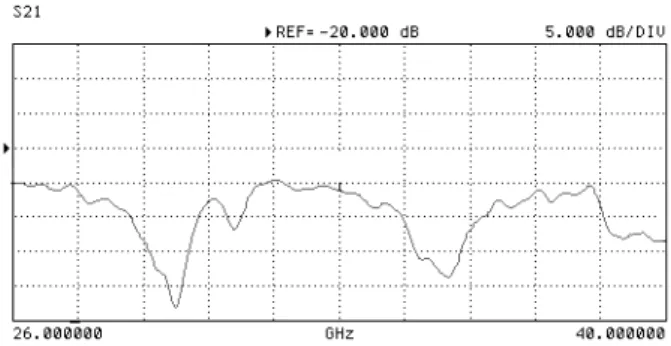
03037-2 shape of the transmission coefficient curve is character-istic of broad-band absorbers since at CR S11 1 dB÷2 dB the maximum value of S21 is lower than – 25 dB, which means the wave attenuation of more than 300 times, and the transmitted radiation is only 0.3 %.
3. RESULTS AND DISCUSSION
Such absorption is due to the appearance of conduc-tion currents in medium. High conductivity of material leads to the monotonic absorption of electromagnetic (EM) radiation. At such interaction of nanoparticles with field Joules heat is released whose specific power Q j·E, where j, E are the density of eddy currents and rigidity coefficient, respectively, in the wire. At interac-tion of CNTs-composites with microwave radiainterac-tion it should be, obviously, taken into account natural fre-quencies due to the fact that nanoparticles have electric or magnetic dipole moments [3]. When these frequen-cies coincide with microwave frequency the absorption by CNTs arrays becomes resonant in character with reasonably high absorption coefficient (up to 40 dB). Natural frequencies of CNTs in analogy with elastic system may be calculated from equation.
0
1 ,
2 m
(1)
where – rigidity constant, m – CNTs mass.
Unlike [4] under these conditions there are no mul-tiple reflections in the system «CNTs-nickel nanoparti-cle», as it follows from plot (Fig. 4). This is probably due to firstly, great distances between nickel nanoparticles and secondly, the fact that CNT radius is considerably lower than the skin-layer (f) – 1/2,where f – microwave frequency, 0– permeability, – electroconductivity. The maximum values on the curve (Fig. 4) likely stem from the excitation of surface currents, which is accompanied by the reduction of EM radiation owing to the Joules heat.
In doing so, the maximum attenuation of EM radia-tion is determined by the minimum transmission coeffi-cient, which at 34.84 amounts to – 37.37 dB, and at 29.64 GHz – 42.70 dB and is of clearly resonant
charac-ter. Equiphase condition of distribution profiles (Fig. 3) is indicative of the link between magnetic nanoparticles and
Fig. 4 – Amplitude-frequency characteristic of transmission coefficient S21 of carbon nanotubes obtained by CVD-technique on nickel catalyst (scale from – 5 to – 45 dB)
nanotubes, which favors the elastic scattering of electro-magnetic energy. When these particles interact with the field of EM wave, ponderomotive forces originate. The forces cause vibrations due to the elastic properties of nanotubes with the frequency according to formula (1). Typical rigidity coefficient of nanotubes, as a rule, is be-tween 100 and 1000 [5], and the center of mass of the system “CNTs-nuckel nanoparticle” is shifted clearly b e-cause of grater nickel density. Predicted size of carbon nanotubes determined by the minimum frequency is equal to 3.13 m, which is in accord with typical relation l / d of CNTs that lies within 100-1000.
4. CONCLUSIONS
Thus, the analysis conducted has revealed high ab-sorption capability to the microwave radiation of the sys-tem “CNT- nickel nanoparticle” due to both high condu c-tivity and the aspect ratio characteristic of CNTs. This is responsible for the action of two mechanisms concurrent-ly: elastic resonant of the whole system and electronetic absorption because of nanoparticle electric or mag-netic dipole moments.
We express our deep gratitude to Deputy Head for Science Chesnokov O.N. of «SCARD-Electronics» firm for his assistance in measuring high-frequency electromag-netic characteristics of samples studied.
REFERENCES
1. A. Saib, L. Bednarz, R. Daussin, IEEE T. Microwave Theo-ry Tech.54, 2745 (2006).
2. R.K. Abu, Al-Rub, A.I. Ashour, B.M. Tyson, Construction and Building Materials35, 647 (2012).
3. V.A. Labunov, A.L. Danilyuk, T.L. Prudnikova,
A.S. Basaev, V.N. Rodionova, IPI NIYAU 1 (2011) [In Russian].
4. A.P. Kuzmrnko, V.V. Rodionov, V.A. Kharseev, Nanotech-niques 4, 35, (2013) [In Russian].