*)
Corresponding author: [email protected]; _____________________________
doi: 10.2298/SOS1501097Y
UDK
622.785; 001.572Interpretation of Frenkel’s Theory of Sintering Considering
Evolution of Activated Pores: II. Model and Reliability
C.-L. Yu
*, D.-P. Gao, S.-M. Chai, Q. Liu, H. Shi, X.-L. Xie
School of Materials Science and Engineering, Shaanxi University of Science &
Technology, Xi’an 710021, P. R. China
Abstract:
Frenkel's liquid-phase sintering mechanism has essential influence on the sintering of materials, however, by which only the initial 10% during isothermal sintering can be well explained. To overcome this shortage, Nikolić et al. introduced a mathematical model of shrinkage vs. sintering time concerning the activated volume evolution. This article compares the model established by Nikolić et al. with that of the Frenkel's liquid-phase sintering mechanism. The model is verified reliable via training the height and diameter data of cordierite glass by Giess et al. and the first-order partial differential equation. It is verified that the higher the temperature, the more quickly the value of the first-order partial differential equation with time and the relative initial effective activated volume to that in the final equibrium state increases to zero, and the more reliable the model is.
Keywords: Frenkel's liquid-phase sintering mechanism; Activated pores; Reliability of the model; The first-order partial differential equation
1. Introduction
Frenkel's phase sintering mechanism has essential influence on the liquid-phase sintering of materials, by which the sintering of glass powders can be successfully interpreted typically. One significant reason is that the shrinkage vs. sintering time is a simple linear relation, which provides the accurate verification for the experimental results[1, 2]. For the ideal glass system, the relation between sintering time and the interfacial radius of two spheric particles was simple linear, verified by Kingery in the 1950s[3]. Kuczynski and Zaplatynskyj also verified the model was accurate by investigation of the sintering of capillary glass tubes[4].
established by Nikolić et al. with that of Frenkel's liquid-phase sintering mechanism.
2. Interpretation of Frenkel’s liquid-phase sintering theory
Nikolić et al. introduced the concept of activated volume, and considered that the shrinkage was based on the decrease of the activated volume. According to reference[7], the effective activated volume of a system can be defined as:
ln
=-
D
V
RT
P
∂
⎛
⎞
⎜
∂
⎟
⎝
⎠
(1) Where the diffusion coefficient D is defined as:2
exp
G
D
a
RT
γ ν
⎛
Δ
⎞
=
⎜
−
⎟
⎝
⎠
(2)where R is the gas constant, T is the sintering temperature, ΔG is the change in free energy, P is the pressure, γ is the geometric factor, a is a crystal lattice constant, and ν is the Debey frequency.
From the viewpoint of processes occurring during the sintering, the process can be described as gravitation of the electronic system towards an equilibrium state. As the process proceeds, the effective activated volume of a system-v at any moment during the sintering process is a parameter that with the increase of sintering time gravitates towards the value of equilibrium-activated volume[8]. The equilibrium state of a system can be characterized by an equilibrium activated volume-v+.
From a physical viewpoint, the effective activated volume of a system can be described as:
+ 0
=
r
N
V
V
N
(3)
Where N0 represents the concentration of all defects at any given moment and Nr-the
equilibrium concentration of defects in the analyzed system.
According to reference[9], reduction of the effective activated volume can be simply defined as:
0
1 1 exp
V V
V V
t
τ
+ +
⎛ ⎞ ⎛ ⎞
= +⎜ − ⎟ ⎜−
⎝
⎝ ⎠ ⎟⎠ (4)
Where τ is the time constant, and usually is with minutes as the unit.
In the most general sense, kinetics of the sintering process can be expressed in terms of the dependence of linear shrinkage during isothermal sintering on the sintering time as[5]:
0
( )
n
L L
K t
′
τ
Δ
=
(5)Where
K
′
- the sintering rate constant, which depends on sintering temperature and time; n - a constant, which depends on the sintering mechanism; t - the sintering time.The sintering rate constant is defined as:
0
=
exp -
E
t
K
K
RT
ϕ
τ
⎛
⎞
⎛
′
⎜
⎟
⋅
⎜
⎝
⎠
⎝
⎞
⎟
⎠
(6)Where K0 is a constant, R is the gas constant, E is the activation energy, and T is the
sintering temperature. The parameter
ϕ
t
τ
⎛ ⎞
⎜ ⎟
degree of sintering can be defined as the ratio between the equilibrium activated volume and the effective activated volume:
=
t
V
V
ϕ
τ
+⎛ ⎞
⎜ ⎟
⎝ ⎠
(7) Then taking eq. (7) into eq. (4), we obtain:
0
1
1
1 exp
-t
V
t
V
ϕ
τ
τ
+⎛ ⎞ =
⎜ ⎟
⎛
⎞
⎝ ⎠
⎛
⎞
+ ⎜
⎟
⎜
⎝
⎟
⎠
⎝
⎠
(8)Thus the expression of relative linear shrinkage vs. time is given by:
0 0
1 1 exp
-n
L K
L V t
V
t
τ
τ
+
Δ = ⎛ ⎞
⎜ ⎟ ⎛ ⎞ ⎛ ⎞⎝ ⎠ +⎜ ⎟ ⎜ ⎟ ⎝ ⎠ ⎝ ⎠ (9)
3. Reliability of the model
According to Frenkel's theory, the linear shrinkage vs. time can be defined as:
( )
( )
0 3
8
T d L L
dt r T
γ
η
Δ
= (10)
Where γ(T) is the suface tension, r is the radius of the particles, η(T) is the viscosity at fixed temperature. By simple modification, the equation can be changed into:
0
( )
3 8 T L t L r
γτ
η
τ
Δ = ⋅ (11) Suppose( )
3
8
FK
r
T
γτ
η
=
, which is a constant at definite temperature, thus:0
F
L
t
K
L
τ
Δ
=
⎛ ⎞
⎜ ⎟
⎝ ⎠
(12)Based on the fact that the linear shrinkage vs. time is unique during the whole sintering process at the definite temperature, thus we obtain:
0
1
1 exp
-n F
K
t
K
V
t
V
t
τ
τ
τ
+⎛ ⎞
=
⎛ ⎞
⎜ ⎟
⎜ ⎟
⎛
⎞
⎛
⎞
⎝ ⎠
⎝ ⎠
+ ⎜
⎟
⎜
⎝
⎟
⎠
⎝
⎠
(13)After simple modification, we obtain:
1
0
=constant
1
1 exp
-n F
t
K
K
V
t
V
τ
τ
− +⎛ ⎞
⎜ ⎟
⎝ ⎠
=
⎛
⎞
⎛
⎞
+ ⎜
⎟
⎜
⎟
⎝
⎠
Define the function
1 1
0 0
, ,
1
1 exp
n
t
t
V
f
n
V
ν
τ
ν
τ
− −
+ +
t
τ
⎡
⎤
⎛
⎞
=
⎛ ⎞
+
⎛
−
⎞
⎛
−
⎞
⎢
⎥
⎜
⎟
⎜ ⎟
⎝ ⎠
⎜
⎟
⎜
⎝
⎟
⎠
⎝
⎠
⎣
⎝
⎠
⎦
, and for thewhole sintering process,
0
,
| V
n V f
t
τ
+
∂
0 = ⎛ ⎞ ∂ ⎜ ⎟⎝ ⎠
, then:
(15)
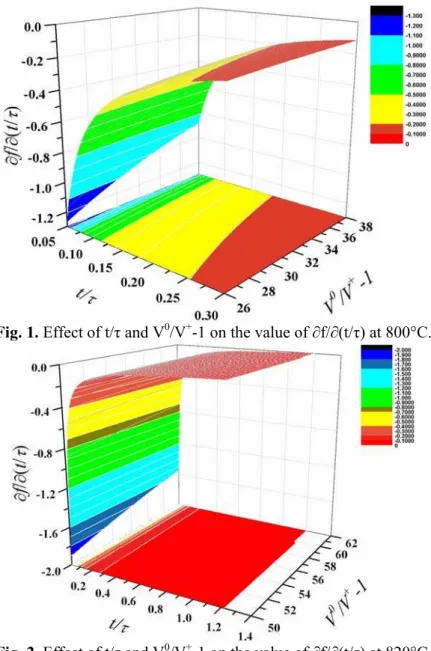
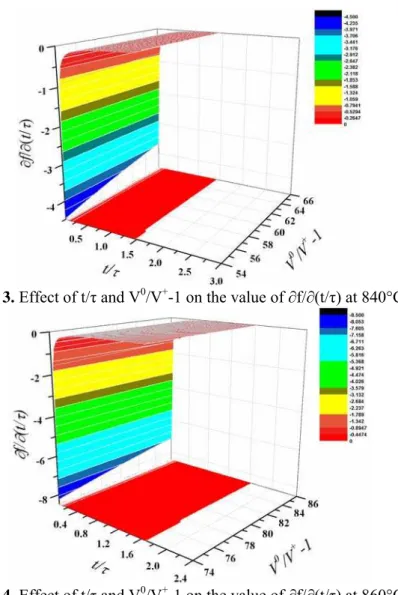
Taking into account of eq. (15) for a real sintering process, if the value of ∂f/∂(t/τ) is near 0, then the model given in eq. (9) is valid.
Fig. 1. Effect of t/τ and V0/V+-1 on the value of ∂f/∂(t/τ) at 800°C.
Fig. 2. Effect of t/τ and V0/V+-1 on the value of ∂f/∂(t/τ) at 820°C.
addressed that ∂f/∂(t/τ) has large values in the very initial stage of sintering because the value of (t/τ)n-2 is rather large when t/τ is within a small range. The rate of ∂f/∂(t/τ) tends to 0 more quickly with t/τ and V0/V+-1 increasing when the temperature increases. In general, the model is reliable according to the value of ∂f/∂(t/τ) near 0 in the whole sintering process.
Fig. 3. Effect of t/τ and V0/V+-1 on the value of ∂f/∂(t/τ) at 840°C.
Fig. 4. Effect of t/τ and V0/V+-1 on the value of ∂f/∂(t/τ) at 860°C.
4. Conclusion
Acknowledgements
This work is co-supported by the Research Fund for Ph.D in SUST, P. R. China under grant No. BJ09-11, the Special Scientific Research Project for the Education Department of Shaanxi Province, P. R. China under Grant No. 12JK0459, the Innovation Fund for Industrial Technologies of Xi’an City under Grant No. CX1256(5), the Ministry of Science and Technology Innovation Fund for Small and Medium Enterprises, P. R. China under Grant No. 12C26216106760, the Innovation Team Fund of SUST, P. R. China under Grant No. TD12-05, and the “6333” Scientific Innovation Project of Baoji City, P. R.China under Grant No. 2009FWPT-9.
5. References
1. M. M. Ristic, S. Dj. Milosevic. Frenkel’s theory of sintering. Sci Sintering, 2006, 38(1): 7-11.
2. Ya. I. Frenkel. Viscous flow of crystalline bodies under action of surface tension. J Phys (U. S. S. R.), 1945, 9:385-39(in English).
3. W. D. Kingery, M. Berg. Study of initial stages of sintering solids by viscous flow, evaporation-condensation, and self-diffusion. J Appl Phys, 1955, 26(10): 1205-1212. 4. G. C. Kuczynski, I. Zaplatynskyj. Sintering of glass. J Am Ceram Soc, 1955, 39(10):
349-350.
5. M. V. Nikolic, N. Labus, M. M. Ristic. A phenomenological analysis of sintering kinetics from the viewpoint of activated volume. Sci Sintering, 2005, 37: 19-25. 6. C. L. Yu, X. F. Wang, X. Tong, et al. Integrated liquid-phase sintering of
glass-alumina functionally graded materials. Sci Sintering, 2007, 39: 133-144.
7. M. M. Ristić. Kinetics of the sintering process from the viewpoint of a thermodynamic formulation of mass transport, Glas CCXCV, Serbian Academy of Sciences and Arts, Department of Technical Sciences, 1976,11 (in Serbian).
8. N. S. Nikolić, M. V. Nikolić, S. M. Radić, et al. Sintering as a process of transport of activated volume. Sci Sintering, 2002, 34(1): 53-56.
9. C. P. Flynn. Point defects and diffusion. Oxford: Clarendon Press, 1972.
10. E. A. Giess, J. P. Fletcher, L. W. Herron. Isothermal sintering of cordierite-type glass powders. J Am Ceram Soc, 1984, 67(8): 549-552.
11. C. L. Yu, D. P. Gao, C. B. Xu, N. B. Tang, Tong Zhao. Interpretation of Frenkel’s theory of sintering considering evolution of activated pores: I. Confirmation of the time constant. Science of Sintering, 46 (2014) 141-147.
Са р а: Ф
-, , 10%
. Д ,
.
Ф .
ђ Giess
. ђ
, ,
.
К учн р чи: Ф - ; ;