Evolution of Pretreatment Methods for Nanoiltration Membrane Used for
Dissolved Organic Matter Removal in Raw Water Supply
Sirikul Siriraksophon a, Charongpun Musikavong a, Chaisri Suksaroj a and Thunwadee Tachapattaworakul Suksaroj b
a
Faculty of Engineering, Prince of Songkla University, Songkhla, Thailand.
b
ASEAN Institute for Health Development, Mahidol University, Salaya, Putthamonthon, Nakhonphathom, Thailand
Abstract
Coagulation and microiltration using polyaluminium chloride (PACl) were investigated as a pretreatment process by nanoiltration to reduce dissolved organic matter in both raw water and treated water at water treatment plants. The dissolved organic matter in the raw water supply may be a precursor of carcinogens produced during the disinfection process. Raw water from pumping stations and treated water from Hat Yai Provincial Waterworks Authority, Songkhla Province, Thailand were used as samples for this study. Fractionation of raw water samples by DAX-8 and XAD-4 resin revealed that they contained hydrophilic, transphilic and hydrophobic groups with hydrophilic the major organic component. PACl coagulation resulted in a higher dissolved organic matter removal than microiltration techniques. A hybrid coagulationnanoiltration process was studied. This effectively reduced dissolved organic matter as dissolved organic carbon and UV-254 by 86% and 94% respectively. The hybrid coagulation-nanoiltration process reduced dissolved organic carbons of the hydrophobic group more effectively than the hydrophilic group. Chloroform and bromodichloroform were the two major species of the trihalomethane group produced when raw water reacted with chlorine. The hybrid coagulation-nanoiltration process reduced the trihalomethane formation potential (THMFP) in raw water samples by up to 90%.
Keywords: water supply; coagulation; dissolved organic matter; microiltration; nanoiltation
1. Introduction
Surface water is the main source of water supply in Thailand. A coagulation process is conventionally used for the removal of contaminants from the raw water before disinfection and distribution. However coagulation does not remove the organic matter, especially dissolved organic matter which serves as a precursor of disinfection by-products (DBPs) when they react with chlorine during the disinfection process. Some of these DBPs such as haloacetic acids (HAAs) and trihalomethanes (THMs) are carcinogenic substances. Natural organic matter, especially dissolved organic matter is released both by nature in ecological systems and also from human activities. Dissolved organic matter is deined as the complex matrix of organic material commonly present in natural water bodies. This can be separated into humic and non-humic fractions. The humic
substances consist of amino acids, sugars, aliphatic acids and a large number of organic molecules (Marhaba
et al., 2003), while non-humic substances consist of
hydrophilic acids, proteins, amino acids, carbohydrates, carboxylic acids and hydrocarbons (Owen et al.,
1993). Trihalomethanes have been identified as potential adverse health agents by the U.S. Environment Protection Agency (USEPA) which proposed the drinking water standard under the DBPs rule with a maximum contaminant level of 0.04 mg/L. Trihalomethanes are usually measured as the summation of four methane derivatives including chloroform (TCM), bromodichloromethane (BDCM), dibromochloromethane (DBCM) and bromoform (TBM) concentrations. The reaction of organic matter with chlorine can be expressed as follows (Marhaba and Washinton, 1998), Organic matter + free chlorine ---> THMs + HAAs + HANs + cyanogen-halides + other DBPs, where HANs are haloacetonitriles. The international journal published by the Thai Society of Higher Education Institutes on Environment
EnvironmentAsia
suspended solids and turbidity in the water, but also reduced the natural organic matter (USEPA, 2009). However it did not eliminate all the organic molecules in the water, removing mainly the hydrophobic organic group. The hydrophilic organic group still remained in the water after the coagulation process. Hybrid or combined coagulation processes were conducted and reported by other researchers, including adsorption by activated carbon and the use of other coagulant aids and membrane processes that became widely used in water treatment (Kim and Yu, 2005; Inthanuchit, 2009; Suksaroj et al., 2009; Ohno et al., 2010; Choi et al.,
2013). Dissolved organic matter was effectively removed during filtration by ultrafiltration and nanoiltration membranes and required relatively low pressure (Yoon et al., 2005; Sari et al., 2013). During
the last decade the removal of dissolved organic matter from ground and surface water for drinking water production was increasingly carried out using nanofiltration membranes (Gorenflo et al., 2003).
Previous coagulation treatment hybrid processes improved dissolved organic matter removal and decreased the resistance of membranes. To optimise the nanoiltration process and reduce the dissolved organic matter appropriate pretreatment processes were assessed and selected. When locculation and adsorption were used as pretreatment prior to membrane filtration, membrane fouling was signiicantly reduced. The dissolved organic matter removal mechanisms not only operated by pore size exclusion, but also utilised other separation mechanisms, including adsorption onto the membrane surface and adsorption onto particles in the cake layer and sieving. These resulted in physical constrictions of the membrane pores due to irreversible fouling (Jacangelo et al., 1997). The
U-Tapao Canal is the main canal of the Songkhla Lake basin in southern Thailand. It originates from the Sankarakiri and the Khao Ban Thad Mountain Ranges in Songkhla Province and has a total length of 130 kilometres. It is the main raw water source for water supply serving four districts including Hat Yai. It can be contaminated by dissolved organic matter from the natural degradation of organic substances within the ecological system, by the manufacturing processes of various industries along its length and by agriculture upstream. This paper therefore emphasised the use of coagulation or microiltration as a pretreatment prior to the nanofiltration membrane process and
reduction in the raw water supply. Only their dissolved organic removal efficiencies were determined in order to ind feasible technique to reduce fouling in nanofiltration membrane. The sampling point was selected at the pumping station of a water treatment plant operated by the Hat Yai Provincial Waterworks Authority, Songkhla Province, Thailand.
2. Materials and Methods
2.1. Raw water
The raw water supply from Pumping Station, Hat Yai Provincial Waterworks Authority (UTM 661975 772906) was sampled during both the rainy and dry seasons of southern Thailand and preserved at 4oC.
2.2. Coagulation-microfiltration process for pretreatment
Two different techniques, the polyaluminium chloride (PACl) and microiltration process were used as pretreatment prior to the nanoiltration process. They were compared for eficiency of turbidity and dissolved organic matter reduction. The coagulation process used 40 mg/L of PACl and was operated at a pH of 7 (optimal condition) by Jar Test apparatus with 100 rpm rapid mixing for 1 min and then 30 rpm slow mixing for 30 min. The sediment was then left to settle for 1 h before the supernatant was collected for analysis. For the microiltration process (Model MF2505Mi; membrane material: polysulphone 0.1 μm; Polymem, France), raw water was sucked from the outside to the inside of the membrane at transmembrane pressure of -0.2 bar. The pretreated water was analysed for water quality and dissolved organic matter reduction prior to the nanoiltration process.
2.3. Nanoiltration set-up
The cross low nanoiltration membrane module used is shown in Fig. 1. The surface area of the membrane was 36.3 cm2 (Ø 6.8 cm) and membrane
sheets (Model NF2540-90; membrane material: polyamide; membrane surface charge: negative; CSM, Korea) were stored in 1.5% sodium meta-bisulphite (Na2S2O5) to prevent oxidation and moisture loss.
conditions. After membrane compaction (indicated by a steady-state permeate lux), the deionised water lux was used to estimate the pure water permeability.
2.4. Analytical methods
The water samples were analysed to determine their pH, turbidity, alkalinity, conductivity, total dissolved solids and dissolved organic matter concentration, following the standard method for examination of water and wastewater (American Public Health Association (APHA), 2012). The trihalomethane formation potential (THMFP) measurements were carried out according to Standard Method 5710B. The residual chlorine was measured according to the procedures outlined in Standard Method 4500-Cl G. Trihalomethanes were extracted with pentane in accordance with Standard Method 6232B (APHA, 1995) and analysed by Agilent Gas Chromatography-6890 with an electron capture detector (ECD) (Agilent technologies Inc., Wilmington, Delaware, USA) and chromatographic column (J & W Science DB-624, DE, USA) with 0.2 mm x 25 m 1.12 m ilm.
3. Results and Discussion
3.1. Characterisation of raw water
The characteristics of the raw water supply from the pumping station, Hat Yai Provincial Waterworks Authority are shown in Table 1.
The pH of the raw water sources was close to neutral and therefore suitable for coagulation; alkalinity was low for both seasons (< 20 mg CaCO3/L).
To prevent pH drop from alkalinity consumption during the coagulation/locculation process additional alkalinity was required. The turbidity and dissolved organic carbon values of the raw water were higher during the rainy season than in the dry season. However, turbidity and speciic ultraviolet absorption (SUVA) were low. Low turbidity of the water affected the loc formation in the coagulation/locculation process and the coagulation process was not suficient to remove dissolved organic matter from the raw water sources. Low SUVA indicated that the raw water contained low levels of aromatic organic groups (Korshin et al., 1997).
Figure 1. Schematic of experiment apparatus.
Table 1. Characteristics of raw water from pumping station
Parameters Raw water
Rainy season Dry season
pH 6.57±0.35 6.41±0.05
Alkalinity (mg/L as CaCO3) 17.5±3.54 12.50±2.12
Conductivity (µs/cm) 54.15±0.21 50.20±1.84
Turbidity (NTU) 29.0±1.84 14.30±1.48
illustrate the dissolved organic carbon mass distribution characteristics in the raw water. Raw water collected during the rainy season contained 37% hydrophobic fraction (HPO), 35% of hydrophilic fraction (HPI) and 28% transphilic fraction (TPI). During the dry season the HPO fraction increased, the TPI fraction decreased and the HPI fraction was unaltered (45%, 20% and 35% respectively). This indicated that the raw water contained a higher proportion of non-humic substances than humic substances. With HPI as the major fraction of the organic groups the water source may be contaminated by wastewater discharged from households or industrial activities. The hydrophobic fraction is primarily made up of humic substances mainly derived from soil, natural water systems and biological processes (American Water Works Association (AWWA), 1993). Musikavong et al. (2007)
noted that the major dissolved organic matter fraction in raw water derived from river water had organic carbon values in the range 3.8–8.4 mg/L and a hydrophilic fraction over 50%.
coagulation-microiltration process as pretreatment
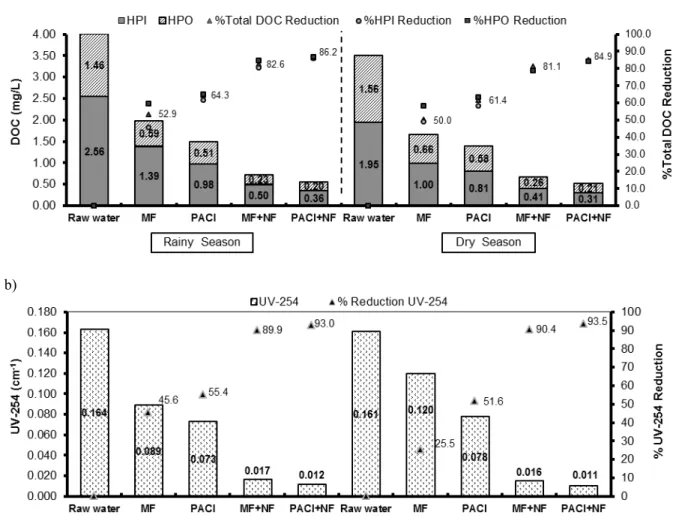
Fig. 2 illustrates the effectiveness of microiltration compared to coagulation by 40 mg/L of PACl under optimised conditions as a pretreatment to reduce dissolved organic matter in the water sample.
The results revealed that both microiltration and PACl processes reduced dissolved organic matter and dissolved organic carbon by 52.9% and 64.3% in the rainy season and 50% and 61.4% in the dry season respectively. Results for UV-254 were 45.6% and 55.4% in the rainy season and 25.5% and 51.6% in the dry season. Dissolved organic carbon removal was therefore higher than UV-254 removal. The result also showed that the PACl process reduced dissolved organic matter in terms of dissolved organic carbon and UV-254 better than the microiltration process in both seasons. These two pretreatment techniques were more effective for reducing the hydrophobic fraction than the hydrophilic fraction. This was because coagulation preferentially removed high molecular
a)
b)
weights as the hydrophobic fraction (AWWA, 1993; Sharp et al., 2006). The hydrophobic fraction
comprised the humic acid fraction and the fulvic acid fraction for hydrophobic acid treatability coagulation (Bond et al., 2009). The solubility of the hydrophobic
substances in raw water reduced because these molecules attached to other anionic organic particles in the raw water (Dentel and Gossett, 1988; Ching et al.,
1994). Moreover, the loc formation of PACl favoured the production of non-soluble aluminium complexes with polar molecules and oxygen containing functional groups such as hydroxyl and carboxyl (Licsko, 1993). Therefore, the charge neutralisation destabilised the colloid and caused settling of the metal cations together with the organic anions (Jekel, 1986). In addition, the hybrid PACl with nanoiltration removed the dissolved organic matter as dissolved organic carbon and UV-254 better than nanoiltration; this process showed higher performance in hydrophobic fraction reduction than for the hydrophilic fraction.
3.3. . The role of pretreatment on nanoiltration mem
-brane lux declining and fouling
The effect of coagulation and the microiltration pretreatment process on nanoiltration lux behaviour was observed (Fig. 3). The measured lux was plotted against time. The nanoiltration membrane lux with 40 mg/L of PACl pretreatment was lower than that pretreated by the microiltration process. The effect of dissolved organic matter interaction dominated flux decline on the membrane surface. Increasing dissolved organic matter caused accumulation, suggesting increased cake formation on the membrane surface. The cake is mainly a porous and loose structure, representing lower resistance to iltration (Fig. 4).
The coagulated water was filtered by the nanoiltration process and the locs deposited on the surface of the membrane formed a cake that absorbed the residual dissolved organic matter. The cake was Figure 3. Effect of coagulation and microfiltration on nanofiltration membrane flux decline
Rainy season Dry season
50,000x (a)
50,000x (b)
50,000x (c) Figure 4. Fouling on surface nanofiltration by SEM analysis; a) New membrane, b) pre-treated by
15 was not stuck to the surface. Microiltration uses a size sieving mechanism with pore size of 0.1 µm that effectively reduces particles larger than 0.1 µm in water. However, particles smaller than 0.1 µm such as humic substances with particle sizes in the range of 0.0025-0.01 µm were not effectively reduced. The dissolved organic matter substances that remained in the water after the microiltration process were rejected by the nanoiltration membrane. These substances with small particle size can be plugged or adsorbed into the pores of the nanoiltration membrane as seen in Fig. 4(b). The locs and uncoagulated dissolved organic matters with sizes smaller to membrane pores may cause pore blocking fouling that is irreversible fouling (Kimura
et al., 2008).
3.4. The removal eficiency of trihalomethane formation potential using two different techniques as pretreatment
combined with nanoiltration membrane
Trihalomethane formation potential (THMFP) has been commonly used to determine the trihalomethanes (THMs) at the completion of the reaction between dissolved organic matter and the excess amount of chlorine. The THMFP was determined from t h e s u m m a t i o n o f C h l o r o f o r m ( C H C l3) ,
Bromodichloroform (CHCl2Br), Dibromochloroform
(CHClBr2) and Bromoform (CHBr3). The results from
the evaluation of raw water from the pumping station in both seasons (Table 2) revealed that the total
dry seasons was 463 µg/L and 350 µg/L respectively. The dominant species of trihalomethanes were chloroform and bromodichloroform. During the rainy season the maximum concentrations of trihalomethanes detected in the chlorinated water samples were 403 µg/L for chloroform and 60 µg/L for bromodichloroform. In the summer dry season the maximum concentrations of trihalomethanes were 286 µg/L for chloroform and 64 µg/L for bromodichloroform. USEPA revised and issued the Disinfectants/Disinfection By-products (D/ DBP) rule which reduced the maximum contaminant levels (MCLs) for THMs to 80 µg/L (USEPA, 2009). The World Health Organisation (WHO, 2004) adopted this report as a water quality standard for tap water in Thailand, with maximum acceptable levels for chloroform and bromodichloroform set at 200 µg/L and 60 µg/L.
The trihalomethane formation potential was related more to the hydrophilic fraction than the hydrophobic fraction, whereas the removal efficiency of the hydrophilic fraction was lower than the hydrophobic fraction (Fig. 5). This was due to the smaller molecular size and solubility of the hydrophilic fraction. The raw water from the pumping station contained a high hydrophilic fraction. Appropriate treatment technology and watershed management is important as a large portion of the hydrophilic fraction is produced by human activities. However, the trihalomethane formation potential of water treated by the hybrid nanofiltration process met the international WHO standard and also the local standard of the Metropolitan Waterworks Authority (Thailand).
Table 2. Comparison the ratio of trihalomethane formation potential (THMFP) detected before and after the fractionation in the raw water
Sample THMFP (%)
Pumping station (Rainy season)
Unfraction Chloroform (87%) > Bromodichloroform (13%)
THMFPHPI(67%) > THMFPHPO(33%) HPI Chloroform (88%) > Bromodichloroform (12%)
HPO Chloroform (85%) > Bromodichloroform (15%)
Pumping station (Dry season)
Unfraction Chloroform (82%) > Bromodichloroform (18%)
THMFPHPI(63%) > THMFPHPO(37%) HPI Chloroform (83%) > Bromodichloroform (17%)
HPO Chloroform (82%) > Bromodichloroform (18%)
The trihalomethane formation potential was related more to the hydrophilic fraction than the
4. Conclusions
Raw water from the pumping station, Hat Yai Provincial Waterworks Authority had low alkalinity, low turbidity and low SUVA which made it dificult to treat by the coagulation process. Pretreatment with PACl coagulation reduced the dissolved organic matter in terms of dissolved organic carbon and UV-254 more effectively than the microfiltration process in both wet and dry seasons. These two pretreatment techniques were more effective in reducing the hydrophobic fraction than the hydrophilic fraction. The rejection of dissolved organic carbon and UV-254 using the hybrid PACl with the nanoiltration method was 86% and 94% respectively, better than microfiltration with the nanofiltration process at 81% and 91%. Nanoiltration lux decline depended on the pretreatment process and related to the size distribution of the remaining organic substances. Microfiltration with the nanofiltration process yielded higher nanoiltration lux than PACl. Microiltration or PACl as pretreatment caused different fouling on the nanoiltration membrane. Furthermore, the fouling type on the nanoiltration membrane was affected by the microiltration membrane pore size
layer formed when PACl was used as a pretreatment. In addition, the trihalomethane formation potential value of the water after treatment by the hybrid nanoiltration process was lower than both the WHO and the Metropolitan Waterworks Authority Thailand standards.
Acknowledgements
The authors appreciate the Faculty of Engineering, Prince of Songkla University, Thailand (contract reference number ENG520105M) and Water resource management and technology research team for inancial support.
References
American Public Health Association (APHA). Standard methods for the examination of water and wastewater.
19th ed. American Public Health Association, Washington
DC, USA. 1995.
American Public Health Association (APHA). Standard methods for the examination of water and wastewater. 22nd
ed. American Public Health Association, Washington DC, USA. 2012.
AWWA. Characterization of natural organic matter and its relationship to treatability. AWWA Research Foundation Figure 5. Trihalomethane formation potential removals by Hybrid-nanofiltration process
Rainy Season
SA. Chemical and biological oxidation of NOM surrogates and effect on HAA formation. Water Research 2009; 43(10): 2615-22
Ching HW, Tanaka TS, Elimelech M. Dynamics of coagulation of kaolin particles with ferric chloride. Water Research 1994; 28(3): 559-69.
Choi YH, Nason JA, Kweon JH. Effects of aluminum hydrolysis products and natural organic matter on nanofiltration fouling with PACl coagulation pretreatment, Separation and Puriication Technology 2013; 120: 78-85.
Dentel SK, Gossett JM. Mechanisms of coagulation with aluminum salts. Journal American Water Works Association 1988; 80(4): 187-98.
Gorenlo A, Velázquez-Padrón D, Frimmel FH. Nanoiltration of a German groundwater of high hardness and NOM content: performance and costs. Desalination 2003; 151(3): 253-65.
Inthanuchit K. Removal of hydrophilic and hydrophobic organic fraction in raw water supply from U-Tapao Canal. Master Thesis. Prince of Songkhla University, Songkhla, Thailand, 2009.
Jacangelo JG, Trussell RR, Watson M. Role of membrane technology in drinking water treatment in the United States. Desalination 1997; 113(2-3): 119-27.
Jekel MR. Interaction of humic acids and aluminum salts in the flocculation process. Water Research 1986; 20(12): 1535-42.
Kim HC, Yu MJ. Characterization of natural organic matter in conventional water treatment processes for selection of treatment processes focused on DBPs control. Water Research 2005; 39(19): 4779-89.
Kimura K, Maeda T, Yamamura H, Watanabe Y. Irreversible membrane fouling in microfiltration menbranes filtering coagulated surface water. Journal of Membrane Science 2008; 320(1-2): 356-62.
Korshin GV, Li CW, Benjamin MM. Monitoring the properties of natural organic through UV spectroscopy: A consistent theory. Water Research 1997; 31(7): 1787-95.
Licsko I. Dissolved organics removal by solid-liquid phase separation (adsorption and coagulation). Water Science and Technology 1993; 27(11): 245-48.
Marhaba TF, Washington MB. Drinking water disinfection by-products: history and current practice. Advances in Environmental Research 1998; 2(1): 103-15.
Marhaba TF, Pu Y, Bengraine K. Modiied dissolved organic matter fractionation technique for natural water. Journal of Hazardous Materials 2003; 101(1): 45-53.
Musikavong C, Wattanachira S, Nakajima F, Furumai H. Three dimensional luorescent spectroscopy analysis for the evaluation of organic matter removal from industrial estate wastewater by stabilization ponds. Water Science and Technology 2007; 55(11): 201-10. Ohno K, Matsui Y, Itoh M, Oguchi Y, Kondo T, Konno Y,
Matsushita T, Magara Y. NF Membrane fouling by aluminum and iron coagulant residuals after coagulation-MF pretreatment. Desalination 2010; 254(1-3): 17-22
natural organic matter and its relationship to treatability. AWWARF, Denver, CO, USA. 1993.
Sari MA, Chellam S. Surface water nanofiltration incorporating (electro) coagulation-microfiltration pretreatment: Fouling control and membrane characterization. Journal of Membrane Science 2013; 437: 249-56.
Sharp EL, Parson SA, Jefferson B. Coagulation of NOM: linking character to treatment. Water Science and Technology 2006; 53(7): 67-76.
Suksaroj C, Rattanamanee P, Musikavong C, Wattanachira S. The determination of tryptophan and humic and fulvic acid-like substances reduction in raw water from U-Tapao Basin, Thailand with alum coagulation. Water Practice and Technology 2009; 4(2): DOI: 10.2166/ wpt.2009.022.
USEPA. List of established maximum contaminant levels (MCL) and their maximum contaminant level goals (MCLG) [homepage on the Internet]. USA: 2009 [cited 2010 Feb 17]. Available from: http://www.epa. gov/safewater/chemicalcontaminant rules/basic information.html.
WHO. Chemical from water treatment and distribution [monograph on the Internet]. 2004 [cited 2009 Oct 1]. Available from: http://www.who.int/water_s anitation_health/dwq/cmp130704chap8.pdf.
Yoon Y, Amy G, Cho J, Her N. Effects of retained natural organic matter (NOM) on NOM rejection and membrane flux decline with nanofiltration and ultrafiltration. Desalination 2005; 173(3): 209-21.
Received 2 September 2015 Accepted 25 December 2015
Correspondence to
Dr.Thunwadee Tachapattaworakul Suksaroj ASEAN Institute for Health Development, Mahidol University,
Salaya, Putthamonthon, Nakhonphathom, 73170
Thailand
Tel: +66 2441 9040-3 ext.33 Fax: +66 2441 9044