Dissolved organic matter (C, N, P) on the Pernambuco coast and Fernando
de Noronha archipelago (Tropical Zone of Western South Atlantic,
Brazil) - A contribution to the evaluation of environmental impact
The dissolved organic compounds found in seawater offer an indication of biogeochemical processes and anthropogenic influence in the light of their concentrations and behavior associated with different oceanic areas. River inputs con -tribute with organic loads to seawater according to the level of natural and urban influence. A dilution of this material is expected toward ocean. Around oceanic islands, the quantity of organic matter results from the life cycle of marine organ -isms and from human occupation. The ratios of dissolved organic carbon (DOC), dissolved organic nitrogen (DON), dissolved organic phosphorus (DOP) and the association with dissolved oxygen can be used to evaluate the environ -mental conditions in terms of natural and anthropogenic impacts. Available information about the essential dissolved organic compounds (C, N and P) in seawater is rare. This study seeks to encourage the use of dissolved organic com -pounds in environmental impact assessment in coastal areas of Brazil. The spatial distribution of DOC, DON, DOP and urea was analyzed in four regions: Itamaracá (ITA), Recife Inner Shelf (RIS), Fernando de Noronha Island (FN) and Recife Harbor (RH), all in Pernambuco State - Brazil. In the case of DOC, the values obtained varied from 51.60 µmol L-1 (0.62 mg L-1) to 358.47 µmol L-1 (4.30 mg L-1), DOP val -ues varied from 0.01 to 2.16 µmol L-1, both presenting their highest values in RH, the most intensely urbanized area. In relation to DON, an extremely high value 92.89 µmol L-1, with urea reaching 12 µmol L-1, both in RH, reflects organic and sanitary discharge. Sometimes the urea concentration was associated with precarious sewage treatment combined with tourist activity, as in the case of FN. No significant spa -tial variation was observed for DOP taking into account all the stations and regions, and the values presented a greater range of variation in FN. The DOC:DON ratios were higher than 7 (2-4 times the Redfield ratio) and revealed the quality of the organic matter and the importance of the local pro-cess of remineralization, confirming that the N-limitation enhanced the use of organic forms, mainly on FN. The pre -served oligotrophic conditions of the RIS, Itamaracá and FN were observed in relation to dissolved organic compounds (C, N, P), but, as regards FN, effective monitoring actions are advisable as it is a pristine area.
A
bstrAct
Elisabete de Santis Braga
1*, Glaucia Bueno Benedetti Berbel
1, Vitor Gonsalez Chiozzini
11Laboratory of Biogeochemistry of Nutrients, Micronutrients and Traces in oceans (LABNUT)do Instituto Oceanográfico da
Universidade de São Paulo
(Praça do Oceanográfico, 191 - Butantã - SP - 05508120 - Brazil)
*Corresponding author: [email protected]
Descriptors:
Dissolved organic nitrogen, dissolved
organic phosphorus, total organic carbon, urea,
Coastal and oceanic areas.
Os compostos orgânicos dissolvidos encontrados na água do mar oferecem uma indicação de processos biogeoquímicos e influência antropogênica à luz de suas concentrações e compor -tamentos associados a diferentes áreas oceânicas. Os aportes de rios contribuem com cargas orgânicas para a água do mar de acordo com o nível de influência natural e urbana. Uma diluição deste material é esperada no oceano. Em torno das ilhas oceâni -cas, a quantidade de matéria orgânica é influenciada pelo ciclo de vida dos organismos marinhos e pela ocupação humana. As proporções de carbono orgânico dissolvido (DOC), nitrogênio orgânico dissolvido (DON), fósforo orgânico dissolvido (DOP) e sua associação com oxigênio dissolvido podem ser utilizadas para avaliar as condições ambientais em termos de impactos naturais e antropogênicos. A informação disponível sobre os compostos orgânicos dissolvidos essenciais (C, N e P) na água do mar é rara. Este estudo busca incentivar o uso de compos -tos orgânicos dissolvidos na avaliação de impacto ambiental nas áreas costeiras do Brasil. A distribuição espacial de DOC, DON, DOP e ureia foi analisada em quatro regiões: Itamaracá (ITA), Plataforma Interna de Recife (RIS), Ilha Fernando de Noronha (FN) e Porto de Recife (RH), todos em Pernambuco - Brasil. No caso do DOC, os valores obtidos variaram de 51,60 μmol L-1 (0,62 mg L-1) a 358,47 μmol L-1 (4,30 mg L-1), os va -lores de DOP variaram de 0,01 a 2,16 μm L-1, ambos Apresen -tando seus valores mais altos em RH, a área mais intensamente urbanizada. Em relação ao DON, um valor extremamente alto de 92,89 μmol L-1, com ureia atingindo 12 μmol L-1, ambos em RH, refletem a descarga orgânica e de esgoto. Às vezes, a concentração de ureia esteve associada ao tratamento precário de esgoto combinado com a atividade turística, como no caso de FN. Nenhuma variação espacial significativa foi observada para DOP tendo em conta todas as estações e regiões, e os valo -res ap-resentaram maior variação de FN. Os índices DOC:DON foram superiores a 7 (2-4 vezes a relação Redfield) e revelaram a qualidade da matéria orgânica e a importância do processo lo -cal de remineralização, confirmando que a N-limitação aumen -tou o uso de formas orgânicas, principalmente em FN. As con -dições oligotróficas preservadas em RIS, Itamaracá e FN foram observadas em relação aos compostos orgânicos dissolvidos (C, N, P), mas no que diz respeito ao FN, são recomendáveis ações de monitoramento efetivas, pois é uma área remota preservada.
r
esumo
Descritores:
Nitrogênio orgânico dissolvido, Fósforo
orgânico dissolvido, Carbono orgânico total, ureia,
Áreas costeiras e oceânicas.
INTRODUCTION
The processes of organic matter construction and deg-radation in the marine environment are permanent and associated with the predominant metabolism of the sys -tem. The dissolved organic C, N and P forms contribute to the understanding of the natural scenarios in each zone of marine systems and also, reveal the degree of anthro -pogenic influence (Cozzi et al., 2014). On this basis, the comprehension of the organic matter dynamic with a focus on dissolved organic matter expressed by C, N and P was used in four different environments with distinct levels of anthropogenic influence and marine hydrodynamic as a contribution to evaluation of environmental impact.
Since Harvey (1955), it has been assumed that in oce -anic areas, low nutrient concentrations during the greater part of the year indicate that primary production is nutri -ent–limited. On the other hand, it is known that in coastal areas, mainly in zones with riverine inputs, the presence of nutrients increases naturally and that nowadays the an -thropogenic contribution promotes an excess of nutrients, indicating an environmental risk of eutrophication even when the initial forms are organic compounds, which are easily mineralized.
There are essentially three sources of organic dis -solved material in aquatic environments, the decompo -sition of plant and animal material with an estimated 15 -50% loss of total biomass by post-mortem changes in the permeability of cell membranes and the effects of autolytic enzymes (Krause et al., 1961) such as amino acids, more easily degradable, keto-acids and the most refractory ma -terial dependent on bac-terial action. A second source of dissolved organic material is the release of extracellular components by living plants and animals by the excretion and secretion of products of their metabolism. A variable rate of from less than 15% to more than 30% of total fixed carbon is released as extracellular product by phytoplank -ton species (Eppley and Sloan, 1965; Watt, 1966; Antia et al., 1963, Parsons and Seki, 1970; Goto et al., 1999). The third source is the anthropogenic contribution in the form of sewage, domestic and agricultural effluents, port activi -ties and others organic effluents. The importance of organ -ic matter in aquat-ic systems is noteworthy, but not enough data are available from some parts of coastal and oceanic areas, as it is presumed that more and more organic mate -rial reaches the oceans. The dissolved fraction of organic matter represents the principal matrix to be worked on by microorganisms releasing inorganic compounds for
primary production, which reinforces the need for studies focused on the biogeochemical behavior of organic matter in seawater.
Some studies of the biogeochemistry of dissolved organic carbon (DOC) and dissolved organic nitrogen (DON) in the open oceans have been published (Bates and Hansell, 1999; Hansell, 2002) yet, despite the importance of coastal seas for the cycling of dissolved organic mat -ter (DOM) (Duursma, 1961; Walsh et al., 1988; Wollast, 1991), few studies have focused on these seas (Hung et al., 2003).
Regardless of its refractory character, a relatively large fraction of that DOM is degraded after being mixed with seawater, with turnover times ranging from days to years (Cauwet, 2002). Though time has passed, Bates and Hansell’s (1999) observation continues to be valid con -sidering that much remains to be learned about the spatial gradients of organic carbon and nitrogen and the processes that control the fluxes and cycling of carbon in oceanic coastal regions. Seasonal studies are important to enable us to understand the effect of wet and dry periods on DOM cycling. This study therefore seeks to provide more infor -mation about DOM (DOC, DON and DOP) on the north -eastern Brazilian coast.
Dissolved organic carbon (DOC)
In general, riverine inputs of DOM represent about 0.25 Gt C per year. This annual input accounts for only about 0.04% of the DOC content of the oceans, assessed at 685 Gt C (Hansell and Carlson, 1998).
levels of bioavailable inorganic compounds and with the excretion and decomposition of particulate organic matter. In particular, microorganisms such as heterotrophic bacte -ria remove DOC by mineralization and by its incorpora -tion into bacterial cell tissue.
The range of DOC in seawater is between 1500 and 2000g m-2 (Braga, 2002), the carbohydrates constitut -ing the principal class of organic compounds in seawa-ter (~70%). A variety of compounds integrate the DOC, including protein and free amino-acids, hydrocarbons (~1%), lipids, vitamins and other compounds such as urea, nucleic acids (<1%) and a contribution of humic substances (10-30% of DOC) is significant in estuarine systems; however, a variety of complex chemical struc -tures belonging to the humic group reach the ocean and the recent introduction of personal care products (such as medicines, beauty products, personal hygiene products, sun block, etc.) form a new group of DOC present close to the coast. Inland waters may introduce anthropogenic DOC in estuaries as a result of pollution, including oil at sea and pesticides in rivers (Aston, 1978). A common process that retains organic compounds near the mouth of estuaries is the flocculation process.
Finally, DOC normally presents a richness of labile compounds more easily biodegradable by microorgan -isms than particulate matter and whose decomposition is more difficult in the open ocean than in coastal waters near solid surfaces on which heterotrophic microorganisms are abundant (Braga, 2002).
Dissolved organic nitrogen (DON)
Nitrogenous organic compounds can be found in the marine environment in particulate and dissolved forms in various chemical speciation (amino acids, proteins, lipid nitrogen, urea, alkaloids and others), with concentrations spatially and temporally distributed in different ways. The decomposition and metabolism of organic N can lead to the formation of ammonium and urea composing the in-organic and in-organic dissolved pool of N, as well as other organic compounds.
The availability of nitrogen in the organic form in sur -face seawater is remarkable because of the metabolism of the system, including the primary production process and the food chain generation of organic matter and organic detritus. The degradation process occurs by means of the oxidation of the organic matter in the euphotic zone, dur -ing its sink-ing and also when it reaches the sediments.
The nitrogen cycle works among the inorganic com -ponents, forms derived from organic matter and during their integration into biological processes. Organic nitro -gen is a key element in the construction of living organic matter, dissolved inorganic nitrogenous compounds being most commonly used in marine primary production, in the form of N-ammonium, nitrate and nitrite. The assimila -tion of N-ammonium takes place principally by means of phytoplankton organisms and its regeneration in the marine environment is more complex as it depends on the activity of microorganisms. The main sources of the N-ammonium occurring in the marine environment are the decomposition of organic nitrogen by bacteria; excre -tion by zooplankton and other animals, including anoxic bacteria; discharge from streams, and precipitation over the sea. The main ammonium sinks include ammonium assimilation by phytoplankton and ammonium oxidation to nitrite and nitrate by nitrification (Wada and Hattori, 1991). The nitrate nitrogen nutrient is the most stable and abundant form of nitrogen in the open ocean and is controlled primarily by assimilation by phytoplankton, re -generation through the decomposition of organic matter and denitrification under anaerobic conditions (Wada and Hattori, 1991). Although nitrate is the most abundant form of nitrogen nutrient found in the ocean, ammonium is the form preferably assimilated by phytoplankton, since this is the ammonium ion, a nitrogen in their optimal oxida -tion state for its more direct assimila-tion during the protein forming process. Nitrite is the intermediary in oxidation-reduction reactions involving ammonia and nitrate. Nitrite is not found in high concentrations in the natural marine environment, its concentration being governed mainly by biological processes such as oxidative production by nitri -fying bacteria; its production and consumption occurring through the respiration of bacteria that use nitrogen com-pounds as electron acceptors, and oxidative consumption by the nitrifying bacteria.
Urea in the nitrogen cycle
organisms, is considered to be connected to two metabolic groups: the cycle of ornithine-urea on one hand and pu -rine-urea, another part of the nitrogen cycle, on the other (Braga, 2002). Urea is the predominant final metabolite that permits the excretion of nitrogen from mammals with concentrations of 7.7 g l-1 in human urine (Udert et al., 2006). The increase in concentrations of urea in coastal areas is attributed to urban sewage, the contribution of at -mospheric deposition being rare (Cozzi et al., 2014). In the marine environment, urea is an important component of the biogeochemical nitrogen cycle (Antia et al., 1991; Bronk, 2002; Solomon et al., 2010). Rather low levels of urea are found in the open sea (0.3 μmol L-1 N), whereas higher values (reaching 13 μmol L-1 N) are often observed in the coastal and estuarine zones.
On the other hand, urea is also considered an or -ganic source of N for small groups of organisms in sea -water. A preference for the assimilation of urea by the Phaeodactylum, a phytoplankton organism, has been observed (McCarthy, 1972). So, in the biogeochemical nitrogen cycle, urea plays a role in the excretion of meta -bolic products of N, it is also a source of dissolved organic nitrogen for some autotrophic species and a substrate for bacteria to have the potential to indicate marine pollution on the coast.
Dissolved organic phosphorus (DOP)
Phosphorus is an essential nutrient for primary pro -duction and can be a limiting factor in marine systems (Benson et al., 1996) due to its role in the construction of organic matter and also by reason of its participation in the conversion of energy throughout the biological sys -tem by means of ATP molecules. In natural waters, dis -solved phosphorus is found in several chemical forms that may be categorized as inorganic (protonated forms of PO43-) or organic (incorporated into organic molecules,
such as those of biological origin including nucleic acids, polyphosphates, phosphorus esters and phosphonates) (Thomson-Bulldis and Karl, 1998; Benitez-Nelson, 2000; Kolowith et al., 2001). It has always been generally ac -cepted that all plankton can utilize inorganic phosphorus, only in the last 15 years, however, have oceanographers demonstrated that dissolved organic phosphorus (DOP) is available to both phytoplankton and bacteria for produc -tion (Monaghan and Ruttenberg, 1999; Kolowith et al., 2001). It is, therefore, important to quantify organic phos -phorus as it is potentially available for primary production in coastal systems.
The availability of phosphorus to the marine environ -ment is considered to be one of the main controlling fac-tors of primary production on both ancient and modern geological time scales (Schenau et al., 2005). Phosphorus is provided for estuarine, coastal and ocean environ -ments through the processes of rock weathering and river transport.
Another form of dissolved phosphorus in the aquatic environment is its organic form whose sources are ad-enosine triphosphate (ATP), phosphonucleotides, phos -pholipids and many products of the decomposition of the organic matter of phosphate diesters and monoesters and phosphonates (Kolowith et al., 2001). The main sources of the phosphorus that supports marine primary production are inorganic, but there are several species that have the capacity to take advantage of both N and P in the form of small organic molecules (Ruttenberg, 2005). In situations where a P deficiency occurs, the activity of the alkaline phosphatase enzyme may be activated in order to hydro -lyze the phosphoric esters to support primary production (Kobayashi et al., 1983). Yet phosphorus is considered one of the main constraints on primary production along with nitrogen.
Phosphorus is part of the group of nutrients essential for life and has a biogeochemical cycle. It participates no -tably in marine pollution mainly in the eutrophication pro -cess due to the input from domestic and industrial effluents and leaching in agricultural and port regions; P’s behavior thus deserves attention in coastal systems under different degrees of anthropic impact.
Study areas
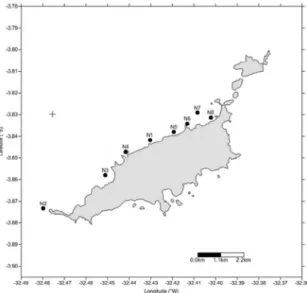
This study was undertaken in four different areas of the Northeastern region of Brazil, namely, Fernando de Noronha Island (FN), Recife Inner Shelf (RIS), Recife Harbor (RH) and Itamaracá (ITA), all of them in the state of Pernambuco.
25.4 ◦C, mean water temperature of 26-27 ◦C and mean salinity of 36 (Maida and Ferreira, 1997). In this region 8 stations (N1-N8) located in the Inner Sea (off the north-western coast of the island) were sampled (Fig. 1).
Figure 1. Spatial distribution of sampling stations (FN) on Fernando
de Noronha Island, in March 2015.
Recife city was built in the estuarine area of the Capibaribe River and several smaller rivers (Beberibe, Tejipio, Jordão and Jiquia), with a network of second -ary waterways. The tide, penetrating the estu-ary, favors mangrove ecosystems, threatened by urban planning. Recife has a hot and humid tropical monsoon climate. Temperatures have little seasonal variation, with a mean of 25°C. Under the influence of the Southern Oscillation (El Nino in 2005 and 2010, La Nina in 2000) and the Atlantic Dipole (Intertropical Convergence Zone), the average rainfall is 2000 mm/year. There are two clearly distinguishable seasons: a rainy one (March-August, 250 mm/month), and a dry one (September-February, 100 mm/month). Rainfall is also spatially highly ir -regular, decreasing westwards from the city. The years 1998-1999 and 2012–2013 are considered to have been extremely dry, and are known as Recife’s most severe droughts. The average levels of precipitation for 2012-2013 attained 1770 mm, 11% below the mean for the period 1961-1990. Except for May 2013, each month of 2012-2013 was between 15 and 90% drier than the re -spective monthly averages for 1961-1990. Nine stations (R1-R9) were sampled on the neighboring shelf and 4 in the port channel (R10-R13), (Fig. 2).
Figure 2. Spatial distribution of stations on Recife’s inner shelf (RIS)
and in the Recife Harbor (RH) channel, March 2015.
The coastal estuarine complex of the Ilha de Itamaracá, located on the northern coast of the state of Pernambuco, approximately 50 km from the city of Recife, is a region distinct from the others by virtue of its high primary pro -ductivity and faunal diversity (CONAMA, 2001). The flat tidal area where the sampling was conducted is about 300 m from the waterline during the average low water spring tides. The area close to the coast is covered by very shallow waters, which makes it difficult to work on with a medium-sized vessel. Six stations (I1-I6) were sampled in this region (Fig. 3).
Figure 3. Spatial distribution of stations (I) off Itamaracá (ITA), in
March 2015.
MATERIAL AND METHODS
Sampling
The seawater samples were collected using Hydrobios®
bottles for determining dissolved oxygen, salinity and N-ammonium and to measure temperature and turbidity. A van Dorn sampling bottle was used for taking water for the dissolved organic (C, N and P) determinations and also to determine inorganic nitrogen (nitrite and nitrate) and phosphorus (phosphate). The water samples were filtered using a preheated (450 °C for 4 h) Whatman® GF/F filter
(47 mm), except for N-ammonium. DON and DOP were sub-sampled from filtered material and analyzed initially as total dissolved nitrogen and phosphorus. In relation to DOC, the subsamples were not filtered and were acidified with a minimum of H3PO4 concentrate in order to elimi-nate the carboelimi-nates (DIC).
Abiotic measurements
Temperatures were measured with protected rever-sal mercury thermometers with a precision of ±0.02ºC. Salinity was determined with a Beckman RS-10 induction salinometer with a precision of 0.001. Turbidity was mea -sured with a nephelometer Hach® model 2100P with 0-100
NTU. The pH was measured using a pHmeter Orion®
with a precision of ±0.001. Dissolved oxygen was mea -sured by the Winkler method as described in Grasshoff et al. (1983), using a Titrando Metrohm® system, with
a precision of 0.02 mL L-1. The oxygen saturation (OS) was calculated based on an equation given by Aminot and Chaussepied (1983). Ammonium was measured as described by Tréguer and Le Corre (1975). Nitrate and nitrite were determined by a colorimetric method as de -scribed in Grasshoff et al. (1983) using an Autoanalyzer II, Bran-Luebbe® with a precision of 0.01µmol L-1 for both.
Dissolved inorganic phosphorus (phosphate) was mea-sured as described in Grasshoff et al. (1983) by the mo -lybdenium blue spectrophotometric method, with a pre -cision of 0.01µmol L-1. The dissolved inorganic nutrients described here, were used to compose the DIN and DIP used to obtain DON and DOP values from total dissolved nitrogen (TDN) and phosphorus (TDP) analyses resulting from the photo-oxidation process described below.
Analyses of dissolved organic compounds
Dissolved organic carbon (DOC)
DOC was determined by a high-temperature catalytic oxidation method using a Vario Cube® analyzer. Briefly,
acidified seawater samples were purged with pure synthet -ic air for 5 min to eliminate inorgan-ic carbon, and then, 7
mL was injected directly into the vertical furnace which contained a standard platinum catalyst at a temperature of 850oC. Oxidation of the DOC occurs by non-dispersive
infrared detection of the carbon dioxide generated. Only the instrument blank was considered as the DOC blank in the calculation of DOC concentrations. During the experi -ments, the instrument blank was about 3-6 mmol L-1.
Dissolved organic nitrogen (DON) and
Dissolved organic phosphorus (DOP)
Dissolved Organic Nitrogen (DON) and Dissolved Organic Phosphorus (DOP) were analyzed by UV-oxidation process in presence of an excess of dissolved oxygen assured by adding hydrogen peroxide, thus de -termining Total Dissolved Nitrogen (TDN) and Total Dissolved Phosphorus (TDP) (Armstrong et al., 1966, Braga, 2002). The extract after photo-oxidation was ana -lyzed for the nitrate and phosphate as described before. Dissolved nitrogenous compounds in seawater were oxi-dized to nitrate in the presence of dissolved oxygen under the action of UV radiation energy.
Urea
The urea content was assessed using the analytical method described by Aminot and Kerouel (1982) adapted for manual determination. The samples were placed in re -action flasks and received 1 mL of two reagents (A - di -acetyl monoxide and thiosemicarbazide; and B - sulphuric acid and iron chloride) after which, the flasks were sub -merged in the water bath (90 ° C) for 45 minutes. Then, the samples were cooled until reach the laboratory tem -perature to proceed with the spectrophotometer reading at 526mn. The method has a detection limit of ± 0.02 µmol L-1 of urea.
Data treatment
The Shapiro -Wink test was used to test the normality of the data for analyzing the type of correlation to be used (Spearman or Pearson), spatial variation being determined by the analysis of variance (ANOVA). The spatial distribu -tion of the studied parameters were showed by figures made using Microsoft Excel 2013® software, which also undertook
Spearman’s nonparametric correlation (rs). The Principal com -ponent analysis (PCA) was made on the basis of standardized data of the variables studied, and was undertaken using Past 3.0 software®. The data were treated with a significance level
RESULTS
Physical and chemical characteristics of
the water
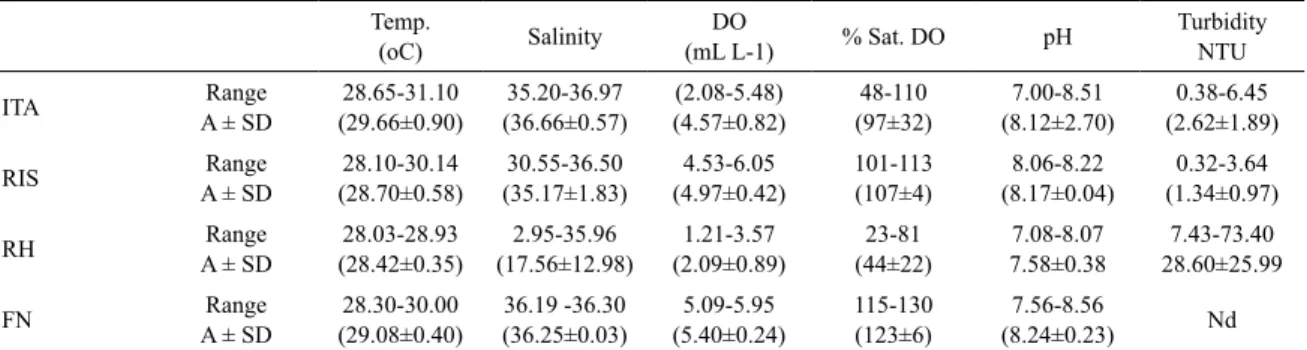
Values of temperature, salinity, dissolved oxygen (DO), saturation of oxygen (DO), pH and turbidity are summarized in Table 1. According to the Shapiro –Wink test, all of them were considered non-parametric and the Kruskall-Wallis test was used for comparing spatial differ -ences between Itamaracá, RIS, RH and FN.
Temperature, considering all the areas sampled, varied from 28.03 to 31.10°C (Table 1), and the highest average was observed at Itamaracá, a coastal region with shal -low, salt water that presented the highest salinity value (36.97) and, the pH and the maximum turbidity indicating the influence of estuarine dynamic, not evidenced by the salinity.
According to Figure 4, salinity values remained above 35 for Itamaracá and FN, whereas on RIS, values of salin -ity started at 30 and presented varying temperature. On the other hand, values in the harbor channel (RH) presented a seaward increase in salinity (r2 = 0.86) with a more re -stricted variation of temperature. The oxygen values were low at RH, indicating that the consumption process ex -ceeded the production and input of gas. A similar situa -tion was observed, specifically at I6, a shallow sta-tion, the northernmost sampled point, with a minimum of 2.08 mL L-1, increasing towards the northern exit of the Santa Cruz Channel.
Evaluating the dissolved oxygen represented as per -centage of saturation, a remarkable tendency, similar to that for DO concentrations, was observed. The low pH values and highest turbidity indicated an association be -tween these two regions, ITA and RH, both under greater terrestrial influence, due to the Capibaribe river, an area
Table 1. Physical and Chemical data of temperature, salinity, dissolved oxygen (DO), percentage of dissolved oxygen (% DO), pH and turbidity (range, average (A) and SD).
Temp.
(oC) Salinity
DO
(mL L-1) % Sat. DO pH TurbidityNTU
ITA A ± SDRange (29.66±0.90)28.65-31.10 (36.66±0.57)35.20-36.97 (4.57±0.82)(2.08-5.48) (97±32)48-110 (8.12±2.70)7.00-8.51 (2.62±1.89)0.38-6.45
RIS A ± SDRange (28.70±0.58)28.10-30.14 (35.17±1.83)30.55-36.50 (4.97±0.42)4.53-6.05 101-113(107±4) (8.17±0.04)8.06-8.22 (1.34±0.97)0.32-3.64
RH A ± SDRange (28.42±0.35)28.03-28.93 (17.56±12.98)2.95-35.96 (2.09±0.89)1.21-3.57 (44±22)23-81 7.58±0.387.08-8.07 28.60±25.997.43-73.40
FN A ± SDRange (29.08±0.40)28.30-30.00 (36.25±0.03)36.19 -36.30 (5.40±0.24)5.09-5.95 115-130(123±6) (8.24±0.23)7.56-8.56 Nd
nd = not determined I = Itamaracá RIS = Recife’s Inner Shelf RH = Recife Harbor FN = Fernando de Noronha
with the highest values for turbidity (Table 1). Dissolved oxygen saturation varied, in general, from 23 to 130% considering all the regions and the lowest dissolved oxy -gen and saturation values were found in the regions close to the continent. Supersaturation in DO was observed on RIS, but especially on FN, the highest values were found in oceanic waters.
Observing the physical and chemical parameters, the continuity of the properties of the harbor channel on Recife’s inner shelf was evident, and a river plume was identified. The values from less impacted waters, increas -ing towards the open sea, were observed as also at ITA, while at FN, the values presented characteristics of pris -tine regions, almost continuously. These conditions will be referred to shortly.
Mitigation of surface water properties
from recife harbor (RH) to recife’s
internal shelf (RIS)
Hydrological and chemical properties
Figure 4. Salinity versus temperature in 4 areas: Fernando de Noronha
(FN), Recife’s Inner Shelf (RIS), and Recife Harbor (RH), Itamaracá (ITA), in March 2015. Red and blue broken lines show the salinity range between 30 and 35.
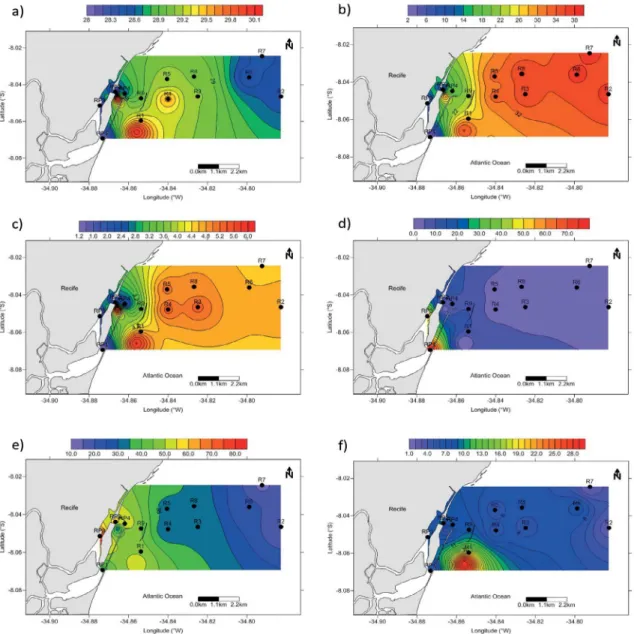
decreasing towards the RIS (Fig. 5e). Particulate organic matter (POM) presented a high values at station R1, in sea -water close to the continent and under the influence of the southern current (Fig. 5f).
Dissolved organic compounds
High concentrations of Dissolved Organic Carbon (DOC), Dissolved Organic Nitrogen (DON) (Fig. 6 a, b) and urea were found at stations 4, 5 and 9, while the highest values of DON were found at the surface in the RIS area. These high concentrations may be attributed to Capibaribe river runoff. This river presents high anthropogenic impact because it receive input of sewage only primarily treated, that contributing to enhance of dissolved organic compound concentrations on the RIS. On the other hand, the external stations on the RIS presented DOC, DON and urea values similar to those of the open ocean (Table 2). Percentages of DON in TDN were 8 to 96% with low values at R1. The highest values of urea were found at the surface at station 5. Despite presenting high values, the percentages of urea in DON were about 33% and the highest values of these percentages were found at station RIS 1, with 71% of urea in DON pool. DON and DOP spatial concentrations in the surface waters of RH and RIS presented different patterns. High levels of DON were found southern of RH, whereas high levels of DOP were found in the northern part of RH (Fig. 6c). DOC presented high concentrations in all the sectors of RH, in the direction to R4 station. As happened with the DON tendency, high concentrations of urea were found in the southern part of RH (Fig. 6d). Considered as an impacted region, RH presented low values of dissolved oxygen, as well as low values of percentages of saturation, while high values of DOC, DON, NTD and urea were ob -served, mainly in low salinity waters, influenced by river inputs, associated with high anthropogenic influence.
DOC, DON and DOP in areas with lowest
anthropogenic influence - Itamaracá and
Fernando de Noronha Island (in pristine
areas)
Observing the Itamaracá region, located northern of Recife, the coastal data enables us to divide it into two ar -eas: i) stations 1 to 3, more distant from the island, presented waters with low values of turbidity, DOC, urea and DON, and ii) stations 4 to 6, closest to the coast, that presented
shallow waters with high levels of turbidity and urea. The lowest salinity was found at station 6, at the northern exit of the Santa Cruz channel.
The organic nitrogen (DON) pool in terms of TDN showed percentages that varied from 45 to 97%. The low -est value was observed at station ITA 4, probably resulting from a different terrestrial input and biological contribution resulting from the secretion and excretion of organic com-pounds. In relation to excretion, the percentages of urea in the DON varied from 2 to 56%, with higher values located at the coastal stations, from ITA 4 to 6, submitted to greater anthropogenic influence in an area of modest human occu -pation as compared to that of RH.
In relation to the oceanic island of Fernando de Noronha, stations FN 5 and 6 presented high DON concentrations, reaching 4.31 mmol L-1 in the bottom water at station 5 (Conceição beach). The highest value of DOC was found at the bottom at station 6 (Cachorro beach). Percentages of urea in the DON varied from 12 to 63%, in this case, the highest percentage being found at FN 2.
No relationship was found between salinity and DOC, DOP, DON or urea, indicating the possibility of rapid changes in concentrations of these parameters, mainly at Itamaracá and FN (Fig. 7a-d). On the other hand, a signifi -cant relationship between DOC and salinity (Fig. 7a) was found in the RH region indicating a process of dilution. DON and salinity also presented a close relationship on the RIS (Fig. 7b).
DISCUSSION
Relationship between dissolved organic
components in surface waters of RIS and
RH
Figure 5. Spatial distribution of hydrological and chemical properties: (a) Temperature (oC), (b) Salinity, (c) Dissolved oxygen (mL L-1), (d)
Turbidity (NTU), (e) Suspended Particulate Matter (mg L-1) and (f) Particulate organic matter (mg L-1) in surface waters of RIS and RH,
Pernambuco-Brazil, in March 2015.
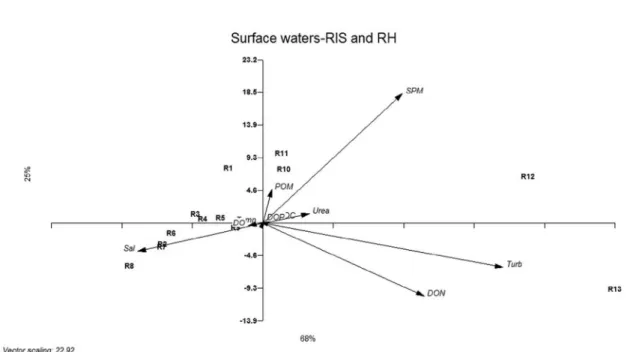
(DOC, DON, DOP and urea) and turbidity was clearly re -markable (Tab. 3) and, in function of it, is possible to infer that these high correlations are related to anthropogenic influence in the Capibaribe river due to untreated sewage inputs. Commonly, in the water body that receive a untreat -ed sewage, the values of urea and dissolv-ed organic matter could reach high concentrations and also the percentage of urea can representing an important fraction of organic mat-ter, informing that it is an important N-source in relation to inorganic N pool, as noticed by Cozzi et al. (2014). It was
also observed that DON was related to the highly turbid wa -ters at station R13 and in general, the high SPM values were related to fresh water, as shown in figure 8 and as observed in the PCA results.
Molar ratios between dissolved organic
compounds
Figure 6. Spatial distribution of dissolved organic matter: (a) Dissolved Organic Carbon - DOC (mg L-1), (b) Dissolved Organic Nitrogen - NOD
(μmol L-1), (c) Dissolved Organic Phosphorus (μmol L-1), (d) Urea (μmol L-1), Pernambuco-Brazil, in March 2015.
found at Itamaracá. The highest values could be due to terres -trial inputs and/or to degradation processes in shallow waters with a terrestrial contribution associated with the quality of the organic matter rich in C compounds. In the case of Fernando de Noronha (FN), an essentially basaltic oceanic island, the terrestrial input is rare due to the very low rainfall, conducing to infer that degradation processes associated with high tem-peratures may be are predominant in its waters.
Generally, if DOC:DON values closer to 6.6 had been observed, that would have indicated a major contribu -tion of organic matter from plankton, fecal pellets and other compounds of biological origin, easily degradable and with great nutritive value, however in all the regions studied, the values of DOC:DON were higher than 7. In this study, most of the stations presented average values of DOC:DON about 2 to 4 times greater than the Redfield ratio. Kolowith et al. (2001), in Pacific Ocean observed values of C:N:P higher than Redfield ratios when consid -ering dissolved organic forms.
This may indicates that in FN there is a probable con -tribution of DOM, mainly from the local water processes
than from any terrestrial contribution, adding to it the low rainfall, typical of the dry season (March 2015), reflect -ing in a different availability of DON in relation to COD. This is maybe due to the quality of the organic matter, as also due to the time residence of DON in this N-limited environment.
The DOC:DON ratio generally ranges from 15 to 30 in the open sea (Haikalla et al. 2015), but in all the regions studied, the DOC:DON molar ratio exceeded the Redfield ratio as observed by Kolowith (2001). Further, there was
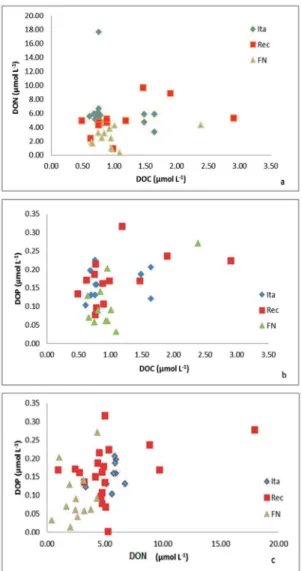
no significant linear relationship between DON and DOC in any of the regions, indicating the strong uncoupling of N and C in the DOM pool (Fig. 9 a), evidencing different origin and/or, biogeochemical processes on C and N.
Table 2. Values of DOP, DON, DOC and urea concentration (in μmol L-1) in different regions and in this study.
DOP
(μmol L-1) (μmol LDON-1)
DOC
(μmol L-1) (μmol LUrea-1) (μmol LUrea-1)
Bay of La Jolla - - - 0.54-1.00 McCarthy et al., 1972
Alaska coast - - - 0.25-2.20 DeManche, 1973
Ubatuba São Paulo
--Brazil - - - 0.05-1.71 Braga, 1995
Santos Bay 0.00-3.24 (summer)0.11-0.76 (winter) 2.57-20.391.49-25.07 - 0.70-4.020.40-3.60 Saraiva, 2002
Mississipi Plume 0.00 -2.50 - - - Rinker & Powell (2002)
Cape Fear River (USA)
Estuary 0.57-1.77 14.80-37.79 - - Dafner et al. (2007)
Santos Channel 0.00-2.08 (summer)0.20-0.50 (winter) - - - Berbel (2008)
São Vicente Channel 0.01-1.02 (winter)1.0.50 (summer) - - - Berbel (2008)
Plym Estuary (USA) - 10-80 90-180 - Badr et al. (2008)
Gulf of Cadiz - 0-20 42 - 198 - Ribas-Ribas et al. (2011)
Gulf of Trieste
(Italy) - - - 1.2-20.0 Cozzi et al. (2014)
Gulf of Riga (Baltic Sea) - - 400-570 - Hoikkala et al. (2015)
Gulf of Finland 0.06-0.29 20.4-22.8 483-690 - Hoikkala et al. (2015)
Itamaracá 0.10-0.22 3.30 -17.64 50.88-136.81 0.02-056 This study
RIS 0.00-0.32 0.94-17.91 40.10-241.88 0.00-2.93 This study
RH 0.02-2.16 2.77-92.89 67.22-358.47 0.99-12.71 This study
FN 0.01 -0.27 0.39-4.31 58.22-198.53 0.50 -4.25 This study
Figure 8. PCA of surface waters on the Recife inner shelf (RIS) and Recife harbor (RH) in Pernambuco, obtained in March 2015. Table 3. Spearman correlation between DOC, DON and DOP and physical and chemical variables.
Temp. Sal. DO Turb. DOC DON DOP Urea SPM POM %POM
Temperature 1.00
Salin. (UPS) 0.57 1.00
OD(mL/L) 0.80 0.92 1.00
Turb. (ntu) -0.54 -0.94 -0.83 1.00
DOC -0.42 -0.91 -0.82 0.77 1.00
DON -0.42 -0.83 -0.76 0.89 0.65 1.00
DOP -0.52 -0.74 -0.66 0.97 0.56 0.83 1.00
Urea -0.59 -0.99 -0.94 0.91 0.92 0.83 0.63 1.00
SPM -0.14 -0.75 -0.61 0.52 0.74 0.27 0.53 0.73 1.00
POM 0.41 -0.02 0.11 -0.05 -0.05 -0.16 0.02 -0.01 0.48 1.00
%POM 0.45 0.38 0.42 -0.31 -0.46 -0.33 -0.24 -0.41 0.00 0.84 1.00
Certainly, DOC and DON availability can influences the phytoplankton community organization as noticed by Church et al. (2002) in Pacific Ocean, related to the or -ganic matter cycling.
No relationship between DOC and DOP was found (Fig. 9b) nor between DOP and DON (Fig. 9c). The vari -ability of the ratios is an indication that DOP and DON are not affected by the same processes. DOP has been found to be preferentially mineralized when compared to DON and DOC (Clark et al., 1998; Kolowith et al., 2001), resulting in the nitrogen-enriched ratios as observed for all the sta-tions. DOP is therefore more labile to phytoplankton than
DON in these systems, leading to shorter turnover times in coastal regions (Suzumura et al., 1998).
Figure 9. Relationship between (a) DOC:DON (b) DOC: DOP (c)
DOP:DON at Ita, REC and FN in March 2015.
nitrogen (Braga et al., in this volume) are found at all the sites typical of oligotrophic waters.
The molar ratio between dissolved oxygen, nitrate and phosphate in marine phytoplankton and in deep oceanic waters is almost constant (O2:N:P=138:16:1; Redfield et al., 1963). Dafner et al. (2007) founding values of O2:DON close to the Redfield ratios. That same author reported that on the shelf, the O2:DON ratios ranged from 24 - 49 and at Itamaracá, RIS and FN, the ratios were extremely high, varying from 16 to 640, indicating a deficit of organic ni -trogen. On the other hand, in RH, values of O2:DON were extremely low.
Organic compounds (DON, DOC and DOP)
throughout the coastal area
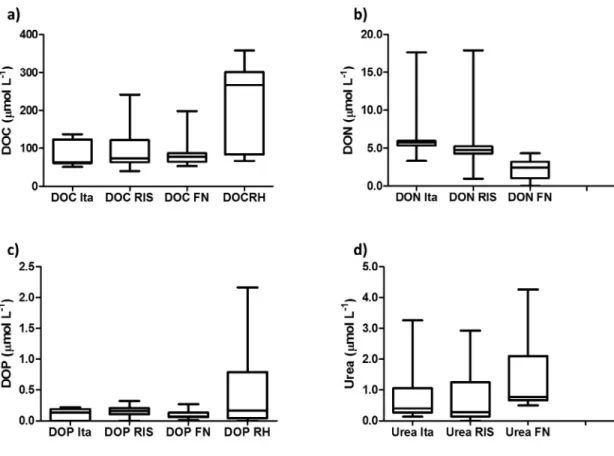
No differences in concentrations of DOC were found on RIS, FN or Itamaracá, except for RH (ANOVA p<
0.05), (Fig. 10a). On the other hand, DON presented spatial differences among the more pristine areas (FN, RIS and Itamaracá) shown in Figure 10b. No differences among DOP concentrations were observed between sta-tions, including impacted stations such as RH (Fig. 10c).
DOP presented less than 50% of TDP in RH and curi -ously also on FN. On the other hand, the highest percentages of DOP/TDP were observed at Itamaracá stations (1 to 5).
According to Dafner et al. (2007), the predominance of DON and DOP in shelf waters could demonstrate either an accumulation of these compounds as the result of terrestrial input from the rivers or of phytoplankton exudation. In this study, there is no river contribution in Itamaracá, as evidenced by salinity of water, however, the suspended particulate matter and the existence of an important calcareous algae bank in this region might account for the principal predominance of DOP and DON, that may be attributed to algae exudation and a ter -restrial contribution as is also mentioned by the author quoted and/or to organic matter decomposition and excretion.
Figure 10. Box Plots of (a) DOC, (b) DON, (c) DOP, (d) DON and Urea, for RH were impossible due to insufficient data for the box plots.
These results demonstrate that the percentage of urea in relation to total dissolved nitrogen and DON is high, even for regions further from the continent and subject to a vigorous hydrodynamic such as that found off FN and on RIS. On the other hand, Itamaracá (stations 1 to 3) pre -sented percentages of urea of less than 10% and we can thus infer that 90% of total dissolved nitrogen indicates the presence of proteins and amino acids from both marine and terrestrial sources of the main form of organic nitro-gen. The comparison between Itamaracá, RH, RIS and FN and other coastal stations is important to establish baseline values of dissolved organic compounds mainly for DON, DOC and urea pools.
In relation to the remarkable presence of organisms found on FN and the oligotrophic properties of the oceanic waters in this region, the role of the organic compounds, mainly of N, is sufficiently accounted for the pool of the recycled organic material. Nitrogenous nutrients, such as ammonium, are recycled readily by microheterotrophs, such as bacteria and protozoa and represent a substantial source of N for phytoplankton organisms (Harrison, 1978;
Caperon et al., 1979; Glibert, 1982). Still, organic com -pounds could be used directly as a source of nitrogen by some genera of microorganisms.
Link between N and P assimilation in oceanic waters is based on the fact that P has its main source in terrestrial inputs derived principally from riverine sources and in the oceanic area, the atmosphere is a proximal source of N (N2) for primary production (Broecker, 1974).
In certain region, the DOM is a terrestrial signature (Fichot and Benner, 2014), mainly if the rivers input is evi -dent as the case of RH and RIS. The removal of DOM from suspension by flocculation is thus of fundamental importance for the understanding the dynamics and bioavailability of ter -restrial-derived DOM and is a key processes in the continuum between the terrestrial system and the benthic environment in estuaries and coastal waters (Fleming-Lehtinen et al., 2015).
CONCLUSION
We studied the spatial variations of DOC, DON, DOP and urea in the coastal region and o n the adjacent shelf (Itamaracá, RIS, RH and FN) and demonstrated that in the marine region, concentrations of dissolved organic compounds were typical of shelves and regions with a low impact of anthropogenic pollution at Itamaracá, FN and RIS. These data are important to enable public policies to establish baseline values of dissolved organic compounds in this region, thus contributing to actions directed to preservation.
ACKNOWLEDGEMENTS
The authors wish to thank the Research Support Foundation of the State of São Paulo (FAPESP 2011/50582-0) and the Foundation for the promotion of Science and Technology of Pernambuco (FACEPE/ APQ-0074-1.08/11) as a part of CARECOS Project FAPESP/ FACEPE/ANR for their financial support. We would also like to thank Chiara M. Vieira and Beatriz F. Scigliano for their collaboration with the organic phosphorus analyses and sampling.
REFERENCES
AMINOT, A. & KEROUEL, R. 1982. Dosage automatique de l’urée dans l’eau de mer: une méthode très sensible à la dia -cétylmonoxime. Canadian Journal of Fisheries and Aquatic Sciences, 39, 174-183.
AMINOT, A. & CHAUSSEPIED, M. 1983. Manuel des Analy -ses Chimiques en Milieu Marin. 1er ed,Brest, Centre national
pour l’exploitation des océans.
ANTIA, N. J., MCALLISTER, C. D., PARSONS, T. R., STE -PHEN, K. & STRICKLAND, J. D. H. 1963. Turther measu -rements of primary production using a large-volume plastic sphere. Limnology and Oceanography, 8, 166-183.
ANTIA, N.J. HARRISON, P.J. OLIVEIRA L. 1991. The role of dissolved organic nitrogen in phytoplankton nutrition, cell biology and ecology. Phycologia, 30, 1-89.
ARMSTRONG, F. A., WILLIAMS, P. M. & STRICKLAND, J. D. H. 1966. Photo-xidation of organic matter in sea water by ultra-violet radiation, anlytical and application. Nature, 211: 481-463.
ASTON, S. R. 1978. Estuarine Chemistry. In: RILEY, J. P., CHESTER, R. (ed.) Chemical Oceanography. 2nd ed. v. 7.
London: Academic Press.
BADR, E. A, TAPPIN, A. D. & ACHTERBERG, E. P. 2008. Dis -tributions and seasonal variability of dissolved organic nitro -gen in two estuaries in SW England. Marine Chemistry, 110, 153-164. 2008.
BATES, N. R. & HANSELL, D. A. 1999. A high resolution study of surface layer hydrographic and biogeochemical properties between Chesapeake Bay and Bermuda. Marine Chemistry, 67, 1-16.
BENITEZ-NELSON, C. R. 2000. The biogeochemical cycling of phosphorus in marine systems. Earth-Science Reviews, 51, 109-135.
BENSON, R. L., MCKELVIE, I. D., HART, B. T., TROUNG, Y. B. & HAMILTON, I. C. 1996. Determination of total phos -phorus in waters and wastewaters by on-line UV/thermal in -duced digestion and flow injection analysis. Analytica Chimi -ca Acta, 326, 29-39.
BRAGA, E. S. 1995. Distribuição sazonal da uréia na região de Ubatuba 45°04W e 23°04S. (Publição especial). Boletim do
Instituto Paulista de Oceanografia, 11, 91-98.
BRAGA, E. S. 2002. Bioquímica Marinha - Efeitos de poluição
nos processos bioquímicos. 2ª ed. São Paulo: FUNDESPA. BRAGA, E. S.; BERBEL, G. B. B.; CHIOZZINI, V. G. and AN
-DRADE, N. C. G. 2017 Dissolved organic nutrients (C, N, P) in seawater on the continental shelf in the Southwestern Sou -th Atlantic wi-th emphasis State Marine Park of Laje de Santos (SMPLS) - São Paulo, Brazil. Braz. J. Oceanogr. 2017, 65, 614-627.
BROECKER W. S. 1974. Chemical Oceanography, New York, Harcourt, Brace, Jovamovich.
CAPERON, J., SCHELL, D., HIROTA, J. & LAWS, E. 1979. Ammonium excretion rates in Kaneohe Bay, Hawaii, mea -sured by a 15N isotope dilution technique. Marine Biology,
54, 33-40.
CAUWET, G. 2002. DOM in the Coastal Zone. In: HANSELL, D. A. & CARLSON, C. A. (eds.) Biogeochemistry of Marine
Dissolved Organic Matter. San Diego: Academic Press. CONAMA - Conselho Nacional do Meio Ambiente. 2001 Reso
-lução Conama nº 295 de 12 de dezembro de 2001.
CHURCH, M. J., DUCKLOW, H. W. & KARL, D. M. 2002. Multiyear increases in dissolved organic matter inventories at Station ALHOA in the North Pacific Subtropical Gyre. Lim
-nology and Oceanography, 47, 1-10.
CLARK, L. L., INGALL, E. D. & BENNER, R. 1998. Marine phosphorus is selectively remineralized. Nature, 393, 426. COZZI, S., MISTARO, A., SPARNOCCHIA, S., COLUGNATI,
L., BAJT, O. & TONIATTI, L. 2014. Anthropogenic loads and biogeochemical role of urea in the Gulf of Trieste. Scien
-ce of The Total Environment, 493, 271-281.
DAFNER, E. V, MALLIN, M. A,
SOUZA
, J. J., WELLS, H. A. & PARSONS, D. C. 2007. Nitrogen and phosphorus species in the coastal and shelf waters of Southeastern North Caroli -na, Mid-Atlantic U.S. coast. coast. Marine Chemistry, 103, 289-303.DEMANCHE, M., CURL, JR., H. & COUGHENOWER, D. D. 1973. An automated analysis for urea in sea water. Limnology
and Oceanography, 18, 686-893.
DUURSMA, E. K. 1961. Dissolved organic carbon, nitrogen and phosphorus in the sea. Neth. J. Sea Res., 1, 1-147
EPPLEY, R. W. & SLOAN, P. R. 1965. Carbon balance experi -ments with marine pkytoplankton. Journal of the Fisheries
Research Board of Canada, 22, 1083-1097.
FLEMING-LEHTINEN, V., RÄIKE, A., KORTELAINEN, P., KAUPPILA, P. & THOMAS, D. N. 2015. Organic carbon concentration in the northern coastal Baltic Sea between 1975 and 2011. Estuaries and Coasts. 38, 466-481.
FICHOT, C. G., & BNEER, R. 2014. The fate of terrigenous dissolved organic carbon in a river-influenced ocean margin. Global Biogeochemical Cycles, 28, 300-318.
GLIBERT, P. M. 1982. Regional studies of daily, seasonal and size fraction variability in ammonium remineralization. Ma -rine Biology, 70, 209-222.
GOTO, N., KAWAMURA, T., MITAMURA, O. & TERAI, H. 1999. Importance of extracellular organic carbon production in the total primary production by tidal-flat diatoms in com -parison to phytoplankton. Marine Ecology Progress Series, 190, 289-295.
GRASSHOFF, K., EHRHARDT, M. & KREMELING, K. 1983. Methods of Seawater Analysis. 2nd ed. Weinhein, Verlag Che
-mie.
HANSELL, D.A., 2002. DOC in the global ocean carbon cycle. In: Hansell, D.A., Carlson, C.A. (Eds.), Biogeochemistry of Marine Dissolved Organic Matter. Academic Press, San Die -go, 685–716.
HANSELL, D.A., C.A. CARLSON 2015. Biogeochemistry of Marine Dissolved Organic Matter, 2nd Edition. Academic
Press, 693.
HANSELL, D. A. & CARLSON, C. A. 1998. Net community production of dissolved organic carbon. Global Biogeoche -mical Cycles, 12, 443-453.
HARRISON, W. G. 1978. Experimental measurement of nitrogen remineralization in coastal waters. Limnology and
Oceano-graphy, 23, 684-694.
HARVEY, H. W. 1955. The chemistry and fertility of the sea
wa-ters, London, Cambridge University Press.
HOIKKALA, L., KORTELAINENC, P., SOINNE, H. & KUO -SA, H. 2015. Dissolved organic matter in the Baltic Sea. Journal of Marine Systems, 142, 47-61.
HUNG, J. J., CHEN, C. H., GONG, G. C., SHEU, D. D. & SHIAH, F. K. 2003. Distributions, stoichiometric patterns and cross-shelf exports of dissolved organic matter in the East China Sea. Deep Sea Research Part II: Topical Studies in Oceanography, 50, 1127-1145.
KOBAYASHI, K., MATSUI, M., HARAGUCHI, H. & FUWA, K. 1983. Identification of alkaline phosphatase in sea water. Journal of Inorganic Biochemistry, 18, 41-47.
KOLOWITH, L. C., INGALL, E. & BENNER, R. 2001. Compo -sition and cicling of marine organic phosphorus. Limnology
and Oceanography, 46, 309-320.
KRAUSE, H. R., MOCHEL, L. & STEGMANN, M. 1961. Or -ganishe Sauren als geloste Intermediarprodukte des postmor -talen Abbaues von Susswasser - Zoopnalkton. Naturwissens -chaften, 48, 434-435.
MAIDA, M. & B. P. FERREIRA. 1997. Coral reefs of Brazil: an overview. Proceedings 8thInternational Coral Reef
Sympo-sium, Panama, 1, 263-274.
MARKAGER, S., C. A., STEDMON, C. A. & SØNDERGAARD, M. 2011. Seasonal dynamics and conservative mixing of dissol -ved organic matter in the temperate eutrophic estuary Horsens Fjord. Estuarine, Coastal and Shelf Science, 92, 376-388.
MENZEL & VACCARO, 1964 D.W. Menzel, R.F. Vaccaro The measurement of dissolved and particulate organic carbon in sea water. Limnol. and Oceanogr., 9, 138-142
MENZEL, D.W. 1970 The role of in situ decomposition of orga -nic matter on the oncentration of non-conservative properties in the sea. Deep-Sea Res., 17, 751-764
MCCARTHY, J. J. 1972. Uptake of urea by natural population of marine phytoplankton. Limnology and Oceanography, 17, 738-448.
MONAGHAN, E. J. & RUTTEMBERG, K. C. 1999. Dissolved or -ganic phosphorus in the coastal ocean: reassessment of available methods and seasonal phosphorus profiles from the Eel River shelf. Limnology and Oceanography, 44, 1702-1714.
PARSONS, T. R. & SEKI, H. 1970. Importance and general implications of organic matter in aquatic environments In: HOOD, D. W. (ed). Simposium Organic matter in natural
Waters. Fairbanks: University of Alaska, 1-28.
REDFIELD, A. C., KETCHUM, B. H & RICHARDS, F. A. 1963. The influence of organisms on the composition of the seawa -ter. In: Hill, M. N. (ed.) The composition of seawater: Com-parative and descriptive oceanography. The sea: ideas and observations on progress in the study of the seas, Vol. 2. New York: Interscience Publishers.
RIBAS-RIBAS, M., GÓMEZ-PARRA, A. & FORJA, J. M. 2011. Spatio-temporal variability of the dissolved organic carbon and nitrogen in a coastal area affected by river input: The nor
-th eastern shelf of -the Gulf of Cádiz (SW Iberian Peninsula). Marine Chemistry, 126, 295-308.
RINKER, K. R. & POWELL, R. T. 2006. Dissolved organic phosphorus in the Mississipi River during spring and fall 2002. Marine Chemistry, 102, 170-179.
RUTTENBERG, K. C. The Global Phosphorus Cycle. 2005. In: SCHLESINGER, W. H. (ed) Biogeochemstry. Treatise of Geochemistry. Vol. 8. 1st ed. New York: Elsevier Science.
SAMBROTTO, R. N., SAVIDGE, G., ROBINSON, C., BOYD, P., TAKAHASHI, T., KARL, D. M., LANGDON, C., CHI -PMAN, D., MARRA, J. & CODISPOTI, L. 1993. Elevated consumption of carbon relative to nitrogen in the surface ocean. Nature, 363, 248-250.
SARAIVA, E. S. B. G. 2002. Nitrogênio e fósforo totais e dis -solvidos e sua frações inorgânicas e orgânicas: considera -ções sobre a metodologia aplicada e estudo de caso em dois sistemas estuarinos do estado de São Paulo. Tese de Livre Docência, Universidade de São Paulo, Instituto Oceanográ -fico. 133 p.
SCHENAU, S. J., REICHART, G. J. & LANGER, G. J. 2005. Phosphorus burial as a function of paleoproductivity and re -dox conditions in Arabian Sea sediments. Geochimica et Cos -mochimica Acta, 69, 919-931.
SHILOVA, I. N., MILLS, M. M., ROBIDART, J. C., TURK --KUBO, K. A., BJÖRKMAN, K. M., KOLBER, Z., RAPP, I., VAN DIJKEN, G. L., CHURCH, M. J., ARRIGO, K. R., ACHTERBERG, E. P. & ZEHR, J. P. 2017. Differential effects of nitrate, ammonium, and urea as N sources for mi -crobial communities in the North Pacific Ocean. Limnology
and Oceanography, 62, 2550-2574.
SUZUMURA, M., ISHIKAWA, K. & OGAWA, H. 1998. Charac -terization of dissolved organic phosphorus in coastal seawater using ultrafiltration and phosphohydrolytic enzymes. Limno
-logy and Oceanography, 43, 1553-1564.
THOMSON-BULLDIS, A. & KARL, D. 1998. Application of a novel method for phosphorus determinations in the oligotro-phic North Pacific Ocean. Limnology and Oceanography, 43, 1565-1577.
TRÉGUER, P. & LE CORRE, P. 1975. Manuel d'analyse des sels
nutritifs dans l'eau de mer. Utilisation de l'Autoanalyser II
Te-chnicon, 2 ème ed, Université de Bretagne Occidentale, Brest, 110p.
WADA, E. & HATTORI, A. 1991. Nitrogen in the Sea: Forms, Abundance, and Rate Processes, Boca Raton, CRC Press.
WALSH, J. J., BISCAYE, P. E. & CSANADY, G. T. 1988. The 1983–1984 shelf edge exchange processes (SEEP)—I experi -ment: hypotheses and highlights. Continental Shelf Research, 8, 435-456.
WATT, W. D. 1966. Release of dissolved organic material from the cells of phytoplankton populations. Royal Society, 164, 521-551.