www.atmos-chem-phys.net/10/7533/2010/ doi:10.5194/acp-10-7533-2010
© Author(s) 2010. CC Attribution 3.0 License.
Chemistry
and Physics
Transport of North African dust from the Bod´el´e depression to the
Amazon Basin: a case study
Y. Ben-Ami1, I. Koren1, Y. Rudich1, P. Artaxo2, S. T. Martin3, and M. O. Andreae4
1Department of Environmental Sciences and Energy Research, Weizmann Institute of Science, Rehovot, Israel 2Institute of Physics, University of S˜ao Paulo, Brazil
3School of Engineering and Applied Sciences & Department of Earth and Planetary Sciences, Harvard University, Cambridge, Massachusetts, USA
4Biogeochemistry Department, Max Planck Institute for Chemistry, Mainz, Germany Received: 26 January 2010 – Published in Atmos. Chem. Phys. Discuss.: 12 February 2010 Revised: 23 July 2010 – Accepted: 26 July 2010 – Published: 16 August 2010
Abstract. Through long-range transport of dust, the
North-African desert supplies essential minerals to the Amazon rain forest. Since North African dust reaches South Amer-ica mostly during the Northern Hemisphere winter, the dust sources active during winter are the main contributors to the forest. Given that the Bod´el´e depression area in southwestern Chad is the main winter dust source, a close link is expected between the Bod´el´e emission patterns and volumes and the mineral supply flux to the Amazon.
Until now, the particular link between the Bod´el´e and the Amazon forest was based on sparse satellite measure-ments and modeling studies. In this study, we combine a detailed analysis of space-borne and ground data with reanal-ysis model data and surface measurements taken in the cen-tral Amazon during the Amazonian Aerosol Characterization Experiment (AMAZE-08) in order to explore the validity and the nature of the proposed link between the Bod´el´e depres-sion and the Amazon forest.
This case study follows the dust events of 11–16 and 18– 27 February 2008, from the emission in the Bod´el´e over West Africa (most likely with contribution from other dust sources in the region) the crossing of the Atlantic Ocean, to the ob-served effects above the Amazon canopy about 10 days after the emission. The dust was lifted by surface winds stronger than 14 m s−1, usually starting early in the morning. The
Correspondence to:Y. Ben-Ami
lofted dust, mixed with biomass burning aerosols over Nige-ria, was transported over the Atlantic Ocean, and arrived over the South American continent. The top of the aerosol layer reached above 3 km, and the bottom merged with the bound-ary layer. The arrival of the dusty air parcel over the Amazon forest increased the average concentration of aerosol crustal elements by an order of magnitude.
1 Introduction
Mineral dust has been suggested to play an important role in biogeochemical cycles (Falkowski et al., 1998; Garrison et al., 2003; Jickells et al., 2005, Mahowald et al., 2009), climatic processes (Twomey, 1974; Levin et al., 1996; Al-brecht, 1989; Falkowski et al., 1998; Ramanathan et al., 2001; Rosenfeld et al., 2001; Koren et al., 2005; Kaufman et al., 2005c; Teller and Levin 2006; Jiang et al., 2006; Stith et al., 2009), and human life (Prospero, 1999; Griffin and Kellogg, 2004).
The Amazon rain forest has important roles in Earth’s climate system. It acts as a source of primary and sec-ondary biogenic aerosol particles and components (Artaxo and Hansson, 1994; Qu´er´e et al., 2009; Martin et al., 2010). It also affects the global biogeochemical cycles, including carbon cycling (Davidson and Artaxo, 2004). To sustain the well-being of the forest and the fragile balance between the rain forest and the atmosphere, the Amazon forest must re-ceive a sufficient amount of nutrients. However, the intense precipitation and ensuing floods wash most of the soluble minerals from the rainforest soil, leaving behind a quite in-fertile soil, with limited nutrients available for plants growth (Vitousek and Sanford, 1986). In-situ measurements (Talbot et al., 1990) and image analysis studies (Swap et al., 1992) have suggested that the deficiency of nutrients in the Amazon soil can be replenished by deposition of mineral dust, mostly from the Sahara.
Mineral dust aerosol were previously observed in the Amazon region, and its appearance was attributed to arrival of air parcels from North Africa (e.g.: Prospero et al., 1981; Artaxo et al., 1990; Swap et al., 1992; Formenti et al., 2001). Nevertheless, not all dust outbreaks reach the Amazon for-est. Transport of the North African dust across the Atlantic Ocean was studied since the early seventies. The active dust sources, the trajectories across the Atlantic Ocean, as well as the sink of North African dust, are subjected to the seasonal cycle due to the shift in the location of the inter tropical con-vergence zone. During the late boreal winter and the spring, North African dust, mixed with biomass-burning aerosols from the Sahel region (Formenti et al., 2008; Ansmann et al., 2009), follows southern trajectories heading to the north-ern part of South America (Kaufmann et al., 2005a; Huang et al., 2010). The transport of dust over the Atlantic Ocean (about 7 days) was intensively studied by ground based (e.g.: Prospero et al., 1981, 1999) and airborne measurements (e.g.: Prospero and Carlson, 1972; Carlson and Prospero, 1972; Reid et al., 2002), satellite remote sensing (Karyampudi et al., 1999; Torres et al., 2002; Kaufman et al., 2005a; Liu et al., 2008a and b; Generoso et al., 2008; Ansmann et al., 2009; Ben-Ami et al., 2009; Huang et al., 2010) and trans-port models (e.g.: Ginoux et al., 2004; Schepanski et al., 2009; Engelstaedter et al., 2009).
The arrival of the dust to the Amazon forest is manifested by an increase of crustal elements such as Al, Si, Fe, Ti, and Mn, generally from the submicron fraction (e.g.: Prospero et al., 1981; Artaxo et al., 1990; Swap et al., 1992; Formenti et al., 2001; Martin et al., 2010). The peak of crustal elements range from one to several days, and is typical to the months of March and April, which is the wet season in the central part of the Amazon Basin. Kaufmann et al. (2005a) esti-mated that 50±15 Tg y−1of dust reaches the Amazon Basin.
Transport of biomass smoke from Africa occurs also during the dry season (Martin et al., 2010). The above elements serve as markers for the arrival of mineral dust and they are not necessarily essential for plants growth. The
bioavailabil-ity of elements contained in mineral dust to plants is beyond the scope of the paper.
Although the transport route of Saharan dust was exten-sively studied, the exact origin of the dust, as well as the mag-nitude and the frequency of transport are not well known. An important reason for these uncertainties is that previous stud-ies focused either on the region of the Amazon forest and the transport route over the Atlantic Ocean, or over North Africa , and so the direct link, between the source and the sink loca-tions was not studied in sufficient detail.
Koren et al. (2006) suggested that the Bod´el´e depression (centered in Chad, 17◦N 18◦E), is the main source for the
dust transported to the Amazon Basin. Using a year-long satellite data set, they studied the emission patterns of the Bod´el´e, and suggested a dust transport route towards the Amazon. However, their study did not include ground-based measurements, and their conclusions were based on induc-tive reasoning, showing that the North African dust arrives in the Amazon mostly during the (Northern Hemisphere) win-tertime and that the Bod´el´e is the main winter source. There-fore, they concluded that the Bod´el´e contributes a significant amount of nutrients to the Amazon Basin.
Other regional (Schepanski et al., 2007; Ginoux et al., 2009) and global (e.g.: Prospero et al., 2002) remote sensing studies also identified the Bod´el´e depression as one of the most active dust sources. The Bod´el´e depression is charac-terized by a year-long activity and a dust emission peak dur-ing the Northern Hemisphere winter months, with estimated emissions of (58±8)×106 tonnes (estimated for winter-spring of 2003–2004), equivalent to emissions of more than 7×10⁵ tonnes per emission day (Koren et al., 2006). The uniqueness of the Bod´el´e as a prime dust source was at-tributed to three factors: A. Mineralogy – being part of the former lake Mega-Chad, the Bod´el´e (∼133532 km2)is a rich dust reservoir, including low density diatomite and eroded diatomite sand (Bristow et al., 2009), composed of SiO2and small quantities of Al2O3and Fe (Chappell et al., 2008). The importance of the Bod´el´e in fertilizing the Amazon Basin with Fe and P was addressed by Bristow et al. (2010); B. Meteorology – The Harmattan winds form the Low Level Jet (Washington and Todd, 2005) and, C. Topography – the persistent surface winds blowing southwestward are focused toward the Bod´el´e depression by the structure of the valley between the Tibesti (∼2600 m) and Ennedi (∼1000 m) mas-sifs (Koren et al., 2006).
During the winter months, dust emitted from the Bod´el´e depression is transported by the Harmattan winds southwest-ward over the Sahel tosouthwest-ward the Gulf of Guinea into the At-lantic Ocean heading to the coast of South America (Kauf-man et al., 2005a).
from, however, remains challenging. In contrast to previous studies who suggested the arrival of North African dust to the Amazon forest but showed no clear evidence for the exact source of the dust, the objective of this study is to use ground based measurements and remote sensing observations in or-der to show clear connection between dust source in North Africa and the Amazon basin. Herein, we present a detailed case study that integrates the data analysis approach to track Bod´el´e’s dust to the Amazon region.
2 Methods
The objectives of AMAZE-08 were to understand the sources and processes that regulate emissions, transformation and de-position of biogenic aerosol particles in the forest. Exten-sive ground based measurements were conducted between 7 February and 14 March 2008 during the wet season. The AMAZE-08 site was 60 km NNW of Manaus and located within a mostly pristine rainforest (Chen et al., 2009; Martin et al., 2010).
We analyzed North African dust emissions and transport along the dust route during this period, using surface and re-mote sensing measurements. The surface wind speed and azimuth were estimated by probing the propagation of a dust front between the morning overpass of the MODerate res-olution Imaging Spectroradiometer (MODIS) instrument on board Terra and the afternoon MODIS-Aqua satellites mea-surements, using the 1 km resolution blue band (440 nm) data (Koren and Kaufman, 2004). Time of emission in Africa was estimated by back propagating the dust front to the source, using the derived wind speed. Dust passage was monitored at the Ilorin AErosol RObotic NETwork (AERONET, Holben et al., 1998) station located in Nigeria (8◦19′12 N, 4◦20′24 E), along the dust pathway.
Dust mass was estimated at two locations, close to the source and over the ocean:
A. Near dust sources, which are far from any others aerosol sources, the observed Aerosol Optical Depth (AOD) was attributed solely to dust. The dust AOD was transformed to dust mass,Mdu, using the following relation:
Mdu=2.7Aτdu(g) (1)
whereAis the plume area (in 1 km resolution) andτduis the mean dust AOD at the 550 nm band (at 10 km resolution) of the MODIS instrument (based on the deep blue data (Hsu et al., 2004)) located on Aqua. The factor 2.7 (±0.4) g m−2is a result of regression calculations between the AOD in the visible (550 nm) and aerosol column concentration, based on several in-situ measurements in the North Africa region. The uncertainty in the mass calculations is±30% (for total AOD
between 0.2 and 0.4, see Kaufmann et al., 2005a and the re-lated references listed therein; Yu et al., 2009). Note that in cases when total AOD>0.4, the error may be larger.
B. Over the Atlantic Ocean, it is likely that dust particles are mixed with marine aerosol (sea salt, organic matter and oxidation products of dimethyl sulfide (Yu et al., 2009)) and biomass-burning aerosols from the Sahel region (Andreae et al., 1994; Formenti et al., 2008; Ansmann et al., 2009). This mixing increases the fine fraction,f, defined as the aerosol fraction with diameter smaller than 1 µm (Kaufmann et al., 2005b). Therefore, over the ocean, the daily dust mass,Mdu, was estimated from Eq. (1), whereA is the area over the ocean covered by dust (between 20◦N–15◦S, and 50◦W–
15◦E).τ
duwas extracted from the total AOD,τ, and fromf, using Eq. (2) (Kaufmann et al., 2005a; Yu et al., 2009):
τdu=
τ (fa−f )−τm(fa−fm)
fa−fd (2)
τ andf were products of the 550 nm band of the MODIS instrument (both in 1◦ resolution) located on the Terra and Aqua satellites. The fine fraction,f, is assumed to be com-posed of 3 main types of aerosol, as described by Eq. (3) (Kaufman et al., 2005a)
f=fa+fm+fd (3)
were fa, fm, fd are the anthropogenic, maritime and dust fine fractions (0.90, 0.45 and 0.37, respectively, with esti-mated error of 20%) as estiesti-mated over selected regions (Yu et al., 2009). The AOD attributed to maritime aerosol,τma, was based on Eq. (4) (Smirnov et al., 2003; Kaufmann et al., 2005a):
τma=0.007W±0.02 (4)
whereW is the magnitude of the wind speed at 1000 hPa, obtained from the National Center for Environmental Pre-diction reanalysis (Kalnay et al., 1996).
The propagation of the dust/biomass-burning plumes was further analyzed by studying the polarization signal of the plumes, using the Cloud-Aerosol LIdar with Orthogonal Polarization (CALIOP) instrument on board the Cloud-Aerosol Lidar and Infrared Pathfinder Satellite Observation (CALIPSO) satellite (Thomason et al., 2007). In order to enhance the backscatter signal, the vertical (up to 8 km) and the horizontal resolution of the profiles were reduced to 60 m (2 signal points) and 5 km (15 signal points), respectively. In contrast to other types of aerosols, dust particles are domi-nated by no spherical particles, and therefore their Volume Depolarization Ratio (VDR, i.e., the ratio of the perpendic-ular to parallel components of the attenuated backscatter at 532 nm, including aerosol and molecular scattering) is ex-pected to be relatively high, approximately between 0.1 to 0.4 (Murayama et al., 2001; Liu et al., 2008a, b, c).
(stratiform clouds). Aerosol plumes, on the other hand, have a continuous horizontal and vertical structure with wide hor-izontal dimension and weaker backscatter signal.
The propagation of the dust over the Atlantic Ocean was also studied by analyzing the spatial distribution of the AOD from MODIS along the center of the dust/biomass-burning plumes (between 10◦N–5◦S, and 50◦W–10◦E).
At the AMAZE-08 field station (2◦35′22′′S, 60◦06′55′′W), aerosol particles having diameters smaller than 2.0 µm as well as those in the size range from 2.0 to 10 µm were collected from above the rain forest canopy, using Stacked Filter Units with Nuclepore filters. Elemental analysis of collected particles was carried out by Particle Induced X-ray Emission (PIXE) (Artaxo et al., 1987).
The transport of the dust, from the Bod´el´e depression to-wards the Amazon Basin, was estimated also by trajecto-ries of the dust-containing air parcels via the HYbrid Single-Particle Lagrangian Integrated Trajectory (HYSPLIT) model (Draxler and Rolph, 2003).
3 Results
The results are presented in four stages, from source to sink, showing correlations that link each subsequent stage to the previous one:
1. Analysis of the Bod´el´e depression emission pattern. 2. Analysis of aerosol properties over the Ilorin
AERONET station near the Gulf of Guinea.
3. Analysis of the transport of air masses over Africa and over the Atlantic Ocean.
4. Elemental analysis (by PIXE) of aerosols collected at the AMAZE-08 field site in Central Amazonia. 5. Forward trajectories of air parcels originated from the
Bod´el´e depression.
3.1 Analysis of the Bod´el´e depression emission pattern
During the period of this study, between February 2008 and mid March, the Bod´el´e depression was the most active dust source in North Africa (Fig. 1). On February 2008, the activ-ity in the Bod´el´e depression was characterized by two periods of dust emission between 6–8 and 11–16 February, followed by an extensive emission between 18–27 February. During early and mid-March, the Bod´el´e was significantly less ac-tive. Additional dust activity with much smaller magnitude was observed in other nearby sources. On a few occasions, the activity in the Bod´el´e was accompanied by significant emissions from other sources along the Moroccan coastline (not shown). These plumes, for the most part, propagated northwest, away from the South American coastline. Fig-ure 1 illustrates the dominance of the Bod´el´e depression, in comparison to other dust sources.
a. b.
c. 18 February 2008
d. 19 February 2008
Sahara
Sahel 1
2
150 km N
More dust emitted from
the Bodélé Mixed plume: Dust
plume from the previous day, possibly
mixed with biomass smoke and fresh dust from dust source along
the route
Dust plumes from additional dust sources
Dust plumes from the Bodélé
Fig. 1. (a)The location of the Bod´el´e depression (marked with red); (b)The Bod´el´e depression (composed of two main dust sources, marked in red) on a clear day (5 March 2008);(c–d)daily images of North Africa as seen by the MODIS instrument on board the Aqua satellite (collection 005) for 18 and 19 February, for the region between 37◦N–5◦S and 17◦W–35◦E. Blue regions marked area with no satellite coverage. The gaps between two aerosol plumes are equivalent to emission less periods (usually nighttime). The images are taken from http://modis-250m.nascom.nasa.gov/.
Frequently, the dust originated from the Bod´el´e is emitted from two sources: the main source area, northeast and within the large ephemeral lake (point 1 in Fig. 1b) and a second smaller source area∼150 km south of the lake which is not always active (point 2 in Fig. 1b).
0 1 2 3 4
A
e
ro
s
o
l
O
p
ti
c
a
l
D
e
p
th
(5
0
0
n
m
)
2 4 6 8 10 12 14 16 18 0
0.2 0.4 0.6 0.8 1
A
n
g
s
tr
o
m
E
x
p
o
n
e
n
t
1
3
/2
1
5
/2
1
7
/2
1
9
/2
2
1
/2
2
3
/2
2
5
/2
2
7
/2
2
9
/2
Fig. 2a.Level-2 AERONET AOD at 500 nm and Angstrom expo-nent for 440–870 nm during the period between 12 February and 1 March 2008. Periods of high AOD and low Angstrom exponent are marked with yellow rectangles.
The emission started during the early morning hours, ap-proximately between 03:30 to 06:30 (local time), with sur-face wind speeds between 14.5 to 18 m s−1and wind azimuth between 225◦ and 250◦. The emitted plumes, observed by
the Aqua satellite, covered an area between 12×103 and 100×103km2. The average AOD of the plumes varied be-tween 2 and 3.9 (most likely underestimated), and the emit-ted mass per emission day (up to about 12:30) varied between 1×10⁵and 1×10⁶tonne. The emitted mass was equivalent to an emission flux between 2.7–40 t s−1(based on different durations of emission).
The estimated time of emission, surface wind azimuth and emission flux are in agreement with the analysis of Koren and Kaufman (2004) and Koren et al. (2006). The estimated sur-face wind speed is slightly higher than measurements done by Koren and Kaufman (2004) and Koren et al. (2006); how-ever, it is in line with the suggested minimum threshold speed for dust emission of 10–11 m s−1(Koren and Kaufman 2004; Todd et al., 2007).
A special case is the dust emission during 18 February, which was characterized by early emission (starting approxi-mately at 23:30) and a large emitted mass of∼2×10⁶tonne
(up to noon local time). The extensive dust emission contin-ued on 19 February. The emission of the Bod´el´e then per-sisted for seven more days until 27 February.
3.2 Analysis of aerosol properties over the Ilorin
AERONET station.
Focusing on two emission periods, 11–16 and 18–27 Febru-ary, we followed the dust plumes along their routes west-ward towest-ward the Gulf of Guinea. During 14–16 and 20–22 February, the Ilorin AERONET station (located at
Fig. 2b. Back trajectories starting from the Ilorin AERONET sta-tion (white circle) during 14–16 and 20–22 February, starting at 1000 m (red) and 2000 m (blue) above ground level (starting at 12:00 UTC), calculated via HYSPLIT model. The location of the Bod´el´e depression is marked with white star.
8◦19′N, 4◦20′E) measured a significantly increased AOD
(most likely underestimated), accompanied by a decrease of the Angstrom exponent ( ˚A, Eck et al., 1999). Small ˚A values indicate the presence of large particles such as dust. Sig-nificant emissions, starting on 18 February, are reflected in the AOD values (Fig. 2a). Back trajectory calculations from Ilorin station, during 14–16 and 20–22 February, suggest that the air masses passed over the Bod´el´e region (Fig. 2b) and that the transport time was∼2.5 days.
3.3 Analysis of the transport of air masses over Africa
and over the Atlantic Ocean
a.
0.1 0.01 0.001 0.0001
Feb 20 Feb 23
Feb 22
Feb 21 Feb 24
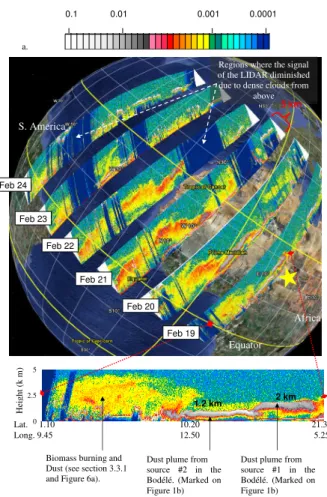
Regions where the signal of the LIDAR diminished due to dense clouds from
above
Biomass burning and Dust (see section 3.3.1 and Figure 6a).
1.2 km 2 km
Africa
Feb 19
S. America
5 km
Dust plume from source #1 in the Bodélé. (Marked on Figure 1b) Equator
Lat. 1.10 10.20 21.30
Long. 9.45 12.50 5.25
5 2.5 0
H
ei
g
h
t
(k
m
)
Dust plume from source #2 in the Bodélé. (Marked on Figure 1b)
Fig. 3a.CALIOP nighttime vertical attenuated backscatter profiles (km−1s−1) in the 532 nm band, plotted over the study area. The vertical profiles are 5 km in height (February 2008). The location of the Bod´el´e is marked by a yellow star. The lower enlargement shows the interaction region between the biomass-burning smoke and the dust plumes. The dust is recognized by the strong backscat-tering signal relative to the biomass-burning plume (the data was verified with MODIS).
3.3.1 Volume depolarization ratio analysis
VDR, retrieved from the vertical profiles of CALIOP, is a function of CALIPSO wavelength and the size and shape of the targets particles and air molecules. Therefore, the ac-quired VDR is in fact a result of different types of interac-tions.
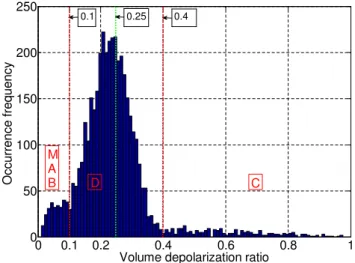
The histogram of the area covered by the aerosol plumes showed that most of the values fell between∼0.1 to∼0.4 (Fig. 5). These VDR values, which are typical for dust (Liu et al., 2008a, b, c; Tesche et al., 2009), indicate that the majority of the observed signal (during the period of the study) was obtained from dust particles. The obtained values are also in agreement with results of 0.31±0.03 (Freudenthaler et al., 2009) attributed solely to dust parti-cles. The relatively high values, namely more signal at the perpendicular band of CALIOP, derived from the irregular
b.
0.1 0.01 0.001 0.0001
Feb 19 Feb 20 Feb 21 Feb 24 Feb 25 Feb 26
S. America
Africa 5 km
Dust Biomass burning
and dust
Feb 18
Lat. 4.60 10.33 22.80
Long. 16.85 13.10 10.10
5
2.5
0
H
ei
g
h
t
(k
m
)
Equator
Fig. 3b.As Fig. 3a, but for daytime profiles and for 1064 nm wave-length.
0 0.1 0.2 0.4 0.6 0.8 1 0
50 100 150 200 250
Volume depolarization ratio
O
c
c
u
rr
e
n
c
e
f
re
q
u
e
n
c
y
0.25
0.1 0.4
D C
M A B
Fig. 5. Frequency of occurrence of VDR, obtained from the verti-cal area covered by the aerosol plumes for the area between 40◦N and 5◦S and between 17◦E and 46◦W as seen in Fig. 3a (based on CALIOP nighttime profiles between 19–24 February 2008). The edges of the plumes are defined based on the VDR and different backscatter patterns (see Sect. 2). Aerosols located in the ma-rine boundary layer (for which the height of the mama-rine boundary layer was defined based on the location of marine stratocumulus clouds, Ben-Ami et al., 2009) were excluded from the analysis, and therefore the VDR obtained from sea salt is expected to be minor. VDR regions dominated by air molecules (M), anthropogenic (A), biomass-burning (B), dust (D) aerosol and clouds (C) are marked in red. Note that the small peak of VDR<0.1 was mostly from data taken on 19 February (see Fig. 6b). The threshold for pure dust (0.25) is marked by a green line.
shape of the dust and from multiple scattering. Note that in a case of high AOD the signal of CALIPSO, obtained from the lower part of the aerosol plume, may have a lower quality.
Water clouds located near or within the aerosol plume, have higher VDR values (between 0.4 to 1) due to multi-ple scattering and were a minor contribution to the overall sampled signal. Anthropogenic aerosols, such as biomass smoke and molecules, which are much smaller compared to the CALIOP wavelength, have low VDR values, between 0 to 0.1 (Liu et al., 2008 a, b, c).
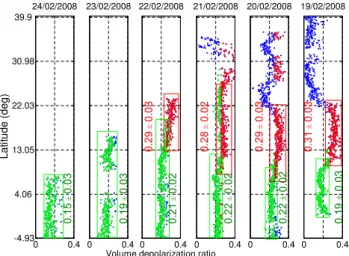
Most of the signal is attributed to dust since most of the VDR data is within 0.1–0.4. To emphasize the loca-tion of cleaner dust within the transported aerosol plume, we showed regions where the VDR is larger than 0.25 (the threshold is marked on Fig. 5) and smaller than 0.4. This relatively high value indicates that the selected regions are dominated by dust. Based on this assumption, several re-gions of relatively pure dust, as well as rere-gions characterized by biomass burning mixed with dust (with lower VDR val-ues) are marked in Fig. 6a. Close to the source (19 Febru-ary), the aerosol plume is composed of (a) biomass burning mixed with dust in the southern parts of the aerosol plume (VDR of 0.19), (b) relatively pure dust in the central part of
the plume (VDR of 0.31) and apparently (c) anthropogenic aerosol (VDR between 0 to∼0.13), most likely transported from North Libya and/or Europe over the Mediterranean (Duncan et al., 2008), in the northern part (Fig. 6a). This as-sumption was supported by back trajectories from HYSPLIT model, showing that the air parcel from the northern part of Fig. 6a (for 19 February, between latitudes∼22 N◦ and ∼30 N◦)passed over Europe and the Mediterranean, head-ing central North Africa (not shown).
The tri-modal distribution of these aerosols is also evident in Fig. 6b. The VDR values of∼0.3 are in line with previous studies, and the VDR value of∼0.19 is significantly larger than that of<0.1 expected for pure biomass smoke (Liu et al., 2008a, b, c), indicating that the biomass smoke is mixed with dust particles.
The mixing of both types of aerosol over the Atlantic Ocean, as well as sedimentation of large dust particles along the transport route, is also evident from the shift of the center of the VDR distribution (Fig. 6b) from 0.32 over Africa to 0.15 over the western Atlantic.
Detailed analysis of the regions that are dominated by dust (marked with red in Fig. 6a) shows that the VDR de-creases over time during transport, possibly due to exten-sive sedimentation of large dust particles. An opposite trend of increasing VDR (from 0.19 to 0.22) characterized the regions that are dominated by biomass burning mixed with dust (marked with green on Fig. 6a), indicating that more dust is dissipating toward the air mass containing the biomass burning. Further west (22–24 February), the VDR decreases again, most likely due to aerosol wet removal and sedimen-tation.
3.3.2 Analysis with MODIS AOD
As the dust plume continued to move away from its source, the spectral signal of the dust weakened, and it was more dif-ficult to observe the dust via MODIS’s spectral bands. How-ever, the spatial and temporal distribution of MODIS AOD, calculated as latitudinal daily averages along the center of the plume, clearly shows a significant increase of AOD, ap-proximately from 17 February to 1 March (Fig. 7a). The spatial and temporal distribution of the fine fraction,f, also calculated as latitudinal daily averages along the center of the plume, is in good agreement with the spatial and tem-poral pattern of the AOD (not shown). The suggestion is that periods of high AOD were characterized by the presence of a significant coarse fraction, presumably dust. The lon-gitudinal distribution of the AOD, which extended from the African coast to the South American coast (50◦W), suggests the arrival of North African dust as far as the edge of the Amazon region. Estimation of dust loading (Fig. 7b), which is contributed to all north African dust sources, proposed that the extensive dust emission increased the dust loading over the ocean (between 20◦N–15◦S, and 50◦W–15◦E) by
0 0.4 20/02/2008 0 0.4 21/02/2008 0 0.4 22/02/2008
Volume depolarization ratio
0 0.4 23/02/2008 0 0.4 19/02/2008 0 0.4 -4.93 4.06 13.05 22.03 30.98 39.9 24/02/2008 L a ti tu d e ( d e g ) 0 .0 3 0 .0 0 .0 0 .0 0 .0 0 .0 3 . 0 .0 3 . 0 .0 . 0 .0 3 . 0 .0
Fig. 6a.Vertical averaged VDR profiles of the aerosol plumes. The edges of the plumes are defined based on different backscatter pat-terns (see Sect. 2). Clouds were removed based on their relatively high VDR and on their spatial distribution. Aerosols located in the marine boundary layer (the height of the marine boundary layer was defined based on the location of marine stratocumulus clouds, Ben-Ami et al., 2009) were excluded from the analysis. Average VDR (±one standard deviation) for selected regions of pure dust with VDR between 0.25 and 0.4 are marked in red, and regions of mixed biomass aerosol with dust (0<VDR<0.25) are marked in green. The blue-marked VDR along the aerosol plumes are those that are not classified by red or green.
17 February to 1 March is composed of minor and major peaks (marked in Fig. 7a) that are simultaneous with the two events of dust emissions that occurred during 11–16 and 18– 27 February, including the signature of these emissions in the Ilorin AERONET measurements (14–16 and 20–22 Febru-ary). The upper part of Fig. 7a–b (∼5–9 February) show evidence for other period of emission.
3.4 Elemental analysis (by PIXE) of aerosols collected
at the AMAZE-08 field site in Central Amazonia
The arrival of the dust in the Amazon region was observed at the AMAZE-08 field site between 22 and 26 February. Ele-mental analysis by PIXE of the aerosol showed an increase in the elements Si, Al, Fe, Mn and Ti in the coarse and the fine fraction, all attributed to mineral dust emitted during 18– 19 February (and possibly even earlier, during 11–16 Febru-ary) from the Bod´el´e depression (Fig. 8). The significant in-crease in the observed crustal elements continued until about 4 March. During this period, the daily averaged concentra-tion of the previously menconcentra-tioned crustal elements increased by approximately one order of magnitude (i.e., from 0.076 to 0.79 µg m−3 and from 0.062 to 0.82 µg m−3in the fine and coarse modes, respectively). The total mass of the above crustal elements during this period (between 22 February and 4 March) was 4.83 µg m−3. Increases in other elements
0 0.25 0.5 0 10 20 30 40 50 60 70 80 90 O c c u rr e n c e f re q u e n c y ( Ca s e s )
0 0.25 0.5 0 0.25 0.5
Volume depolarization ratio
0 0.25 0.5 0 0.25 0.5 0 0.25 0.5
0.15 0.17 0.20 0.26 0.32 0.23 0.13 0.25
24/02/2008 23/02/2008 22/02/2008 21/02/2008 20/02/2008 19/02/2008
D B D M A
Fig. 6b. Frequency of occurrence of VDR (as in Fig. 5, but for all days) obtained from CALIOP nighttime profiles. Rare inci-dences of VDR>0.5 are not shown. VDR regions dominated by air molecules (M), anthropogenic (A), biomass-burning (B) and dust (D) aerosol are marked in red.
Longitude (deg)
50 W 30 W 10 W 10 E
5/2
14/2
24/2
5/3
15/3
0.5 1 1.5 2
2 1
b. Dust mass a. AOD
0 10 20 30 40 50
15/3 5/3 24/2 14/2 5/2
Daily dust mass (tonne) ×106
D
a
y
Fig. 7.Daily distribution of AOD and estimation of dust mass. Note that the area cover by(a)and(b)is not similar: (a) daily AOD dis-tribution over the oceanic region. Each line of the figure is a daily latitudinal average for the rectangle region between 10◦N–5◦S and
50◦W–10◦E. The data is based on MODIS AOD maps, in
spa-tial resolution of one degree, as obtained from the Aqua and Terra satellites. The signature of dust emitted during (1) 11–16 February and (2) 18–27 February is indicated; (b) daily estimated dust mass (tonne) over the Atlantic Ocean between 20◦N–15◦S and 50◦W– 15◦E using Eq. (1–4). Uncertainty in the mass estimate is calcu-lated based on±30% (dashed lines). Note that in cases when total AOD>0.4, the error may be larger.
0 500 1000 AL Si Fe 0 10 20 30 Diameter betwen 2-10 micron
Mn Ti 0 500 1000 AL Si Fe 0 10 20 30 Diameter < 2 micron
Mn Ti
n
g
m
-3 (
fo r M n a n d T i) n g m
-3 (
fo r A l, S i a n d F e ) 1 0 -1 4 /2 1 4 -1 6 /2 1 6 -1 9 /2 1 9 -2 2 /2 2 2 -2 6 /2 2 6 -2 9 /2 2 9 /2 -4 /3 4 -8 /3 8 -1 2 /3 1 2 -2 1 /3 2 1 -3 0 /3 3 0 /3 -2 /4 2 -5 /4 5 -9 /4 9 -1 4 /4 1 4 -2 2 /4 2 2 -2 8 /4 2 8 /4 -5 /5 5 -9 /5 9 -1 3 /5 1 3 -1 6 /5 1 6 -2 0 /5 2 0 -2 7 /5 2 7 /5 -2 /6 2 -1 3 /6 1 3 -1 9 /6
Fig. 8.Elemental composition of aerosol collected at the AMAZE-08 field site in Central Amazonia during February and June 20AMAZE-08, (a)fine (diameter<2.0µm) and(b)coarse fraction (2.0 to 10 µm). The area in the green rectangle marks the dates for which crustal el-ements were enhanced. The left Y-axis refers to the concentrations of Al, Si, and Fe. The right Y-axis refers to the concentrations of Mn and Ti.
The increase in crustal elements during additional periods, as seen in Fig. 8 (e.g.: during 5–9 April), suggests that this is not a singular event and that there are additional cases of North African dust transport to the Amazon Basin. Anal-ysis of CALIOP profiles along the Brazilian coastline (for 24 February, Fig. 3a) showed that the aerosol plume attained a maximum height near 3.3 km, while its base merged with the underlying boundary layer, in agreement with Ansmann et al. (2009).
3.5 Forward trajectories of air parcels originated from
the Bod´el´e depression.
Forward trajectories, calculated using the HYSPLIT trans-port model, starting over the Bod´el´e depression at the lev-els of 0, 500, and 1000 m above ground level, propose that the increase of crustal elements between 22 and 26 Febru-ary was contributed to dust emitted from the Bod´el´e (and the nearby sources) between∼14 and∼15 February (Fig. 9a).
Similarly, the increase of crustal elements between 26 Febru-ary and 4 March can be attributes to emission of dust from
∼18 February and the following days (and partly to emission
from previous days, Fig. 9b). The results of the model pro-posed that the dust arrived to the heart of the Amazon Basin (near 60◦W) in height between 1700 and 5000 m above
ground level, and the transport time from the Bod´el´e to the Amazon Basin is between∼10 and∼17 days.
a. b.
Fig. 9.Forward trajectories calculated using the HYSPLIT model, starting from several locations over the region of the Bod´el´e depres-sion from the period between(a)14 and 15 and(b)for 18 Febru-ary 2008. The green, red and blue lines mark the height of the starting point at 0, 500 and 1000 m above ground level. The region near Manaus is marked by a white circle.
4 Conclusions
Koren et al. (2006) suggested the Bod´el´e as source of nu-trients for the Amazon Basin based on inductive reason-ing without showreason-ing evidence for dust deposition. Here we present a detailed case study that closely follows dust emitted mainly from the Bod´el´e depression in Chad and deposited in the Amazon Basin. The AMAZE-08 measurements in the central Amazon show episodes of dust, biomass burning and marine aerosol elements, in agreement with the expected ar-rival time of the dust-laden air from the Bod´el´e, as retrieved by remote sensing measurements. The arrival of dust in the Amazon Basin is also in line with simultaneous in-situ mea-surements from AMAZE-08, showing enhancement in ice nuclei due to the presence of the dust particles (Prenni et al., 2009).
Nonetheless, despite the dominance of the Bod´el´e dust emissions, it is fair to assume contributions from addi-tional dust sources along the transport path. We also as-sume that not all dust episodes (during winter in the North-ern Hemisphere) reach the Amazon forest. For example, Lidar observations from one month before our case study (15 January to 14 February 2008), showed that dust/biomass-burning plumes that originated from North Africa and were transported westward, were almost depleted of dust parti-cles when they reached the Amazon region (Ansmann et al., 2009).
that the Bod´el´e’s activity is clearly reflected by changes in aerosol size distribution and dust loading over the tropical Atlantic.
Following the two emission periods (between 11– 16 February and between 18–27 February) and based on the relatively week emission between 11–13 February, the travel time from the source region to the heart of the Amazon Basin would be approximately between 8 and 12 days. The HYS-PLIT results partly agree with the above suggestion.
Although further studies are needed, our study suggests that in addition, events with early emission starting time (around midnight) are likely to be strong dust events and are more likely to be transported and to reach the Amazon forest (during the winter season).
Acknowledgements. This research was partly funded by the Min-erva foundation, with funding from the Federal German Ministry for Education and Research, and the German Israeli Science
Foundation (GIF) Contract no. I-899-228.10/2005. Y. R.
ac-knowledges support by the Helen and Martin Kimmel Award for Innovative Investigation. B. A. Y. acknowledges Jeremy Seltzer for proofreading.
Edited by: J. Schneider
References
Albrecht, B. A.: Aerosols, cloud microphysics, and fractional cloudiness, Science, 245, 1227–1230, 1989.
Andreae, M. O., Anderson, B. E., Blake, D. R., Bradshaw, J. D., Collins, J. E., Gregory, G. L., Sachse, G. W., and Shipham, M. C.: Influence of plumes from biomass burning on atmospheric chemistry over the equatorial Atlantic during CITE-3, J. Geo-phys. Res., 99, 12793–12808, 1994.
Ansmann, A., Baars, H., Tesche, M., Muller, D., Althausen, D., En-gelmann, R., Pauliquevis, T., and Artaxo, P.: Dust and smoke transport from Africa to South America: lidar profiling over Cape Verde and the Amazon rainforest, Geophys. Res. Lett., 36, L11802, doi:10.1029/2009GL037923, 2009.
Artaxo, P. and Orsini, C.: PIXE and receptor models applied to remote aerosol source apportionment in Brazil, Nuclear Instru-ments & Methods in Physics Research, B22, 259–263, 1987. Artaxo, P., Maenhaut, W., Storms, H., and Grieken, R. V.: Aerosol
characteristics and sources for the Amazon Basin during the wet season, J. Geophys. Res., 95, 16971–16986, 1990.
Artaxo, P. and Hansson, H.C.: Size distribution of biogenic aerosol particles from the Amazon Basin, Atmos. Environ., 29, 393–402, 1994.
Ben-Ami, Y., Koren, I., and Altaratz, O.: Patterns of North African dust transport over the Atlantic: winter vs. summer, based on CALIPSO first year data, Atmos. Chem. Phys., 9, 7867–7875, doi:10.5194/acp-9-7867-2009, 2009.
Bristow, C., Drake, N., and Armitage, S.: Deflation in the dustiest place on Earth: the Bod´el´e depression, Chad, Geomorphology, 105, 50–58, 2009.
Bristow, C. S., Hudson-Edwards, K. A., and Chappell, A.: Fertiliz-ing the Amazon and Equatorial Atlantic with West African dust,
Geophys. Res. Lett., 37, L14807, doi:10.1029/2010GL043486, 2010.
Carlson, T. N. and Prospero, J. M.: The large-scale movement of Saharan Air outbreaks over the Northern Equatorial Atlantic, J. Appl. Meteor., 11, 283–297, 1972.
Chappell, A., Warren, A., O’Donoghue, A., Robinson, A., Thomas, A., and Bristow, C.: The implications for dust emission modeling of spatial and vertical variations in horizontal dust flux and par-ticle size in the Bode’le Depression, Northern Chad, J. Geophys. Res., 113, D04214, doi:10.1029/2007JD009032, 2008.
Chen, Q., Farmer, D. K., Schneider, J., Zorn, S. R., Heald, C. L., Karl, T. G., Guenther, A., Allan, J. D., Robinson, N., Coe, H., Kimmel, J. R., Pauliquevis, T., Borrmann, S., P¨oschl, U., An-dreae, M. O., Artaxo, P., Jimenez, J. L., and Martin, S. T.: Mass spectral characterization of submicron biogenic organic parti-cles in the Amazon Basin, Geophys. Res. Lett., 36, L20806, doi:10.1029/2009GL039880, 2009.
Davidson, E. A. and Artaxo, P.: Globally significant changes in bio-logical processes of the Amazon Basin: results of the Large-scale Biosphere-Atmosphere Experiment, Glob. Change Biol., 10, 1– 11, 2004.
Draxler, R. R. and Rolph, G. D.: HYSPLIT (HYbrid Single-Particle Lagrangian Integrated Trajectory) Model access via NOAA ARL READY Website. http://www.arl.noaa.gov/ready/hysplit4.html, NOAA Air Resources Laboratory, Silver Spring, MD, 2003. Duncan, B. N., West, J. J., Yoshida, Y., Fiore, A. M., and Ziemke,
J. R.: The influence of European pollution on ozone in the Near East and northern Africa, Atmos. Chem. Phys., 8, 2267–2283, doi:10.5194/acp-8-2267-2008, 2008.
Eck, T. F., Holben, B. N., Reid, J. S., Dubovik, O., Smirnov, A., O’Neill, N. T., Slutsker, I., and Kinne, S.: Wavelength depen-dence of the optical depth of biomass burning, urban, and desert dust aerosols, J. Geophys. Res., 104, 31333–31349, 1999. Engelstaedter, S., Washington, R., and Mahowald, N.: Impact of
changes in atmospheric conditions in modulating summer dust concentration at Barbados: A back-trajectory analysis, J. Geo-phys. Res., 114, D17111, doi:10.1029/2008JD011180, 2009. Falkowski, P. G., Barber, R. T., and Smetacek, V.: Biogeochemical
Controls and Feedbacks on Ocean Primary Production, Science, 281, 200–206, 1998.
Formenti, P., Andreae, M. O., Lange, L., Roberts, G., Cafmeyer, J., Rajta, I., Maenhaut, W., Holben, B. N., Artaxo, P., and Lelieveld, J.: Saharan dust in Brazil and Suriname during the Large-Scale Biosphere-Atmosphere Experiment in Amazonia (LBA) – Coop-erative LBA Regional Experiment (CLAIRE) in March 1998, J. Geophys. Res., 106, 14919–14934, 2001.
Formenti, P., Rajot, J. L., Desboeufs, K., Caquineau, S., Chevail-lier, S., Nava, S., Gaudichet, A., Journet, E., Triqute, S., Al-faro, S., Chiari, M., Haywood, J., Coe, H., and Highwood, E.: Regional variability of the composition of mineral dust from western Africa: Results from the AMMA SOP0/DABEX and DODO field campaigns, J. Geophys. Res., 113, D00C13, doi:10.1029/2008JD009903, 2008.
Garrison, V. H., Shinn, E. A., Foreman, W. T., Griffin, D. W., Holmes, C. M., Kellogg, C. A., Majewski, M. S., Richardson, L. L., Ritchie, K. B., and Smith, G. W.: African and Asian dust: from desert soils to coral reefs, Bioscience, 53, 469–480, 2003. Generoso, S., Bey, I., Labonne, M., and Br’eon, F. M.: Aerosol
vertical distribution in dust outflow over the Atlantic: Compar-isons between GEOS-Chem and Cloud-Aerosol Lidar and In-frared Pathfinder Satellite Observation (CALIPSO), J. Geophys. Res., 113, D24209, doi:10.1029/2008JD010154, 2008.
Ginoux, P., Prospero, J. M., Torres, O., and Chin, M.: Long-term simulation of global dust distribution with the GOCART model: correlation with North Atlantic Oscillation, Environ, Modell Softw, 19(2), 113–128, 2004.
Ginoux, P., Garbuzov, D., and Hsu, N. C.: The
identifica-tion of anthropogenic and natural dust sources using MODIS Deep Blue Level 2 data, J. Geophys. Res., 115, D05204, doi:10.1029/2009JD012398, 2010.
Griffin, D. W. and Kellogg, C. A.: Dust storms and their impact on ocean and human health: dust in earth’s atmosphere, Ecohealth, 1, 248–295, 2004.
Holben, B. N., Eck, T. F., Slutsker, I., Tanre, D., Buis, J. P., Set-zer, A., Vermote, E., Reagan, J. A., Kaufman, Y. J., Nakajima, T., Lavenu, F., Jankowiak, I., and Smirnov, A.: AERONET-A federated instrument network and data archive for aerosol char-acterization, Remote Sens. Environ., 66(1), 1–16, 1998. Hsu, N. C., Tsay, S. C., King, M. D., and Herman, J. R.: Aerosol
properties over bright-reflecting source regions, IEEE Trans. Geosci. Remote Sens., 42, 557–569, 2004.
Huang, J., Zhang, C., and Prospero, J. M.: African dust outbreaks: a satellite perspective of temporal and spatial variability over the tropical Atlantic Ocean, J. Geophys. Res., 115, D05202, doi:10.1029/2009JD012516, 2010.
Jiang, H, Xue, H., Teller, A., Feingold, G., and Levin, Z.: Aerosol effects on the lifetime of shallow cumulus, Geophys. Res. Lett., 33, L14806, doi:10.1029/2006GL026024, 2006.
Jickells, T. D., An, Z. S., Andersen, K. K., Baker, A. R., Bergametti, G., Brooks, N., Cao, J.J., Boyd, P. W., Duce, R. A.,. Hunter, K. A, Kawahata, H., Kubilay, N., laRoche, J., Liss, P. S., Mahowald, N., Prospero, J. M., Ridgwell, A. J., Tegen, I., and Torres, R.: Global Iron Connections Between Desert Dust, Ocean Biogeo-chemistry and Climate, Science, 308, p. 67–71, 2005.
Kalnay, E., Kanamitsu, M., Kistler, R., Collins, W., Deaven, D., Gandin, L., Iredell, M., Saha, S., White, G., Woollen, J., Zhu, Y., Leetmaa, A., Reynolds, R., Chelliah, M., Ebisuzaki, W., Higgins, W., Janowiak, J., Mo, K. C., Ropelewski, C., Wang, J., Jenne, R., and Joseph, D.: The NCEP/NCAR 40-Year Reanalysis Project, Bull. Amer. Met. Soc., 3, 43–471, 1996.
Karyampudi, V. M., Palm, S. P., Reagan, J. A., Fang, H., Grant, W. B., Hoff, R. M., Moulin, C., Pierce, H. F., Torres, O., Browell, E. V., and Melfi, S. H.: Validation of the Saharan dust plume conceptual model using lidar, Meteosat, and ECMWF data, B. Am. Meteorol. Soc., 80, 1045–1075, 1999.
Kaufman, Y. J., Koren, I., Remer, L. A., Tanre, D., Ginoux,
P., and Fan, S.: Dust transport and deposition observed
from the Terra-Moderate Resolution Imaging Spectroradiometer (MODIS) spacecraft over the Atlantic Ocean, J. Geophys. Res., 110, D10S12, doi:10.1029/2003JD004436, 2005a.
Kaufman, Y. J., Boucher, O., Tanre, D., Chin, M., Remer, L,
and Takemura, T.: Aerosol anthropogenic component
esti-mated from satellite data, Geophys. Res. Lett., 32, L17804, doi:10.1029/2005GL023125, 2005b.
Kaufman, Y. J, Koren, I., Remer, L. A., Rosenfeld, D., and Rudich, Y.: The Effect of Smoke, Dust and Pollution Aerosol on Shallow Cloud Development Over the Atlantic Ocean, P. Natl. Acad. Sci., 102(32), 11207–11212, 2005c.
Koren, I. and Kaufman, Y. J.: Direct wind measurements of Saharan dust events from Terra and Aqua satellites, Geophys. Res. Lett., 31, L06122, doi:10.1029/2006GL026024, 2004.
Koren, I., Kaufman, Y. J., Rosenfeld, D., Remer, L. A., and
Rudich, Y.: Aerosol invigoration and restructuring of
At-lantic convective clouds, Geophys. Res. Lett., 32, LI4828, doi:10.1029/2005GL023187, 2005.
Koren, I., Kaufman, Y. J., Washington, R., Todd, C. C., Rudich, Y., Martins, J. V., and Rosenfeld, D.: The Bod’el’e depression: a single spot in the Sahara that provides most of the mineral dust to the Amazon forest, Environ. Res. Lett., 1, 1–5, 2006. Levin, Z., Ganor, E., and Gladstein, V.: The effects of desert
parti-cles coated with sulfate on rain formation in the eastern Mediter-ranean, J. Appl. Meteor., 35, 1511–1523, 1996.
Liu, D., Wang, Z., Liu, Z., Winker, D., and Trepte, C. A.: height resolved global view of dust aerosols from the first year CALIPSO lidar measurements, J. Geophys. Res., 113, D16214, doi:10.1029/2007JD009776, 2008a.
Liu, Z., Omar, A., Vaughan, M., Hair, J., and Kittaka, C.: CALIPSO lidar observations of the optical properties of saha-ran dust: a case study of long-saha-range tsaha-ransport, 113, D07207, doi:10.1029/2007JD008878, 2008b.
Liu, Z., Liu, D., Huang, J., Vaughan, M., Uno, I., Sugimoto, N., Kit-taka, C., Trepte, C., Wang, Z., Hostetler, C., and Winker, D.: Air-borne dust distributions over the Tibetan Plateau and surround-ing areas derived from the first year of CALIPSO lidar obser-vations, Atmos. Chem. Phys., 8, 5045–5060, doi:10.5194/acp-8-5045-2008, 2008c.
Mahowald, N., Engelstaedter, S., Luo, C., Sealy, A., Artaxo, P., Benitez-Nelson, C., Bonnet, S., Chen, Y., Chuang, P. Y., Cohen, D. D., Dulac, F., Herut, B., Johansen, A. M., Kubilay, N., Losno, R., Maenhaut, W., Paytan, A., Prospero, J. M., Shank, L. M., and Siefert, R. L.: Atmospheric Iron deposition: Global distribution, variability and human perturbations, Ann. Rev. Marine Sci., 1, 245–278, doi:10.1146/annurev.marine.010908.163727, 2009. Martin, S. T., Andreae, M. O., Artaxo, P., Baumgardner, D., Chen,
Q., Goldstein, A. H., Guenther, A., Heald, C. L., Mayol-Bracero, O. L., McMurry, P. H., Pauliquevis, T., P¨oschl, U., Prather, K. A., Roberts, G. C., Saleska, S. R., Silva Dias, M. A., Spracklen, D. V., Swietlicki, E., and Trebs, I.: Sources and properties of Amazonian aerosol particles, Rev. Geophys, 48, RG2002, doi:10.1029/2008RG000280, 2010.
Murayama, T., Sugimoto N., Uno I., Kinoshita K., Aoki K., Hagi-wara N., Liu Z., Matsui I., Sakai T., Shibata T., Arao K., Sohn B.-J., Won J.-G., Yoon S.-C., Li T., Zhou B.-J., Hu H., Abo M., Iokibe K., Koga R., and Iwasaka Y.: Ground-based network observation of Asian dust events of April 1998 in east Asia, J. Geophys. Res., 106(D16), 18346–18359, 2001.
Prospero, J. and Carlson, T.: Vertical and areal distribution of Sa-haran dust over the western equatorial North Atlantic Ocean, J. Geophys. Res., 77, 5255–5265, 1972.
Prospero, J. M., Glaccum, R. A., and Nees, R. T.: Atmospheric transport of soil dust from Africa to South America, Nature, 289, 570–572, 1981.
Prospero, J. M.: Long-term measurements of the transport of African mineral dust to the southeastern United States: Impact on regional air quality, J. Geophys. Res., 104(D13), 15917–15927, 1999.
Prospero, J. M., Ginoux, P., Torres, O., Nicholson, S. E., and Gill, T. E.: Environmental characterization of global sources of at-mospheric soil dust identified with the NIMBUS 7 total ozone mapping spectrometer (TOMS) absorbing aerosol product, Rev. Geophys., 40, 1002, doi:10.1029/2000RG000095, 2002. Qu´er´e, C. L., Raupach, M. R., Canadell, J. G., Marland, G., Bopp,
L., Ciais, P., Conway, T. J., Doney, S. C., Feely, R. A., Foster, P., Friedlingstein. P., Gurney, K., Houghton, R. A., House, J. I., Huntingford, C., Levy, P. E., Lomas, M. R., Majkut, J., Metzl, N., Ometto, J. P., Peters, G. P., Prentice, I. C., Randerson, J. T., Running, S. W., Sarmiento, J. L., Schuster, U., Sitch, S., Taka-hashi, T., Viovy, N., Van der Werf, G. R., and Woodward, F. I.: Trends in the sources and sinks of carbon dioxide, Nat. Geosci., 2, 831–836, 2009.
Ramanathan, V., Crutzen, P. J., Kiehl, J. T., and Rosenfeld, D.: Aerosols, climate, and the hydrological cycle, Science, 294, 2119–2124, 2001.
Reid, J. S., Westphal, D. L., Livingston, J. M., Savoie, D. L., Mar-ing, H. B., Jonsson, H. H., Eleuterio, D. P., Kinney, J. E., and Reid, E. A.: Dust vertical distribution in the Caribbean during the Puerto Rico Dust experiment, Geophys. Res. Lett., 29(7), 1151, doi:10.1029/2001GL014092, 2002.
Rosenfeld, D., Rudich, Y., and Lahav, R.: Desert dust suppressing precipitation – a possible desertification feedback loop, P. Natl. Acad. Sci., 98, 5975–5980, 2001.
Schepanski, K., Tegen, I., Laurent, B., Heinold, B., and Macke, A.: A new Saharan dust source activation frequency map de-rived from MSG-SEVIRI IR-channels, Geophys. Res. Lett., 34, L18803, doi:10.1029/2007GL030168, 2007.
Schepanski, K., Tegen, I., and Macke, A.: Saharan dust trans-port and deposition towards the tropical northern Atlantic, At-mos. Chem. Phys., 9, 1173–1189, doi:10.5194/acp-9-1173-2009, 2009.
Smirnov, A., Holben, B. N., Eck, T. F., Dubovik, O., and Slutsker, I.: Effect of wind speed on columnar aerosol opti-cal properties at Midway Island, J. Geophys. Res., 108, 4802, doi:10.1029/2003JD003879, 2003.
Stith, J. L., Ramanathan, V., Cooper, W. A., Roberts, G. C., DeMott, P. J., Carmichael, G., Hatch, C. D., Adhikary, B., Twohy, C. H., and Rogers, D. C.: An overview of aircraft observations from the Pacific Dust Experiment campaign, J, Geophys, Res., 114(d5), D05207, doi:10.1029/2008JD010924, 2009.
Swap, R., Garstang, M., Greco, S., Talbot, R., and Kallberg, P.: Saharan dust in the Amazon Basin, Tellus, 44B, 133–149, 1992. Talbot, R. W., Andreae, M. O., Berresheim, H., Artaxo, P., Garstang, M., Harriss, R. C., Beecher, K. M., and Li, S. M.: Aerosol chemistry during the wet season in central Amazonia: The influence of long range transport, J. Geophys. Res., 95, 16955–16969, 1990.
Teller, A. and Levin, Z.: The effects of aerosols on precipitation and dimensions of subtropical clouds: a sensitivity study us-ing a numerical cloud model, Atmos. Chem. Phys., 6, 67–80, doi:10.5194/acp-6-67-2006, 2006.
Tesche, M., Ansmann A., M¨uller, D., Althausen, D., Engel-mann, R., Freudenthaler, V., and Groß, S.: Vertically resolved separation of dust and smoke over Cape Verde using multi-wavelength Raman and polarization lidars during Saharan Min-eral Dust Experiment 2008, J. Geophys. Res., 114, D13202, doi:10.1029/2009JD011862, 2009.
Thomason, L. W., Pitts, M. C., and Winker, D. M.: CALIPSO ob-servations of stratospheric aerosols: a preliminary assessment, Atmos. Chem. Phys., 7, 5283–5290, doi:10.5194/acp-7-5283-2007, 2007.
Todd, M. C., Washington, R., Martins, J. V., Dubovik, O.,
Lizcano, G., M’Bainayel, S., and Engelstaedter, S.:
Min-eral dust emission from the Bode’le’ Depression, northern Chad, during BoDEx 2005, J. Geophys. Res., 112, D06207, doi:10.1029/2006JD007170, 2007.
Torres, O., Bhartia, P. K., Herman, J. R., Sinyuk, A., Ginoux, P., and Holben, B.: A long-term record of aerosol optical depth from TOMS observations and comparison to AERONET mea-surements, J. Atmos. Sci., 59, 398–413, 2002.
Twomey, S.: Pollution and the planetary albedo, Atmos. Environ., 8 1251–1256, 1974.
Vitousek, P. M. and Sanford, R. L. L. Jr.: Nutrient cycling in moist tropical forest, Annu. Rev. Ecol. Syst., 17, 137–167, 1986. Washington, R. and Todd, M.C.: Atmospheric controls on mineral
dust emission from the Bod´el´e Depression, Chad, Geophys. Res. Lett., 32(17), L17701, doi:10.1029/2005GL023597, 2005. Yu, H. B., Chin, M., Remer, L. A., Kleidman, R. G., Bellouin, N.,