Submitted 8 March 2015 Accepted 14 June 2015 Published14 July 2015
Corresponding author
Eamonn B. Mallon, [email protected]
Academic editor Leon Higley
Additional Information and Declarations can be found on page 10
DOI10.7717/peerj.1079
Copyright
2015 Amarasinghe et al.
Distributed under
Creative Commons CC-BY 4.0
OPEN ACCESS
Allele specific expression in worker
reproduction genes in the bumblebee
Bombus terrestris
Harindra E. Amarasinghe1,3, Bradley J. Toghill2,3, Despina Nathanael1 and Eamonn B. Mallon1
1Department of Biology, University of Leicester, UK
2Department of Cardiovascular Sciences, University of Leicester, UK 3Joint first authors.
ABSTRACT
Methylation has previously been associated with allele specific expression in ants. Recently, we found methylation is important in worker reproduction in the bumblebeeBombus terrestris. Here we searched for allele specific expression in twelve genes associated with worker reproduction in bees. We found allele specific expression in Ecdysone 20 monooxygenase and IMP-L2-like. Although we were unable to confirm a genetic or epigenetic cause for this allele specific expression, the expression patterns of the two genes match those predicted for imprinted genes.
Subjects Animal Behavior, Entomology, Evolutionary Studies, Genetics, Zoology Keywords Social insect, Hymenoptera, Ecdysone, Epigenetics
INTRODUCTION
Epigenetics refers to heritable changes in gene expression that do not involve DNA sequence alterations. Several recent reviews have heralded hymenopteran insects (ants, bees and wasps) as important emerging models for epigenetics (Glastad et al., 2011;Weiner & Toth, 2012;Welch & Lister, 2014;Yan et al., 2014). This is based mainly on data showing a fundamental role for methylation in their biology (Chittka, Wurm & Chittka, 2012). Methylation, the addition of a methyl group to a cytosine, is an epigenetic marker in many species (Glastad et al., 2011).
The recently sequenced genome of the bumblebee,Bombus terrestrisdisplays a full complement of genes involved in the methylation system (Sadd et al., 2015). In a recent paper (Amarasinghe, Clayton & Mallon, 2014), we showed that methylation is important in worker reproduction in this bumblebee. We found methylation differences between the genomes of queenless reproductive workers and queenless non-reproductive workers. In a follow up experiment, queenless workers whose genomes had experimentally altered methylation (fed 5-aza-2′-deoxycytidine) were more aggressive and more likely to develop ovaries compared with control queenless workers.
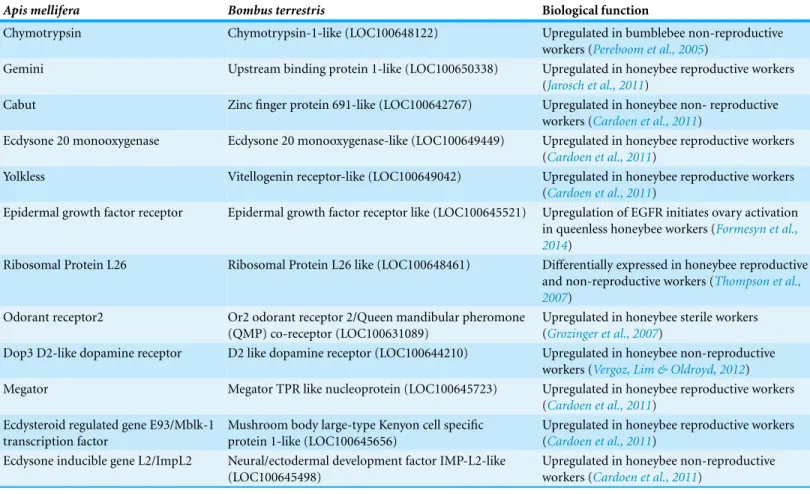
Table 1 Candidate genes selected from the literature search.
Apis mellifera Bombus terrestris Biological function
Chymotrypsin Chymotrypsin-1-like (LOC100648122) Upregulated in bumblebee non-reproductive workers (Pereboom et al., 2005)
Gemini Upstream binding protein 1-like (LOC100650338) Upregulated in honeybee reproductive workers (Jarosch et al., 2011)
Cabut Zinc finger protein 691-like (LOC100642767) Upregulated in honeybee non- reproductive workers (Cardoen et al., 2011)
Ecdysone 20 monooxygenase Ecdysone 20 monooxygenase-like (LOC100649449) Upregulated in honeybee reproductive workers (Cardoen et al., 2011)
Yolkless Vitellogenin receptor-like (LOC100649042) Upregulated in honeybee reproductive workers (Cardoen et al., 2011)
Epidermal growth factor receptor Epidermal growth factor receptor like (LOC100645521) Upregulation of EGFR initiates ovary activation in queenless honeybee workers (Formesyn et al., 2014)
Ribosomal Protein L26 Ribosomal Protein L26 like (LOC100648461) Differentially expressed in honeybee reproductive and non-reproductive workers (Thompson et al., 2007)
Odorant receptor2 Or2 odorant receptor 2/Queen mandibular pheromone (QMP) co-receptor (LOC100631089)
Upregulated in honeybee sterile workers (Grozinger et al., 2007)
Dop3 D2-like dopamine receptor D2 like dopamine receptor (LOC100644210) Upregulated in honeybee non-reproductive workers (Vergoz, Lim & Oldroyd, 2012) Megator Megator TPR like nucleoprotein (LOC100645723) Upregulated in honeybee reproductive workers
(Cardoen et al., 2011) Ecdysteroid regulated gene E93/Mblk-1
transcription factor
Mushroom body large-type Kenyon cell specific protein 1-like (LOC100645656)
Upregulated in honeybee reproductive workers (Cardoen et al., 2011)
Ecdysone inducible gene L2/ImpL2 Neural/ectodermal development factor IMP-L2-like (LOC100645498)
Upregulated in honeybee non-reproductive workers (Cardoen et al., 2011)
Notes.
NCBI gene IDs are in parentheses.
chose twelve genes previously associated with worker reproduction in bees (seeTable 1). We looked for polymorphisms in their exonic DNA in queens and their daughter workers using single strand conformation polymorphism (SSCP) and Sanger sequencing.
SSCP relies on the principle that the electrophoretic mobility of a single-stranded DNA molecule is dependent on its structure (nucleotide sequence) and size. In the absence of the complementary strand, DNA becomes unstable and reanneals to itself to form conformations; hairpins, pseudoknots and triple helices (Nielsen, Novoradovsky & Goldman, 1995). These conformations vary according to the primary sequence of the molecule, such that a single nucleotide difference in DNA could dramatically affect the strand’s mobility through a gel due to its unique 3D structure.
METHODS
Identification of candidate genes and designing primers
Twelve social insect genes previously associated with differential expression in queens, reproducing workers and non-reproducing workers were selected via a literature search (Table 1). Sequences for all selected candidate genes were obtained fromApis mellifera
genome data, available in NCBI.Apis melliferadata was BLASTed against theBombus terrestrisNucleotide library (NCBI) in order to find the homolog inBombus terrestris. Primers were designed to the exonic regions using Geneious Pro (version 5.5.6) and primer 3 version 0.4.0 (http://frodo.wi.mit.edu). The focus was on exonic regions to ensure that the same loci was present in the cDNA for the allele specific qPCR analysis.
Samples
The queen and 5 randomly selected workers from each colony were used for SSCP analysis. Most candidate genes were tested in four different bumblebee colonies. Chymotrypsin, Gemini, Cabut and Yolkless were tested in colonies 1–4. Another four colonies (5–8) were used to test Epidermal growth factor receptor, Ribosomal protein L26, Odorant receptor 2, Dop3, Megator, Ecdysteroid regulated gene E93 (Mblk1) and Ecdysone inducible gene L2 (IMP-L2). Ecdysone 20 monooxygenase-like was tested in eight colonies. All qPCR data are based on bees from colony 5.
DNA and RNA extraction and cDNA synthesis
Bees were frozen in liquid nitrogen and then stored at−80◦C. Genomic DNA for SSCP analysis was extracted from each queen and respective worker bees using the Qiagen DNA Micro kit according to manufacturer’s instructions. Concentration of total genomic DNA was measured using the NanoDrop 1000 Spectrophotometer.
A 30 mg sample of frozen tissue was ground with mortar and pestle on dry ice. RNA was extracted with the QIAGEN RNeasy Mini Kit according to manufacturer’s instructions.
Any DNA contamination present in the above RNA extractions was removed according to Amplification Grade DNase I Kit protocol (Sigma-Aldrich), prior to the synthesis of cDNA. Concentrations of DNase treated RNA was determined by the NanoDrop 1000 spectrophotometer.
cDNA was synthesized from a 8µl sample of RNA using the Tetro cDNA synthesis Kit
(Bioline) as per manufacturer’s instructions. Synthesized cDNA was stored at−80◦C.
PCR amplifications
For each primer set, a 25µl reaction volume (60 ng of DNA, 12.5µl YB-Taq 2x Buffer, 1.5µl
of each forward and reverse primer (10µlM/µl), 1µl of 10 mM MgCl2and 6.5µl of dH20)
was run using the following conditions: an initial denaturation for 5 min at 94◦C, 30 cycles of 30 s at 94◦C, 30 s each at the relevant annealing temperature followed by a final exten-sion of 10 min at the relevant extenexten-sion temperature and a holding step of 4◦C. The se-quences and annealing and extension temperatures used for each primer set are inTable S1.
Prior to SSCP analysis, each PCR product (10µl) was checked on a 3% agarose gel. If the
SSCP analysis
SSCP analysis was carried out according toGasser et al. (2007)using GMA wide mini S-2x25 gels (Elchrom Scientific). Sample denaturing solution was prepared by mixing 990µl of 95% formamide with 10µl of 1 M NaOH just prior to use. 4µl of the PCR product
was denatured with 7µl of denaturing mixture, incubated in a thermocycler at 94◦C for
10 min and immediately chilled on ice for 5 min.
The temperature of the running buffer (1x TAE) in the Origins gel tank (Elchrom Scientific) was kept constant at 9◦C. 7µl of the denatured PCR product was mixed with 2µl of Elchrom loading dye and loaded in to a well on the gel. The gels were run at 72 V.
The electrophoretic running times were varied depending on the fragment size; 10 h for 150–200bp fragment length, 12 h for 200–250bp fragment length, 15 h for 250–350bp fragment length and 17 h for 350–450bp fragment length.
Following electrophoresis, the gels were stained for 30 min with SybrGold (Invitrogen) (1:10,000 diluted in TAE) and destained with 100 ml of 1x TAE buffer for a further 30 min. If a polymorphic banding pattern among the queen and her 5 workers was observed during SSCP, another SSCP was run to confirm the reproducibility of those results. The genomic DNA of those queen and worker bees were amplified with their respective primers (seeTable S1) and PCR products were sent for commercial clean up and Sanger sequencing.
All sequencing results were blasted against NCBI,Bombus terrestrisnucleotide library to verify if the correct sequence was amplified. Sequencing results were analyzed using the heterozygote analysis module in Geneious version 7.3.0 to identify heterozygotic nucleotide positions.
Allele specific PCR
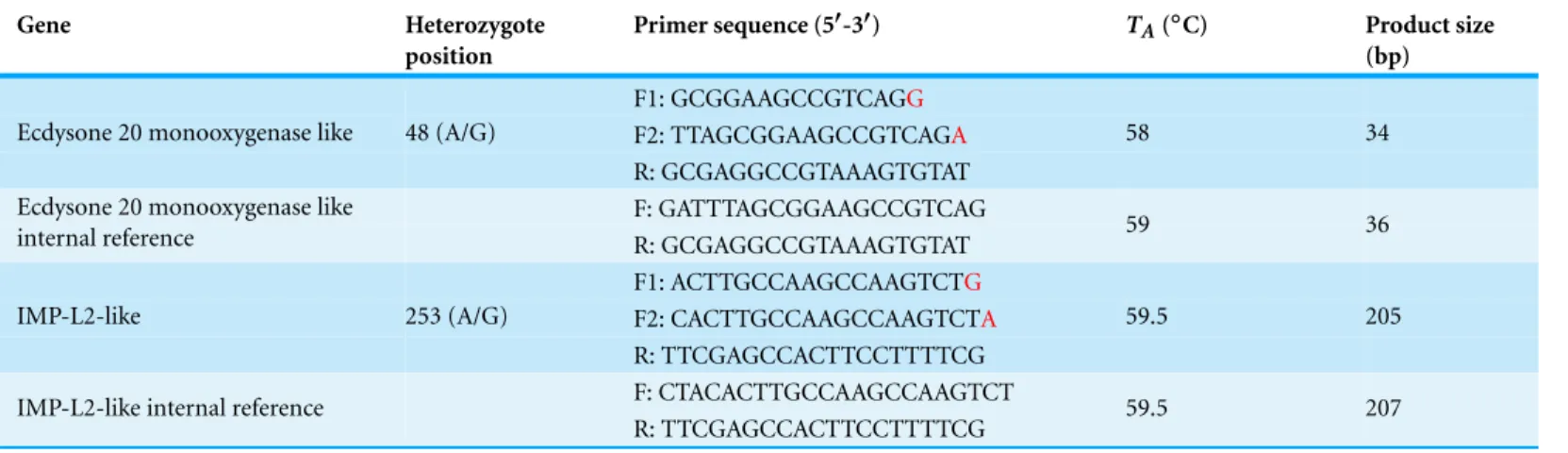
Allele specific PCR was used to confirm the maternal and paternal alleles identified during heterozygote analysis. Allele specific primers were designed using Batch primer 3 program (http://probes.pw.usda.gov/batchprimer3/) to cover the heterozygotic nucleotide positions identified above. Two forward primers specific to either maternal (F1) or paternal (F2) allele sequences and a common reverse primer were designed. Genomic DNA of the queen and 5 heterozygous workers in each colony, were PCR amplified with these allele specific primers (Table 2). PCR products were checked on a 3% agarose gel. When using allele specific primers, only the allele which includes the relevant snp would be amplified. Primers which amplified the snp region successfully were used for qPCR analysis.
Allele specific quantitative PCR
Table 2 Allele specific primers used for gene expression analysis.
Gene Heterozygote
position
Primer sequence (5′-3′) TA(◦C) Product size
(bp)
F1: GCGGAAGCCGTCAGG
F2: TTAGCGGAAGCCGTCAGA
Ecdysone 20 monooxygenase like 48 (A/G)
R: GCGAGGCCGTAAAGTGTAT
58 34
F: GATTTAGCGGAAGCCGTCAG Ecdysone 20 monooxygenase like
internal reference R: GCGAGGCCGTAAAGTGTAT 59 36
F1: ACTTGCCAAGCCAAGTCTG
F2: CACTTGCCAAGCCAAGTCTA
IMP-L2-like 253 (A/G)
R: TTCGAGCCACTTCCTTTTCG
59.5 205
F: CTACACTTGCCAAGCCAAGTCT IMP-L2-like internal reference
R: TTCGAGCCACTTCCTTTTCG 59.5 207
Notes.
The snp present is located at the′end of each forward primer (marked in red).
F1, Forward primer 1; F2, Forward primer 2; R, Common reverse primer;TA, Annealing temperature.
Each heterozygous locus was run for 3 different reactions; maternal (F1), paternal (F2) and reference (Table 2). Three replicate samples were run for each reaction. All reactions were prepared by the Corbett robotics machine, in 96 well qPCR plates (Thermo Scientific, UK). The qPCR reaction mix (20µl) was composed of 1µl of diluted cDNA (50 ng/µl),
1µl of forward and reverse primer (5µM/µl each,Table 2), 10µl 2x SYBR Green JumpStart
Taq ReadyMix (Sigma Aldrich, UK) and 7µl ddH20. Samples were run in a PTC-200 MJ
thermocycler. The qPCR profile was; 4 min at 95◦C denaturation followed by 40 cycles of 30 s at 95◦C, 30 s at the relevant annealing temperature (Table 2) and 30 s at 72◦C and a final extension of 5 min at 72◦C.
Forward primers are different, both in their terminal base (to match the snp) and in their length. It is entirely possible that they may amplify more or less efficiently even if there was no difference in amount of template (Pfaffl, 2001). To test for this we repeated all qPCRs with genomic DNA 1µl of diluted DNA (20 ng/µl) from the same bees as the
template. We would expect equal amounts of each allele in the genomic DNA. We also measured efficiency of each reaction as perLiu & Saint (2002).
Data analysis
MedianCtwas calculated for each set of three technical replicates. A measure of relative expression (ratio) was calculated for each parental allele in each worker bee as follows:
ratiomaternal=
E−Ctmaternal
maternal
E−Ctreference
reference
(1)
ratiopaternal=
E−paternalCtpaternal
E−Ctreference
reference
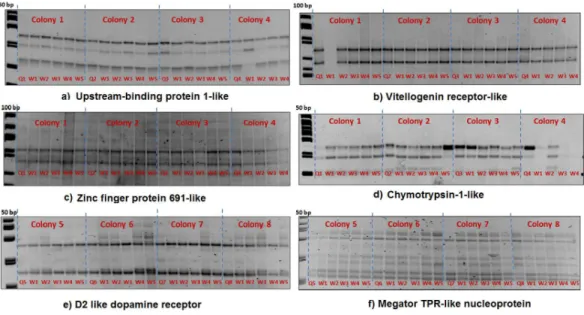
Figure 1 The queen (Q) and 5 workers (W1–W5) are represented in each colony.SSCP gel results of six genes (A–F) with no queen-worker variations (homozygous banding patterns).
Eis the median efficiency of each primer set (Liu & Saint, 2002;Pfaffl, 2001). Matched pairedt-tests was performed to check if the allele specific expression values are significantly different among the two parental alleles. All statistical analysis was carried out using R (3.1.0) (R Core Team , 2015).
RESULTS
SSCP analysisExon coverage for each gene is given inTable 3. We found no polymorphisms in nine genes out of the twelve candidate genes tested (seeTable 3).Figure 1shows representative examples of these gels with the queen and her workers sharing the same banding pattern.
Compared with the queen, workers in colony 3, 5 and 7 showed a heterozygous banding pattern in 3 genes; ecdysone 20-monooxygenase-like (ecdysone 20-monooxygenase-like), IMPL-2-like and MBLK1-like (Fig. 2).
Sequences of polymorphic loci
Table 3 SSCP exon coverage.Percentage exon coverage for each gene was calculated as the sum of all tested amplicon lengths as a fraction of the total length of mRNA per gene.
Gene name Coverage (%) Polymorphism
Chymotrypsin-1-like 92 Absent
Upstream-binding protein 1-like 93 Absent Zinc finger protein 691-like 70 Absent
Vitellogenin receptor-like 30 Absent
Epidermal growth factor receptor like 21 Absent 60S Ribosomal Protein L26 like 32 Absent
Or2 odorant receptor 2 25 Absent
D2 like dopamine receptor 54 Absent
Megator TPR like nucleoprotein 17 Absent Ecdysone 20-monooxygenase-like 37 Present Mushroom body large-type Kenyon cell-specific protein 1-like 35 Present Neural/ectodermal development factor IMP-L2-like 47 Present
Figure 2 SSCP allelic polymorphism in IMP-L2-like, MBLK1-like and Ecdysone 20-monooxygenase-like.
Allele specific PCR
Allele specific primers designed for ecdysone 20-monooxygenase-like and IMP-L2-like worked successfully with genomic DNA and cDNA to produce the expected fragment lengths. They were used for gene expression analysis in the next section. Amplification of MBLK1-like using allele specific primer sets was unsuccessful possibly due to the large number of snps. Thus, we did not continue with qPCR analysis for MBLK1-like.
Allele specific qPCR
The allele specific primer sets for ecdysone 20-monooxygenase-like showed no difference in their ability to amplify genomic DNA (pairedt-test:t=0.4815,df =4,p-value=
0.6553, Maternal primersCt =36.73±2.494, Paternal primersCt=36.27±1.792
(mean±standard deviation)). For IMP-L2-like, the two primer sets did show a significant difference in efficiency to amplify genomic DNA (pairedt-test:t=7.062,df =4,p-value
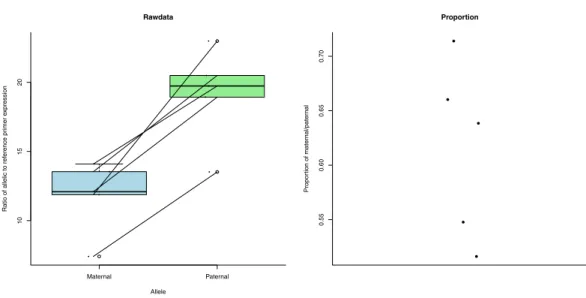
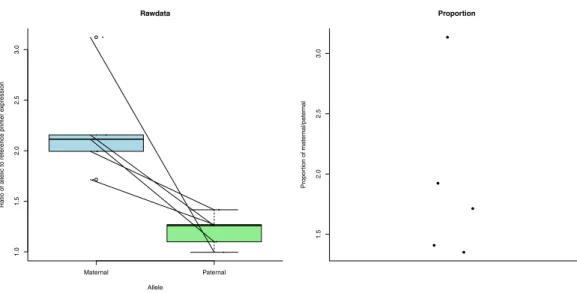
Figure 3 Expression (measured as ratio of allelic to reference primer expression (see ‘Methods’)) differences between maternal and paternal alleles of ecdysone 20-monooxygenase-like.The first plot shows the expression data as individual dots. The diagonal lines join data from the same bee. Boxplots represent the distributions. The second plot shows the proportion of maternal to paternal expression as individual dots.
(mean±standard deviation)). AsCtdecreases with increasing copy number, the paternal
primers amplified better than the maternal set.
To control for this difference in primer efficiency we used a modification of the pfaffl
method to calculate a measure of expression (Liu & Saint, 2002;Pfaffl, 2001). This includes efficiency in its calculations (see ‘Methods’). The patrigene showed significantly increased expression compared to the matrigene in ecdysone 20-monooxygenase-like (Fig. 3) (paired
t-test:t= −7.517,df =4,p-value=0.001676). For IMP-L2-like, the matrigene was more
expressed than the patrigene (Fig. 4) (pairedt-test:t=3.409,df =4,p-value=0.02705).
DISCUSSION
Using a candidate gene approach we found evidence for allele specific expression in the bumblebee,Bombus terrestris. Out of twelve genes examined during this study, we found exonic variation in only three genes; MBLK1-like, IMP-L2-like and ecdysone 20-monooxygenase-like. Of these we were able to carry out allele specific qPCR on IMP-L2-like and ecdysone 20-monooxygenase-like. We found allele specific expression in ecdysone 20-monooxygenase-like and IMP-L2-like.
Figure 4 Expression (measured as ratio of allelic to reference primer expression (see ‘Methods’)) differences between maternal and paternal alleles of Ecdysone-inducible gene L2 (IMP-L2-like).The first plot shows the expression data as individual dots. The diagonal lines join data from the same bee. Boxplots represent the distributions. The second plot shows the proportion of maternal to paternal expression as individual dots.
Our expression analysis used the bees’ whole bodies. Therefore gene expression patterns observed during this analysis should represent the overall expression of all body tissues. However, potentially it means allele specific expression which is only found in some tissues would be masked by the overall response.
We found allele specific expression in Ecdysone 20 monooxygenase. Ecdysone 20 monooxygenase catalyses the reaction which turns ecdysteroid ecdysone into 20-hydroxyecdysone, also an ecdysteroid. An up-regulation of ecdysone 20-monooxygenase-like was observed in egg laying honeybee workers compared to non-reproductive work-ers (Cardoen et al., 2011). Generally, ecdysteroids have been identified as key regulators of
B. terrestrisworker reproduction (Geva, Hartfelder & Bloch, 2005). Ecdysteriods are key compounds involved in ovary activation, regulating agonistic behaviour and establishing the dominance hierarchy in workers and queens (Geva, Hartfelder & Bloch, 2005). We also found allele specific expression in IMP-L2-like. In honeybees, this gene is linked with reproductive inhibition of workers. It functions similarly to an insulin like peptide and negatively regulates insulin signaling pathways to repress ovary activation (Cardoen et al., 2011;Grozinger et al., 2007).
Our analysis found allele specific expression in two worker reproduction genes. We are interested in this as an example of epigenetics. However, allele specific expression is known to be caused by a number of genetic (i.e., cis-acting inherited variation) as well as epigenetic (e.g., genomic imprinting) processes (Palacios et al., 2009). As our results are based on a single genetic line (colony) we are unable to say whether the examples of allele specific expression we found are due to epigenetic or genetic causes.
imprinted genes involved in worker reproduction in a singly mated social insect colony (Queller, 2003).Queller (2003)used Haig’s kinship theory for the evolution of genomic imprinting (Haig, 2000) to predict the imprinting patterns of genes involved in various functions under various social contexts in the social insects. He predicted that genes that are associated with the initiation of worker reproduction (e.g., ecdysone 20-monooxygenase-like) should be paternally expressed in social insect species such as
B. terrestriswith singly-mated, monogynous (one queen), queenright (queen still alive) colonies. Ecdysone 20-monooxygenase-like’s expression is consistent with increased pa-ternal expression. Reciprocally we would expect a gene that inhibits worker reproduction (e.g., IMP-L2-like) to be maternally expressed. IMP-L2-like’s expression is consistent with increased maternal expression. Fascinating as this is, it must be tempered with the proviso that, as previously stated, this work was carried out on a single genetic line so cannot differentiate epigenetic from genetic causes.
Clearly the candidate gene approach is limited in its application. Next generation sequencing technology allows gene expression analysis at genome-wide scale (RNA-seq). Several recent papers have applied RNA-seq to search, without bias, for novel imprinted genes in mammals (Okae et al., 2012;DeVeale, Van der Kooy & Babak, 2012;Gregg et al., 2010;Wang & Clark, 2014) and flowering plants (Gehring, 2013). Our results suggest that this could be a potentially fruitful avenue for research in social insects.
ACKNOWLEDGEMENT
Thanks to Sally Adams for discussions.
ADDITIONAL INFORMATION AND DECLARATIONS
Funding
This work was financially supported by NERC grant no. NE/H010408/1 to EBM. The funders had no role in study design, data collection and analysis, decision to publish, or preparation of the manuscript.
Grant Disclosures
The following grant information was disclosed by the authors: NERC: NE/H010408/1.
Competing Interests
The authors declare there are no competing interests.
Author Contributions
• Harindra E. Amarasinghe conceived and designed the experiments, performed the experiments, analyzed the data, wrote the paper, prepared figures and/or tables, reviewed drafts of the paper.
• Bradley J. Toghill conceived and designed the experiments, performed the experiments, analyzed the data, reviewed drafts of the paper.
• Eamonn B. Mallon conceived and designed the experiments, analyzed the data, wrote the paper, prepared figures and/or tables, reviewed drafts of the paper.
Supplemental Information
Supplemental information for this article can be found online athttp://dx.doi.org/ 10.7717/peerj.1079#supplemental-information.
REFERENCES
Amarasinghe HE, Clayton CI, Mallon EB. 2014.Methylation and worker reproduction in the bumble-bee (Bombus terrestris).Proceedings of the Royal Society B: Biological Sciences 281(1780):20132502DOI 10.1098/rspb.2013.2502.
Araujo PR, Yoon K, Ko D, Smith AD, Qiao M, Suresh U, Burns SC, Penalva LOF. 2012.Before it gets started: regulating translation at the 5′ UTR.International Journal of Genomics 2012:e475731DOI 10.1155/2012/475731.
Bonasio R, Li Q, Lian J, Mutti NS, Jin L, Zhao H, Zhang P, Wen P, Xiang H, Ding Y, Jin Z, Shen SS, Wang Z, Wang W, Wang J, Berger SL, Liebig J, Zhang G, Reinberg D. 2012. Genome-wide and caste-specific DNA methylomes of the antsCamponotus floridanusand
Harpegnathos saltator.Current Biology22(19):1755–1764DOI 10.1016/j.cub.2012.07.042.
Cardoen D, Wenseleers T, Ernst UR, Danneels EL, Laget D, DE Graaf DC, Schoofs L, Verleyen P. 2011.Genome-wide analysis of alternative reproductive phenotypes in honeybee workers.
Molecular Ecology20(19):4070–4084DOI 10.1111/j.1365-294X.2011.05254.x.
Castle JC. 2011.SNPs occur in regions with less genomic sequence conservation.PLoS ONE 6(6):e20660DOI 10.1371/journal.pone.0020660.
Chittka A, Wurm Y, Chittka L. 2012.Epigenetics: the making of ant castes.Current Biology 22(19):R835–R838DOI 10.1016/j.cub.2012.07.045.
DeVeale B, Van der Kooy D, Babak T. 2012.Critical evaluation of imprinted gene expression by RNA–Seq: a new perspective.PLoS Genetics8(3):e1002600DOI 10.1371/journal.pgen.1002600. Formesyn EM, Cardoen D, Ernst UR, Danneels EL, Van Vaerenbergh M, De Koker D,
Verleyen P, Wenseleers T, Schoofs L, de Graaf DC. 2014.Reproduction of honeybee workers is regulated by epidermal growth factor receptor signaling.General and Comparative
Endocrinology197:1–4DOI 10.1016/j.ygcen.2013.12.001.
Gasser RB, Hu M, Chilton NB, Campbell BE, Jex AJ, Otranto D, Cafarchia C, Beveridge I, Zhu X. 2007.Single-strand conformation polymorphism (SSCP) for the analysis of genetic variation.Nature Protocols1(6):3121–3128DOI 10.1038/nprot.2006.485.
Gehring M. 2013.Genomic imprinting: insights from plants.Annual Review of Genetics 47(1):187–208DOI 10.1146/annurev-genet-110711-155527.
Geva S, Hartfelder K, Bloch G. 2005.Reproductive division of labor, dominance, and ecdysteroid levels in hemolymph and ovary of the bumble beeBombus terrestris.Journal of Insect Physiology 51(7):811–823DOI 10.1016/j.jinsphys.2005.03.009.
Gineikiene E, Stoskus M, Griskevicius L. 2009.Single nucleotide polymorphism-based system improves the applicability of quantitative PCR for chimerism monitoring.The Journal of
Molecular Diagnostics11(1):66–74DOI 10.2353/jmoldx.2009.080039.
Glastad KM, Hunt BG, Yi SV, Goodisman MAD. 2011.DNA methylation in insects: on the brink of the epigenomic era.Insect Molecular Biology20(5):553–565
Gregg C, Zhang J, Weissbourd B, Luo S, Schroth GP, Haig D, Dulac C. 2010.High-resolution analysis of parent-of-origin allelic expression in the mouse brain.Science329(5992):643–648
DOI 10.1126/science.1190830.
Grozinger CM, Fan Y, Hoover SER, Winston ML. 2007.Genome-wide analysis reveals differences in brain gene expression patterns associated with caste and reproductive status in honey bees
(Apis mellifera).Molecular Ecology16(22):4837–4848DOI 10.1111/j.1365-294X.2007.03545.x.
Haig D. 2000. The kinship theory of genomic imprinting.Annual Review of Ecology and
Systematics31:9–32DOI 10.1146/annurev.ecolsys.31.1.9.
Jarosch A, Stolle E, Crewe RM, Moritz RFA. 2011.Alternative splicing of a single transcription factor drives selfish reproductive behavior in honeybee workers (Apis mellifera).Proceedings
of the National Academy of Sciences of the United States of America108(37):15282–15287
DOI 10.1073/pnas.1109343108.
Liu W, Saint DA. 2002.A new quantitative method of real time reverse transcription polymerase chain reaction assay based on simulation of polymerase chain reaction kinetics.Analytical
Biochemistry302(1):52–59DOI 10.1006/abio.2001.5530.
Lytle JR, Yario TA, Steitz JA. 2007. Target mRNAs are repressed as efficiently by
microRNA-binding sites in the 5′UTR as in the 3′UTR.Proceedings of the National Academy of
Sciences of the United States of America104(23):9667–9672DOI 10.1073/pnas.0703820104.
Nielsen DA, Novoradovsky A, Goldman D. 1995.SSCP primer design based on single-strand DNA structure predicted by a DNA folding program.Nucleic Acids Research23(12):2287–2291
DOI 10.1093/nar/23.12.2287.
Okae H, Hiura H, Nishida Y, Funayama R, Tanaka S, Chiba H, Yaegashi N, Nakayama K, Sasaki H, Arima T. 2012.Re-investigation and RNA sequencing-based identification of genes with placenta-specific imprinted expression.Human Molecular Genetics21(3):548–558
DOI 10.1093/hmg/ddr488.
Palacios R, Gazave E, Go˜ni J, Piedrafita G, Fernando O, Navarro A, Villoslada P. 2009.
Allele-specific gene expression is widespread across the genome and biological processes.PLoS ONE4(1):e4150DOI 10.1371/journal.pone.0004150.
Pereboom JJM, Jordan WC, Sumner S, Hammond RL, Bourke AFG. 2005.Differential gene expression in queenworker caste determination in bumble-bees.Proceedings of the Royal Society
B: Biological Sciences272(1568):1145–1152DOI 10.1098/rspb.2005.3060.
PfafflMW. 2001.A new mathematical model for relative quantification in real-time RT–PCR.
Nucleic Acids Research29(9):e45–e45DOI 10.1093/nar/29.9.e45.
Queller DC. 2003.Theory of genomic imprinting conflict in social insects.BMC Evolutionary
Biology3:15DOI 10.1186/1471-2148-3-15.
R Core Team. 2013.R: a language and environment for statistical computing. Vienna: R Foundation for Statistical Computing.Available athttp://www.R-project.org/.
K¨ohler A, Kraus FB, LattorffHMG, Leask M, Lockett GA, Mallon EB, Antonio DSM, Marxer M, Meeus I, Moritz RF, Nair A, N¨apflin K, Nissen I, Niu J, Nunes FM, Oakeshott JG, Osborne A, Otte M, Pinheiro DG, Rossi´e N, Rueppell O, Santos CG, Schmid-Hempel R, Schmitt BD, Schulte C, Sim˜oes ZL, Soares MP, Swevers L, Winnebeck EC, Wolschin F, Yu N, Zdobnov EM, Aqrawi PK, Blankenburg KP, Coyle M, Francisco L, Hernandez AG, Holder M, Hudson ME, Jackson L, Jayaseelan J, Joshi V, Kovar C, Lee SL, Mata R, Mathew T, Newsham IF, Ngo R, Okwuonu G, Pham C, Pu L-L, Saada N, Santibanez J, Simmons D, Thornton R, Venkat A, Walden KK, Wu Y-Q, Debyser G, Devreese B, Asher C, Blommaert J, Chipman AD, Chittka L, Fouks B, Liu J, O’Neill MP, Sumner S, Puiu D, Qu J, Salzberg SL, Scherer SE, Muzny DM, Richards S, Robinson GE, Gibbs RA, Schmid-Hempel P, Worley KC. 2015.The genomes of two key bumblebee species with primitive eusocial organization.Genome
Biology16(1):1–31DOI 10.1186/s13059-015-0623-3.
Thompson GJ, Yockey H, Lim J, Oldroyd BP. 2007. Experimental manipulation of ovary activation and gene expression in honey bee (Apis mellifera) queens and workers: testing hypotheses of reproductive regulation.Journal of Experimental Zoology Part a-Ecological
Genetics and Physiology307A:600–610DOI 10.1002/jez.415.
Vergoz V, Lim J, Oldroyd B. 2012. Biogenic amine receptor gene expression in the ovarian tissue of the honey beeApis mellifera.Insect Molecular Biology 21(1):21–29
DOI 10.1111/j.1365-2583.2011.01106.x.
Wang X, Clark AG. 2014.Using next-generation RNA sequencing to identify imprinted genes.
Heredity113(2):156–166DOI 10.1038/hdy.2014.18.
Weber F, Fukino K, Villalona-Calero M, Eng C. 2005. Limitations of single-strand conformation polymorphism analysis as a high-throughput method for the detection of EGFR mutations in the clinical setting.Journal of Clinical Oncology23(24):5847–5848
DOI 10.1200/JCO.2005.01.5222.
Weiner SA, Toth AL. 2012.Epigenetics in social insects: a new direction for understanding the evolution of castes.Genetics Research International2012:609810DOI 10.1155/2012/609810. Welch M, Lister R. 2014.Epigenomics and the control of fate, form and function in social insects.
Current Opinion in Insect Science1:31–38DOI 10.1016/j.cois.2014.04.005.
Yan H, Simola DF, Bonasio R, Liebig J, Berger SL, Reinberg D. 2014.Eusocial insects as emerging models for behavioural epigenetics.Nature Reviews Genetics15(10):677–688