Vol-7, Special Issue-Number5-July, 2016, pp1180-1184 http://www.bipublication.com
Research Article
Investigation of Night (Radiative) Cooling Event and Construction of
Experimental Radiator
Ali Ahmadi*, M Afkhami Karaei
and Hooman Fallah
1Department of Petroleum Engineering, Firoozabad Branch,
Islamic Azad University, Firoozabad, Iran.
*Corresponding author: Email: [email protected]; [email protected]
ABSTRACT
In the countries of hot climate, especially those countries with great desert area, such as Iran, a considerable part of energy is consumed due to cooling and air conditioning system in hot season. So it is important to find a renewable energy supply for cooling systems. Although, there are few consistent researches in this field of renewable energy in compare with other fields. This research is presenting a study on performance of a night cooling radiator and working fluid storage for night time operation and day time resting periods. In these experiments we didn’t expose any heating load but focused only on the possibility of system combination and its potential cooling effect. A very simple radiator has been designed in south of Iran, Shiraz, in order to perform this study. The radiator has been insulated with polystyrene foam and bubbled plastic sheets have been used as top cover. Using a single bubbled plastic sheet, the radiator temperature reached 0 oC which is 20 oC lower than minimum ambient temperature. Putting a small storage tank in the line increased the radiator’s minimum temperature at night; however provided some cool fluid source for hot days of Shiraz that easily reaches 40 oC. The results has shown very good cooling potential without heating load and acceptable temperature increasing during hot day with a small, short term storage tank. Future studies can make the system more effective and applicable.
Key words: Night cooling, Radiative Cooling, Cooling Radiator, Chill Storage.
1. INTRODUCTION
In the regions of hot climate, especially in the urban regions of desert hot climate as in large part of Iran, a considerable amount of energy is consumed due to cooling and air conditioning in hot season. Therefor it seems necessary to study, innovate or combine renewable energy systems for cooling and air conditioning purposes. Although there are notable researches performed in this field, it looks like such researches are receiving less attention in compare with other fields of renewable energy. One of the key equipment in renewable cooling systems is a night radiator. We may consider two types of night radiators as they have been used in researches.
Dimoudi [1], Heirarinezhad [2] and Meir [3] have used unglazed radiators. The working fluid flows through pipes in these radiators to be cooled by air convection. So these radiators will never reach a minimum temperature lower than that of the ambient air.
lower than the ambient, but of course this minimum is limited. For instance Al-Nimr [5] has cooled down the radiator’s outlet 8oC below the ambient temperature, but Erel [4] could only reach 3oC below the ambient. Hamzeh Ali [7] reported minimum of 20oC as dry-bulb and 15oC as wet-bulb temperature for their covered radiator. The experimental radiator of Yi Man [8] had a minimum temperature of 14.6oC and Xu [9] has reached a minimum temperature of 18oC i.e. 2oC lower than the ambient temperature. Bagiorgas [10] also reported a minimum radiator temperature
of 10oC. In this research, the minimum
temperature of the experimental temperature has
been measured to be 1oC. This is 20oC lower than
the ambient minimum and considerable in compare with similar studies.
2. APPARATUS
A night cooling radiator is similar to flat-plate solar collectors in both structure and application. The difference is that in night cooling radiators, tilt angle isn’t important and all radiators are installed horizontally. In fact, the only important factor in installation of the radiator is the radiation shape factor. In design of night radiators, the same as solar collectors, it should be considered seriously to maximize thermal radiation and to minimize conductive heat transfer to the ambient. So, the radiator is has been insulated completely with 10 cm of polystyrene foam from bottom and side walls. Its top has been covered with a single layer of bubbled plastic (polyethylene) sheet which has high transmittance in IR region and the bubbles cause high conductive resistance. In compare with glass and other uniform transparent coverings, these bubbled plastic sheets have greater ratio of transmitted heat radiation to heat conducted to the ambient, which causes the experimental radiator to work more effectively. Each sheet of mentioned bubbled plastics has a thickness of 4.5 mm consisted of two layers of transparent polyethylene of 0.45 mm thickness and air bubbles between them which work well as thermal insulation.
The radiator has 2 cm depth to suppress the air convection - as it has mentioned that convection won’t perform in a fluid with thickness of 1 in or less [11].
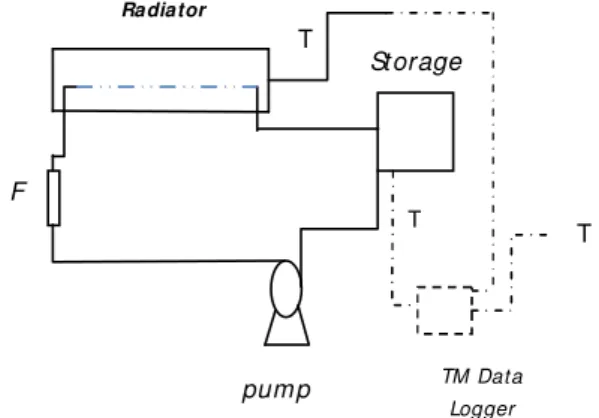
Water flows as working fluid through 8 mm copper pipe. Total length of pipe in the radiator is 13.5 m. Figure 1 represents a schematic view of experimental set up.
Figure 1- Schematic view of experimental setup
The radiator’s bottom plate is a 1×0.6 m2
rectangle covered with black color as well as inside walls and copper pipe.
A 30×30×40 cm3 rectangular tank has been used as water storage and insulated like the radiator itself by 10 cm thick polystyrene foam.
A Grundfos, ALPHA1 pump circulates water as a conventional rotameter (F) measures water circulation flow rate. A gate valve manually controls the flow rate. A digital Lutron TM-946
thermometer measures and records the
temperature of radiator, storage tank and the ambient every hour.
3. RESULTS
In order to investigate the performance of experimental radiator, sets of experiments have been performed in June and July in Shiraz, in south of Iran. In these experiments, the temperature change of radiator and storage tank have been measured and recorded every hour like as ambient temperature.
At the first step, it seemed necessary to specify the optimum number of plastic sheets to cover the
F
St orage
T
TM Data Logger
pum p
T Ra dia tor
radiator. For this reason the first set of experiments was performed with 1, 2, 4, 6, 8, 10, 12 and 14 layers of plastic and the the radiator and ambient temperature have been measured every hour to find minimum possible temperature of radiator. The results are presented in figures 2 through 9. You can see that the minimum
temperature of 0oC has been achieved with a
single layer of plastic sheet (figure 2).
Figure 2- temperature monitoring of radiator with ambient during night hours – single layer cover Addition of more plastic sheets increases the minimum radiator temperature (compare figures 2 through 9). So the experiments would be continued with a single plastic cover.
Figure 3- temperature monitoring of radiator with ambient during night hours – 2 layers cover
Figure 4- temperature monitoring of radiator with ambient during night hours – 4 layers cover
In this set of experiments, there wasn’t water flow through the radiator and the results are representing only the cooling potential of the radiator.
Figure 5- temperature monitoring of radiator with ambient during night hours – 6 layers cover
Figure 7- temperature monitoring of radiator with ambient during night hours – 10 layers cover
Figure 8- temperature monitoring of radiator with ambient during night hours – 12 layers cover
Figure 9- temperature monitoring of radiator with ambient during night hours – 14 layers cover
For the next set of experiments, addition of a storage tank was considered to investigate the possibility of storing cold water during hot day
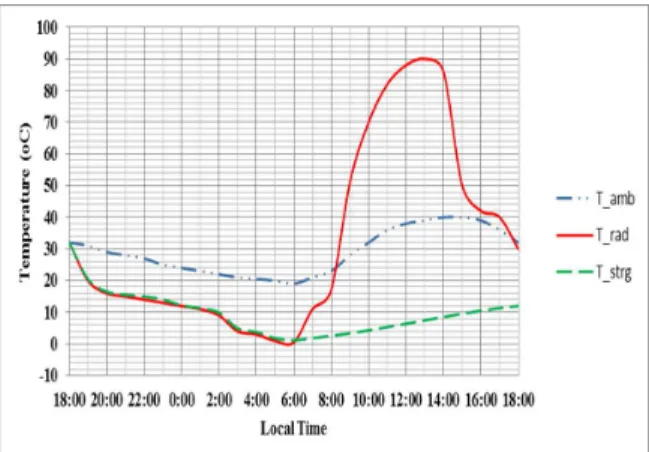
time. However, at day time with solar radiation the radiator works as a solar collector, warming up the water supply. So the circulation pump should be turned off in morning. The experiments show that the minimum radiator temperature occurs at 6:00 AM and at 6:00 PM the radiator temperature equals to ambient temperature (Figure 10). Therefor it has been decided the pump to be turned off at 6:00 AM and turned again on at 6:00 PM. Figure 10 shows temperature change of radiator and storage beside ambient in a 24h period with 5 LPM water circulation rate.
Figure 10- Temperature change of radiator and storage tank with ambient – 5 LPM water flow rate
The storage temperature was measured 12oC at the
end of the day. That is about 18oC below the ambient temperature.
The experiment was repeated with 10 and 15 LPM circulation rate and the results have been represented in figures 11 and 12. It can be seen that increasing water flow rate hasn’t significant effect on storage temperature. The event we can discuss about, as a sequence of small storage capacity.
Figure 12- Temperature change of radiator and storage tank with ambient – 15 LPM water flow rate
4. DISCUSSIONS
Night cooling radiators are seemed to be a necessary requirement in hot climate and desert region to be used in renewable cooling systems. While other researches have been reported
minimum temperatures not less than 10oC, the
experimental setup of this research recorded a minimum temperature of 0oC in the radiator and 3oC in the storage tank.
The storage also supplied us 12oC cold water at the end of the day. The small storage capacity didn’t allow us to investigate the effect of water flow rate on storage tank temperature.
Although we didn’t expose any thermal load to this system, the experiments show the possibility of using this system as an acceptable cooling system and we suggest that by using larger storage, the performance of the system should be investigated in facing known thermal loads.
5. REFERENCES
1. Dimoudi A, Androutspoulos A (2006) The
cooling performance of a radiator based roof component. Solar Energy 80: 1037-1047.
2. Heidarinezhad G, Farahani M F, Delfani S.
(2010) Investigation of a hybrid system of
nocturnal radiative cooling and direct
evaporation cooling. Building and
Environment 45: 1521-1528.
3. Meir M G, Rekstad J B, Lovvik O M. (2002) A
study of a polymer-based radiative cooling system. Solar Energy 73: 403-417.
4. Erell E, Etzion Y. (2000) Radiative cooling of
buildings with flat-plate solar collectors. Building and Environment 35:297-305.
5. Al-Nimr M A, Kodah Z, Nassar B (1998) A
theoretical and experimental investigation of a radiative cooling system. Solar Energy 63: 367-373.
6. Chui T, Bock J, Holmes W, Raab J (2010)
Thermal design and analysis of a multistage 30 K radiative cooling system for EPIC. Cryogenics 50: 633-637.
7. Ali A H H, Taha I M S, Ismail I M (1995) Cooling water flowing through a night sky radiator. Solar Energy 55: 235-253.
8. Yi Man, Yang H, Qu Y, Fang Z (2015) A
novel nocturnal cooling radiator used for supplemental heat sink of active cooling system. Procedia Engineering 121: 300-308.
9. Xu X, Niu R, Feng G (2015) An experimental
and analytical study of a radiative cooling system with flat-plate collectors. Procedia Engineering 121: 1574-1581.
10.Bagiorgas H S, Mihalakakou G (2008)
Experimental and theoretical investigation of a nocturnal radiator for space cooling. Renewable Energy 33: 1220-1227.
11.Incorpera, F P; De Witt, D (1986) Introduction