iMAgENS EM REUMATOLOgiA
ÓRgÃO OfiCiAL DA SOCiEDADE PORTUgUESA DE REUMATOLOgiA
167
Chronic recurrent multifocal osteomyelitis
with isolated spinal involvement
ACTA REUMATOL PORT. 2016;41:167-168
Chronic recurrent multifocal osteomyelitis (CRMO), also named nonbacterial osteomyelitis (NBO) and being a form of presentation of synovitis, acne, pustu-losis, hyperostosis, osteitis syndrome (SAPHO), is an increasingly recognized auto-inflammatory non-bacte-rial disease, of unknown etiology, which occurs pre-dominantly in children and adolescents1. The clinical
course is characterized by prolonged, selflimiting re-curring episodes. Its differential diagnosis includes in-fection and malignancy.
Spinal involvement, although less common, has been reported. In a review of 35 cases, lesions of the vertebral bodies accounted for 3%2. The thoracic spine
is the most affected, followed by the lumbar vertebrae3.
It may present as spondylodiscitis-like lesions or as pre-dominantly lytic lesions, resulting in the collapse of the affected vertebral bodies and progressive kyphosis4.
Magnetic resonance imaging (MRI) is the most sen-sitive and specific imaging modality in assessing local extent, evolution and disease activity4.
The authors report the image study of a case of spinal CRMO in a 13-year-old female patient presented to the emergency department in April 2014 with insidious, recurrent back pain on the upper thoracic spine for the last 4 months. The pain rated between 6 and 8 in 10 in intensity and had an inflammatory rhythm, worsening at night with morning stiffness, being refractory to anal-gesics including non-steroidal anti-inflammatory drugs (NSAIDs). She did not recall a precipitating event, parti -cularly trauma, reported no fever, lethargy or weakness. There was no relevant personal or family history.
On examination, painful palpation of the thoracic spinal processes, paraspinal muscles contractures and
kyphotic accentuation were noted. Tender or swollen peripheral joints, cutaneous stigma or neurological deficits were absent. Her complete blood count and serum biochemistry were within normal range (NR), erythrocyte sedimentation rate 28mm/h (NR <20 mm) and C-reactive protein 2.86 mg/dl (NR <0.3 mg/dl).
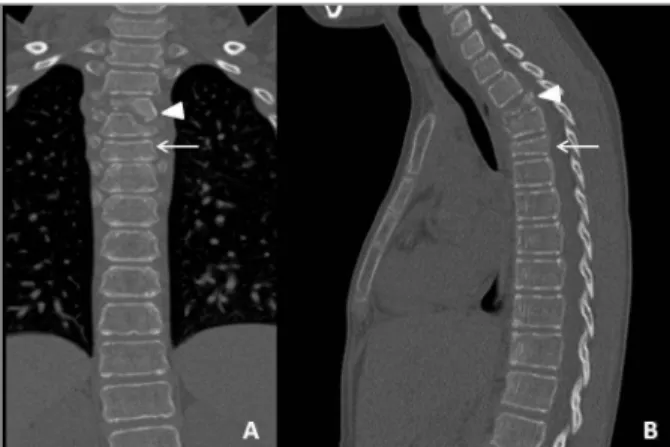
Spinal computed tomography (CT) evidenced lytic destruction of 3th and 4th, and collapse of 5th thoracic vertebral bodies, originating kyphotic deformation (Figure 1). MRI showed that these lesions were hypoin -tense on T1-weighted and hyperin-tense on T2 (Figure 2). Whole-body scan confirmed radioactivity pooling in 3th to 5th thoracic vertebrae.
She underwent several empirical intravenous an-tibiotic treatments, including cefotaxime, vancomycin (suspended for toxidermia), tazobactam, teicoplanin (discontinued by secondary agranulocytosis) and a therapeutic trial with tuberculostatics, without clinical improvement. Microbial laboratory assays of blood and bone cultures were sterile for bacteria, including tu-berculosis. A CT-guided biopsy of 4th and 5th thoracic vertebral bodies showed fibrotic marrow and non-spe-cific chronic inflammatory lymphoplasmocytic infil-Furtado C1, Amaral R2, Jacinto T3, Amaral P4
1. Department of Rheumatology, Hospital do Divino Espírito Santo – EPE, Ponta Delgada, Azores
2. Department of Radiology, Hospital do Divino Espírito Santo – EPE, Ponta Delgada, Azores
3. Department of Pediatrics, Hospital do Divino Espírito Santo – EPE, Ponta Delgada, Azores
4. Department of Orthopedic Surgery, Hospital do Divino Espírito Santo – EPE, Ponta Delgada, Azores
ÓRgÃO OfiCiAL DA SOCiEDADE PORTUgUESA DE REUMATOLOgiA
168
The use of The color Doppler ulTrasonography in The Diagnosis anD moniToring of an aTypical case of gianT-cell arTeriTis
REFEREnCEs
1. Jansson AF, Grote V. ESPD Study group. Nonbacterial osteitis in children: data of a German incidence surveillance study. Acta Paediatrica 2011; 100: 1150-1157.
2. Jurriaans E, Singh NP, Finlay K, Friedman L. Imaging of chro-nic recurrent multifocal osteomyelitis. Radiol Clin North Am 2001; 39: 305-327.
3. Anderson SE, Heini P, Sauvain MJ et al. Imaging of chronic re-current multifocal osteomyelitis of childhood first presenting with isolated primary spinal involvement. Skeletal Radiol 2003; 32: 328-336.
4. Jurik AG, Egund N. MRI in chronic recurrent multifocal os-teomyelitis. Skeletal Radiol 1997; 26: 230-238.
5. Hospach T, Langendoerfer M, Von Kalle T, Maier J, Dannecker GE. Spinal involvement in chronic recurrent multifocal osteo-myelitis (CRMO) in childhood and effect of pamidronate. Eur J Pediatr 2010; 169:1105-1111.
FIGURE 2.MRI showed that these lesions were hypointense on T1-weighted and hyperintense on T2
FIGURE 3.CT-guided biopsy of 4th and 5th thoracic vertebral bodies showed fibrotic marrow and non-specific chronic inflammatory lymphoplasmocytic infiltrate
trate (Figure 3). Clinical findings, diagnostic imaging, negative histological and microbiological examina-tions, and no response to antibiotics led to the diag-nosis of CRMO in September 2014. Intravenous pamidronate 1mg/kg was administered for 3 days with rapid pain relief, with no recurrence of symptoms af-ter 12 months of follow-up.
The present case, illustrating the challenge of time-ly diagnosis, highlights the importance of considering CRMO in adolescents with presumed infective verte-bral osteomyelitis, especially if refractory to antibiotics, in order to avoid potentially unnecessary or invasive investigations or treatments.
Pamidronate is recommended in refractory CRMO with extended spinal involvement, with favorable clini cal outcome5.
CoRREspondEnCE to
Carolina Furtado
Department of Rheumatology, Hospital do Divino Espiríto Santo – EPE
Ponta Delgada, Azores Portugal