Association between CYP1A1 Ile462Val Variation and
Acute Leukemia Risk: Meta-Analyses Including 2164
Cases and 4160 Controls
Wenlei Zhuo1*, Liang Zhang2, Bo Zhu1, Zhiqun Qiu2, Zhengtang Chen1
1Institute of Cancer, Xinqiao Hospital, Third Military Medical University, Chongqing, China,2Department of Environmental Hygiene, College of Preventive Medicine, Third Military Medical University, Chongqing, China
Abstract
Background:Previously, CYP1A1 Ile462Val polymorphism has been indicated to be a risk factor for several malignancies. Increasing reports have focused on the association of CYP1A1 Ile462Val polymorphisms with susceptibility to acute leukemia and have generated controversial results. The goal of the present study was to derive a more precise estimation of the relationship.
Methods:Relevant literature has been rigorously searched and screened. Eligible studies were identified for the period up to Apr 2012. Meta-analyses evaluating the association of CYP1A1 Ile462Val variation with acute leukemia were carried out. Subgroup analyses on ethnicity, clinical types and source of controls were further performed.
Results:A total of thirteen publications including fourteen case-control studies with 2164 cases and 4160 controls were selected for analysis. The overall data indicated a significant association of CYP1A1 Ile462Val polymorphism with acute leukemia risk (Val/Val vs Ile/Ile OR = 1.49; 95% CI = 1.11–1.98; dominant model: OR = 1.26; 95% CI = 1.05–1.51; recessive model: OR = 1.38; 95% CI = 1.04–1.83). In subgroup analysis on ethnicity, increased risk was shown among mixed ethnicities (Val/Val vs Ile/Ile: OR = 2.36; 95% CI = 1.46–3.82; dominant model: OR = 1.37; 95% CI = 1.01–1.86; recessive model: OR = 2.20; 95% CI = 1.37–3.53) but not Asians or Caucasians. In subgroup analysis on clinical types, increased risk was observed in the acute lymphocytic leukemia (ALL) subgroup (Val/Val vs Ile/Ile: OR = 2.06; 95% CI = 1.42–3.01; recessive model: OR = 1.91; 95% CI = 1.32–2.76) but not in the acute myeloid leukemia (AML) subgroup.
Conclusion:The results of the present study suggest that CYP1A1 Ile462Val polymorphism might be a low-penetrant risk factor for acute leukemia. Subgroup analyses suggest that homozygous Val/Val alleles might modify the susceptibility to ALL.
Citation:Zhuo W, Zhang L, Zhu B, Qiu Z, Chen Z (2012) Association between CYP1A1 Ile462Val Variation and Acute Leukemia Risk: Meta-Analyses Including 2164 Cases and 4160 Controls. PLoS ONE 7(10): e46974. doi:10.1371/journal.pone.0046974
Editor:Javier S. Castresana, University of Navarra, Spain
ReceivedMay 11, 2012;AcceptedSeptember 10, 2012;PublishedOctober 4, 2012
Copyright:ß2012 Zhuo et al. This is an open-access article distributed under the terms of the Creative Commons Attribution License, which permits unrestricted use, distribution, and reproduction in any medium, provided the original author and source are credited.
Funding:The authors have no support or funding to report.
Competing Interests:The authors have declared that no competing interests exist. * E-mail: [email protected]
Introduction
Acute leukemia, a malignant tumor of the hematopoietic system, is characterized by a rapid increase in the numbers of immature blood cells. The disease can be subdivided into two major groups according to the cell affected as acute lymphoblastic leukemia (ALL) and acute myeloid leukemia (AML), respectively. ALL is the most common type of leukemia in young children while AML occurs more commonly in adults than in children [1,2]. The mechanisms for acute leukemia genesis are not fully understood. Previous evidence suggests that radiation, smoking, obesity and exposure to chemical carcinogens are considered as its risk factors [3]. Nevertheless, though individuals are exposed to these environmental and lifestyle risk factors, acute leukemia develops only in a small proportion of the exposed people, indicating that the host genetic factors might play an important role in the genesis of leukemia.
Several genetic variations have been evaluated as possible risk factors for leukemia by meta-analyses. Polymorphisms of GSTM1, GSTT1, MTHFR C677T and XRCC1 Arg399Gln have been indicated to increase leukemia risk [4,5,6]. However, significant associations of polymorphic MTR A2756G with decreased acute leukemia susceptibility were found [7]. Thus, different genetic polymorphisms exert different effects on acute leukemia risk. Nevertheless, only a few gene polymorphisms associated with leukemia susceptibility have been identified. To explore the roles of other genetic polymorphisms on the risk is required.
Previous evidence indicates that carcinogen-metabolizing genes may play critical roles in determining individual susceptibility to malignancies [8,9]. Genetic variations in these genes may change the activities of their encoded enzymes, possibly by altering their expression and function. Cytochrome P450 enzymes catalyze Phase I metabolism reaction. Cytochrome P450 1A1 (CYP1A1) is a member of the CYP1 family that participates in the metabolism
of xenobiotics and endogenous compounds, particularly polycyclic aromatic hydrocarbons (PAHs) such as benzo[a]pyrene [10]. A commonly investigated single nucleotide polymorphism (SNP) in the CYP1A1 gene has been suggested to have a correlation with cancer risk. The SNP leads to a base substitution of isoleucine with valine at codon 462 in exon7 (Ile462Val or CYP1A1*2C polymorphism, rs1048943). Thus, the exon7 restriction site polymorphism results in three genotypes: a predominant homo-zygous Ile/Ile, the heterozygote Ile/Val and a rare homohomo-zygous Val/Val [11].
A number of published studies have been conducted on the relationship between CYP1A1 Ile462Val polymorphism and acute leukemia risk. However, the results are inconclusive. The issue of whether the CYP1A1 Ile462Val polymorphism is a risk factor for acute leukemia has not been clearly addressed. Thus, in this study we aimed to derive a more precise estimation of the relationship by performing a quantitative meta-analysis that increases statistical power to reach more convincible results.
Materials and Methods
1 Literature search Strategy
To obtain eligible literature, we carried out a search in the Medline, EMBASE, OVID, Sciencedirect, Google Scholar and Chinese National Knowledge Infrastructure (CNKI) without a language limitation, covering published publications up to Apr 2012, with a combination of the following keywords: Cytochrome P450 1A1, CYP1A1, Ile462Val, exon7, acute leukemia, hematology, malignancy, neoplasm, cancer, variation and polymorphism. All searched studies were retrieved and the bibliographies were checked for other relevant publications. Review articles and bibliographies of other relevant studies identified were electric/hand searched to find additional eligible studies.
2 Inclusion and Exclusion Criteria
The following criteria were used for the literature selection: first, studies should concern the association of CYP1A1 Ile462Val polymorphism with acute leukemia risk; second, studies must be observational studies (Case–control or cohort); third, papers must offer the sample size, odds ratios (ORs) and their 95% confidence intervals (CIs), the genetic distribution or the information that can help infer the needed results. Accordingly, the following criteria for exclusion were also used: first, the design and the definition of the experiments were obviously different from those of the selected articles; second, the source of cases and controls and other essential information were not offered; third, reviews and duplicated publications. After rigorous searching, we reviewed all papers in accordance with the criteria defined above for further analysis.
3 Data Extraction
Data were carefully extracted from all eligible publications independently by two of the authors (Zhuo and Zhang)
according to the inclusion criteria mentioned above. For conflicting evaluations, an agreement was reached following a discussion. If a consensus could not be reached, another author was consulted to resolve the dispute and then a final decision was made by the majority of the votes. The extracted information was entered into a database.
4 Statistical Analysis
The odds ratio (OR) of CYP1A1 Ile462Val polymorphisms and acute leukemia risk was estimated for each study. The pooled ORs were performed for a homozygote comparison model (Val/Val
versus Ile/Ile), a dominant model (Val/Val+Val/Ile versus Ile/Ile) and a recessive model (Val/Val versus Val/Ile+Ile/Ile), re-spectively. To detect any possible sample size biases, the OR and its 95% confidence interval (CI) to each study was plotted against the number of participants respectively. I2 value was applied to evaluate heterogeneity between the included studies (I2= 0–25%, no heterogeneity;I2= 25–50%, moderate heteroge-neity; I2.50%, large heterogeneity) [12]. In addition, a Chi-square based Q statistic test was conducted to assess the heterogeneity. If the result of the Q-test wasP.0.1, ORs were pooled according to the fixed-effect model (Mantel-Haenszel), Otherwise, the random-effect model (DerSimonian and Laird) was used. The significance of the pooled ORs was determined by Z-test. The Hardy-Weinberg equilibrium (HWE) was assessed by Fisher’s exact test. Publication bias was assessed by visual inspection of funnel plots [13], in which the standard error of log (OR) of each study was plotted against its log (OR). An asymmetric plot indicates a possible publication bias. The symmetry of the funnel plot was further evaluated by Egger’s linear regression test [14]. Statistical analysis was undertaken using the program STATA 11.0 software (Stata Corporation, Texas, USA).
Results
1 Study Characteristics
Relevant publications were retrieved and screened carefully. A total of ninety-six publications were identified, of which seventy-three irrelevant papers were excluded. As shown in Figure 1, twenty-three publications were preliminary eligible, of which two review articles [15,16] and one publication without detailed subtypes of leukemia [17] were then excluded. Next, three publications not being case-control studies [18,19,20] and one article without sufficient data [21] were discarded. As a result, sixteen publications were selected for data extraction. However, three duplicate publications [16,22,23] which concerned the same research with one selected study [24] were further excluded. Moreover, an included article provided two separated groups of data regarding childhood leukemia and adult leukemia, re-spectively [25]. Thus, each group was considered as a separate study for analysis. Lastly, thirteen publications containing fourteen
case-control studies were selected
[24,25,26,27,28,29,30,31,32,33,34,35,36].
Of the selected publications, one publication was written in Chinese [26] while the remaining twelve were in English. The relevant information was listed in Table 1. According to this table, the first author and the number and characteristics of cases and controls for each study as well as other necessary information were presented. There were three groups of Caucasians [24,27,34], five of Asians [26,29,31,32,36] and six of mixed ethnicities [25,28,30,33,35] in this meta-analysis. As shown in
Table 1, five groups of AML [25,27,31,33,36] and nine of ALL [24,25,26,28,29,30,32,34,35] were included in this study. As for age groups, there were eight childhood ALL [24,25,26,29,30,32,34,35] and one adult ALL [28] groups in this study. All AML studies concerned adult AML.
The distributions of CYP1A1 Ile462Val genotypes as well as the genotyping methods of the included studies were presented in
Table 2. The genetic distributions of the control groups in all studies were consistent with HWE except for one study [35].
2 Test of Heterogeneity
I2= 42.1%), except for the homozygote comparison (P = 0.171 for Q-test;I2= 27.9%) and the recessive models (P = 0.247 for Q-test; I2= 20.1%). However, when subgroup analyses on ethnicity, clinical types and source of controls were further conducted, we found diminished heterogeneities in some of the subgroups under the dominant model.
3 Meta-analysis Results
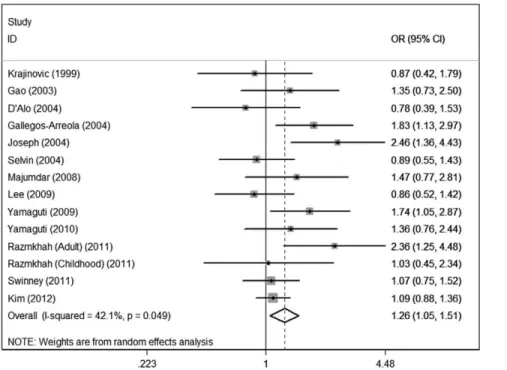
The main results of the meta-analysis were listed inTable 3. For the overall data containing 2164 cases and 4160 controls, significant associations of CYP1A1 Ile462Val polymorphism with acute leukemia risk were shown under the homozygote compar-ison (OR = 1.49; 95%CI = 1.11–1.98), the dominant (OR = 1.26; 95%CI = 1.05–1.51) (Figure 2) and the recessive (OR = 1.38; 95%CI = 1.04–1.83; P = 0.247 for heterogeneity) models, indicat-ing that individuals carryindicat-ing the variant Val allele may have an increased acute leukemia risk compared with those bearing the wild-type Ile allele.
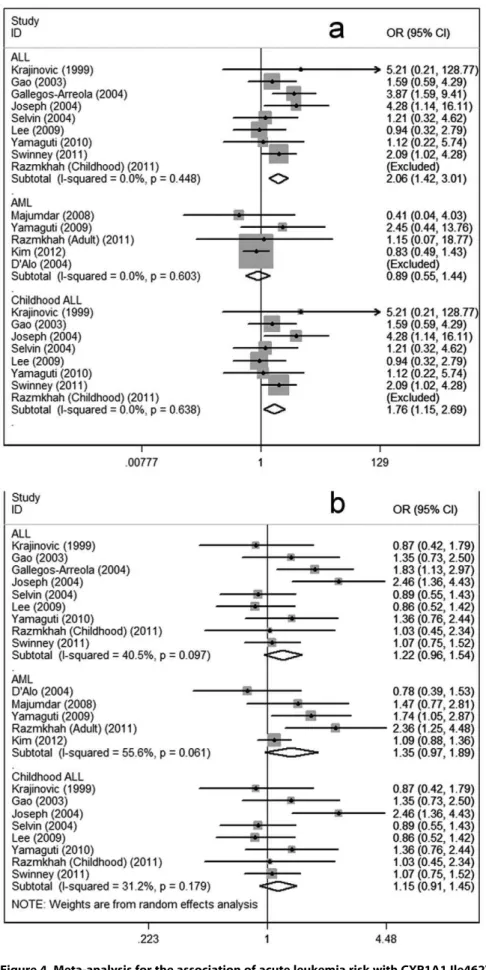
Considering the potential impact of the confounding factors on the overall results, we further conducted subgroup analyses. In the primary literature, only the detailed information on ethnicity, clinical types and source of controls were sufficient for analysis. Therefore, subgroup analyses on these issues were performed. In subgroup analysis according to ethnicity, increased leukemia risks were observed in the three genetic models among mixed ethnicities (homozygote comparison: OR = 2.36; 95%CI = 1.46–3.82; dom-inant: OR = 1.37; 95%CI = 1.01–1.86; recessive: OR = 2.20; 95%CI = 1.37–3.53) but not Caucasians or Asians (Figure 3). In subgroup analyses regarding clinical types, increased risks for ALL were found under the homozygote comparison (OR = 2.06; 95%CI = 1.42–3.01) and the recessive models (OR = 1.91; 95%CI = 1.32–2.76), respectively. When the data regarding ALL were separated by age groups, significant increased risk could be observed in both adult ALL and childhood ALL. No significant associations were shown in subgroup regarding AML under the three genetic models(Figure 4). In subgroup analysis on source of controls, elevated risks were observed in the population-based
subgroup (homozygote comparison: OR = 1.44; 95%CI = 1.05– 1.96; dominant: OR = 1.23; 95%CI = 1.04–1.46) rather than the hospital-based subgroup(Figure 5).
4 Sensitivity Analysis
When the effect-models were changed, the significance of the overall data for the three models was not statistically altered (data not shown). Then, we discarded one study whose genetic distributions in controls exhibited significant deviation from HWE [35], given that the deviation might lead to any bias [37]. The significances of the overall data in the three models, respectively, were also not statistically changed. Then, one-way sensitivity analysis [38] was carried out to assess the stability of the meta-analysis. The statistical significance of the results was not changed when any single study was deleted (data not shown), indicating the credibility of the results.
5 Bias Diagnostics
Funnel plots were created to assess the publication bias. Then, Egger’s linear regression tests were used to assess the symmetries of the plots. The funnel plots seemed symmetrical for the overall data of the three genetic models(Figure 6a). Additionally, the data of the Egger’s tests also indicate the absence of the publication bias in the three models, respectively (homozygote comparison model: t = 0.68, P.0.05; dominant model: t = 0.98, P.0.05; recessive model: t = 0.58, P.0.05)(Figure 6b), suggesting that the results of the meta-analyses are relatively stable and the potential publication bias might not have an evident influence on the results.
Discussion
For the overall data, the results showed that CYP1A1 Ile462Val might have a marked correlation with increased acute leukemia risk. Moreover, in subgroup analyses stratified by ethnicity, the data failed to reveal an association among either Asians or Caucasians, but mixed ethnicities. In subgroup analysis according to clinical types, the results indicated that Val/Val alleles might increase susceptibility to ALL.
The relations of CYP1A1 Ile462Val variations with cancer risk have been evaluated by several meta-analyses. CYP1A1 Ile462Val polymorphism might have a correlation with increased risks of lung cancer, cervical cancer, colorectal cancer, esophageal cancer and breast cancers [39,40,41,42,43]. Nevertheless, for gastric cancer, prostate cancer and laryngeal cancers [44,45,46], such associations were not significant. Thus, CYP1A1 Ile462Val polymorphism might have different influences on different types of malignancies. Recently, a meta-analysis regarding the associ-ation of CYP1A1 MspI variassoci-ation with childhood acute leukemia failed to reveal a significant association [47]. However, this meta-analysis focused on CYP1A1 MspI variation but not exon7 (Ile462Val) polymorphism. To our knowledge, the present meta-analysis for the first time shed light on the association between CYP1A1 Ile462Val polymorphism and acute leukemia risk.
In the subgroup analysis according to ethnicity, significant increased leukemia risk was found in the mixed races subgroup but not Asian and Caucasian subgroups, suggesting that CYP1A1 Ile462Val genetic variation may not confer acute leukemia risk among either Asians or Caucasians. Nevertheless, since we could not obtain the data regarding separate ethnicities from the mixed ethnicities subgroup, the possible effects of ethnicity variations on the results could not be precisely evaluated. Evidence suggested that gene polymorphisms could result in ethnic-specific suscepti-bility to leukemia [35]. In addition, environmental factors such as birth place and socioeconomic status may also play critical roles in Figure 1. The flow diagram of included/excluded studies.
doi:10.1371/journal.pone.0046974.g001
CYP1A1 Ile462Val Polymorphism and Acute Leukemia
First Author
Publication Year
Number of Cases (male/female)
Number of Controls
(male/female) Subtypes of cases Type of controls
Median (or mean) age, (range)
year (Cases/Controls) Racial decent Country
Krajinovic 1999 177 (110/67) 304 (144/160) 177 ALL Healthy controls (PB) 8(1–21)/NA Caucasian Canada
Gao 2003 78 (40/38) 112 (58/54) 78 ALL Healthy controls (PB) NA(2–15)/NA(3–15) Asian China
D’Alo 2004 193 (107/86) 273(147/126) 193 AML Healthy controls (PB) 62(19–87)/60(19–90) Caucasian Italy
Gallegos-Arreola 2004 136 (57/79) 136 (66/70) 136 ALL Healthy controls (PB) 37.5(18–78)/41.9(18–72) Mixed Mexico
Joseph 2004 118 (77/41) 118 (77/41) 118 ALL Non-cancer controls (age,-
sex-matched; HB)
NA(0–14)/NA(0–14) Asian India
Selvin 2004 175 (NA) 175 (NA) 175 ALL Healthy controls (PB) NA(0–14)/NA(0–14) Mixed USA
Majumdar 2008 110 (70/40) 126 (54/72) 110 AML Healthy controls (PB) 35(4–81)/30(8–73) Asian India
Lee 2009 164 (101/63) 164 (101/63) 106 ALL Non-cancer controls (age,-
gender-matched; HB)
6.96(0–18)/7.09(0–18) Asian Korea
Yamaguti 2009 133 (70/63) 133 (70/63) 133 AML Healthy controls (PB) 47(11–89)/53(25–60) Mixed Brazil
Yamaguti 2010 99 (52/47) 99 (52/47) 99 ALL Healthy controls (PB) 4(NA)/53(NA) Caucasian Brazil
Razmkhah (Adult) 2011 144 (77/67) 95 (52/43) 105 AML Healthy controls (PB) 45.7(NA)/44.8(NA) Mixed Iran
Razmkhah (Childhood)2011 85 (47/38) 94 (53/41) 85 ALL Healthy controls (PB) 5.6(0–16)/6.2(0–16) Mixed Iran
Swinney 2011 258 (137/121) 646 (NA) 258 ALL Healthy controls (age-, gender-,
ethnicity-matched; PB)
6.3(NA)/NA Mixed USA
Kim 2012 415 (223/192) 1700 (821/879) 415 AML Healthy controls (PB) 50.5(15–86)/52.2(20–74) Asian Korea
NA: not available; AML, acute myeloid leukemia; ALL, acute lymphocytic leukemia; PB: population-based; HB: hospital-based. doi:10.1371/journal.pone.0046974.t001
CYP1A1
Ile462Val
Polymorphism
and
Acute
Leukem
ia
ONE
|
www.ploson
e.org
4
October
2012
|
Volume
7
|
Issue
10
|
Table 2.Distribution of CYP1A1 Ile462Val genotype among acute leukemia cases and controls included in the meta-analysis.
First Author Year
Genotyping
method Cases Controls HWE (control)
Val/Val Val/Ile Ile/Ile Val/Val Val/Ile Ile/Ile Chi-squre P
Krajinovic 1999 PCR-RFLP 1 11 158 0 24 275 0.523 .0.05
Gao 2003 ASA 10 44 24 11 59 42 2.226 .0.05
D’Alo 2004 PCR-RFLP 0 14 179 0 25 248 0.629 .0.05
Gallegos-Arreola 2004 PCR 22 65 49 8 59 69 1.010 .0.05
Joseph 2004 PCR-RFLP 10 34 74 3 20 95 2.168 .0.05
Selvin 2004 Not determined 5 39 131 4 44 127 0.007 .0.05
Majumdar 2008 PCR-RFLP 1 24 85 3 18 105 3.687 .0.05
Lee 2009 SNaPshot 6 39 60 9 65 85 0.567 .0.05
Yamaguti 2009 PCR-RFLP 4 54 75 2 39 92 0.891 .0.05
Yamaguti 2010 PCR-RFLP 3 36 60 3 29 67 0.004 .0.05
Razmkhah (Adult) 2011 PCR-RFLP 1 38 66 1 18 76 0.003 .0.05
Razmkhah (Childhood) 2011 PCR-RFLP 0 13 72 0 14 80 0.609 .0.05
Swinney 2011 Golden gate assay 14 40 188 18 118 505 10.693 ,0.05
Kim 2012 PCR-RFLP 17 173 225 87 654 959 3.311 .0.05
doi:10.1371/journal.pone.0046974.t002
Table 3.Main results of the pooled data in the meta-analysis.
No. (cases/
controls) Val/Val vs Ile/Ile (Val/Val+Val/Ile) vs Ile/Ile Val/Val vs (Val/Ile+Ile/Ile)
OR (95%CI) P
P
(Q-test) I2 OR (95%CI) P
P
(Q-test) I2 OR (95%CI) P
P (Q-test) I2 Total 2164/4160 1.49 (1.11–1.98) 0.007 0.171 27.9% 1.26 (1.05–1.51) 0.011 0.049 42.1% 1.38 (1.04–1.83) 0.025 0.247 20.1% Clinical types
ALL 1208/1833 2.06 (1.42–3.01) 0.000 0.448 0.0% 1.22 (0.96–1.54) 0.098 0.097 40.5% 1.91 (1.32–2.76) 0.001 0.601 0.0% AML 956/2327 0.89 (0.55–1.44) 0.633 0.603 0.0% 1.35 (0.97–1.89) 0.076 0.061 55.6% 0.83 (0.51–1.34) 0.439 0.672 0.0% Age group (ALL)
Adult ALL 136/136 3.87 (1.59–9.41) 0.003 – – 1.83 (1.13–2.97) 0.015 – – 3.09 (1.32–7.21) 0.009 – – Childhood ALL 1072/1697 1.76 (1.15–2.69) 0.009 0.638 0.0% 1.15 (0.91–1.45) 0.258 0.179 31.2% 1.68 (1.11–2.53) 0.015 0.701 0.0% Ethnicity
Caucasian 462/671 1.60 (0.39–6.55) 0.512 0.400 0.0% 1.01 (0.69–1.48) 0.945 0.418 0.0% 1.47 (0.37–5.95) 0.586 0.362 0.0% (ALL) 269/398 1.60 (0.39–6.55) 0.512 0.400 0.0% 1.14 (0.72–1.79) 0.571 0.344 0.0% 1.47 (0.37–5.95) 0.586 0.362 0.0%
(AML) 193/273 – – – – 0.78 (0.39–1.53) 0.466 – – – – –
Asian 826/2215 1.09 (0.74–1.61) 0.646 0.173 37.2% 1.29 (0.94–1.76) 0.115 0.072 53.6% 1.02 (0.70–1.49) 0.901 0.247 26.2% (ALL) 301/389 1.73 (0.94–3.21) 0.080 0.221 33.8% 1.40 (0.76–2.59) 0.286 0.029 71.9% 1.57 (0.87–2.83) 0.138 0.327 10.6% (AML) 525/1826 0.80 (0.47–1.35) 0.403 0.556 0.0% 1.13 (0.92–1.38) 0.256 0.393 0.0% 0.76 (0.45–1.27) 0.298 0.533 0.0% Mixed 876/1274 2.36 (1.46–3.82) 0.000 0.642 0.0% 1.37 (1.01–1.86) 0.041 0.064 52.0% 2.20 (1.37–3.53) 0.001 0.791 0.0% (ALL) 638/1046 2.41 (1.45–4.01) 0.001 0.323 11.6% 1.16 (0.85–1.60) 0.348 0.182 38.4% 2.28 (1.38–3.77) 0.001 0.523 0.0% (AML) 238/228 2.00 (0.47–8.53) 0.348 0.651 0.0% 1.95 (1.31–2.90) 0.001 0.457 0.0% 1.64 (0.39–6.92) 0.502 0.628 0.05 Source of controls
PB 1941/3883 1.44 (1.05–1.96) 0.022 0.207 25.7% 1.23 (1.04–1.46) 0.015 0.178 27.2% 1.33 (0.98–1.81) 0.064 0.247 21.3% (ALL) 985/1556 2.14 (1.39–3.29) 0.001 0.600 0.0% 1.17 (0.96–1.43) 0.118 0.424 0.0% 1.96 (1.29–2.97) 0.002 0.661 0.0% (AML) 956/2327 0.89 (0.55–1.44) 0.633 0.603 0.0% 1.35 (0.97–1.89) 0.076 0.061 55.6% 0.83 (0.51–1.34) 0.439 0.672 0.0% HB 223/277 1.83 (0.83–4.02) 0.132 0.083 66.7% 1.44 (0.51–4.01) 0.489 0.008 85.9% 1.74 (0.80–3.82) 0.164 0.144 53.1% (ALL) 223/277 1.83 (0.83–4.02) 0.132 0.083 66.7% 1.44 (0.51–4.01) 0.489 0.008 85.9% 1.74 (0.80–3.82) 0.164 0.144 53.1%
(AML) – – – – – – – – – – – – –
AML, acute myeloid leukemia; ALL, acute lymphocytic leukemia; PB: population-based; HB: hospital-based. doi:10.1371/journal.pone.0046974.t003
CYP1A1 Ile462Val Polymorphism and Acute Leukemia
the genesis of leukemia [48]. Therefore, possible racial disparities might exist. Further investigations regarding different ethnicities are needed to clarify this issue.
In the subgroup analysis stratified by clinical types, increased risk for ALL was shown under the homozygote comparison and the recessive models, suggesting that the homozygous Val/Val allele carriers might have an increased ALL risk relative to those of Figure 2. Meta-analysis for the association of acute leukemia risk with CYP1A1 Ile462Val polymorphism for the overall data (Val/ Val+Val/Ile versus Ile/Ile).
doi:10.1371/journal.pone.0046974.g002
Figure 3. Meta-analysis for the association of acute leukemia risk with CYP1A1 Ile462Val polymorphism (Val/Val+Val/Ile versus Ile/ Ile; stratified by ethnicity).
Figure 4. Meta-analysis for the association of acute leukemia risk with CYP1A1 Ile462Val polymorphism stratified by clinical types.
(a) Val/Val versus Ile/Ile; (b) Val/Val+Val/Ile versus Ile/Ile; AML, acute myeloid leukemia; ALL, acute lymphocytic leukemia. doi:10.1371/journal.pone.0046974.g004
CYP1A1 Ile462Val Polymorphism and Acute Leukemia
the wild-type Ile carriers. When the data about ALL were further divided by age groups, similar results were obtained in the two subgroups. However, only one study provided the information about adult ALL; thus, the results should be interpreted with care. As for AML, no associations could be observed. The disparity may be due to the different precise mechanisms involved in the genesis of different types of leukemia. ALL is a common childhood leukemia with poor outcomes [49], characterized by cytogenetic abnormalities, such as translocations and changes in ploidy. Parental exposure to specific chemicals and widely spread carcinogens may increase risk of childhood ALL [50,51]. Hence, variations of CYP1A1 Ile462Val may result in altered activities of the enzymes and the effects of carcinogens on the blood could thus be strengthened. Consequently, ALL risk might be increased.
Smoking and alcohol consumption are also important risk factors for leukemia. Evidence indicates that maternal smoking and drinking prior to and during pregnancy may increase risk of childhood leukemia, particularly ALL [52]. We tried to extract relevant information regarding smoking and drinking from the primary literature. However, insufficient data were obtained. Hence, relevant subgroup analyses have not been performed and further investigations concerning the interactions of smoking, drinking and gene variations on leukemia are required.
In the subgroup analysis according to source of controls, significance increased leukemia risk were observed in the population-based subgroup but not the hospital-based group. Since hospital-based controls might not be always truly represen-tative of the general population, any biases might exist and the results should be interpreted with care. Therefore, use of proper control participants with strict matching criteria and large sample sizes are important for reducing such selection bias in future investigations.
In the present meta-analysis, both Q-tests and I-squared values were used to assess the heterogeneities. Evident between-study heterogeneities for overall data were observed in the dominant genetic model, and thus the random-effect models were utilized in this model. However, as shown in Table 3, in the subgroup analyses, removed or reduced heterogeneities were found in the relevant subgroups, implying that the heterogeneities may result from multi-factors; in addition to ethnicity and clinical types of leukemia, other factors such as selection of controls, gender, and prevalence of lifestyle factors might also lead to the heterogeneities. Publication bias is an important factor that should be considered in a meta-analysis. We used funnel plots to evaluate the potential publication bias. Then, Egger’s linear regression test was also used as an approach for assessment of the symmetries. The results failed to suggest evident bias in the three genetic models, suggesting little influences of the bias on the results and demonstrating the robustness and credibility of the present meta-analysis.
Several limitations should be addressed. First, in this meta-analysis, the primary articles only provided data about Caucasians, Asians and mixed ethnicities. Separate data regarding other ethnicities such as African should be concerned. Second, only studies written in English and Chinese were searched and included in this meta-analysis. Thus, any selection bias should be noted. Third, subgroup analyses regarding age, gender and other factors such as smoking, drinking and radiation exposure have not been conducted in the present study because relevant sufficient data were not available in the primary articles. Furthermore, among the fourteen included studies, only three studies provided the adjusted ORs [31,32,35]. We did not pool the adjusted ORs because the included studies either did not adjust for confounders, or the adjustments were not comparable among them. As the adjusted ORs are much more accurate than crude ORs but not Figure 5. Meta-analysis for the association of acute leukemia risk with CYP1A1 Ile462Val polymorphism stratified by source of controls (Val/Val+Val/Ile versus Ile/Ile).PB: population-based; HB: hospital-based.
available for most included studies, and adjusted factors differed across these studies, residual confounding might have affected the analysis. Therefore, the results should be interpreted with caution. Additionally, gene-gene and gene-environment interactions should also be considered in the further investigations.
In summary, the results of the present meta-analysis suggest that variant Val allele of CYP1A1 Ile462Val polymorphism might have an association with excess acute leukemia risk. Moreover, subgroup analyses indicate that homozygous Val/Val might
modify the susceptibility to ALL. Further well-designed investiga-tions in view of the confounding factors are needed reach a more convincible conclusion.
Author Contributions
Conceived and designed the experiments: WZ ZC. Performed the experiments: WZ LZ BZ. Analyzed the data: LZ BZ ZQ. Contributed reagents/materials/analysis tools: LZ BZ. Wrote the paper: WZ ZC.
References
1. Meenaghan T, Dowling M, Kelly M (2012) Acute leukaemia: making sense of a complex blood cancer. Br J Nurs 21: 76, 78–83.
2. Advani AS, Hunger SP, Burnett AK (2009) Acute leukemia in adolescents and young adults. Semin Oncol 36: 213–226.
3. Ilhan G, Karakus S, Andic N (2006) Risk factors and primary prevention of acute leukemia. Asian Pac J Cancer Prev 7: 515–517.
4. Yan J, Yin M, Dreyer ZE, Scheurer ME, Kamdar K, et al. (2012) A meta-analysis of MTHFR C677T and A1298C polymorphisms and risk of acute lymphoblastic leukemia in children. Pediatr Blood Cancer 58: 513–518. 5. Ye Z, Song H (2005) Glutathione s-transferase polymorphisms (GSTM1,
GSTP1 and GSTT1) and the risk of acute leukaemia: a systematic review and meta-analysis. Eur J Cancer 41: 980–989.
6. Wang L, Yin F, Xu X, Hu X, Zhao D (2012) X-Ray Repair Cross-Complementing Group 1 (XRCC1) Genetic Polymorphisms and Risk of
Figure 6. Publication bias tests for the overall data (Val/Val+Val/Ile versus Ile/Ile).(a): Funnel plot; (b) Egger’s linear regression test. doi:10.1371/journal.pone.0046974.g006
CYP1A1 Ile462Val Polymorphism and Acute Leukemia
Childhood Acute Lymphoblastic Leukemia: A Meta-Analysis. PLoS One 7: e34897.
7. Yu K, Zhang J, Dou C, Gu S, Xie Y, et al. (2010) Methionine synthase A2756G polymorphism and cancer risk: a meta-analysis. Eur J Hum Genet 18: 370–378. 8. Boffetta P (2010) Biomarkers in cancer epidemiology: an integrative approach.
Carcinogenesis 31: 121–126.
9. Klaunig JE, Kamendulis LM, Hocevar BA (2010) Oxidative stress and oxidative damage in carcinogenesis. Toxicol Pathol 38: 96–109.
10. Guengerich FP, Shimada T (1998) Activation of procarcinogens by human cytochrome P450 enzymes. Mutat Res 400: 201–213.
11. Zhou SF, Liu JP, Chowbay B (2009) Polymorphism of human cytochrome P450 enzymes and its clinical impact. Drug Metab Rev 41: 89–295.
12. Higgins JP, Thompson SG, Deeks JJ, Altman DG (2003) Measuring inconsistency in meta-analyses. BMJ 327: 557–560.
13. Munafo MR, Clark TG, Flint J (2004) Assessing publication bias in genetic association studies: evidence from a recent meta-analysis. Psychiatry Res 129: 39–44.
14. Egger M, Davey Smith G, Schneider M, Minder C (1997) Bias in meta-analysis detected by a simple, graphical test. BMJ 315: 629–634.
15. Vijayakrishnan J, Houlston RS (2010) Candidate gene association studies and risk of childhood acute lymphoblastic leukemia: a systematic review and meta-analysis. Haematologica 95: 1405–1414.
16. Sinnett D, Krajinovic M, Labuda D (2000) Genetic susceptibility to childhood acute lymphoblastic leukemia. Leuk Lymphoma 38: 447–462.
17. Manuguerra M, Matullo G, Veglia F, Autrup H, Dunning AM, et al. (2007) Multi-factor dimensionality reduction applied to a large prospective investigation on gene-gene and gene-environment interactions. Carcinogenesis 28: 414–422. 18. Krajinovic M, Labuda D, Mathonnet G, Labuda M, Moghrabi A, et al. (2002) Polymorphisms in genes encoding drugs and xenobiotic metabolizing enzymes, DNA repair enzymes, and response to treatment of childhood acute lymphoblastic leukemia. Clin Cancer Res 8: 802–810.
19. Pelloso LA, Da Silva ID, De Souza NC, Yamamoto M, Botelho CA, et al. (2007) CYP1A1 polymorphisms modify overall survival in acute myeloid leukemia patients. Leuk Lymphoma 48: 1211–1215.
20. Yang Y, Tian Y, Jin X, Yan C, Jiang F, et al. (2009) A case-only study of interactions between metabolic enzyme polymorphisms and industrial pollution in childhood acute leukemia. Environ Toxicol Pharmacol 28: 161–166. 21. Infante-Rivard C, Krajinovic M, Labuda D, Sinnett D (2000) Parental smoking,
CYP1A1 genetic polymorphisms and childhood leukemia (Quebec, Canada). Cancer Causes Control 11: 547–553.
22. Krajinovic M, Richer C, Sinnett H, Labuda D, Sinnett D (2000) Genetic polymorphisms of N-acetyltransferases 1 and 2 and gene-gene interaction in the susceptibility to childhood acute lymphoblastic leukemia. Cancer Epidemiol Biomarkers Prev 9: 557–562.
23. Mathonnet G, Krajinovic M, Labuda D, Sinnett D (2003) Role of DNA mismatch repair genetic polymorphisms in the risk of childhood acute lymphoblastic leukaemia. Br J Haematol 123: 45–48.
24. Krajinovic M, Labuda D, Richer C, Karimi S, Sinnett D (1999) Susceptibility to childhood acute lymphoblastic leukemia: influence of CYP1A1, CYP2D6, GSTM1, and GSTT1 genetic polymorphisms. Blood 93: 1496–1501. 25. Razmkhah F, Pazhakh V, Zaker F, Atashrazm F, Sheikhi M (2011) Frequency of
CYP1A1*2C polymorphism in patients with leukemia in the Iranian population. Lab Med 42: 220–223.
26. Gao J, Huang Y, Liang J, Fang X (2003) Relationship between genetic polymorphisms of CYP1A1 and ALL. Chin J Birth Health & Heredity 11: 21– 24.
27. D’Alo F, Voso MT, Guidi F, Massini G, Scardocci A, et al. (2004) Polymorphisms of CYP1A1 and glutathione S-transferase and susceptibility to adult acute myeloid leukemia. Haematologica 89: 664–670.
28. Gallegos-Arreola MP, Batista-Gonzalez CM, Delgado-Lamas JL, Figuera LE, Puebla-Perez AM, et al. (2004) Cytochrome P4501A1 polymorphism is associated with susceptibility to acute lymphoblastic leukemia in adult Mexican patients. Blood Cells Mol Dis 33: 326–329.
29. Joseph T, Kusumakumary P, Chacko P, Abraham A, Radhakrishna Pillai M (2004) Genetic polymorphism of CYP1A1, CYP2D6, GSTM1 and GSTT1 and susceptibility to acute lymphoblastic leukaemia in Indian children. Pediatr Blood Cancer 43: 560–567.
30. Selvin S (2004) Cytochrome P450 1A1 polymorphism and childhood leukemia: an analysis of matched pairs case-control genotype data. Cancer Epidemiol Biomarkers Prev 13: 1371–1374.
31. Majumdar S, Mondal BC, Ghosh M, Dey S, Mukhopadhyay A, et al. (2008) Association of cytochrome P450, glutathione S-transferase and N-acetyl transferase 2 gene polymorphisms with incidence of acute myeloid leukemia. Eur J Cancer Prev 17: 125–132.
32. Lee KM, Ward MH, Han S, Ahn HS, Kang HJ, et al. (2009) Paternal smoking, genetic polymorphisms in CYP1A1 and childhood leukemia risk. Leuk Res 33: 250–258.
33. Yamaguti GG, Lourenco GJ, Costa FF, Lima CS (2009) High risk of ‘de novo’ acute myeloid leukaemia in individuals with cytochrome P450 A1 (CYP1A1) and NAD(P)H:quinone oxidoreductase 1 (NQO1) gene defects. Eur J Haematol 83: 270–272.
34. Yamaguti GG, Lourenco GJ, Silveira VS, Tone LG, Lopes LF, et al. (2010) Increased risk for acute lymphoblastic leukemia in children with cytochrome P450A1 (CYP1A1)- and NAD(P)H:quinone oxidoreductase 1 (NQO1)-inherited gene variants. Acta Haematol 124: 182–184.
35. Swinney RM, Beuten J, Collier AB, 3rd, Chen TT, Winick NJ, et al. (2011) Polymorphisms in CYP1A1 and ethnic-specific susceptibility to acute lympho-blastic leukemia in children. Cancer Epidemiol Biomarkers Prev 20: 1537–1542. 36. Kim HN, Kim NY, Yu L, Tran HT, Kim YK, et al. (2012) Association of GSTT1 polymorphism with acute myeloid leukemia risk is dependent on smoking status. Leuk Lymphoma 53: 681–687.
37. Thakkinstian A, McElduff P, D’Este C, Duffy D, Attia J (2005) A method for meta-analysis of molecular association studies. Stat Med 24: 1291–1306. 38. Tobias A (1999) Assessing the influence of a single study in the meta-analysis
estimate. Stata Techn Bull 8: 15–17.
39. Zhuo WL, Zhang YS, Wang Y, Zhuo XL, Zhu B, et al. (2009) Association studies of CYP1A1 and GSTM1 polymorphisms with esophageal cancer risk: evidence-based meta-analyses. Arch Med Res 40: 169–179.
40. Sergentanis TN, Economopoulos KP, Choussein S, Vlahos NF (2012) Cytochrome P450 1A1 (CYP1A1) gene polymorphisms and cervical cancer risk: a meta-analysis. Mol Biol Rep.
41. Zhan P, Wang Q, Qian Q, Wei SZ, Yu LK (2011) CYP1A1 MspI and exon7 gene polymorphisms and lung cancer risk: an updated meta-analysis and review. J Exp Clin Cancer Res 30: 99.
42. Zheng Y, Wang JJ, Sun L, Li HL (2012) Association between CYP1A1 polymorphism and colorectal cancer risk: a meta-analysis. Mol Biol Rep 39: 3533–3540.
43. Sergentanis TN, Economopoulos KP (2010) Four polymorphisms in cytochrome P450 1A1 (CYP1A1) gene and breast cancer risk: a meta-analysis. Breast Cancer Res Treat 122: 459–469.
44. Zhuo WL, Wang Y, Zhuo XL, Zhu B, Zhu Y, et al. (2009) Polymorphisms of CYP1A1 and GSTM1 and laryngeal cancer risk: evidence-based meta-analyses. J Cancer Res Clin Oncol 135: 1081–1090.
45. Shaik AP, Jamil K, Das P (2009) CYP1A1 polymorphisms and risk of prostate cancer: a meta-analysis. Urol J 6: 78–86.
46. Guo R, Guo X (2012) Quantitative assessment of the associations between CYP1A1 polymorphisms and gastric cancer risk. Tumour Biol.
47. Zhang YD, Tan LN, Zhang XL, Wei HY, Xiong H, et al. (2011) Meta-analysis of cytochrome P4501A1 MspI gene polymorphism and childhood acute leukemia. Biomed Environ Sci 24: 683–687.
48. Bhatia S, Sather HN, Heerema NA, Trigg ME, Gaynon PS, et al. (2002) Racial and ethnic differences in survival of children with acute lymphoblastic leukemia. Blood 100: 1957–1964.
49. Hunger SP, Raetz EA, Loh ML, Mullighan CG (2011) Improving outcomes for high-risk ALL: translating new discoveries into clinical care. Pediatr Blood Cancer 56: 984–993.
50. Castro-Jimenez MA, Orozco-Vargas LC (2011) Parental exposure to carcino-gens and risk for childhood acute lymphoblastic leukemia, Colombia, 2000– 2005. Prev Chronic Dis 8: A106.
51. Shu XO, Perentesis JP, Wen W, Buckley JD, Boyle E, et al. (2004) Parental exposure to medications and hydrocarbons and ras mutations in children with acute lymphoblastic leukemia: a report from the Children’s Oncology Group. Cancer Epidemiol Biomarkers Prev 13: 1230–1235.