© 2016 he Author(s). Published by Modern Phytomorphology. his is an open access article under the Creative Commons BY-NC-ND license (htp://creativecommons.org/licenses/by-nc-nd/4.0/)
Introduction
Rhododendron arboreum Sm., commonly called as Lali Guras is placed under the subsection Arborea Sleumer, section Ponticum
G. Don, subgenus Hymenanthes (Bl.) K. Koch and the genus Rhododendron L. in the family Ericaceae Juss. he species was irst described and named by Smith (1805: 9). he genus
Rhododendron L. consists of c. 1000 species (Mingyuan et al. 2005; Mabberley 2008). However, Craven et al. (2008: 435-442) reported a range between 600-1000 species in the world as they mentioned “this number range depending upon the breadth of speciic variation accepted by individual workers”, of these c. 102 species occur in India by Bhatacharyya & Sanjappa (2014: 9).
R. arboreum Sm. is restricted to a few South Eastern Asian countries viz India, Nepal, Bhutan, Sri Lanka, South Western China, Northern Myanmar, Northern hailand and Northern Vietnam. In India, the species is distributed in the Himalayas, North Eastern
India and hill tops of South Western Ghats (Tamil Nadu & Kerala).
Detailed investigations of the genus were studied by several workers like Clarke (1882: 493-498), Chamberlain (1982: 328-332), Pradhan & Lachungpa (1990: 65), Long (1991: 372), Chamberlain et al. (1996: 1-184), Kron et al. (2002: 335-423); Mingyuan et al.
(2005: 260-455) and Bhatacharyya (2007: 131-138).
Nair & Kothari (1985: 1-7) as well as Paria & Pal (1990: 95-104) described pollen morphology (LM & SEM) of some Indian Ericaceae including a few species of
Rhododendron, but they did not study diferent populations of R. arboreum, rather they studied based on herbarium material from a single collection. Similarly, Vasanthy & Pocock (1987: 213-245) studied pollen tetrads of a few South Indian Ericaceae including R. nilagiricum, but they did not study other subspecies of
R. arboreum. Meanwhile, Zhang et al. (2009: 123-138) studied pollen morphology (LM & SEM) of 80 taxa of Rhododendron subgen.
VarIatIon In RHODODENDRON ARBOREUM Sm. complex
(erIcaceae): InSIghtS from exomorphology, leaf anatomy and pollen morphology
Subhasis Panda 1, 2* & Indranil Kirtania 3
abstract. Rhododendron arboreum Sm., placed under the genus Rhododendron L. in the family Ericaceae Juss. consists of
c. 1000 species, of these c. 102 species occur in India. R. arboreum Sm. is restricted to a few South Eastern Asian countries. In India, the species is distributed in the Himalayas, North Eastern India and hill tops of South Western Ghats. Detailed investigations of the genus were studied by several workers but nobody studied variation in R. arboreum complex. A few workers described pollen morphology of Ericaceae including Rhododendron, but they did not study diferent subspecies of
R. arboreum. No detailed investigation on leaf anatomy was also reported. he purpose of the present study is to evaluate the contribution of leaf anatomy and pollen morphology along with herbarium and ield based exomorphological data to delimit infraspeciic variations in R. arboreum complex.
Key words: Rhododendron arboreum, Ericaceae, variation, exomorphology, leaf anatomy, pollen morphology
1 Angiosperm Taxonomy & Ecology Laboratory, PG Dept of Botany, Darjeeling Government College, University of North
Bengal, Darjeeling-734101, India
Tsutsusi, but they did not include R. arboreum
Sm. Similarly, Sarwar & Takahashi (2013: 185-199) and Park & Song (2010: 663-672) studied pollen grains of 40 taxa of Rhododendron
and its closely related genera and pollen morphology of 11 species of Rhododendron in Korea respectively, but they did not include
R. arboreum like Zhang et al. (2009). No detailed investigation on leaf anatomy (leaf-stomata, leaf areole paterns, vein endings) were reported. Researchers like Niedenzu (1890: 134-263), Cox (1948: 493-498) and Stevens (1971: 1-53) contributed a litle works on leaf-stomata, vein islets and vein endings.
he purpose of the present study is to evaluate the contribution of leaf anatomy (LM) and pollen morphology (both LM & ESEM) along with herbarium and ield based exomorphological data to delimit infraspeciic variations in R. arboreum complex.
material and methods
he present work is the outcome of detailed light microscopic (LM; Olympus, Tokyo) as well as environmental scanning electronic microscopic (ESEM; FEI Quanta-200 MK2, Leiden) studies of leaf stomata, leaf areolar patern (vein islets and vein endings) and pollen morphology of diferent populations of R. arboreum complex based on Indian (live as well as herbarium materials in CAL, BSIS, ASSAM & Barasat Govt College (BGC) herbaria), Nepal, Bhutan, China, Sri Lanka and Myanmar materials (duplicate herbarium materials in CAL & BSIS). his work was carried out partly in the Taxonomy and Biosystematics Laboratory, Barasat Government College and partly in the Angiosperm Taxonomy & Ecology Laboratory, Darjeeling Government College. All measurements are given in metric system. he dimensions “D”, “(d)” and “2f ” corresponding to the tetrad diameter, diameter of individual pollen grains and colpi lengths respectively were measured according to Oldfield (1959: 37). hese pollen measurements are based on at least 10 grains from each specimen.
Methodology for stomatal study. Mature leaves were obtained from live specimens
collected during ield tour in Arunachal Pradesh and Meghalaya as well as from the herbarium specimens (CAL, ASSAM, BSIS and BGC herbaria). Small cubical pieces (c. 1 cm2) were excised from the base, middle and apical regions of the blade. Several existing methods viz 10% HNO3-boiling for 10 minutes, 5% KOH overnight (12-24 hours) treatment without boiling and with boiling were done. Pieces were ringed in sterilized water until clear. Ater clearing, pieces were dehydrated in an ethanol series followed by staining with 10% safranin and mounted onto microscope slide in DPX (pieces of basal, middle and apical regions in one slide). he slide was examined under Olympus (Tokyo, Japan) light microscope using ×10, ×40 and ×100 objectives and drawings were made with the help of camera lucida. he descriptive terminology follows Metcalfe & Chalk (1950:1-806), Dilcher (1974: 1-53), Stace (1965: 3-78; 1989: 78-80), Fahn (1997: 168) and Carpenter (2005: 1595-1615).
Methodology of leaf clearing for venation study. Entire mature leaves were immersed in 2.5% NaOH solution until clear (closed condition). In the present study, most of the leaves were cleared ater 15 days of NaOH treatment. Ater 7-12 days, these NaOH-treated leaf samples were again immersed in 2.5% NaOH solution for 2-3 days followed by 1 drop chloral hydrate treatment overnight. Leaf samples were then washed in distilled water. Ater clearing, pieces were dehydrated in an ethanol series followed by staining with 1% safranin and mounted onto microscope slide in DPX (pieces of basal, middle and apical regions in one slide or entire leaf when small size). he descriptive terminology follows Hickey (1973: 17-33) and Dilcher (1974: 1-53).
Preparation of pollen slides. he method used in this study was by Erdtman (1952: 1-539; 1969: 486; 1986: 553). he descriptive terminology follows Erdtman (1952, 1969, 1986) and Sarwar et al. (2006: 15-34).
made with FEI Quanta-200 MK2 (Leiden, Netherlands) in the high vacuum mode at an applied voltage of 10 KV. For ESEM, above samples were mounted on the metallic stub using double stick tape.
results
Rhododendron arboreum Sm., Exot. Bot. 1: 9, t. 6, 1805; Hook. f., J. Hort. Soc. London 7: 78, 92, 1852; C.B. Clarke in Hook. f., Fl. Brit. India
3: 465. 1882; Tagg in J.B. Stev., Sp. Rhodod.: 14. 1930; Kanjilal in Kanjilal et al., Fl. Assam
3: 152. 1939; Hara in Hara et al., Enum. Fl. Pl. Nepal3: 58. 1982; D.F. Chamb., Notes Roy. Bot. Gard. Edinburgh39 (2): 328. 1982; Ghosh & Samaddar, J. Econ. Taxon. Bot. 13 (1): 206. 1989; Pradhan & Lachungpa, Sikkim-Himalayan Rhododendr.: 75. 1990; Long in Grierson & Long, Fl. Bhutan 2: 372. 1991; Mingyuan et al., in Ruizheng & Chamberlain (eds.), Fl. China 14: 368. 2005; Bhatacharyya, Rev. Gen. Rhododendr. India (Ph.D. thesis): 131. 2007; Bhatacharyya & Sanjappa in Sanjappa & Sastry, Fasc. Fl. India no. 25 (Ericaceae): 87-93. 2014.
he species is variable in respect with indumentums present or absent, lamina surface, margin, apex, lower colour, stamens length, style indumentum.
5 subspecies recognized (Chamberlain 1982).
KEY TO THE SUBSPECIES
(based on exomorphology, leaf anatomy and pollen morphology)
1. Abaxial leaf with a unistrate compacted indumentum, if rarely bistrate, then adaxial surface rufous loccose; stomata variable paracytic, amphiparacytic, brachyparacytic to desmocytic types; stomatal dimensions 16-21 × 12.5-21.5 µm; 300 µm long; tetrads 30.4-45.6 µm in diameter; exine surface reticulate with viscin threads ... 2
1*. Abaxial leaf with a fawn to light brown spongy tomentum, always unistrate; stomata variable paracytic, amphiparacytic, brachyparacytic to desmocytic types; stomatal dimensions 15.5-17.5 × 15.5-17.5
µm; leaf areoles up to 176 µm long; tetrads 38.7-46.6 µm in diameter; surface reticulate with viscin threads ... 3
2. Abaxial leaf surface with white to silvery compacted indumentum; stomata brachypara to desmocytic besides para and amphiparacytic; stomatal dimension 16 × 12.3 µm; tetrad 30.4-45.6 µm in diameter ... ... 1. subsp. arboreum
2*. Abaxial leaf surface with fawn indumentums; stomata only amphiparacytic; stomatal dimension 21.5 × 21.5 µm; tetrad 38.5-42.6 µm in diameter ... 2. subsp. cinnamomeum
3. Leaves strongly concave with bullate upper surface ... 5. subsp. zeylanicum
3*. Leaves with a ± plane, reticulate or rugose upper surface ... 4
4. Leaf apex rounded, margins revolute, rugulose to rugose; stomata para and amphiparacytic; stomatal dimension 15.5 × 15.5 µm; tetrad 38.7-40.6 µm in diameter ... ... 4. subsp. nilagiricum
4*. Leaf apex acute, margins not recurved, not rugulose; stomata only paracytic; stomatal dimension 17.5×17.5 µm; tetrad 42.4-46.6 µm in diameter ... 3. subsp. delavayi
1. subsp. arboreum Figs 1-2.
Description based on duplicate herbarium specimens in CAL, BSIS & ASSAM which include all probable natural habitats of its distribution (Himalayas, North-Eastern India, Nepal, Bhutan, China & Myanmar) as well as live collections from Sikkim, Arunachal Pradesh and Nagaland.
fig. 1. Habit photographs of Rhododendron arboreum subsp. arboreum: a – Salari forest, Arunachal Pradesh (S. Panda 111, BGC); B – Jabrang, Arunachal Pradesh (G. Panigrahi 61878, CAL); c – Lachung, N Sikkim (S. Panda 16, BGC).
a
f
d e
fig. 2. Habit photographs of Rhododendron arboreum subsp. arboreum: a – Utaranchal (Strachey & Winterbotom 169, CAL); B – Himachal Pradesh (Lace 1307, CAL); c – Nepal (Scully s.n., CAL); d – Bhutan (Griith 3487/2, CAL).
a c
e
f
Gard. Misc.5: 357. 1853. Type: Nepal, on the ridges and slopes of Ropprye, 7000-9000 t,
Nutall s.n. (K, photo!).
Vernacular names. Pullasa (Sanskrit), Brons (Almora), Etok (Bhutia), Zalatni (Burmese), Cheu (Chamba), Burans (Hindi), Bras, Burans (Kumaon), Al-etok-Koong (Lepcha), Guras, Lal-guras, Laliguras, Bhorans, Dotial, Taggu (Nepali), Ardawal, Aru, Broa, Chacheon, Mandal (Punjabi), Baras (Bengali), Chhan, Chiu (Kashmiri), Tin-saw, Dieng-tin-thuin (Khasi).
description. Lamina (6)8-15 × (2)3-5 cm, usually oblong-lanceolate, apex acute to rarely acuminate (J. Scully 44, Nepal, CAL!), adaxial surface reticulate, abaxial surface compacted, usually white to silvery indumentums; petioles 5-14 mm long. Flowers mostly 33 mm long and 32 mm across, occasionally 40 mm long (K. Biswas 9277, Sikkim, CAL!); pedicels 4-7 mm long, sparsely to densely pubescent. Corolla bright red to carmine, occasionally pink to white. Stamens 10, longer one 16-28 mm long (anther lobes c. 2 mm long in all cases). Ovary 4-7 mm log, style 18-24 mm long, glabrous.
distribution. India: Himalayas ( Jammu & Kashmir, Himachal Pradesh, Utarakhand, Sikkim, West Bengal (Darjeeling) and Arunachal Pradesh), North-Eastern States (Meghalaya, Nagaland, Manipur, Mizoram); Nepal; Bhutan; South-Western China.
habitat. Grows in dry as well as moist rocky slope in dense or open forests at altitudes ranging from (800)1500-2800(3400) m in association with Gaultheria ragrantissima, G. seshagiriana,
Leucothoe griithiana and Rhododendron vaccinioides at altitudes ranging in 2200-3200 m.
flowering. March – May.
fruiting. July – September.
Specimens examined in cal otherwise mentioned. IndIa: eastern himalaya: arunachal pradesh: West Kameng district: New road from Bomdi-La to Rupa, 2484 m, 14.04.1957, G. Panigrahi 6893; Senge Dzong, ½ mile from Rest house, Kameng F.D., 3231 m, 21.05.1957, R.S. Rao 7656; Duphla hills, 7000 t, 1874, J.L. Lister s.n., Acc. No. 268259; Salari village, West Kameng district, 24.05.2010, 2200 m, S. Panda 197 (Barasat Govt. College Herbarium). West Bengal (darjeeling): Senchel, 2250 m, 24/05/1909,
I.H. Burkill 32143; Darjeeling, 2700 m, 08.05.1977,
J.L. Lister s.n., Acc. no. 268304; Sandakphoo, 3800 m, fig. 2. Continued. e – China, Yunnan, (Henry 10983,
18.06.1961, Lepcha Jagat 135; 24/11/1996; Sangachelling, 2300 m, 24.05.1909, I.H. Burkill 32143 (BSIS). Sikkim: Phadonchen, 3100 m, 19.05.1950, Dr. K. Bisaws 9175; Lachung, 2750 m, 19.09.1892, G.A. Gammie 10. north-eastern States: meghalaya: Shillong peak, 1850 m, 05.04.1959, H. Deka 18301; Khasia hills, 05.04.1894,
G.A. Gammie 374; Elephant falls, 1700 m, 23.12.1958,
G.K. Deka 14082. nagaland: Kohima, 5000-5500 t, 23/04/1886, Dr. D. Prain s.n., acc no. 268263. manipur: Mao, 2100 m, Feb. 1882, George Wat 6126; Ching Sow, 2100 m, May 1882, G. Wat 5178. Western himalaya: Utaranchal: Near Mussourie, May 1870, G. King s.n., acc. no. 268345; Kedarnath north side, 3800 m, June 1893,
J.S. Gamble 24429. himachal pradesh: Simla, 2300 m, Oct. 1907, A. Meebold 8676. nepal: Manichur, 2300 m, 18.03.1961, Dr. P.N. Juwal & Party 133; Chandragiri pass, 2350 m, 03.12.1907, I.H. Burkill 29808; On the way from Chitlong to Sisagan, 03/11/1950, K.S. Srinivasan s.n., acc. no. 44626 (BSIS). BhUtan: hachu, 2500 m, 24.08.1963, N.P. Balakrishnan 1304. chIna: Near Rima, 2450 m, 26.03.1950, F. Kingdonward 19245; Chumbi, 2700 m, April 1909, G.L. Searight 3. myanmar: Haka, 2500 m, 05.04.1939, F.G. Dickason 7386; Shan hills, upper Burma, Feb.1892, Abdul Huk 135.
field notes.he species is a variable from population to population in lamina size and shape, petiole length, lower size, corolla colour varying from blood red, crimson, pink, pinkish-white to white, pedicel indumentums and length, stamens length, pistil length and capsule diameter.
leaf stomata (Fig. 4). he study of LM (×40, ×100) stomatal architecture includes number, form and arrangement of specialized epidermal cells associated with the stomatal guard cells. Distribution and orientation:
Stomata are distributed more or less evenly over the entire abaxial leaf surface in between the veins, but generally not over the iner veins and main veins. Type: he investigated species shows diferent forms of paracytic stomata, mostly euparacytic to amphiparacytic (Sikkim population, Panigrahi 6385), occasionally brachiparacytic (Himachal population, Burkill
28678) to desmocytic (Arunachal population, acc. no. 268259). Dimensions of stomata: he average dimension is 16 × 12.3 µm in apex, middle and base. he length varies from 12.6 µm to 19.4 µm and breadth – from 10.5 µm to 14.2 µm (19 µm in Sikkim population,
Panigrahi 6385). Size of guard cells: he average dimension is 10.6 × 4.4 µm. Size of epidermal cells: he epidermal cells are usually penta- to polygonal, isodiametric to rarely irregular,
fig. 3. Habit photographs of Rhododendron arboreum: a – var. cinnamomeum (Burkill 32026); B – subsp.
delavayi (China, Henry 10983, CAL).
a
c e
d f
fig. 4. Stomatal complex of Rhododendron arboreum subsp. arboreum: a – stomata (LM ×40 at apex, Panigrahi 15422, Arunachal Pradesh); B – stomata (LM ×40 at middle, Townaud 766, Sikkim); c – stomata (LM ×40 at base, Burkill 29808, Sikkim); d – stomata (LM ×40 at base, Balakrishnan 1304, Bhutan).
a
B
С
d
some are quadrangular, elongated to deltoid. here is no deinite patern of arrangement of epidermal cells. he epidermal walls in surface view are mostly straight to slightly wavy to sinuous (Sikkim and Meghalaya populations). he epidermal walls in the adaxial surface are also straight. Dimensions of epidermal cells: he maximum length is 44.4 µm and breadth is 19.3 µm. he minimum length is 7.5 µm and breadth is 4.3 µm.
leaf areolar (vein islets) patern
(Figs 6-7). Shape of areole: Most populations
show deltoid shape, occasionally quadrangular, pentangular, rhomboid (Sikkim population,
G. Panigrahi 15747) to very rarely irregular in shape. Larger areole: 282 × 70 µm. Smaller areole:
58 × 35 µm. Vein islets (areoles): 73 (average) per 1 mm2. (116 per mm2 in Sikkim population,
fig. 5. Stomatal complex of Rhododendron arboreum:a – subsp. cinnamomeum var. cinnamomeum (LM ×40 at base, King’s Collector s.n., Sikkim); B – subsp. delavayi (LM ×40 at apex, Mc Laren 38AA, China); c – subsp. nilagiricum (LM ×40 at apex, Ramamurthy 66376, Kerala); d – subsp. nilagiricum (LM ×40 at apex, Fischer 2530, Tamil Nadu).
a c
B d
G. Panigrahi 15747) to rarely bulbous-rounded (Sikkim population).
pollen morphology (Figs 9-11). Pollen grains are variable in size. Grains occur mostly in tetrahedral tetrads, occasionally decussate tetrads (Nepal population 23 & Burkill 28678 from Himachal Pradesh), 3-zonocolporate.
Tetrad size (D): 30.4-45.6 µm in diameter (30.4 µm in Manipur, 33 µm in Western Himalaya, 34.2 µm in Darjeeling in West Bengal and China, 35.5 µm in Bhutan and Myanmar, 38 µm in Nepal, 43.1 µm in Meghalaya and
Nagaland, 45.6 µm in Sikkim populations), subspheroidal. Individual grain size (d) also variable, 15-31.7 µm in diameter, mostly 19.3 µm. Exine tectate, 2.8-3.9 µm thick,
surface reticulate with viscin threads under ESEM, aperture margin granulated and compact.
fig. 6. Leaf areolar (vein islets) patern of Rhododendron arboreum subsp. arboreum: a-B – Arunachal Pradesh (LM ×100, ×400); c-e – Sikkim (LM ×50, ×400, and ×100); f – Darjeeling (LM ×50).
a d
B e
fig. 7. Leaf areolar (vein islets) patern of Rhododendron arboreum subsp. arboreum: a-B – Nagaland (LM ×100, ×400); c – Manipur (LM ×100); d, e – Nepal (LM ×50, ×100); f – Bhutan (LM ×50).
a d
B e
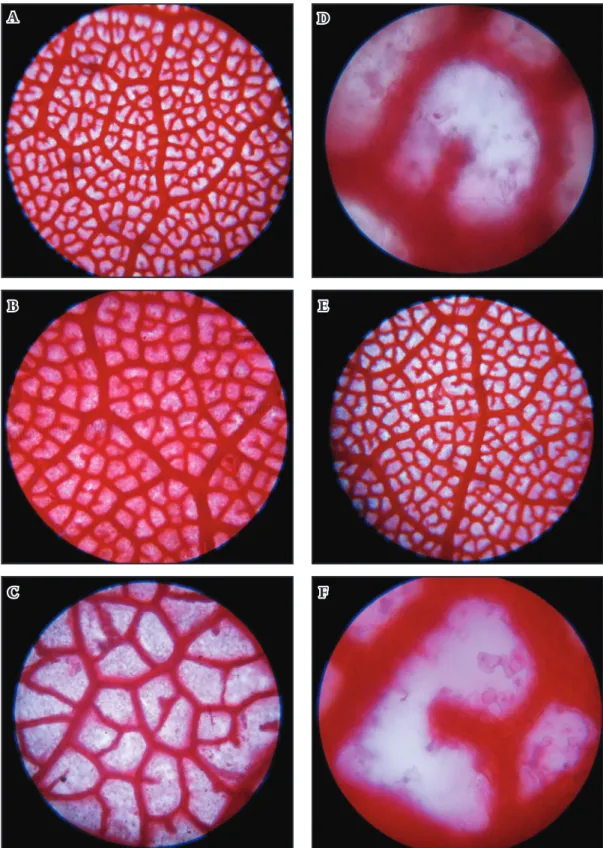
fig. 8. Leaf areolar (vein islets) patern of: a – Rhododendron arboreum subsp. cinnamomeum var. cinnamomeum from Himachal Pradesh (LM ×50); B – R. arboreum subsp. delavayi from China (LM ×100); c-f – R. arboreum subsp.
nilagiricum from Kerala (c, d – LM ×100, ×400) and Tamil Nadu (e, f – ×50, ×400).
a d
B e
2. subsp. cinnamomeum (Lindley) Tagg in J.B. Stev., Sp. Rhodod.: 17. 1930; D.F. Chamb.,
Notes Roy. Bot. Gard. Edinburgh39 (2): 330. 1982; Bhatacharyya, Rev. Gen. Rhododendr. India (Ph.D. thesis): 135. 2007. Bhatacharyya & Sanjappa in Sanjappa & Sastry, Fasc. Fl. India no. 25 (Ericaceae): 91. 2014.
3 varieties recognized (Bhatacharyya & Sanjappa 2014).
KEY TO THE VARIETIES
1. Abaxial leaf unistrate, compacted, fawn or whitish ... 2
1*. Abaxial leaf bistrate, upper layer loose, loccose, rufous, lower layer compacted, whitish to fawn ... 2a. var. cinnamomeum
2. Corolla pink to carmine ... 2b. var. roseum
2*. Corolla white ... 2c. var. album
2a. var. cinnamomeum. R. campbelliae Hook. f., Rhododendr. Sikkim-Himalaya: t. 6. 1849.
Fig. 3 A.
type. India, Sikkim Himalaya, 9000-10000 t,
J.D. Hooker s.n. (CAL!). R. arboreum Sm. subsp.
campbelliae (Hook. f.) Tagg in J. B. Stev., Sp. Rhodod.: 15. 1930; Bhatacharyya, Rev. Gen. Rhododendr. India (Ph.D. thesis): 135. 2007.
Vernacular names. Etok (Bhutia); Guras, Lal Guras (Nepali).
description. Lamina 6-13 × (1.5) 2.5-3.3 cm, usually elliptic-lanceolate to rarely oblong-lanceolate, apex acute, adaxial surface reticulate, abaxial surface with a bistrate indumentums, the upper layer loose and loccose, rufous, lower surfacewhitish to fawn and compacted; petioles 5-8 mm long. Flowers
c. 32 mm long and 32 mm across; pedicels 4-8 mm long, sparsely to densely pubescent. Corolla pink to carmine.
distribution. India: Eastern Himalaya [Sikkim, Darjeeling in West Bengal]; Eastern Nepal; Bhutan; South-Western China.
habitat. Grows in dry as well as moist rocky slope in dense or open forests at altitudes ranging in 2500-3400 m.
flowering. March – June.
fruiting. September – November.
Specimens examined in cal otherwise mentioned. IndIa: eastern himalaya: Sikkim: J.E. Lister s.n., acc. no. 268304; J.D. Hooker s.n., acc. no. 268303; Dr. King s.n., acc. no. 268326. No specimens available from Nepal, Bhutan and China in CAL.
field notes. he species is a variable from population to population in lamina size and shape, petiole length, lower size, corolla colour.
leaf stomata (Fig. 5 A, B). he investigated species shows only amphiparacytic type.
Dimensions of stomata: he average dimension is 21.05 × 21.05 µm in apex, middle and base. he length varies from 19.3 µm to 22.8 µm and breadth – from 19.3 µm to 22.8 µm. Size of guard cells: he average dimension is 11.5 × 5.8 µm. Size of epidermal cells: he epidermal cells are usually penta- to polygonal, isodiametric to rarely irregular, some are quadrangular. here is no deinite patern of arrangement of epidermal cells. he epidermal walls in surface view are straight. he epidermal walls in the adaxial surface are also straight. Dimensions of epidermal cells: he maximum length is 25.3 µm and breadth is 6.3 µm. he minimum length is 8.5 µm and breadth is 6.3 µm.
leaf areolar (vein islets) patern
(Fig. 8 A). Shape of areole: Most populations show deltoid shape, occasionally quadrangular and pentangular in shape. Larger areole: 164 × 70 µm. Smaller areole: 58 × 47 µm. Vein islets (areoles): 119 (average) per 1 mm2. Vein
endings: 46 (average) per 1 mm2; veinlets simple unbranched occurring inside areole. Vein ends:
Bulbous-rounded (Sikkim population).
pollen morphology (Fig. 12 A, B). Pollen grains occur in tetrahedral tetrads, 3-zonocolporate. Tetrad size (D): 38.5-42.6 µm in diameter, subspheroidal. Individual grain size (d): 25-27.7 µm in diameter. Exine tectate, 3.6-4 µm thick, surface reticulate with viscin threads under ESEM, aperture margin granulated and compact. Colpi distinct, 8.5-15.4 µm long, width 2.4-2.8 µm. 2f/D: 0.24-0.27 µm, colpus margin distinct, acute to tapering towards ends.
Septum thickness 1.7-1.9 µm.
in herbaria or in ield. herefore, these two varieties are not included in this work.
3. subsp. delavayi (Franchet) D.F. Chamberlain, Notes Roy. Bot. Gard. Edinburgh 37: 328. 1979; D.F. Chamb., Notes Roy. Bot. Gard. Edinburgh 39 (2): 331. 1982; Bhatacharyya, Rev. Gen. Rhododendr. India (Ph.D. thesis): 136. 2007. R. delavayi Franchet, Bull. Soc. Bot. France 33: 231. 1886.
Fig. 3 C, D.
type. China, Yunnan, in monte Calcareo Houangli-pin, 2500 m, Delavoy 242 (iso. K, photo!).
Vernacular name. Lali gurans (Nepalese of Tenga, Arunachal Pradesh). Bhatacharyya & Sanjappa in Sanjappa & Sastry, Fasc. Fl. India no. 25 (Ericaceae): 92. 2014.
description. Lamina 8-15 × 2-4 cm, usually elliptic-lanceolate, apex acute, adaxial surface reticulate, abaxial surface with a unistrate spongy, whitish to fawn indumentums; petioles 5-14 mm long. Flowers 32-55 mm (Yunnan population, Henry s.n.) long and 22-40 mm across; pedicels 4-6 (-10 in Yunnan population) mm long, sparsely to densely pubescent. Corolla deep crimson to carmine.
distribution. India: Eastern Himalaya (Arunachal Pradesh), North-Eastern India (Meghalaya, Nagaland, Manipur, Mizoram); China (Yunnan, Guizhou); Northern Myanmar; Northern hailand.
habitat. Grows in dry as well as moist rocky slope in dense or open forests at altitudes ranging in 1500-2800 m.
flowering. Late March – May.
fruiting. September – November.
Specimens examined in cal otherwise mentioned. IndIa: eastern himalaya: arunachal pradesh: West Kameng district, 16 km from Bomdi-La toward Tenga valley, road side slope, 2150 m, 27.11.2011,
S. Panda 212 (BGC). chIna: Pai-Ching Summit, Mc laren 48AA; Yunnan, 1897, Dr. A. Henry 10983 & 11330; Soshuich mt. Mc Laren 60A; hills west of Lung-fang, 9000-10000 t, April, 1925, acc. no. 26475.
field notes. he species is a variable from population to population in lamina size and shape, petiole length, lower size, corolla colour.
leaf stomata (Fig. 5 C, D). he investigated species shows only paracytic type. Dimensions of stomata: he average dimension is 17.5 ×
17.5 µm in apex, middle and base. he length varies from 15 µm to 20.3 µm and breadth – from 15 µm to 20.3 µm. Size of guard cells: he average dimension is 14.5 × 6.1 µm. Size of epidermal cells: he epidermal cells are usually polygonal to rarely irregular. here is no deinite patern of arrangement of epidermal cells. he epidermal walls in surface view are straight. he epidermal walls in the adaxial surface are also straight. Dimensions of epidermal cells: he maximum length is 21.5 µm and breadth is 6.3 µm. he minimum length is 15 µm and breadth is 6.3 µm.
leaf areolar (vein islets) patern
(Fig. 8 C, D). Shape of areole: Most populations show quandrangular, pentangular to deltoid in shape. Larger areole: 176 × 141 µm.
Smaller areole: 94 × 58 µm. Vein islets (areoles): 67 (average) per 1 mm2. Vein endings: 22 (average) per 1 mm2; veinlets simple unbranched, occurring inside areole. Vein ends: Bulbous-rounded (Sikkim population).
pollen morphology (Fig. 12 C, D). Pollen grains occur mostly in tetrahedral tetrads, occasionally decussate tetrads (Yunnan population), 3-zonocolporate. Tetrad size (D): 42.4-46.6 µm in diameter, spheroidal.
Individual grain size (d): 30-32.7 µm in diameter. Exine tectate, 2-2.8 µm thick, surface reticulate with viscin threads under ESEM, aperture margin granulated and compact. Colpi distinct, 12.8-14 µm long, width 2.4-2.8 µm. 2f/D:
0.26-0.33 µm, colpus margin distinct, acute to tapering towards ends. Septum thickness: 1.7-3.2 µm.
4. subsp. nilagiricum (Zenker) Tagg in J. B. Stev., Sp. Rhodod.: 15. 1930; D.F. Chamb.,
Notes Roy. Bot. Gard. Edinburgh 39 (2): 331. 1982; Bhatacharyya, Rev. Gen. Rhododendr. India (Ph.D. thesis): 137. 2007. Bhatacharyya & Sanjappa in Sanjappa & Sastry, Fasc. Fl. India no. 25 (Ericaceae): 93. 2014. R. nilagiricum
Zenker, Amer. Sci. Nat. Ser. 26: 150. 1836. Fig. 3 E, F.
type. S. India, Saladia, Nilgiris Hills, Utacamund, Schmidt s.n. (iso. E n.v.).
(Malayalam), Pumaram (local inhabitants of Nilgiris).
description. Lamina 8-12 × 2-3.6 cm, usually oblong, oblong-lanceolate, apex rounded-acute with a short mucro, adaxial surface rugose, abaxial surface with a spongy, yellowish-brown indumentum; petioles 5-10 mm long. Flowers c. 32 mm long and
c. 32 mm across; pedicels 4-6 mm long, sparsely to densely pubescent. Corolla carmine. Stamens 10, c. 16 mm long.
distribution. India: hill tops of Western Ghats (Tamil Nadu, Kerala). Endemic.
habitat. Grows in open rocky slopes, mostly in shola forests at altitudes ranging from 2000-2500 m.
flowering. February – May.
fruiting. September – November.
Specimens examined in cal otherwise mentioned. IndIa: Western ghats: tamil nadu: Bison Swamp, Kuyndak, Nilgiri hill, 2250 m, 3.2.1916, C.E.C. Fischer
2530; Naduvatam, Nilgiri hill, 2060 m, 18.01.1961,
B.V. Shety 11920; Edapalli, Nilgiri Dt., 2067 m, 19.10.1956, K.M. Sebastine 991; Pillar rock, Kodaikanal, Madurai dt., 2333 m, 9.3.1958, K. Subramanyam 55; Perumalmalai, Madurai Dt., 12/02/1978, M. Chandrabose
53390. Kerala: Deviculum, 19.02.1957, G.S. Puri
15470; Kodanad-Kotagiri road, 2000 m, 5.1.1957,
K. Subramanyam 1925; Coonoor, upper Tiger Shola, 1400 m, 19.01.1957, K.M. Sebastine 2071. Munnar to Bodi road 1800 m, 25.03.1980, K. Ramamurthy 66376.
field notes. he species is a variable from population to population in lamina size and shape, petiole length, lower size, corolla colour.
leaf stomata (Fig. 5 E, F). he investigated species shows both paracytic and amphiparacytic types. Dimensions of stomata: he average dimension is 15.5 × 15.5 µm in apex, middle and base. he length varies from 11.4 to 25.3 µm and breadth – from11.4 to 25.3 µm.
Size of guard cells: he average dimension is 14.5 × 6.4 µm. Size of epidermal cells: he epidermal cells are polygonal to irregular. here is no deinite patern of arrangement of epidermal cells. he epidermal walls in surface view are straight. he epidermal walls in the adaxial surface are also straight. Dimensions of epidermal cells: he maximum length is 19.4 µm and breadth is 6.3 µm. he minimum length is 12.6 µm and breadth is 6.3 µm.
leaf areolar (vein islets) patern
(Fig. 8 E, F). Shape of areole: Most populations show quadrangular, pentangular to deltoid in shape (Kerala population (Sebastine 5695,CAL) does not show deltoid shape). Larger areole: from 141 µm (Tamil Nadu population, Fischer 2530) to 235 µm (Kerala population, Sebastine 5695) × 117 (× 235) µm. Smaller areole: 94 × 84 µm. Vein islets (areoles): 46 (average) (Kerala, Sebastine
5695, CAL) to 78 (Tamil Nadu population,
Fischer 2530) per 1 mm2. Vein endings: 24 in Tamil Nadu and 30 in Kerala (average) per 1 mm2; veinlets simple unbranched occurring inside areole. Vein ends: Bulbous-rounded to bulbous acute.
pollen morphology (Fig. 12 E, F). Pollen grains are slightly variable in size. Grains occur in tetrahedral tetrads, 3-zonocolporate. Tetrad size (D): 38.7-40.6 µm in diameter (Tamil Nadu & Kerala populations), spheroidal. Individual grain size (d) also variable, 21.9-30.4 µm in diameter. Exine tectate, 3-3.9 µm thick, surface reticulate with viscin threads under ESEM, aperture margin granulated and compact. Colpi distinct, 12.8-14.4 µm long, width 2.4-2.8 µm. 2f/D:
0.26-0.33 µm, colpus margin distinct, acute to tapering towards ends. Septum thickness: 5-5.07 µm.
5. subsp. zeylanicum (Booth) Tagg in J.B. Stev., Sp. Rhodod.: 16. 1930; D.F. Chamb.,
Notes Roy. Bot. Gard. Edinburgh 39 (2): 332. 1982. R. zeylanicum Booth, Gard. Chron.: 150. 1850.
type. Described from a plant cultivated in Sir Charles Lemon’s Garden in Cornwall.
Vernacular names. Ma-ratmal, Asoka (Sinhalese of Sri Lanka – Jayaweera & Senaratna 2006); Alingi, Bili (Tamilese of Sri Lanka – Jayaweera & Senaratna 2006).
description. Lamina 8-11 × 3-4 cm, usually oblong, oblong-lanceolate, apex blunt-acute, adaxial surface with a strongly impressed veins, bullate, margins strongly recurved, abaxial surface with a spongy, brownish indumentum; petioles 8-10 mm long. Flowers
a d
B e
c f
fig. 10. Pollen morphology of Rhododendron arboreum subsp. arboreum: a, B – tetrads of Nepal population (a – LM ×400; B – ESEM); c-e – tetrads of Bhutan population (c – LM ×400; d – ESEM; e – ESEM part mag).
a d
B e
fig. 11. Pollen morphology of Rhododendron arboreum subsp. arboreum: a, B – tetrads of Yunnan population, China (a – LM ×400; B – ESEM); c-f – tetrads of Myanmar population (c – LM ×400; d, e – ESEM of tetrads; f – part of tetrad mag.).
a d
B e
fig. 12. Pollen morphology of Rhododendron arboreum:a-B – tetrads of R. arboreum subsp. subsp. cinnamomeum from Sikkim population (a – LM ×400; B – ESEM); c-f – tetrads of R. arboreum subsp. nilagiricum from Tamil Nadu (c – LM ×1000; d – ESEM), and Kerala (e – LM ×400; f – ESEM) populations.
a d
B e
distribution. Sri Lanka (Upland regions).
habitat. Grows in open rocky slopes at an altitude of c. 2300 m.
flowering. April – May.
fruiting. September – November.
Specimens examined. SrI lana: ceylon: Upland region, Kurz s.n., acc. no. 268375, veg. (CAL).
field notes. he species is a variable from population to population in lamina size and shape, petiole length, lower size, corolla colour.
Duplicate materials were not available for leaf anatomical and pollen morphological studies.
discussion and conclusions
Live and herbarium specimens-based analysis on diferent populations of R. arboreum
complex including its 5 existing subspecies (subsp. arboreum, subsp. cinnamomeum, subsp. delavayi, subsp. nilagiricum and subsp. zeylanicum) and 2 varieties (var.
arboreum and var. cinnamomeum) shows that exomorphological variations are qualitative among diferent infraspeciic taxa which are justiied as valid taxa in leaf anatomical and pollen morphological data (LM & ESEM).
Subsp. arboreum is more variable in respect to exomorphology, leaf anatomy and pollen morphological data comparing to other subspecies in respect to leaf texture, lamina shape & size, corolla colour, the variable range of stomatal types (from euparacytic, amphiparacytic, brachiparacytic to desmocytic), variable epidermal walls on surface view (straight, slightly wavy to sinuous), longer epidermal cells (up to 44 µm long), largest vein islets (up to 282 µm long), variable vein endings (bulbous-acute, bulbous-truncate to bulbous-rounded) and variable size of pollen tetrads (30.4-45.6 µm in diameter). Among the existing subspecies, subsp. arboreum is more close to subsp. cinnamomeum in respect to leaf texture, amphiparacytic stomata, variable epidermal cells, deltoid vein islets and subspheroidal tetrads in both, and more isolated from subsp. nilagiricum in respect to leaf texture, leaf apex, corolla size, epidermal cells, vein islets shape, vein endings, diameter of pollen tetrads as well as its shape and septum thickness.
Subsp. nilagiricum is more close to subsp. zeylanicum (in respect to exomorphology) and subsp. dilavayi (in respect to leaf anatomy and pollen morphology), but more isolated from subsp. arboreum (in respect to exomorphology, leaf anatomy and pollen already mentioned). Subsp. cinnamomeum
and subsp. delavayi are comparatively more closely related in respect to exomorphology, leaf anatomy and pollen morphological data. hus, the present work shows that exomorphological variations are qualitative among diferent infraspeciic taxa which are justiied as valid taxa in leaf anatomical and pollen morphological data.
acknowledgements
he authors wish to thank Dr. M. Sanjappa, former Director in Botanical Survey of India, to Dr. P.K. Das, former Principal, Barasat Govt College and to Dr. P.C. Lama, Oicer-In-Charge, Darjeeling Govt College for providing all kinds of facilities during this work and to the Curators of said Indian Herbaria for their kind permission to consult herbarium specimens.
references
Bhatacharyya d. 2007. Revision of the genus
Rhododendron L. (Ericaceae) in India. Ph.D. hesis: 131–138. Calcuta University, Kolkata.
Bhatacharyya d., Sanjappa m. 2014.
Rhododendron L. In: Sanjappa M., Sastry A.R.K. (eds), Fascicle of Flora of India. Fascicle 25. Ericaceae: 9, 87–93. Botanical Survey of India, Kolktata.
carpenter K.J. 2005. Stomatal architecture and evolution in basal angiosperms. Am. J. Bot. 92 (10): 1595–1615.
chamberlain d.f. 1982. A revision of Rhododendron
II. Subgenus Hymenanthes. Notes Roy. Bot. Gard. Edinburgh 39 (2): 328–332.
chamberlain d.f., hyam r., argent g., fairweather g., Walter K.S. 1996. he genus
Rhododendron: Its classiication and synonymy: 1–184. Royal Botanic Garden Edinburgh.
clarke c.B. 1882. Ericaceae. In: Hooker J.D. (ed.), Flora of British India 3: 465. Reeve & Co., London.
craven l.a., goetsch l.a., hall B.d., Brown g.K. 2008. Classiication of the Vireya group of
Rhododendron (Ericaceae). Blumea 53: 435–442. dilcher d.l. 1974. Approaches to the identiication of
angiosperm leaf remains. Bot. Rev. 40 (1): 1–53. erdtman g. 1952. Pollen morphology and plant
taxonomy I. Angiosperms: 1–539. Almqvist & Wikshell, Stockholm.
erdtman g. 1969. Handbook of palynology: 486. Munksgaard, Copenhagen.
erdtman g. 1986. Pollen morphology and plant taxonomy: Angiosperms (an introduction to palynology): 553. E.J. Brill, Leiden.
fahn a. 1997. Plant anatomy, 4th ed.: 168. Aditya Books
(P) Ltd., New Delhi (India).
hickey l.J. 1973. Classiication of the architecture of dicotyledonous leaves. Am. J. Bot. 60 (1): 17–33. Jayaweera d.m., Senaratna l.K. 2006. Medicinal
plants (indigenous and exotic) used in Ceylon. part 2: 185. he National Science Foundation, Colombo, Sri Lanka.
Kron K.a., Judd W.S., Stevens p.f., crayn d.m., anderberg a.a., gadek p.a., Quinn c.J., luteyn J.l. 2002. Phylogenetic classiication of Ericaceae: Molecular and morphological evidence.
Bot. Rev. 68 (3): 335–423.
long d.g. 1991. Ericaceae. In: Grierson A.J.C., Long D.G. (eds), Flora of Bhutan 2 (1): 372. Royal Botanical Garden, Edinburgh.
mabberley d.J. 2008. Rhododendron. Mabberley’s Plant-Book: A portable dictionary of plants, their classiication and uses. Ed. 3: 737. Cambridge University Press, Cambridge, England.
metcalfe c.r., chalk l. 1950. Anatomy of Dicotyledonds. Vol. 1: 1–806. Clarendon Press, Oxford. mingyuan f., ruizheng f., mingyou h.e.,
linzhen h.U., hanbi y., chamber-lain d.f. 2005. Rhododendron L. In: Ruizheng F., Chamberlain D.F. (eds), Flora of China. 14 (Ericaceae): 260–455. Science Press, Beijing & Missouri Botanical Garden Press, St. Louis.
nair p.K.K., Kothari S. 1985. Pollen morphology of Indian Heteromerae. Adv. Pollen-Spore Res. 13: 1–7.
niedenzu f. 1890. Über den anatomischen Bau der Laubbläter der Arbutoideae und Vaccinioideae in Beziehung zu ihrer systematischen Gruppierung und geographischen Verbreitung. Bot. Jahrb. 11: 134–263. oldfield f. 1959. he pollen morphology of some of
the west European Ericales. Preliminary descriptions and a tentative key to their identiication. Pollen Spores
1: 19–48.
paria n.d., pal a. 1990. Quantitative and experimental studies on pollen morphology of some Indian
Rhododendron (Ericaceae). J. Palynol. 91: 95–104. park J., Song U. 2010. Pollen morphology of the genus
Rhododendron (Ericaceae) in Korea. J. Corean For. Soc.
99 (5): 663–672.
pradhan U.c., lachungpa S.t. 1990. Sikkim-Himalayan rhododendrons: 65. Primulaceae Books, Kalimpong.
Sarwar a.K.m.g., takahashi h. 2013. Pollen morphology of Rhododendron L. and related genera genera and its taxonomic signiicance. Bangladesh J. Pl. Taxon. 20 (2): 185–199.
Sarwar a.K.m.g., Ito t., takahashi h. 2006. An overview of pollen morphology and its relevance to the sectional classiication of Vaccinium L. (Ericaceae).
Jpn. J. Palynol. 52 (2): 77–96.
Smith J.e. 1805. Rhododendron arboreum. In: Smith J.E. Exotic Botany. Vol. 1: 9. London.
Stace c.a. 1965. Cuticular studies as an aid to plant taxonomy. Bull. Brit. Mus. Bot. 4: 3–78.
Stace c.a. 1989. Plant taxonomy and biosystematics. 2nd
ed: 78–80. Edward Arnold.
Stevens p.f. 1971. A classiication of the Ericaceae: Subfamilies and tribes. Bot. J. Linn. Soc. 64: 1–53. Vasanthy g., pocock S.a.J. 1987. On the pollen
tetrads of the South Indian Ericaceae, Gaultheria, Rhododendron & Vaccinium with special reference to
R. nilagiricum Zenk. Bull. Jard. Bot. Nat. Belgium 57: 213–245.
Zhang y.-J., Jin x.-f., ding B.-y., Zhu J.-p. 2009. Pollen morphology of Rhododendron subgen. Tsutsusi