and Drug-Resistance Chromosomal Mutations
Rui F. Silva1,2., Sı´lvia C. M. Mendonc¸a1,2., Luı´s M. Carvalho1,2
, Ana M. Reis3,4, Isabel Gordo2, Sandra Trindade1,2, Francisco Dionisio1,2,3*
1Centro de Biologia Ambiental, Faculdade de Cieˆncias da Universidade de Lisboa, Lisboa, Portugal,2Instituto Gulbenkian de Cieˆncia, Oeiras, Portugal,3Departamento de Biologia Vegetal, Faculdade de Cieˆncias da Universidade de Lisboa, Lisboa, Portugal,4Center for Biodiversity, Functional, and Integrative Genomics (BioFIG), Faculdade de Cieˆncias da Universidade de Lisboa, Lisboa, Portugal
Abstract
Multidrug-resistant bacteria arise mostly by the accumulation of plasmids and chromosomal mutations. Typically, these resistant determinants are costly to the bacterial cell. Yet, recently, it has been found that, inEscherichia colibacterial cells, a mutation conferring resistance to an antibiotic can be advantageous to the bacterial cell if another antibiotic-resistance mutation is already present, a phenomenon called sign epistasis. Here we study the interaction between antibiotic-resistance chromosomal mutations and conjugative (i.e., self-transmissible) plasmids and find many cases of sign epistasis (40%)—including one of reciprocal sign epistasis where the strain carrying both resistance determinants is fitter than the two strains carrying only one of the determinants. This implies that the acquisition of an additional resistance plasmid or of a resistance mutation often increases the fitness of a bacterial strain already resistant to antibiotics. We further show that there is an overall antagonistic interaction between mutations and plasmids (52%). These results further complicate expectations of resistance reversal by interdiction of antibiotic use.
Citation:Silva RF, Mendonc¸a SCM, Carvalho LM, Reis AM, Gordo I, et al. (2011) Pervasive Sign Epistasis between Conjugative Plasmids and Drug-Resistance Chromosomal Mutations. PLoS Genet 7(7): e1002181. doi:10.1371/journal.pgen.1002181
Editor:William F. Burkholder, Agency for Science, Technology, and Research, Singapore
ReceivedJanuary 8, 2011;AcceptedMay 26, 2011;PublishedJuly 28, 2011
Copyright:ß2011 Silva et al. This is an open-access article distributed under the terms of the Creative Commons Attribution License, which permits unrestricted use, distribution, and reproduction in any medium, provided the original author and source are credited.
Funding:This work was supported by Fundac¸a˜o para a Cieˆncia e Tecnologia: a fellowship to SCMM (from project PTDC/BIA-BDE/66180/2006), a fellowship to ST (SFRH/BD/40162/2007), a fellowship to LMC (SFRH/BPD/33633/2009), and projects PTDC/BIA-BDE/66180/2006 and TECH/2007/0001, as well to the TECT-European Science Foundation program. The funders had no role in study design, data collection and analysis, decision to publish, or preparation of the manuscript.
Competing Interests:The authors have declared that no competing interests exist.
* E-mail: [email protected]
.These authors contributed equally to this work.
Introduction
Multidrug resistance is a major hurdle for modern medicine, putting at risk commonplace medical practices [1] and the treatment of infection by bacterial pathogens [2]. Bacteria can become resistant by spontaneous mutation of chromosomal genes or through the acquisition of horizontally mobile genetic elements [1]. In the absence of antibiotics, resistance mutations are often deleterious and confer a fitness cost to the cell [3,4,5,6]. It is logical to expect that, in the absence of antibiotic selective pressure, resistant strains will be outcompeted by the susceptible ones. Thus, a possible procedure to eliminate resistance is to ban the use of an antibiotic. This policy has been applied in different countries with varying results. For example, a deliberate reduction in the prescription of macrolides in Finland, resulted in a 50% decrease in the frequency of macrolide-resistant group A streptococci [7]. However, in the UK, a 98% decrease in the consumption of sulfonamides was accompanied by an increase of
6.2% in the frequency of sulfonamide resistance inEscherichia coli[8].
Clearly, there are other factors affecting the reversal to susceptibility. For example, resistant-bacteria often gain second-site mutations that ameliorate the fitness cost of resistance [3,4,9,10,11,12,13]. Some-times, compensatory mutations even increase the level of resistance itself [14,15].
The exchange of accessory genetic elements, in particular of conjugative plasmids, is frequent [16,17,18] and can disseminate
genes among related and phylogenetically distant bacteria [16,18,19]. In addition, conjugative plasmids are able to mobilize other plasmids from a donor to a recipient cell [20]. Thus, resistance genes can quickly spread among bacterial communities. Plasmid-encoded resistance is generally the result of the activity of efflux pumps, agent-modifying enzymes [3], or protection of the antibiotic target [21].
Harboring mobile genetic elements generally creates a cost to the host, associated with the replication and maintenance of the genetic element and with the expression of its genes. Such cost has been experimentally demonstrated in a number of resistance-encoding plasmids [22,23,24,25,26].
A recent study of the interaction between resistance-determin-ing chromosomal mutations, responsible for resistance to nalidixic
acid, rifampicin and streptomycin in E. coli, found that, in the
mutant is less fit than the expected sum of costs. Different studies of epistasis gathered evidence for both antagonistic and synergistic gene interaction. Positive epistasis between random deleterious
mutations has been experimentally detected in phageWX174 [29],
HIV-1 [30], RNA virusW6 [31],Salmonella typhimurium[32] and in
the yeastSaccharomyces cerevisiae[33]. Other studies have found no
evidence of epistatic interactions within the HIV-1 transcriptional
promoter [34], in RNA virus [35,36] and in S. cerevisiae[33], or
evidence that positive epistasis occurs as often as negative epistasis
in RNA virus [37] and inE. coli[38].
Here we focus on the interplay between conjugative plasmids
and chromosomal mutations in E. coli. In particular, we look at
how bacterial fitness is affected by genetic interactions between plasmids and resistance mutations. First, we quantify the degree of epistasis between five conjugative resistance plasmids (R124, R831, R16, R702 and RP4, carrying between one and four resistance genes and belonging to four different incompatibility
groups) and 10 mutant alleles of the housekeeping genesgyrA,rpoB
and rpsL, conferring resistance to nalidixic acid, rifampicin and
streptomycin, respectively. The plasmids were isolated from nature and the resistance mutations are polymorphic in natural populations of different species of bacteria [13]. These genes are involved in different steps of the cell’s essential flow of information
from DNA to protein. Specifically,gyrAcodes for DNA gyrase, an
enzyme involved in DNA replication. Nalidixic acid and other quinolones inhibit DNA replication by binding to DNA gyrase and resistance to this class of drugs arises from the prevention of this binding. Rifampicin belongs to the rifamycin class of antibiotics
which bind to theb-subunit of RNA polymerase, coded byrpoB,
thereby inhibiting transcription. Mutations inrpsL, which codes for
ribosomal protein S12, interfere with translation and can produce resistance to streptomycin by blocking the binding of this drug to the ribosome 30S subunit. Secondly, using the same plasmids, we estimate epistasis between pairwise combinations of conjugative plasmids inside the same cell.
We find pervasive sign epistasis in the interaction between resistance mutations and conjugative plasmids. This implies that the acquisition of an additional resistance plasmid to the existing
chromosomal resistance or the appearance of a chromosomal drug-resistance mutation in a bacterial cell already containing a plasmid may ameliorate the initial fitness cost of resistance and therefore complicate resistance reversal. We also observed an overall positive level of epistasis between mutations and plasmids. Both the chromosomal allele and the plasmid seem to contribute to determine the nature of the epistatic interaction, although the host genotype appears to have a more determinant effect. In contrast, the interaction between plasmids exhibit sign epistasis only once, and, despite the occurrence of several cases of somewhat strong epistasis, on average it appears to be null.
Results
Interaction between antibiotic resistance mutations and resistance plasmids
Pairwise epistasis,e, between loci A and B can be measured as
follows. Suppose that the wild-type strain contains alleles A and B.
If wAb and waB are the fitnesses of each of the single mutants
relative to the wild-type strain, andwab the relative fitness of the
double mutant, then multiplicative epistasis is given by:
e~wab{wAbwaB. To estimate epistasis between plasmids and
mutations, we defined these quantities in a similar way. If
w(A;plasmid) is the relative fitness of the strain with the wild-type
allele (A) and containing a plasmid,w(a;{)is the relative fitness of
the mutant strain (with A allele replaced by the a allele), and
w(a;plasmid) is the relative fitness of the strain containing both the
mutation (a allele) and the plasmid, then epistasis between a
plasmid and a chromosomal mutation becomes:e~w(a;plasmid){
w(A;plasmid)w(a;{).
Each conjugative plasmid was introduced in E. coli K12
MG1655 cells by conjugation. Then, we determined the fitness
cost due to the presence of each plasmid relative to plasmid-freeE.
coliK12 MG1655 cells. This was performed using a competition
assay, in the absence of antibiotics (see Materials and Methods). Fitness costs of plasmids span from 2.8% to 8% (Table S1).
The fitness cost imposed by ten different spontaneous antibiotic-resistance mutations was previously determined in ref. [27]. Table S2 presents the clones chosen from ref. [27] and the fitness costs of these mutations. Fitness costs of mutations vary between 0.5% and 27.5% (Table S2) [27].
To screen for epistatic interactions between chromosomal mutations and conjugative plasmids, we further constructed, by conjugation, all possible 50 combinations between these ten mutations and the five plasmids. Then we determined the fitness for each of these 50 combinations.
We found that 52% of the interactions present positive epistasis and only 8% present negative epistasis (Figure 1A). Figure 1A additionally shows that the nature of the epistatic interaction is not gene but allele specific. In fact, the conjugative plasmid influences how a specific allele interacts with plasmid-borne resistance determinants. This means that, depending on the plasmid, an allele can display no epistasis, positive epistasis or negative
epistasis. For example, allele gyrA D87G exhibits no epistatic
interaction with plasmid R124, however the same allele displays negative epistasis with plasmid R831 and positive epistasis with plasmids R16, R702 and RP4 (Figure 1A). The same pattern (allele specific nature of epistasis) had been observed for epistasis between resistance chromosomal mutations [27]. Supporting the pervasive nature of antagonistic interactions between mutations
and plasmids, the distribution of the evalues (Figure 1B) has a
significant positive median (median = 0.037, bootstrap 95% CI [0.021; 0.065]). Figure S1 plots the observed fitness against the
fitness expected in the absence of epistasis (e= 0).
Author Summary
Bacteria can become resistant to antibiotics by spontane-ous mutation of chromosomal genes or through the acquisition of horizontally mobile genetic elements, mainly conjugative plasmids. Plasmid-borne resistance is wide-spread among bacterial pathogens. Plasmids generally entail a cost to the host, associated with the replication and maintenance of the genetic element and with the expression of its genes. Therefore, in the absence of antibiotic, both plasmids and resistance mutations are often deleterious and confer a fitness cost to the cell. Here we studied epistatic interactions between five natural conjugative plasmids and ten chromosomal mutations conferring resistance to three types of antibiotics, making a total of 50 different combinations of chromosomal mutations and conjugative plasmids. We show that sometimes plasmids confer an advantage to bacterial strains carrying resistance mutations in their chromosome. This occurs in 32% (16 out of 50) of tested combinations. Furthermore, in 5 out of 50 plasmid-mutations combina-tions studied (10%), we observed an increased fitness when a plasmid-bearing bacterial cell acquires a drug-resistant mutation. These examples of sign epistasis are highly unexpected. This work explains, at least in part, how multidrug resistance evolved so rapidly.
To rule out the existence of compensatory mutations, we reconstructed five (double) combinations independently and in the
opposite direction from what we did before:gyrAS83L(R16),rpoB
I572F(R831), rpoB H526N(R16), rpoB R529H(R702), and rpsL
K43N(RP4). We constructed these five clones by transducting [27]
the antibiotic resistance mutation from our mutantE. colistrains
into the wild-type strain (E. coliK12 MG1655) already containing
the plasmid. Using this method we decreased the number of generations involving the antibiotic-resistance mutation by a half (because the plasmid was already there). In this way, we decrease the probability of occurrence of compensatory mutations. We measured the fitness of two independent clones corresponding to Figure 1. Epistasis between antibiotic resistance mutations and conjugative plasmids.(A) Epistasis between mutations in genesgyrA,
rpoBandrpsLand conjugative resistance plasmids (positive epistasis in grey, negative in black and no epistasis in white). Sign epistasis is indicated with ‘‘++’’. (B) Distribution of the epistasis values. Median is positive (0.037) with bootstrap 95% confidence interval [0.021; 0.065], showing an overall level of positive epistasis between chromosomal resistance mutations and conjugative resistance plasmids. According to a Shapiro-Wilk W-test, thee
each of the five (double) combinations. For all five combinations, fitness values are not significantly different from the ones obtained
using the previous method (Kruskal-Wallis, p.0.05). Four (gyrA
S83L(R16), rpoB I572F(R831), rpoB H526N(R16) and rpoB
R529H(R702)) of these five combinations correspond therefore
to cases of sign epistasis (Figure 1A). One combination (rpsL
K43N(RP4)) shows no interaction with these new independent clones as observed before (Figure 1A). The fact that independent clones exhibit the same fitness (and the same type of epistasis) shows that our results are robust. To further strengthen this point,
we constructed two new independent clones ofrpoBR529H(R702),
this time using yet a different method: by simultaneous conjugation and transduction. The fitnesses of these clones were again not significantly different from before (Kruskal-Wallis,
p.0.05).
Focusing on the resistance mutations, we notice that the mean epistatic value significantly varies among them (Kruskal-Wallis
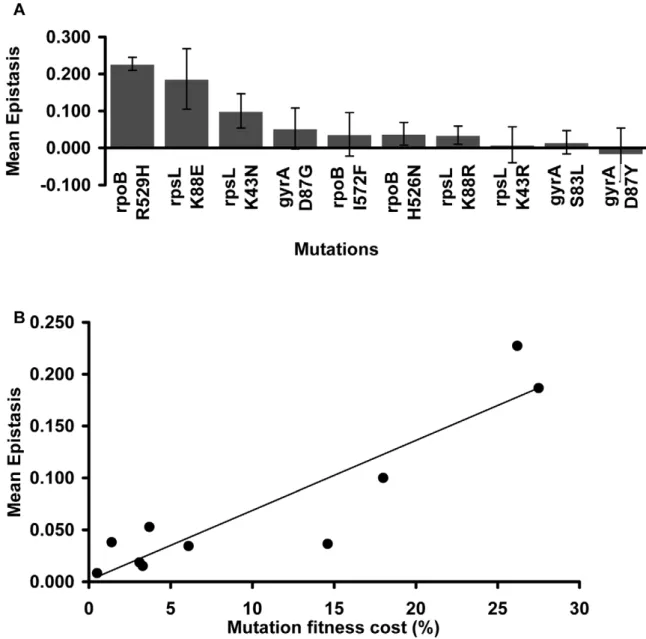
p = 0.0016). Figure 2A shows that mutations rpoB R529H, rpsL
K88E and rpsL K43N exhibit positive and large e values. The
other mutations show lower mean e values (Mann-Whitney
U-Test, p = 0.000002).
Figure 2B shows that there is a significant correlation between the fitness cost created by a mutation and its mean epistatic value (deviation from zero in absolute value) (Spearman p = 0.006). In other words, mutations with a more deleterious effect on the cell tend to be more epistatic. This relationship had been initially
proposed afterin silicostudies of digital organisms and theoretical
modeling of RNA secondary structures [39]. Our results are in accordance with previous experimental data from studies of
epistasis amongst antibiotic resistance alleles inE. coli [27], and
from a study of enzymes involved in gene expression and protein
synthesis inPseudomonas aeruginosa[40].
Focusing on the conjugative plasmids, Figure 3A shows their
meanevalues. There are no significant differences in the meane
values between plasmids (Kruskal-Wallis p = 0.676). This means that, on average, all studied conjugative plasmids tend to interact in the same way with chromosomal mutations. Moreover, comparison between Figure 2A and Figure 3A seems to suggest that the mutation (and not the plasmid) may be the major factor determining the type and the strength of the epistatic interactions we observed. In contrast to what was observed with the effect of mutations on epistasis [27], there is no significant correlation between the fitness cost created by a plasmid and its mean epistatic value (Figure 3B – Spearman p = 0.188). This may simply be due to lack of power, as variation in plasmids cost is much smaller than for mutations.
Sign epistasis
A specific mutation can be deleterious on a particular genetic background and beneficial on others – a phenomenon known as sign epistasis. Strikingly, we report that 40% of the combinations between resistance chromosomal mutations and conjugative
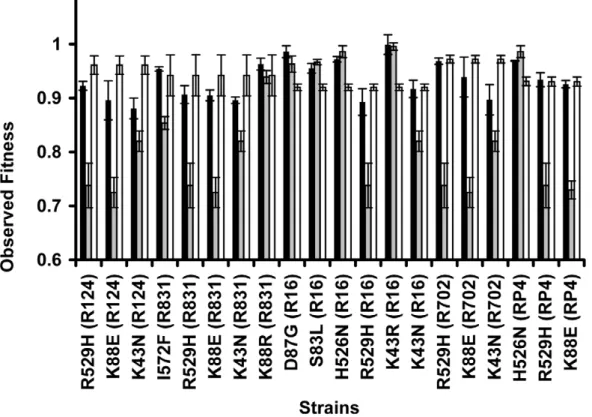
plasmids present sign epistasis (Figure 1A, where ‘‘++’’ indicates
sign epistasis). These are cases where the strain carrying both resistant determinants was fitter than the strain carrying only the mutation or only the plasmid (Figure 4). One of the genotypes (D87G(R16)) presents reciprocal sign epistasis [41], meaning that the mutant D87G and harboring the R16 plasmid is fitter than both the plasmid-free mutant and the plasmid-bearing strain without the mutation (hence sensitive to nalidixic acid).
We found examples of sign epistasis in all resistance alleles and all plasmids of this study, i.e. there was no plasmid nor mutation where we did not find, at least one case of sign epistasis. This high prevalence of positive epistasis is not a consequence of plasmid
transfer to the reference strain. The proportion of transconjugants was monitored at stationary phase, when bacterial density is
higher than 109cells per ml, and was found to be less than 3%
(Table S3). Also, computer simulations show that these plasmid transfer events imply an error in the calculation of epistasis that is less than 1%, hence less than the experimental error.
Another interesting aspect of our data is that, three out of the 50
combinations (plasmid+mutation) presented fitness costs not
significantly different from zero (t-test, p.0.05); these strains are
the following: rpsL K43R(R16), rpsL K43R(R831) and gyrA
D87G(R16).
Interaction between conjugative resistance plasmids Finally, we measured epistasis between conjugative plasmids. This is relevant because there have been several reports of bacterial pathogens harboring multiple resistance plasmids [42,43]. We constructed nine out of the 10 possible pairwise combinations of the five plasmids (plasmids R702 and RP4 belong to the same incompatibility group, thereby preventing the construction of this double transconjugant). In this context,
epistasis was estimated as: e~w(plasmid1;plasmid2){w(plasmid1;-)
w({;plasmid2).
In this mathematical expression, w({;plasmid2) and w(plasmid1;{)
are the fitnesses of single-plasmid carrying strains relative to the
wild-type plasmid-free strain, andw(plasmid1;plasmid2)is the fitness of
the strain carrying both plasmids, relative to the same wild-type plasmid-free strain.
Two different plasmids inside the same bacterial cell can interact either antagonistically or synergistically (Figure 5A). Epistatic interaction was found in 7 out of 9 (78%) strains. Positive epistasis (antagonistic interaction) is nearly as frequent (4/9) as negative epistasis (3/9). One out of nine pairwise combinations of
plasmids presented sign epistasis (‘‘++’’ in Figure 5A). Figure 5B
shows the distribution of e values for all pairwise combinations
of plasmids. On average, plasmid pairwise epistasis is close
to 0 (median =20.000830, bootstrap 95% CI [20.034690;
0.061360]). It is interesting to note that one of the plasmids, R16, interacts antagonistically with all other plasmids, and also with most mutations. This plasmid is also the most costly (Table S1).
Discussion
Our results show that 52% (26/50) of the combinations between antibiotic resistance mutations and resistance conjugative plasmids interact antagonistically. This is a remarkable result because the fitness cost of these strains that carry both resistance determinants is lower than the independent sum of the cost of each determinant. Moreover, 20 out of these 26 antagonistic interactions (77%) exhibit sign epistasis or reciprocal sign epistasis, also an outstanding finding because it means that the fitness cost of harboring both resistance determinants is lower than the fitness cost of bearing one of them. In other words, an initially deleterious antibiotic resistance mutation can become beneficial through the acquisition of a transferable antibiotic resistant plasmid (16 cases); likewise, an initially costly antibiotic resistant plasmid may become beneficial through the acquisition of a mutation conferring resistance to an additional antibiotic (5 cases). This adds up to 20 cases of sign epistasis because of one instance of reciprocal sign
epistasis. Last, but not least, three of the plasmid+mutation
combinations presented fitnesses not significantly different from the fitness of the wild-type strain.
Positive epistasis has been shown to occur between resistance
alleles in multidrug resistantE. coli. [27], P. aeruginosa [44] and
Streptococcus pneumoniae [45]. Such phenomena reduce the fitness
cost associated with multidrug resistance and may drive its spread. Our study aimed to detect the putative occurrence of epistatic interactions involving conjugative resistance plasmids. Such knowledge may help predict how a bacterial population will evolve after the introduction of plasmid-borne resistance determi-nants through horizontal gene transfer.
Our data strikingly suggests the pervasive occurrence of sign epistasis in the interaction between chromosomal antibiotic resistance mutations and conjugative plasmids. Sign epistasis has been shown to have the power to constrain protein adaptation by limiting the number of possible mutational paths and is therefore relevant to the understanding of multidrug resistance emergence [46]. Moreover, bacterial adaptation to the cost of mutation-determined resistance involves the acquisition of second-site mutations that compensate the fitness cost of the original mutation [10]. Thus, compensatory mutations are an example of sign epistasis [3,10,11,46]. Our finding of pervasive sign epistasis with
conjugative plasmids is one of the worst possible scenarios for the current efforts to eradicate resistance through antibiotic bans. Sign epistasis allows strains carrying a resistance mutation and a plasmid to exhibit higher fitness, thus being able of outcompeting strains carrying only the mutation or the plasmid (depending on the specific case). These results pinpoint the need for future studies involving other plasmids and other resistances.
Also important in the context of antibiotic resistance is our finding of the ubiquitous occurrence of positive epistasis between resistance plasmids and chromosomal resistance mutations. If such antagonistic interaction is a common phenomenon, then multi-drug resistance determined by the simultaneous presence of plasmid-borne and chromosomal determinants will not create such a high fitness cost as one could predict based on the individual costs. Hence, such multiresistant strains may be able to persist at significant frequencies in populations where the antibiotic selective pressure has been removed.
Figure 2. Mutation effect on the mean epistatic value.(A) Mean epistatic value for each mutation. Error bars indicate twice the standard error. Note how the mean epistatic effect significantly differ between mutations (Kruskal-Wallis p = 0.0016) (B) Mutations become increasingly epistatic as their severity increases. Note how the mean absolute epistatic effect correlates with the fitness cost associated with each mutation (Spearman p = 0.006).
Our findings are in accordance with the results of a large-scale
survey for genes of theE. colichromosome that are affected by the
presence of the conjugative F-plasmid [47]. Such study found 107 genes exhibiting epistatic effects with the F-plasmid. Although such
effect was not found for gyrA, rpoB and rpsL, other host genes
involved in information transfer were reported to be affected by the presence of the F-plasmid [47]. Under the framework of the complexity hypothesis, these interactions between plasmids and
informational genes (rpoB [48,49,50] and rpsL [51]) and a
topoisomerase (gyrA [52]) are expected, given their pleiotropic
interactions with other genes. For example, Schmitt et al. have
shown that certainrpoB,rpsLandgyrAalleles affect F-exclusion of
bacteriophage T7 [53]. In addition, Ozawa et al. [54] showed that
rpoB mutations interact with a plasmidic gene (in Enterococcus
faecalis). Similarly,gyrBmay also interact with plasmids, eventually
leading to their elimination from cells [55]. In conclusion, resistance genes present on plasmids are not necessarily respon-sible for the epistatic interactions observed.
We also report here the occurrence of significant epistasis between two types of conjugative plasmids within the same host. This finding has relevance for clinical isolates exhibiting multidrug resistance afforded by the co-existence of several plasmids, a situation which appears to be relatively common [43]. Our data indicates that, on average, epistasis between the conjugative
plasmids is close to zero. However, we do not believe that our results suggest a tendency for no epistatic interactions between conjugative plasmids. In fact, our near-zero median level of epistasis between conjugative plasmids is the consequence of having a similar frequency of somewhat strong positive and negative epistatic interaction pairs. Our results may indicate that plasmid interaction follows an all-or-nothing type of response where the net epistatic effect is either strongly negative or strongly positive. However, further studies should use a larger sample of
plasmids. Recently, in silico studies of E. coli and S. cerevisiae
metabolic networks have suggested that genes involved in essential reactions tend to interact antagonistically, while negative epistasis was mainly limited to non-essential gene pairs [56]. The accessory
nature of plasmids versus the essential role ofgyrA,rpoBandrpsLin
information flow may explain why positive epistasis appears to be more frequent in the interaction between chromosomal mutations and a plasmid than between two types of plasmids.
Our finding of pervasive positive epistasis and, in particular, of sign epistasis, between mutations and conjugative plasmids raises serious concerns to the reversal of antimicrobial-drug resistance. Plasmid-borne multidrug resistance is widespread in microbial clinical, animal and environmental isolates. Dissemination is facilitated by the conjugative plasmids’ ability to mobilize their own transfer (and of other plasmids) from the original host to a Figure 3. Plasmid effect on the mean epistatic value.(A) Mean epistatic value for each plasmid. Error bars indicate twice the standard error. Note how the mean epistatic effect does not significantly differ between plasmids (Kruskal-Wallis p = 0.6758). (B) Evidence for the lack of correlation between the fitness cost associated with each plasmid and its mean epistatic value (Spearman p = 0.188).
doi:10.1371/journal.pgen.1002181.g003
new cell. Many plasmids are even able to move between phylogenetically distant organisms. Furthermore, it is known that plasmids act as recruiting platforms for resistance genetic determinants, many of them able to transpose between the plasmid and the host chromosome (and vice-versa). Thus, and given the widespread nature of horizontal gene transfer in prokaryotes it has been suggested that microbes share a common gene pool [57]. Therefore, we predict that plasmid-borne resistance dissemination control through antibiotic bans is not likely to be successful. We suggest that resistance reversal policies must target plasmids vulnerabilities. Three approaches have been suggested [58]: inhibition of plasmid conjugation, inhibition of plasmid replication, and exploitation of plasmid-encoded toxin-antitoxin systems.
Materials and Methods
Bacterial strains, plasmids, and growth conditions We used five natural conjugative plasmids, R124, R702, R16, R831, and RP4, kindly provided by the Institute for Health, Environment and Safety of the Belgian Nuclear Research Centre. Plasmid characteristics are listed in Table S1. We introduced these
plasmids in wild-type E. coli K12 MG1655 and in a set of 10
spontaneous antibiotic-resistant clones derived from the wild-type strain (Table S2). These mutations have been previously mapped
to gyrA, rpoB and rpsL resulting in resistance to nalidixic acid,
rifampicin and streptomycin (ref. 27).
For the construction of bacterial strains with conjugative
plasmids, donors and recipients (either wild-type E. coli K12
MG1655 or strains shown in Table S2) were put together for 24 hours. All donor strains are auxotrophic for specific
amino-acids and/or unable to use maltose, due to deletions in essential
genes/operons, as indicated in chromosomal markers: Mal2:
maltose; Trp2: tryptophan; Met2: methionine and Pro2: proline.
Selection of transconjugants was performed in M9 minimal medium (56.4 g/L M9 minimal salts, 2 mM magnesium sulfate, 4 g/l sugar (see bellow), 15 g/l agar), supplemented with the appropriate antibiotics. If donors are auxotrophic (Table S4) for
two amino-acids (E. coliCM140 andE. coliCM597),
transconju-gants were selected on minimal medium plates containing glucose and no amino-acids. Otherwise, we used maltose and tryptophan
(E. coliCM317,E. coliCM319,E. coliCM312). As a control we
confirmed that neither donors (due to auxotrophies or inability to use maltose as carbon source) nor recipient (due to antibiotics selecting for plasmidic resistance genes) grow on these plates.
Transduction was done with P1 bacteriophage, according to the methods described by Trindade et al. [27].
In competition assays, we usedE. coli K12 MG1655Dara as
‘‘reference strain’’. Due to a deletion in the arabinose operon this strain produces red colonies when grown in tetrazolium arabinose (TA) indicator agar, allowing it to be distinguished from its competitor, which produces white colonies. TA medium contains 1% peptone, 0.1% yeast extract, 0.5% sodium chloride, 1.5% agar, 1% arabinose and 0.005% tetrazolium chloride.
All bacterial strains were grown in liquid Luria-Bertani (LB)
medium at 37uC with agitation. Solid media was obtained by the
addition of agar (15 g/l). For growth and transconjugant selection,
antibiotics were added as follows: 40mg/ml of nalidixic acid,
100mg/ml of rifampicin, 100mg/ml of streptomycin, 20mg/ml of
tetracycline, 100mg/ml of kanamycin and 100mg/ml of ampicillin.
Dilutions of cultures were done in MgSO40.01 M. All strains
were kept frozen in 15% glycerol stocks.
Figure 4. Sign epistasis between chromosomal mutations and conjugative plasmids.Sign epistasis occurs when the fitness of the strain carrying both resistance determinants (black bars) is greater than the fitness of at least one of the strains carrying a single resistance determinant (mutation – grey bars; or plasmid – white bars). The genotype D87G(R16) presents reciprocal sign epistasis [41]. Error bars represent twice the standard error.
Fitness assays
Competition assays were performed to determine the fitness cost of the resistance determinants, either the plasmid carriage alone, the coexistence of both plasmid and mutation or the carriage of two plasmids. The method used has been previously described by ref. [27]. The strains carrying resistance determinants were competed
against a susceptible reference strain,E. coliK12 MG1655Dara, in an
approximate proportion of 1:1 and in the absence of antibiotic selective pressure. (i) Both strains were grown in 10 ml of liquid LB
medium for 24 hours at 37uC with aeration. (ii) 50ml of the dilution
1024
of each strain was added to 50 ml screw-cap tubes containing 10 ml of liquid LB medium. (iii) Values of both strain’s initial ratio were estimated by plating a dilution of the mixture in TA agar medium. (iv) Competitions proceeded by a period of 24 hours at
37uC with aeration. (v) At the end of the competition, appropriate
dilutions were plated onto TA agar plates to obtain the final ratios of both competitors. These competitions spanned about 19 to 22
bacterial generations. If a high fitness cost precluded the resistant strain of being recovered in the TA plates, a smaller dilution was plated onto minimal medium supplemented with arabinose, which does not allow the growth of the reference strain. The fitness cost of each strain – i.e. the selection coefficient, s, – was estimated as the per generation difference in Malthusian parameters between the mutant
and the wild-type (rmand rwrespectively): specifically,s~rm{rw~
log
m(T)
m(0)
w(T)
w(0) " #
=g, where T is the final time and g is the total
number of generations from t = 0 until t = T. Then, we discounted
the cost of theDara marker [59]. The fitness cost was estimated as an
average of three independent competition assays.
Measurement of epistasis and statistical significance As explained in the main text, epistasis between a mutation and
plasmid can be calculated as e~w(a;plasmid){w(A;plasmid)w(a;{),
Figure 5. Evidence for epistasis between conjugative plasmids. (A) Distribution of the types of epistatic interaction found between conjugative plasmids (positive epistasis in grey, negative epistasis in black and no epistasis in white). ‘‘Inc’’ indicates a combination of incompatible plasmids. The single case of sign epistasis is marked with ‘++’. (B) Distribution of the epistasis level,e, whose median is20.00083 with bootstrap
confidence interval [20.035; 0.061], showing that there are several cases of strong positive and negative epistasis despite the near 0 median. doi:10.1371/journal.pgen.1002181.g005
wherew(A;plasmid)is the relative fitness of the strain with the
wild-type allele (A) and carrying the plasmid,w(a;{)is the relative fitness
of the mutant strain (with Aallele replaced by theaallele), and
w(a;plasmid) is the relative fitness of the strain containing both the
mutation (aallele) and the plasmid. Similarly, we defined epistasis
between plasmids ase~w(plasmid1;plasmid2){w(plasmid1;-)w({;plasmid2),
where w({;plasmid2) and w(plasmid1;{) are the fitnesses of
single-plasmid strains relative to the wild-type single-plasmid-free strain, and
w(plasmid1;plasmid2) is the fitness of the strain carrying two types of plasmids, relative to the same wild-type plasmid-free strain. Then,
the error (se) of the value ofeis estimated by the method of error
propagation;
for pairwise combinations of mutation and plasmid:
se~
ffiffiffiffiffiffiffiffiffiffiffiffiffiffiffiffiffiffiffiffiffiffiffiffiffiffiffiffiffiffiffiffiffiffiffiffiffiffiffiffiffiffiffiffiffiffiffiffiffiffiffiffiffiffiffiffiffiffiffiffiffiffiffiffiffiffiffiffiffiffiffiffiffiffiffiffiffiffiffiffiffiffiffiffiffiffiffiffiffiffiffiffiffiffi s2
(a;plasmid)z s2
w(A;plasmid)w2(a;{)zs2(a;{)w2(A;plasmid) q
;
for pairwise combinations of plasmids:
se~
ffiffiffiffiffiffiffiffiffiffiffiffiffiffiffiffiffiffiffiffiffiffiffiffiffiffiffiffiffiffiffiffiffiffiffiffiffiffiffiffiffiffiffiffiffiffiffiffiffiffiffiffiffiffiffiffiffiffiffiffiffiffiffiffiffiffiffiffiffiffiffiffiffiffiffiffiffiffiffiffiffiffiffiffiffiffiffiffiffiffiffiffiffiffiffiffiffiffiffiffiffiffiffiffiffiffiffiffiffiffiffiffiffiffiffiffiffiffiffiffiffiffiffiffiffiffiffiffiffiffiffiffiffiffi s2
(plasmid1;plasmid2)zs2w(plasmid1;{)w 2
({;plasmid2)zs2({;plasmid2)w2(plasmid1;{) q
:
If the value ofewas within the calculated error, we considered
that the two resistance determinants (mutation and plasmid or plasmid and plasmid) did not show significant epistasis (indicated as white boxes labeled ‘‘no epistasis’’ in Figure 1A and Figure 5A).
From the distribution of values ofe, provided in Figure 1B and
Figure 5B, we calculated the median value ofeand its 95% CI by
bootstrap where we took 10 000 samples.
To test the presence of sign epistasis, we compared the fitness of each strain carrying two resistance determinants (mutation and plasmid or plasmid and plasmid) and its corresponding single resistance-determinant strains. We used a Student t-test to assess if the fitness of the double-resistance-determinants strain was higher than the fitness of any of the single resistance-determinant strains.
Statistical analyses performed using software Statistica 9.0 and MatLab R2009b. Computer simulations performed with Mathe-matica 7.
Supporting Information
Figure S1 Evidence for positive epistasis between plasmids and mutations. Relation between the observed fitness of the strains carrying a resistance mutation and a conjugative plasmid and the expected fitness under the assumption of no epistasis (represented by the line). Most points (52%) are significantly above the line. Error bars represent twice the standard error.
(TIF)
Table S1 List of the conjugative plasmids used in the present study.
(DOC)
Table S2 List of antibiotic resistant mutants and fitness cost. (DOC)
Table S3 Monitoring of conjugative transfer of plasmids to reference strain.
(DOC)
Table S4 List of plasmid donors used for strains construction. (DOC)
Acknowledgments
We are grateful to the Belgian Centre D’Etude De L’Energie Nucleaire (SCKNCEN) (though Prof. Max Mergeay) for sending us the plasmids used
in this study. We also thank three anonymous reviewers for suggestions that significantly improved the manuscript.
Author Contributions
Conceived and designed the experiments: RFS FD. Performed the experiments: RFS SCMM ST. Analyzed the data: RFS SCMM LMC AMR IG ST FD. Contributed reagents/materials/analysis tools: FD AMR. Wrote the paper: RFS FD SCMM. Statistics: RFS LMC IG FD. Contributed to the writing of the paper: LMC AMR IG ST.
References
1. Martinez JL, Fajardo A, Garmendia L, Hernandez A, Linares JF, et al. (2009) A global view of antibiotic resistance. FEMS Microbiol Rev 33: 44–65. 2. Bertino JS (2009) Impact of antibiotic resistance in the management of ocular
infections: the role of current and future antibiotics. Clin Ophthalmol 3: 507–521.
3. Andersson DI, Levin BR (1999) The biological cost of antibiotic resistance. Curr Opin Microbiol 2: 489–493.
4. Andersson DI (2006) The biological cost of mutational antibiotic resistance: any practical conclusions? Curr Opin Microbiol 9: 461–465.
5. Lenski RE (1998) Bacterial evolution and the cost of antibiotic resistance. Int Microbiol 1: 265–270.
6. Nilsson AI, Berg OG, Aspevall O, Kahlmeter G, Andersson DI (2003) Biological costs and mechanisms of fosfomycin resistance in Escherichia coli. Antimicrob Agents Chemother 47: 2850–2858.
7. Seppala H, Klaukka T, Vuopio-Varkila J, Muotiala A, Helenius H, et al. (1997) The effect of changes in the consumption of macrolide antibiotics on erythromycin resistance in group A streptococci in Finland. Finnish Study Group for Antimicrobial Resistance. N Engl J Med 337: 441–446.
8. Enne VI, Livermore DM, Stephens P, Hall LM (2001) Persistence of sulphonamide resistance in Escherichia coli in the UK despite national prescribing restriction. Lancet 357: 1325–1328.
9. Schrag SJ, Perrot V (1996) Reducing antibiotic resistance. Nature 381: 120–121. 10. Schrag SJ, Perrot V, Levin BR (1997) Adaptation to the fitness costs of antibiotic
resistance in Escherichia coli. Proc R Soc B 264: 1287–1291.
11. Maisnier-Patin S, Berg OG, Liljas L, Andersson DI (2002) Compensatory adaptation to the deleterious effect of antibiotic resistance in Salmonella typhimurium. Mol Microbiol 46: 355–366.
12. Bjorkman J, Nagaev I, Berg OG, Hughes D, Andersson DI (2000) Effects of environment on compensatory mutations to ameliorate costs of antibiotic resistance. Science 287: 1479–1482.
13. Gagneux S, Long CD, Small PM, Van T, Schoolnik GK, et al. (2006) The competitive cost of antibiotic resistance in Mycobacterium tuberculosis. Science 312: 1944–1946.
14. Trzcinski K, Thompson CM, Gilbey AM, Dowson CG, Lipsitch M (2006) Incremental increase in fitness cost with increased beta-lactam resistance in pneumococci evaluated by competition in an infant rat nasal colonization model. J Infect Dis 193: 1296–1303.
15. Orio AGA, Pinas GE, Cortes PR, Cian MB, Echenique J (2011) Compensatory Evolution of pbp Mutations Restores the Fitness Cost Imposed by beta-Lactam Resistance in Streptococcus pneumoniae. PLoS Path 7: e1002000. doi:10.1371/ journal.ppat.1002000.
16. Denamur E, Lecointre G, Darlu P, Tenaillon O, Acquaviva C, et al. (2000) Evolutionary implications of the frequent horizontal transfer of mismatch repair genes. Cell 103: 711–721.
17. Boucher Y, Douady CJ, Papke RT, Walsh DA, Boudreau ME, et al. (2003) Lateral gene transfer and the origins of prokaryotic groups. Annu Rev Genet 37: 283–328.
18. Cohen O, Pupko T (2009) Inference and Characterization of Horizontally Transferred Gene Families using Stochastic Mapping. Mol Biol Evol 27: 703–713.
19. Dionisio F, Matic I, Radman M, Rodrigues OR, Taddei F (2002) Plasmids spread very fast in heterogeneous bacterial communities. Genetics 162: 1525–1532.
20. Ama´bile-Cuevas CF, Chicurel ME (1992) Bacterial Plasmids and Gene Flux. Cell 70: 189–199.
21. Bennett PM (2008) Plasmid encoded antibiotic resistance: acquisition and transfer of antibiotic resistance genes in bacteria. Br J Pharmacol 153 Suppl 1: S347–357.
23. McDermott PJ, Gowland P, Gowland PC (1993) Adaptation of Escherichia coli growth rates to the presence of pBR322. Lett Appl Microbiol 17: 139–143. 24. Smith MA, Bidochka MJ (1998) Bacterial fitness and plasmid loss: the
importance of culture conditions and plasmid size. Can J Microbiol 44: 351–355.
25. Dahlberg C, Chao L (2003) Amelioration of the cost of conjugative plasmid carriage in Eschericha coli K12. Genetics 165: 1641–1649.
26. Dionisio F, Conceicao IC, Marques AC, Fernandes L, Gordo I (2005) The evolution of a conjugative plasmid and its ability to increase bacterial fitness. Biol Lett 1: 250–252.
27. Trindade S, Sousa A, Xavier KB, Dionisio F, Ferreira MG, et al. (2009) Positive Epistasis Drives the Acquisition of Multidrug Resistance. PLoS Genet 5: e1000578. doi:10.1371/journal.pgen.1000578.
28. Phillips PC (2008) Epistasis--the essential role of gene interactions in the structure and evolution of genetic systems. Nat Rev Genet 9: 855–867. 29. Silander OK, Tenaillon O, Chao L (2007) Understanding the evolutionary fate
of finite populations: the dynamics of mutational effects. PLoS Biol 5: e94. 10.1371/journal.pbio.0050094.
30. Parera M, Fernandez G, Clotet B, Martinez MA (2007) HIV-1 protease catalytic efficiency effects caused by random single amino acid substitutions. Mol Biol Evol 24: 382–387.
31. Burch CL, Chao L (2004) Epistasis and its relationship to canalization in the RNA virus phi 6. Genetics 167: 559–567.
32. Maisnier-Patin S, Roth JR, Fredriksson A, Nystrom T, Berg OG, et al. (2005) Genomic buffering mitigates the effects of deleterious mutations in bacteria. Nat Genet 37: 1376–1379.
33. Jasnos L, Korona R (2007) Epistatic buffering of fitness loss in yeast double deletion strains. Nat Genet 39: 550–554.
34. van Opijnen T, Boerlijst MC, Berkhout B (2006) Effects of random mutations in the human immunodeficiency virus type 1 transcriptional promoter on viral fitness in different host cell environments. J Virol 80: 6678–6685.
35. Elena SF (1999) Little evidence for synergism among deleterious mutations in a nonsegmented RNA virus. J Mol Evol 49: 703–707.
36. Crotty S, Cameron CE, Andino R (2001) RNA virus error catastrophe: direct molecular test by using ribavirin. Proc Natl Acad Sci U S A 98: 6895–6900. 37. Sanjuan R, Moya A, Elena SF (2004) The contribution of epistasis to the
architecture of fitness in an RNA virus. Proc Natl Acad Sci U S A 101: 15376–15379.
38. Elena SF, Lenski RE (1997) Test of synergistic interactions among deleterious mutations in bacteria. Nature 390: 395–398.
39. Wilke CO, Adami C (2001) Interaction between directional epistasis and average mutational effects. Proc Biol Sci 268: 1469–1474.
40. MacLean RC (2010) Predicting epistasis: an experimental test of metabolic control theory with bacterial transcription and translation. J Evol Biol 23: 488–493.
41. Carneiro M, Hartl DL (2010) Adaptive landscapes and protein evolution. Proc Natl Acad Sci U S A 107(Suppl 1): 1747–1751.
42. Casjens S, Palmer N, van Vugt R, Huang WM, Stevenson B, et al. (2000) A bacterial genome in flux: the twelve linear and nine circular extrachromosomal
DNAs in an infectious isolate of the Lyme disease spirochete Borrelia burgdorferi. Mol Microbiol 35: 490–516.
43. San Millan A, Escudero JA, Gutierrez B, Hidalgo L, Garcia N, et al. (2009) Multiresistance in Pasteurella multocida is mediated by coexistence of small plasmids. Antimicrob Agents Chemother 53: 3399–3404.
44. Ward H, Perron GG, Maclean RC (2009) The cost of multiple drug resistance in Pseudomonas aeruginosa. J Evol Biol 22: 997–1003.
45. Rozen DE, Mcgee L, Levin BR, Klugman KP (2007) Fitness costs of fluoroquinolone resistance in Streptococcus pneumoniae. Antimicrob Agents Chemother 51: 412–416.
46. Weinreich DM, Watson RA, Chao L (2005) Perspective: Sign epistasis and genetic constraint on evolutionary trajectories. Evolution 59: 1165–1174. 47. Harr B, Schlotterer C (2006) Gene expression analysis indicates extensive
genotype-specific crosstalk between the conjugative F-plasmid and the E. coli chromosome. BMC Microbiol 6: 80.
48. Fisher RF, Yanofsky C (1983) Mutations of the Beta-Subunit of Rna-Polymerase Alter Both Transcription Pausing and Transcription Termination in the Trp Operon Leader Region Invitro. J Biol Chem 258: 8146–8150.
49. Drlica K, Franco RJ, Steck TR (1988) Rifampin and Rpob Mutations Can Alter DNA Supercoiling in Escherichia-Coli. J Bacteriol 170: 4983–4985. 50. Jin DJ, Gross CA (1989) Characterization of the Pleiotropic Phenotypes of
Rifampin-Resistant Rpob Mutants of Escherichia-Coli. J Bacteriol 171: 5229–5231.
51. Zengel JM, Young R, Dennis PP, Nomura M (1977) Role of Ribosomal Protein-S12 in Peptide Chain Elongation - Analysis of Pleiotropic, Streptomycin-Resistant Mutants of Escherichia-Coli. J Bacteriol 129: 1320–1329.
52. Jeong KS, Xie Y, Hiasa H, Khodursky AB (2006) Analysis of pleiotropic transcriptional profiles: A case study of DNA gyrase inhibition. PLoS Genet 2: e152. doi:10.1371/journal.pgen.0020152.
53. Schmitt CK, Kemp P, Molineux IJ (1995) Streptomycin- and Rifampin-Resistant Mutants of Escherichia-Coli Perturb F-Exclusion of Bacteriophage-T7 by Affecting Synthesis of the F-Plasmid Protein Pifa. J Bacteriol 177: 1589–1594. 54. Ozawa Y, De Boever EH, Clewell DB (2005) Enterococcus faecalis sex pheromone plasmid pAM373: Analyses of TraA and evidence for its interaction with RpoB. Plasmid 54: 57–69.
55. Wolfson JS, Hooper DC, Swartz MN, Mchugh GL (1982) Antagonism of the B-Subunit of DNA Gyrase Eliminates Plasmid-Pbr322 and Plasmid-Pmg110 from Escherichia-Coli. J Bacteriol 152: 338–344.
56. He X, Qian W, Wang Z, Li Y, Zhang J (2010) Prevalent positive epistasis in Escherichia coli and Saccharomyces cerevisiae metabolic networks. Nat Genet 42: 272–276.
57. Norman A, Hansen LH, Sorensen SJ (2009) Conjugative plasmids: vessels of the communal gene pool. Philos Trans R Soc Lond B Biol Sci 364: 2275–2289. 58. Williams JJ, Hergenrother PJ (2008) Exposing plasmids as the Achilles’ heel of
drug-resistant bacteria. Curr Opin Chem Biol 12: 389–399.
59. Lenski RE, Rose MR, Simpson SC, Tadler SC (1991) Long-term Experimental Evolution in Escherichia coli. I. Adaptation and divergence during 2,000 generations. Am Nat 138: 1315 - 1341.