UM ESTUDO EMPÍRICO SOBRE O USO DE
TIPAGEM OPCIONAL EM SISTEMAS DE
CARLOS ALEXANDRE GARCIA DE SOUZA
UM ESTUDO EMPÍRICO SOBRE O USO DE
TIPAGEM OPCIONAL EM SISTEMAS DE
SOFTWARE
Dissertação apresentada ao Programa de Pós-Graduação em Ciência da Computação do Instituto de Ciências Exatas da Univer-sidade Federal de Minas Gerais como req-uisito parcial para a obtenção do grau de Mestre em Ciência da Computação.
Orientador: Eduardo Magno Lages Figueiredo
Belo Horizonte
CARLOS ALEXANDRE GARCIA DE SOUZA
AN EMPIRICAL STUDY ABOUT THE USE OF
OPTIONAL TYPING IN SOFTWARE SYSTEMS
Dissertation presented to the Graduate Program in Computer Science of the Uni-versidade Federal de Minas Gerais - Detamento de Ciência da Computação in par-tial fulfillment of the requirements for the degree of Master in Computer Science.
Advisor: Eduardo Magno Lages Figueiredo
Belo Horizonte
c
2014, Carlos Alexandre Garcia de Souza.
Todos os direitos reservados.
Souza, Carlos Alexandre Garcia de
DS729e An Empirical Study About the Use of Optional Typing in Software Systems / Carlos Alexandre Garcia de Souza. — Belo Horizonte, 2014
xxvi, 80 f. : il. ; 29cm
Dissertação (mestrado) — Universidade Federal de Minas Gerais - Departamento de Ciência da
Computação
Orientador: Eduardo Magno Lages Figueiredo
1. Computação - Teses. 2. Linguages de programação - Teses. 3. Groovy (Linguagem de programação de computador) - Teses. I. Título.
Dedicuum cest laborae a quelquis personatum que ajudorat a facirelo.
Acknowledgments
I would like to express my deepest apprectiation to my mentor, Prof. Eduardo Figueiredo, whose wisdom guided me through the difficult process of becoming a Mas-ter. He always set me in the correct path when I was lost and he believed in me until the end, even when I did not believe myself. Furthermore, I would like to thank Prof. Stefan Hanenberg, for the valuable contributions to the statistical analysis.
I am greateful to my family and friends, who were supportive and patient, and never let me go. To my parents who raised me with all the love in the world and made me the man I am today. In special, to my mother, who watched me work all night so many times and always comforted me with sweet words and a hot cup of coffee.
Finally, I would like to thank my beautiful wife, Angelica. You were always there for me. You are my angel.
“If someone claims to have the perfect programming language, he is either a fool or a salesman or both.” (Bjarne Stroustrup)
Resumo
A recente popularização de linguagens dinamicamente tipadas, como Ruby e JavaScript, tem chamado a atenção para a discussão sobre os impactos de diferentes sistemas de tipos sobre o desenvolvimento de software. Tipagem estática permite que o compilador encontre erros de tipos mais cedo e potencialmente melhora a legibil-idade e manutenibillegibil-idade do código. Por outro lado, código "não tipado" pode ser mais fácil de se alterar e requer menos trabalho dos programdores. Esta dissertação tenta identificar qual é o ponto de vista dos programdores sobre esses compromissos. Uma análise do código fonte de 6638 projetos escritos em Groovy, uma linguagem de programação com tipagem opcional, mostra em que cenários programadores preferem tipar ou não suas declarações. Nossos resultados mostram que tipos são populares na definição da interface de módulos, mas são menos usados em scripts, classes de teste e código frequentemente alterado. Não há correlação entre o tamanho e a idade de projetos e como estes são tipados. Por fim, também foi possível encontrar evidências de que a experiência de programdores com outras linguagens de programação possui influência sobre como tipos são usados por esses programadores.
Palavras-chave: Sistemas de Tipos, Análise de Repositórios, Tipagem Opcional,
Groovy.
Abstract
The recent popularization of dynamically typed languages, such as Ruby and JavaScript, has brought more attention to the discussion about the impact of typ-ing strategies on software development. Types allow the compiler to find type errors sooner and potentially improve the readability and maintainability of code. On the other hand, "untyped" code may be easier to change and requires less work from pro-grammers. This paper tries to identify the programmers’ point of view about these tradeoffs. An analysis of the source code of 6638 projects written in Groovy, a program-ming language which features optional typing, shows in which scenarios programmers prefer to type or not to type their declarations. Our results show that types are popular in the definition of module interfaces, but are less used in scripts, test classes and fre-quently changed code. There is no correlation between the size and age of projects and how their constructs are typed. Finally, we also found evidence that the background of programmers influences how they use types.
Palavras-chave: Type Systems, Repository Analysis, Optional Typing, Groovy.
List of Figures
3.1 Most popular languages among Groovy developers . . . 17
4.1 Usage of types in all declarations of all projects . . . 20
4.2 Usage of types in all declarations by type of declaration . . . 21
4.3 Usage of types in all declarations by type of declaration . . . 24
4.4 Usage of types by declaration type in test classes and main classes . . . 26
4.5 Usage of types by declaration type in script files and class files . . . 28
4.6 Usage of types by declaration type and programmer background . . . 30
4.7 Usage of types by declaration visibility and programmer background . . . . 31
4.8 Usage of types in projects by declaration type and project maturity . . . . 35
4.9 Usage of types in projects by declaration visibility and project maturity . . 36
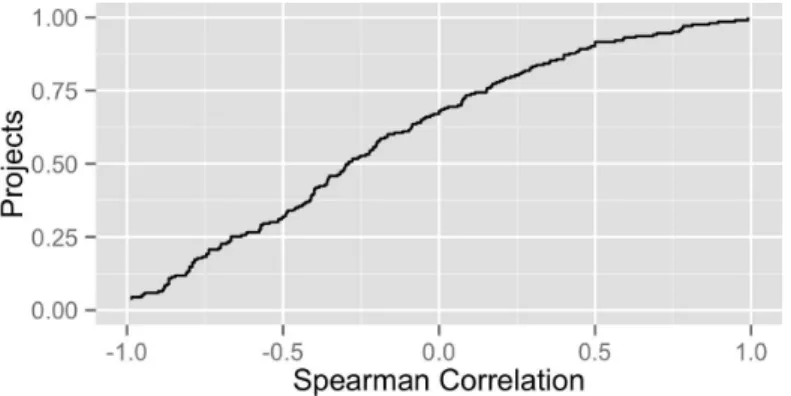
4.10 Spearman ranking for the correlation between frequency of changes of files and the usage of types in mature projects . . . 37
A.1 Usage of types in all declarations . . . 53
A.2 Usage of types in declarations of fields . . . 54
A.3 Usage of types in declarations of constructor parameters . . . 54
A.4 Usage of types in declarations of parameters of methods . . . 54
A.5 Usage of types in declarations of returns of methods . . . 54
A.6 Usage of types in declarations of local variables . . . 55
A.7 Usage of types in public declarations . . . 55
A.8 Usage of types in protected declarations . . . 55
A.9 Usage of types in private declarations . . . 55
A.10 Usage of types in declarations inside test classes . . . 56
A.11 Usage of types in declarations of fields inside test classes . . . 56
A.12 Usage of types in declarations of constructor parameters inside test classes 56 A.13 Usage of types in declarations of parameters of methods inside test classes 57 A.14 Usage of types in declarations of returns of methods inside test classes . . 57
A.15 Usage of types in declarations of local variables inside test classes . . . 57
A.16 Usage of types in public declarations inside test classes . . . 57
A.17 Usage of types in protected declarations inside test classes . . . 58
A.18 Usage of types in private declarations inside test classes . . . 58
A.19 Usage of types in declarations inside main classes . . . 59
A.20 Usage of types in declarations of fields inside main classes . . . 59
A.21 Usage of types in declarations of constructor parameters inside main classes 59 A.22 Usage of types in declarations of parameters of methods inside main classes 60 A.23 Usage of types in declarations of returns of methods inside main classes . . 60
A.24 Usage of types in declarations of local variables inside main classes . . . . 60
A.25 Usage of types in public declarations inside main classes . . . 60
A.26 Usage of types in protected declarations inside main classes . . . 61
A.27 Usage of types in private declarations inside main classes . . . 61
A.28 Usage of types in declarations inside script files . . . 62
A.29 Usage of types in declarations of parameters of methods inside script files . 62 A.30 Usage of types in declarations of returns of methods inside script files . . . 62
A.31 Usage of types in declarations of local variables inside script files . . . 63
A.32 Usage of types in declarations inside class files . . . 63
A.33 Usage of types in declarations of fields inside class files . . . 63
A.34 Usage of types in declarations of constructor parameters inside class files . 64 A.35 Usage of types in declarations of parameters of methods inside class files . 64 A.36 Usage of types in declarations of returns of methods inside class files . . . 64
A.37 Usage of types in declarations of local variables inside class files . . . 64
A.38 Usage of types in public declarations inside class files . . . 65
A.39 Usage of types in protected declarations inside class files . . . 65
A.40 Usage of types in private declarations inside class files . . . 65
A.41 Usage of types in projects with programmers with statically typed only background . . . 66
A.42 Usage of types in declarations of fields in projects with programmers with statically typed only background . . . 66
A.43 Usage of types in declarations of constructor parameters in projects with programmers with statically typed only background . . . 66
A.44 Usage of types in declarations of parameters of methods in projects with programmers with statically typed only background . . . 67
A.45 Usage of types in declarations of returns of methods in projects with pro-grammers with statically typed only background . . . 67
A.46 Usage of types in declarations of local variables in projects with program-mers with statically typed only background . . . 67 A.47 Usage of types in public declarations in projects with programmers with
statically typed only background . . . 68 A.48 Usage of types in protected declarations in projects with programmers with
statically typed only background . . . 68 A.49 Usage of types in private declarations in projects with programmers with
statically typed only background . . . 68 A.50 Usage of types in declarations in projects with programmers with
dynami-cally typed background . . . 69 A.51 Usage of types in declarations of fields in projects with programmers with
dynamically typed background . . . 69 A.52 Usage of types in declarations of constructor parameters in projects with
programmers with dynamically typed background . . . 69 A.53 Usage of types in declarations of parameters of methods in projects with
programmers with dynamically typed background . . . 70 A.54 Usage of types in declarations of returns of methods in projects with
pro-grammers with dynamically typed background . . . 70 A.55 Usage of types in declarations of local variables in projects with
program-mers with dynamically typed background . . . 70 A.56 Usage of types in public declarations in projects with programmers with
dynamically typed background . . . 71 A.57 Usage of types in protected declarations in projects with programmers with
dynamically typed background . . . 71 A.58 Usage of types in private declarations in projects with programmers with
dynamically typed background . . . 71 A.59 Usage of types in declarations in projects with programmers with statically
and dynamically typed background . . . 72 A.60 Usage of types in declarations of fields in projects with programmers with
statically and dynamically typed background . . . 72 A.61 Usage of types in declarations of constructor parameters in projects with
programmers with statically and dynamically typed background . . . 72 A.62 Usage of types in declarations of parameters of methods in projects with
programmers with statically and dynamically typed background . . . 73 A.63 Usage of types in declarations of returns of methods in projects with
pro-grammers with statically and dynamically typed background . . . 73
A.64 Usage of types in declarations of local variables in projects with program-mers with statically and dynamically typed background . . . 73 A.65 Usage of types in public declarations in projects with programmers with
statically and dynamically typed background . . . 74 A.66 Usage of types in protected declarations in projects with programmers with
statically and dynamically typed background . . . 74 A.67 Usage of types in private declarations in projects with programmers with
statically and dynamically typed background . . . 74 A.68 Usage of types in declarations in mature projects . . . 75 A.69 Usage of types in declarations of fields in mature projects . . . 75 A.70 Usage of types in declarations of constructor parameters in mature projects 75 A.71 Usage of types in declarations of parameters of methods in mature projects 76 A.72 Usage of types in declarations of returns of methods in mature projects . . 76 A.73 Usage of types in declarations of local variables in mature projects . . . 76 A.74 Usage of types in public declarations in mature projects . . . 76 A.75 Usage of types in protected declarations in mature projects . . . 77 A.76 Usage of types in private declarations in mature projects . . . 77 A.77 Usage of types in declarations in non-mature projects . . . 78 A.78 Usage of types in declarations of fields in non-mature projects . . . 78 A.79 Usage of types in declarations of constructor parameters in non-mature
projects . . . 78 A.80 Usage of types in declarations of parameters of methods in non-mature
projects . . . 79 A.81 Usage of types in declarations of returns of methods in non-mature projects 79 A.82 Usage of types in declarations of local variables in non-mature projects . . 79 A.83 Usage of types in public declarations in non-mature projects . . . 79 A.84 Usage of types in protected declarations in non-mature projects . . . 80 A.85 Usage of types in private declarations in non-mature projects . . . 80
List of Tables
3.1 Characterization of Projects . . . 15 3.2 Number of Declarations per Project . . . 16 3.3 Number of Declarations by Visibility . . . 16 3.4 Distribution of the Number of Developers per Project . . . 16
4.1 Tukey Honest Significant Differences Test results for the comparison be-tween the usage of types by kind of declaration . . . 23 4.2 Tukey Honest Significant Differences Test results for the comparison
be-tween the usage of types by visibility of declaration . . . 24 4.3 Tukey Honest Significant Differences Test results for the comparison
be-tween the usage of types by main and test classes . . . 27 4.4 Tukey Honest Significant Differences Test results for the comparison
be-tween the usage of types in script files and class files . . . 28 4.5 Tukey Honest Significant Differences Test results for the comparison
be-tween the usage of types by declaration type and programmers background 32 4.6 Tukey Honest Significant Differences Test results for the comparison
be-tween the usage of types by declaration visibility and programmers back-ground . . . 32 4.7 Spearman Correlation between the usage of types and the size, age and
number of commits of projects . . . 33 4.8 Descriptive statistics for mature projects . . . 34
Contents
Acknowledgments xi
Resumo xv
Abstract xvii
List of Figures xix
List of Tables xxiii
1 Introduction 1
1.1 Motivation . . . 2 1.2 Contributions . . . 3 1.3 Organization . . . 3
2 Background 5
2.1 Types and Related Work . . . 5 2.2 The Groovy Language . . . 8 2.2.1 Groovy Type System . . . 8 2.2.2 Other Groovy Features . . . 10
3 Study Settings 13
3.1 Research Questions . . . 13 3.2 Data Collection Procedure . . . 14 3.3 Dataset . . . 15 3.4 Static Code Analyzer . . . 17
4 Results 19
4.1 Overall Result . . . 19 4.2 Kind of Declaration . . . 21
4.3 Declaration Visibility . . . 23 4.4 Test Classes and Main Classes . . . 25 4.5 Script Files and Class Files . . . 27 4.6 Programmers’ Background . . . 29 4.7 Project Size, Age and Number of Commits . . . 33 4.8 Frequency of changes . . . 37
5 Discussion 39
5.1 Research Questions . . . 39 5.2 Threats to Validity . . . 43
6 Conclusions and Future Work 45
6.1 Conclusions . . . 45 6.2 Future Work . . . 46
Bibliography 49
Attachment A Detailed Results 53
A.1 Overall Result . . . 53 A.2 Test and Main Classes . . . 56 A.3 Script and Class Files . . . 62 A.4 Programmers’ Background . . . 66 A.5 Project Maturity . . . 75
Chapter 1
Introduction
Type systems are one of the most important characteristics of a programming language and also a major topic of research in software engineering (Furr et. al. [2009]; Takikawa et. al. [2012]; Siek et. al. [2007]). A type system is a tractable syntactic method for proving the absence of certain program behaviors by classifying phrases according to the kinds of values they compute (Pierce [2002]). In other words, type systems define the interface of the different parts that compose a program. Their main purposes are to prevent the occurrence of execution errors and to document code (Cardelli [1996]). In dynamically typed languages, such as Ruby and JavaScript, the definition of the type of an expression only happens at run time. On the other hand, statically typed programming languages, such as Java and C#, require types to be defined during compile time, either explicitly declared by the programmer or inferred by the compiler (Milner [1978]). In such languages, the compiler can check for most errors statically.
Discussions about what is the best type system for a particular situation have become increasingly important in recent years due to the rapid popularization of dy-namically typed languages. According to the TIOBE Programming Community Index (Tiobe Website [2013]), a well-known ranking that measures the popularity of program-ming languages, 27% of the programprogram-ming languages used in industry are dynamically typed. A decade ago, this number was only 17%. Among the 10 languages on top of the ranking, four are dynamically typed: JavaScript, Perl, Python and PHP. None of these languages were among the top 10 rank before 1998.
Several factors may be considered when choosing a typing paradigm. Dynamically typed languages tend to allow programmers to code faster and to adapt their programs to frequently changing requirements more easily. Also, by removing the repetitive work of defining types, these languages allow programmers to focus on the problem to be solved rather than on the rules of the language (Tratt [2009]).
2 Chapter 1. Introduction
Statically typed languages also have their advantages. They allow compilers to find type errors statically (Lamport et. al. [1999]). Typed declarations increase the maintainability of systems because they implicitly document the code, telling program-mers about the nature of expressions (Cardelli [1996]; Mayer et. al. [2012]). Systems built with these languages tend to be more efficient since they do not need to perform type checking during execution (Bruce [2002]; Chang et. al. [2011]). Finally, modern development environments, such as Eclipse and IDEA, are able to assist programmers with functionalities such as code completion based on the information provided by statically typed declarations (Bruch et. al. [2009]).
Some languages try to combine characteristics from both static and dynamic type systems. Groovy [2013] is one of these languages. Although Groovy is mostly a dynamically typed language, it gives programmers the option to use type annotations as a means to document their code. It is also possible to turn static type checking on so the compiler can find type errors before execution. This allows developers to choose the most appropriate paradigm for each situation. In addition to that, some statically typed languages, such as Java or C#, allow the programmer to use casts in order to bypass type checking of an expression.
1.1
Motivation
Although the tradeoffs between different typing paradigms have been widely researched, specially though controlled experiments, it is still unclear how programmers actually perceive these tradeoffs. For example, assuming that statically typed programs are more reliable, but dynamically typed programs can be written faster, which factor would be considered more relevant by programmers and in which contexts?
Understanding the point of view of programmers about the use of types is an important matter. Tools can be created or improved to support programmers in the use of types. Programming language developers can consider that information in their design so they can develop the most appropriate features for their target audience. For example, dynamically typed languages can introduce type annotations in order to help programmers document their code in the scenarios where programmers judge this feature more useful. Finally, programmers can benefit from this knowledge when choosing programming languages or typing paradigms for a given context.
1.2. Contributions 3
systems ’Wohlin [2012]’. Also, one cannot find the point of view of programmers about types by simply analyzing the programming language they choose since there are many other factors which might influence such choice.
1.2
Contributions
This dissertation presents a large scale empirical study about how programmers use optional typing in Groovy. Through the analysis of a massive dataset with 6638 Groovy projects, we were able to identify when programmers prefer to type or not their dec-larations. In particular, we found that programmers do not use types in test classes, script files and frequently changed code as often as in other scenarios. On the other hand, types are extremely popular in interfaces of modules. Also, there is evidence that the use of types by programmers with statically typed languages background is more frequent.
Our results bring more visibility over the point of view of programmers about the use of types in software systems. This analysis complements existing studies based on controlled experiments (Hanenberg et. al. [2013]; Daly et. al. [2009]; Hanenberg [2010]; Kleinschmager et. al. [2012]; Mayer et. al. [2012]; Gannon [1977]; Prechelt et. al. [1998]). Finally, we hope to inspire new researches about this topic by raising new research questions based on the obtained results.
Partial results of this study have been published as a research paper (Souza et. al. [2013]) on the First Brazilian Workshop on Visualization, Evolution and Software Maintenance where they received the best paper award. More recent results have been approved to be published on the 13th International Conference on Modularity (Souza et. al. [2014]). In addition, the artifacts built in this study form the basis of an ongoing effort to develop a scalable framework for the static source code analysis of massive datasets called Elastic Repository Analysis (ERA [2014]).
1.3
Organization
Chapter 2
Background
In this chapter, we present the background of our study. We start by discussing the tradeoffs of different typing paradigms in Section 2.1. In Section 2.2, we introduce the main concepts of the Groovy language, including its optional type system.
2.1
Types and Related Work
In the literature, it is common to find the following arguments in favor of statically typed languages (Cardelli [1996]; Lamport et. al. [1999]; Mayer et. al. [2012]; Bruch et. al. [2009]):
• They allow compilers to find type errors statically, thus decreasing the occurrence
of defects on a system
• They simplify the task of verifying the correctness of a program and potentially
lead to higher productivity
• They implicitly document the source code by communicating the nature of
con-structs to programmers and hence the increasing maintainability of a program
• They generally lead to more efficient systems since no type checking need to be
performed during run time
• They allow modern development environments, such as Eclipse and IDEA, to
use the information provided by types to assist programmers with productivity functionalities such as code completion or integrated documentation
Conversely, dynamically typed languages also have advantages (Pierce [2002]; Tratt [2009]):
6 Chapter 2. Background
• They tend to lead programmers to code faster by eliminating the repetitive work
of declaring types
• They allow programmers to focus on the problem to be solved rather than on the
rules of the language
• They allow programmers to perform faster changes on a program thus adapting
to changing requirements more easily
The impacts of different typing strategies have been widely studied in the litera-ture. In an experiment conducted by Prechelt et. al. [1998], it was possible to observe a positive impact when using type checking on procedure arguments. In this experi-ment, 40 programmers were split into two groups and asked to perform two non trivial tasks based on an existing API. One group used ANSI C, which check types statically. Meanwhile, the other group used a dialect of C which did not perform type checking (although types were still declared). The group using the C dialect with type checking produced less defects, were able to find errors more quickly and were more productive than the other group.
A recent series of experiments conducted by Hanenberg analyzes typing paradigms in various contexts. Hanenberg [2010] compares the performance of two groups of students asked to develop two small systems. Both groups used a language developed by the author, called Purity. The only difference in the language used by the two groups was the type system. One group used a statically typed version of Purity while the other used a dynamically typed version of the same language. Results showed that the group using the dynamic version was significantly more productive than the other, which contradicts the results found by Prechelt et. al. [1998].
In a follow up study by Kleinschmager et. al. [2012], the authors obtained op-posite conclusions. They compared the performance of two groups of developers in maintenance tasks. The first group used Java, a statically typed language, and the other used Groovy, but restricting developers to use only untyped declarations in order to simulate a dynamically typed version of Java. In this case, the group using the statically typed language, Java, was much more productive.
2.1. Types and Related Work 7
of the use of types when these were used to document design decisions or when a high number of classes had to be identified by programmers. On the other hand, for easier tasks, programmers developed faster in the dynamically typed language. This study provides a more consistent view of the tradeoffs between different typing strategies. They show that this is a complex topic and that results might vary depending on several different factors.
Daly et. al. [2009] conduct an experiment in order to compare the performance of two groups working on small development tasks. One group used Ruby, a dynami-cally typed language, while the other used DRuby, a statidynami-cally typed version of Ruby. Results showed that the DRuby compiler rarely managed to capture any errors that were not already evident for programmers. This result contradicts the argument that type checking can significantly reduce the occurrence of defects. However, the authors suggest an interesting explanation. Since most subjects involved in the study had pre-vious experience with Ruby, they were probably used to the lack of typing. This result also raises the question whether type checks can effectively reduce the occurrence of run time errors only among developers who are not used to dynamic typing.
The studies discussed above present very different and often contradictory results. The impact of the use of types on the development of software systems is a very complex topic and depends on a wide range of factors. Although controlled experiments are capable of analyzing this question in detail, they might suffer heavy interference from several factors, such as the selection of the groups and the background of the subjects. Moreover, these studies provide no visibility on how programmers perceive these results. For example, assuming that typed programs are more reliable, but dynamically typed programs can be written faster, which factor would be considered more relevant by programmers and in which contexts?
8 Chapter 2. Background
their code rather than to provide compile time type checking. They seem to prefer unit tests as a means to increase the reliability of a program over static type checking. However, it is important to say that these results might be biased in favor of dynami-cally typed languages since they were based on a survey conducted among students of a web development course.
2.2
The Groovy Language
Groovy is a dynamically typed programming language designed to run on the Java Virtual Machine. Its adoption has grown remarkably over the last years. According to the TIOBE Programming Index, Groovy is the 22nd most popular language in the
software industry Tiobe Website [2013], ahead of languages like Haskell and Scala. It builds upon the strengths of Java, but has additional features inspired by dynamic languages such as Python and Ruby, such as metaprogramming, closures and script support. Like Java, Groovy code is compiled to bytecode, allowing it to seamlessly integrate with existing Java classes and libraries. These factors have attracted a large number of Java programmers who want to use Groovy’s dynamic functionality without having to learn a completely different language or change the execution platform of their systems.
2.2.1
Groovy Type System
When Groovy was first launched, in 2007, it was a purely dynamically typed language. However, it allowed programmers to optionally type their declarations. Examples of typed and untyped declarations combined in the same file are shown in Listing 1. This kind of typing should not be confused with static typing since the Groovy compiler does not use these type annotations to look for errors. For example, the snippet of code shown in Listing 2 compiles without any errors. Nevertheless, during runtime, thestring variable refers to an instance of the Integer class and an exception is thrown when the method toUpperCase is invoked since the Integer class does not have such method.
2.2. The Groovy Language 9
Listing 1 Typed and untyped declarations mixed together
1 class DynamicTyping {
2 private String typedField
3 private untypedField
4
5 DynamicTyping(typedParam){}
6
7 def untypedMethod(untypedParam,int typedParam){
8 def untypedVariable = 1.0
9 return untypedVariable
10 } 11
12 int typedMethod(){
13 String typedVariable = ""
14 return typedVariable
15 } 16 }
Listing 2 Types are not checked by default by the Groovy compiler
1 String string = new Integer(1) 2 string.toUpperCase()
the methodsum is supposed to receive two parameters of the typeint, but it is actually called with two parameters of the type String.
Listing 3 Forcing the compiler to check types
1 @TypeChecked
2 class TypeCheckedGroovyClass { 3
4 static int sum(int a, int b) {
5 a + b
6 }
7
8 public static void main(String[] args) {
9 println sum("1", "2") 10 }
11 }
10 Chapter 2. Background
the code and aiding in the integration with development tools. In the remainder of this text, we refer to declarations with type annotations as "typed", while the word "untyped" is used for declarations with no type annotations.
2.2.2
Other Groovy Features
Groovy was designed to be more expressive and concise than Java. Two implemen-tations of a simple algorithm are shown below. Given a list of numbers, return a list containing only the even numbers of that list. Listing 4 shows the Java implementation while Listing 5 shows the Groovy counterpart.
Listing 4 A simple algorithm written in Java
1 import java.util.ArrayList; 2 import java.util.List;
3
4 public class JavaFilter {
5 List<Integer> evenNumbers(List<Integer> list) { 6 List<Integer> result = new ArrayList<Integer>();
7 for(int item : list) {
8 if(item % 2 == 0) {
9 result.add(item);
10 }
11 }
12
13 return result;
14 } 15
16 public static void main(String[] args) {
17 List<Integer> list = new ArrayList<Integer>();
18 list.add(1);
19 list.add(2);
20 list.add(3);
21 list.add(4);
22
23 List<Integer> rslt = new JavaFilter().evenNumbers(list);
24 System.out.println(rslt);
25 } 26 }
2.2. The Groovy Language 11
except when there are multiple statements in the same line. When the keywordreturn is omitted (line 10), the last expression evaluated inside a method is returned. Also, parentheses in method calls can often be omitted (line 16). In addition, Groovy implic-itly imports frequently used classes, like those of the java.util package, and methods, like System.out.println(line 16).
Listing 5 A simple algorithm written in Groovy
1 class GroovyFilter {
2 List<Integer> evenNumbers(List<Integer> list) { 3 List<Integer> result = []
4 for(int item : list) {
5 if(item % 2 == 0) {
6 result << item
7 } 8 } 9 10 result 11 } 12
13 public static void main(String[] args) {
14 List<Integer> list = [1, 2, 3, 4]
15 List<Integer> result = new GroovyFilter().evenNumbers( list)
16 println result
17 } 18 }
The design of Groovy was influenced by dynamic features of programming lan-guages such as Ruby and Python. Listing 6 shows how these features can be used to rewrite the same algorithm presented in Listing 4 in a single line of code. First, notice that the code shown in Listing 6 is a script, rather than a class file. It makes use of a closure to allow a programmer to define a filter logic. This closure is passed down to the findAll method, which applies this closure to every element of the list in order to decide if that element should be returned or not. Closures are one of the most impor-tant features of Groovy as compared to Java. They allow a functional programming style, which is both expressive and powerful.
Listing 6 A class written in Groovy
12 Chapter 2. Background
Metaprogramming is another dynamic feature present in Groovy. Listing 7 shows how to add a method to an existing class dynamically. By adding the method even-Numbers() to the List class, it is possible to achieve higher expressiveness. This is specially useful when implementing Domain Specific Languages (Fowler [2010]).
Listing 7 An example of metaprogramming in Groovy
1 List.metaClass.evenNumbers = { 2 delegate.findAll {it % 2 == 0} 3 }
Chapter 3
Study Settings
The study presented in this thesis consists in the static analysis of the source code of a corpus of 6638 Groovy projects. Its goal is to find in which contexts Groovy programmers type or do not type their declarations. We have shared all the artifacts of this study in our project website.1 This includes the source code of the programs
used in the data collection and analysis procedures, the analyzed data and the detailed results. We do not share the source code of the analyzed projects, but we do share their metadata, such as author name, project name, size, contributors, etc. Our goal is to allow this study to be easily replicated or extended.
The remainder of this chapter is organized as follows. In Section 3.1, we present five research questions that guide our analysis. Section 3.2 shows the data collection procedure and Section 3.3 characterizes the obtained dataset. Finally, the analysis procedure is presented in Section 3.4.
3.1
Research Questions
We aim to answer the following research questions about the usage of types by Groovy programmers:
• Question Q1: Do programmers use types more often in the interface of their modules? We believe that the benefits of the use of types are more clear
in declarations that define the interface of modules, which are exposed through public or protected visibility. In such cases, programmers are specifying how the rest of the program should interact with a module, potentially improving readability and maintainability. On the other hand, in declarations that are
1http://github.com/carlosgsouza/groovonomics
14 Chapter 3. Study Settings
hidden from external modules, we expect programmers to opt for the simplicity and flexibility offered by untyped declarations more often.
• Question Q2: Do programmers use types less often in test classes and scripts? Many studies analyze typing paradigms in the main classes of a
program. However, little is known about this question in scripts or test classes. We want to understand if programmers consider different typing strategies in these scenarios.
• Question Q3: Does the experience of programmers with other lan-guages influence their choice for typing their code? It is expected that
programmers familiar with a dynamically typed language are more comfortable with the lack of types and end up using types less often in Groovy.
• Question Q4: Does the size, age or level of activity of a project have any influence on the usage of types? We hypothesize that as these metrics grow,
there is an increased concern about keeping code more maintainable. This can lead programmers to use types more often as a means to improve code readability.
• Question Q5: In frequently changed code, do developers prefer typed or untyped declarations? It makes sense to assume that developers try to
increase the maintainability of frequently changed code. One way to achieve that is improving the readability of such code with the use of types. On the other hand, the flexibility of untyped declarations is capable of increasing the changeability of those files. We want to understand which one of these strategies is actually preferred by Groovy developers.
3.2
Data Collection Procedure
The projects used in this study were obtained from GitHub, a popular source control service based on Git. For each project, it was necessary to retrieve its source code, metadata, commit history, and the metadata of all its developers. GitHub does not offer a listing of all hosted projects, but it offers two search mechanisms, a REST API and a Web based search page. Unfortunately, the GitHub API is too limited for our requirements. It imposes a limit of one thousand results and does not allow filtering projects by their programming language.
3.3. Dataset 15
special care was necessary to make this work. For instance, because the number of results is limited to one thousand projects, we had to segment the queries. Multiple requests were made, each of them asking for the name of all projects created on a given month. Results were then combined into a single list. Another problem faced was that GitHub denies excessive requests from the same client. By adding artificial delays between requests, it was possible to overcome this limitation.
With the name of all projects in hand, it was then possible to use the GitHub REST API to query their metadata. That metadata also contains the identifiers of the developers and of the commits of that project. Using those identifiers we once again used the GitHub REST API and obtained the background of all developers and the file changes of all projects.
3.3
Dataset
Our dataset consists of 6638 projects with almost 9.8 million lines of code. Table 3.1 shows descriptive statistics for the size, age and number of commits of these projects. There are more than 1.5 million declarations of all types and visibilities in our dataset. Note that the value of the median of the number of lines is relatively small. Most projects have 529 lines of code or less. This was expected. Since Groovy is a very expressive language, with many traits of functional programming languages, program-mers can write more concise code leading to smaller programs. In addition, by manually inspecting our dataset, we found a significant number of projects with a small number of Groovy files among files written in other languages. Also, we found many small projects created with learning purposes only.
Table 3.1: Characterization of Projects
Mean Median Sd Max Total Size (LoC) 1,471 529 4,545 149,933 9,770,783
Commits 31 5 175 6,545 203,375 Age (Days) 361 280 333 1,717 2,395,441
16 Chapter 3. Study Settings
Table 3.2: Number of Declarations per Project
Mean Median Sd Max Total Field 54 19 163 5,268 366,148 Constructor Parameter 3 0 16 933 18,956
Method Parameter 30 6 110 3,554 202,617 Method Return 53 15 165 4,893 357,997 Local Variable 88 21 361 16,427 602,645 Public 74 20 239 7,942 507,296
Protected 6 0 32 1,394 42,646
Private 58 21 178 5,268 395,776 All Declarations 227 71 744 29,862 1,548,363
Table 3.3: Number of Declarations by Visibility
Private Protected Public Field 346,462 2,996 16,690 Constructor Parameter 680 246 18,030 Method Parameter 27,174 10,897 164,546
Method Return 21,460 28,507 308,030
The projects of our dataset were developed by 4481 people. Table 3.4 shows the distribution of the number of developers per project. While 96% of the projects were developed by small groups of 3 people or fewer, there were projects with up to 58 developers involved. These developers have different backgrounds according to GitHub. Figure 3.1 shows what are the most popular languages used by the Groovy developers in other GitHub projects. Java is the most popular among them. Almost 2500 out of of the 4481 developers of projects in our dataset also have Java projects hosted on GitHub.
Table 3.4: Distribution of the Number of Developers per Project
Number of Developers Fraction of Projects
1 84%
2 9%
3 3%
3.4. Static Code Analyzer 17
Figure 3.1: Most popular languages among Groovy developers
3.4
Static Code Analyzer
In order to understand in which situations programmers use types, we developed a static code analyzer based on the Groovy metaprogramming library. This analyzer is capable of retrieving the declaration information of parameters and returns of methods, parameters of constructors, fields and local variables. In addition, the analyzer can tell if a declaration is part of a test class or a script and the corresponding visibility.
Chapter 4
Results
This section presents the data obtained from our analysis. Section 4.1 shows the overall result. The usage of types according to the kind and visibility of declarations are presented in Sections 4.2 and 4.3. Section 4.4 shows how types are used in test and functional classes while Section 4.5 compares the usage of types in script and class files. We study the influence of programmers’ background in Section 4.6 and how types are used according to age, size and number of commits of projects in Section 4.7. Finally, we analyze the usage of types according to frequency of changes of files in Section 4.8. In this chapter we focus on the presentation and on the statistical treatment of the obtained results. Their interpretation is left to Chapter 5.
4.1
Overall Result
This section presents an overview of the results. Figure 4.1 shows a histogram and the descriptive statistics for the relative usage of types in declarations of projects. This value can vary from 0 (a project does not declare any types) to 1 (all declarations of a project are typed). All declarations are considered without making any distinction among them.
Note that there is a significant number of projects for which the relative usage of types is either approximately 0 or 1. These are mostly small projects. About 95% of them have less than 1000 lines of code and 22% of them have less than 100 lines of code. In such projects, it is easier to be consistent on the typing strategy since there are just a few declarations. We initially considered not including these projects in the rest of our analysis since they could not represent well the entire population of Groovy projects. However, doing so did not alter the results significantly and we decided to include all projects in our analysis regardless of their size. In the rest of
20 Chapter 4. Results
Quartiles n mean std. dev. 1st
2nd
3rd
4th
6638 0.45 0.28 0.25 0.42 0.64 1.00
Figure 4.1: Usage of types in all declarations of all projects
4.2. Kind of Declaration 21
4.2
Kind of Declaration
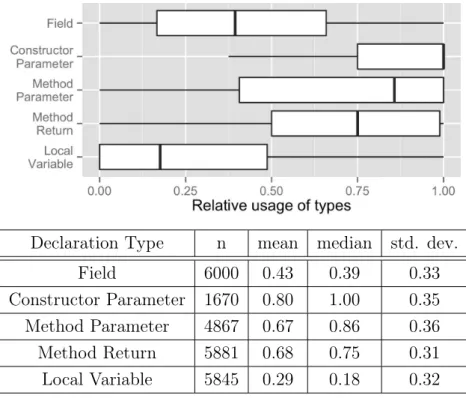
This section investigates whether programmers use types differently depending on the kind of the declaration. For each project, we measured the relative usage of types in fields, constructor parameters, method returns, method parameters and local variables. These results are displayed in box plots in Figure 4.2 along with the corresponding descriptive statistics. Note that the size of each sample, n, is different since not all projects have all types of declarations. For instance, there are only 1670 out of 6638 projects that declare constructor parameters. On the other hand, 6000 projects have declarations of fields.
Declaration Type n mean median std. dev. Field 6000 0.43 0.39 0.33 Constructor Parameter 1670 0.80 1.00 0.35 Method Parameter 4867 0.67 0.86 0.36 Method Return 5881 0.68 0.75 0.31 Local Variable 5845 0.29 0.18 0.32
Figure 4.2: Usage of types in all declarations by type of declaration
22 Chapter 4. Results
The box plot graph and the descriptive statistics are not enough to determine whether the difference in the usage of types in any two kinds of declaration is significant. In order to do that, a significance test should be applied. We start by defining a hypothesis below, which can then be rejected or accepted by the test.
H0 There is no difference in how programmers type different kinds of declarations H1 Programmers type their declarations differently depending on the kind of the
dec-laration
The appropriate significance test should be chosen carefully. It needs to compare multiple treatments, which represent the 5 distinct kinds of declaration. We first considered applying repeated t-tests or Mann-Whitney U-tests (Wohlin [2012]) in order to compare every two kinds of declaration, i.e, fields vs. local variables, fields vs method returns, etc. However, applying repeated tests over the same sample increases the probability of getting Type-I errors (rejecting the null hypothesis when it actually should be accepted).
A valid alternative for our scenario is to use One-Way Between Groups ANOVA, which compares all means simultaneously and maintains the Type-I error probability at the designated level (Wohlin [2012]). ANOVA computes ap value which indicates whether at least two treatments are significantly different from each other. The smaller the value of p, the "more significant" is the difference and, consequently, the stronger the rejection of the null hypothesis.
Given the level of significance, α, we can reject the null hypothesis if p < α. Typically, α = 0.05 or α = 0.01 are used, but in this study we decided to use a very small value for this purpose,α = 0.001. This value might seem too small at first, which
would require the difference between two treatments to be unnecessarily high in order to be considered significant. However, since we are analyzing such a large dataset, this value ofαseems reasonable (Labovitz [1968]). For the treatments described in Figure 4.2 the p value reported by ANOVA is 0. This allows us to strongly reject the null hypothesis, even though we are using such an extreme value for α, and state that at least two treatments are different from each other.
4.3. Declaration Visibility 23
means of these two treatments. The results of the Tukey Honest Significant Differences are displayed in Table 4.1. Confidence intervals were calculated with a confidence of 0.999 (1−α).
Table 4.1: Tukey Honest Significant Differences Test results for the comparison between the usage of types by kind of declaration
p Difference Local Variable Contructor Parameter 0 (-0.55, -0.47)
Field Contructor Parameter 0 (-0.41, -0.34) Method Parameter Contructor Parameter 0 (-0.17, -0.10) Method Return Contructor Parameter 0 (-0.16, -0.09) Local Variable Field 0 (-0.16, -0.11) Method Return Field 0 ( 0.22, 0.26) Method Parameter Field 0 ( 0.22, 0.27) Method Parameter Local Variable 0 ( 0.35, 0.40) Method Return Local Variable 0 ( 0.36, 0.41) Method Return Method Parameter 0.95 (-0.02, 0.03)
The table above shows that there are only two kinds of declaration for which there is no significant difference, parameters and returns of methods. This result is reasonable. Since returns and parameters of methods are declared together as part of a method signature, programmers probably use the same typing strategy in both declarations. All other declaration types can be considered significantly different from each other. In particular, note that these results clearly show that local variables and constructor parameters are the least and most typed declarations respectively. Another interesting insight provided by these results is that parameters of methods and param-eters of constructors are typed differently. Although these are essentially the same kind of declaration in Groovy, they seem to be perceived differently by programmers when it comes to typing.
4.3
Declaration Visibility
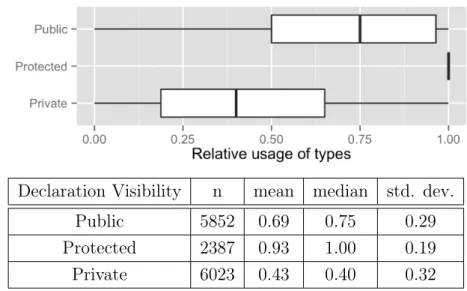
24 Chapter 4. Results
the Tukey HSD Test are reported in Table 4.2. These results show that all treatments are different from each other since allp values are equal to 0.
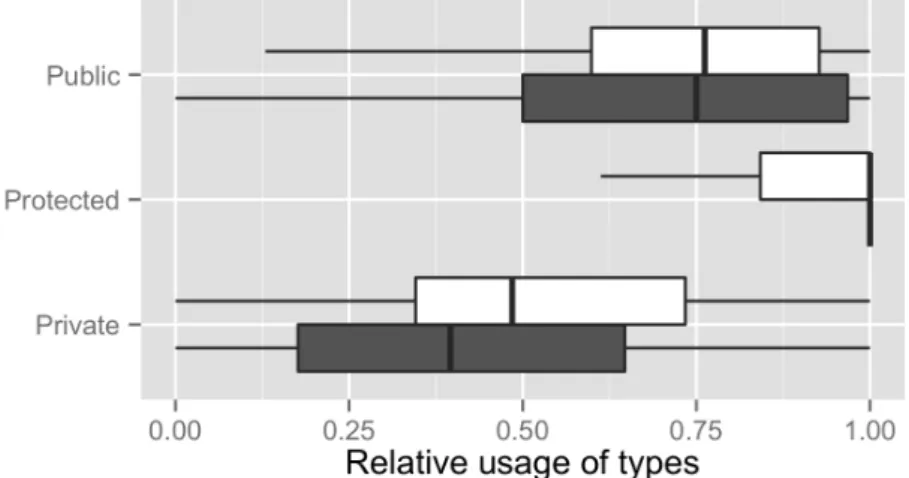
Declaration Visibility n mean median std. dev. Public 5852 0.69 0.75 0.29 Protected 2387 0.93 1.00 0.19 Private 6023 0.43 0.40 0.32
Figure 4.3: Usage of types in all declarations by type of declaration
Table 4.2: Tukey Honest Significant Differences Test results for the comparison between the usage of types by visibility of declaration
p Difference Protected Private 0 ( 0.47, 0.52)
Public Private 0 ( 0.24, 0.28) Public Protected 0 (-0.27, -0.22)
4.4. Test Classes and Main Classes 25
4.4
Test Classes and Main Classes
We now analyze the use of types in test classes in comparison to main classes. We used a simple heuristic to determine the kind of the class. In Groovy, like in Java, it is common to organize test classes and main classes in different source folders. The convention adopted by build tools popular among Groovy programmers, such as Gradle and Maven, assumes that test classes and main classes are in the src/test/groovy and src/main/groovy directories respectively. Based on these conventions, we assume that all classes inside a test directory, but not in amain directory, are test classes.
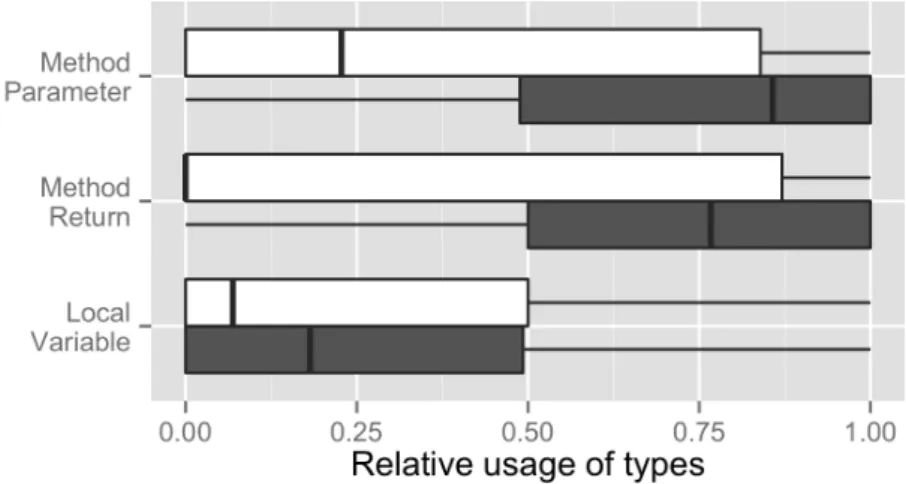
For every project, we measured the usage of types in test classes and main classes. Script files are not considered in this analysis. We found test classes in 4350 of the 6638 projects in our dataset. Results are displayed in Figure 4.4 and show the relative usage of types by declaration type. White and gray box plots correspond to test classes and main classes respectively.
In order to compare the usage of types in test and main classes, we use a slightly different approach. In this analysis, there are two independent variables, the kind of declaration and the kind of class. Thus, we are required to use Factorial ANOVA (Wohlin [2012]), which is the generalization of the One Way ANOVA for multiple factors. Multiple values of p are calculated by this test, each one corresponding to the comparison of treatments according to one of the factors. We report the p value corresponding to the factor representing the kind of class. We also apply the Tukey HSD test, for which results are displayed in Table 4.3. This time we want to show what is the difference of the relative usage of types between the same kinds of declaration, but in different kinds of classes. For example, the third row of Table 4.3 shows that there is a significant difference in how programmers type local variables in main and test classes. The overall difference between the relative usage of types in main classes and test classes falls in the (0.05,0.11) interval.
The ANOVA test reported once again a p value equal to 0, implying that the usage of types is different in test and main classes. Figure 4.4 and Table 4.3 show that this difference is significant for all kinds of declarations, except for constructor parameters. While local variables in main classes are not typed very often, they are typed even less in test classes. At least half of the projects type none of the declarations of this kind in test classes. The difference in declarations of parameters of methods is even more evident since they are often typed in main classes, but almost never typed in test classes. The confidence interval reported by the Tukey HSD Test in this case is
26 Chapter 4. Results
noteworthy. This indicates that many projects type either almost all or none of these declarations.
Declaration Type Class Type n mean median std. dev.
Field Test 1769 0.48 0.47 0.43 Main 5857 0.43 0.39 0.33 Constructor Test 124 0.77 1.00 0.41 Parameter Main 1623 0.80 1.00 0.34 Method Test 1524 0.34 0.00 0.43 Parameter Main 4593 0.71 0.91 0.35 Method Test 4334 0.85 1.00 0.31 Return Main 5299 0.54 0.60 0.39 Local Test 2842 0.23 0.00 0.35 Variable Main 5548 0.30 0.19 0.32
Figure 4.4: Usage of types by declaration type in test classes and main classes
4.5. Script Files and Class Files 27
Table 4.3: Tukey Honest Significant Differences Test results for the comparison between the usage of types by main and test classes
Declaration Type p Difference Constructor Parameter 0.98 (-0.08, 0.16)
Field 0 (-0.08, -0.02) Local Variable 0 ( 0.05, 0.11) Method Parameter 0 ( 0.36, 0.44) Method Return 0 (-0.31, -0.26)
void. Other popular test frameworks, such as TestNG, have similar requirements. This implies that, in this case, developers type their methods not because they want to, but because they have to.
4.5
Script Files and Class Files
In Groovy, programmers can write code in the form of scripts, not requiring the defini-tion of classes for simple tasks. This secdefini-tion investigates how programmers type their code in such scripts. Similar to what was done in the previous section, we measured the usage of types in script and class files in all projects and compared the obtained data. We do not consider test classes in this analysis. Determining whether a file corresponds to a script or a class is fairly simple since, in Groovy, scripts are compiled into a class extending groovy.lang.Script.
Figure 4.5 shows the distribution of the relative usage of types in class and script files. Note that constructors and fields are not considered since there is no way to declare those elements in scripts. Also, we do not present an analysis of declarations grouped by visibility since, although allowed, defining the visibility of a declaration inside a script does not make much sense.
28 Chapter 4. Results
Declaration Type File Type n mean median std. dev. Method Script 504 0.40 0.23 0.42 Parameter Class 4647 0.69 0.86 0.35 Method Script 583 0.34 0.00 0.43 Return Class 5662 0.70 0.77 0.30 Local Script 1775 0.28 0.07 0.37 Variable Class 5246 0.30 0.18 0.32
Figure 4.5: Usage of types by declaration type in script files and class files
Table 4.4: Tukey Honest Significant Differences Test results for the comparison between the usage of types in script files and class files
Declaration Type p Difference Local Variable 0.39 (-0.01, 0.04) Method Parameter 0 ( 0.24, 0.35) Method Return 0 ( 0.30, 0.40)
4.6. Programmers’ Background 29
4.6
Programmers’ Background
In this section, we analyze how programmers use types in their declarations according to their backgrounds. Projects are distributed in three groups based on the type system of the languages their developers have used on GitHub. The first group comprises those projects of programmers who developed only in statically typed languages, such as Java or C#. The projects of those who developed only in dynamically typed languages, such as Ruby or JavaScript, comprise the second group. Finally, the third group is formed by the projects of those programmers with both dynamically and statically typed languages in their portfolio. We refer to these three groups by the names Static Only, Dynamic Only and Static and Dynamic respectively.
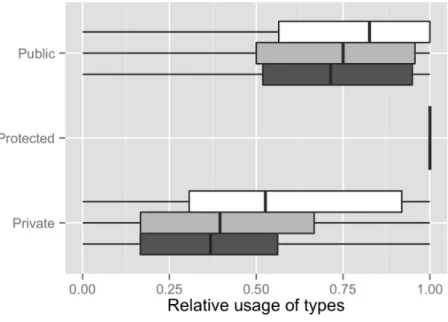
Figures 4.6 and 4.7 show results by declaration type and visibility respectively. The p value reported by the ANOVA test is equal to 0, implying that there is a signifi-cant difference in how programmers with different backgrounds type their declarations. The results of the Tukey HSD test are reported in Tables 4.5 and 4.6. These tables are divided in three parts, each one corresponding to the comparison between the data of two of the three groups.
There are significant differences in the usage of types between all groups. These differences, however, are not as clear as those found in the previous anlayses. Let us start with the comparison between projects in the Static and Dynamic and the Dynamic Only groups. There are significant differences only in private declarations and declarations of fields. Still, these differences are not very large, (0.01,0.08) for fields and(0.02,0.09) for private declarations. All in all, these two groups present very similar behavior when typing their declarations, apart from those two exceptions.
30 Chapter 4. Results
Declaration Type Background N Mean Median std. dev. Static 782 0.56 0.52 0.35 Field Both 3183 0.43 0.39 0.34 Dynamic 2035 0.38 0.36 0.29
Constructor Parameter
Static 224 0.83 1.00 0.33 Both 991 0.80 1.00 0.35 Dynamic 455 0.80 1.00 0.34
Method Parameter
Static 662 0.73 0.91 0.34 Both 2694 0.67 0.84 0.36 Dynamic 1511 0.65 0.83 0.37
Method Return
Static 764 0.73 0.85 0.30 Both 3205 0.66 0.75 0.32 Dynamic 1912 0.68 0.74 0.29
Local Variable
Static 798 0.39 0.31 0.36 Both 3230 0.28 0.17 0.32 Dynamic 1817 0.25 0.14 0.30
4.6. Programmers’ Background 31
The results reported in this section suggest a positive answer for Question Q3, i.e, programmers use types differently depending on their background. This difference is larger when comparing those projects of the Static group with projects of the other groups. These results are statistically strong, but should be generalized with care. The detailed results reported by the Tukey HSD test reveal many exceptions, specially in the comparison between the groups comprising the projects of those programmers who have at least one dynamically typed language in their portfolio, Static and Dynamic and Dynamic Only. This comparison reveals that, for all kinds and visibilities of declarations, the difference is either not significant or small.
Declaration Type Background n mean median std. dev. Static 757 0.73 0.83 0.29 Public Both 3191 0.68 0.75 0.30 Dynamic 1904 0.69 0.71 0.27
Protected
Static 287 0.92 1.00 0.20 Both 1275 0.94 1.00 0.18 Dynamic 825 0.93 1.00 0.20
Private
Static 787 0.56 0.53 0.34 Both 3196 0.43 0.40 0.33 Dynamic 2040 0.38 0.37 0.28
32 Chapter 4. Results
Table 4.5: Tukey Honest Significant Differences Test results for the comparison between the usage of types by declaration type and programmers background
Declaration Type p Difference
Static and Dynamic vs.
Static
Field 0 (-0.17, -0.07) Constructor Parameter 1.0 (-0.12, 0.06) Method Parameter 0 (-0.11, 0.00) Method Return 0 (-0.11, -0.01) Local Variable 0 (-0.15, -0.05)
Dynamic vs. Static
Field 0 (-0.23, -0.12) Constructor Parameter 0.99 (-0.12, 0.07) Method Parameter 0 (-0.14, -0.02) Method Return 0.01 (-0.10, 0.00) Local Variable 0 (-0.18, -0.07)
Static and Dynamic vs.
Dynamic
Field 0 ( 0.01, 0.08) Constructor Parameter 1.00 (-0.07, 0.06) Method Parameter 0.84 (-0.02, 0.06) Method Return 0.94 (-0.05, 0.02) Local Variable 0.12 (-0.00, 0.06)
Table 4.6: Tukey Honest Significant Differences Test results for the comparison between the usage of types by declaration visibility and programmers background
Declaration Visibility p Difference Static and Dynamic
vs. Static
Public 0.00 (-0.10, 0.00) Protected 1.00 (-0.07, 0.09) Private 0.00 (-0.18, -0.08) Dynamic
vs. Static
Public 0.01 (-0.10, 0.01) Protected 1.00 (-0.08, 0.09) Private 0.00 (-0.23, -0.13) Static and Dynamic
vs. Dynamic
4.7. Project Size, Age and Number of Commits 33
4.7
Project Size, Age and Number of Commits
This section investigates whether programmers use types differently in their code de-pending on the project characteristics. We analyze three project metrics: age, number of lines of code and number of commits. We start by analyzing the correlation between these metrics and the relative use of types in declarations by type and visibility. The Spearman rank correlation coefficient is used for this purpose. This coefficient, which ranges from -1 to 1, is a measure of the dependence between two variables. A positive value means that two variables are correlated, i.e, as the value of one grows, so does the value of the other. A negative value means an inverse correlation. Values close to 1 or -1 indicate very strong relationships and values above 0.5 or below -0.5 can be considered strong correlations.
Table 4.7: Spearman Correlation between the usage of types and the size, age and number of commits of projects
Declaration Type/Visibility Size Age Commits Field 0.221 -0.063 0.153 Constructor Parameter -0.072 -0.132 -0.053
Method Parameter -0.123 -0.079 -0.004 Method Return -0.071 0.168 -0.027 Local Variable 0.057 -0.049 0.112
Public -0.063 0.119 -0.024 Protected -0.286 -0.020 -0.165 Private 0.213 -0.068 0.160
Table 4.7 shows the Spearman correlation coefficient between the usage of types and the age, size and number of commits of a project. Most of values in this table are close to 0. There are a few coefficient values which could indicate a relationship, such as Size vs. Protected orCommits vs. Private, but these relationships are still considerably weak. All in all, these values do not seem to suggest any direct relationship between these metrics and the usage of types.
34 Chapter 4. Results
2KLoC and 100 commits. These numbers were defined by manually inspecting our dataset and finding that there are popular and mature projects that barely exceed these three metrics. According to our criteria, there are 223 mature projects in our dataset, which are characterized in Table 4.8.
Table 4.8: Descriptive statistics for mature projects
Mean Median Std. Dev. Max Total Size (LoC) 9947 5627 14594 149933 2218189
Commits 487 213 800 6545 108583 Age (Days) 600 574 350 1469 133697
4.7. Project Size, Age and Number of Commits 35
Declaration Type Project Type n mean median std. dev.
Field Mature 221 0.53 0.48 0.27 Other 5779 0.43 0.39 0.33 Constructor Mature 172 0.83 1.00 0.30 Parameter Other 1498 0.80 1.00 0.35 Method Mature 222 0.69 0.78 0.29 Parameter Other 4645 0.67 0.86 0.37 Method Mature 222 0.72 0.79 0.24 Return Other 5659 0.68 0.75 0.32 Local Mature 223 0.32 0.22 0.28 Variable Other 5622 0.29 0.17 0.32
36 Chapter 4. Results
Declaration Type Project Type n mean median std. dev.
Public Mature 223 0.72 0.76 0.24 Other 5629 0.69 0.75 0.29
Protected Mature 183 0.88 1.00 0.21 Other 2204 0.94 1.00 0.19
Private Mature 221 0.53 0.48 0.26 Other 5802 0.43 0.40 0.32
4.8. Frequency of changes 37
4.8
Frequency of changes
This section investigates whether programmers prefer to type their declarations in frequently changed code or not. Only the mature projects defined in the previous section are considered since we would not be able to obtain meaningful results from small and young projects.
We calculated the Spearman correlation coefficient between the frequency of changes of a file and the usage of types in that file for all mature projects. In projects where types are used more often in frequently changed files, this coefficient is positive, and negative when untyped declarations are preferred. Figure 4.10 displays the cumu-lative distribution of this coefficient across the mature projects dataset. It shows that 65% of them present a negative Spearman correlation coefficient and that almost half of these present strong correlations, i.e., inferior to -0.5. On the other hand, only 10% of the mature projects present strong positive correlations.
Chapter 5
Discussion
This chapter is split in two sections. We try and answer the research questions in Section 5.1. In Section 5.2, we discuss the threats to the validity of this study.
5.1
Research Questions
In this section, we discuss the results of our study in the light of the research questions proposed in Section 3.1. Although we were able to obtain a good understanding of the usage of types in different contexts, the cause for such results is still unclear in many of them. We provide several hypotheses with the goal of identifying future research topics that can provide more detailed insights about such causes.
Q1: Do programmers use types more often in the interface of
their modules?
The analysis of the usage of types by kind and visibility of declarations, presented in Sections 4.2 and 4.3, provides evidence that the answer for Q1 is affirmative. Private declarations are typed less often than protected and public declarations. Also, fields, methods and constructors are typed more often than local variables. Although fields are significantly less typed than methods and constructors, this can be explained by the fact that most fields are declared privately as shown in Section 3.3. In Groovy, similar to what happens with Java, interactions with fields of other modules usually happen through accessor methods.
While it seems that module definitions are typed more often, the cause for such phenomena is still open to discussion. We believe that the main motivation for this is the implicit documentation provided by types. In these scenarios, types provide useful
40 Chapter 5. Discussion
hints about the behavior of modules (Curtis [1987]) and define pre and post condition of contracts Meyer [1988]; Meijer et. al. [2004]; Wadler et. al. [2004]; Plosch [1997]; Flanagan [2006]; Furr et. al. [2009]. Users of a well defined module learn how to use it faster and do not need to read its implementation to understand how to use it. Programmers may consider that delicate contracts, such as those defined by protected methods, should be well documented and thus are typed more often.
Constructor parameters and protected declarations are always the elements typed most often. In addition, the analyses of different contexts, i.e, main and test classes, mature and non-mature projects and programmers’ backgrounds, show no significant difference in the usage of types. This reveals that the presence of these particular declarations is considered by programmers as a more important factor in their choice whether to type a declaration than these contexts. We hypothesize that programmers consider documentation more important in these elements. Constructors usually define the dependencies of an object, at least for its creation. In addition, they might be the first element that a programmer interacts with when dealing with a new module. Protected declarations are often used as a means to delegate the implementation of a method to subclasses, which requires a well defined contract so the superclass can work properly. Moreover, they give subclasses and other classes in the same package access to internal elements of a class, forming a tightly coupled relationship (Chidamber et. al. [1994]).
We can also speculate that declarations that are not part of a module definition, which are local variables and those with private visibility, require less documentation and thus are typed less often. Programmers can easily find all the references to these elements. Local variables are only used inside the block of code where they are declared, while all the references to elements declared privately are in the same file. This makes it easier for a programmer to infer the type of such a declaration even when it is not explicitly defined.