OF FRICATIVES /Z/, /
S
/ AND /
Z
/: VARIABILITY IN THE
PHONOLOGICAL ACQUISITION OF SIX SUBJECTS
Ambientes linguísticos para a produção das fricativas /Z/, /
S
/ e /
Z
/:
variabilidades na aquisição fonológica de seis sujeitos
Fernanda Maraiga Wiethan(1), Helena Bolli Mota (2)
(1) Speech Therapist; PhD student in Human Communication Disorders – Universidade Federal de Santa Maria – RS – Brazil.
(2) Speech Therapist; Professor of the Speech and Hearing Therapy graduation and Post-graduate in Human Commu-nication Disorders of Universidade Federal de Santa Maria – RS – Brazil; PhD in Applied Linguistics – Pontifícia Univer-sidade Católica do Rio Grande do Sul – Brazil.
Conlict of interest: non-existent
natural way, presenting delays or diversions, even after the age in which the adult target-system would
be expected to exist. These changes occur due to
the absence of stability of certain segments, distinc-tive features and / or syllabic constituents2,3. This
framework characterizes the phonological disorder
(PD), deined as speech disorders marked by dele -tions, substitu-tions, insertions or reorganization of sounds in the child’s phonological system (PS). The changes in speech occur without evidence of etiological factors and, according to their severity, speech may become unintelligible to the listeners1.
It is known that children with PD may have a different the order of phoneme acquisition from the chronology established in studies of normal acquisi-tion2. Mota4 researched the acquisition of phonemes
and distinctive features in cases of PD. The author
aimed to build a model to explain the segmental
INTRODUCTION
During the irst ive years of life, the children’s
phonological knowledge is mature. This is a gradual, universal, non-linear process, which goes through several individual variations1,2.
But for some children, the phonological devel-opment occurs more slowly and differs from the
ABSTRACT
Background: routes of phonological acquisition in children treated with favorable environments in contrast with unfavorable and neutral environments for production of /z/, /S/ and /Z/ in phonological therapy. Procedures: six children with phonological disorder aged between 4:7 and 7:8 were selected to take part in the study. They were properly authorized by their parents. There were speech-language and complementary evaluations in order to diagnose the phonological disorder. The subjects were matched according to the severity of the phonological disorder, gender, age and aspects of the phonological system in relation to the altered phonemes. Half of the children were treated with words in which the phonemes /z/, /S/ and /Z/ were in favorable environments and the other half with unfavorable and neutral environments. There were eight sessions and, after that, new evaluations were made in order to describe and qualitatively compare the routes of phonological acquisition in the said subjects
through the Implicational Model of Features Complexity. Results: the results indicated a small advantage in the therapeutic evolution of two subjects treated with favorable environments, in relation to their matches. However, children treated with unfavorable and neutral environments obtained more positive results than their matches. Conclusion: the favorable environments for production of fricatives /z/, /S/ and /Z/ did not determine the therapeutic success, but positively inluenced the phonological evolution in the subjects in the study.
KEYWORDS: Child; Speech Disorders; Speech Therapy; Speech
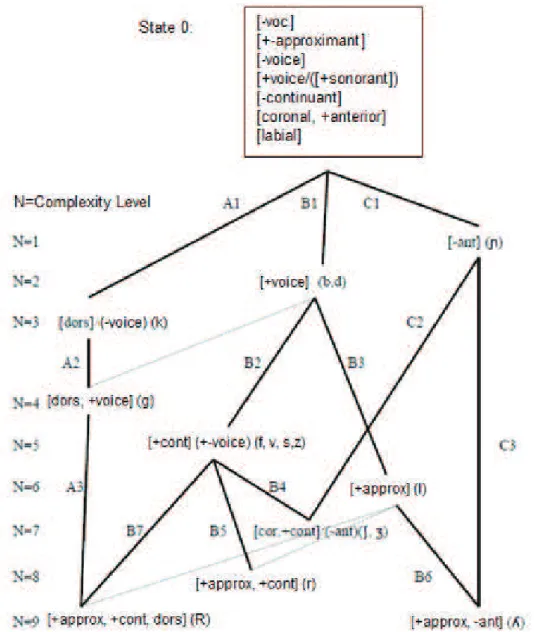
According to this model4, children come to the
phonological acquisition process with the basic geometric structure already ready, i.e. with a Root node, a Throat node, an Oral Cavity node and a Consonants´ points node. This basic structure lies in the Universal Grammar and contains only unmarked features. The child acquires the segmental system
of the language by increasing the complexity of this
basic structure, i.e. through the introduction of the marked features. The tree structure of the IMFC can be seen in Figure 1.
acquisition of Brazilian Portuguese (BP). In order to do this, the author analyzed the contrastive systems of 25 children with PD and determined the impli-cational relations of distinctive features marking through the theory of Calabrese5. After that, she
constructed an implicational model of segmental
complexity using the representational model of
Clements and Hume6. Thus, the Implicational Model
of Features Complexity (IMFC), which accounts for
the segmental acquisition of consonants, consists of a model of implicational relationships among the features that provides various possibilities for the phonological development.
and 7:6 respectively. The subjects S3, S4, S5 and S6 were females. S3 and S4 had PCC-R of 73.6% and 78.4% (MMD) and ages between 5:5 and 4:7, respectively. S5 and S6 had PCC-R of 87.6% and 87.5% (Mild disorder – MD) and ages between 6:6 and 6:5 respectively.
All children gave verbal consent for their participa-tion, and their parents signed the informed consent (IC) from a research project linked to the Federal University of Santa Maria – RS and approved by the Ethics and Research Committee under number 052/04.
Pre-treatment assessment
To establish the diagnosis of PD, we made the following assessments: interviews with parents or guardians, phonological assessment of the stomato-gnathic system, of the language, vocabulary, phono-logical awareness skills and auditory processing. In addition, the patients were referred for audiology and ENT assessment to rule out organic factors that would determine the changes in speech. Through the interview, we sought to dismiss cognitive or neurological disorders that could be causing the phonological alterations.
The speech data was collected by means of
the Phonological Assessment of Child Speech
(PACS)14, which is an instrument comprised of ive
thematic igures with balanced representation of all
phonemes in all possible positions in the syllable
and in the word, for the naming of the invoked igure.
The speech data were recorded and broadly phonetically transcribed, initially by the researcher, and later by two other judges. The transcribed words had to be equal for at least two of researchers, and if no agreement were found, the word was out of the sample. This measure is important, since the correct transcription is a vital tool for determining the necessary diagnosis and intervention15. Based
on these data, a contrastive analysis was performed to determine the phonetic and phonological inven-tories of children, using the criteria of Bernhardt16:
occurrence from 0 to 39% – phoneme missing or not acquired; occurrence from 40% to 79% – phoneme partially acquired; occurrence equal or higher than 80% – acquired phoneme.
The severity of PD was calculated from the
PCC-R13, which divides them into MD (PCC-R
between 86 and 100%), MMD (PCC-R between 66 and 85%), moderate-severe disorder (MSD) when PCC-R is between 51 and 65%, and severe devia-tion (SD) when the PCC-R is equal or less than 50%. Subsequently, we carried out the systems analysis of the subject’s features through the IMFC4. After the analysis was performed, we found that:
In order to promote the reorganization of the PS, models were created based on phonological therapy. In this paper, we will address the Cycles
Modiied Model7, since it has been widely used in
the literature8. Moreover, the model is easy to apply
and enables the therapists to select up to six target
phonemes for treatment, without the need for the words to be minimal pairs, which in this case would
dificult their choices, since the value of favoring is
controlled. It still considers the phonotactic environ-ment as fundaenviron-mental to correct production of the child. The basic principle of this therapeutic approach is the elimination of phonological processes in the child’s speech from the awareness of the charac-teristics of each phoneme in which each process operates7.
The choice of target-words for therapy has currently in Brazil received special attention from the studies that focus on the favorable environments
(contexts) for the production of certain phonemes. Such contexts have been researched and applied in
therapy for the liquid consonants of Brazilian
Portu-guese so that it might be veriied whether the deter -mination of target-words with their target-phonemes in favorable environments would bring major
bene-its to the correct production9-11.
We only found one study addressing the poten-tial environments for the production of the fricative in therapy12. One of its goals was to investigate the
effect of the value of favoring that the target-word of treatment caused by stress, number of syllables, word position, preceding and following phonological
context, involving the fricatives, have in a successful
therapeutic treatment. It concluded that although the favoring environments have a role as a facili-tator, they are not crucial for the production of the fricative phonemes12.
Thus, the purpose of this study was to analyze and compare the routes of phonological acquisition, via the IMFC based on the stimulation of fricatives /z/, /S/ and /Z/, as well as on the three pairs of chil-dren, being one of them a member of the treated pair with the target phonemes in favorable
phono-logical contexts and another with the neutral and
unfavorable environments.
CASES REPORT
Participants
The study included six children with PD, who were
matched according to the severity of the disorder,
sex, age and characteristics of PD towards the
altered phonemes. Subjects S1 and S2 both males presented Percentage of Consonants
Correct-Revised (PCC-R)13 of 73.1% and 78.3%
The sessions lasted 50 minutes and were held twice a week. If the patient missed a session, the
activities were put off to the next session. In the
beginning and at the end of each session a auditory bombardment was conducted, that is, the words containing the selected target-phonemes were read for the child.
To select the target-words, we calculated their phonological weight according to the assumptions of Blanco-Dutra12, which assign weights to the
absolute favoring values. The weights range from 0 to 3, considering the following variables: position of the phoneme in the word, tonicity, previous and
following context and number of syllables in the
word.
We should add the weight of each context,
which will indicate whether the word is very favor-able (weight 15), favorfavor-able (weight 14 to 10), neutral (weight 9), little favorable (weight 8-3) or unfavorable (smaller than or equal to 2). Half of the children were treated with words in which the target-phoneme was in a favorable environment whereas the other half was treated with words in which the same phoneme was in neutral or unfavorable environments. It is noteworthy that the chosen target-phonemes were the same for the members of each pair, being the
only difference between the children the context in
which they were inserted.
The very favorable and unfavorable environ-ments were disregarded, since there were no words, which could be scored too high (15) or too low (2 or less), respectively, as predicted by Blanco-Dutra12. Thus, S1, S3 and S5 were treated with
target-words in which the fricative phonemes were in favorable production environments. S2, S4 and S6 were treated with words in which the fricatives were in neutral or unfavorable environments.
Treatment outcomes assessment
Upon completion of two cycles, we used a new phonological assessment, which was based on the same criteria for the initial assessment, to determine the changes in PS, as well as the alterations in the
distinctive features of children after they inished the
phonological treatment.
RESULTS
After eight sessions of therapy, which used the fricatives as the target- phonemes, through the Phonological assessment of child speech (PACS),
we could ind out that all subjects required more
sessions to be discharged from therapy.
S1 remained with alterations in the feature [+ voice] for the majority of the plosives, even though it percentage of correct production had been
– S1 and S2 did not have the feature [+ voice]
speciied, as well as the features [coronal,-ante -rior] for the fricatives. We also realizes that these subjects did not take the A2 route, since they did not have / g / in their PS; B1, since they had not
speciied the feature [+ voice], represented in the
IMFC by the plosives /b/ and /d/; and B4/C2 due to the absence of coronal fricatives /S/ and /Z/. Since S2 had the phoneme / l / partially acquired, the B3 route was not taken by this subject.
– S3 showed alterations towards the feature
[-anterior] for the production of fricatives /S/ and /Z/, the lateral liquids were partly acquired and the rhoticswere not acquired. Thus, S3 had not taken the A3/B7, B3, B4/C2, B5, B6/C3 routes. S4 also had changes towards the feature [-anterior] in the production of fricatives /S/ and /Z/. There-fore, she did not take the B4/C2 routes and the side palatal liquid was partially acquired, which impaired the B6/C3 routes. Also, the phoneme / r / was absent in the system and the B5 route was not taken.
– S5 and S6 had not established the feature
[-anterior] for the fricatives /S/ and /Z/ yet, not having taken the B4/C2 routes. S5 had not taken the B5 route either, since the phoneme / r / was partially acquired. S6 had alterations on the B6/ C3 routes, for she had the phoneme /ʎ/ partially acquired.
Treatment
The treatment was performed via the Modiied
Cycles Model7, which was adapted for this research
so that the same target phonemes might be stim-ulated for the pairs of subjects. Only one or two phonological processes to be treated and two target phonemes were chosen. There were two rounds with each child, being one in a single-word level and the other in the sentence level. But if the children did not obtain the percentage of correct answers equal or higher than 50% for a particular target phoneme, the same procedure would be repeated in isolated-word level in the second cycle. Each phoneme-target was stimulated during two sessions per cycle, totalizing eight sessions for each patient at the end of data collection.
S1 and S2 were treated with the phonemes / z / and /S/ whereas S3, S4, S5 and S6 were treated with the phonemes /S/ and /Z/. We emphasize that the choice of target-phonemes for treatment was not based on the IMFC4, since the treated targets
should be the referred fricatives, and the therapeutic model is based on the occurrence of phonological
processes. Instead, we selected six target-words for
DISCUSSION
This study aimed to analyze and compare the phonological acquisition routes of two groups of chil-dren through the IMFC.Oneof groups used words with favorable phonological environments and the other used neutral and unfavorable environments, based on the treatment of the fricatives / z /, /S/ and /Z/.
From the objective, we could elaborate two
hypotheses mutually exclusive:
– Hypothesis 1: Subjects treated with the same
therapeutic model and target-phonemes would obtain the same results with phonological therapy;
– Hypothesis 2: Although the subjects had very
similar PS and have received the same treat-ment, they would get different results due to both the differences in the phonological environments in which the target-phonemes were inserted and the individual variabilities.
The second hypothesis seems to correspond the obtained results, since we could observe that although the pairs of children have been treated with the same therapeutic model and the same target-phonemes, they had differences towards their phonological acquisition routes. Moreover, the obtained generalizations varied among the subjects. This variation is shown in the literature, because although the construction of the PS occurs similarly to all children, individual variations in segmental and prosodic domains are observed between them2.
Our results showing that all subjects would need more therapy sessions to stabilize the PS may also be found in the literature, which says that the duration of two traditional cycles would be around 12 sessions; a higher number than we used in this study7. Hodson17, while planning therapy for a child
with severe PD, established around 16 sessions in just one cycle of therapy. In the Vocabulary Centered Approach, it is necessary an average of
six sessions to obtain considerable improvement in
the PS of children with inconsistent speech errors18.
However, a study with three subjects, using the
same approach showed the need for six sessions for
a boy, 13 for another and 19 for a girl19. This shows
that it is not possible to generalize the number of sessions required for determining the improvement in phonological patterns due to the characteristics and different responses each child gives to
treat-ment18. Some studies also show that outcomes
can be achieved quite well with only six sessions
of therapy where the minimal pairs are used, with gains not only in terms of articulatory precision, but also in generalization20.
increased. Although he maintained his dificulties with the syllabic structure of complex coda and
onset, he completely suppressed the alterations in the feature [-anterior]. S2 had the same results as
S1, except for not having dificulty with the syllabic
structure of coda, which was considered to be normal for him.
S3 kept having dificulties in the production of the liquids, in the syllabic structure of complex onset
and coda, in spite of having acquired the fricative /S/ and /Z/. S4 did not acquire the phoneme /r/ in
coda, simple and complex onset positions, as well as the phoneme /l/ in complex onset, suppressing
the alterations towards the fricatives.
Despite having increased her percentage of correct production and acquiring the phonemes /S/ and /Z/ and / r / (simple onset), S5 kept having difi
-culty producing complex onset and coda. Besides
keeping the partially acquired palatal liquid, S6 acquired the fricative phonemes and stabilized the
production of complex onset and coda.
The post-treatment analysis via the IMFC showed the following results:
– S1 and S2 set the feature [-anterior] in their
systems, for they acquired the phoneme /S/. Although the fricative /Z/ had some substitu-tions of the feature [+ voice], we observed that the B4/C2 routes were taken by both subjects. The A2 route was also taken, since there was an increase in the number of correct productions for the phoneme /g/ in both subjects. S1 took the B1 route, because the phoneme /d/ shifted its situa-tion from partially acquired to totally acquired in his PS. S2 did not specify the feature [+ voice], and therefore, did not take this route but the B3 route, since the phoneme /l/, which was partly acquired, shifted to the acquired position in his system.
– S3 set the feature [-anterior] to /S/ and /Z/ and took
the B4/C2 routes. Regarding the lateral liquids,
she showed no progress in her PS, except for
showing a slight development for the rhotics, whichproves that she began running the B5 and the A3/B7 routes. Similarly to what happened to S3, S4 established the feature [-anterior] and took the B4/C2 routes. Regarding the liquids, this subject took the B6/C3 routes, establishing the phoneme /ʎ/. But, the phoneme / r / remained not acquired, so the B5 route remained not taken.
– S5 and S6 set the feature [-anterior], running the
8 and 9, showing no phonemes levels 2, 4, 6, 7. After therapy, he took the B3 route, establishing the phoneme / l / whereas for the B4/C2 routes, he only set the feature [-anterior] (phoneme /S/). We also emphasize that the acquisition of the phoneme / l / probably occurred because it is in a lower level of
complexity than the treated target /S/, even though there is no implicational relationship between them4.
Based on this result, one can infer that the devoicing repair strategy causes a lot of impair-ment to the PS organization for children, since it may affect many phonemes in different classes and
different levels of complexity.
The comparison between the outcomes of the two subjects showed some differences. Whereas S1 set the feature [+ voice] by running the B1 route, S2 did not, what is especially surprising because this route is to be taken before the B2 route (which contains the treatment-target /z/) with a high impli-cational relationship4. This could be explained by
the fact that S2 also had to take the B3 route, which was in a previous level in comparison to the treated target /S/, as well as it could be treated with the neutral and unfavorable environments.
Through the pre-treatment assessment of S3, we could realize that her PS is the most organized among all the other subjects, since she produced
the phonemes in the irst ive levels correctly and only had dificulty with the last ones. After therapy,
she acquired the B4/C2 routes and showed discrete
improvement with the rhotic phonemes that are
located in the A3/B7 and B5 routes, which, despite having a high implicational relationship with the B4/ C24, were not taken.
S4 presented phonemes levels 1, 2, 3, 4, 5, 6 and 9, showing no phonemes levels 7 and 8. After therapy, she established the feature [-anterior] and took the B4/C2 routes. As for the liquids, she estab-lished the palatal, running the B6/C3 routes, what
was not expected since they were at level 94.
We analyzed the differences between the ther-apeutic improvement of S3 and S4 and found out that, although S3 had some progress with the rhotic phonemes, she took no other route rather than the one that was presented in the therapy. On the other hand, S4 was able to take the same route as S3 did and stabilized the phoneme /ʎ/ in her PS. This
case is an example of a non-expected generaliza -tion, because the phoneme is at higher level of
complexity4. Furthermore, the child was treated with
the phonemes /S/ and /Z/ in neutral and unfavorable environments.
Prior to therapy, S5 had taken the C1 (level 1), B1 (level 2), A1 (level 3), A2 (level 4), B2 (level 5), B3 (level 6), and B6/C3 and A3/B7 (level 9) routes, without having stabilized the phonemes from We observed that S1 and S2 showed quite
consistent changes in the feature [+ voice], although it is acquired at an early age in Portuguese, since it
is in the complexity level 2 of the IMFC4. As an effect
of therapy, both subjects increased the percentage of correct productions of sound consonants, but they still remained far from the typical pattern of language, which may be due to the fact that the
devoicing represents a dificulty in coordinating the
glottic and supraglottic events. This demonstrates impairment in temporal-spatial organization of the articulatory organs movements, from what we
may assume a greater dificulty in suppressing this
process towards the others21-23.
Data from S3 and S4 match the literature, since
the class of fricatives is less complex than the liquids, except for the phoneme / l / that has a lower complexity level than the fricatives /S/ and /Z/4, and
was partly acquired by S3 and S4. Thus, consid-ering only the treated phonemes /S/ and /Z/, we could
not expect the liquid phonemes to be acquired, even
though most of the children have shown a slight increase in the percentage of correct production of these segments24.
In addition to the treated phonemes, S5 surpris-ingly acquired the liquid /r/, which is in a more
complex level than /S/ and /Z/4. S6 kept the lateral
palatal liquid partially acquired, which was already
explained in the previous paragraph4,24.
All subjects except S5, kept having dificulties in the production of complex onset, what, according to the implicational laws, is the most complex
or marked syllabic structure. According to same assumption there could be no production of certain
phoneme in complex onset if it were not produced
correctly in simple onset24.
As for the analyses of S1 via IMFC4, we can say
that the irst assessment showed that he had not
taken the A2, B1 and B4/C2 routes. Although the feature [-anterior] was also impaired, making the acquisition of the phonemes /S/ and /Z/ harder, the main speech problem he had was not the establish-ment of voicing contrasts, since the three routes that were not taken presented phonemes with the feature [+ voice]. Also, his PS was really disorga-nized and presented phonemes from levels 1, 3, 5, 6, 8 and 9, but it had no phonemes levels 2, 4 and 7. After treatment, this subject took the B4/C2 routes (level 7), because he manage to establish the feature [-anterior], and the B1 route (level 2), acquiring only the phoneme /d/, which is similar to the results of another study25 that used the
differences between the therapeutic outcome of treated patients with more words in which the
fricative phonemes were in favorable contexts
as opposed to neutral or unfavorable ones12. By
comparing this study to others, which dealt with the class of the liquids, we realized that two studies9,10
considered the favorable environments as relevant to the acquisition of the phoneme / r /. Both of them regarded the general aspects of the PS and the generalization obtained. Another study, comparing the generative and gestural approaches through the
use of the favorable contexts, concluded that the
favorable linguistic environment does not apply to children with PD11.
We assume that the results of therapy would be even more positive in terms of occurrence of a greater number of generalizations, if the treated
targets were at levels of greater complexity, except
for S1 and S2, who were treated with the most
complex non-acquired phonemes in their PS.
Furthermore, a therapeutic approach that took into
account the complexity of the features rather than
the occurrence of phonological processes could also
present more outcomes, since it is expected that by treating more complex targets, the child manage to acquire the less complex target-phonemes without
direct intervention24.
CONCLUSION
Through the analysis of the phonological
acqui-sition routes of six patients via IMFC, we observed that in general the therapeutic outcome was similar for all the subjects, since most of them (S1, S2, S3, S6) took only the handled routes, as well as those
that are at a lower level of complexity. Nonetheless,
subjects 4 and 5 acquired phonemes that could not be predicted by the IMFC, for being at higher levels
of complexity.
We found a slight advantage in the therapeutic outcome of S1 and S5, who were treated with favor-able environments, when compared to their pairs, S2 and S6 respectively. However, S4, who was
treated with neutral and unfavorable contexts, had
better results than her pair, S3.
Therefore, based on Blanco-Dutra12, we can
conclude that the favorable environments for the production of fricatives / z /, /S/ and /Z/ play an impor-tant but not decisive role to deviant phonological acquisition.
levels 7 (B4/C2 routes) and 8 (B5 route). This child demonstrated more satisfactory therapeutic outcomes than the others, due to being able to take all the routes in the IMFC at the end of two cycles of therapy,eventhough the B5 route was at greater
level of complexity than the treated one. It is note -worthy that this patient was treated with favorable
contexts for the /S/ and /Z/ production.
S6 had a very similar PS to S5 in the begin-ning of therapy, since she had taken the C1 (level 1), B1 (level 2), A1 (level 3), A2 (level 4), B2 (level 5), B3 (level 6), B5 (level 8) and A3/B7 (level 9) routes, without having stabilized the phonemes from levels 7 (B4/C2 routes) and 9 (B6/C3 routes). After therapy, despite having taking the treated route, she showed no increase in the production of /ʎ/, besides not having taken the B6/ C3 routes, what was not a complete surprise due to
their higher level of complexity4. In the assessment
performed prior to the treatment, patients S1, S2,
S4, S5 and S6 had less complex segments when compared to the more complex ones.
When we compare the pre-treatment PS of S3 to the others, we can realize the differences between disorders and delays in phonological acquisition.
Thus, we could afirm that the characteristics of
delay are: the presence of suppressed processes in typical phonological acquisition between four and
ive years old, i.e. inal frame of the liquid acquisi -tion of /r/, omission of consonants in coda (/s/ and /r/), cluster reduction, and fronting of palatal frica-tives. The disorder is characterized by the presence of several processes, including many sound classes and the ones with idiosyncrasies. Patients with PD may still display changes involving root segmental features26. According to the classiication proposed
by Keske-Soares27, S3 would be considered to have
“phonological disorders with delayed features.” In
such cases, the children exhibit characteristics of
a PS with “simple delay” towards the acquisition
stage, i.e., they have alterations in the inal stage
of typical phonological acquisition. The changes usually comprise the palatal fricatives and liquids,
and notions of syllable structure (complex onset and
coda).
We could also observe in this study that the six
subjects managed to establish the feature [-ante-rior] in their PS, which was the only changed feature common to all children. Besides, we found out that the therapeutic outcome was similar to all subjects.
REFERENCES
1. Grunwell P. Os desvios fonológicos evolutivos numa perspectiva linguística. In: Yavas M. (Org.). Desvios fonológicos em crianças: teoria, pesquisa e tratamento. Porto Alegre: Mercado Aberto, 1990. p. 51-82.
2. Lamprecht RR. Aquisição fonológica do
português: peril de desenvolvimento e subsídios
para terapia. Porto Alegre, RS: Artmed, 2004. 3. Ribas LP. Aquisição das líquidas por crianças com desvio fonológico: Aquisição silábica ou segmental?. Revista de Letras (PPGL / UFSM). 2008; 36: 129-49.
4. Mota HB. Aquisição segmental do português: um
modelo implicacional de complexidade de traços
[Tese]. Porto Alegre (RS): Pontifícia Universidade Católica do Rio Grande do Sul; 1996.
5. Calabrese A. A constraint-based theory of
phonological markedness and simpliication
procedures. Ling Inq. 1995; 26(3): 373-463.
6. Clements GN, Hume E. The Internal Organization
of Speech Sounds. Oxford: Blackwell, 1995.
7. Tyler A, Edwards ML, Saxman J. Clinical
application of two phonologically based treatment procedures. J Speech Hear Disord. 1987; 52: 393-409.
8. Kamhi AG. Treatment Decisions for Children with Speech-Sound Disorders. Lang Speech Hear Serv Sch. 2006; 37: 271–9.
9. Keske-Soares M, Mota HB, Pagliarin KC, Ceron MI. Estudo sobre os ambientes favoráveis à produção da líquida não-lateral /r/ no tratamento do desvio fonológico. Rev Soc Bras Fonoaudiol. 2007; 12(1): 48-54.
10. Keske-Soares M, Pagliarin KC, Ceron MI. Terapia fonológica considerando as variáveis linguísticas. Rev Soc Bras Fonoaudiol. 2009;14(2):261-6.
11. Gonçalves GF, Keske-Soares M, Checalin
MA. Estudo do papel do contexto linguístico no
tratamento do desvio fonológico. Rev Soc Bras Fonoaudiol. 2010; 15(1): 96-102.
12. Blanco-Dutra, AP. A aquisição das fricativas /f/, /v/, /S/ e /Z/ por crianças com desvio fonológico [Tese]. Porto Alegre (RS): Pontifícia Universidade Católica do Rio Grande do Sul; 2009.
13. Shriberg L, Austin D, Lewis B, McSweeny J, Wilson D. The percentage of consonants correct
(PCC) metric: extensions and reliability data. J
Speech Lang Hear Res. 1997; 40: 708-22.
14. Yavas M, Hernandorena CLM, Lamprecht RR. Avaliação fonológica da criança: reeducação e terapia. Porto Alegre: Artes Médicas; 1991.
15. Ball MJ. Transcribing disordered speech: By target or by production. Clin Linguist Phon. 2008; 22(10–11): 864–70.
16. Bernhardt B. Developmental implications of nonlinear phonological theory. Clin Linguist Phon. 1992; 6(4): 259-81.
17. Hodson BW. Identifying phonological patterns
and projecting remediation cycles: Expediting RESUMO
Tema: percursos de aquisição fonológica de crianças tratadas com ambientes favoráveis em oposi-ção aos ambientes pouco favoráveis e neutros para a produoposi-ção de /z/, /S/ e /Z/ na terapia fonológica.
Procedimentos: foram selecionadas seis crianças com desvio fonológico e idades entre 4:7 e 7:8 para participarem do estudo. As mesmas estavam devidamente autorizadas por seus responsáveis. Foram realizadas avaliações fonoaudiológicas e complementares para diagnóstico do desvio
fono-lógico. Os sujeitos foram pareados de acordo com a gravidade do desvio fonológico, sexo, faixa
etária e aspectos do sistema fonológico em relação aos fonemas alterados. Metade das crianças foi tratada com palavras em que os fonemas /z/, /S/ e /Z/ encontravam-se em ambientes favoráveis e a outra metade com ambientes pouco favoráveis e neutros. Foram realizadas oito sessões e, após estas, novas avaliações foram realizadas para descrever e comparar qualitativamente os percursos
de aquisição fonológica dos sujeitos por meio do Modelo Implicacional de Complexidade de Traços.
Resultados: os resultados indicaram discreta vantagem na evolução terapêutica de dois sujeitos tra-tados com ambientes favoráveis, em relação a seus pares. Porém, uma criança tratada com ambien-tes pouco-favoráveis e neutros, obteve resultados mais positivos do que seu par. Conclusão: os ambientes favoráveis à produção das fricativas /z/, /S/ e /Z/ não determinaram o sucesso terapêutico,
porém inluenciaram positivamente a evolução fonológica dos sujeitos do estudo.
23. Lowenstein JH, Nittrouer S. Patterns of acquisition of native voice onset time in English-learning children. J Acoust Soc Am. 2008; 124(2):1180-91.
24. Morrisette ML, Farris AW, Gierut JA. Applications of learnability theory to clinical phonology. Adv Speech Lang Path. 2006; 8(3): 207-19.
25. Barberena LS, Keske-Soares M, Mota HB. Generalização baseada nas relações implicacionais obtida pelo modelo “ABAB-Retirada e Provas Múltiplas”. Rev Soc Bras Fonoaudiol. 2008; 13(2): 143-53.
26. Ramos APF, Carreirao, L; Pergher, GL, Collares, LM; Marques, J. Distúrbios fonológicos:
peril fonológico e inteligibilidade de fala. Cad Pesq
Ling. 2005;1(1): 67-78.
27. Keske-Soares M. Terapia fonoaudiológica fundamentada na hierarquia implicacional dos traços distintivos aplicada em crianças com desvios fonológicos [Tese]. Porto Alegre (RS): Pontifícia Universidade Católica do Rio Grande do Sul; 2001. intelligibility gains of a 7 year old Australian child.
Adv Speech Lang Path. 2006; 8(3): 257-64.
18. Crosbie, S., Holm, A. and Dodd, B.: Intervention for children with severe speech disorder: A comparison of two approaches. Int J Lang Commun Disord. 2005; 40(4): 467–91.
19. McIntosh B, Dodd B. Evaluation of Core Vocabulary intervention for treatment of inconsistent phonological disorder: Three treatment case studies. Child Lang Teach Ther. 2008; 25 (1): 9–30.
20. Dodd B, Crosbie S, McIntosh B, Holm A, Harvey C, Liddy M et al. The impact of selecting different contrasts in phonological therapy. Int J Speech Lang Path. 2008; 10(5): 334- 45.
21. Pincas J, Jackson PJ. Amplitude modulation of turbulence noise by voicing in fricatives. J Acoust Soc Am. 2006; 120(6):3966-77.
22. Zeroual C, Esling JH, Crevier-Buchman L. The contribution of supraglottic laryngeal adjustments to voice: phonetic evidence from Arabic. Logoped Phoniatr Vocol. 2008; 33(1): 3-11.
http://dx.doi.org/10.1590/S1516-18462011005000111
Received on: March 29, 2011 Accepted on: April 30, 2011
Mailing Address:
Fernanda Maraiga Wiethan
Rua Júlio Nogueira, 130 – Uglione Santa Maria – RS – Brasil
CEP: 97070-510