CPD
10, 3027–3051, 2014A new approach for modeling the Cenozoic oceanic
lithium isotope paleo-variations
N. Vigier and Y. Godderis
Title Page
Abstract Introduction
Conclusions References
Tables Figures
◭ ◮
◭ ◮
Back Close
Full Screen / Esc
Printer-friendly Version
Interactive Discussion
Discussion
P
a
per
|
Discus
sion
P
a
per
|
Discussion
P
a
per
|
Discussion
P
a
per
|
Clim. Past Discuss., 10, 3027–3051, 2014 www.clim-past-discuss.net/10/3027/2014/ doi:10.5194/cpd-10-3027-2014
© Author(s) 2014. CC Attribution 3.0 License.
This discussion paper is/has been under review for the journal Climate of the Past (CP). Please refer to the corresponding final paper in CP if available.
A new approach for modeling the
Cenozoic oceanic lithium isotope
paleo-variations: the key role of climate
N. Vigier1and Y. Godderis2
1
Laboratoire d’Océanographie de Villefranche-sur-Mer, CNRS, UPMC, 06230 Villefranche-sur-Mer, France
2
Géosciences Environnement Toulouse, CNRS, Université Paul Sabatier, 31400 Toulouse, France
Received: 9 June 2014 – Accepted: 16 July 2014 – Published: 28 July 2014 Correspondence to: N. Vigier ([email protected])
CPD
10, 3027–3051, 2014A new approach for modeling the Cenozoic oceanic
lithium isotope paleo-variations
N. Vigier and Y. Godderis
Title Page
Abstract Introduction
Conclusions References
Tables Figures
◭ ◮
◭ ◮
Back Close
Full Screen / Esc
Printer-friendly Version
Interactive Discussion
Discussion
P
a
per
|
Discus
sion
P
a
per
|
Discussion
P
a
per
|
Discussion
P
a
per
|
Abstract
The marine record of the ocean lithium isotope composition may provide important information constraining the factors that control continental weathering and how they have varied in the past. However, the equations establishing the links between the continental flux of Li to the ocean, its Li isotope composition and the ocean Li isotope
5
composition are under-constrained, and their resolution are related to significant un-certainties. In order to partially reduce this uncertainty, we propose a new approach that couples the C and Li cycles, such that our proposed reconstruction of the Ceno-zoic Li cycle is compatible with the required stability of the exospheric carbon cycle on geological timescales. The results of this exercise show, contrary to expectations,
10
that the Li isotope composition of rivers exerts only a minor influence on theδ7Li of the ocean. In contrast, variations in the continental flux of Li to the ocean are demonstrated to play a major role in setting the oceanδ7Li. We also provide evidence that Li storage in soils is an important element of the global Li cycle that cannot be neglected dur-ing the Cenozoic. Our modeldur-ing of the published foraminifera record highlight a close
15
link between soil formation rate and indexes recording the climate evolution during the Cenozoic, such as foraminiferaδ18O and pCO2 reconstructions. This leads us to propose that climate exerted a dominant control on soil production and therefore on continental weathering during the last 70 Ma.
1 Introduction 20
Weathering (chemical erosion) of continental Ca-Mg rich silicates serves as a major sink of atmospheric CO2. However, determining how such weathering has evolved in the past, as a function of climate or tectonic activity, remains a challenge. Filling this gap in our knowledge is essential if we are to understand how global temperature is regu-lated on geological timescales. The great potential of lithium isotopes to trace alteration
25
CPD
10, 3027–3051, 2014A new approach for modeling the Cenozoic oceanic
lithium isotope paleo-variations
N. Vigier and Y. Godderis
Title Page
Abstract Introduction
Conclusions References
Tables Figures
◭ ◮
◭ ◮
Back Close
Full Screen / Esc
Printer-friendly Version
Interactive Discussion
Discussion
P
a
per
|
Discus
sion
P
a
per
|
Discussion
P
a
per
|
Discussion
P
a
per
|
Nevertheless, analytical difficulties have limited their use as a marine paleoproxy. Misra and Froelich (2012) determined the evolution of the lithium isotopic composition of bulk carbonates and planktonic foraminifera over the past 68 Ma. These authors argue that this record reflects ocean-wide variations, and that the 9 ‰ increase of the marineδ7Li from the Paleocene to the present (see Fig. 1), can be explained by an increase of river
5
δ7Li from 3 ‰ 60 Ma ago, to 23 ‰ at present. To account for such a dramatic change in riverineδ7Li Misra and Froelich (2012) invoke a change of the alteration regime (from a congruent to a weathering-limited regime) and an increase of clay formation (which fractionates Li isotopes) in mountainous – rapidly eroding – areas. This assertion links the secular increase in the marineδ7Li record to increasing tectonic uplift and mountain
10
building over the course of the Cenozoic. Under this interpretive framework, continen-tal weathering during the early Paleogene (≈60 Myr ago) was characterized principally
by high dissolution rates of continental rocks and relatively low rates of clay formation and transport. Such a weathering regime offers a mechanism for producing lowδ7Li values in rivers, close to that of the continental crust, because dissolution is not
accom-15
panied by significant Li isotope fractionation. Later in the Cenozoic, as tectonic activity intensifies, incongruent weathering and clay formation is supposed to become more significant, leading to a shift to larger riverineδ7Li.
However, several lines of evidence call this interpretation of the seawater record into question, and in particular the notion that lowδ7Li values in rivers of the Cretaceous
20
could be sustained by predominately congruent weathering. Indeed, a congruency of the weathering process, that would correspond to small rates of clay formation or soil production, at 60 Ma is not supported by the occurrence of thick weathering profiles found at this period of time (e.g. Beauvais and Chardon, 2013; Tavlan et al., 2011; Meshram and Randiv, 2011). A compilation of about 80 ODP or DSDP core sites
in-25
CPD
10, 3027–3051, 2014A new approach for modeling the Cenozoic oceanic
lithium isotope paleo-variations
N. Vigier and Y. Godderis
Title Page
Abstract Introduction
Conclusions References
Tables Figures
◭ ◮
◭ ◮
Back Close
Full Screen / Esc
Printer-friendly Version
Interactive Discussion
Discussion
P
a
per
|
Discus
sion
P
a
per
|
Discussion
P
a
per
|
Discussion
P
a
per
|
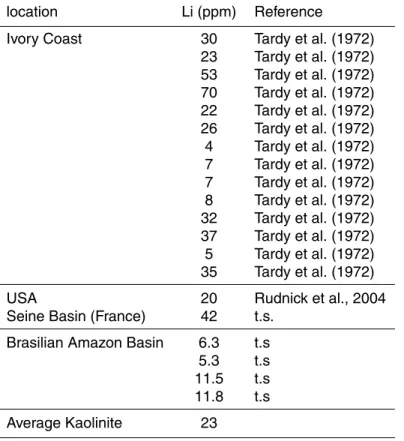
and 1000 ppmv (Beerling and Royer, 2011). These conditions have favored the forma-tion of thick weathering profiles, in particular of lateritic regolith mantles rich in kaolinite and/or bauxite. These resistant phases are depleted in major cations playing a key role in the carbon cycle (such as Ca and Mg), but they contain significant amounts of Li. Our compilation of Li levels in kaolinite-rich samples (Table 1) shows that they
5
are – on average – similar to the Li content estimated for the continental crust gran-ites (22 ppm±4 ppm, Teng et al., 2009). They may therefore have played a key role in
the continental Li cycle. Li-containing regoliths provide empirical evidence against the idea that congruent weathering prevails during warm intervals of Earth history driving riverineδ7Li to values similar to average upper crust.
10
In this study, we propose a new modeling approach of the seawater record, that consists in coupling a simple mathematical description of the carbon and the lithium exospheric budget, throughout the Cenozoic. The objective is not to produce an ex-haustive study of the impact of each parameter implied in the Li and the C cycle, but rather to show that for a given set of parameters consistent with published estimations,
15
there is an alternative solution that can explain the Cenozoicδ7Li oceanic variations. Our model takes into account the changes in Li flux coming from the continents in response to a balance between (1) dissolution rates of continental rocks releasing Li in waters and (2) temporary storage of Li into secondary phases formed in weathering profiles. Since lithium isotopes fractionate during clay mineral accumulation (e.g. Huh
20
et al., 2001; Kisakurek et al., 2004; Rudnick et al., 2004), soil formation rate is expected to drive the Li isotope composition of rivers. One illustration is that, at present, the mean δ7Li value of the continental runoff(+23 ‰; Huh et al., 1998) is much higher than the averageδ7Li value estimated for the continental crust granites (+2±4 ‰, Teng et al.,
2009). Since Li isotopes do not fractionate during dissolution, this difference is best
ex-25
in-CPD
10, 3027–3051, 2014A new approach for modeling the Cenozoic oceanic
lithium isotope paleo-variations
N. Vigier and Y. Godderis
Title Page
Abstract Introduction
Conclusions References
Tables Figures
◭ ◮
◭ ◮
Back Close
Full Screen / Esc
Printer-friendly Version
Interactive Discussion
Discussion
P
a
per
|
Discus
sion
P
a
per
|
Discussion
P
a
per
|
Discussion
P
a
per
|
vestigations, as well as soil studies support these findings (e.g. Wimpenny et al., 2010; Vigier et al., 2008; Lemarchand et al., 2010). Thus, we explore how Li storage in soils at the global scale has affected the oceanδ7Li value, as well as the potential of ocean δ7Li to quantify the balance between physical denudation and chemical alteration and its variation throughout the Cenozoic.
5
2 Model equations and basics
2.1 Seawater isotopic balance
The two main sources of dissolved lithium to the ocean (oc) are river waters (riv) and high temperature hydrothermal fluids (hyd) (see Huh et al., 1998 and a detailed review in Tomascak, 2004 and in the Supplement of Misra and Froelich, 2012). The main sink
10
of oceanic lithium is its incorporation into authigenic phases, in particular marine clays which are the marine phases the most enriched in Li (Chan et al., 2006). The seawater isotopic mass balance can thus be written as :
MocLi ×dδoc/dt=Friv(δriv−δoc)+Fhyd(δhyd−δoc)−Fclay(δoc−∆oc−δoc) (1)
15
whereF is for the Li flux, andδriv,δocandδhyd are for theδ 7
Li values of rivers, ocean and hydrothermal fluids respectively.∆ocrepresents the absolute value of the fraction-ation factor of the Li isotopes during marine secondary phase formfraction-ation. In literature, this factor ranges between −10 and −25 ‰ depending on the temperature at which
authigenic phases are being formed (Chan et al., 1992, 1993; Vigier et al., 2008).
20
authi-CPD
10, 3027–3051, 2014A new approach for modeling the Cenozoic oceanic
lithium isotope paleo-variations
N. Vigier and Y. Godderis
Title Page
Abstract Introduction
Conclusions References
Tables Figures
◭ ◮
◭ ◮
Back Close
Full Screen / Esc
Printer-friendly Version
Interactive Discussion
Discussion
P
a
per
|
Discus
sion
P
a
per
|
Discussion
P
a
per
|
Discussion
P
a
per
|
genic clay formation:Friv+Fhyd=Fclay) and isotopic Li cycles. Equation (1) becomes:
Friv(δriv−δoc)+Fhyd(δhyd−δoc)+Friv×∆oc+Fhyd×∆oc=0 (2)
Consequently, we can solve the above equations forδoc:
δoc=(Frivδriv+Fhydδhyd+ ∆oc×(Friv+Fhyd))/(Friv+Fhyd) (3)
5
where present day published values forFriv,Fhyd and∆oc are reported in Table 2. We consider that the hydrothermal flux during the Cenozoic decreased slightly as a func-tion of time, following the curve described in Engebretson et al. (1992), based on vari-ations of subduction rates and mid-ocean ridge volume. This trend is currently used in
10
numerical modeling of the global carbon cycle and appears to be consistent with the Cenozoic climatic evolution (Berner, 2004; Lefebvre et al., 2013).
Basically, Eq. (3) has two unknowns:FrivLi andδriv. In previous studies (Hathorne and James, 2006; Misra and Froelich, 2012), riverδ7Li has been interpreted as co-varying in a straightforward way with the ocean δ7Li. However, one equation is not enough
15
for two independent unknowns. In contrast to the a priori expectation, the variation of the oceanδ7Li composition during the Cenozoic may not reflect riverineδ7Li varia-tions in a straightforward way. The reason for this is that it strongly depends on the continental Li flux too, which is likely to have been strongly affected by variation in continental weathering rates during this period of time. One purely theoretical example
20
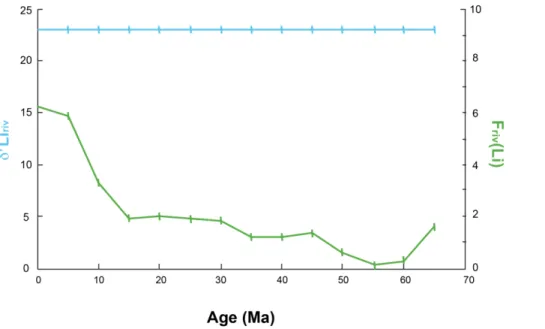
of the influence of the Li continental flux is illustrated in Fig. 2. This simulation shows that the 0–65 Ma foraminiferaδ7Li record (shown in Fig. 1) can still be fitted by impos-ing a constant riverδ7Li throughout the Cenozoic, and using parameters values which are consistent with published data (Table 2). We fixed the δriv (δ
7
Li in rivers) to its present-day value (23 ‰). This is an extreme and unlikely scenario because it does not
25
CPD
10, 3027–3051, 2014A new approach for modeling the Cenozoic oceanic
lithium isotope paleo-variations
N. Vigier and Y. Godderis
Title Page
Abstract Introduction
Conclusions References
Tables Figures
◭ ◮
◭ ◮
Back Close
Full Screen / Esc
Printer-friendly Version
Interactive Discussion
Discussion
P
a
per
|
Discus
sion
P
a
per
|
Discussion
P
a
per
|
Discussion
P
a
per
|
shows that, by taking into account the Li ocean budget only, the system of equations is under-constrained and it is not possible to calculate the temporal variations of riverine δ7Li without making assumptions about the link between FrivLi and δriv. It also shows that low seawaterδ7Li, as highlighted by early Eocene foraminifera can be compatible with a highδ7Li value of the riverine flux. Our result shows therefore that low δ7Li in
5
the ocean does not systematically imply low riverδ7Li. The temporal variations of the riverine Li flux also need to be established. In the following, we add constraints on this aspect and the Li cycle, by coupling it to the carbon cycle.
2.2 Walker paleothermostat
The Walker paleothermostat (Walker et al., 1981) implies that, at the multi-million year
10
scale, the consumption of carbon by silicate weathering (FCO2
riv ) closely balances the release by volcanic degassing (assumed to be proportional at first order to the seafloor spreading rate, and hence to the hydrothermal activity) (FCO2
hyd ), a condition absolutely needed to avoid unrealistic atmospheric CO2 fluctuations (Godderis and François, 1995; Kump and Arthur, 1997):
15
FCO2
hyd =F CO2
riv (4)
During high temperature water-rock interactions, Li is known to be highly mobile, as reflected by the large Li concentrations found in hydrothermal fluids located in mid-ocean ridges (ppm level, Chan et al., 1994; Foustoukos et al., 2004; Mottl et al., 2011),
20
and which are∼3 orders of magnitudes greater than in river waters or seawater.
Con-sequently, we consider that the amounts of Li released by hydrothermal process is proportional to the carbon flux released into the ocean:
FCO2
hyd =k2F Li
hyd (5)
25
CPD
10, 3027–3051, 2014A new approach for modeling the Cenozoic oceanic
lithium isotope paleo-variations
N. Vigier and Y. Godderis
Title Page
Abstract Introduction
Conclusions References
Tables Figures
◭ ◮
◭ ◮
Back Close
Full Screen / Esc
Printer-friendly Version
Interactive Discussion
Discussion
P
a
per
|
Discus
sion
P
a
per
|
Discussion
P
a
per
|
Discussion
P
a
per
|
In contrast with hydrothermal conditions, Li is much less “mobile” on the continents, as reflected by low Li contents in river waters (ppb level) while granites (the main source of river Li) are enriched in Li compared to oceanic crust. Indeed, first, thermodynamic laws indicate that dissolution rate is lower at lower temperature. Additionally, it is ob-served that most of the Li carried by rivers to the ocean is mainly located in the
particu-5
late load (>70 %, e.g. Millot et al., 2010), while the dissolved Li represents only a minor proportion. This is consistent with the fact that Li can be significantly incorporated into the structure of secondary minerals, mainly clays. As a consequence, the flux of dis-solved Li carried by rivers may not be proportional to the flux of CO2consumed during the leaching or dissolution of continental mineral phases. The relationship linking the
10
flux of lithium carried by rivers and the flux of atmospheric CO2consumed by mineral dissolution becomes:
FCO2
riv =1/k1×FdissLi =(F Li riv+F
Li
sp)/k1 (6)
FrivLi and FspLi being the flux of lithium in river waters and in secondary phases or soils
15
respectively, andFdissLi the flux of Li released into continental waters during the disso-lution of continental rocks (FrivLi=FdissLi −FspLi).k1is calculated assuming that dissolution of continental rocks release Li, Mg and Ca congruently. Also, we consider that 1 mol of atmospheric CO2 is consumed by the dissolution of 1 mol of Mg+Ca present in continental rocks (accouting for the subsequent carbonate precipitation in the ocean)
20
(Berner, 2004). Consequently,k1=LiUCC/(Ca+Mg)UCC (UCC being the Upper Conti-nental Crust, Table 2).
If present-day conditions might reflect a recent disequilibrium due to the last glacia-tion (Vance et al., 2009), at the Cenozoic timescale, formaglacia-tion of thick weathering pro-files with significant residence time (>0.5 Ma) are likely to have impacted the Li cycle.
25
CPD
10, 3027–3051, 2014A new approach for modeling the Cenozoic oceanic
lithium isotope paleo-variations
N. Vigier and Y. Godderis
Title Page
Abstract Introduction
Conclusions References
Tables Figures
◭ ◮
◭ ◮
Back Close
Full Screen / Esc
Printer-friendly Version
Interactive Discussion
Discussion
P
a
per
|
Discus
sion
P
a
per
|
Discussion
P
a
per
|
Discussion
P
a
per
|
Combining Eqs. (4)–(6) we obtain the following relationship:
FrivLi=k1×k2FhydLi −FspLi (7)
where the flux of riverine Li is a function of both the hydrothermal flux and of the soil formation rate on the continents.
5
2.3 Riverineδ7Li
All published studies indicate the existence of a strong isotope fractionation during the formation of secondary phases, such as clays or Fe oxides, always in favor of the light isotope (6Li). At periods when the soil production and thickness increased in the past, we therefore expect that theδ7Li of river waters increase, since more6Li is incorporated
10
and stored into soils. In fact, the riverine δ7Li is the result of the competition (e.g. Bouchez et al., 2013) between the isotopically congruent dissolution of fresh bedrock, and the precipitation of secondary phases with an isotope fractionation∆land(Table 2), such that:
FrivLiδriv=δUCC×FdissLi −FsoilLi ×(δriv−∆land) (8)
15
withδUCC being the average δ 7
Li value estimated for the upper continental crust (Ta-ble 2).
Given thatFdissLi =FrivLi+FspLi, Eq. (8) becomes:
δriv=δUCC+(FspLi∆land)/(FrivLi+FspLi) (9)
20
This equation states that, ifFspLi=0, thenδrivequalsδUCC. Otherwise,δrivis higher than δUCC. To date the published values ofδ
7
Li of most rivers (e.g. Huh et al., 1998; Millot et al., 2010; Kisakurek et al., 2004) are significantly greater than theδ7Li estimated for UCC (2 ‰, Teng et al., 2009), and thus are consistent with Eq. (9).
CPD
10, 3027–3051, 2014A new approach for modeling the Cenozoic oceanic
lithium isotope paleo-variations
N. Vigier and Y. Godderis
Title Page
Abstract Introduction
Conclusions References
Tables Figures
◭ ◮
◭ ◮
Back Close
Full Screen / Esc
Printer-friendly Version
Interactive Discussion
Discussion
P
a
per
|
Discus
sion
P
a
per
|
Discussion
P
a
per
|
Discussion
P
a
per
|
2.4 Method for solving the model
We assume that the foraminiferaδ7Li reflect the oceanδ7Li, as assumed in Misra and Froelich (2012) and in Hathorne and James (2006). We consider that potential vital effects, responsible for changes of Li isotope fractionation during foraminifera growth may explain some observed rapid (<0.5 Ma) changes of foraminifera Li isotope
compo-5
sitions, but we do not take into account these effects since the model aims at working at the multi million scale only. A moving average of the oceanic lithium isotopic data is calculated, with a window width of 5 millions of years (see Fig. 1). This data smoothing ensure the validity of the steady-state hypothesis and remove all short term fluctuations potentially related to vital effects.
10
The equations describing the seawater isotopic budget (Eq. 3), the paleothermostat (Eq. 7), and the riverine isotopic budget (Eq. 9) define a system of equations where the unknowns are the riverine Li flux as a function of time (FrivLi), the storage flux of Li in soils (FspLi), and the riverineδ
7
Li (δriv). It can be reduced to the following quadratic equation :
15
A1FrivLi 2+(δoc−∆oc−δUCC−∆land)FrivLi−A2=0. (10)
whereA1andA2are equal to :
A1= ∆land/(k1k2FHydLi ) (11)
A2=FHydLi (δhyd−δoc+ ∆oc) (12)
20
The values for the various parameters used in the model are described in Table 2. As long as the discriminant of Eq. (10) is strictly positive, Eq. (10) has two solutions for FrivLi. This means that two radically different histories ofFrivLi can explain the rise of the Li isotopic composition of seawater.
CPD
10, 3027–3051, 2014A new approach for modeling the Cenozoic oceanic
lithium isotope paleo-variations
N. Vigier and Y. Godderis
Title Page
Abstract Introduction
Conclusions References
Tables Figures
◭ ◮
◭ ◮
Back Close
Full Screen / Esc
Printer-friendly Version
Interactive Discussion
Discussion
P
a
per
|
Discus
sion
P
a
per
|
Discussion
P
a
per
|
Discussion
P
a
per
|
3 Results and discussion
3.1 Paleo-variations of continental weathering
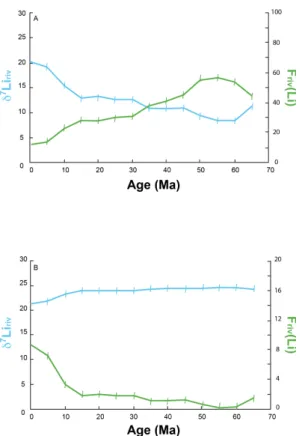
Two solutions have thus been found for the Cenozoic (represented in Fig. 3a and b). The first solution (Fig. 3a) implies an increase of the riverineδ7Li over the Cenozoic, associated to a decrease of riverine Li flux with time. We consider this scenario as
5
the less robust of the two possible solutions because it is inconsistent with geological and mineralogical evidence which are based on (1) high Li content in laterites rich in kaolinite such as those observed in the Paleocene (Table 1), and that would lead to low Li flux in rivers, and (2) a decrease of the river Li flux towards recent time that is difficult to reconcile with the Sr/Ca,87Sr/86Sr and the187Os/188Os ocean curves (e.g.
10
Lear et al., 2003; Li and Elderfield, 2013). This first solution is close to the scenario described in details by Misra and Froelich (2012), arguing for an increasing contribution of orogenesis on silicate dissolution, clay formation and CO2 consumption towards recent time. In this scenario, sequestration of lithium in clays increased from the past towards the present day.
15
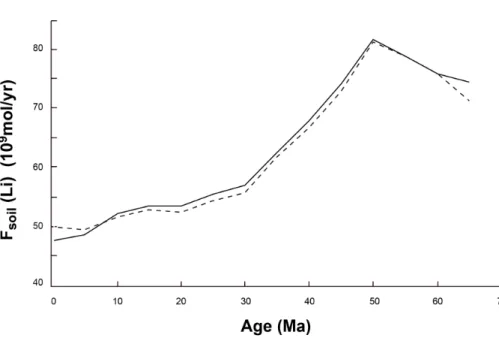
Surprisingly, our model results demonstrate that a second scenario that is more consistent with geological and isotope observations, can also explain the Cenozoic Li isotope record. Indeed, Fig. 3b shows that the δ7Li paleorecord mainly reflects an increase of the riverine Li flux through the Cenozoic. As illustrated in Fig. 4, this in-crease is not due to an inin-crease in the dissolution rate of the silicate lithologies, but
20
is mostly due to the decrease of Li storage in soils. In order to test the robustness of this result, we performed two different simulations, using (1) the whole set of equations (for both C and Li, see Sect. 2), and (2) an imposed variation ofδriv that is arbitrarily forced to increase linearly from 15 ‰ at 65 Ma to 23 ‰, its present day value (in that case, only the Li budget is solved, not C). Both simulations lead to similar trends, where
25
CPD
10, 3027–3051, 2014A new approach for modeling the Cenozoic oceanic
lithium isotope paleo-variations
N. Vigier and Y. Godderis
Title Page
Abstract Introduction
Conclusions References
Tables Figures
◭ ◮
◭ ◮
Back Close
Full Screen / Esc
Printer-friendly Version
Interactive Discussion
Discussion
P
a
per
|
Discus
sion
P
a
per
|
Discussion
P
a
per
|
Discussion
P
a
per
|
soil Li storage was high from 65 to 50 Myr, and then decreased continuously until its stabilization at about 20 Myr ago (Fig. 4).
In order to be more quantitative, check the consistency of these results and compare them to other proxies, we estimated the corresponding soil formation rates, assuming a Li concentration of 25 ppm, which corresponds to an average soil Li concentration,
5
including data shown in Table 1. This value may be associated with a large error, as there are currently only few soil data. It may also have varied as a function of time, although this is not supported by the relative narrow range of Li concentration of the most abundant clays. Nevertheless, this assumption allows us to assess if the order of magnitude for fluxes extracted from our model makes sense. Also, a compilation of Li
10
contents for the most abundant low-T continental clays show that the average Li value is not so different from one type of clay to another (Tardy et al., 1972; Table 1). During the Cenozoic, we thus estimate that soil formation rate ranged from 2.2×10¹⁹kg Ma−1
to a present-day value of 1.3×10¹⁹kg Ma−1, i.e. 2.2×10¹⁰t yr−1 to 1.3×10¹⁰t yr−1.
For comparison, Syvitski et al. (2003) estimated a present-day global physical
denuda-15
tion rate of 2×10¹⁰t yr−1. Reconstitution of paleo-denudation rate during the Cenozoic
are controversial (e.g. Willenbring and von Blanckenburg, 2010), but given the uncer-tainties typical of global scale estimations, it is worth noting that the calculated soil formation falls quite close (less than an order of magnitude difference) to the global denudation estimate, indicating that our calculations – based on C and Li cycles and
20
published values for corresponding parameters – make sense.
3.2 Assessing the role of climate
Except for the last few Ma, the paleo-reconstruction of soil formation rate during the Cenozoic is remarkably parallel to the δ18O values measured in benthic foraminifera (Zachos et al., 2001, see Fig. 5b). This strongly suggests a major role of climate on
25
CPD
10, 3027–3051, 2014A new approach for modeling the Cenozoic oceanic
lithium isotope paleo-variations
N. Vigier and Y. Godderis
Title Page
Abstract Introduction
Conclusions References
Tables Figures
◭ ◮
◭ ◮
Back Close
Full Screen / Esc
Printer-friendly Version
Interactive Discussion
Discussion
P
a
per
|
Discus
sion
P
a
per
|
Discussion
P
a
per
|
Discussion
P
a
per
|
therefore not able to compensate the role of temperature. In the open debate concern-ing the controls of continental chemical erosion rates at global scale over the Cenozoic, Li isotopes yield good evidence of the predominance of climate over mechanical ero-sion. Specifically the fact that soil formation rates predicted by the model parallel the global benthic oxygen isotope record shows that the impact of orogenesis is not strong
5
enough to counter-balance the impact of temperature decrease.
More closely inspecting the comparison between soil formation rate,δ18O andpCO2 paleo-variations reveals four remarkable features:
1. High soil formation rates during the Paleocene and Early Eocene, coincides with high pCO2 estimations (Beerling and Royer, 2011) as well as low foraminifera
10
δ18O values. This strongly suggests that weathering rates were high because of climatic conditions favoring both dissolution of silicate rocks and formation of secondary minerals and laterites.
2. A sharp decrease of soil formation rate coeval with a sharp increase in foraminifera δ18O during the Eocene until the beginning of the Oligocene. This
15
co-variation suggests a predominant role of climate cooling on continental soil production. However, during this period of time, we cannot exclude a global thin-ning of soils by mountain building and orogenesis. Steeper slopes, higher relief, and increasing impact of landslide contribute significantly to reduce the world av-erage soil thickness.
20
3. A stabilization of the weathering rates between 30 and 10 Ma, which matches the plateaus exhibited bypCO2(not shown here, but see Beerling and Royer, 2011) andδ18O proxies.
4. A decoupling between soil formation rate, benthic foraminifera δ18O and phys-ical denudation rate during the Quaternary period. Indeed, both soil formation
25
CPD
10, 3027–3051, 2014A new approach for modeling the Cenozoic oceanic
lithium isotope paleo-variations
N. Vigier and Y. Godderis
Title Page
Abstract Introduction
Conclusions References
Tables Figures
◭ ◮
◭ ◮
Back Close
Full Screen / Esc
Printer-friendly Version
Interactive Discussion
Discussion
P
a
per
|
Discus
sion
P
a
per
|
Discussion
P
a
per
|
Discussion
P
a
per
|
variations, consistent with the development of a cool climate and glaciations. Our results suggest that the recent climatic variations were not strong enough to affect the Li cycle, as evidenced by constant foraminiferaδ7Li value during the last 5 Ma. The other possibility is that the present-day residence time of Li in the ocean is un-derestimated and the chemical – and potentially physical – disturbances related
5
to Quaternary glaciations did not have time yet to significant affect its oceanic budget.
4 Conclusions
We provide a new approach for modeling the seawaterδ7Li record, preserved in ma-rine foraminifera and carbonate records (Misra and Froelich, 2012). The Li cycle
in-10
cludes several fluxes of importance for the carbon cycle (and hence for the climatic evolution), including continental weathering and hydrothermal water-rock interactions. For this reason, we have combined the C and the Li cycles, so that our proposed re-construction of the Cenozoic Li cycle is compatible with the required stability of the exospheric carbon cycle at the geological timescale (Walker et al., 1981). Results are
15
consistent with the current knowledge of the behavior of Li isotopes during continental weathering: (1) in terms of isotope fractionation during dissolution and clay formation (2) in term of present-day river flux and riverδ7Li.
In order to fit the paleovariation of the ocean δ7Li through out the Cenozoic, the model required significant Li to be stored on the continents during the Paleocene and
20
Eocene, likely in secondary phases which are Li-rich, such as phyllosilicates and ox-ides. Then this storage flux globally decreases towards the present day, while the ex-port to the ocean by weathering increases. This storage follows indexes recording the climate evolution during the Cenozoic, such as foraminifera δ18O and pCO2 recon-structions. This leads us to propose that climate exerted a dominant control on soil
25
CPD
10, 3027–3051, 2014A new approach for modeling the Cenozoic oceanic
lithium isotope paleo-variations
N. Vigier and Y. Godderis
Title Page
Abstract Introduction
Conclusions References
Tables Figures
◭ ◮
◭ ◮
Back Close
Full Screen / Esc
Printer-friendly Version
Interactive Discussion
Discussion
P
a
per
|
Discus
sion
P
a
per
|
Discussion
P
a
per
|
Discussion
P
a
per
|
References
Beauvais, A. and Chardon, D.: Modes tempo, and spatial variability of Cenozoic cra-tonic denudation: the West African example, Geochem. Geophy. Geosy., 14, 1590–1608, doi:10.1002/ggge.20093, 2013.
Beerling D. J. and Royer, D. R.: Convergent cenozoic CO2 history, Nat. Geosci., 4, 418–420,
5
doi:10.1038/ngeo1186, 2011.
Berner, R. A.: The Phanerozoic Carbon Cycle: CO2and O2, Oxford University Press, 160 pp., 2004.
Bouchez, J., Von Blankenburg, F., and Schuessler, J. A.: Modeling novel stable isotope ratios in the weathering zone, Am. J. Sci., 313, 267–308, doi:10.2475/04.2013.01, 2013.
10
Burton, K. W. and Vigier, N.: Lithium isotopes as tracers in marine and terrestrial environments, in: Handbook of Environmental Isotope Geochemistry, 41–61, 2011.
Chan, L.-H., Edmond, J. M., Thompson, G., and Gillis, K.: Lithium isotopic composition of sub-marine basalts: implications for the lithium cycle to the ocean, Earth Planet. Sc. Lett., 108, 151–160, 1992.
15
Chan, L.-H., Edmond, J. M., and Thompson, G.: A lithiumisotope study of hot springs and metabasalts from mid ocean ridge hydrothermal systems, J. Geophys. Res., 98, 9653–9659, 1993.
Chan, L.-H., Gieskes, J. M., You, C.-F., and Edmond, J. M.: Lithium isotope geochemistry of sediments and hydrothermal fluids of the Guaymas Basin, Gulf of California,∼, Geochim.
20
Cosmochim. Ac., 58, 4443–4454, 1994.
Chan, L.-H., Leeman, W. P., and Plank, T.: Lithium isotopic composition of marine sediments, Geochem. Geophy. Geosy., 7, Q06005, doi:10.1029/2005GC001202, 2006.
Engebretson, D. C., Kelley, K. P., Cashman, H. J., and Richard, M. A.: 180 million years of subduction, GSA Today, 2, 93–100, 1992.
25
Godderis, Y. and Francois, L. M.: The Cenozoic evolution of the strontium and carbon cycles: relative importance of continental erosion and mantle exchanges, Chem. Geol., 126, 169– 190, 1995.
Foustoukos, D. I., James, R. H., Berndt, M. E., and Seyfried Jr., W. E.: Lithium isotopic system-atic of hydrothermal vent fluids at the Main Endeavour Field, Northern Juan de Fuca Ridge,
30
CPD
10, 3027–3051, 2014A new approach for modeling the Cenozoic oceanic
lithium isotope paleo-variations
N. Vigier and Y. Godderis
Title Page
Abstract Introduction
Conclusions References
Tables Figures
◭ ◮
◭ ◮
Back Close
Full Screen / Esc
Printer-friendly Version
Interactive Discussion
Discussion
P
a
per
|
Discus
sion
P
a
per
|
Discussion
P
a
per
|
Discussion
P
a
per
|
Hathorne, E. C. and James, R. H.: Temporal record of lithium in seawater: a tracer for silicate weathering?, Earth Planet. Sc. Lett., 246, 393–406, 2006.
Hay, W. W., Sloan, J. L. I., and Wold, C. N.: The mass/age distribution of sediments on the ocean floor and the global rate of loss of sediment, J. Geophys. Res., 93, 14933–14940, 1988.
5
Huh, Y., Chan, L.-H., Zhang, L., and Edmond, J. M.: Lithium and its isotopes in major world rivers: Implications for weathering and the oceanic budget, Geochim. Cosmochim. Ac., 62, 2039–2051, 1998.
Huh, Y., Chan, L.-H., and Edmond, J. M.: Lithium isotopes as a probe of weathering processes: Orinoco River, Earth Planet. Sc. Lett., 194, 189–199, 2001.
10
Kisakurek, B., Widdowson, M., and James, R. H.: Behaviour of Li isotopes during continental weathering: the Bidar laterite profile, India, Chem. Geol., 212, 27–44, 2004.
Kump, L. R. and Arthur, M. A.: Global chemical erosion during the Cenozoic: weatherability balances the budgets, in: Tectonics Uplift and Climate Change, edited by: Ruddiman, W., Plenum Press, NY, 399–426, 1997.
15
Lear, C. H., Elderfield, H., and Wilson, P. A.: A Cenozoic seawater Sr/Ca record from benthic foraminiferal calcite and its application in determining global weathering fluxes, Earth Planet. Sc. Lett., 208, 69–84, 2003.
Lefebvre, V., Donnadieu, Y., Goddéris, Y., Fluteau, F., and Hubert-Théou, L: Was the Antarctic glaciation delayed by a high degassing rate during the early Cenozoic?, Earth Planet. Sc.
20
Lett., 371, 203–211, 2013.
Lemarchand, E., Chabaux, F., Vigier, N., Millot, R., and Pierret, M.-C.: Lithium isotope system-atics in a forested granitic catchment (Strengbach, Vosges Mountains, France), Geochim. Cosmochim. Ac., 74, 4612–4628, 2010.
Li, G. and Elderfield, H.: Evolution of carbon cycle over the past 100 million yr, Geochim.
Cos-25
mochim. Ac., 103, 11–25, 2013.
Meshram, R. R. and Randive, K. R.: Geochemical study of laterites of the Jamnagar district, Gujarat, India: implications on parent rock, mineralogy and tectonics, J. Asian Earth Sci., 42, 1271–1287, doi:10.1016/j.jseaes.2011.07.014, 2011.
Millot, R., Vigier, N., and Gaillardet, J.: Behaviour of lithium and its isotopes during weathering
30
in the Mackenzie Basin, Canada, Geochim. Cosmochim. Ac., 74, 3897–3912, 2010.
CPD
10, 3027–3051, 2014A new approach for modeling the Cenozoic oceanic
lithium isotope paleo-variations
N. Vigier and Y. Godderis
Title Page
Abstract Introduction
Conclusions References
Tables Figures
◭ ◮
◭ ◮
Back Close
Full Screen / Esc
Printer-friendly Version
Interactive Discussion
Discussion
P
a
per
|
Discus
sion
P
a
per
|
Discussion
P
a
per
|
Discussion
P
a
per
|
Mottl, M. J., Seewald, J. S., Wheat, C. J., Tivey, M. K., Michael, P. J., Proskurowski, G., Mc-Collom, T. M., Reeves, E., Sharkey, J., You, C. F., Chan, L. H., and Pichler, T.: Chemistry of hot springs along the Eastern Lau Spreading Center, Geochim. Cosmochim. Ac., 75, 1013– 1038, 2011.
Rudnick, R. L., Tomascak, P. B., Njoa, H. B., and Gardnerb, L. R.: Extreme lithium isotopic
frac-5
tionation during continental weathering revealed in saprolites from South Carolina, Chem. Geol., 212, 45–57, 2004.
von Strandmann, P. A. E. P., Burton, K. W., James, R. H., van Calsteren, P., and Gislason, S. R.: Assessing the role of climate on uranium and lithium isotope behaviour in rivers draining a basaltic terrain, Chem. Geol., 270, 227–239, 2010.
10
Syvitskia, J. P. M., Peckhama, S. D., Hilbermana, R., and Mulder, T.: Predicting the terrestrial flux of sediment to the global ocean: a planetary perspective, Sediment. Geol., 162, 5–24, 2003.
Tardy, Y., Krempp, G., and Trauth, N.: Le lithium dans les minéraux argileux des ciments et des sols, Geochim. Cosmochim. Ac., 36, 397–412, 1972.
15
Tavlan, M., Thorne, R., and Herrington, R. J.: Uplift and lateritization history of the Caldag ophiolite in the context of Neo-Tethyan ophiolite obduction and uplift: implications for the Cenozoic weathering history of western Anatolia, J. Geol. Soc. London, 168, 927–940, 2011. Teng, F.-Z., Rudnick, R. L., McDonough, W. F., and Wu, F. Y.: Lithium isotopic systematics of
A-type granites and their mafic enclaves: further constraints on the Li isotopic composition
20
of the continental crust, Chem. Geol., 262, 370–379, 2009.
Tomascak, P. B.: Developments in the understanding and application of lithium isotopes in the Earth and Planetary Sciences, Rev. Mineral. Geochem., 55, 153–195, 2004.
Vance, D., Teagle, D. A. H., and Foster, G. L.: Variable Quaternary chemical weathering rates and imbalances in marine geochemical budgets, Nature, 458, 493–496, 2009.
25
Vigier, N., Decarreau, A., Millot, R., Carignan, J., Petit, S., and France-Lanord, C.: Quantifying Li isotope fractionation during smectite formation and implications for the Li cycle, Geochim. Cosmochim. Ac., 72, 780–792, 2008.
Vigier, N., Gislason, S. R., Burton, K. W., Millot, R., and Mokadem, F.: The relationship between riverine lithium isotope composition and silicate weathering rates in Iceland, Earth Planet. Sc.
30
CPD
10, 3027–3051, 2014A new approach for modeling the Cenozoic oceanic
lithium isotope paleo-variations
N. Vigier and Y. Godderis
Title Page
Abstract Introduction
Conclusions References
Tables Figures
◭ ◮
◭ ◮
Back Close
Full Screen / Esc
Printer-friendly Version
Interactive Discussion
Discussion
P
a
per
|
Discus
sion
P
a
per
|
Discussion
P
a
per
|
Discussion
P
a
per
|
Walker, J. C. G., Haysand, P. B., and Kasting, J. F.: A negative feedback mechanism for the long-term stabilization of Earth’s surface temperature, J. Geophys. Res., 86, 9776–9782, 1981.
Willenbring, J. K. and von Blanckenburg, F.: Long-term stability of global erosion rates and weathering during late-Cenozoic cooling, Nature, 465, 211–214, 2010.
5
Wimpenny, J., Gíslason, S. R., James, R. H., Gannoun, A., Von Strandmann, P., and Bur-ton, K. W.: The behaviour of Li and Mg isotopes during primary phase dissolution and sec-ondary mineral formation in basalt, Geochim. Cosmochim. Ac., 74, 5259–5279, 2010. Zachos, J. C., Shackleton, N. J., Revenaugh, J. S., Pälike, H., and Flower, B. P.: Climate
response to orbital forcing across the Oligocene–Miocene boundary, Science, 292, 274–
10
CPD
10, 3027–3051, 2014A new approach for modeling the Cenozoic oceanic
lithium isotope paleo-variations
N. Vigier and Y. Godderis
Title Page
Abstract Introduction
Conclusions References
Tables Figures
◭ ◮
◭ ◮
Back Close
Full Screen / Esc
Printer-friendly Version
Interactive Discussion
Discussion
P
a
per
|
Discus
sion
P
a
per
|
Discussion
P
a
per
|
Discussion
P
a
per
|
Table 1.Li concentrations measured in kaolinite (Tardy et al., 1972). These clays contain 0.2 % MgO (Tardy et al., 1972). On average, the Li level for kaolinite is estimated to be 23 ppm. For comparison, average Li content for smectite is found to be 27 ppm (Tardy et al., 1972) and 22 ppm for granites (Teng et al., 2009).
location Li (ppm) Reference
Ivory Coast 30 Tardy et al. (1972) 23 Tardy et al. (1972) 53 Tardy et al. (1972) 70 Tardy et al. (1972) 22 Tardy et al. (1972) 26 Tardy et al. (1972) 4 Tardy et al. (1972) 7 Tardy et al. (1972) 7 Tardy et al. (1972) 8 Tardy et al. (1972) 32 Tardy et al. (1972) 37 Tardy et al. (1972) 5 Tardy et al. (1972) 35 Tardy et al. (1972) USA 20 Rudnick et al., 2004 Seine Basin (France) 42 t.s.
CPD
10, 3027–3051, 2014A new approach for modeling the Cenozoic oceanic
lithium isotope paleo-variations
N. Vigier and Y. Godderis
Title Page
Abstract Introduction
Conclusions References
Tables Figures
◭ ◮
◭ ◮
Back Close
Full Screen / Esc
Printer-friendly Version
Interactive Discussion
Discussion
P
a
per
|
Discus
sion
P
a
per
|
Discussion
P
a
per
|
Discussion
P
a
per
|
Table 2.Parameters used in the model.∆ocand∆land(Li isotope fractionation during secondary
phase formation in the ocean and on land respectively) are chosen from within the published range, such that (1) the seawater paleo-variation exactly match the 5 Myr fit of the Misra and Froelich (2012) foraminifera data through the Ceonozoic (0–65 Ma) (shown in Fig. 1) and (2) at timet=0 (present day), bothFriv(Li) andδ7Lirivvalues must be within the published range (see text for references).
Published values Model values
Friv(Li) 4–12×10
9
mol yr−1
Free (see figures)
Fhyd(Li) 2–145×109mol yr−1
5×10⁹mol yr−1
δ7Lihyd 8.5±1 ‰ 8
δ7LiUCC 1.7±2 ‰ 1.7
δ7Liriv 23±2 ‰ Fixed at 23 ‰ / linear / free (see figures)
∆oc 10–25 ‰ 14 ‰
∆land 10–25 ‰ 23 ‰
C/Lihyd=k2 6.67×10⁻⁴
CPD
10, 3027–3051, 2014A new approach for modeling the Cenozoic oceanic
lithium isotope paleo-variations
N. Vigier and Y. Godderis
Title Page
Abstract Introduction
Conclusions References
Tables Figures
◭ ◮
◭ ◮
Back Close
Full Screen / Esc
Printer-friendly Version
Interactive Discussion
Discussion
P
a
per
|
Discus
sion
P
a
per
|
Discussion
P
a
per
|
Discussion
P
a
per
|
CPD
10, 3027–3051, 2014A new approach for modeling the Cenozoic oceanic
lithium isotope paleo-variations
N. Vigier and Y. Godderis
Title Page
Abstract Introduction
Conclusions References
Tables Figures
◭ ◮
◭ ◮
Back Close
Full Screen / Esc
Printer-friendly Version
Interactive Discussion
Discussion
P
a
per
|
Discus
sion
P
a
per
|
Discussion
P
a
per
|
Discussion
P
a
per
|
Figure 2.Simulation assuming constantδ7Liriv (in blue) as a function of time. As shown here, the seawater δ7Li record presented in Fig. 1 can still be fitted if the flux of river Li (Friv in 109mol yr−1
, in green) increased significantly during the same period of time. This example demonstrates the lack of constraints on the steady-state model if only the equation for Li is considered. In addition this example shows that riverδ7Li can display temporal variations that are significantly different from the oceanδ7Li record.
CPD
10, 3027–3051, 2014A new approach for modeling the Cenozoic oceanic
lithium isotope paleo-variations
N. Vigier and Y. Godderis
Title Page
Abstract Introduction
Conclusions References
Tables Figures
◭ ◮
◭ ◮
Back Close
Full Screen / Esc
Printer-friendly Version
Interactive Discussion
Discussion
P
a
per
|
Discus
sion
P
a
per
|
Discussion
P
a
per
|
Discussion
P
a
per
|
Figure 3.The two solutions of the model described in the text that can both explain the sea-water record (see Eqs. 3–12, and Table 2)Friv is in 109mol yr−1
CPD
10, 3027–3051, 2014A new approach for modeling the Cenozoic oceanic
lithium isotope paleo-variations
N. Vigier and Y. Godderis
Title Page
Abstract Introduction
Conclusions References
Tables Figures
◭ ◮
◭ ◮
Back Close
Full Screen / Esc
Printer-friendly Version
Interactive Discussion
Discussion
P
a
per
|
Discus
sion
P
a
per
|
Discussion
P
a
per
|
Discussion
P
a
per
|
Figure 4.Flux of lithium incorporated into soil secondary phases as a function of time (Fsoil), following solution #2 of the modeling (shown in Fig. 3b). Comparison is made using a linear evolution for riverδ7Li as a function of time, from 15 ‰ (at 65 Ma) to 23 ‰ (present-day) (dashed line).
CPD
10, 3027–3051, 2014A new approach for modeling the Cenozoic oceanic
lithium isotope paleo-variations
N. Vigier and Y. Godderis
Title Page
Abstract Introduction
Conclusions References
Tables Figures
◭ ◮
◭ ◮
Back Close
Full Screen / Esc
Printer-friendly Version
Interactive Discussion
Discussion
P
a
per
|
Discus
sion
P
a
per
|
Discussion
P
a
per
|
Discussion
P
a
per
|