SED
7, 1007–1024, 2015Comparison of cultivation areas in
terms of soil properties
B. Turgut
Title Page
Abstract Introduction
Conclusions References
Tables Figures
◭ ◮
◭ ◮
Back Close
Full Screen / Esc
Printer-friendly Version Interactive Discussion
Discussion
P
a
per
|
Discussion
P
a
per
|
Discussion
P
a
per
|
Discussion
P
a
per
|
Solid Earth Discuss., 7, 1007–1024, 2015 www.solid-earth-discuss.net/7/1007/2015/ doi:10.5194/sed-7-1007-2015
© Author(s) 2015. CC Attribution 3.0 License.
This discussion paper is/has been under review for the journal Solid Earth (SE). Please refer to the corresponding final paper in SE if available.
Comparison of wheat and sa
ffl
ower
cultivation areas in terms of total carbon
and some soil properties under semi-arid
climate conditions
B. Turgut
Artvin Coruh University, Forestry Faculty, Department of Soil and Ecology, Artvin, Turkey
Received: 10 February 2015 – Accepted: 17 February 2015 – Published: 6 March 2015
Correspondence to: B. Turgut ([email protected])
SED
7, 1007–1024, 2015Comparison of cultivation areas in
terms of soil properties
B. Turgut
Title Page
Abstract Introduction
Conclusions References
Tables Figures
◭ ◮
◭ ◮
Back Close
Full Screen / Esc
Printer-friendly Version Interactive Discussion
Discussion
P
a
per
|
Discussion
P
a
per
|
Discussion
P
a
per
|
Discussion
P
a
per
|
Abstract
The aim of this study was to compare the soils of the wheat cultivation area (WCA) and the safflower cultivation area (SCA) within semi-arid climate zones in terms of their total carbon, nitrogen, sulphur contents, particle size distribution, aggregate stability, organic matter content, and pH values. This study presents the results from the analyses of 140
5
soil samples taken at two soil layers (0–10 and 10–20 cm) in the cultivation areas. At the end of the study, it has been established that there were significant differences between the cultivation areas in terms of soil physical properties such as total carbon (TC), total nitrogen (TN), total sulphur (TS) contents and pH, while only the TN content resulted in significantly different between the two soil layers. Moreover significant differences
10
were identified in the cultivation areas in terms of soil physical properties including clay and sand contents, aggregate stability and organic matter content, whereas the only significant difference found among the soil layers was that of their silt content. Since safflower contains higher amounts of biomass than wheat, we found higher amounts of organic matter content and, therefore, higher amounts of TN and TS content in the
15
soils of the SCA. In addition, due to the fact that wheat contains more cellulose – which takes longer to decompose – the TC content of the soil in the WCA were found to be higher than that of the SCA. The results also revealed that the WCA had a higher carbon storage capacity.
1 Introduction
20
The soil forming process have significant effects on soil properties (Ubalde et al., 2010). One of such processes is the agricultural management practice. It is well known fact that different agricultural management practices such as soil tillage, irrigation, crop design cause changes in physical and chemical properties of soils even though they are formed under same conditions (Özgöz et al., 2012; Reynolds et al., 2007; Valpassos
25
SED
7, 1007–1024, 2015Comparison of cultivation areas in
terms of soil properties
B. Turgut
Title Page
Abstract Introduction
Conclusions References
Tables Figures
◭ ◮
◭ ◮
Back Close
Full Screen / Esc
Printer-friendly Version Interactive Discussion
Discussion
P
a
per
|
Discussion
P
a
per
|
Discussion
P
a
per
|
Discussion
P
a
per
|
Plants have direct and indirect effects on the soil properties (Schjønning et al., 2004). Plants roots’ influence over the physical soil properties such as aggregate formation, compaction and infiltration rate can be described as the direct effects of the plants (Angers and Caron, 1998; Milleret et al., 2009). Having completed their natural life cycles, the plants begin to decompose inside the soil and thereby become one of the
5
main sources of the organic matters, which in turn provide positive contributions to most of the physical, chemical and biological properties of the soils (Karaman et al., 2007; Rowell, 1994; Turgut and Aksakal, 2011).
The crop residues – such as the components dried up or torn from the plants on the ground during the cultivation season or those left underground during the harvest
10
season – along with their roots under the soil constitute a significant portion of the organic materials of the soil (Schjønning et al., 2004). For this reason, the plant types with advanced vegetative components and root distribution contribute more greatly in terms of organic matter contents. In addition the main sources of carbon (C) and nitrogen (N) found in the soil also come from such crop residues (Karaman, 2012).
15
However, since the decomposition of cellulose and lignin – found richly in some types of plants such as wheat – takes longer than other components, it is observed that the soils of such cultivation areas are rich in C content and poor in N content as compared to other cultivation lands (Benbi et al., 2015; Kramer et al., 2002; Srinivasarao et al., 2014; Zhengchao et al., 2013; Kuzyakov and Domanski, 2000).
20
The total carbon content of soils are highly important due to being both an indicator of the overall soil quality (Rowell, 1994; Schjønning et al., 2004) and relevant to the climate change (Wan et al., 2011; Munoz-Rojas et al., 2012; Parras-Alcantara et al., 2015). Storage of carbon inside the soil involves the processes of carbon intake from the atmosphere by plants and usage of the same in photosynthesis and the transfer of
25
SED
7, 1007–1024, 2015Comparison of cultivation areas in
terms of soil properties
B. Turgut
Title Page
Abstract Introduction
Conclusions References
Tables Figures
◭ ◮
◭ ◮
Back Close
Full Screen / Esc
Printer-friendly Version Interactive Discussion
Discussion
P
a
per
|
Discussion
P
a
per
|
Discussion
P
a
per
|
Discussion
P
a
per
|
et al., 2012; Parras-Alcantara et al., 2013; Fialho and Zinn, 2014; Srinivasarao et al., 2014), whereas only a few research has been completed on the comparison of lands formed under the same conditions but allocated to different plant cultivations. This study attempts to compare the soils devoted to wheat and safflower cultivation in the semi-arid climate zones in respect to some of their physical and chemical properties, with
5
particular attention given to their TC content. Since the soil’s capacity to store carbon is vitally important in term of climate change and soil fertility, it is believed that the results of this study will be useful in this particular sense.
2 Materials and methods 2.1 Materials
10
The study was conducted in two different experimental areas, the wheat cultivation area (WCA) and safflower cultivation area (SCA), located within the province of Eskişehir (Fig. 1). These areas had been maintained with bread wheat (Triticum aestivum) – fallow sequence and safflower (Carthamus tinctorius) – fallow sequence for more than 20 years. Average wheat yield in the experimental area is 2.75 t ha−1, 15
while average safflower yield is 0.7 t ha−1. The geographical coordinates of the WCA are 39◦46′12.32′′N and 30◦23′53.27′′E, while the coordinates of the SCA are 39◦44′12.88′′N and 30◦09′50.51′′E. Moreover both areas rely on a precipitation based agricultural system. Total annual precipitation rate in the experimental area is 370 mm, classified as the semi-arid climate zone. While the lowest temperature in the area is
20
−0.1◦C in January, the highest temperature is 21.7◦C in July. The soils on the both experimental areas were formed on non-decomposed quaternary material (MRE Earth Science Portal, 2014). Both areas of cultivation are situated on a straight slope, and the elevations from the sea level are 812 and 1018m for the WCA and the SCA, respectively.
SED
7, 1007–1024, 2015Comparison of cultivation areas in
terms of soil properties
B. Turgut
Title Page
Abstract Introduction
Conclusions References
Tables Figures
◭ ◮
◭ ◮
Back Close
Full Screen / Esc
Printer-friendly Version Interactive Discussion
Discussion
P
a
per
|
Discussion
P
a
per
|
Discussion
P
a
per
|
Discussion
P
a
per
|
2.2 Methods
2.2.1 Sampling pattern and soil analyses
In order to identify the soil properties of the experimental areas, the WCA and SCA were divided into 10 m×10 m grids, and 140 disturbed soil samples were taken from 0–10 and 10–20 cm depths in each 35 points where the grids intersect. Total carbon
5
(TC), total nitrogen (TN) and total sulphur (TS) contents of the soils were identified using an elemental analysis device (elemental analyzer, vario MAKRO cube CHNS, Elementar). Wet combustion method (Sparks et al., 1996), Yoder wet-sieving method (Dane et al., 2002) and hydrometer method (Gee et al., 1986) were used for identifying the organic matter content, aggregate stability (1–2 mm aggregates) and particle size
10
distribution of the soils, respectively. The pH values of the soils were measured in the 1 : 2.5 soil-water suspension (Conklin, 2005).
2.2.2 Statistical analyses
Descriptive statistics, including average, SD, the minimum and maximum values and coefficient of variation were determined for all the studied soil properties The Shapiro–
15
Wilk W Test was used for determining whether soil properties fit normal distribution Moreover, the analysis of variance was applied in determining the differences between the cultivation areas and the soil layers in terms of the soil properties. JMP 5.0 package software was used in conducting statistical analyses.
3 Results and discussion
20
3.1 Fundamental characteristics of the soils in the experimental areas
SED
7, 1007–1024, 2015Comparison of cultivation areas in
terms of soil properties
B. Turgut
Title Page
Abstract Introduction
Conclusions References
Tables Figures
◭ ◮
◭ ◮
Back Close
Full Screen / Esc
Printer-friendly Version Interactive Discussion
Discussion
P
a
per
|
Discussion
P
a
per
|
Discussion
P
a
per
|
Discussion
P
a
per
|
was clay (Fig. 2a). In addition the organic matter content, the aggregate stability and pH were classified as intermediate, very-good and mid-level alkaline, respectively. As for the SCA, the results revealed that the texture was within the clay and loamy clay (Fig. 2b), and was considered to be “very good” in terms of aggregate stability, high in organic matter content and within the light alkaline in terms of pH. The coefficient
5
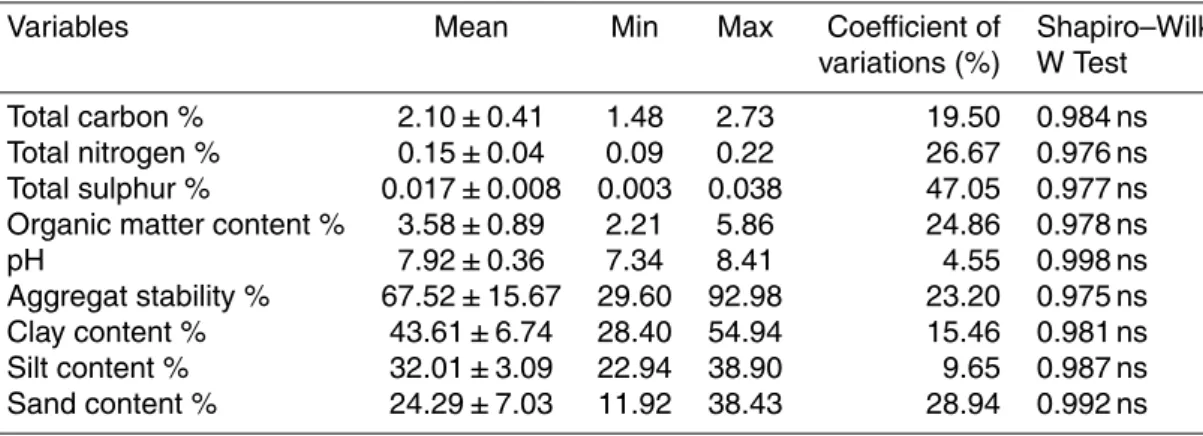
of variation (CV) values for studied soil properties were less than 50 %, while the lowest CV was observed for pH and the highest was observed for the TS. Moreover the Shapiro–Wilk W test results indicated that all the observed soil properties were normally distributed (Table 1).
3.2 Comparison of the soil properties
10
3.2.1 Particle size distribution
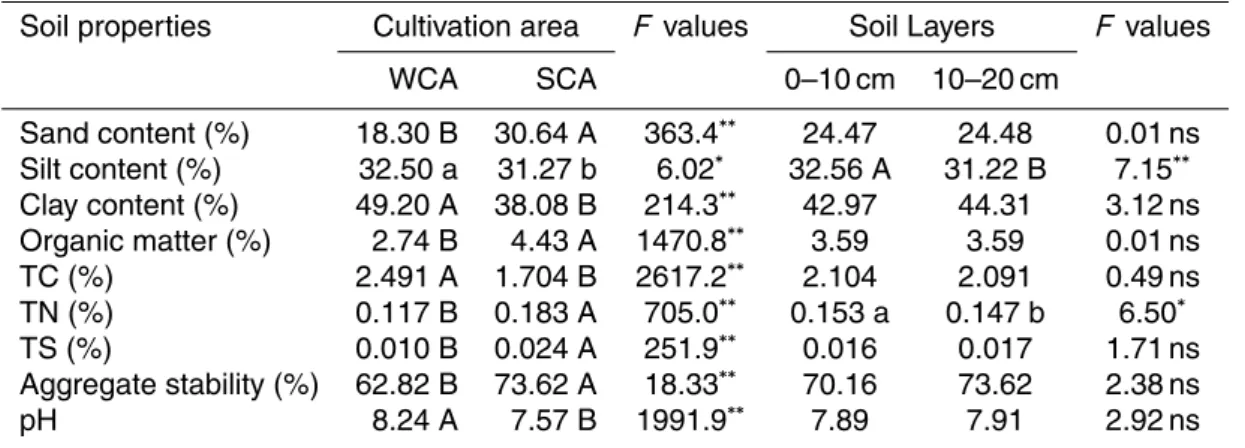
The results of particle size analysis showed that the clay and silt contents were significantly greater in the WCA, while the sand content was significantly greater in the SCA. As for soil layers, the differences in terms of clay and sand content were not significant, while silt content was significantly greater at the 0–10 cm layer (Table 2).
15
The particle size distribution is regarded as the least affected soil property from agricultural management practices (Karaman et al., 2012). For this reason, it is believed that the difference between the cultivation areas, in term of particle size distribution, was caused by the parent material differences where the soils were originally formed (Table 2).
20
3.2.2 Organic matter content
The organic matter content was found to be significantly greater in the SCA than the WCA (Table 2). As it is well known that the main source of the organic matter in the soil is the plant and animal residues (Karaman et al., 2012) and any organic substance amount resulting from a plant is directly proportionate to its biomass (Sollins et al.,
SED
7, 1007–1024, 2015Comparison of cultivation areas in
terms of soil properties
B. Turgut
Title Page
Abstract Introduction
Conclusions References
Tables Figures
◭ ◮
◭ ◮
Back Close
Full Screen / Esc
Printer-friendly Version Interactive Discussion
Discussion
P
a
per
|
Discussion
P
a
per
|
Discussion
P
a
per
|
Discussion
P
a
per
|
1996; Jaiarree et al., 2011; Novara et al., 2013). The reason for the greater organic matter content in the SCA than the WCA can be explained by the fact that the biomass amount of the safflower (Lenssen et al., 2007; Schillinger et al., 2007) and its residues remaining after the harvest season (Krupinsky et al., 2006) are greater than the wheat. No significantly difference was observed among the soil layers in terms of organic
5
matter content (Table 2).
3.2.3 Total carbon
Average TC was significantly greater in the WCA compared to the SCA (Table 2). The fact that the wheat contains a higher amount of cellulose (59 %) than safflower (40 %) (Del Río et al., 2012; Schjønning et al., 2004; Smith, 1996), and that the decomposition
10
rate of cellulose is fairly slow (Boswell, 1941) can help explain the higher rates of TC content in the WCA. Another reason for the higher rates of carbon content in the WCA can be associated with a higher rate of C : N ratio for the wheat compared to the safflower. Despite the absence of any study directly comparing the TC contents of both wheat and safflower cultivation areas, the studies comparing the soils of wheat with
15
other crop species also reported greater TC and C : N ratios for wheat (Benbi et al., 2015; Bolinger et al., 1997; Koga et al., 2011). TC content was greater in the top soil layer but this difference was not significant (Table 2).
3.2.4 Total nitrogen
The TN content was found to be greater in the soils of the SCA than the WCA
20
(Table 2), most probably due to the higher soil organic matter content recorded in the former site as organic nitrogen is converted into mineral nitrogen as a result of the decomposition of the organic materials (Rowell, 1993). Previous studies under different climate conditions and management practices also reported similar findings of positive correlation between organic matter and total nitrogen in soils. (Barrett and Burke, 2000;
25
SED
7, 1007–1024, 2015Comparison of cultivation areas in
terms of soil properties
B. Turgut
Title Page
Abstract Introduction
Conclusions References
Tables Figures
◭ ◮
◭ ◮
Back Close
Full Screen / Esc
Printer-friendly Version Interactive Discussion
Discussion
P
a
per
|
Discussion
P
a
per
|
Discussion
P
a
per
|
Discussion
P
a
per
|
and Lozano-Garcia, 2014). In respect to the soil layers, the analyses revealed that the TN content was significantly greater in the topsoil (Table 2), which is similar to the previous studies (Parras-Alcantara et al., 2013; Yu and Jia, 2014). The fundamental reason for this difference can be related to the rate of decomposition being faster on the top surface due to better ventilation conditions.
5
3.2.5 Total sulphur
In similar to the TN content, the TS content in the SCA was significantly greater than that of the WCA (Table 2). Literature show that a significant portion of the sulphur component in the soil consists of the organic sulphur resulting from the organic matter decomposition (Karaman, 2012; Janzen and Ellert, 1998), and for this reason it is
10
anticipated that the SCA with rich organic matter content should also yield a higher TS content. Moreover, it was established that there was no significant differences among the soil layers in terms of TS content (Table 2).
3.2.6 Aggregate stability
It was determined that the aggregate stability values of the SCA were significantly
15
higher than the WCA (Table 2). Low aggregate stability can generally be related with deterioration in the structural properties of the soil generally caused by some agricultural practices including use of heavy machinery and tillage under unsuitable soil moisture conditions in agricultural fields (Dilkova et al., 2002). In order to promote the aggregate stability in such areas it is suggested that the organic substance content
20
in the soil be increased by way of fertilization and scattering of plant residues in the field (Lal, 1998; Swindale, 1998). As explained above, the SCA had greater organic matter content than the WCA, considered as one of the factors for the higher aggregate stabilility. Moreover, literature shows that the safflower cultivation improves the physical properties of the soil (Jayawardane and Chan, 1994) through its deep roots
25
SED
7, 1007–1024, 2015Comparison of cultivation areas in
terms of soil properties
B. Turgut
Title Page
Abstract Introduction
Conclusions References
Tables Figures
◭ ◮
◭ ◮
Back Close
Full Screen / Esc
Printer-friendly Version Interactive Discussion
Discussion
P
a
per
|
Discussion
P
a
per
|
Discussion
P
a
per
|
Discussion
P
a
per
|
values the SCA. In addition, Nichols and Toro (2011) reported that when safflower is used in crop rotation sequences, higher aggregate stability values were found over the wheat-fallowing crop rotation sequence). No significant difference was detected among the soil layers in terms of aggregate stability (Table 2).
3.2.7 pH
5
It was established that the pH values of the SCA was significantly lower than the WCA (Table 2). The reasons for this low pH in the SCA may be associated with two processes including the decomposition of organic matter emerging organic acids and carbonic acids produced by dissolving of CO2 in soil solution following root and microbial respiration (Karaman et al., 2013; Rowell, 1993). These reasons are parallel to our
10
findings since the analyses revealed higher organic matter content in the SCA, a main factor lowering pH compared to the WCA. No significantly difference was observed among the soil layers in terms of pH values (Table 2).
4 Conclusions
This study was initiated to examine the soil properties of the wheat and safflower
15
cultivation areas formed under the similar parent material and climate conditions. The results revealed that the organic matter content of the soils has a determining effect on the TN, TS, pH and aggregate stability. Due to the higher ratio of organic matter content in the SCA, we found that the TN, TS and aggregate stability values were all significantly greater in the SCA than the WCA while the pH was significantly lower in
20
SED
7, 1007–1024, 2015Comparison of cultivation areas in
terms of soil properties
B. Turgut
Title Page
Abstract Introduction
Conclusions References
Tables Figures
◭ ◮
◭ ◮
Back Close
Full Screen / Esc
Printer-friendly Version Interactive Discussion
Discussion
P
a
per
|
Discussion
P
a
per
|
Discussion
P
a
per
|
Discussion
P
a
per
|
TN contents of the soils were found to be significantly greater in the bottom soil layer the rest of the soil properties were measured to be similar among the soil layers.
References
Angers, D. A. and Caron, J.: Plant-induced changes in soil structure: processes and feedbacks, in: Plant-Induced Soil Changes: Processes and Feedbacks, Springer, Netherlands, 55–72,
5
1998.
Benbi, D. K., Brar, K., Toor, A. S., and Singh, P.: Total and labile pools of soil organic carbon in cultivated and undisturbed soils in northern India, Geoderma, 237, 149–158, 2015.
Barrett, J. E. and Burke, I. C. Potential nitrogen immobilization in grassland soils across a soil organic matter gradient, Soil Biol. Biochem., 32, 1707–1716,
doi:10.1016/S0038-10
0717(00)00089-4, 2000.
Bolinder, M. A., Angers, D. A., and Dubuc, J. P.: Estimating shoot to root ratios and annual carbon inputs in soils for cereal crops, Agr. Ecosyst. Environ., 63, 61–66, doi:10.1016/S0167-8809(96)01121-8, 1997.
Boswell, J. G.: The biological decomposition of cellulose, New Phytol., 40, 20–33, 1941.
15
Conklin, A. R.: Introduction to Soil Chemistry: Analysis and Instrumentation, Wiley, Hoboken, NJ, USA, 2005.
Dane, J. H., Topp, C., Campbell, G. S., Horton, R., Jury, W. A., Nielsen, D. R., van Es, H. M., Wierenga, P. J., and Topp, G. C.: Methods of Soil Analysis: Part 4 – Physical methods, Soil Since Society of America, Inc., Madison, WIS, USA , 2002.
20
Debasish-Saha, Kukal, S. S., and Bawa, S. S.; Soil organic carbon stock and fractions in relation to land use and soil depth in the degraded Shiwaliks Hills of lower Himalayas, Land Degrad. Dev., 25, 407–416, 2014.
Del Río, J. C., Rencoret, J., Prinsen, P., Martínez, A. N. T., Ralph, J., and Gutieìrrez, A.: Structural characterization of wheat straw lignin as revealed by analytical pyrolysis, 2D-NMR,
25
and reductive cleavage methods, J. Agr. Food Chem., 60, 5922–5935, 2012.
SED
7, 1007–1024, 2015Comparison of cultivation areas in
terms of soil properties
B. Turgut
Title Page
Abstract Introduction
Conclusions References
Tables Figures
◭ ◮
◭ ◮
Back Close
Full Screen / Esc
Printer-friendly Version Interactive Discussion
Discussion
P
a
per
|
Discussion
P
a
per
|
Discussion
P
a
per
|
Discussion
P
a
per
|
Fialho, R. C. and Zinn, Y. L.: Changes in soil organic carbon under eucalyptus plantations in Brazil: a comparative analysis, Land Degrad. Dev., 25, 428–437, doi:10.1002/ldr.2158, 2014. Filep, T. and Rékási, M.: Factors controlling dissolved organic carbon (DOC), dissolved organic
nitrogen (DON) and DOC/DON ratio in arable soils based on a dataset from Hungary,
Geoderma, 162, 312–318, doi:10.1016/j.geoderma.2011.03.002, 2011.
5
Gee, G. W., Bauder, J. W., and Klute, A.: Particle-Size Analysis, Methods of Soil Analysis, Part 1. Physical and Mineralogical Methods, Soil Since Society of America, Inc., Madison, WIS, USA, 1986.
Hu, K., Wang, S., Li, H., Huang, F., and Li, B.: Spatial scaling effects on variability of soil organic matter and total nitrogen in suburban Beijing, Geoderma, 226, 54–63,
10
doi:10.1016/j.geoderma.2014.03.001, 2014.
Jaiarree, S., Chidthaisong, A., Tangtham, N., Polprasert, C., Sarobol, E., and Tyler, S. C.: Carbon budget and sequestration potential in a sandy soil treated with compost, Land Degrad. Dev., 25, 120–129, 2014.
Janzen, H. H. and Ellert, B. H.: Sulfur dynamics in cultivated, temperate agroecosystems, in:
15
Sulfur in the Environment, edited by: Maynard, D. G., Marcel Decker, New York, 11–43, 1998.
Jayawardane, N. and Chan, K.: The management of soil physical properties limiting crop production in Australian sodic soils – a review, Aust. J. Soil Res., 32, 13–44, 1994.
Karaman, M.: Plant Nutrition, Gubretas Guide Book Series No 2, Detay Press, Ankara, 2012.
20
Karaman, M., Brohi, A., Müftüoğlu, N., Öztaş, T., and Zengin, M.: Sustainable Soil Fertility, Detay Press, Ankara, 2013.
Koga, N., Smith, P., Yeluripati, J. B., Shirato, Y., Kimura, S. D., and Nemoto, M.: Estimating net primary production and annual plant carbon inputs, and modelling future changes in soil carbon stocks in arable farmlands of northern Japan, Agr. Ecosyst. Environ., 144, 51–60,
25
doi:10.1016/j.agee.2011.07.019, 2011.
Kramer, A. W., Doane, T. A., Horwath, W. R., and van Kessel, C.: Short-term nitrogen-15 recovery vs. long-term total soil N gains in conventional and alternative cropping systems, Soil Biol. Biochem., 34, 43–50, 2002.
Krupinsky, J. M., Tanaka, D. L., Merrill, S. D., Liebig, M. A., and Hanson, J. D.: Crop
30
sequence effects of 10 crops in the northern Great Plains, Agr. Syst., 88, 227–254,
SED
7, 1007–1024, 2015Comparison of cultivation areas in
terms of soil properties
B. Turgut
Title Page
Abstract Introduction
Conclusions References
Tables Figures
◭ ◮
◭ ◮
Back Close
Full Screen / Esc
Printer-friendly Version Interactive Discussion
Discussion
P
a
per
|
Discussion
P
a
per
|
Discussion
P
a
per
|
Discussion
P
a
per
|
Kuzyakov, Y. and Domanski, G.: Carbon input by plants into the soil, review, J. Plant Nutr. Soil Sc., 163, 421–431, 2000.
Lal, R.: Soil degradation, in: Red and Lateritic Soils, vol. 1, edited by: Sehgal, J., Blum, W. E., and Gajbhiye, K. S., Oxford and IBH Publishing CO.P.V.T. LTD, New Delhi, 237–253, 1998. Lenssen, A. W., Johnson, G. D., and Carlson, G. R.: Cropping sequence and tillage system
5
influences annual crop production and water use in semiarid Montana, USA, Field Crop. Res., 100, 32–43, doi:10.1016/j.fcr.2006.05.004, 2007.
Milleret, R., Le Bayon, R. C., Lamy, F., Gobat, J. M., and Boivin, P.: Impact of roots, mycorrhizas and earthworms on soil physical properties as assessed by shrinkage analysis, J. Hydrol., 373, 499–507, 2009.
10
MRE Earth Science Portal: available at: http://yerbilimleri.mta.gov.tr/anasayfa.aspx, last access: 2 February 2015, 2014.
Muñoz-Rojas, M., Jordán, A., Zavala, L. M., De la Rosa, D., Abd-Elmabod, S. K., and Anaya-Romero, M.: Organic carbon stocks in Mediterranean soil types under different land uses (Southern Spain), Solid Earth, 3, 375–386, doi:10.5194/se-3-375-2012, 2012.
15
Nichols, K. A. and Toro, M.: A whole soil stability index (WSSI) for evaluating soil aggregation, Soil Till. Res., 111, 99–104, doi:10.1016/j.still.2010.08.014, 2011.
Novara, A., Gristina, L., Rühl, J., Pasta, S., D’Angelo, G., La Mantia, T., and Pereira, P.: Grassland fire effect on soil organic carbon reservoirs in a semiarid environment, Solid Earth, 4, 381–385, doi:10.5194/se-4-381-2013, 2013.
20
Özgöz, E., Günay, H., Önen, H., Bayram, M., and Acir, N.: Effect of management on spatial and temporal distribution of soil physical properties, J. Agr. Sci., 18, 77–91, 2012.
Parras-Alcántara, L. and Lozano-García, B.: Conventional tillage versus organic farming in relation to soil organic carbon stock in olive groves in Mediterranean rangelands (southern Spain), Solid Earth, 5, 299–311, doi:10.5194/se-5-299-2014, 2014.
25
Parras-Alcántara, L., Martín-Carrillo, M., and Lozano-García, B.: Impacts of land use change in soil carbon and nitrogen in a Mediterranean agricultural area (Southern Spain), Solid Earth, 4, 167–177, doi:10.5194/se-4-167-2013, 2013.
Parras-Alcántara, L., Lozano-García, B., and Galán-Espejo, A.: Soil organic carbon along an altitudinal gradient in the Despeñaperros Natural Park, southern Spain, Solid Earth, 6, 125–
30
SED
7, 1007–1024, 2015Comparison of cultivation areas in
terms of soil properties
B. Turgut
Title Page
Abstract Introduction
Conclusions References
Tables Figures
◭ ◮
◭ ◮
Back Close
Full Screen / Esc
Printer-friendly Version Interactive Discussion
Discussion
P
a
per
|
Discussion
P
a
per
|
Discussion
P
a
per
|
Discussion
P
a
per
|
Reynolds, W. D., Drury, C. F., Yang, X. M., Fox, C. A., Tan, C. S., and Zhang, T. Q.: Land management effects on the near-surface physical quality of a clay loam soil, Soil Till. Res., 96, 316–330, doi:10.1016/j.still.2007.07.003, 2007.
Rowell, D. L.: Soil Science: Methods and Applications, Longman Scientific & Technical, Harlow, Essex, UK, 1994.
5
Schillinger, W. F., Kennedy, A. C., and Young, D. L.: Eight years of annual no-till cropping in Washington’s winter wheat-summer fallow region, Agr. Ecosyst. Environ., 120, 345–358, doi:10.1016/j.agee.2006.10.017, 2007.
Schjønning, P., Elmholt, S., and Christensen, B. T.: Managing soil quality: challenges in modern agriculture, Publishing, Wallingford, UK, CABI Publishing, Cambridge, MA, USA, 2004.
10
Smith, J. R.: Safflower, Taylor & Francis, The American Oil Chemist Society, Urbana, IL, USA, 1996.
Sollins, P., Homann, P., and Caldwell, B. A.: Stabilization and destabilization of soil organic matter: mechanisms and controls, Geoderma, 74, 65–105, doi:10.1016/S0016-7061(96)00036-5, 1996.
15
Sparks, D., Page, A., Helmke, P., and Loeppert, R.: Methods of Soil Analysis, Part 3 – Chemical Methods, Soil Science Society of America Inc., Madison, DE, USA, 1996.
Srinivasarao, C., Lal, R., Kundu, S., Babu, M. B. B. P., Venkateswarlu, B., and Singh, A. K.: Soil carbon sequestration in rainfed production systems in the semiarid tropics of India, Sci. Total Environ., 487, 587–603, 2014.
20
Swindale, L. D.: Challenges and future strategies for managing red and lateritic soils in the Tropics and Subtropics, in: Red and Lateritic Soils, vol. 1, edited by: Sehgal, J., Blum, W. E., and Gajbhiye, K. S., Oxford and IBH Publishing CO.P.V.T. LTD, New Delhi, 419–432, 1998. Turgut, B. and Aksakal, E. L.: Effects of sorghum residues and farmyard manure applications
on soil erodibility parameters, Artvin Çoruh University, Faculty of Forestry Journal, 11, 1–10,
25
2010.
Ubalde, J. M., Sort, X., and Poch, R. M.: How soil forming processes determine soil-based viticultural zoning in Catalonia, Spain, in: Proceedings of the 19th World Congress of Soil Science, Brisbane, Australia, 1–6 August 2010, 1.4.2, 5–9, 2010.
Wachsmann, N., Norton, R., and Jochinke, D.: An update on the role and agronomy of safflower
30
SED
7, 1007–1024, 2015Comparison of cultivation areas in
terms of soil properties
B. Turgut
Title Page
Abstract Introduction
Conclusions References
Tables Figures
◭ ◮
◭ ◮
Back Close
Full Screen / Esc
Printer-friendly Version Interactive Discussion
Discussion
P
a
per
|
Discussion
P
a
per
|
Discussion
P
a
per
|
Discussion
P
a
per
|
Wan, Y., Lin, E., Xiong, W., Li, Y. E., and Guo, L.: Modeling the impact of climate change on soil organic carbon stock in upland soils in the 21st century in China, Agr. Ecosyst. Environ., 141, 23–31, 2011.
Valpassos, M. A. R., Cavalcante, E. G. S., Cassiolato, A. M. R., and Alves, M. C.: Effects of soil management systems on soil microbial activity, bulk density and chemical properties,
5
Pesqui. Agropecu. Bras., 36, 1539–1545, doi:10.1590/S0100-204X2001001200011, 2001. Yu, Y. and Jia, Z. Q.: Changes in soil organic carbon and nitrogen capacities ofSalix cheilophila
Schneid along a revegetation chronosequence in semi-arid degraded sandy land of the Gonghe Basin, Tibet Plateau, Solid Earth, 5, 1045–1054, doi:10.5194/se-5-1045-2014, 2014.
10
SED
7, 1007–1024, 2015Comparison of cultivation areas in
terms of soil properties
B. Turgut
Title Page
Abstract Introduction
Conclusions References
Tables Figures
◭ ◮
◭ ◮
Back Close
Full Screen / Esc
Printer-friendly Version Interactive Discussion
Discussion
P
a
per
|
Discussion
P
a
per
|
Discussion
P
a
per
|
Discussion
P
a
per
|
Table 1.Descriptive statistics of the soil properties.
Variables Mean Min Max Coefficient of Shapiro–Wilk
variations (%) W Test
Total carbon % 2.10±0.41 1.48 2.73 19.50 0.984 ns
Total nitrogen % 0.15±0.04 0.09 0.22 26.67 0.976 ns
Total sulphur % 0.017±0.008 0.003 0.038 47.05 0.977 ns
Organic matter content % 3.58±0.89 2.21 5.86 24.86 0.978 ns
pH 7.92±0.36 7.34 8.41 4.55 0.998 ns
Aggregat stability % 67.52±15.67 29.60 92.98 23.20 0.975 ns
Clay content % 43.61±6.74 28.40 54.94 15.46 0.981 ns
Silt content % 32.01±3.09 22.94 38.90 9.65 0.987 ns
SED
7, 1007–1024, 2015Comparison of cultivation areas in
terms of soil properties
B. Turgut
Title Page
Abstract Introduction
Conclusions References
Tables Figures
◭ ◮
◭ ◮
Back Close
Full Screen / Esc
Printer-friendly Version Interactive Discussion
Discussion
P
a
per
|
Discussion
P
a
per
|
Discussion
P
a
per
|
Discussion
P
a
per
|
Table 2.Summary of ANOVA for soil properties.
Soil properties Cultivation area F values Soil Layers F values
WCA SCA 0–10 cm 10–20 cm
Sand content (%) 18.30 B 30.64 A 363.4∗∗ 24.47 24.48 0.01 ns
Silt content (%) 32.50 a 31.27 b 6.02∗ 32.56 A 31.22 B 7.15∗∗
Clay content (%) 49.20 A 38.08 B 214.3∗∗ 42.97 44.31 3.12 ns
Organic matter (%) 2.74 B 4.43 A 1470.8∗∗ 3.59 3.59 0.01 ns
TC (%) 2.491 A 1.704 B 2617.2∗∗ 2.104 2.091 0.49 ns
TN (%) 0.117 B 0.183 A 705.0∗∗ 0.153 a 0.147 b 6.50∗
TS (%) 0.010 B 0.024 A 251.9∗∗ 0.016 0.017 1.71 ns
Aggregate stability (%) 62.82 B 73.62 A 18.33∗∗ 70.16 73.62 2.38 ns
pH 8.24 A 7.57 B 1991.9∗∗ 7.89 7.91 2.92 ns
∗0.05 significant level;∗∗: 0.01 significant level; ns: non-significant. The means with different capital and small letters
SED
7, 1007–1024, 2015Comparison of cultivation areas in
terms of soil properties
B. Turgut
Title Page
Abstract Introduction
Conclusions References
Tables Figures
◭ ◮
◭ ◮
Back Close
Full Screen / Esc
Printer-friendly Version Interactive Discussion
Discussion
P
a
per
|
Discussion
P
a
per
|
Discussion
P
a
per
|
Discussion
P
a
per
|
SED
7, 1007–1024, 2015Comparison of cultivation areas in
terms of soil properties
B. Turgut
Title Page
Abstract Introduction
Conclusions References
Tables Figures
◭ ◮
◭ ◮
Back Close
Full Screen / Esc
Printer-friendly Version Interactive Discussion
Discussion
P
a
per
|
Discussion
P
a
per
|
Discussion
P
a
per
|
Discussion
P
a
per
|
Figure 2. The particle size distribution of soil samples in the wheat (a) and safflower (b)