309
CONTROL OF THE WAX MOTH GALLERIA MELLONELLA L. (LEPIDOPTERA: PYRALIDAE)
BY THE MALE STERILE TECHNIQUE (MST)
REZA JAFARI1, SHILA GOLDASTEH2 and SHAHRAM AFROGHEH3
1 Department of Agriculture, Islamic Azad University, Borojerd branch, 12345 Borojerd, Iran 2 Department of Entomology, Islamic Azad University, Arak branch, 88181-41167 Arak, Iran 3 Department of Foreign Languages, Islamic Azad University, Borojerd branch, 12345 Borojerd, Iran
Abstract - In this study we examined the control of wax moth using the male sterile technique (MST) with gamma-rays. To determine the safe and effective dosage of gamma-rays capable of sterilizing male pupae of the wax moth, male pupae were exposed to increasing single doses of gamma-rays (250, 300, 350 and 400 Gy). The release ratio of sterile to normal males was also studied in a similar experiment. Treatments included sterile males, normal males and virgin females at the following ratios: 1:1:1, 2:1:1, 3:1:1, 4:1:1 and 5:1:1. Possible parthenogenetic reproduction of this pest was also examined. The results showed that 350 Gy was the most effective dose capable of sterilizing the male pupae of the wax moth. The best release ratio was established at four sterile males, one normal male for each normal female (4:1:1). Also females were incapable of producing offspring without males.
Keywords: Galleria mellonella, male sterile technique
UDC 595.78.08
INTRODUCTION
Wax is one of the most useful products of honey bees. It is used in the pharamaceutical industry, dentistry and cosmetics. Wax contains many nu-trients, pollen and honey, and is therefore attacked by various pests (Ebadi, 1980). The wax moth,
Galleria mellonella, is one of the most devastating and economically important pests of wax in the world (Burges, 1978, Chang & Hsieh, 1992, Haewoon et al.,1995 and Smith, 1965). In Iran the generated economic loss has reached up to 38% p.a. Contamination by the pest was found widely dis-tributed in many wax stores during the summer months (Tamigi & Akbarzadeh, 1982).
This insect feeds on comb wax in larval stage and damages it severely. The larvae of the wax moth, cause considerable damage to combs left unattended by bees. Combs in weak or dead colonies and in storage areas are subject to attack (Caron, 1992). Adult female moths fly at night and deposit masses of eggs on unprotected honeycombs and in the cracks between
hive bodies. After a few days these larvae hatch, crawl onto the comb, and begin their feeding activity. They damage or destroy the combs by boring through the cells as they feed on cocoons, cast skins, and pollen. As they chew through the wax, they spin silken galleries for protection. Full grown caterpillars vary in color but are generally a dirty white, 1.5 inches long. Adult moths are grayish to purplish brown, have dark markings and lead-colored tips on the forewings, pale brownish or yellowish hind wings and a wingspan of about 1 to 1.25 inch. The wings are held over the back when at rest (Chang & Hsieh, 1992).
Paradi-chlorobenzene and Phestoxin (Goodman et al., 1990). These can be used to protect all combs in storage except those containing honey intended for human consumption. The odor of Paradichloro-benzene and Phestoxin is readily absorbed by ho-ney, and though the bees do not object to this odor, such honey is unfit for human consumption. The wax moth has developed relatively high levels of resistance to insecticides. In addition, the poison residue in the wax is a result of the frequent use of insecticides (Colter 1995, Goodman et al.,1990). In the development of pest management for G.mello-nella, possible control methods need to be explored. An effective biological and environment-friendly control of this pest is the male sterile technique (MST) (Hornziky, 1994 & Walker et al., 1975).The MST reduces a pest population by mass release of reproductively sterile male insects into a wild type (WT) population of the same species. This decrea-ses the progeny by competition of the sterilized males with WT males for WT females (Knipling, 1955). The idea of using MST in a natural popu-lation was considered by Knipling as early as 1938 for the control of the screw-worm fly, a destructive livestock pest in the United States. Various methods of cashing sterility or other genetic defects in the insects prior to release may occur, including exposure to atomic radiation (Nielsen & Briester 1980). The MST should eventually prove useful for suppressing or eliminating populations of a wide range of lepidopterous insects. Owing to the special biological characteristics of this store pest, such as active in closed rooms, nocturnal and non parthe-nogenetic reproduction, the potential advantage of the MST is quite evident (Nielsen & Cantwel, 1973, Walker et al., 1975). The purpose of this research was to evaluate the sterile dosage and male-sterile release ratio in the wax moth.
MATERIALS AND METHODS
Samples of wax infested with wax moth growth at several stages was collected from wax stores in the Isfahan province (Iran) and then transferred to Beekeeping Research. For the rearing of the wax-moth some infested combs were placed in
Lang-stroth hives and then moved to a dark chamber maintained at temperature 30±2 °C and 50±10% relative humidity. The different growth stages of the
G. mellonella were reared on wax. The optimum stage for irradiation is when there is the greatest difference in sensitivity between the somatic and gametic tissues. This is found at the pupal stage when the imaginal tissues have differentiated and cell division is most active in the gonads. The pupae were collected and kept in plates. Male and female pupae were separated by the Smith method (1965). Within the first three days male pupae were placed in 10 cm diameter glass Petri dishes and singly irradiated by using a Co60source in the Entomolo-gy Laboratory of the Nuclear Agriculture Center.
The various stages of experiment were carried out as follows:
Determination of the sterile-dose
A number of factors must be considered in selecting the dose. If a high dose is selected to induce a correspondingly high level of sterility in a genera-tion, the release will have a very strong suppressive effect on the wild population. Male pupae were selected in this stage of the experiment. This stage was carried out with 5 treatments and 5 repli-cations. Treatments were different doses of gamma-rays. The male pupae were exposed to sterilizing doses of gamma radiation ranging from 0, 250, 300, 350 and 400 Gy). Each treatment was separately applied. After irradiation exposure, the pupae were kept at 30±2°C and 50±10% relative humidity in the dark. The specimens were examined daily to determine the individual life cycle until the pupa reached maturity. The killed pupae (related each dose) were removed and substituted by active adult stages in female cages. After the mating of the adult moths, the incubation period, developmental stage, longevity, daily and total fecundity of the moth were recorded at identical intervals.
Determining of Relative Release
and allowed to mate with WT females, which leads to infertile mating. After establishing the male sterile dose, male pupae were exposed to the dose and released at different ratios. In order to determine the ratio of sterile insects to nor-mal ones, they were released in stores (115×100×176 cm). Five treatments formulated as sterile male×non-sterile male×normal female at ratios of 1:1:1, 2:1:1, 3:1:1, 4:1:1 and 5:1:1, we-re performed with 5 we-replications. The egg number, egg hatching and other developmental stages were recorded daily at identical intervals related to the developmental stage, longevity, daily and total fecundity of the moth. This experiment was conducted at 30±2°C and 50±10% relative humidity in the dark.
Parthenogenesis
This stage of the experiment was conducted with 2 treatments and 5 replications. Virgin females and coupled females were treated. Male and female pupae were collected from infested combs and placed in separate 10 cm diameter glass Petri dishes. The specimens were examined daily until the pupae reached adult maturity. Then in some cages (130×260×400 mm) only one female and in other cages both one male and one female were main-tained for determination of the life cycle and, in particular, parthenogenesis. The surviving egg numbers and egg hatching were counted daily. The experiment was conducted in a dark chamber at 30±2 °C and 50±10% relative humidity.
Table 2. The effect of different release ratios of sterile males (Sm) to normal males (Nm) and females (F) regarding egg number, egg hatching and mature pupae of wax moth
Release ratio Nm, F,Sm Mean number of eggs laid Mean of eggs hatched Mean of mature pupae
1:1:1 384.0±12.5 a 338.7±12.7 a 259.7±50.2 a
1:1:2 359.7±28.8 a 330±25.7 a 242±41.2 a
1:1:3 368.3±37.1 a 323.3±39.8 a 250±66.6 a
1;1:4 393.3±8.8 a 157.6±19.7 b 0 b
1;1:5 340.6±33.4 a 167.6±13.3 b 0 b
Mean followed by the same letter in the same column are not significantly different; p=0.01
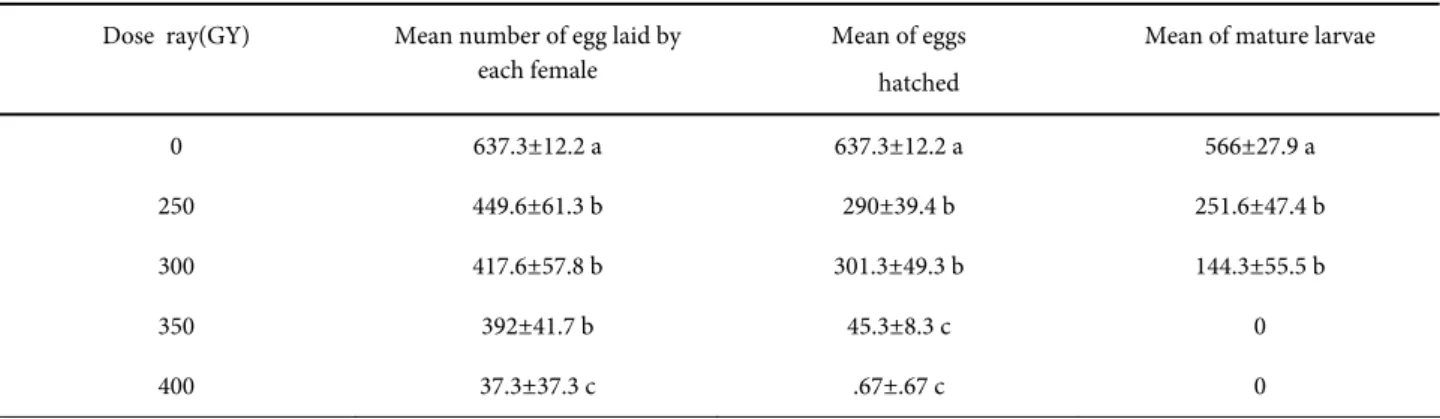
Table 1. The effect of different doses of gamma radiation on the mean of egg number, egg hatching and mature larvae of wax moth
Dose ray(GY) Mean number of egg laid by
each female
Mean of eggs
hatched
Mean of mature larvae
0 637.3±12.2 a 637.3±12.2 a 566±27.9 a
250 449.6±61.3 b 290±39.4 b 251.6±47.4 b
300 417.6±57.8 b 301.3±49.3 b 144.3±55.5 b
350 392±41.7 b 45.3±8.3 c 0
400 37.3±37.3 c .67±.67 c 0
RESULTS AND DISCUSSION
Investigations regarding the effect of various doses of gamma radiation on G. mellonella pupae for male sterility revealed that emergence depended on the radiation dose. There is a significant difference between different doses of gamma-rays regarding the mean of laid eggs at the level of 1%. The ovi-position clearly decreased with increasing doses of gamma-rays. Radiation reduced total egg emergen-ce. The maximum and minimum numbers of hatched eggs were 590 and 0.67 in untreated and specimens exposed to a dose of 400 Gy, respec-tively. The maximum and minimum larval stage which can successfully reach the pupal stage was observed in untreated specimens and specimens exposed to 350 and 400 Gy, respectively. The dose of 350 Gy proved to be suitable for sterilization.
The most suitable release ratio was 4:1:1 (due to the decrease of hatched eggs and the number of larvae that changed to pupae). The maximum and minimum egg hatches can be found in the release treatment at ratios of 2:1:1 and 4:1:1, respectively. The minimum number of produced pupae was in the released treatment at ratios of 4:1:1 and 5:1:1. There is no significant difference between the laid eggs with the increase of male insects to female ones.
Males normally mate several times on any given day and females normally mate only once. If 90% of a native population could be sterilized, reproduction would immediately cease in the females and the males would be available to compete with non-sterile males in mating with non- sterile females. Our results indicate that females of G. mellonella cannot produce offspring without males. Although some female insects could lay eggs without mating, no egg hatching occurs. Thus, this pest is not partheno-genetic. This result is in agreement with previous studies (Chang & Hsieh, 1992; Nielsen & Briester, 1980). The maximum and minimum eggs, 366 and 26.6, were observed in coupled females and virgin females, respectively. The maximum and minimum hatched eggs, 332 and 0, were observed in coupled-females and virgin coupled-females, respectively. The coupled-females
of this pest normally mate only once and males can mate several times on any given day. Thus, the possibility of mating between normal female with sterile males has increased. As far as results of this study are concerned, integrated control should be used. It entails that first an insecticide is used to decrease the population of the pest, followed by the release of sterile males to control the population of the store. The risk of residue of poison in the wax would be as a result of a single exposure of the hives to the poison. Thus, this method could be used either alone or in combination with other control practices. The technique of partial sterility is preferred for the control of lepidopterous pests as complete sterilization tends to induce physiological disturban-ces such as reduction of mating competitiveness, lack of sperm transfer, etc.
In order to develop a MST, attention was paid to the investigation of the G. mellonella dynamics and the estimation of the natural populations by means of traps and markers. Similar to other lepidopterous insects, in G. mellonella comparati-vely higher radiation doses induce sterility. It is well known that the chromosome contains the genetic material, so the severity and quantity of damage to germ-cells would directly affect the fertility of irradiated insects.
Acknowledgment - The authors wish to thank Dr. Ebadi, Dr. Majd and Dr. Zolfagharieh. This research was supported by Karaj Research Center of Beekeeping and the Entomology Laboratory of the Nuclear Energy Center for Agriculture, University of Tehran, Iran.
REFERENCES
Burges, H. D. 1978. Control of wax moth: Physical, Chemical and biological met-hods. Bee World, 59(4),129-138.
Caron, D.M. 1992. Wax moth. American Bee Journal. 132 (10),647-649.
Chang, C.P. and F.K. Hsieh, 1992. Morphology and bionomics of Galleria mellonella. Chinian Journal of Entomology. 12 (2);121-129.
Cole. M.M. Labrecque, G.C. and G.S. Burden, 1959. Effects of gamma radiation on some insects affecting man. Journal of Economic Entomology. 52 (5),448-450.
Colter, D. 1995. Those pesky wax moths. Part 2: Controls.
American Bee Journal.135 (2),121-122.
Ebadi, R. 1975. Wax of bee. Journal of Iranian Entomology. 10 (4),61-64.
Eishen, F.A., Dietz, A. and J.H. Brower, 1984. Effect of again on the mating competitiveness of irradiated male greater
wax moth (Lep.,Pyralidae). Journal of Economic
Entomology. 77 (6),1534-1536.
Goodman, R.D., Williams, P., Oldroyd, B.P. and J. Hoffman,
1990. Studies on the use of Phosphine for the control of greater wax moth, Galleria mellonella in store honeybee comb. American Bee Journal. 130(8),437-477.
Haewoon, O., Young, M., and Y. Chang, 1995. Developing periods of damage patterns of combs by the wax moth, Galleria mellonella.Journal of Apiculture Research. 10 (1),5-10.
Hornizky, M.A. 1994. Commerical use of gamma radiation in the beekeeping industry. Bee World. 75,135-142.
Hubbe, W. 1996. Fighting wax moth larvae. American Bee Journal. 136 (8),579-580.
Knipling, E.F. 1955. Possibilities of insect control or eradiation through the use of sexually sterile males. Journal of Economic Entomology. 48 (4),459-462.
Nielsen, R.A. and G.E. Cantwel, 1973.The question of parthe-nogenesis in the greater wax moth (Galleria mellonella).
Journal of Economic Entomology. 66 (1),37-38.
Nielsen, R.A. and C.D. Briester, 1980. Induced genetic load in descendants of irradiated greater wax moths. Annual Entomology Society of American. 73 (4),460-474.
Smith, T.L. 1965. External morphology of the larva, pupa and adult of the wax moth Galleria mellonella. Journal of Kansas Entomology Society. 38 (3),287-310.
Tamigi, Y. and Akbarzadeh, M. 1982. Diseases of Honeybee.
Journal of Iranian Entomology. 21 (2),45-50.
Walker ,D.W., Singh, H. and K.P. Mackay, 1975. Gamma-induced sterility of the greater wax moth (Galleria mellonella) in sterility principle for insect control.