Static Analysis of G+2 Institutional Building in Bhopal
Aakash Saxena, S S Kushwah
Department of Civil Engineering, UIT (RGPV), Bhopal (MP)
ABSTRACT
A Seismic design is aimed at controlling the structural damage based on precise estimations of proper response parameters. Seismic design explicitly evaluates how a building is likely to perform; given the potential hazard it is likely to experience, considering uncertainties inherent in the quantification of potential hazard and uncertainties in assessment of the actual building response. It is an interactive process that begins with the selection of performance objectives, followed by the development of a preliminary design, an assessment as to whether or not the design meets the performance objectives, and finally redesign and reassessment, if required, until the desired performance level is achieved.
In this present study one R.C. buildings, of G + 2 storey institutional building (designed according to IS 456:2000) are analysed. Analysis and redesigning by changing the main reinforcement of various frame elements and again analyzing. The structural analysis has been carried out using STAAD.Pro V8i, a product of Structural Analysis and Design Program. A total of 1 cases for a particular G + 2 storey institutional building located in Zone-II have been analyzed. The results of analysis are compared in terms of reinforcement in the column and beam. The best possible combination of reinforcement that is economical, effective and whose damage is limited to Grade 2 (slight structural damage, moderate non structural damage) in order to enable Immediate Occupancy is determined and is termed as Seismic Design.
I.
INTRODUCTION
Amongst the natural hazards, earthquakes have the potential for causing the greatest damages. Since earthquake forces are random in nature & unpredictable, the engineering tools needs to be sharpened for analyzing structures under the action of these forces. Performance based design is gaining a new dimension in the seismic design philosophy wherein the near field ground motion (usually acceleration) is to be considered. Earthquake loads are to be carefully modelled so as to assess the real behaviour of structure with a clear understanding that damage is expected but it should be regulated. In this context pushover analysis which is an interactive procedure shall be looked upon as an alternative for the orthodox analysis procedures. This study focuses on pushover analysis of multi-storey RC framed
buildings subjecting them to monotonically
increasing lateral forces with an invariant height wise distribution until the preset performance level (target displacement) is reached. Te promise of performance-based seismic engineering (PBSE) is to
produce structures with predictable seismic
performance. To turn this promise into a reality, a comprehensive and well-coordinated effort by professionals from several disciplines is required.
Performance based engineering is not new. Automobiles, airplanes, and turbines have been designed and manufactured using this approach for many decades. Generally in such applications one or more full-scale prototypes of the structure are built and subjected to extensive testing. The design and
manufacturing process is then revised to incorporate
the lessons learned from the experimental
evaluations. Once the cycle of design, prototype manufacturing, testing and redesign is successfully completed, the product is manufactured in a massive scale. In the automotive industry, for example, millions of automobiles which are virtually identical in their mechanical characteristics are produced following each performance-based design exercise.
The primary objective of this work is to compare the design of building with and without seismic forces by variation in reinforcement by using STAAD.Pro of RC framed building designed. The effect of earthquake force on G+2 storey institutional building of Bhopal, with the help of STAAD.Pro, for various different sets of reinforcement at different levels has been investigated.
Some of the prominent literature on the topic are as follows:
S.Mahesh and Dr.B.Panduranga Rao (2014) considered the behaviour of G+7 multi story building of regular and irregular configuration under earthquake. A residential of G+7 multi story building is studied for earthquake and wind load using STAAD.Pro V8i .Assuming that material properties and static and dynamic analysis are performed. These analysis are carried out by considering different seismic zones and for each zone the behaviour is assessed by taking three different types of soils namely Hard , Medium and Soft .
Kevadkar, Kodag et.al. (2013) observed that the structure heavy susceptible to lateral forces may be concerned to severe damage. In this they found that along with gravity load (dead load, live load) the frames are able to withstand to lateral load (loads due to earthquake, wind, blast, fire hazards etc.) which can develop high stresses. For that purpose they used shear wall and steel bracing system to resist such type of loading like earthquake, wind, blast etc. In this study according to author R.C.C. building is modeled and analyzed in STAAD.Pro and results are compared in terms of Lateral Displacement, Storey Shear and Storey Drifts, Base shear and Demand Capacity (Performance point).
P.B. Kulkarni et. al. (2013) Masonry infill walls are mainly used to increase initial stiffness and strength of reinforced concrete (RC) frame buildings. It is mainly considered as a non-structural element. In this paper, symmetrical frame of college building (G+5) located in seismic zone-III is considered by modeling of initial frame. With reference to FEMA-273, & ATC-40 which contain the provisions of calculation of stiffness of infilled frames by modeling the infill panels are modeled as a equivalent diagonal strut method. This linear static analysis is to be carried out on the models such as bare frame, strut frame, strut frame with centre &corner opening, which is performed by using computer software STAAD.Pro from which different parameters are computed. In which it shows that infill panels increase the stiffness of the structure. While the increase in the opening percentage leads to a decrease on the lateral stiffness of infilled frame.
Salehuddun (2011) focused on nonlinear geometric analysis to be compared with linear analysis. In this study, a six storey 2-D steel frame structure with 24 m height has been selected to be idealized as tall building model. The model was analyzed by using SAP2000 structural analysis software with the consideration of geometric nonlinear effect. This study showed that a steel frame with the consideration of wind load produce greater sway value as compared to the steel frame without wind load
Gajjar and DhavalP.Advani(2011) focused on the design of multi-storeyed steel buildings to have good lateral load resisting system along with gravity load system because it also governs the design. This paper is presented to show the effect of different types of bracing systems in multi storied steel buildings. For this purpose the 20 stories steel buildings models is used with same configuration and different bracings systems such as knee brace, X brace and V brace is used. A commercial package STAAD.Pro is used for the analysis and design and different parameters are
compared. The property of the section is used as per IS 800:2007 which incorporates Limit State Design philosophy.
Kevadkar, Kodag et.al. (2013) observed that the structure heavy susceptible to lateral forces may be concerned to severe damage. In this they found that along with gravity load (dead load, live load) the frames are able to withstand to lateral load (loads due to earthquake, wind, blast, fire hazards etc) which can develop high stresses. For that purpose they used shear wall and steel bracing system to resist such type of loading like earthquake, wind, blast etc. In this study according to author R.C.C. building is modeled and analyzed in STAAD.Pro and results are compared in terms of Lateral Displacement, Storey Shear and Storey Drifts, Base shear and Demand Capacity (Performance point).
Qiang Xue, Chia-Wei Wu et al (2007) summarized the development of the seismic design draft code for buildings in Taiwan using performance-based seismic design methodology and case studied. They presented the design of a reinforced concrete building by using the draft code. Seismic design code provisions are examined according to the theoretical basis of PBSD to identify which methodologies of PBSD need to be incorporated into the current seismic design code.
The performance-based seismic design code
introduces a transparent platform in which the owners and designers can exchange their views on the expected seismic performance of the buildings under different levels of earthquakes.
II.
Methodology Methodology And
Selection Of Problems
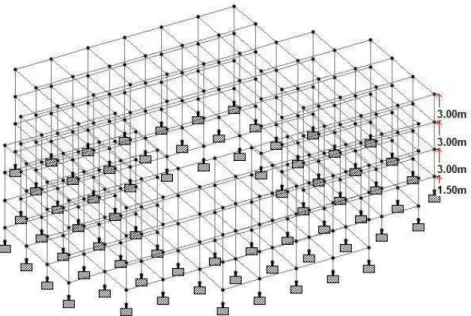
In this present study one R.C. buildings, of G + 2 storey institutional building (designed according to IS 456: 2000) are analysed. Analysis and redesigning by changing the main reinforcement of various frame elements and again analyzing. The structural analysis has been carried out using STAAD.Pro V8i, a product of Structural Analysis and Design Program. Following steps are implemented in this study:-
Step-1 Selection of building geometry
Step-2 Selection of seismic zones
TABLE 1: SEISMIC ZONES FOR DIFFERENT CASES AND MODELS
Case Model Earthquake zones as per
IS 1893 (part-1) : 2002
Step-4 Considering of load combination (13 load combinations)
TABLE 2: LOAD CASE DETAILS
Load case no. Load case details
1. 1.5 (DL + LL)
Step-4 Modelling of building frames using STAAD.Pro software.
Step-5 Results evaluation in terms of maximum bending moment, maximum shear force, axial force, maximum joint displacement and maximum section displacement
III.
MATERIAL AND GEOMERICAL
PROPERTIES
Following properties of material have been considered in the modelling -
Density of RCC: 25 kN/m3
Density of Masonry: 20 kN/m3 (Assumed)
Young's modulus of concrete: 5000 � �
Poisson's ratio: 0.17
The foundation depth is considered at 1.5 m below ground level and the floor height is 4 m.
LOADING CONDITIONS
Following loadings are considered for analysis -
(a) Dead Loads: as per IS: 875 (part-1) 1987 Self wt. of slab
Slab = 0.15 x 25 = 3.75 kN/m2 (slab thick. 150 mm
assumed)
Floor Finish load = 1 kN/m2
Total slab load = 4.75 kN/m2
Masonry Wall Load = 0.25 m x 2.55 m x 20 kN/m3 =
12.75 kN/m
Parapet wall load = 0.25 m x 1 m x 20 kN/m3= 5
kN/m
(b) Live Loads: as per IS: 875 (part-2) 1987
Live Load on typical floors = 3 kN/m2
Live Load in earthquake = 0.75 kN/m2
(c) Earth Quake Loads: All Structures are analyzed for 4 earthquake zones
The earth quake calculation are as per IS: 1893 (2002) [21]
a. Earth Quake Zone-II,III,IV,V
(Table - 2) b. Importance Factor: 1
(Table - 6) c. Response Reduction Factor: 5
(Table - 7) d. Damping: 5%
(Table - 3) e. Soil Type: Medium Soil (Assumed)
f. Period in X direction (PX):0.09∗ℎ
� seconds
Clause 7.6.2 [21]
g. Period in Z direction (PZ):0.09∗ℎ
� seconds
Clause 7.6.2 [21] Where h = height of the building
dx= length of building in x direction dz= length of building in z direction
LOADING DIAGRAM
Typical diagram for different types of loading conditions are shown below
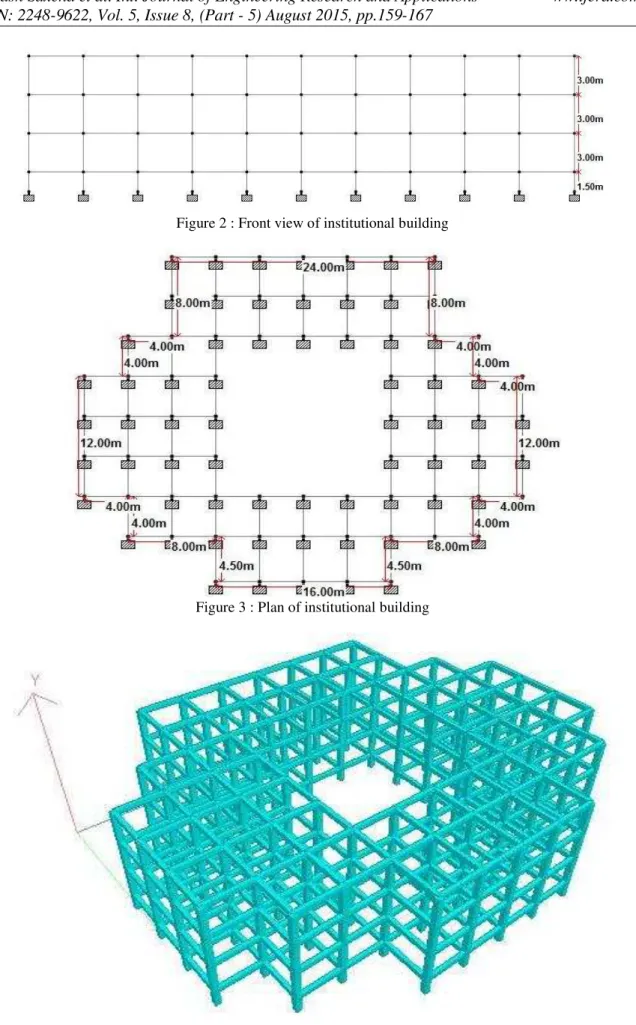
Figure 2 : Front view of institutional building
Figure 3 : Plan of institutional building
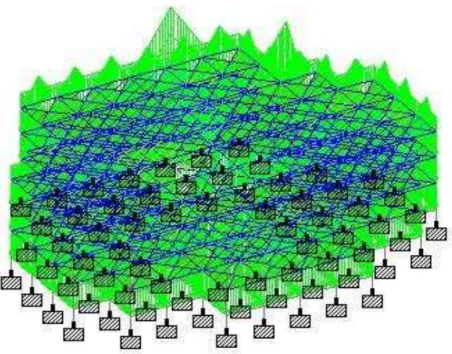
Figure 5 : Dead load of institutional building
Figure 6 : Live load of institutional building
IV.
RESULT AND DISUSSION
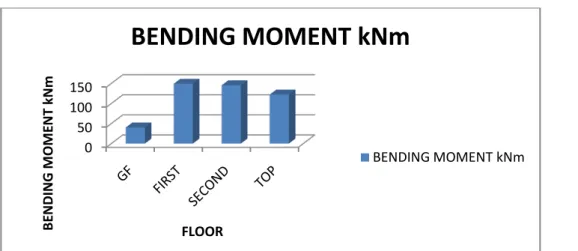
The various results like maximum bending moment, maximum shear force, maximum axial force, maximum joint displacement and maximum section displacement are evaluated and effective and critical floor is determine among the structure considering seismic loading. Following tables and graphs are presented to find optimum system to resist seismic forces under following heads:-
A. Maximum Bending Moment
TABLE 3: MAX. BENDING MOMENT (Mz) kNm FLOOR WISE
MAX. BENDING MOMENT (Mz) kNm FLOOR WISE
FLOOR BENDING MOMENT kNm
GF 40.13
FIRST 149.053
SECOND 145.478
FIGURE 7: MAX. BENDING MOMENT (Mz) kNm FLOOR WISE
B. Shear Force
TABLE 4 : MAXIMUM SHEAR FORCE kN FLOOR WISE MAXIMUM SHEAR FORCE Kn FLOOR WISE
FLOOR SHEAR FORCE kN
GF 54.107
FIRST 229.203
SECOND 227.219
TOP 191.089
FIGURE 8: MAXIMUM SHEAR FORCE kN FLOOR WISE
C. Axial Force
TABLE 5: MAXIMUM AXIAL FORCE KN MAXIMUM AXIAL FORCE KN
FLOOR AXIAL FORCE KN
BASE 1733.519
GF 1584.462
FIRST 1016.806
SECOND 452.876
0 50 100 150
B
E
N
D
ING
M
OM
E
N
T k
N
m
FLOOR
BENDING MOMENT kNm
BENDING MOMENT kNm
0 100 200 300
GF FIRST SECOND TOP
S
H
E
A
R
FORCE
kN
FLOOR
SHEAR FORCE kN
FIGURE 9 :MAXIMUM AXIAL FORCE KN
D. Maximum Joint Displacement
TABLE 6: MAX. JOINT DISPLACEMENT MM FLOOR WISE IN X DIRECTION MAX. JOINT DISPLACEMENT MM FLOOR WISE
FLOOR DISPLACEMENT IN X DIRECTION
GF 0.015
FIRST 0.082
SECOND 0.253
TOP 0.577
FIGURE 10: MAX. JOINT DISPLACEMENT MM FLOOR WISE IN X DIRECTION
TABLE 7: MAX. JOINT DISPLACEMENT MM FLOOR WISE IN Z DIRECTION
MAX. JOINT DISPLACEMENT MM FLOOR WISE
FLOOR DISPLACEMENT IN Z DIRECTION
GF 0.018
FIRST 0.107
SECOND 0.36
TOP 0.812
0 500 1000 1500 2000
BASE GF FIRST SECOND
A
X
IA
L FORC
E
K
N
FLOOR
AXIAL FORCE KN
AXIAL FORCE KN
0 0.2 0.4 0.6
GF FIRST SECOND TOP
JOI
N
T DI
S
PL
A
CE
M
E
N
T
(M
M
)
FLOOR
DISPLACEMENT IN X DIRECTION
FIGURE 11: MAX. JOINT DISPLACEMENT MM FLOOR WISE IN Z DIRECTION
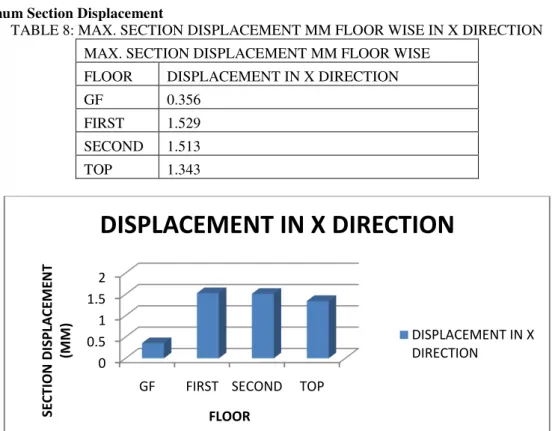
E. Maximum Section Displacement
TABLE 8: MAX. SECTION DISPLACEMENT MM FLOOR WISE IN X DIRECTION MAX. SECTION DISPLACEMENT MM FLOOR WISE
FLOOR DISPLACEMENT IN X DIRECTION
GF 0.356
FIRST 1.529
SECOND 1.513
TOP 1.343
FIGURE 12: MAX. SECTION DISPLACEMENT MM FLOOR WISE IN X DIRECTION
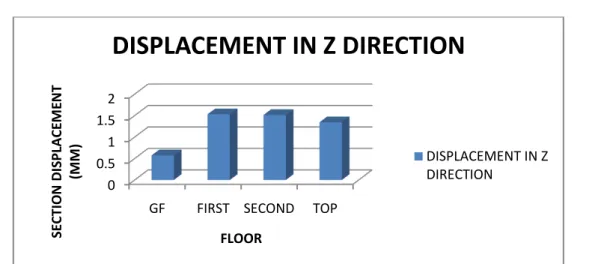
TABLE 9: MAX. SECTION DISPLACEMENT MM FLOOR WISE IN Z DIRECTION MAX. SECTION DISPLACEMENT MM FLOOR WISE
FLOOR DISPLACEMENT IN Z DIRECTION
GF 0.571
FIRST 1.529
SECOND 1.513
TOP 1.343
0 0.5 1
GF FIRST SECOND TOP
JOI
N
T DI
S
PL
A
CE
M
E
N
T
(M
M
)
FLOOR
DISPLACEMENT IN Z DIRECTION
DISPLACEMENT IN Z DIRECTION
0 0.5 1 1.5 2
GF FIRST SECOND TOP
S
E
CTIO
N
D
IS
PL
A
CE
M
E
N
T
(M
M
)
FLOOR
DISPLACEMENT IN X DIRECTION
TABLE 13: MAX. SECTION DISPLACEMENT MM FLOOR WISE IN Z DIRECTION
V.
CONCLUSIONS
In this study, performance of institutional building frames are studied considering various combination and seismic parameters. Results of this parametric study are as follows
1. In beam forces, maximum bending moment and maximum shear force are calculated and it is observe that second floor is critical and ground floor is efficient because of direct contact with soil and foundation.
2. In column force, maximum axial force is calculated and it is observed that maximum load is in base columns because it resist complete load of institutional building and as seen in top floor axial force is reduced up to 4 times of base 3. In joint displacement, maximum displacement is seen in top floor in both direction ( X and Z direction) but Z direction is more critical than X direction.
4. In section displacement, maximum displacement is seen in first floor section in both direction ( X and Z direction)
REFERENCES
[1.] S.Mahesh and Dr.B.Panduranga Rao Comparison of analysis and design of regular and irregular configuration of multi Story building in various seismic zones and various types of soils using STAAD-Volume 11, Issue 6 Ver. I (Nov- Dec. 2014), PP 45-52
[2.] Kevadkar M.D., Kodag P.B., 'Lateral load
(loads due to earthquake, wind, blast, fire hazards etc) (earthquake loads, wind loads, blast, fire hazards etc) Analysis of R.C.C. Building', International Journal of Modern Engineering Research (IJMER), Vol.3, Issue.3, May-June. 2013, pp-1428-1434.
[3.] Salehuddin Shamshinar, Stability of a six
storey steel frame structure, International
Journal of Civil & Environmental
Engineering, Vol.13 No.06, 2011. User Manual STAAD.Pro.
[4.] Chopra, A. K., Dynamics of
Structures(1995): Theory and Applications to Earthquake Engineering, Prentice-Hall. Inc., Englewood Cliffs, New Jersey.
[5.] IS 1893 : 2002, Indian Standard criteria for
earthquake resistant design of frames, Part 1 General provisions and buildings, Draft of Fifth Revision, Bureau of Indian Standards, New Delhi, 2002.
[6.] IS 800:2007, ‘General construction in steel – Code of practice Bureau of Indian standards, New Delhi.
[7.] IS: 875(Part-1)- 1987 ‘Code of Practice for
Design Loads (Other than Earthquake) buildings and frames’, Part-1 Dead load, Unit weight of building materials and stored materials, Bureau of Indian Standards, New Delhi.
[8.] IS: 875(Part-2) - 1987 ‘Code of Practice for
Design Loads (Other than Earthquake) buildings and frames’, Part-2 Imposed loads, Bureau of Indian Standards, New Delhi.
[9.] IS: 875(Part-3) - 1987 ‘Code of Practice for
Design Loads (Other than Earthquake) for buildings and structures’, Part-3Wind loads, Bureau of Indian Standards, New Delhi. 0
0.5 1 1.5 2
GF FIRST SECOND TOP
S E CTIO N D IS PL A CE M E N T (M M ) FLOOR