6
THE RATIONALE BEHIND WEAKLY TIED NETWORKING OF THE BANGLADESHI DIASPORA IN MALAYSIA
Sultana Nayeem, Associate Professor
Department of Development Studies, University of Dhaka, Dhaka-1000, Bangladesh Phone: +880-1924752886, E-mail: [email protected]
Received August 7, 2012
ABSTRACT
This paper is an exploration of the survival strategies of the Bangladeshi Diaspora in Malaysia. To cope with the realities, Bangladeshi migrants develop different forms of survival strategies. As a result intra and inter-ethnic strong and weak ties are formed in the receiving country. Empirical analysis depicts that respondents with weak ties have higher income mobility than those with strong ties. It also demonstrates that the Bangladeshi migrants of the study areas do not restrict themselves only to their close social networks; rather they develop distant networks for higher social mobility. Or in other words, though the ideal socio-cultural model emphasizes community cohesion (something that can be conceptualized as an example of a tightly structured social system), the actual behavior of the Bangla-deshi migrants indicates a loosely or disintegrated social system. Migrant’s embeddedness in the on-going social relations and power structures regulates the nature and strength of these ties.
KEY WORDS
Mixed embeddedness; Bangla bazaar; Bangladeshi diaspora; Strong ties; Weak ties.
Migration and settlement of Bangladeshis in Malaysia is a common fact during this period of globalization. The question is, therefore, not whether Bangladeshis migrate, instead, how they survive in a foreign country and develop different strategies to improve their fortunes. Bearing this question in mind an intensive ethno-survey was conducted both in Bangladesh (country of origin) and Malaysia (country of residence)1. These mi-grants are found as the heterogeneous groups of people, embedded in the diverse realities and lia-bilities of the origin and host societies2.
Therefore, in this study, the readers may come across their non-homogeneous interests and
1
Sultana, N. 2008. The Bangladeshi Diaspora in Malaysia. Organi-zational Structure, Survival Strategies and Networks, ZEF Devel-opment Studies. LIT: Berlin
2
Research for this study was carried out through the financial assis-tance of DAAD (German Academic Exchange Service). Field re-search in Malaysia and Bangladesh was conducted among the im-migrants and their families from June 2005 till August 2006. Field research data are derived from an interview-survey among 150 current Bangladeshi migrants in Malaysia and intensive ethnograph-ic fieldwork in Bangladesh and Malaysia. Along with 165 semi-structured interviews (with returned and current migrants), some group discussions were arranged with returned migrants, their fami-lies, friends and neighbourhoods as well as with a N.G.O (estab-lished by well-off repatriated migrants). Sources of secondary data were literature reviews, newspaper articles, published and unpub-lished reports and conference papers.
concomitant coping strategies. There (in the re-ceiving society) networking is an asset. Our anal-ysis has moreover evidenced that depending on their demands firstly of adaptation (to cope and survive in a foreign country) and secondly of upward mobility both strong and weak ties have been developed along the lines of horizontal and vertical networking. These networking are for-mulated (by the migrants) on the basis of the di-verse everyday realities they face through their “mixed embeddedness”3. Regarding this, both the socio-economic, political and institutional struc-tures of the origin and receiving countries as well as migrants’ socio-economic statuses, transna-tional contacts and duties are found as the regula-tors. Thus, along with bonds of strong and weak ties different types of alliances and cleavages are developed by the well-off and poor migrants in the horizontal level. Consequently, instead of homogeneity, heterogeneity and diversity are the common criteria for the Bangladeshi Diaspora in Malaysia.
However, apart from these primordial types of networking, a kind of inter-ethnic strong
3
7
ter-ethnic friendship, marital and other kinds of intimate relationships) and weak ties (commercial networking like partnership in business etc.) were also found as the outcome of the migrants’ em-beddedness in the receiving society, with which after all they had to cope with.
The question is which of these characteris-tics are prominent, how do they contribute to the organizational structure of the community and in what context does that happen? Therefore, in the next sections at first we will define how strong and weak ties are operationalized. Later on, Gra-novetter’s (1973, 1983, and 1985) conception of “strong” and “weak ties” and the concomitant strength of weak ties (posited by him) will be analyzed testing against the data of this study4. This type of comparison is important on the ground that the formulation of different forms of networking, like friendship (for adaptation) or distant relationships (for survival in the host so-ciety), were defined by the migrants as a must that may bear a resemblance to his (Granovetter) point of view. This study will continue discussion highlighting the following aspects: methodology; operational definitions of strong and weak ties; revisiting Granovetter’s conception on strong and weak ties.
Methodology. A brief overview of the sources of data and the methods that were applied to collect data is important to support the argu-ments of this study. Field research in Malaysia and Bangladesh was conducted among the immi-grants and their families from June 2005 till Au-gust 2006. Field research data are derived from an interview-survey among 150 current Bangla-deshi migrants in Peninsular Malaysia and inten-sive ethnographic fieldwork (with returned and current migrants) in Bangladesh and Peninsular Malaysia.
Applying snowball sampling (something usually applied to find hidden population) Ban-gladeshi respondents were selected. In fact, nei-ther the immigration department of the host coun-try nor the emigration authorities of the home country had any concrete information about Ban-gladeshi migrants. Likewise, the central statistics bureau, the local police as well as the Bangladesh
4
Mark S. Granovetter. 1973. The Strength of Weak Ties. AJS vo-lume 78, Number 6 and Mark S. Granovetter. 1983. The Strength of Weak Ties: A Network Theory Revisited. Sociological Theory, volume 1. See also Mark Granovetter. 1985. The University of Chicago. Economic Action and Social Structure: The Problem of Embeddedness. AJS Volume 91 Number 3, p. 481-510.
High Commission in Malaysia failed to provide any data about the “hotspots” of Bangladeshi mi-grants or their statistical figure in Malaysia. On the contrary, each of them spoke of the migrants’ essentially mobile character. They also empha-sized that Bangladeshi migrants used to stay and work there as undocumented workers and even, some of them could be found as husbands of Ma-laysians. Consequently, some open-ended ques-tions were added in the survey questionnaires that provided information about the nature of their integration, embeddedness in local society and coping strategies.
Besides, utilizing the networks of the res-pondents selected for interview-survey, intervie-wees were selected for more intensive interviews. These in-depth interviews were conducted to see whether or not the best solution was taken by Bangladeshi migrants to deal with their multi-dimensional embeddedness. Data, collected in that way, revealed that social networks, devel-oped along the lines of horizontal and vertical networking, supported the migrants bearing their socio-cultural and psychological responsibilities in the transnational hubs. The said networks, moreover, decreased their costs of migration.
Operational definitions of strong and weak ties. Trust is a common factor in close so-cial networks. Unless an extreme situation (struggle for a scarce resource, e.g. an opportuni-ty of migration to a foreign country) arrives, re-spective fellow feelings, duties and moral obliga-tions remain intact within these strong ties that may echo the examples of the Chinese Gunaxi model as portrayed in Hammond’s work5. Refer-ring to the work of Gao and Ting Toomey (1998) he has argued that the unconditional sharing of information (even secret) within the insider net-works, is the main function of the Gunaxi rela-tionship. In these relationships members are con-sidered highly trustworthy and they are obliged to maintain that honor. According to him, within the insider networks relationships are perceived as family or like a family that cannot be altered ex-cept under extreme conditions. However, it is now known to us from the previous section’s dis-cussion that with the exception of friends (that means fictive ties) most of the actors of strong ties always remain intimate since they possess common goals as each other’s consanguine and affine.
5
8
For weak ties, the opposite situation is sup-posed to be normal, since this relationship is de-veloped to mitigate different kinds of supply and demand. Since their (migrants’) close networks fail to fulfill their necessities (because of limited capabilities), they develop weak ties. For exam-ple, managing a way of migration or finding al-ternative sources of income etc. are fulfilled by developing weak ties. The actors of weak ties are not closely related to each other and hence do not meet frequently. In the same way, these people are not morally bound to assist each other, unless their service is purchased by the clients. Though the relationship is also developed instrumentaliz-ing national brotherhood, but it mainly works depending on commercial exchange, instead of relying only on moral obligations (that can be seen in strong ties).
Due to mutual demand for upward mobility well-off brokers support their clients (after ex-tracting service charges from them) as parts of their manpower business; while on the other hand, in order to find ways of migration or higher income mobility, poor migrants develop relation-ships with them. Better-off businessmen cum brokers depend on poor migrants to make a profit via manpower and “hundy” business. They (the poor migrants) are also the buyers of Bangladeshi goods and food stuffs from these entrepreneurs’ enterprises, which operate in the study areas. Hence the actors of weak ties know that these ties are secondary (derivative/unoriginal) in nature and are essentially a tool for upward mobility. Accordingly it delineates that within the weak ties - all the actors cannot belong to the same
so-cio-economic position and are not the possessors of equal capabilities (as well).
As a matter of fact, if they all held equal power, information and capabilities to command any act, then none of them would waste money and time on these then essentially useless their weak ties. Rather, as a rational human being, they would find their own way depending solely on their strong ties. As an opposite form of relation-ship the strong ties on the other hand, are infor-mal and primary (fundamental/original) in nature. They become parts of their close social networks naturally, owing to their embeddedness in kin-ship (blood related and marital kin) and friend-ship circles. So, these are the strong and weak tie situations in the study areas of Peninsular Malay-sia.
Nevertheless, to make clear how strong and weak ties are operationalized in this research, discussion on the following variables are incor-porated to extract ideas about the roles and mod-es of networking as a potential survival strategy. The variables and values are:
Frequency - the following questions were asked to find out how often actors of a network meet or get chances for interpersonal interaction:
With whom are you living here? With whom are you working here? Do you have any fixed place or area for community get together? Where is this meeting place? When do you usually meet? How do you pass your leisure time? Normally where do you meet your inter-ethnic friends?
Concerning these queries the following table is constructed:
Table 1 – Frequency of Networks
Housemate Co-workers
Fixed place for community get together Passing leisure time Get together with inter-ethnic friends E th n ic ( 6 1 .3 % ) A lo n e (6 .7 % ) E th n ic an d i n te r-et h n ic (3 2 % ) E th n ic A n d i n te r-et h n ic (9 4 .6 % ) N o t fi x ed (5 .3 % ) Y es (9 7 .3 % ) N o (2 .7 % ) Within
Neighbor-hood Outside
1-Housemates (18%) 2-Workmates (48.7%) 3-Mosjid and restaurant (15.3%) 4-Neighbour (18%) 1-Enjoying movies at home (9.3%) 2-Gossiping in local restaurant (12%) 3-Visiting local friends (10%) 1-Visiting Kotaraya (23.3%)
2-Going to pub 12.7%)
3-Attending religious, political meetings and community get together
(32.6%)
9
Table 1 denotes that apart from maintaining networks with their housemates, workmates and neighbors, Bangladeshis also attend different po-litical and religious meetings and cultural cele-brations. There are certain places for this kind of celebration which the migrants (both poor and off) try to visit. It is found that the better-off migrants become the conveners of these cul-tural and politico-religious programs, where poor migrants participate in their free times. They visit Kotaraya (‘Bangla Bazaar’) to buy Bangladeshi goods from ethnic enterprises as well as to meet powerful labor brokers.
The data also indicates that the migrants’ common living and working environment pro-vides them the opportunity for regular contact with their ethnic and inter-ethnic friends. The common living and working niche as well as eve-ryday interactions enable them to develop friend-ships with each other. In fact, along with the common experiences of immigration and every-day contacts, they (the Bangladeshis) face more or less the same realities as neighbors and work-mates. Besides, they are found to spend their lei-sure hours together in their common surround-ings (apart from visiting distant places and weak tie based networks). However, while the locals do not need to face an alien way of life (since they are all insiders there), owing to regular corres-pondence either in local restaurants or at their home and work places both of these groups still get the chance to construct networks. Banglade-shis meet the locals of Muslim belief in local mosque and “suraus”. Because of the same reli-gious background (Islam) most of the Banglade-shi migrants and their (Malay, Indian Muslim and Indonesians etc.) friends enjoy and practice more or less similar religious festivals and rituals.
Strength and Intensity - To pull out infor-mation on the emotional intensity, reciprocal ex-change and respective obligations to each others in the network some questions were asked, such as:
Whom do you consider your friend? How do you define your friend? Why do you maintain networks? How do you manage jobs and work permits? How did you get your dwelling place? Who introduced you to your employer? Where do you go to acquire a better job and other facili-ties? Do you pay them? Why do you assist poor/undocumented workers? How did you mi-grate? How do you send remittance to home country? How did you learn Bahasa? How do
you manage to cope here? Why are you living together with others? How did/will you manage to stay longer? Why do you maintain homeland contacts? Why did you prefer inter-ethnic mar-riage? How did you meet your inter-ethnic spouse? How did you manage your business vi-sa? How did you get this property? How did you manage risks?
As a matter of fact, friendship ties were found primarily within people of the same socio-economic background. For example, un-skilled and semi-skilled workers identified other workers as their friends who often also were their house-mates, neighbors and workmates. In the same way, no professional and businessman was found who considered a semi-skilled and un-skilled worker as his or her friend. It is not likely that all of the neighbors or co-workers converted each other’s friend. Nor was national brotherhood con-sidered as the only factor for friendship. Rather, migrants emphasized those as their friends whom they could trust in need. According to Ranjan Mallik (he used to work in a furniture factory of Kajang),
“My co-workers, likewise Bangladeshi workers in Kajangjaya, are my friends. We are not so well-off. We have to send money to our families. I also have some friends in my home town. They take care of my family. Sometimes I send gifts for them or try to make phone calls. But I don’t have any girlfriend. I also don’t like the rich and educated Bangladeshis. They behave like we are not their countrymen. I know they would not assist me in danger. I don’t know any female workers. It is better to avoid them, be-cause they might create extra burdens and our families would not be happy about that.”
10
types of reciprocal obligations may remind us of the Chinese style of reciprocity, which is, “favors are always remembered and returned, but not al-ways quickly. People who don’t return favors are seen as poisoning the well”6.
Migrants on the other hand, reciprocate their service through being related with them. Main-tenance of correspondence sometimes by gift do-nations or by long distance phone calls (allowing migrants to keep themselves informed about re-cent events) eases the cross border friendships. Thus along with the consanguine and affine, friends (both home and abroad) become part of the close social networks of the migrants.
All of the workers (100%) argued that they needed to buy these services (management of a new job, renewal of work permit, immigration to Malaysia, transfer of money back to home etc.) from their powerful patrons (e.g. brokers cum businessmen). They went on to say that these brokers tried to “cheat” workers if they noticed that their so-called clients failed to participate in their forgeries and other un-lawful activities. Poor migrants thus instead of feeling loyalty and gratefulness (what they feel for their strong tied networks) towards their distant vertical networks, preferred to consider them as a strategy for high-er social mobility. Thhigh-erefore, from the compari-sons between horizontal (intimate networks) and vertical networking (distant networks) we may safely say that distant and close social networks fundamentally do not resemble each other. Strong ties and close social networks incorporate mutual feelings and emotions towards each other, whe-reas in weak ties the expectation of material gains (higher income mobility, finding ways of settle-ment etc.) was more vital than any other con-cerns. Considering weak ties as distant relation-ships, actors visit them only when they become unable to fulfill their demands. As a result, the relative frequency of interactions of weak ties is lesser than that of strong ties.
Whilst poor migrants strive after vertical networking with their affluent country men, the well-off businessmen try to enrich themselves (buying houses, setting up business enterprises, managing permanent resident status, staying on spouse visa etc.) through inter-ethnic business and marital relationships as well as depending on intra-ethnic weak ties. They meet their inter-ethnic spouses either as co-workers and
6
Scott et al. (2004)
bors (33.3%) or through inter-ethnic friends’ con-tacts (66.7%). Because of the embeddedness in the institutional structures of the host society, these well-off businessmen instrumentalize inter-ethnic networking to by-pass the anti-integrating immigration policy. Therefore, these privileged Bangladeshis not only empower themselves through patron client relationships, but also through inter-ethnic business and marital rela-tions.
Learning from their predecessors, poor mi-grants also try to develop inter-ethnic strong ties as they can then settle down in Malaysia and gain different means for shadow economic activities. Consequently, though for intra-ethnic strong ties moral obligations are the major factor, for inter-ethnic strong ties commercial necessity is also a significant factor (for Bangladeshi migrants). However, these are identified as strong ties (ra-ther than weak ties) on the ground that the marital relationship opens a scope of options for integra-tion into the host society. Regarding this, Ban-gladeshi husbands also do not need to pay their inter-ethnic spouses. Actors do not belong to sep-arate households; rather they interact on a daily basis. Bangladeshi husbands and their inter-ethnic wives have more or less common aims (the well-being of their offspring and household).
Revisiting Granovetter’s Conceptions on Strong and Weak Ties7. In his two articles en-titled ‘The Strength of Weak Ties’ and ‘The Strength of Weak Ties: A Network Theory Revi-sited’, Granovetter (1973, 1983) sets some argu-ments on the functions of interpersonal networks, such as: (1) if any information is passed through weak ties it will reach a larger number of people and also cross more social distance than if same is attempted by strong ties (restricted to a small group of friends), because weak ties bridge dif-ferent groups of people from difdif-ferent levels, (2) a person who has few or no weak ties is less like-ly to manage a way for upward mobility. Individ-uals with numerous weak ties can overcome this constraint. Since strong ties possess the same type of information that he already has, (such as, information about appropriate jobs openings at the exact time etc.), he fails to achieve his goals
7
11
unless he increases his stock of information through forming weak ties.
The hypothesis of the following statistical analysis is migrants with weak ties have higher income mobility than others with strong ties. Some proxies are made to define weak and strong ties, e.g. respondents were asked how they passed their leisure time? Their answers are coded as:
Weak tie: visiting ‘Bangla Bazaar’ of Kota-raya, going to pubs and shopping centres, attend-ing religious and political discussion and com-munity get togethers.
Strong tie: watching movies using satellite (with the housemates), visiting local friends (neighbours) and gossiping in a restaurant (local).
We have regressed their monthly wage with both quantitative regressors: job alteration, length of stay in years in Malaysia and qualitative or dummy regressor: weak or strong tie. ANCOVA (Analysis of Covariance) model is as follows:
i i i
i
i
D
X
X
u
Y
=
β
1+
β
2 2+
β
3 2+
β
4 3+
,
where, Yi= monthly wage of the ith migrant in
RM, X2i= job alteration of the ith migrant, X3i=
length of staying in years of the ith migrant, D2i=
1, if the migrant has weak tie; 0, otherwise (if strong tie). With
u
i = error term, β1= constant,4 3 2,β ,β
β = coefficients of dummy, job alteration and length of staying respectively. The following regression results are obtained:
i i
i
i D X X
Y =−7.295+363.779 2 +93.556 2 +83.228 3
∧
se = (250.001) (173.518) (74.742) (19.806)
t = (-.029) (2.096) (1.252) (4.202)
p-value= (.977) (0.038)*(.213) (0.000)*
R2 = .171, n= 150
Where, se means standard error of the esti-mated coefficient, t is t-statistic, p-value is the probability value, * - indicating p-value is signif-icant at 5% level of significance, R2 is multiple coefficient of determination, i.e. the 17% varia-tion in wages are explained by the regressors and n is the sample size.
From the above results, it can be concluded that the dummy variable and length of stay have statistically significant relationship with the wage. Duration of migrant life in the host country has the strong positive effect on wage. Keeping
all other variables constant, the average monthly wages of migrants with weak ties are higher by about RM 363.78 than those with strong ties. Our data in this study is cross-sectional one where heteroscedasticity may involve frequently. So, we assume that ui is normally distributed with mean
zero and variance 2
i
σ , i.e. ui~N(0,σi2). We test
by graphical method and White’s general hete-roscedasticity test (White, 1980) with the null hypothesis: H0: there is no heteroscedasticity in
the error variance and found H0 may be rejected.
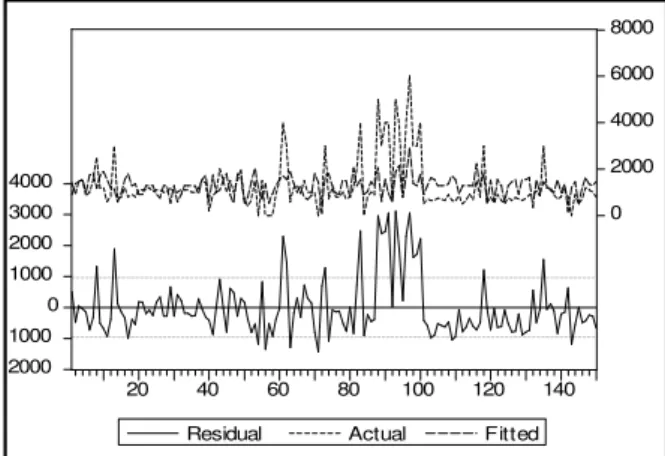
Figure 1 – Plotting residual to check heteroscedasticy
From the above figure, it is depicted that the residual term of the fitted regression showing heteroscedasticity for different values of the re-gressors. The variances of the error (according to the black line of zero value) are fluctuating for different values at different band width.
Table 2 – White Heteroskedasticity Test Results
F-statistic 9.932964 Probability 0.000000
Obs*R-squared 38.46709 Probability 0.000000
So, this study performed the White heteros-cedasticity-consistent variances and standard er-ror test for the remedy of heteroscedasticity and to get robust standard errors.
Table 3 – White Heteroskedasticity-Consistent Stan-dard Errors & Covariance
Variable Coefficient Std. Error t-Statistic Prob.
CONST -7.295058 279.9356 -0.026060 0.9792
Dummy 363.7786 130.4603 2.788424 0.0060
Alteration of job 93.55614 82.85140 1.129204 0.2607
Length of staying 83.22766 33.05351 2.517968 0.0129 -2000
-1000 0 1000 2000 3000 4000
0 2000 4000 6000 8000
20 40 60 80 100 120 140
12
From the above results, it is depicted that standard errors are changed from the earlier esti-mates but the dummy and duration of abode in Malaysia remain significant at 5% level of signi-ficance. So, there is significantly and robustly higher average wage of migrants with weak ties than those with strong ties.
Our regression result shows that job altera-tion is insignificant and is very much related to the other realities of the study areas (of Peninsu-lar Malaysia). It was noticed that migrants changed their jobs or were forced to quit it not only for higher earning, but also for other causes. Such as: (1) dismissal from job by the employer, (2) to find a permanent job (though sometimes the new one is not highly paid), (3) being arrested
(as undocumented workers) they lost their job, (4) for security, (5) to prolong their duration of stay they change jobs (to bypass law that imposes a restriction on the un-skilled and semi-skilled migrant workers saying that they are not allowed to work for more than ten years), (6) due to sick-ness (caused by a hard working job), (7) some workers identified some jobs as “risky” (immi-gration police might come and want to check their ‘jalan card’) and not preferable (e.g. work-ing under sun or in open space, mostly, in the construction site) and changed jobs etc.
However, the above result regarding the contributions of weak ties on the higher income mobility of migrants can also be shown through the following line graph:
Figure 2 – Contribution of Strong and Weak Ties for Higher Income Mobility
The line graph depicts that migrants with weak ties have higher income mobility than those with strong ties. Though we do not see a smooth line graph, the average monthly income rate non-etheless shows that weak tied groups on average manage to stay longer and earn RM 6000, whe-reas for strong tied groups the highest income rate is around RM 2000 in their 9th year. The line graph does not indicate that strong tied networks help them to earn this amount. Rather, it is
13
see a decreasing rate of earning until their 11 year of stay. In their 12th and 13 years they slightly increased their slim earnings, but in the end were not successful at this. They even failed to reach their previous rate of income (RM 2000), though they had stayed in Malaysia for more than 10 years. Or in other words, their length of stay did not assist the strong tied groups to earn more. Though they had stayed more than 10 years, they had restricted themselves to their own (ethnical) domain. Limited capabilities and information (which in any case they already possessed) failed to show them paths for higher income mobility.
On the contrary, regarding weak ties though we notice a lower income rate at the very begin-ning, it finally helps the migrants to reach their peak. Migrants who migrated depending only on weak ties (commercial labour brokers) could not adapt to the foreign environment in the begin-ning. As they lacked the strong ties, necessary to cope (with foreign customs, language, ways of working etc.) with their immigrant life, they failed to earn more. But after staying a while they gradually achieved local knowledge on “what to do, where to go” and also managed to develop new networks, necessary for upward mobility. These new ties not only provided them with the opportunities for higher income mobility, but also incorporated risks. Therefore, the decreasing rates of income of the followers of weak ties can be explained highlighting risks. It is found that in the host society migrants encounter different types of risks ranging from intra-ethnic tension to inter-ethnic conflict. For example, while some of the poor migrants identify their weak ties or pa-trons as exploiters, they also express their fears of Tamil Indians. However, to overcome these drawbacks they need to find another weak tie (a well-connected person both with the local power structure and other well-off countrymen). They try to find a better one who likewise possesses the necessary capabilities, links (networks) and who is also knowledgeable in combating risks. To find a “risk free” & better strategy they form new weak ties so they can stay longer in the study areas and also manage opportunities for higher income mobility. Though they consider weak ties as commercial and exploitative, they still do not prefer to depend only on their trust-worthy strong ties. Their strong ties represent their own workmates, housemates as well as rela-tives (who possess more or less same level of information and networks that they themselves
already have). Having failed to find a suitable job at home, they migrate to Malaysia to make their fortunes (within a short time frame). They also want to earn more for a “better future”. They know, if they fail to earn enough money, they will be unable to maintain their expenditures both at home and abroad. As a result, even though they consider their weak ties exploitative they depend on them unless better ones are found. Through criticizing them they feel psychological relief. They also express their expectations to-wards well-off countrymen. For example, “He is rich, but very polite! Not like others.” This single sentence denotes how through discursive practic-es migrants are exprpractic-essing their experiencpractic-es and expectations towards well-off people. According to Moerman (1988),
“In every moment of talk, people are expe-riencing and producing their cultures, their roles, their personalities.”
However, though weak ties are identified as exploitative, the line graph nevertheless shows that respondents with weak ties have higher in-come mobility than those with strong ties. At the same time, it also demonstrates that the Bangla-deshi migrants of the study areas do not restrict themselves only to their close social networks; rather they develop distant networks for higher social mobility. Thus the migrants of a certain area remain connected with other migrants from different parts of the host society. They thus get opportunities to construct interpersonal networks through weak ties, because most of the less privi-leged migrants visit either ‘Noakhali’ group or ‘Barishal’ group for their higher social mobility. Through their transnational business activities, the better-off merchants assist poor migrants so that they can maintain transnational networks with their kith and kin.
14
social status and prestige both in the origin and receiving countries. The well-off businessmen cum manpower agents, who make up the weak ties of these poor migrants, also try to continue the relationship because of their business inter-ests.
Along with kinship based strong ties, it also incorporates weak ties, where profit maximiza-tion, conflicting interests etc. are major concerns. Or in other words, though the ideal socio-cultural model emphasizes community cohesion (some-thing that can be conceptualized as an example of
a tightly structured social system), the actual be-havior of the migrants indicates a loosely or dis-integrated social system. On the contrary, the well-off professionals and professionals cum merchants mainly depend on trust based strong ties, since these networks possess enough infor-mation and contacts required for upward mobili-ty. Micro level individual’s life is thus connected with the macro level authorities, while the mi-grant’s embeddedness in the ongoing social rela-tions and power structures regulates the nature and strength of these ties.
REFERENCES
Gao, G. and Ting-Toomey, S. 1998. Commu-nicating Effectively with the Chinese. Thousand Oaks, CA: Sage.
Granovetter, Mark S. 1973. The Strength of Weak Ties. The American Journal of So-ciology, Volume 78, No. 6, 1361-1380. Granovetter, Mark S. 1983. The Strength of
Weak Ties: A Network Theory Revisited. Sociological Theory, Volume 1, 201-233. Granovetter, Mark S. 1985. Economic Action and Social Structure: The Problem of Em-beddedness. The American Journal of So-ciology, Volume 91, No. 3, 481-510. Kloosterman, Robert, Joanne van der Leun and
Jan Rath. 1999. Mixed Embeddedness: (In) formal Economic Activities and Im-migrant Businesses in the Netherlands. In-ternational Journal of Urban and Regional Research, Volume 23, No. 2, 253-267. Michael Moerman. 1988. University of
Penn-sylvania Press. Talking Culture. Ethno-graphy and Conversation Analysis, p. pre-face xi.
Scott C. Hammond & Lowell M. Glenn. E: 2004. The Ancient Practice of Chinese Social Networking: Gunaxi and Social Network Theory, Vol. 6 Nos. 1, p. 24-31. Sultana, Nayeem. 2010. The Solutions of the
‘Trans-migrants’ Dilemma. The Bangla-deshi Diaspora in Malaysia. Dhaka Uni-versity Journal of Development Studies, 1(1): 181-192. Dhaka University Journal of Development Studies, 1(1): 181-192. Sultana, Nayeem. 2010. Re-visiting the
Strength of Weak Ties: Bangladeshi Mi-gration to Malaysia. Journal of Diaspora Studies, 3(2): 115-142.