Pakistan Vet. J., 2008, 28(1): 5-8.
5
COMPARATIVE PRODUCTIVE PERFORMANCE AND EGG CHARACTERISTICS OF PULLETS AND SPENT LAYERS
F. YASMEEN, S. MAHMOOD1, M. HASSAN, N. AKHTAR AND M. YASEEN2
Department of Zoology, Government College University, Faisalabad;
1
Department of Poultry Science, 2Department of Statistics, University of Agriculture, Faisalabad, Pakistan
ABSTRACT
Production performance and egg quality characteristics of pullets and spent layers were compared in this study. Forty birds, each from the flocks of pullets (24 weeks old) and spent layers (76 weeks old) were selected as experimental birds. The birds from each age group were divided into five replicates, each comprising of eight birds. All the experimental birds were fed a commercial layer ration @ 110g/bird/day for 12 weeks. The data on egg production, feed consumption, egg weight and egg quality characteristics viz. shell thickness, shell weight, breaking strength, albumen diameter, albumen weight and yolk weight were recorded. The data thus collected were utilized for calculation of FCR, Haugh unit and yolk index values. The results revealed that pullets produced more eggs and utilized their feed more efficiently than spent layers. However, egg weight in spent layers was higher than in their counterparts. Pullets also produced eggs with thicker shell and higher Haugh unit values when compared to the spent layers. Feed consumption and yolk index values remained unaffected due to the age. Pullets also had better egg quality characteristics than those of spent layers.
Key words: Pullets, spent layers, egg production, FCR, egg characteristics.
INTRODUCTION
Commercial hybrids (layers and broilers) all over the world are being propagated for production of eggs and meat. The hybrid layers usually start laying at about 20 weeks of age and peak egg production is attained during the first production cycle. The average production rate of commercial layers usually remains very close to 0.9 eggs per day (Kekeocha, 1985). However, as the age increases, their egg production decreases. This situation is further aggravated during the second production cycle. Appetitive behaviour of hens is also affected during the later stage of production age. The climatic conditions have also been known to affect the production behaviour of the laying hens (Oluyemi and Roberts, 1979; Smith and Leclecq, 1990). In areas where climate is hot and humid, commercial hybrids produce an average of 180-200 eggs per year, while in more temperate climate, birds can produce between 250 and 300 eggs per year. The production cycle of eggs may also be influenced by many other factors such as breed, mortality rate, body weight, laying house lightening schedule, feed and culling (North and Bell, 1990).
After one year of production, layers are culled and used for meat purpose without exploiting their full inherent potential, which can be exploited up to second production cycle (North and Bell, 1990). The factors like diseases and market rates usually reflect a
miserable picture of annual flock replacement while rearing new pullets for profitable egg production. Moreover, keeping aged hens as such is uneconomical because of gradual decline in egg production with more erratic clutch cycles and poor feed efficiency in the relatively heavy layers. Therefore, pullets and spent layers must be managed effectively and efficiently in order to get maximum output and profitability (Kekeocha, 1985).
However, very little research work has been conducted under local climatic conditions in Pakistan to exploit the production potential of spent layers. Therefore, this project was designed to compare the production performance of pullets and spent layers. The effect of age on various egg characteristics in these birds was also studied.
MATERIALS AND METHODS
Pakistan Vet. J., 2008, 28(1): 5-8. 6
birds were maintained under the same managemental conditions. The temperature was maintained at about 24-26°C, while the relative humidity inside the experimental room varied between 50 and 60%. The birds were provided light for 16 ½ hours daily.
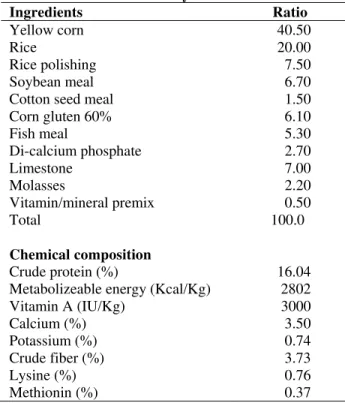
Table 1: Ingredients and chemical composition of the commercial layers ration
Ingredients Ratio
Yellow corn 40.50
Rice 20.00
Rice polishing 7.50
Soybean meal 6.70
Cotton seed meal 1.50
Corn gluten 60% 6.10
Fish meal 5.30
Di-calcium phosphate 2.70
Limestone 7.00 Molasses 2.20
Vitamin/mineral premix 0.50
Total 100.0
Chemical composition
Crude protein (%) 16.04
Metabolizeable energy (Kcal/Kg) 2802
Vitamin A (IU/Kg) 3000
Calcium (%) 3.50
Potassium (%) 0.74
Crude fiber (%) 3.73
Lysine (%) 0.76
Methionin (%) 0.37
The data on weekly feed consumption, egg production, egg weight and mortality, if any, were collected to calculate the feed conversion ratio (FCR) for birds of the two groups on the basis of per dozen eggs or per Kg egg mass produced. Random samples of three eggs from each replicate were taken weekly. The eggs were broken to check their quality characteristics i.e. breaking strength, shell thickness, shell weight, albumen weight, yolk weight, albumen diameter, yolk diameter and yolk height. The observations recorded were used to calculate Haugh unit and yolk index
values. The data thus collected were subjected to analysis of variance technique using completely randomized design (Steel et al., 1997).
RESULTS AND DISCUSSION
The mean values of the feed consumption, egg production, egg weight, FCR/dozen of eggs and FCR/Kg egg mass are shown in Table 2. There was no significant difference in the feed consumption values of pullets and spent layers, indicating that increase in age did not exert any effect on feed intake of birds. Applegate et al. (1999) and Schafer et al. (2005) also observed that feed intake did not differ significantly with increase in age of birds. However, Mehta et al.
(1986) observed that the spent layers consumed more feed than pullets. The reason for the contrary findings might be difference in the strain of birds used for these studies.
Egg production in the pullets was higher (P<0.01) than the spent layers. Kriz et al. (1988), Bell and Adams (1992), Siopes (1995) and Bare and Striem (1998) also reported higher egg production during the first year than in the second year of production cycle. The probable explanation for more egg production in first production cycle may be the ability of birds to utilize their feed more efficiently than those of second production cycle as has been indicated by the results of this study regarding FCR.
Spent layers produced significantly heavier eggs than those of pullets (P<0.01). Verheyen and Decuypere (1991), Bare and Striem (1998) and Peebles
et al. (2000) also found that egg weight of layers increased with the increase in age of birds. Similar results have been reported by Suk and Park (2001) in two commercial egg type strains of chicken i.e. ISA Brown (CEC) and Korean Native Chicken (KNC) where egg weight increased with increase in age (45 to 80 weeks of age). Egg weight is largely affected by the environmental factors and food restriction (Shaler and Pasternak, 1993) alongwith evidence of genetic involvement including breed effect.
Table 2: Mean values of feed consumption, egg production, egg weight, FCR/dozen of eggs and FCR/ Kg egg mass basis for pullets and spent layers
Treatment groups Parameters
Pullets Spent layers
Feed consumption (Kg) 1.54 ± 0.145 1.52 ± 0.137
Egg production 12.80± 1.114a 10.06± 0.966b
Egg weight (g) 51.36± 2.825a 58.05± 3.541b
FCR/dozen of eggs 1.45± 0.111a 1.83± 0.159b
FCR/Kg egg mass 2.33 ± 0.137a 2.61± 0.120b
Pakistan Vet. J., 2008, 28(1): 5-8. 7
Feed conversion ratio based upon per dozen eggs or per Kg egg produced was significantly different (P<0.01) between the pullets and spent layers. Pullets utilized their feed more efficiently than spent layers. Haq et al. (1997) also found that FCR values of layers during the first production cycle was better than in the second production cycle. As FCR values are based on the amount of feed consumed and number of eggs produced, the feed consumption of the birds remained unaffected, but egg production of pullets was significantly higher than those of spent layers, therefore, a probable explanation of better FCR values for pullets may be the higher egg production than their counterparts.
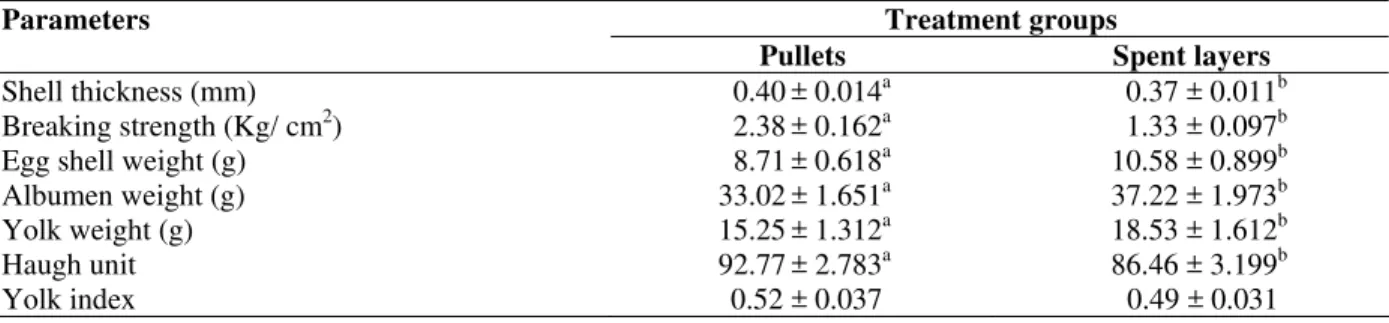
Mean values of various egg characteristics viz., shell thickness, breaking strength, egg shell weight, albumen weight, yolk weight, Haugh unit and yolk index are shown in Table 3. The egg shell thickness in pullets was significantly higher than that of spent layers. Bare and Striem (1998) and Suk and Park (2001) also observed that egg shell thickness decreased during the second production cycle than in the first. A probable explanation for thin egg shell in older hens may be lessening of calcium deposition (Bare and Striem, 1998) with the passage of time.
Eggs of the pullets were stronger than those of spent layers. Bare and Striem (1998) also observed that breaking strength decreased progressively with the advancement of age of birds. The strength of egg shell is determined not just by the amount of shell but also by the quality of shell (Roberts, 2004).
The egg shell weight of pullets was lower than spent layers (P<0.01), indicating that egg shell of the pullets was lighter than egg shell of spent layers. Suk and Park (2001) also observed that the egg shell was heavier in older birds. A number of studies have shown that egg shell weight increases as the birds grow older (Ronald et al., 1975; Ronald, 1979; Nys, 1986; Roberts, 2004). So, the reason for heavier egg shells of spent layers might be their production of heavier eggs than those of pullets.
The albumen of the pullet’s egg was lighter than the eggs of spent layers. Similarly, Izat et al. (1985) and Suk and Park (2001) observed that the albumen weight increased with the increase in age of birds. More albumen weight of the eggs produced by the spent layers in this study may be attributed to their heavier eggs produced with the advancement of age.
Eggs produced by pullets had lighter yolks (P<0.01) than those of spent layers. Suk and Park (2001) also found that the yolk weight increased with increase in age of the birds. Applegate et al. (1999) observed that the eggs of older hens contained proportionately more yolk. The results also depicted that weight of the eggs greatly influenced the yolk weight. A probable explanation for more yolk weight in spent layers might be heavier eggs produced by the birds during the second production cycle.
Pullet eggs exhibited higher values of Haugh unit than those of spent layers. However, yolk index did not differ between birds of the two groups (P>0.05). Izat et al. (1985) and Verheyen and Decuypere (1991) also
found that Haugh unit values decreased with increase in age of birds. Many factors have been reported to affect Haugh units such as storage time, temperature, age of birds, strain, nutrition and disease (Toussant and Latshaw, 1999).
Cost of feed incurred on pullets and spent layers were Rs. 5418 and 5369, respectively, during the experimental period. Whereas, the miscellaneous cost including cost of labour, electricity, litter, disinfections, medications and vaccination summed up as Rs. 500. Thus, the total calculated cost was Rs. 5918 and 5869 in the respective groups. The pullets and spent layers produced 3072 and 2414 eggs, respectively during the experimental period. These eggs were sold at the rate of Rs. 40 per dozen. The income from the eggs produced during the experimental period was Rs. 10240 and 8039 for the two groups indicating that pullets fetched more profit (Rs. 4821) than spent layers (Rs. 2670).
Table 3: Mean values of egg quality characteristics of pullets and spent layers
Treatment groups Parameters
Pullets Spent layers
Shell thickness (mm) 0.40± 0.014a 0.37 ± 0.011b
Breaking strength (Kg/ cm2) 2.38± 0.162a 1.33 ± 0.097b
Egg shell weight (g) 8.71± 0.618a 10.58 ± 0.899b
Albumen weight (g) 33.02± 1.651a 37.22 ± 1.973b
Yolk weight (g) 15.25± 1.312a 18.53 ± 1.612b
Haugh unit 92.77± 2.783a 86.46 ± 3.199b
Yolk index 0.52 ± 0.037 0.49 ± 0.031
Pakistan Vet. J., 2008, 28(1): 5-8. 8
The results of the study depicted that pullets produced more eggs and utilized their feed more efficiently alongwith more profit margin than the spent layers. Therefore, rearing of commercial layers up to first production cycle is recommended for efficient egg production and good profit margin in commercial poultry farming.
REFERENCES
Applegate, T., J. E. Ladwig, L. Weissert and M. S. Lilburn, 1999. Effect of hen age on intestinal development and glucose tolerance of the Pekin duckling. Poult. Sci., 78: 1485-1492.
Bare, A. and S. V. Striem, 1998. Effects of age at onset of production, light regime and dietary calcium on performance, eggshell traits, duodenal calbindin and cholecalciferol metabolism. British Poult. Sci.,
39: 282–290.
Bell, D. D. and C. J. Adams, 1992. First and second cycle egg production characteristics in commercial table egg flocks. Poult. Sci.,71: 448-459.
Haq, A., N. Ahmad, S. Rasool and T. H. Shah, 1997. Effect of light and feed restriction during rearing on production performance of egg strain layers. Asian-Austr. J. Anim. Sci., 10(6): 657-664.
Izat, A. L., F. A. Gardner and D. B. Mellor, 1985. The effects of age of birds and season of the year on egg quality, Haugh units and compositional attributes. Poult. Sci., 65: 726-728.
Kekeocha, C. C., 1985. Poultry Production Handbook. Macmillan Publishers Ltd., London, UK.
Kriz, L., A. Faruga and P. Stojnov, 1988. Turkey egg quality during two egg production cycles. Zivocisna Vyroba Vide, 33: 1005-1014 (Poult. Abst.,14: 839, 1988).
Mehta, V. S., R. L. Lakhotia and B. Singh, 1986. A study on forced resting and recycling of white layers. Indian J. Prod. Management, 2: 138-140. North, M. O. and D. D. Bell, 1990. Breeder
Management. In: “Commercial Chicken Production Manual”. 4th Ed., Van Nostrand Reinhold. New York, USA.
Nys, Y., 1986. Relationships between age, shell quality and individual rate and duration of shell formation in domestic hens.British Poult. Sci.,27: 253- 259.
Oluyemi, J. A. and F. A. Roberts, 1979. Poultry Production in Warm Wet Climate. Macmillan Publishers, Ltd., London, UK.
Peebles, E. D., C. D. Zumwalt, S. M. Doyle, P. D. Gerard, M. Latour, C. R. Boyle and T. W. Smith, 2000. Effects of breeder age and dietary fat source and level on broiler hatching egg characteristics. Poult. Sci., 79: 698-704.
Roberts, J. R., 2004. Factors affecting egg internal quality and egg shell quality in laying hens. J. Poult. Sci., 41: 161-177.
Ronald, D. A., 1979. Factors influencing shell quality of aging hens. Poult. Sci., 58: 774-777.
Ronald, D. A., D. R. Sloan and R. H. Harms, 1975. The ability of hens to maintain calcium deposition in the egg shell and egg yolk as the hen ages. Poult. Sci., 54: 1720-1723.
Schafer, C. M., C. M. Corsiglia, A. Jr. Mireles and E. A. Koutsos, 2005. Turkey breeder hen age affects growth and systemic and intestinal inflammatory responses in female poults examined at different ages post-hatch. J. Appl. Poult. Res., 14: 258-264.
Shaler, B. A. and H. Pasternak, 1993. Increment of egg weight with hen age in various commercial avian species. British Poult. Sci., 34: 915-924.
Siopes, T. D., 1995. Turkey breeder hen performance by strain during consecutive lay periods. Poult. Sci., 74: 1269-1279.
Smith, A. J. and P. Leclecq, 1990. Poultry. Macmillan Publishers Ltd., London, UK.
Steel, R. G. D., J. H. Torrie and D. A. Dickey, 1997. Principles and Procedures of Statistics; A biometrical approach. 2nd Ed., McGraw-Hill, Singapore.
Suk, Y. and C. Park, 2001. Effects of broiler breeder age and length of egg storage on albumen characteristics and hatchability. Poult. Sci., 80: 855-858.
Toussant, M. J. and J. D. Latshaw, 1999. Ovomucin contents and composition in chicken eggs with different interior quality. J. Sci. Food and Agri., 79: 1666-1670.