www.adv-geosci.net/27/29/2010/ doi:10.5194/adgeo-27-29-2010
© Author(s) 2010. CC Attribution 3.0 License.
Geosciences
Hydrological system analysis and modelling
of the Nam Co basin in Tibet
P. Krause, S. Biskop, J. Helmschrot, W.-A. Fl ¨ugel, S. Kang, and T. Gao
Department for Geoinformatics, Hydrology and Modelling, Friedrich-Schiller-University, Jena, Germany
Received: 16 February 2010 – Revised: 15 August 2010 – Accepted: 17 August 2010 – Published: 25 August 2010
Abstract. The Tibetan Plateau and the adjacent high moun-tain regions of the Himalayas play an important role in the global climate dynamic through its impact on the Asian monsoon system, which in turn is impacting the water re-sources of this extremely vulnerable region. To provide fur-ther knowledge about the changing impact of rainfall pat-terns, spatial and temporal variability of snow cover contri-bution, amount of snow and ice melt runoff, evapotranspira-tion as well as dynamics of wetlands and permafrost water balance studies are required. This is of particular importance in terms of global climate change because of a severe gap in the knowledge of the short, mid and long term implications on the hydrological system.
This study concentrates on the macroscale catchment of the lake Nam Co, located at 4718 m a.s.l. at the foot of the Nyainqentanglha Mountains in central Tibet (30◦N, 90◦E). The water balance of the Nam Co basin is dominated by semi-arid climate, snow and ice melt runoff and high evap-oration rates due to the high radiation input and the low air humidity. The observed temperature rise, glacier retreat, per-mafrost decay and lake level increase indicate significant sys-tem changes and the high sensitivity of the Tibetan Plateau on global warming. The development of a suitable water bal-ance model and its preliminary application was the main ob-jective of this study. The development was done with the Jena Adaptable Modelling System JAMS along with existing scientific process components of the J2000 module library which were partly further developed to reflect the specific conditions of the high elevation Nam Co basin.
The preliminary modelling exercise based on gridded data from a downscaled ECHAM5 data set provided reasonable estimates about the important hydrological water balance components of the Nam Co basin. With the modelling results the observed lake level rise could be reproduced and it could
Correspondence to:P. Krause ([email protected])
be shown that the runoff from the glaciered areas seems to be the most important component to explain the increasing amount of lake water.
1 Introduction
The Tibetan Plateau is a key area within the earth system and is outstandingly relevant for the global climate dynam-ics due to its huge extension on high altitudes and the re-sulting importance for the Asian monsoon system. Although there have been many investigations on parts of this complex ecosystem in the recent past, knowledge about physiograph-ical processes and todays anthropogenic impact on the Ti-betan ecosystem and its spatial and temporal dimensions is still limited. In the last decades a number of research studies investigated parts of the global change impact on the Tibetan Plateau and presented results about climate development (Yu et al., 2001; Treydte et al., 2006; Wang and Ding, 2006; Wu et al., 2006), glacier retreat (Thompson et al., 2003; Ye et al., 2006), lake hydrology (Cyranoski, 2005), and vegetation pat-terns (Chen et al., 2005; Zhou et al., 2006a).
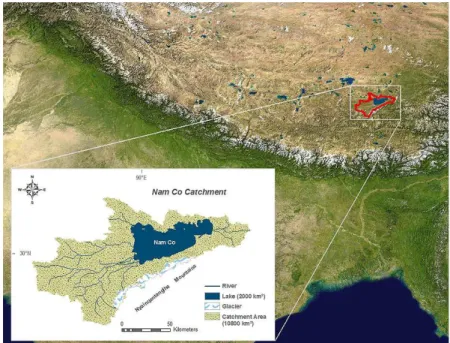
Fig. 1.Nam Co basin test site and its position on the Tibetan Plateau.
2010). The prediction of effects of climate change on the summer monsoon rainfall is very uncertain due to the local topographic characteristics causing a high spatial and tempo-ral variability of rainfall.
Changing precipitation and evapotranspiration rates are di-rectly affecting the amount of available water for runoff gen-eration. Due to rising temperatures more precipitation will fall as rain instead of snow which will lead to short and long term storage decreases. In consequence the majority of glaciers on the Tibetan Plateau were retreating dramati-cally during the last decades. In the last 40 years the glaciers on the Tibetan Plateau shrank by 7%, with a decrease of 4.5% during the last 20 years (CNCCC, 2007). Projections of glacier retreat suggest that glacier shrinkage will acceler-ate significantly with continuing global warming (Solomon et al., 2007) which will affect the hydrological regime of river basins originating in the Himalayas: first by increasing dis-charge due to accelerated melting rate, and subsequently by decreasing stream flow much lower than at present as glacier water storage is reduced (Eriksson et al., 2009).
Field observations on the Zhadang glacier south of the lake Nam Co showed that the glacier mass balance in this re-gion is not only influenced by the air temperature, but is also strongly affected by the precipitation seasonality – signifi-cantly more than by the annual amount (Kang et al., 2008). The mass balance in the years 2005/2006 and 2006/2007 of Zhadang glacier was strongly negative caused by higher air temperature and lower precipitation during the ablation period resulting in distinct glacier melt runoff (Kang et al., 2008). However, the lower summer temperature and higher
precipitation in the early stages of the ablation season in May and June 2008 led to an increasing mass balance and rela-tively low and constant river runoff from the glacier termi-nus. Chen et al. (2008) assessed that between 1970 and 2007 the glacier area of the Nam Co basin decreased by 37.1 km2. In the same period the area of Nam Co lake increased by 72.6 km2.
Lake fluctuations are investigated on the Tibetan Plateau in the last 30 years. Ye et al. (2008) found both – lake size decreases and increases – of lakes in the Mapam Yumco basin in western Tibet between 1974 and 2003. Bianduo et al. (2009) monitored four smaller lakes in the vicinity of the Nam Co using Landsat TM and CBERS data. They re-ported lake area increases since 1975 with accelerating speed in 2000–2005. Lake level changes obtained by satellite al-timetry were published by Maheu (2003); Berry et al. (2005); Harrison et al. (2006). The Nam Co lake level is observed since 2005 during ice free periods (May–October) (You et al., 2006; Zhou et al., 2006b). Zhou et al. (2006b) concluded that the lake level rise of 36 cm from May to mid September 2005 was caused by higher rainfall and melting snow during the summer season, whereas less precipitation and retention of water in ice and snow cover indicated a lower input which led to a 10 cm lake level decrease in autumn.
especially on their spatial and temporal dimensions. B¨ohner (2006) stated that water balance estimates are still afflicted with major uncertainties due to methodological limits in the spatial estimation of rainfall rates and widely lacking evap-otranspiration records, particularly on the Tibetan Plateau and adjacent high mountain systems. Distributed, process-oriented hydrological modelling can provide further knowl-edge about the complex process interactions on the Tibetan Plateau.
2 Study site lake Nam Co
The lake Nam Co (30◦N/90◦E, 4718 m a.s.l.) is the largest lake in Tibet and the biggest lake in the world in that height. It is located at the foot of the north slope of the Nyainqen-tanglha Mountain in central Tibet. The lake itself covers an area of approx. 2000 km2with a drainage basin of about 11 000 km2(Fig. 1).
The Institute of Tibetan Plateau Research, Chinese Academy of Sciences (ITP-CAS), operates a research sta-tion at the eastern end of the lake. Here, climatological ob-servations as well as measurements of runoff and lake level fluctuations are undertaken since 2005 (Kang et al., 2008; Zhou et al., 2006b). Additionally, some climate measure-ments as well as snow and ice hydrological data are avail-able from Zhadang glacier, located at the north-eastern slope of Mt. Nyainquentanglha. Here, in 2005 two automatic weather stations (AWS) were set up at elevations of 5400 and 5800 m a.s.l., complemented by the installation of a rain gauge near the terminus in May 2007.
The climate of the Nam Co region is located at the in-tersection of the Westerlies, the winter monsoon, the South West Asian monsoon, and the East Asian monsoon (Kang et al., 2007). During the summer months (June–September) the Nam Co basin is controlled by the Indian Monsoon, while dominated by Westerlies during the dry winter sea-son. The Nam Co basin features semi-arid subarctic plateau climate according to the climate classification developed by the Chinese Meteorological Adminstration (Liu, 1998). At the Nam Co the annual mean temperature was measured as 0◦C with a large daily and seasonal variability (Zhang et al., 2008). The highest monthly temperature is about 10◦C and the lowest around−12◦C. The large diurnal temperature gra-dient (absolute maximum and minimum temperatures were observed as 20.6◦C and−30.3◦C) indicates the strong con-tinentality of the area. The Nam Co basin is located in the rain shadow of the Himalayas and the annual precipitation is estimated as about 300–500 mm occurring mainly during the summer monsoon season (Zhu et al., 2004). The annual pre-cipitation amount at Nam Co station from 2005 to 2008 was measured as 415 mm (Zhang et al., 2008).
3 Material and methods 3.1 Input data
The Chinese project partner of the Institute of Tibetan Plateau Research (ITP) provided hydro-meteorological data measured at the Nam Co research station for the time pe-riod 2005–2008. These measurements include air tempera-ture, radiation, wind speed and direction, precipitation, air pressure and relative humidity. Apart from the Nam Co sta-tion no other stasta-tion is located within the study area. Data from other meteorological stations outside the Nam Co basin south of Nyainqentanglha Mountains in the Brahmaputra re-gion was found not to be representative for the study area because the Nam Co region features significantly colder and drier conditions. Because of the limited availability of ob-served data, gridded global and regional climate projections had to be used to provide driving data for the hydrological modelling. For this purpose a downscaled ECHAM5 data set (Ahrens and Dobler, 2008) generated with a combined (dynamical and statistical) downscaling approach was used. Since the gridded climate data provided only precipitation, temperature and wind speed as direct climate input variables, relative humidity and sunshine hours had to be derived. Rela-tive humidity was estimated from temperature and dew point temperature; sunshine hours were derived from cloud cover and potential sunshine duration.
To assess the quality of the climate variables, the data set was compared to another gridded climate data set from the Climate Research Unit (CRU) and to observed data from the Nam Co station. The comparison of gridded temperature and precipitation values from downscaled ECHAM5 und CRU for the time period 1961–2000 showed that (1) the projected temperatures had a high agreement whereas precipitation data were less correlated, (2) precipitation of the ECHAM5 data set was significantly higher than the precipitation of the CRU data sets, (3) both data sets showed the same trends with more or less the same magnitude. The comparison of the gridded data with measured data of the Nam Co research station showed a reasonable accordance but also discrepan-cies which will have to be investigated in more detail in the future. For this first study only the downscaled ECHAM5 data were used. They were considered to be sufficient for the estimation of the long term water balance of the Nam Co basin.
3.1.1 The model J2000g
requires spatially distributed information related to topogra-phy, land use, soil type and hydrogeology to estimate specific attribute values for each modelling unit. J2000g also requires meteorological inputs (precipitation, minimum as well as av-erage and maximum temperature, sunshine duration, wind speed, and relative humidity). From this input data net radia-tion and the potential evapotranspiraradia-tion (PET) according to the Penman-Monteith approach is calculated using the meth-ods presented in Allen et al. (1998).
Snow accumulation and snow melt are simulated with a day-degree approach followed by a soil moisture account-ing module consistaccount-ing water storage with a capacity defined from the field capacity of the specific soil type within the respective modelling unit. Soil water storage is only emp-tied by evapotranspiration uptake. The actual evapotranspira-tion is determined by the saturaevapotranspira-tion of the soil water storage, the potential evapotranspiration and a calibration coefficient. The runoff is generated only when the soil water storage is at saturation and partitioned into direct runoff and percolation based on the slope of the modelling unit and the underlying hydrogeology. The percolation component is transferred to a groundwater storage and then into baseflow by a linear stor-age approach. The total streamflow of a catchment results from the summation of the direct runoff and the baseflow components from each modelling unit.
For this specific project two additional modules were im-plemented into J2000g – a glacier module and a lake module. The glacier module is based on the method of Hock (2005) which calculates melt from snow and ice using a degree-day-factor approach. The lake module considers lake evapora-tion according to Penman (1948) and is tracking the volume changes that result from the hydrological dynamics in the lake basin.
When using gridded climate input data as drivers for dis-tributed modelling one has to make sure that the mass and en-ergy balances of the data set are preserved in the modelling results. This was considered by assigning each modelling unit exactly one climate data grid cell and passing the cli-mate data to the modelling unit without further interpolation or regionalisation. The disadvantage of this approach is the insufficient representation of small or regional scale climate patterns. In terms of the Nam Co basin this is of particu-lar importance for the mountain range in the south. In these parts elevation controlled gradients in temperature, rainfall and other weather elements could not be fully represented.
3.2 Catchment distribution
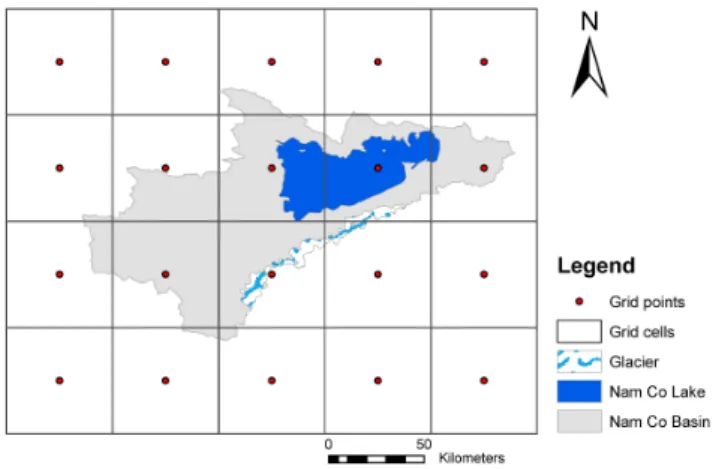
Due to the limited data availability a simple catchment dis-tribution was used in this study. Unlike the traditional HRU-concept which is normally used with J2000g, simplified modelling entities were created by overlay of the grid cells from the downscaled ECHAM5 data and land cover types (lake, glacier, land surface). Figure 2 shows the lake basin and the coarse modelling entities.
Fig. 2.Simplified spatial distribution of modelling units and climate grid cells.
The entire basin was distributed into 21 modelling units with areas between 5 and 2000 km2. The land surface was represented by 15 modelling units with an average elevation of 5060 m a.s.l., the lake surface was composed of three mod-elling units with an average elevation of 4725 m a.s.l. and the glaciered area was represented by three response units with an average elevation of 5600 m a.s.l. For each modelling unit elevation, slope, aspect, dominant land cover and soil type was defined using GIS and provided as a J2000g compliant parameter file.
3.3 Model setup and calibration
Due to the lack of long term observation data of stream-flow or lake volume the model was not calibrated for the Nam Co basin. Moreover, model parameters obtained in an alpine catchment in Austria were transferred and used for the Nam Co with only one minor adaptation. That means the base temperature parameter which controls the melt of the snow and glacier was increased to a value of 5.5◦C to com-pensate the insufficient spatial resolution of the gridded cli-mate data. Without such adaptation the runoff from glaciers would have been much too high in summer times.
4 Results and discussion
With the J2000g model of the Nam Co catchment a long term mean annual air temperature of −1.7◦C for the period of
to be 4.48 km3/yr. The mean total annual amount of wa-ter from the glaciered areas was computed as 7.12 km3/yr whereas the lake balance (without inflows) was negative with
−4.67 km3/yr. These numbers indicate the likely importance of the glacier dynamics for the observed lake level rise.
The trend analysis of the modelling results reproduced the patterns already discussed in the literature (e.g. Kang et al., 2008). To quantify whether trends are significant or not a signal to noise ratio (SNR) was calculated as the ratio be-tween the trend and the standard deviations of the anomalies. SNR values of larger than 1 are assumed to show a significant trend (Bormann, 2005).
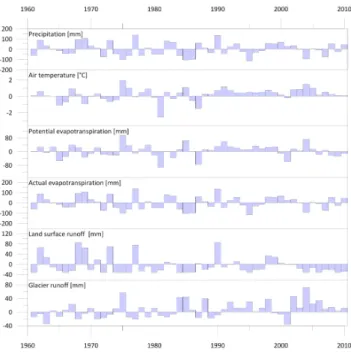
Annual precipitation showed no significant trend over the period of 1961–2010. The mean air temperature showed a non-significant (SNR 0.92) increasing trend which amounted to 0.69◦C in the 50 yr period. A significant increasing trend (SNR 1.15) of +6% was also found for relative humidity. The other climate variables and also the potential (PET) and actual evapotranspiration (AET) did not show signif-icant trends. The land surface runoff showed a decreas-ing trend which was not significant (SNR 0.78). A signif-icant (SNR 1.27) increasing trend was found for the simu-lated glacier runoff and resimu-lated to the fact that a significant (SNR 1.23) decreasing trend for the average glacier mass bal-ance was calculated. The annual anomalies calculated by the subtraction of the 1960–1990 mean from the annual sums or means are shown in Fig. 3.
The analysis of the single decades between 1961 and 2010 showed that the first decade (1961–1970) was very wet with a precipitation of about 18 mm/yr above average whereas the following decade was very dry with a precipita-tion of 15 mm/yr below average. The following three decades showed average rainfall amounts with anomalies between−5 and +2 mm/yr. The first and the third decade showed colder temperatures of about −0.3◦C below average whereas the last two decades from 1991 to 2010 were both about 0.3◦C warmer than the average. The second decade was slightly warmer (+0.08◦C) than the long term average.
The simulated actual evapo(transpi)ration (AET) values for the decades show relatively constant values for the lake evaporation between 738 and 755 mm/yr which is close to the value of 760 mm/yr reported by Morrill (2004) for the lake Ahung Co which is about 150 km2from Nam Co on the same elevation. Evapotranspiration from land surface with-out glaciers is much lower due to the limited water avail-ability. It was estimated as 482 mm/yr for the entire period, with a minimum value of 467 mm/yr in the second decade and a maximum value of 501 mm/yr at the end of the simu-lation period. During the entire 50 yrs a slight increase of AET on land surface was calculated. The AET from the glaciered areas was estimated as only 55 mm/yr stemming from sublimation from the snow cover. When the glaciers are snow free the model assumes that no evaporation occurs. Figure 4 shows the AET values for the five decades and the three different land cover types.
Fig. 3.Mean basin wide annual anomalies (from 1960–1990 mean) of various climate and water balance terms.
Fig. 4.Actual evaporation rates for the five simulated decades and the three different land cover types.
On the basis of precipitation, actual evapotranspiration as well as snow and glacier melt the runoff generation was cal-culated by J2000g for the three different land cover types land surface, lake surface and glaciers. In this simplified model it is assumed that the entire runoff generated on one of these land cover types is contributing directly to the lake Nam Co.
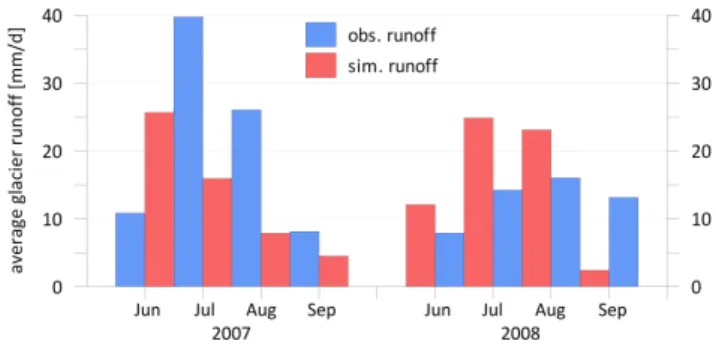
Fig. 5.Observed and simulation glacier runoff volumes.
Fig. 6. Absolute water contribution to Nam Co lake in km3from the three different land cover types.
basin is covered by glaciers. Figure 5 shows the observed and simulated runoff volumes from the glaciered regions. The discrepancy between measured and simulated runoff is partly caused by the fact that the model was run with pro-jected climate data for the period of 2001 to 2010 which is different than the climate which was responsible for the ob-served runoff. Under this consideration a reasonable agree-ment of the simulated glacier contribution with measured runoff values from the outlet of the Zhadang glacier from 2007 and 2008 (Kang et al., 2008) could be stated.
Figure 6 shows the water in contribution in km3for each decade and for each land cover type. The balance of the lake without inflows from land surface and glaciers is negative but is not showing a trend in the 50 yrs period. The runoff generation from the land surface is relative high in the first wet decade and very low in the last decade primarily because of increasing evapotranspiration. The continuous rise in air temperature is causing a rising trend in the water contribution from the glaciered part of the catchment.
Fig. 7.Observed and simulate lake levels in meter for 2006 to 2008.
The sum of all water inflow to the lake minus the lake evaporation for the 50 yrs period resulted in an increase of the lake volume by 33.5 km3. This volume that is related to the average lake surface equals a lake level rise of about 17.5 m or 35 cm/yr. This is in good correlation with measure-ments and literature values. At the Nam Co the lake level is registered since 2005. From remote sensing information us-ing a combination of various altimetry sensors an increase of the Nam Co lake level of about 2.5 m from 2000 to 2009 (≈31 cm/yr) was estimated. The comparison between these observed values and the simulated lake level is shown in Fig. 7. The data gaps in the observed data occur primarily in times when the lake is frozen which is very often damag-ing the measurement equipment.
Figure 7 shows the general agreement between the ob-served and the simulated lake level. The discrepancies be-tween the observation and the simulation are partly caused by the use of the climate projection data and the simplified model structure. However, the result shows that the magni-tude is matched well by the model.
5 Conclusions and outlook
could be done by the comparison of the model results with the few observations of lake level changes and glacier melt runoff available for the catchment. In the near future the data situation will become much better as different research groups are investigating different aspects of the complex sys-tem of the Nam Co.
Despite the uncertainty the presented modelling study stressed the importance of the melt water runoff from glaciers which cover only 4% of the basin to explain the lake level rise which was observed in the last decades. In the 50 yr long pe-riod the simulated melt water contribution from the glaciers to the lake was always higher than the contribution by runoff from the glacier free land surface. The trend analysis showed that the simulated glacier melt was the only variable which showed a significant positive trend during the simulated pe-riod.
Future work should concentrate on a reduction and quan-tification of the overall uncertainty by using climate data from other sources with a higher spatial resolution. Addi-tional data for model validation which will be available in the future will help to analyse the model structure and the model parameterisation. To use the model for projection of the future the current glacier module needs to be extended to simulate not only glacier melt but also the glacier mass balance.
Acknowledgements. This project is funded in the DFG priority programme 1372 TiP – Tibetan Plateau: Formation-Climate-Ecosystem. We thank two anonymous reviewers for their valuable comments which helped to improve the paper.
Edited by: A. Wahren, F. Tavares Wahren, and K.-H. Feger Reviewed by: two anonymous referees
References
Ahrens, B. and Dobler, A.: Downscaling of precipitation – the ob-servational pitfall, in: 10th Plinius Conference on Mediterranean Storms, Nicosia, Cyprus, PLINIUS10-A-00101, 2008.
Allen, R. G., Pereira, L., Raes, D., and Smith, M.: Crop evapotran-spiration: Guidelines for computing crop water requirements, FAO Irrigation and Drainage Paper 56, FAO, Rome, 1998. Berry, P., Garlick, J., Freeman, J., and Mathers, E.: Global inland
water monitoring from multi-mission altimetry, Geophys. Res., 32, L1604, doi:10.1029/2005GL022814, 2005.
Bianduo, Bianbaciren, Li, L., Wang, W., and Zhaxiyangzong: The response of lake change to climate fluctuation in north Qinghai-Tibet Plateau in last 30 years, J. Geogr. Sci., 19, 131–142, 2009. B¨ohner, J.: General climatic controls and topoclimatic variations in
Central and High Asia, Boreas, 35, 279–295, 2006.
Bormann, H.: Evaluation of hydrological models for scenario anal-yses: signal-to-noise-ratio between scenario effects and model uncertainty, Adv. Geosci., 5, 43–48, doi:10.5194/adgeo-5-43-2005, 2005.
Chen, F., Kang, S., Zhang, Y., and You, Q.: Glaciers and Lake Change in Response to Climate Change in the Nam Co Basin, in: CAS Annual Report of Nam Co Monitoring and Research Station for Multisphere Interactions, 3, Chinese Academy of Sci-ence, 51-59, 2008.
Chen, X., Zhang, X., and Li, B.: Influence of Tibetan Plateau on vegetation distributions in East Asia: a modelling perspective, Ecol. Model., 181, 79–86, 2005.
CNCCC: China National Report on Climate Change 2007, China National Committee on Climate Change, Tech. rep. No. 1, 2007. Cyranoski, D.: The long-range forecast, Nature, 438, 275–276,
2005.
Eriksson, M., Xu, J., Shrestha, A., Vaidya, R., S., N., and Sand-strom, K.: The changing Himalayas: Impact of Climate Change on Water Resources and Livelihoods in the Greater Himalayas, ICIMOD, Kathmandu, 2009.
Harrison, J., Berry, P., Garlick, J., and Freeman, J.: Assessment of multi-mission radar altimeter performance over the Amazon basin, ESA Pub. SP-614, 2006.
Hock, R.: Glacier melt: a review of processes and their modelling, Prog. Phys. Geog., 29, 362–391, 2005.
Kang, S., Qin, D., Ren, J., Zhang, Y., Kaspari, S., Mayewski, P. A., and Hou, S.: Annual Accumulation in the Mt. Nyainqentanglha Ice Core, Southern Tibetan Plateau, China: Relationships to At-mospheric Circulation over Asia, Arct. Antarct. Alp. Res., 39, 663–670, 2007.
Kang, S., Gao, T., Zhang, Y., Yang, W., Yu, W., Chen, F., and Zhou, S.: Early Onset of Rainy Season Supresses Glacier Melt: A Case Study on the Zhadang Glacier, Tibetan Plateau, in: CAS Annual Report of Nam Co Monitoring and Research Station for Multi-sphere Interactions, 3, 30–43, 2008.
Kralisch, S. and Krause, P.: JAMS - A Framework for Natural Re-source Model Development and Application, in: Proceedings of the International Environmental Software Society (IEMSS), Ver-mont, USA, 2006.
Krause, P.: Das hydrologische Modellsystem J2000: Beschreibung und Anwendung in grossen Flusseinzugsgebieten, Schriften des Forschungszentrum J¨ulich: Reihe Umwelt/Environment, Band 29, peer reviewed, 2001 (in German).
Krause, P.: Quantifying the Impact of Land Use Changes on the Wa-ter Balance of Large Catchments using the J2000 Model, Phys. Chem. Earth, 27, 663–673, doi:10.1016/S1474-7065(02)00051-7, 2002.
Krause, P. and Hanisch, S.: Simulation and analysis of the im-pact of projected climate change on the spatially distributed waterbalance in Thuringia, Germany, Adv. Geosci., 21, 33–48, doi:10.5194/adgeo-21-33-2009, 2009.
Liu, M. (Ed.): Physical Atlas of China, China Cartographic Pub-lishing House, Bejing, 1998.
Maheu, C.: Water level fluctuations in the Plata Basin (South Amer-ica) from Topex/Poseidon Satellite Altimetry, Geophys. Res. Lett., 30(3), 1143, doi:10.1029/2002GL016033, 2003.
Morrill, C.: The influence of Asian summer monsoon variability on the water balance of a Tibetan lake, J. Paleolimnol., 32, 273–286, 2004.
Rupa Kumar, K., Sahai, A., Krishna Kumar, K., Patwardhan, S., Mishra, P., Revadkar, J., Kamala, K., and Pant, G.: High res-olution climate change scenario for India for the 21st Century, Current Science, 90, 334–345, 2006.
Solomon, S., Qin, D., Manning, M., Chen, Z., Marquis, M., Av-eryt, K., Tignor, M., and Miller, H. (Eds.): The physical science basis, in: Contribution of Working Group I to the Fourth Assess-ment Report of the IntergovernAssess-mental Panel on Climate Change, IPCC, Cambridge University Press, Cambridge, 2007.
Thompson, L., Mosley-Thompson, E., Davis, M., Lin, P., Hender-son, K., and Mashiotta, T.: Tropical glacier and ice core evidence of climate change an annual to millennial time scales, Climatic Change, 59, 137–155, 2003.
Treydte, K., Schleser, G., Helle, G., Frank, D., M., W., Haug, G., and Esper, J.: The twentieth century was the wettest period in Northern Pakistan over the past millenium, Nature, 440, 1179– 1182, 2006.
Wang, B. and Ding, Q.: Changes in global monsoon precipita-tion over the past 56 years, Geophys. Res. Lett., 33, L06711, doi:10.1029/2005GL025347, 2006.
Wu, S., Yin, Y., Zheng, D., and Yang, Q.: Moisture conditions and climate trends in China during the period 1971–2000, Int. J. Cli-matol., 26, 193–206, 2006.
Wu, S., Yin, Y., Zheng, D., and Yang, Q.: Climatic trends over the Tibetan Plateau during 1971–2000, J. Geogr. Sci., 17(2), 141–51, doi:10.1007/s11442-007-0141-7, 2007.
Xu, Z., Gong, T., and Li, J.: Decadal trend of climate in the Tibetan Plateau-regional temperature and precipitation, Hydrol. Process., 22, 3056–2065, 2008.
Ye, Q., Kang, S., Chen, F., and Wang, J.: Monitoring glacier varia-tions on Geladandong mountain, central Tibetan Plateau, from 1969 to 2002 using remote-sensing and GIS technologies, J. Glaciol., 52(179), 537–545, 2006.
Ye, Q., Yao, T., and Chen, F.: Response of Glacier and Lake Co variations to Climate Change in Mapam Yumco Basin on Tibetan Plateau during 1974-2003, Journal of China University of Geo-sciences, 19(2), 135–145, 2008.
You, Q., Kang, S., Tian, K., Liu, J., Li, C., and Zhang, Q.: Cli-matic Features on Mt. Nyainqen-tanglha, Tibetan Plateau, in: CAS Annual Report of Nam Co Monitoring and Research Sta-tion for Multisphere InteracSta-tions, 1, 16–23, 2006.
You, Q., Kang, S., Aguilar, E., Pepin, N., Fl¨ugel, W.-A., Yan, Y., Xu, Y., Zhang, Y., and Huang, J.: Changes in daily climate ex-tremes in China and their connection to the large scale atmo-spheric circulation during 1961–2003, Clim. Dynam., in press, doi:10.1007/s00382-009-0735-0, 2010.
Yu, G., Harrison, S., and Xue, B.: Lake status records from China: Data base documentation, Tech. Rep. 4, Max-Planck-Inst. f. Bio-geochemie, Jena, 2001.
Zhang, Y., Kang, S., and Li, M.: Preliminary research of Climatic Features at Nam Co Station, Tibetan Plateau, in: CAS Annual Report of Nam Co Monitoring and Research Station for Multi-sphere Interactions, 3, 8–14, 2008.
Zhou, H., Zhou, L., Zhao, X., Liu, W., Li, Y., Gu, S., and Zhou, X.: Stability of alpine meadow ecosystem on the Qinghai-Tibetan Plateau, Chinese Science Bulletin, 51, 320–327, 2006a. Zhou, S., Kang, S., Liu, J., and Wang, S.: Preliminary results for
hydrological observations in the Nam Co drainage area, in: CAS Annual Report of Nam Co Monitoring and Research Station for Multisphere Interactions, 1, 57–58, 2006b.