Summary
Particle size distribution of raw materials plays an important role in extrusion process during direct expanded extrudates manufacturing. In most of the food industries all types of l ours come in a production plant packed in bags with certain checkmarks that consist of average size of particles expressed in μm. h at particle size range is very relative, because mostly it means that size of most frequent particles is expressed. During extrusion processing of corn l our and whey or soy proteins blends are interject, then it is very important to know precise particle size of the interjected blends. If it does not match, raw materials should be sieved and particular fractions separated.
To obtain the best fraction of corn l our for extrusion processing (200 – 450 μm), sieving was conducted in shaker “Analysette 3” with sieving times of 5, 10 and 15 minutes. For each of these three measurements an agglomerate creation was spotted, followed by the major remain of the sample at the mesh of 450 μm. Sieving was repeated with aid of ultrasound (250 W), using power generator and by ultrasonic ring with transducer (“UIS 250 L”) mounted on the sieves. Sieving was conducted again with sieving times of 5, 10 and 15 minutes, and variable amplitude of works of 25, 50 and 75% for ultrasound. Within each of these nine measurements a partial or complete agglomerate breakdown was achieved, and an optimal fraction for extrusion processing was acquired. For the desirable particle size fraction in range of 200 – 450 μm for extrusion, under the conditions of 10 and 15 minutes of sieving time with amplitude work of 75%, the most of the sample remained within desirable range (83,79% and 83.4%).
Key words
ultrasound, sieving, extrusion, corn l our
Ultrasonically Improved Sieving of Food
Materials for Manufacturing of Direct
Expanded Extrudates
Mladen BRNČIĆ 1( ), Ines BRADAČ 1, Branko TRIPALO 1, Damir JEŽEK 1, Valentina OBRADOVIĆ 2, Sven KARLOVIĆ 1, Tomislav BOSILJKOV 1
1 University of Zagreb, Faculty of Food Technology & Biotechnology, Department of Process Engineering, Laboratory for Unit Operations, Pierottijeva 6, 10000 Zagreb, Croatia
e-mail: [email protected]
Introduction
In food technology extrusion should be specii ed as a cook-ing-extrusion process with the goal of manufacturing crispy, well nutritionally balanced, expanded, tasty and voluminous products. h ere is no limitation for using main raw materials for this kind of products. However, cereals stand for a lot of products. Corn, wheat, rye and barley are very high placed in this chain (Garber et al., 1997; Brnčić et al., 2006). Beside dough characteristics, presence of water, pressure and many other various characteristics of manufacturing system, a par-ticle size of inputted raw material play an important role in getting a i nal product with already mentioned properties. For instance, when raw material is enhanced with whey pro-teins or soy bean propro-teins (both concentrates) it is very im-portant to be aware of dif erences between sizes of particles of main raw material (Guy, 1994; Brnčić et al., 2008a). If there is concern about that, raw material should be sieved. Corn l our as a raw material should be in size from 200 μm to 600 μm. For possible enrichment of i nal product with proteins, whose particle size is about 50 μm (whey and soy bean), than particle size of corn l our should be between 200 and 450 μm (Brnčić et al., 2008b). h at kind of raw material is not easy to get from manufacturer and in most cases it is necessary to sieve it before extrusion.
Starch is main component of cereals and very sticky one (Onwulata and Constance, 2006; Brnčić et al., 2000). During sieving when particles collide these property causes creation of clusters or agglomerates commonly named “screen or sieve blocking” or “blinding”. In Figure 1 typical “blinding” prob-lem is presented.
When blinding occurs, the useful sieving area and sieves overall capacity are reduced, slowing down production levels. All l ours are subjected to this problem. Most of the conven-tional methods are helpful for solving this problem down but limitation stands for the particles of 500 μm and bellow in size. When such a raw material is inputted in extruder without pre-vious preparation, it can cause problems in expansion, qual-ity and nutritional values of the product (Huber and Rokey, 1990; Guy, 1994). Manual cleaning of sieves with brushes re-sults in cleaner sieving area but also with damaged, broken or twisted sieves. Many researches and companies developed various cleaning systems that use some type of mechanical devices. Example of these devices are cleaning discs or small balls, which during sieving are bouncing up and down, hit-ting the sieve and material to be sieved and shaking free any blockages. Mechanical forces produced during hitting, beside its main aim of deblinding i.e. breaking down of agglomer-ates, could seriously damage the sieves. Even larger problem could be if the balls or discs (at er longer period of work) are not replaced and start to wear out. Small pieces of these units could fall behind and incorporate in sieved material. Another disadvantage with mechanical deblinding systems that is be-coming increasingly relevant in today health and safety-con-scious manufacturing environment is the noise these devices generate—noise levels of over 90 dB(A) have been recorded with some deblinding disc assemblies.
Solution for this severe problem is use of power ultrasound for deblinding. Ultrasound waves as well as sound waves are mechanical vibrations in a solid or l uid. Ultrasound is the part of the sonic spectrum which ranges from 20 kHz to 10 MHz. It has been used in a many dif erent technologies for a various industries. More and more in food industry, this utilizable technology is taking place as an analytical tool, or for the raw material modii cation before, during and at er the manufacturing of food products (Mc Clements, 1995). Power ultrasound works with frequencies from 20 to 100 kHz. For ultrasonic deblinding a specially developed transducer was mounted on one empty ring (without mesh), and low fre-quency with high power output was provided for breaking down the surface tension, making the wires of the mesh free and as result of sieving needed fractions of food materials were achieved.
Material and methods
h is work was carried out with corn l our purchased in local market. Chemical composition was declared by manu-facturer: water – less than 15%; degree of acidity – up to 4.0. Trade description of l our was “Corn l our - germinated”.
particles, but also for the particles suspended in various liq-uids. Dependable of sample amount, sieves dif erent in size could be used. Corn l our was processed under this set-up of device: shaking amplitude of 2.5 mm in time interval of i ve seconds (between each shaking cycle), and variable time duration of 5 , 10 and 15 min.
At erward shaking was repeated for corn l our aided with power ultrasound accessory (max. 250W) (“UIS 250L”, Hielscher Ultrasonics, GMBH). h e system is composed of three main parts: generator, sieving tower set and ultrasonic processor with sonotrode mounted on sieving ring. Processor and power generator are operational with maximum power range of 250 W, variable amplitude in range of 20-80%, and unchangeable frequency of 24 kHz. Ultrasonic processor with sonotrode and maximum of eight laboratory sieves can be si-multaneously mounted during measurement. Nine measure-ments were conducted in time duration of 5, 10 and 15 min, and variable ultrasonic amplitude of 25%, 50% i 75% (Table 1)
Results and discussion
A great number of researchers tried do determine opti-mal particle size distribution of raw materials for direct ex-panded extrudate production without or with addition of various types of proteins. Onwulata and Konstance (2006) found that optimal particle size distribution is 200-300 μm; while Gomez et al. (1991) suggested the range in 150-250 μm of inputted particles for this kind of product.
In this work, based on literature data, a task has been placed to get an optimal particle size for input of raw mate-rial (corn l our) that should be in range of 200-450 μm. To achieve this a separation of corn l our was conducted in shaker „Analysette 3“ model Pro. Corn l our was sieved in periods of 5, 10 and 15 minutes, with sieving interval of i ve seconds. h e quality of direct expanded extrudate directly de-pends on proper choice of raw material (corn l our or corn meal) and also on particle size. It is known that proi tability of processing is good when at least 75% of raw material
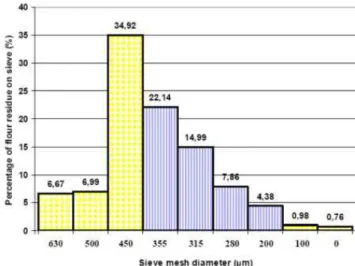
ticles are in desirable range of size (Brnčić, 2006). For a par-ticular need of raw material, like in this research, that should be later used in processing of extrudates enriched with whey protein concentrate (WPC) or soy bean proteins (SBP), the study showed that particle size of corn l our was not match for the task. Results showed that for sieving of i ve minutes (Sample 1 CF) 55.58% of corn l our has been in desirable range and for sieving for 10 minutes even less (54.11%). In Figure 2, a diagram is presented for sample 3 CF; 49.37% of l our remained in the desirable range.
It is obvious that quite contrary ef ect of what was expected occured. Obtained results could be explained with formation of signii cant quantity of agglomerates that took place during sieving as result of particles collision (Barleta and Barbosa-Canovas, 1993). While collision is in progress, particles get stick to each other. Reason lies in starch stickiness. Starch is basic component of corn l our and at er some time the ag-glomerates are created. Even with extended sieving (sample 3 CF) situation gets worse because larger agglomerates are created and as result a sieve is blocked or blinded.
To get an optimal fraction in size of 200 - 450 μm sieving was assisted with power ultrasonic equipment setup (maxi-mum power of 250 W). Device consisted of ultrasonic trans-ducer attached to the ring and power generator (“UIS 250”, Dr.Hielsher). Ultrasonic ring with transducer was placed be-tween sieve with smallest mesh diameter (100 μm) and base. Power generator created electric impulses of 50 Hz frequency that were converted in transducer in high energy mechanical signal with frequency of 24,000 cycles per second (24 kHz). h is large amount of energy emitted in second penetrated through surface of the sieve and breaked down agglomerates, thus making possible regular separation of particles. Ef ect of deblinding was achieved. h ree amplitudes of sonication were used in this work (25, 50 i 75%), combined with dura-tion of 5, 10 and 15 minutes (Table 1).
On samples 4 CF-US, 5 CF-US and 6 CF-US, i.e., those which are treated i rst with ultrasound signii cant dif
er-Corn flour sieving without ultrasound treatment Sample Sieving conditions
1 CF Time of sieving, 5 minutes 2 CF Time of sieving, 10 minutes 3 CF Time of sieving, 15 minutes
Corn flour sieving with ultrasound treatment Sample Sieving conditions
4 CF-US Time of sieving, 5 minutes, amplitude of ultrasound 25 % 5 CF-US Time of sieving, 5 minutes, amplitude of ultrasound 50 % 6 CF-US Time of sieving, 5 minutes, amplitude of ultrasound 75 % 7 CF-US Time of sieving, 10 minutes, amplitude of ultrasound 25 % 8 CF-US Time of sieving, 10 minutes, amplitude of ultrasound 50 % 9 CF-US Time of sieving, 10 minutes, amplitude of ultrasound 75 % 10 CF-US Time of sieving, 15 minutes, amplitude of ultrasound 25 % 11 CF-US Time of sieving, 15 minutes, amplitude of ultrasound 50 % 12 CF-US Time of sieving, 15 minutes, amplitude of ultrasound 75 %
Table 1. Conditions of corn l our sieving without and with ultrasound treatment
ences were evident compared with samples that are sieved without ultrasound assistance. h ose were samples sieved in duration of i ve minutes. Since in this work only material that passed through sieve of mesh diameter of 450 μm, and remained on sieve in diameter of 200 μm was used in this in-vestigation. Corn l our above and bellow that range was not further used for extrusion. Percentage of l our in desirable range showed severe dif erence between samples sieved with and without ultrasound, h is already happened with sample 4 CF-US (68.95%), and then with samples 5 CF-US (74.2%) and 6 CF-US (79.57%) as well. Concerning settings presented in Table 1, an impact of ultrasonic amplitude on sieving i.e. sep-aration results was evident. Yet, the result of sample 6 CF-US (79.57%) was within acceptable range and was acceptable for extrusion. For the samples marked as 7 CF-US (69.12%) and
8 CF-US (73.09%) a higher percentage of l our remained in desirable range while sample 9 CF-US (83.79%) completely fuli lled above mentioned requirement for extrusion (Figure 3). In this case, longer period of shaking (10 min.) with eligi-ble amplitude (75%) gave an appropriate result.
h ere was a signii cant inl uence of ultrasound amplitude (75%) that managed to break down the most of the devel-oped agglomerates created within i rst minute of the shaking. At erwards, during remaining period of shaking power of ul-trasound was too strong for the agglomerates to keep them in piece. Corn l our, rye l our and wheat l our were just some of the raw materials used for this kind of work and also chestnut l our (Sacchetti et al., 2004; Bounous and Giacalone, 1992.).
Finally results of the samples separated in duration of 15 minutes also showed progress and verii ed accuracy of method. Among them, sample 12 CF-US (Figure 4) was the most similar to 9 CF-US with 83.4% of the corn l our within wanted range.
Determination of particle size and separation of desirable fraction of corn l our is very important for extrusion process-ing with addition of various proteins. In this case sievprocess-ing was used to separate fraction of corn l our that was according to the literature proper for such a processing. At er sieving corn l our was mixed individually and with the whey pro-teins before extrusion took place. As the size of particles of whey protein concentrate is between 50-150 μm (Herceg et al., 2004a; Herceg et al., 2004b), also basic raw material (corn l our for this research) should be in sizes for maintaining proper mixing before processing in extruder and extrusion as well.
Garber et al. (1997) noticed that during extrusion process-ing bigger particles possessed smaller contact area with the extruder barrel than smaller particles, with less inl uence of heat in device and as consequence raw material was poorly processed. On the contrary, smaller particles were in better contact with interfaced area of the main inner parts of ex-truder (barrel, screw system). At the end smaller particles would be heated faster and acceptable conditions of extrusion could be established with better results (Zhang and Hoosney, 1998). Desrumaux et al. (1998) concluded that bigger particles of the corn l our give unwanted textural properties of direct expanded extrudates.
Conclusions
h e results of sieving using ultrasonic setup showed jus-tii cation of such a processing for corn l our. Without ultra-sonic deblinding system sieves were blocked during i rst or second minute of the experiment. Samples sieved without ul-trasound caused blocking of sieves from the top of the device, but most of blocking occurs on sieve of 450 μm. Using power ultrasound process of sieving was improved. h is kind of re-search demonstrates that time of sieving and amplitude of ultrasound had important inl uence on particle sizing i.e. separation of desirable fraction. Sample sieved in duration of 10 minutes and 75% of ultrasonic amplitude had 83.79% of corn l our within range of 200-450 μm. In later research this Figure 3.
Results of sieving in time of 10 minutes (sample 9 CF-US)
Figure 4.
fraction was used for high temperature-short time extrusion for manufacturing direct expanded extrudates enriched with whey protein concentrate. h is method is adjustable also for particle size measurement of the powdered materials in va-riety of industries.
References
Barletta, B.J., Barbos-Canovas, G.V. (1993) An attrition index to asses i nes formation and particle size reduction in tapped agglomerated food powders. Powder Technology, 77, 89-93. Bounous, G., Giacalone, G. (1992) Chestnut storage, processing
and usage in Italy. Proceedings of the world chestnut conference, Morgantown, Wv, July 8-10.
Brnčić M., Ježek D., Rimac Brnčić S., Bosiljkov T., Tripalo B. (2008b) Utjecaj dodatka koncentrata proteina sirutke na teksturalna svojstva izravno ekspandiranog kukuruznog ekstrudata, Mljekarstvo 58 (2); 131-149.
Brnčić M., Karlović S., Bosiljkov T., Tripalo B., Ježek D., Cugelj I., Obradović V. (2008a) Obogaćivanje ekstrudiranih proizvoda proteinima sirutke, Mljekarstvo 58, (3) 275-295.
Brnčić M., Tripalo B., Ježek D., Semenski D., Drvar N., Ukrainczyk M. (2006) Ef ect of twin-screw extrusion parameters on mechanical hardness of direct-expanded extrudates. Sadhana, 31, 527-536.
Brnčić, M. (2006) Utjecaj ultrazvuka na svojstva sirovine za ekstruziju i gotovog ekstrudiranog proizvoda, Disertacija, Prehrambeno-biotehnološki fakultet, Zagreb, Prosinac 2006. Brnčić, M., Mrkić, V., Ježek, D., Tripalo, B. (2000) Modeli reakcija
za vrijeme ekstruzije pšeničnog škroba. Kemija u Industriji, 49, 101-110.
Desrumaux, A., Bouvier, J.M., Burri, J. (1998) Corn Grits Particle Size and Distribution Ef ects on the Characteristics of Expanded Extrudates. Journal of Food Science, 63, 857-863.
Garber, B.W., Hsieh, F., Huf , H.E. (1997) Inl uence of particle size on the Twin – screw extrusion of corn meal. Cereal chemistry, 74, 665 – 661.
Gomez, M.H., Waniska, R.D., Rooney, L.W. (1991) Starch characterization of nixtamalized corn l our. Cereal Chemistry, 68, 578-582.
Guy, R.C.E. (1994) Raw materials for extrusion cooking processes.
Technology of Extrusion Cooking (N.D.Frame ed.), Blackie
Academic and Professional Press, Glasgow, Uk, 55-72. Herceg Z., Lelas V., Brnčić M., Tripalo B., Ježek D. (2004a)
Tribomechanical micronization and activation of whey protein concentrate and zeolite, Sadhana, 29, part 1, Pg 13-26. Herceg Z., Lelas V., Brnčić M., Tripalo B., Ježek D. (2004b) Fine
Milling and Micronization of Organic and Inorganic Materials Under Dynamic Conditions, Powder Technology, 139, 111-117. Huber, G.R., Rokey, G.J. (1990) Extruded snacks. In Snack Food
(R.G.Booth, ed.) Van Nostrand Reinhold, New York, 107-138. Mc Clements, D.J. (1995) Advances in the application of ultrasound
in food analysis and processing. Trends in Food Science & Technology, 6, 293-299.
O’Connell, R (2003) Shake-down for a better results in i ne powders. Technical Trends, 4, 82-85.
Onwulata, C.I., Konstance, R.P. (2006) Extruded corn meal and whey protein concentrate: ef ect of particle size. Journal of Food Processing and Preservation, 30, 475-487.
Sacchetti, G., Pinnavaia, G.G., Guidolin, E., Dalla Rosa, M. (2004) Ef ects of extrusion temperature and feed composition on the functional, physical and sensory properties of chestnut and rice l our-based snack like products. Food Research International, 37, 527-534.
Zhang, W., Hosney, R. C. (1998) Factors af ecting expansion of corn meals with poor and good expansion properties. Cereal chemistry, 75, 639-643