www.atmos-chem-phys.net/14/10431/2014/ doi:10.5194/acp-14-10431-2014
© Author(s) 2014. CC Attribution 3.0 License.
How sensitive is the recovery of stratospheric ozone to changes
in concentrations of very short-lived bromocarbons?
X. Yang1,2,*, N. L. Abraham1,2, A. T. Archibald1,2, P. Braesicke1,2,**, J. Keeble2, P. J. Telford1,2, N. J. Warwick1,2, and J. A. Pyle1,2
1National Centre for Atmospheric Science (NCAS-Climate), Cambridge, UK
2Centre for Atmospheric Science, Department of Chemistry, University of Cambridge, Cambridge, UK *now at: British Antarctic Survey, Cambridge, UK
**now at: Karlsruhe Institute of Technology, Institute for Meteorology and Climate Research, Karlsruhe, Germany
Correspondence to: X. Yang ([email protected])
Received: 25 February 2014 – Published in Atmos. Chem. Phys. Discuss.: 14 April 2014 Revised: 21 August 2014 – Accepted: 22 August 2014 – Published: 1 October 2014
Abstract. Naturally produced very short-lived substances (VSLS) account for almost a quarter of the current strato-spheric inorganic bromine, Bry. Following VSLS oxida-tion, bromine radicals (Br and BrO) can catalytically de-stroy ozone. The extent to which possible increases in sur-face emissions or transport of these VSLS bromocarbons to the stratosphere could counteract the effect of halogen re-ductions under the Montreal Protocol is an important policy question. Here, by using a chemistry–climate model, UM-UKCA, we investigate the impact of a hypothetical doubling (an increase of 5 ppt Bry) of VSLS bromocarbons on ozone and how the resulting ozone changes depend on the back-ground concentrations of chlorine and bromine. Our model experiments indicate that for the 5 ppt increase in Bryfrom VSLS, the ozone decrease in the lowermost stratosphere of the Southern Hemisphere (SH) may reach up to 10 % in the annual mean; the ozone decrease in the Northern Hemisphere (NH) is smaller (4–6 %). The largest impact on the ozone column is found in the Antarctic spring. There is a signif-icantly larger ozone decrease following the doubling of the VSLS burden under a high stratospheric chlorine background than under a low chlorine background, indicating the impor-tance of the inter-halogen reactions. For example, the de-cline in the high-latitude, lower-stratospheric ozone concen-tration as a function of Bryis higher by about 30–40 % when stratospheric Clyis∼3 ppb (present day), compared with Cly of ∼0.8 ppb (a pre-industrial or projected future situation). Bromine will play an important role in the future ozone layer. However, even if bromine levels from natural VSLS were to
increase significantly later this century, changes in the con-centration of ozone will likely be dominated by the decrease in anthropogenic chlorine. Our calculation suggests that for a 5 ppt increase in Bryfrom VSLS, the Antarctic ozone hole recovery date could be delayed by approximately 6–8 years, depending on Clylevels.
1 Introduction
contribution to the polar loss, as first suggested by McElroy et al. (1986). Following on from the scientific understand-ing that anthropogenic halogens were responsible for ozone loss, the Montreal Protocol was enacted to regulate the pro-duction and consumption of ozone-depleting substances. The protocol has been a major success, and atmospheric concen-trations of the regulated chlorine and bromine gases are now in decline (WMO, 2011).
Chlorine in the stratosphere arises mainly from industrial compounds, principally the CFCs, with a contribution of about 0.6 ppb (∼20 % relative to current values) from long-lived, naturally occurring CH3Cl (see, for example, Harper and Hamilton, 2003). In contrast, the bromine budget of the stratosphere is less well constrained (Ko et al., 1997; Dorf et al., 2008). It is now thought that about 5 ppt (∼20 to 25 %) of stratospheric bromine may come from the oxida-tion of halocarbons with lifetimes of less than about 6 months (so-called very short-lived substances, VSLS), while the ma-jority comes from methyl bromide and the anthropogenic halons. Thorough reviews of these halogen gases are avail-able in the recent UNEP/WMO ozone assessment (Montzka et al., 2011), where the total stratospheric bromine concen-tration in 2008 is given as 22.5 ppt. In the pre-industrial era, the VSLS contribution may have been as much as 50 % of the total atmospheric bromine loading. VSLS bromocarbons are mainly produced by macro- and micro-algae (Carpen-ter and Liss, 2000; Quack and Wallace, 2003; Yokouchi et al., 2005). CHBr3and CH2Br2are the dominant contributors to bromine VSLS species. Although their tropospheric life-time is relatively short (a few weeks for CHBr3and several months for CH2Br2), they can be lifted effectively through deep convective systems and transported into the upper tro-posphere and/or lower stratosphere (UTLS) to make a signif-icant contribution to the total ambient bromine (Sturges et al., 2000; Yang et al., 2005; Salawitch, 2006). Being short lived, there are large uncertainties in using atmospheric concentra-tion measurements to estimate their global fluxes and their net contribution to the stratospheric bromine (Warwick et al., 2006; Liang et al., 2010; Pyle et al., 2011; Ordóñez et al., 2012; Ziska et al., 2013; Hossaini et al., 2013). A large range of contributions to stratospheric inorganic bromine of 110 ppt can be found in the literature (Dorf et al., 2008; Salawich et al., 2010; Schofield et al., 2011; Aschmann et al., 2011; Tegtmeier et al., 2012; Stachnik et al., 2013; Hossaini et al., 2012a). The UNEP/WMO ozone assessment of 2011 reports the value as 6(3–8) ppt (Montzka, Reimann et al., 2011).
Stratospheric inorganic chlorine has increased from pre-industrial levels of∼0.6 ppb to a peak of greater than 3 ppb in the 1990s and, under the influence of the Montreal Pro-tocol, is decreasing and is expected to continue to decrease during this century (WMO, 2011). The sum of the concen-trations of anthropogenic bromine compounds is now also declining. Under the influence of the Montreal Protocol, the stratospheric ozone layer should recover later this century.
While anthropogenic halogen loading to the stratosphere should decrease in response to the Montreal Protocol, we do not know how the concentration of the VSLS bromocarbons will change in the future. Since they are mainly produced by biochemical processes, mostly in the ocean, their emis-sions could change with climate, perhaps depending on sea surface temperature, on ocean pH or on surface wind stress (Gschwend et al., 1985; Keppler et al., 2000). We currently do not have a good enough understanding to allow confident predictions. Changes in transport to the stratosphere could also occur due to climate change. For example, Hossaini et al. (2012b) predict 0.3–1.0 ppt increases in the direct trans-port of bromine source gases to the stratosphere between 2000 and 2100 under RCPs 4.5 and 8.5, while the earlier study of Dessens et al. (2009) projects a 1–2 ppt increase in total bromine in the lower stratosphere.
Bromine is about 100 times more efficient than chlorine as an ozone sink in the high-latitude lower stratosphere, with an annual average global value of around 65 (Sinnhuber et al., 2009), so any future increases in stratospheric bromine, per-haps driven by increased emissions of VSLS bromocarbon or its transport to the stratosphere, could affect stratospheric ozone recovery. Our primary aim in this paper is to explore the sensitivity of ozone recovery to changes in the concentra-tions of bromine in the stratosphere arising from very short-lived bromocarbons.
Gas phase and heterogeneous inter-halogen reactions in-volving both bromine and chlorine contribute significantly to ozone loss, so that the ozone loss due to bromine should be dependent on the chlorine concentration. A second aim of this paper is to investigate how ozone might respond to changes in VSLS loading when future stratospheric chlorine levels have declined.
To address these aims, we use the UM-UKCA chemistry– climate model. We perform a number of idealised experi-ments under two different stratospheric chlorine concentra-tions, corresponding very roughly to the present day and to the end of the twenty-first century, and three different bromine levels. The range of bromine concentrations chosen allows us to explore the sensitivity of the coupled chlorine– bromine system. Each experiment is run twice, first with a VSLS contribution of 5 ppt and then with an additional in-crease of 5 ppt. These experiments allow us to explore how ozone loss due to short-lived bromocarbons could vary with background chlorine and bromine loading. We note that 5 ppt would represent a large change in the contribution of short-lived bromine to the stratosphere; we reiterate that these are idealised experiments designed to explore the sensitivity of ozone recovery to hypothetical changes in bromine.
ozone is particularly important under enhanced aerosol load-ing. Transient changes due to volcanic eruptions would cer-tainly affect the trajectory of recovery, while a sustained in-crease in stratospheric aerosol would also lead to a general decrease in ozone and an increased role of bromine and chlo-rine heterogeneous processing. However, in the calculations here, aerosol loading is held constant. Climate change will also affect the recovery of stratospheric ozone, as is well known. Salawitch et al. (2005) show that, while the effect of bromine on ozone is dominated by the ClO+BrO reaction in the lowermost stratosphere, the reaction of BrO+HO2 be-comes increasingly important with increasing VSLS. Thus, any change in HO2in the future could potentially affect the estimation of the ozone impact from these changes in halo-gens. We do not deal with this in detail here, although we do mention in Sect. 3 possible changes in the flux through the BrO+HO2reaction under climate change.
The model and the experimental set-up are described in more detail in Sect. 2. The model results are presented in Sect. 3. A concluding discussion is found in Sect. 4.
2 Model and experiments
UM-UKCA is a chemistry–climate model; its dynamical core is Met Office Unified Model (UM) version 7.3 running in the HadGEM3-A configuration (similar to Hewitt et al., 2011). The detailed chemistry scheme for the troposphere and stratosphere, CheST, combines the schemes described by Morgenstern et al. (2009) and O’Connor et al. (2014), and was further updated with tropospheric bromine chem-istry based on our work in the pTOMCAT chemchem-istry trans-port model (Yang et al., 2005, 2010). The stratospheric halo-gen scheme is improved by introducing a number of het-erogeneous reactions to stratospheric particles (polar strato-spheric clouds (PSCs) and sulfate aerosol) to account for inter-halogen (chlorine and bromine) reactivation, as in our recent study (Braesicke et al., 2013). The model’s horizon-tal resolution is 3.75◦in longitude and 2.5◦in latitude on an Arakawa C grid. A hybrid sigma geometric height coordi-nate is used to resolve the vertical range from the surface to
∼84 km with 60 levels. All experiments are performed for year 2000 boundary conditions with prescribed monthly sea surface temperatures (SSTs) and sea ice conditions. The ra-diative species concentrations for CO2, N2O and CH4 are taken for the year 2000; ozone is calculated interactively. Apart from the halocarbons (e.g. CFCs, CH3Br), chemical emissions are for the present day. The sulfate aerosol field is a monthly climatology. PSCs and ice particles are calculated online based on water vapour fields and temperatures. To get significant results, each of the experiments was performed as a 40-year time-slice integration, with the first 20 years as spin-up and the last 20 years for analysis.
For the VSLS bromocarbons in the model, we have intro-duced tracers for five additional species (CHBr3, CH2Br2,
CH2BrCl, CHBr2Cl and CHBrCl2), with emissions based on the original work (scenario 5) of Warwick et al. (2006), except for emissions of CH2Br2, which were updated to 57 Gg yr−1, 50 % of the original flux, but which are now much more in accordance with Liang et al. (2010) and Or-dóñez et al. (2012). Our updated fluxes provide∼5 ppt of inorganic bromine to the stratosphere.
We have six base experiments, using two different strato-spheric chlorine loadings and three different stratostrato-spheric bromine loadings designed to cover a range of past, present and possible future halogen loadings. We chose stratospheric chlorine levels of∼0.8 and ∼3 ppb, achieved by applying fixed concentrations in the model’s lowest layer for the ma-jor chlorine species, CFCs, CH3Cl and CCl4 (from the A1 scenario of the WMO, 2011). 3 ppb is roughly a present-day stratospheric chlorine loading. The low chlorine level of 0.8 ppb represents both a pre-industrial chlorine value (when CH3Cl at 0.6 ppb was the major chlorine carrier), as well as a likely chlorine level towards the end of the century, on a Montreal Protocol trajectory towards “recovery”, according to projected mitigation scenarios for 2100. For stratospheric inorganic bromine, we chose three levels of∼10,∼15 and
∼23 ppt to represent approximately a low (∼pre-industrial era, when ice core data suggest a methyl bromide concentra-tion of about 5 ppt; Saltzman et al., 2008), medium and high (∼present-day) level, respectively. These values all include
∼5 ppt from VSLS (as described above), with the remaining Brycoming from long-lived halons and CH3Br. These values are somewhat arbitrary; our simple aim is to explore a range of Bry values and, based on them, to investigate the ozone response to perturbed VSLS bromocarbon emissions.
Our study is designed to address how changes in VSLS bromocarbons would impact stratospheric ozone against a background of changes in stratospheric chlorine and bromine loading, so each base experiment is then repeated with the VSLS bromocarbon contribution doubled, to about 10 ppt. In the next section, for each base experiment, we look at the difference in the ozone results between the 2×VSLS and 1×VSLS (a∼5 ppt increase in stratospheric Bry) integra-tions.
3 Result and discussions
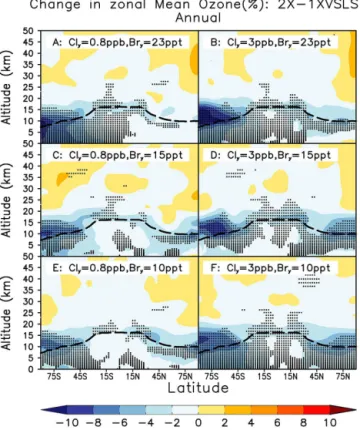
Figure 1. Relative ozone changes (in %) arising from doubling VSL emissions under 0.8 ppb Cly(left column) and 3 ppb Cly(right col-umn). The base case Bryconcentrations (with 1×VSLS, represent-ing 5 ppt of the total Bry)increase from the bottom to the top row,
as indicated in the panels. The dotted regions represent statistically significant signals on a confidence level above 95 %, as calculated by a student’sttest.
(Fig. 1a, b),∼15 ppt (Fig. 1c, d), and a low bromine back-ground of∼10 ppt (Fig. 1e, f).
For a doubled VSLS emission, with an extra∼5 ppt Bryin the stratosphere, the ozone differences in these runs are sta-tistically significant (P< 0.05) (marked with dots in Fig. 1) in most of the atmosphere below 20 km. The less significant signals above 20 km are likely due to the strong dynamical feedback rather than the chemical response, as addressed in a related paper by Braesicke et al. (2013). Longer runs would be required to ensure statistical significance in the middle and upper stratosphere, where the relative changes in ozone are small, and we focus here on the lowermost stratosphere, where VSLS has a more important role.
Below 20 km in the SH, the largest annual mean decrease is about 10 %, while at the NH high latitudes, the ozone creases by 4–6 %. Near the tropical tropopause, an ozone de-cline of 2–4 % is modelled. Since the ozone concentration near the tropopause is low, these losses are small in absolute terms (less than 10 ppbv). In terms of the seasonal response, a maximum local ozone reduction of∼20 % is simulated at the SH high latitudes from spring to early summer. The
sea-sonal variation in column ozone loss at the SH high latitudes is discussed below.
It is interesting to see that ozone decrease is significant in most of the troposphere, with a small deficit of less than 2 % in the tropics, 2–4 % at high latitudes of the NH, and 2–6 % in the SH. In absolute terms, the ozone decline in most of the free troposphere is smaller than 2 ppb. Further experiments in which we switched off the inter-halogen heterogeneous reactions suggest that the tropical response is due to in situ tropospheric chemistry. The changes in tropospheric ozone at high latitudes, in contrast, are largely due to the transport of ozone-depleted air from the lower stratosphere.
When Cly is ∼3 ppb, the maximum SH polar ozone decrease of about 10 % shown in Fig. 1 corresponds to
∼100 ppb, compared with∼70 ppb for a Cly mixing ratio of 0.8 ppb. In the NH, the ozone decrease is about half of the magnitude simulated in the SH.
Comparing the left and right panels in Fig. 1 for the same bromine loadings, we see a greater ozone decrease when the chlorine background is higher. Cycles involving both chlo-rine and bromine radicals will be more efficient at a given bromine concentration when chlorine levels are higher. To demonstrate this clearly, Fig. 2 plots the relationship between the ozone and total inorganic Bryconcentrations at∼15 km for (a) 80◦S and (b) 80◦N from our experiments with the different chlorine levels. We note that, in all cases, ozone de-creases almost linearly with increasing Bry concentrations; straight line fits are given for each Clyvalue. The gradient of the ozone decrease as a function of increasing Bryis larger by about 30–40 % when Cly is∼3 ppb, compared with the Clyof∼0.8 ppb. As would be expected given the greater po-tential for heterogeneous chemistry, there is more ozone loss in the SH than in the NH under the same Clylevel.
Comparing the red and blue lines in Fig. 2a, we can see that, for a given Bry level, the ozone concentrations un-der a pre-industrial (or ozone-recovered) Clyof 0.8 ppb are ∼500 ppb higher than that at the current Clyof ∼3 ppb in the SH. According to the fit lines in Fig. 2a, for a Bry in-crease of 20 ppt (a roughly four-fold inin-crease of VSLS emis-sions), the ozone decreases are 190 (red line) and 280 ppb (blue line), respectively, considerably less than the chlorine-driven changes, so even if bromine levels from natural VSLS were to increase very significantly later this century, changes in the concentration of ozone will likely be dominated by the recovery of anthropogenic chlorine.
Figure 2. Relationship between stratospheric ozone concentrations and Bryat∼15 km and (a) 80◦S and (b) 80◦N. Straight lines have
been fitted for each Cly concentration (red: Cly=0.8 ppb; blue: Cly=3 ppb), and the quality of the fit is indicated by the correlation coefficient (r2).
column ozone by averaging the results from the three differ-ent Brybackgrounds for each of the 0.8 ppb and 3.0 ppb Cly cases, respectively.
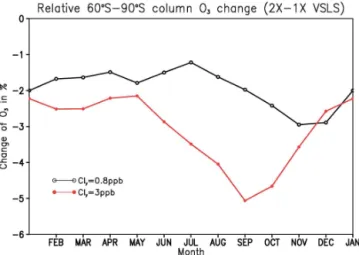
Figure 3 shows the seasonal evolution of column ozone at high southern latitudes, plotting the average difference when VSLS bromine is increased by 5 ppt for each of the two background chlorine loadings. Again, the relative change in ozone is higher under the higher chlorine loading. Un-der higher chlorine (red line), we model much lower column ozone globally and a larger ozone hole compared with the Cly=0.8 ppb case (black line). For 3 ppb of chlorine, a more pronounced seasonal cycle emerges, with the ozone differ-ences peaking in Antarctic spring. In spring (October), the modelled total column ozone decrease is about 9 DU for the 0.8 ppb chlorine case, and about 11 DU for the 3 ppb case. Column differences in the Arctic are only marginally sig-nificant, at best (see Fig. 4), so we do not discuss the NH seasonal evolution.
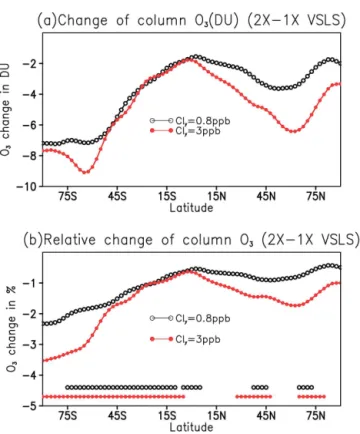
Figure 4 shows annually averaged column ozone differ-ences as a function of latitude. The largest reductions in the column occur at high latitudes, as expected, with a peak re-duction of above 8 DU at southern high latitudes under the high chlorine scenario (Fig. 4a), which is about 3.5 % of the total column ozone (Fig. 4b). The changes in Fig. 4 are smaller at low latitudes (∼2 DU, or∼1 %), and appear to be relatively insensitive to the chlorine background. Note the re-duced area of statistical significance in the NH (as indicated by the horizontal lines in Fig. 4b; see caption for details),
Figure 3. Relative change in column ozone (in %) due to a doubling of VSLS Bryaveraged over 60–90◦S. Each line represents one par-ticular Clylevel (black open circles: Cly=0.8 ppb; red closed cir-cles: Cly=3 ppb). Note that we average the ozone difference over the three different Bry concentrations for each Clycase. The in-dividual results for different background Bryare shown in Figs. 1 and 2.
especially under low chlorine loading, consistent with much greater dynamical variability there.
All our integrations have used year 2000 boundary con-ditions, so the impact of climate change on the chemistry here has not been considered. Separate integrations looking at ozone recovery under a range of different greenhouse gas scenarios, but with constant boundary conditions for chlo-rine and bromine source gases (see Banerjee et al., 2014), do throw some light on possible changes in some key bromine reaction fluxes. For example, focusing just on changes in the stratosphere, the change in the flux through the reaction HO2+BrO between 2000 and 2100 under RCP8.5 is less than 10 % in the lower stratosphere of high southern lati-tudes, where the calculated changes reported here are high-est. Slightly larger changes are found in the tropical very low stratosphere, where ozone concentrations are low, and just above the tropopause at high northern latitudes, where dynamically driven variability in ozone is high. We believe that while climate change will certainly affect the impact of VSLS on ozone recovery, it will not change the general re-sults presented here.
4 Conclusions and discussions
Figure 4. Latitude distributions of annual mean total ozone changes due to a doubling of VSLS. The top panel (a) shows the absolute changes in Dobson units, and the bottom panel (b) shows the rel-ative changes in %. Each line represents one particular Clylevel (black open circles: Cly=0.8 ppb; red closed circles: Cly=3 ppb). Note that we average the ozone difference over the three different Bryconcentrations for each Clycase. The corresponding horizon-tal lines indicate where the differences are significant in each of the three pairs of integrations above a confidence level of 99 % as cal-culated by student’sttest.
et al., 2013) that transport to the stratosphere, where these compounds play an important role in regulating lower strato-spheric ozone, will increase in the future. To what extent pos-sible increases in VSLS surface emissions or transport to the stratosphere could counteract the effect of halogen reduc-tions under the Montreal Protocol is an important research question, which we have addressed here by using a simple experimental design. In particular, we have asked to what ex-tent the impact of a hypothetical increase in VSLS (we use 5 ppt here) could affect ozone in the lower stratosphere, and how that impact depends on the background concentrations of chlorine and bromine.
Our model experiments indicate that for a∼5 ppt increase in inorganic bromine from VSLS, the depletion of strato-spheric ozone can reach up to 10 % in the annual mean in the lowermost stratosphere of the SH polar region, and 4–6 % in the NH. Decreases in the ozone column are largest at high latitudes, are greater for higher chlorine levels, and are dom-inated by the ozone reductions in the low stratosphere. The SH high latitudes see the largest reductions, with an annual
average south of 70◦S of around 8 DU (Fig. 4a); changes at middle and low latitudes are small.
Ozone losses following an increase in the VSLS burden are highest under a high stratospheric chlorine background, indicating the importance of the inter-halogen reactions. Al-though bromine plays an important role in destroying at-mospheric ozone, chlorine concentrations largely dominate the changes in stratospheric ozone concentrations. Even if bromine levels from natural VSLS were to increase signifi-cantly later this century, the concentration of ozone will be dominated by the recovery of anthropogenic chlorine.
It is possible to make a crude estimate of the possi-ble impact on ozone recovery of a hypothetical increase in VSLS bromine. In our calculations, the increase in Bry by 5 ppt leads to a reduction in modelled springtime (Octo-ber) Antarctic ozone of about 9 DU for the 0.8 ppb chlorine case and ∼11 DU for the 3 ppb chlorine case. A range of chemistry–climate models reported by the WMO (2011) and Eyring et al. (2010) give a linearly averaged Antarctic spring-time (October) ozone recovery rate of about 1.4 DU yr−1 be-tween the years 2025 and 2075 (see Fig. 3.11 and Table 4 of those papers, respectively), so our modelled decreases of 9 and 11 DU, due to the additional 5 ppt of bromine under two different chlorine levels, correspond to a delayed recovery of about 6 and 8 years, respectively. We note, in passing, that although Antarctic ozone recovery is predicted consistently by models for the second half of this century, there are large model–model differences.
In these model studies, we have only considered the ef-fect of variations in chlorine and bromine concentrations. We recognise that other changes, including changes in climate and aerosol loading, could also modulate the impact on ozone of changed VSLS emissions. Further studies are required.
Acknowledgements. J. A. Pyle and X. Yang thank the EU for
support through SHIVA (SHIVA-226224-EP7-ENV-2008-1) and the ERC for support through the ACCI project (project number 267760). We thank Tara Banerjee for information on changes in the HO2+BrO flux with climate change. We thank NCAS-CMS for modelling support. Model integrations have been performed using the UK National Supercomputing Service HECToR.
Edited by: W. T. Sturges
References
Aschmann, J., Sinnhuber, B.-M., Chipperfield, M. P., and Hossaini, R.: Impact of deep convection and dehydration on bromine load-ing in the upper troposphere and lower stratosphere, Atmos. Chem. Phys., 11, 2671–2687, doi:10.5194/acp-11-2671-2011, 2011.
capac-ity, Atmos. Chem. Phys., 14, 9871–9881, doi:10.5194/acp-14-9871-2014, 2014.
Braesicke, P., Keeble, J., Yang, X., Stiller, G., Kellmann, S., Abra-ham, N. L., Archibald, A., Telford, P., and Pyle, J. A.: Circula-tion anomalies in the Southern Hemisphere and ozone changes, Atmos. Chem. Phys., 13, 10677–10688, doi:10.5194/acp-13-10677-2013, 2013.
Carpenter, L. J. and Liss, P. S.: On temperate sources of bromoform and other reactive organic bromine gases, J. Geophy. Res., 105, 20539–20547, doi:10.1029/2000JD900242, 2000.
Chipperfield, M. P. and Pyle, J. A.: Model sensitivity studies of Arctic ozone depletion, J. Geophys. Res., 103, 28389–28403, doi:10.1029/98JD01960, 1998.
Dessens, O., Zeng, G., Warwick, N., and Pyle, J.: Short-lived bromine compounds in the lower stratosphere; impact of climate change on ozone, Atmos. Sci. Let., 10, 201–206, doi:10.1002/asl.236, 2009.
Dorf, M., Butz, A., Camy-Peyret, C., Chipperfield, M. P., Kritten, L., and Pfeilsticker, K.: Bromine in the tropical troposphere and stratosphere as derived from balloon-borne BrO observations, Atmos. Chem. Phys., 8, 7265–7271, doi:10.5194/acp-8-7265-2008, 2008.
Eyring, V., Cionni, I., Bodeker, G. E., Charlton-Perez, A. J., Kinni-son, D. E., Scinocca, J. F., Waugh, D. W., Akiyoshi, H., Bekki, S., Chipperfield, M. P., Dameris, M., Dhomse, S., Frith, S. M., Garny, H., Gettelman, A., Kubin, A., Langematz, U., Mancini, E., Marchand, M., Nakamura, T., Oman, L. D., Pawson, S., Pitari, G., Plummer, D. A., Rozanov, E., Shepherd, T. G., Shibata, K., Tian, W., Braesicke, P., Hardiman, S. C., Lamarque, J. F., Mor-genstern, O., Pyle, J. A., Smale, D., and Yamashita, Y.: Multi-model assessment of stratospheric ozone return dates and ozone recovery in CCMVal-2 models, Atmos. Chem. Phys., 10, 9451– 9472, doi:10.5194/acp-10-9451-2010, 2010.
Farman, J. C., Gardiner, B. G., and Shanklin, J. D.: Large losses of total ozone in Antarctica reveal seasonal ClOx/NOxinteraction, Nature, 315, 207–210, doi:10.1038/315207a0, 1985.
Feng, W., Chipperfield, M. P., Dorf, M., Pfeilsticker, K., and Ri-caud, P.: Mid-latitude ozone changes: studies with a 3-D CTM forced by ERA-40 analyses, Atmos. Chem. Phys., 7, 2357–2369, doi:10.5194/acp-7-2357-2007, 2007.
Gschwend, P. M., Macfarlane, J. K., and Newman, K. A.: Volatile Halogenated Organic-Compounds Released To Seawater From Temperate Marine Macroalgae, Science, 227, 1033–1035, 1985. Harper, D. B. and Hamilton, J. T. G.: The global cycles of the naturally-occurring monohalomethanes, in: The Handbook of Environmental Chemistry Vol. 3, Part P, Natural production of organohalogen compounds, edited by: Gribble, G. W., Springer, Berlin, 17–41, 2003.
Hewitt, H. T., Copsey, D., Culverwell, I. D., Harris, C. M., Hill, R. S. R., Keen, A. B., McLaren, A. J., and Hunke, E. C.: Design and implementation of the infrastructure of HadGEM3: the next-generation Met Office climate modelling system, Geosci. Model Dev., 4, 223–253, doi:10.5194/gmd-4-223-2011, 2011.
Hossaini, R., Chipperfield, M. P., Feng, W., Breider, T. J., Atlas, E., Montzka, S. A., Miller, B. R., Moore, F., and Elkins, J.: The contribution of natural and anthropogenic very short-lived species to stratospheric bromine, Atmos. Chem. Phys., 12, 371– 380, doi:10.5194/acp-12-371-2012, 2012a.
Hossaini, R., Chipperfield, M. P., Dhomse, S., Ordonez, C., Saiz-Lopez, A., Abraham, N. L., Archibald, A. T., Braesicke, P., Telford, P. J., Warwick, N. J., Yang, X., and Pyle, J. A.: Mod-elling future changes to the stratospheric source gas injection of biogenic bromocarbons, Geophys. Res. Lett., 39, L20813, doi:10.1029/2012GL053401, 2012b.
Hossaini, R., Mantle, H., Chipperfield, M. P., Montzka, S. A., Hamer, P., Ziska, F., Quack, B., Krüger, K., Tegtmeier, S., At-las, E., Sala, S., Engel, A., Bönisch, H., Keber, T., Oram, D., Mills, G., Ordóñez, C., Saiz-Lopez, A., Warwick, N., Liang, Q., Feng, W., Moore, F., Miller, B. R., Marécal, V., Richards, N. A. D., Dorf, M., and Pfeilsticker, K.: Evaluating global emission in-ventories of biogenic bromocarbons, Atmos. Chem. Phys., 13, 11819–11838, doi:10.5194/acp-13-11819-2013, 2013.
Keppler, F., Eiden, R., Niedan, V., Pracht, J., and Schöler, H. F.: Halocarbons produced by natural oxidation processes during degradation of organic matter, Nature, 403, 298–301, 2000. Ko, M. K. W., Sze, N.-D., Scott, C. J., and Weisenstein, D. K.:
On the relation between stratospheric chlorine/bromine loading and short-lived tropospheric source gases, J. Geophys. Res., 102, 25507–25517, 1997.
Liang, Q., Stolarski, R. S., Kawa, S. R., Nielsen, J. E., Douglass, A. R., Rodriguez, J. M., Blake, D. R., Atlas, E. L., and Ott, L. E.: Finding the missing stratospheric Bry: a global modeling study of CHBr3 and CH2Br2, Atmos. Chem. Phys., 10, 2269–2286, doi:10.5194/acp-10-2269-2010, 2010.
McElroy, M. B., Salawitch R. J., Wofsy, S. C., and Logan, J. A.: Reductions of Antarctic ozone due to synergistic interactions of chlorine and bromine, Nature, 321, 759–762, 1986.
Molina, M. J. and Rowland, F. S.: Stratospheric Sink for Chloroflu-oromethanes: Chlorine Atom-Catalysed Destruction of Ozone, Nature, 249, 810–812, doi:10.1038/249810a0, 1974.
Montzka, S. A. and Reimann, S. (Lead Authors), Engel, A., Krüger, K., O’Doherty, S., Sturges, W. T., Blake, D., Dorf, M., Fraser, P., Froidevaux, L., Jucks, K., Kreher, K., Kurylo, M. J., Mel-louki, A., Miller, J., Nielsen, O.-J., Orkin, V. L., Prinn, R.G., Rhew, R., Santee M. L., and Verdonik, D.: Ozone-depleting sub-stances (ODSs) and related chemicals, in: Scientific Assessment of Ozone Depletion: 2010, Global Ozone Research and Mon-itoring Project, edited by: World Meteorological Organization, Report No. 52, Chapt. 1, Geneva, Switzerland, 2011.
Morgenstern, O., Braesicke, P., O’Connor, F. M., Bushell, A. C., Johnson, C. E., Osprey, S. M., and Pyle, J. A.: Evaluation of the new UKCA climate-composition model – Part 1: The strato-sphere, Geosci. Model Dev., 2, 43–57, doi:10.5194/gmd-2-43-2009, 2009.
O’Connor, F. M., Johnson, C. E., Morgenstern, O., Abraham, N. L., Braesicke, P., Dalvi, M., Folberth, G. A., Sanderson, M. G., Telford, P. J., Voulgarakis, A., Young, P. J., Zeng, G., Collins, W. J., and Pyle, J. A.: Evaluation of the new UKCA climate-composition model – Part 2: The Troposphere, Geosci. Model Dev., 7, 41–91, doi:10.5194/gmd-7-41-2014, 2014.
Pyle, J. A., Ashfold, M. J., Harris, N. R. P., Robinson, A. D., War-wick, N. J., Carver, G. D., Gostlow, B., O’Brien, L. M., Manning, A. J., Phang, S. M., Yong, S. E., Leong, K. P., Ung, E. H., and Ong, S.: Bromoform in the tropical boundary layer of the Mar-itime Continent during OP3, Atmos. Chem. Phys., 11, 529–542, doi:10.5194/acp-11-529-2011, 2011.
Quack B. and Wallace, D. W. R.: Air-sea flux of bromoform: con-trols, rates and implications, Global Biogeochem. Cycles, 17, 1023, doi:10.1029/2002GB001890, 2003.
Salawitch, R. J.: Atmospheric chemistry – Biogenic bromine, Na-ture, 439, 275–277, 2006.
Salawitch, R. J., Wofsy, S. C., and McElroy, M. B.: Chem-istry of OClO in the Antarctic stratosphere: Implications for bromine, Planet. Space Sci.,36, 213–224, doi:10.1016/0032-0633(88)90058-X, 1988.
Salawitch, R. J., Weisenstein, D. K., Kovalenko, L. J., Sioris, C. E., Wennberg, P. O., Chance, K., Ko, M. K. W., and McLinden, C. A.: Sensitivity of ozone to bromine in the lower stratosphere, Geophys. Res. Lett., 32, L05811, doi:10.1029/2004GL021504, 2005.
Salawitch, R. J., Canty, T., Kurosu, T., Chance, K., Liang, Q., da Silva, A., Pawson, S., Nielsen, J. E., Rodriguez, J. M., Bhartia, P. K., Liu, X., Huey, L. G., Liao, J., Stickel, R. E., Tanner, D. J., Dibb, J. E., Simpson, W. R., Donohoue, D., Weinheimer, A., Flocke, F., Knapp, D., Montzka, D., Neuman, J. A., Nowak, J. B., Ryerson, T. B., Oltmans, S., Blake, D. R., Atlas, E. L., Kinnison, D. E., Tilmes, S., Pan, L. L., Hendrick, F., Van Roozendael, M., Kreher, K., Johnston, P. V., Gao, R. S., Johnson, B., Bui, T. P., Chen, G., Pierce, R. B., Crawford, J. H., and Jacob, D. J.: A new interpretation of total column BrO during Arctic spring, Geo-phys. Res. Lett., 37, L21805, doi:10.1029/2010gl043798, 2010. Saltzman, E. S., Aydin, M., Tatum, C., and Williams, M.
B.: 2000-year record of atmospheric methyl bromide from a South Pole ice core, J. Geophys. Res., 113, D05304, doi:10.1029/2007JD008919, 2008.
Schofield, R., Fueglistaler, S., Wohltmann, I., and Rex, M.: Sen-sitivity of stratospheric Bry to uncertainties in very short lived
substance emissions and atmospheric transport, Atmos. Chem. Phys., 11, 1379–1392, doi:10.5194/acp-11-1379-2011, 2011. Sinnhuber, B.-M., Sheode, N., Sinnhuber, M., Chipperfield, M. P.,
and Feng, W.: The contribution of anthropogenic bromine emis-sions to past stratospheric ozone trends: a modelling study, At-mos. Chem. Phys., 9, 2863–2871, doi:10.5194/acp-9-2863-2009, 2009.
Solomon, S.: Stratospheric ozone depletion: A review of concepts and history, Rev. Geophys., 37, 275–316, doi:10.1029/1999RG900008, 1999.
Stachnik, R. A., Millán, L., Jarnot, R., Monroe, R., McLinden, C., Kühl, S., Pukíte, J., Shiotani, M., Suzuki, M., Kasai, Y., Goutail, F., Pommereau, J. P., Dorf, M., and Pfeilsticker, K.: Strato-spheric BrO abundance measured by a balloon-borne submil-limeterwave radiometer, Atmos. Chem. Phys., 13, 3307–3319, doi:10.5194/acp-13-3307-2013, 2013.
Sturges, W., Oram, D., Carpenter, L., Penkett, S., and Engel, A.: Bromoform as a source of stratospheric bromine, Geophys. Res. Lett., 27, 2081–2084, doi:10.1029/2000GL011444, 2000. Tegtmeier, S., Krüger, K., Quack, B., Atlas, E. L., Pisso, I., Stohl,
A., and Yang, X.: Emission and transport of bromocarbons: from the West Pacific ocean into the stratosphere, Atmos. Chem. Phys., 12, 10633–10648, doi:10.5194/acp-12-10633-2012, 2012. Warwick, N. J., Pyle, J. A., Carver, G. D., Yang, X., Savage, N. H., O’Connor, F. M., and Cox, R. A.: Global modeling of biogenic bromocarbons, J. Geophys. Res., 111, D24305, doi:10.1029/2006JD007264, 2006.
WMO (World Meteorological Organization), Scientific Assessment of Ozone Depletion: 2010, Global Ozone Research and Monitor-ing Project-Report No. 52, 516 pp., Geneva, Switzerland, 2011. Wofsy, S., McElroy, M., and Yung, Y.: Chemistry of
at-mospheric bromine, Geophys. Res. Lett., 2, 215–218, doi:10.1029/GL002i006p00215, 1975.
Yang, X., Cox, R. A., Warwick, N. J., Pyle, J. A., Carver, G. D., O’Connor, F. M., and Savage, N. H.: Tropospheric bromine chemistry and its impacts on ozone: A model study, J. Geophys. Res., 110, D23311, doi:10.1029/2005JD006244, 2005.
Yang, X., Pyle, J. A., Cox, R. A., Theys, N., and Van Roozen-dael, M.: Snow-sourced bromine and its implications for po-lar tropospheric ozone, Atmos. Chem. Phys., 10, 7763–7773, doi:10.5194/acp-10-7763-2010, 2010.
Yokouchi, Y., Hasebe, F., Fujiwara, M., Takashima, H., Shiotani, M., Nishi, N., Kanaya, Y., Hashimoto, S., Fraser, P., Toom-Sauntry, D., Mukai, H., and Nojiri, Y.: Correlations and emis-sion ratios among bromoform, dibromochloromethane, and di-bromomethane in the atmosphere, J. Geophys. Res.-Atmos., 110, D23309, doi:10.1029/2005JD006303, 2005.