SAGE Open
October-December 2014: 1 –8 © The Author(s) 2014 DOI: 10.1177/2158244014560524 sgo.sagepub.com
Creative Commons CC BY: This article is distributed under the terms of the Creative Commons Attribution 3.0 License
(http://www.creativecommons.org/licenses/by/3.0/) which permits any use, reproduction and distribution of the work without further permission provided the original work is attributed as specified on the SAGE and Open Access page (http://www.uk.sagepub.com/aboutus/openaccess.htm). Article
Introduction
During the early schooling phase, the ability to master read-ing is undoubtedly the premier academic achievement. It prepares the children for all their educational endeavors and is a key to the possibilities that the future has in store for them (Bialystok, Luk, & Kwan, 2005). When beginning to receive formal instruction in reading, a large majority of chil-dren show no difficulty in learning how to read and write under normal conditions. However, several millions of chil-dren and adults worldwide, despite having average or above average cognitive abilities, adequate educational conditions, normal hearing and vision, have specific impairment in pick-ing up readpick-ing (Schulte-Körne et al., 2007). Well-designed literacy assessments help identifying the problem of students in literacy development and guiding appropriate instruction needed (Black & Wiliam, 2003; Helman, 2005; Hu & Commeyras, 2008; National Council of Educational Research and Training, 2006; Shaywitz & Shaywitz, 1994; Torgesen, 2000).
India is one of the largest functionally multilingual coun-tries in the world (Annamalai, 2001). The Report of the Education Commission (1964-1966) of Central Government of India recommended the Three-Language Formula (TLF), which necessitates all primary schools to teach three lan-guages to pupils (Kothari, 1966). The TLF includes mother-tongue or the regional language; the official language of the
Union or the associate official language so long as it exists; and a modern Indian or foreign language not covered above and other than that used as a medium of instruction. After the approval of the parliament, it was incorporated into the National Policy on Education in 1968, and today almost all schools in India expose their students to the learning of three languages. In the state of Karnataka (where the present study was conducted), majority of the schools teach Kannada, English, and Hindi. Kannada, a Dravidian language, is the official language of Karnataka State and is spoken by about 50 to 60 million people in India. It is an agglutinative, highly inflective language, which follows subject–object–verb order canonically. Kannada orthography is an alphasylla-bary, in which orthographic units (called akshara) represent syllables. It is a transparent orthography. As the grain size is larger, it has a larger set of symbols. Furthermore, it has hardly a few monosyllabic words, the most common words having two or three syllables (more details of Kannada may be seen in Prakash & Joshi, 1989, 1995). Hindi, a major
1
Department of Psychology, University of Mysore, Mysore, India. 2
Genomics Laboratory, Department of Studies in Zoology, University of Mysore, Mysore, India.
Corresponding Author:
Prakash Padakannaya, Department of Psychology, University of Mysore, Manasagangotri, Mysore 570 006, Karnataka, India.
Email: [email protected]; [email protected]
Catch Them Before They Fall: A Simple
Test of Sight-Word and Pseudo-Word
Reading in Kannada for a Quick and Early
Assessment
Marita Saldanha
1, Anand Siddaiah
1, Avinash M. Veerappa
2,
Nallur B. Ramachandra
2, and Prakash Padakannaya
1Abstract
The challenge of mastering reading is universally seen across all populations and languages. A small fraction of students all over the world, however, fail in learning to read proficiently. Early assessments can help children who are likely to get into the vicious circle of failure in mastering word reading, leading to poor academic performance and eventually to low motivation in academics and possible lifelong socioeconomic and mental health consequences. In languages such as English, there are quite a few tests available for early assessment and interventions. In India, a multilingual society, all children going to school learn to read at least in three languages, including English. Dearth of suitable assessment tools in local languages is a major impediment in clinical services and research. Here, we report an attempt at developing a quick and reliable test for assessment of decoding and sight-word reading skills in Kannada language.
Keywords
language used all over India, belongs to the Indo-European family of languages. Both Kannada and Hindi orthographies are derived from a common source, Brahmi (Coulmas, 1989). English and the Indian writing systems have contrast-ing features with respect to transparency, grain size, and the orthographic principle (Padakannaya & Mohanty, 2004; Padakannaya & Ramachandra, 2011). Furthermore, different writing systems put different cognitive demands on readers, which are reflected in the way reading and spelling/spelling are acquired in those languages (Chengappa, Bhat, & Padakannaya, 2004; Padakannaya, Rekha, Vaid, & Joshi, 2002; Perfetti, 1999; Wang, Liu, & Perfetti, 2004; Ziegler & Goswami, 2006). In such multilingual settings where chil-dren are formally exposed to two or three languages simulta-neously, testing needs to be done in all the languages children are learning for any assessment or diagnostic purposes.
There are several standard tests available for assessing reading ability in languages such as English that facilitate research studies and early assessment of reading skills in nor-mal and at-risk children. However, in a multiliterate setting like India, there is dearth for such tools in local languages. There is an urgent need to develop tests in the Indian lan-guages, which will help identify children in need for interven-tion. This will save them from the vicious circle of the mental trauma they would experience on account of academic diffi-culties. Here, we report an attempt at developing a quick and reliable measure for assessment of decoding and sight-word reading skills of higher primary and high schoolchildren in Kannada language, one of the major languages of India, in the lines of Test of Word Reading Efficiency (TOWRE) in English (Torgesen, Wagner, & Rashotte, 1999). The TOWRE, a widely used test in English, assesses sight-word efficiency and phonemic decoding efficiency by asking readers to read a list of high frequency words and another list of pseudo-words for 45 s each. The Performance on the first list provides a measure of one’s sight-word reading, whereas the Performance on the second list provides an index of one’s decoding ability. The present article presents a brief account of our attempt at developing a similar measure in Kannada with an assumption that development of such measures helps cross-linguistic comparisons in multilingual contexts prevailing in India.
Method
Participants
Fifty (30 boys and 20 girls) students, studying in an English-medium school and taught Kannada and English from the first-grade level, participated in the study. Their age ranged from 10 to 18 years. Twenty-six of them were studying at the middle school level (Grades 5-8), and 24 were from the sec-ondary to the higher secsec-ondary level (Grades 8-12) as per the Indian school system.
Their inclusion in the study was based on the class teach-ers’ checklist report endorsing that children were average or higher than average performers with consistency in academics
and did not have any observable physical or psychological/ behavioral/emotional problems on record. All of them belonged to middle or high socioeconomic families.
Procedure
The first phase involved preparing a list of words for sight-word efficiency (drishti pada in Kannada) and pseudo-words (husi pada in Kannada) for phonological decoding efficiency sections of the proposed Kannada test. The first author went through Kannada language textbooks of Grade Levels 1 through 5, made a list of words and frequency of their appear-ing in the textbooks. These words were arranged accordappear-ing to their frequency, that is, words of high frequency were placed at the beginning of the list, followed by words that were less frequent (the frequency ranged from 1 to 117). Following this, we performed a median split and considered the words above the median for the proposed list for sight-word reading. Of this list, we prepared two separate lists A and B of 72 words matching for frequency and mixing words of varied lengths and syllables in complexity. The mean frequency of words in Lists A and B was comparable (13.6 and 17.9), and the difference was not statistically significant. Both the lists were serially rearranged in the order of increasing frequency of words. Furthermore, two experienced primary school Kannada language teachers ranked the words based on their perception of how familiar the words were to schoolchildren. There was a very significant correlation between the raters (.95 and .93, respectively, on Lists A and B).
Two lists of 62 pseudo-words each were prepared for assessing phonological decoding skill. Pseudo-words (husi pada) were prepared by substituting a phoneme or a syllable of a real word by another without violating the orthographic rules of Kannada language. The composition and arrangement of pseudo-words within the lists were similar to those of sight-word (drishti pada) lists, that is, they were arranged in an increasing order of length and syllable/akshara complexity. Thus, at the end of the first phase, we had two lists (A and B), each for assessing sight-word reading skill and pseudo-word reading skill. The whole process of preparing the final list of words along with two helpers took about a month’s time.
Reliability Measures
and reliability coefficient for the whole test for sight-word and pseudo-word lists are presented in Table 1. All the mea-sures exhibited a very high degree of reliability and internal consistency.
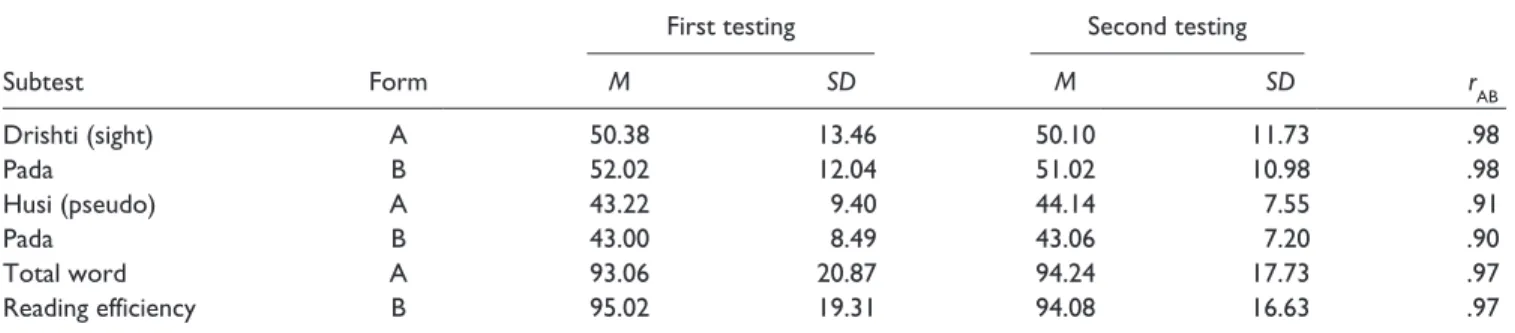
The stability-over-time or test–retest reliability was deter-mined by administering these tests to a group of 50 children (30 boys and 20 girls from Grade Levels 4 through 12) twice with a gap of 2 weeks between testing sessions. The obtained mean, standard deviations, and correlation coefficient values of the pre- and post-test scores are shown in Table 2. The magnitude of the correlation coefficient values was .91 and above, which definitely meet the required criterion of .90 for such purposes (Nunnally & Bernstein, 1994). The alternate forms, used to assess sight-word and pseudo-word reading, were also found to be highly correlated (see Table 3).
Validity
The lists of sight words and pseudo-words were evaluated for validity. If these tests tap underlying reading skills, the reading scores should increase over the grade levels and the
mean differences between lower and higher grades should be statistically significant.
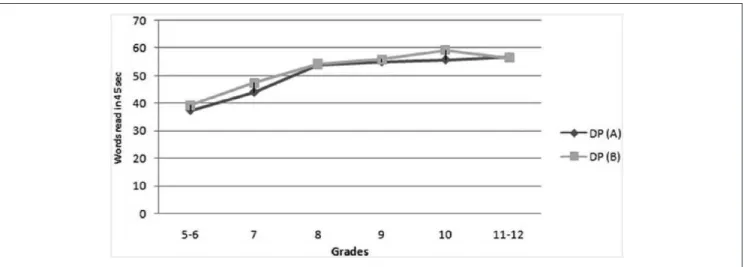
A gradual increase in performance over the grade levels on all word lists was observed (see Figures 1-3). The results of the independent-samples t tests confirmed that the mean differences between lower grades (5 and 6) and higher grades (11 and 12) on the total score of forms A and B of sight words (drishti pada) and pseudo-words (husi pada) were signifi-cant, t(10) = 3.28, p < .01, and t(10) = 3.19, p < .01, respectively.
Conclusion
To make important decisions with respect to specific scores, a reliability of .90 is the bare minimum, and a reliability of .95 is considered the desirable standard (Nunnally & Bernstein, 1994). Most values in the present study reached or exceeded the minimum standard of .90. Thus, the reading lists constructed (given in the appendix) for assessing sight-word reading and pseudo-sight-word reading are reliable tools that could be the resources available in Kannada for assessment
Table 1. Odd–Even Reliability and Reliability Coefficient of the Whole Test.
Subtest Coefficient of odd–even reliability Reliability coefficient of the whole test
Drishti pada A .92 .96
Drishti pada B .95 .97
Husi pada A .96 .98
Husi pada B .97 .98
Table 2. Test–Retest Reliability Measures.
Subtest Form
First testing Second testing
rAB
M SD M SD
Drishti (sight) A 50.38 13.46 50.10 11.73 .98
Pada B 52.02 12.04 51.02 10.98 .98
Husi (pseudo) A 43.22 9.40 44.14 7.55 .91
Pada B 43.00 8.49 43.06 7.20 .90
Total word A 93.06 20.87 94.24 17.73 .97
Reading efficiency B 95.02 19.31 94.08 16.63 .97
Table 3. Correlations Between Parallel Forms A and B.
Pre-test Post-test
rAB Significance rAB Significance
Words read in 45 s
PDE .84 .0001 .81 .0001
SWE .84 .0001 .84 .0001
Total words read
PDE .83 .0001 .72 .0001
SWE .78 .0001 .63 .0001
Figure 1. Mean number of sight words (DP) read in 45 s by different grade-level children.
Note. DP = drishti pada.
Figure 2. Mean number of pseudo-words (HP) read in 45 s by different grade-level children.
Note. HP = husi pada.
Figure 3. Mean total number of words read by different grade-level children.
and research purposes. The new measures also exhibited sat-isfactory criterion validity as the tests successfully differenti-ated between lower grade–level and higher grade–level students. We do believe that ours is an earnest, albeit small, attempt to address the need for developing valid and reliable measures in languages and orthographies that are less
studied. It is not only beneficial for the population studied but also could be useful in bilingual/trilingual education studies and cross-linguistic comparisons. However, we acknowledge the limitation of the study in having a small sample with a broad age range. Future studies may further validate the measures we have presented here.
Appendix
Acknowledgments
We record our thanks to PRO-ED, Inc., Austin, TX 78757-6897 for permitting us to adapt Test of Word Reading Efficiency (TOWRE) first edition (Permission T3010) for use in this research.
Declaration of Conflicting Interests
The author(s) declared no potential conflicts of interest with respect to the research, authorship, and/or publication of this article.
Funding
The author(s) disclosed receipt of the following financial support for the research and/or authorship of this article: We thank Department of Science and Technology, Government of India, New Delhi, for funding this research.
References
Annamalai, E. (2001). Managing multilingualism in India: Political
and linguistic manifestations. New Delhi, India: SAGE.
Bialystok, E., Luk, G., & Kwan, E. (2005). Bilingualism, biliteracy, and learning to read: Interactions among languages and writing systems. Scientific Studies of Reading, 9, 43-61.
Black, P., & Wiliam, D. (2003). In praise of educational research: Formative assessment. British Educational Research Journal,
29, 623-637.
Chengappa, S., Bhat, S., & Padakannaya, P. (2004). Reading and writing skills in multilingual and multiliterate aphasics: Two case studies. Reading and Writing: Interdisciplinary Journal,
17, 121-135.
Coulmas, F. (1989). The writing systems of the world. Oxford, UK: Basil Blackwell.
Helman, L. (2005). Using literacy assessment results to improve teaching for English language learners. The Reading Teacher,
58, 668-677.
Hu, R., & Commeyras, M. (2008). A case study: Emergent biliter-acy in English and Chinese of a 5-year-old Chinese child with wordless picture books. Reading Psychology, 29, 1-30. Kothari, D. S. (1966). Report of the Education Commission,
1964-1966: Education and national development. New Delhi, India:
Ministry of Education, Government of India.
National Council of Educational Research and Training. (2006).
Position paper: National focus group on teaching of Indian
languages. New Delhi, India: National Council of Educational
Research and Training, Publication Department by the Secretary. Retrieved from http://www.ncert.nic.in/html/pdf/ schoolcurri-culum/Position_Papers/Indian_Languages.pdf Nunnally, J. C., & Bernstein, I. H. (1994). Psychometric theory (3rd
ed.). New York, NY: McGraw-Hill.
Padakannaya, P., & Mohanty, A. K. (2004). Indian orthography and teaching how to read: A psycholinguistic framework.
Psychological Studies, 49, 262-271.
Padakannaya, P., & Ramachandra, N. B. (2011). Reading Akshara: Indian alphasyllabary. In P. McCardle, J. R. Lee, O. Tzeng, & B. Miller (Eds.), Dyslexia across languages: Orthography and
the brain-gene-behavior link (pp. 76-95). Baltimore, MD: Paul
H. Brookes.
Padakannaya, P., Rekha, D., Vaid, J., & Joshi, M. (2002, December).
Simultaneous acquisition of literacy skills in English and
Kannada: A longitudinal study. Paper presented at 13th World
Congress of Applied Psycholinguistics (AILA), Singapore.
Perfetti, C. A. (1999). Comprehending written language: A blueprint of the reader. In C. Brown & P. Hagoort (Eds.),
Neurocognition of language (pp. 167-208). New York, NY:
Oxford University Press.
Prakash, P., & Joshi, R. M. (1989). Language representation and reading in Kannada—A south Indian language. In P. G. Aaron & R. M. Joshi (Eds.), Reading and writing disorders in
dif-ferent orthographic systems (pp. 223-230). New York, NY:
Kluwer Academic Publishers.
Prakash, P., & Joshi, R. M. (1995). Orthography and reading in Kannada: A Dravidian language. In I. Taylor & D. Olson (Eds.), Scripts and reading: Reading and learning to read world’s scripts (pp. 95-108). London: Kluwer Academic Publishers. Schulte-Körne, G., Ludwig, K. U., Sharkawy, J., Nöthen, M. M.,
Müller-Myhsok, B., & Hoffman, P. (2007). Genetics and neu-roscience in dyslexia: Perspectives for education and remedia-tion. Mind, Brain, & Education, 1(4), 162-172.
Shaywitz, B. A., & Shaywitz, S. E. (1994). Learning disabilities and attention disorders. In K. Swaiman (Ed.), Principles of
pediat-ric neurology (pp. 1119-1151). St. Louis, MO: Mosby.
Torgesen, J. K. (2000). Individual differences in response to early interventions in reading: The lingering problem of treatment resisters. Learning Disabilities Research & Practice, 15, 55-64. Torgesen, J. K., Wagner, R. K., & Rashotte, C. A. (1999). Test of
Word Reading Efficiency: Examiner’s manual. Austin, TX:
Pro-Ed.
Wang, M., Liu, Y., & Perfetti, C. A. (2004). The implicit and explicit learning of orthographic structure and function of a new writing system. Scientific Studies of Reading, 8, 357-379. Ziegler, J. C., & Goswami, U. (2006). Becoming literate in
dif-ferent languages: Similar problems, difdif-ferent solutions.
Developmental Science, 9, 429-436.
Author Biographies
Prakash Padakannaya is Professor of Psychology in University of Mysore, Mysore, India. His major research interests have been Reading, Orthography and Dyslexia across languages, Cognition, and Psycholinguistics. He is involved in behavioural (including eye tracking), neural, and genetic studies of reading and dyslexia.
Nallur B Ramachandra is Professor of Zoology (Genetics) in University of Mysore, Mysore, India. His major research interests have been Genomics of human diseases, Drosophila genetics, and Evolution. He is also the coordinator for the genetic data bases at the University (UMGC).
Marita Saldanha is currently a Ph. D. scholar in Psychology at University of Mysore, Mysore. She is also working as a Guest Lecturer at a local college. Her research interests include Reading, Dyslexia and Remediation.
Anand Siddaiah is currently working as a Psychologist in Tender Minds Pvt. Ltd, at Mysore. He is also a Ph. D. scholar in Psychology at University of Mysore, Mysore. His research interest involves Dyslexia and Mental health of school children.