Corncrake
Crex crex
census estimates:
a conservation application
of vocal individuality
T. M. Peake & P. K. McGregor
Peake, T. M. & McGregor, P. K., 2001. Corncrake Crex crex census estimates: a conservation application of vocal individuality. Animal Biodiversity and Conservation, 24.1: 81–90.
Abstract AbstractAbstract AbstractAbstract
Corncrake Crex crex census estimates: a conservation application of vocal individuality.—Vocal individuality
could be used to estimate numbers of individuals in species otherwise difficult to monitor. However, the usefulness of this technique in providing conservation information is little studied. The vocalisations of the Corncrake show a high level of individual distinctiveness. This fact was used to examine current counting methods and estimate movement patterns within one breeding season. Information on individual identity gained from vocalisations increased census estimates by 20–30% and showed that male Corncrakes called less frequently than previous studies had suggested. Males moved greater distances in areas with lower availability of suitable habitat. The conservation implications of these results are discussed.
Key words: Vocal individuality, Census accuracy, Corncrake.
Resumen ResumenResumen ResumenResumen
Estimación del censo de guiones de codornices Crex crex: una aplicación de la individualidad vocal a la conservación.— La individualidad vocal puede utilizarse para estimar el número de individuos en especies que de otra manera sería difícil controlar. Sin embargo, la utilidad de esta técnica para obtener información acerca de la conservación ha sido poco estudiada. La vocalización del guión de codornices muestra un alto grado de diferenciación individual, lo que se utilizó para examinar métodos de recuento y estimar patrones de movimiento durante la época de reproducción. La información basada en la identificación individual a partir de las vocalizaciones incrementó la estimación del censo en un 20–30% y mostró que el macho del guión de codornices efectuaba cantos de llamada con menor frecuencia de lo que otros estudios previos sugerían. Los machos recorren grandes distancias en áreas que presentan una escasa disponibilidad de hábitats adecuados. Se discuten las implicaciones de estos resultados en cuanto a la conservación.
Palabras clave: Individualidad vocal, Exactitud en los censos, Guión de codornices. (Received: 16 V 01; Final acceptance: 22 V 01)
T. M. Peake & P. K. McGregor, Behaviour and Ecology Research Group, Dept. of Life Science, Univ. of Nottingham, NG7 2RD, UK.– Current address, Dept. of Animal Behaviour, Univ. of Copenhagen, Tagensvej 16, DK 2200 Copenhagen N, Denmark.
Introduction
A wide variety of techniques is used to count and monitor the fates of animal populations (SOUTHWOOD, 1978; KREBS, 1989; BIBBY et al., 1992; POLLARD & YATES, 1993; SUTHERLAND, 1996), most of which do not require the identification of individuals. Techniques that involve the ability to identify individual animals can provide ecological information that alternative techniques cannot. Such information generally falls into three categories (MCGREGOR & PEAKE, 1998): a. The assessment of census error; b. The estimation of population parameters including age structure, survival and migration rates; c. The detection of individual behavioural differences.
Census errors are due either to random sampling error, which leads to an imprecise estimate, or to systematic bias, which leads to an inaccurate estimate (BIBBY et al., 1992). Census precision can be increased by taking more samples. Census accuracy is more difficult to determine as the extent of bias is frequently unknown even if the sources and directions of bias are understood.
Often it may be reasonable to assume that census estimates from different areas or times are subject to the same sources of bias and are therefore comparable. However, the extent of bias in census estimates for many endangered species is particularly likely to differ between years and areas due to the effects of habitat change, large fluctuations in density due to stochastic variation in small populations or human exploitation. Differences in bias between areas may be of particular importance if habitat management decisions are made based upon census estimates. For example, GIBBS & WENNY
(1993) found that unpaired males of two bird species were three to five times more likely to be detected than paired males; thus, one area could appear to contain many fewer individuals than another while actually providing a better breeding habitat. Hypothetically, management decisions based upon measures of habitat in an apparently high–density site could result in a reduction in the amount of available breeding habitat.
Measurement of bias can only be achieved if the actual number of animals within an area is known; this requires intensive study and frequently involves the use of individually identifiable animals (BIBBY et al., 1992).
The majority of identification techniques involve capture and the addition of external marks (STONEHOUSE, 1978; MCGREGOR & PEAKE, 1998); both capture and marking are capable of producing biased data. Appreciation of the potential biases and welfare implications of capture has led to an increasing interest in the use of naturally occurring marks to identify animals. For example, photo–identification techniques are routinely used in cetacean censuses (DUFAULT & WHITEHEAD, 1995).
While the majority of techniques based upon natural variation utilise variation in visual features, many studies have found a degree of individuality in bird vocalisations, to the extent that the potential for use as a monitoring tool is established (e.g. SAUNDERS & WOOLLER, 1988; DAHLQUIST et al., 1990; GILBERT et al., 1994). Some studies have utilised this level of individuality; e.g. GALEOTTI (1994) used individual characteristics of Tawny Owl (Strix aluco) hoots (GALEOTTI & PAVAN, 1991) to determine owl territories. However, few studies show that such techniques can provide information useful to conservation. A recent survey of bird survey techniques lists only one census that routinely uses this technique, that of the European Bittern (Botaurus stellaris) in the UK by the Royal Society for the Protection of Birds (RSPB; GILBERT et al, 1998).
The Corncrake (Crex crex) is an endangered land–rail (COLLAR & ANDREW, 1988) that presents monitoring problems due to its tendency to occupy areas of tall, dense vegetation. The census technique currently employed for Corncrakes in Britain and Ireland is based upon findings from studies of radio–tagged individuals (STOWE & HUDSON, 1988, 1991). Results from radio–tracking suggest that, although they forage over a larger area, males rarely move more than 250 m between calling sites. STOWE & HUDSON (1988) visited males carrying radio–tags on a number of nights and found that males called on 75–80% of nights. Based on these findings, the current census technique involves mapping calling males within an area on two nights, separated by one to two weeks, between 20th May and 10th July (HUDSON et al., 1990; GREEN, 1995). These maps are then combined on a single map. A problem arises when a male calls from one site (A) on the first visit, and on the second visit a male calls from a site nearby (B) with no calling heard from site A; is this one male or two? Currently this problem is solved using the rule: if site A is < 250 m from B then count one male, otherwise count two males (henceforth "the 250 m rule"). Violations of the 250 m rule provide an obvious source of bias in census estimates as males moving more than 250 m are consistently over–counted if encountered on both census nights. Another potential source of bias is between–male variation in the incidence of calling, males calling on fewer than 75% of nights being consistently undercounted owing to a lower likelihood of encounter.
2. Assessment of the ability of vocal individuality to provide information on within–season movements in a small study area and how these movements relate to vegetation characteristics.
Methods
Fieldwork took place at Balranald RSPB reserve, North Uist, Scotland, an area of approximately 400 hectares. The entire study area was visited on 80 nights from 5 V 95 to 27 VII 95 between 23.00 h and 03.00 h. Positions of calling males were mapped after close approach (< 20 m) on each visit and recordings made whenever weather conditions allowed. Recordings were collected using Sennheiser MKH–816T microphones, AKB– 11 pre–amplifiers and Uher 4000 Report Monitors. In comparing census methods, only nights between 20 V 95 and 10 VII 95 were included in accordance with the standard census method outlined previously. Between these dates the area was visited on 48 nights; recording was possible on 33 of 48 nights.
In order to determine individual identity, five calls with a high signal–to–noise ratio and no obvious calling from neighbouring males were chosen from each recording on each night. On nights on which recording was not possible, it was assumed that calling sites were occupied by the same individual as had been recorded there on the most recent night possible.
Following the methods of PEAKE et al. (1998), measurements of call structure were taken from waveform representations of recorded calls. For each pair of recordings, Pearson correlation coefficients (r) were then calculated as a measure of similarity. PEAKE et al. (1998) found that calls recorded from the same individual had r values > 0.7, while over 80% of calls from different individuals had r values < 0.7. On occasions where two sets of calls had r > 0.7 it was assumed that the two sets were recorded from the same individual; in this way, over–estimation of the number of males present was avoided.
Three counting methods were examined, in each case comparing results derived from mapping data alone with those derived from mapping data and individual identification based on recordings.
The current (two–night) census technique was assessed by randomly selecting pairs of nights that were separated by a minimum seven and a maximum 14 days; each night only appeared in one pair. For each pair of nights, calling sites were plotted on a single map and the 250 m rule used together with information on males calling simultaneously to decide how many males were present. This process was then repeated adding information on identity obtained from recordings. The value of information gained by using three nights of data rather than two was then assessed. From 48 nights, 16 sets of three nights
were randomly chosen such that no two nights were separated by fewer than seven or more than 28 nights. As with the two night census assessment, data from each triplet was plotted on the same map and the total number of Corncrakes calculated: a. Using the 250 m rule, b. Adding information on individual identity.
Finally, the information gained by using four nights of data was assessed. Twelve sets of four nights were chosen randomly such that no two nights were within seven days of one another; the maximum separation between nights was 39 days. Again, results obtained with and without knowledge of individual identity were compared. The total number of males present on the study site over the whole season was estimated from the combined map of calling sites over 80 nights. On each night several calling sites were used simultaneously and hence those sites represented different birds. As the season progressed some sites were no longer used and new calling sites were used. Based on the timings of site abandonment and new site occupation and the distances between sites, the pattern of movements of individuals and hence the total number of males present was estimated.
This exercise was then repeated with the addition of information on individual identity. Here, distance between calling sites was ignored when estimating movement patterns. Again the threshold criteria for acceptance of a correct match between recordings was r > 0.7, which could conceivably lead to the spurious matching of different individuals. However, the chances of this occurring were small due to the large number of recordings collected from individuals on different nights, the number of possibly incorrect matches that could be ruled out due to simultaneous calling and thus the small number of comparisons that needed to be made relative to the number that could possibly be made.
Vegetation characteristics were measured for the entire study area on three occasions during the season (15 May, 15 June and 15 July). In each case vegetation was categorised according to GREEN & STOWE (1993) and the extent of each category plotted on a large scale map (1 cm = 20 m). Based on vegetation suitability indices calculated by GREEN
& STOWE (1993), vegetation types were split into two simple categories: those having a positive effect on Corncrake presence (usable habitat: Iris pseudacorus patches, areas of the grasses Phragmites australis and/or Phalaris arundinacea and hay meadows) and those having a negative effect on the presence of Corncrakes (unusable habitat: short dry pasture, wet pasture and unsuitable areas such as roads, open water and buildings). Areas of nettles (Urtica dioica) and umbellifers were also considered "usable habitat" as these are heavily used by Corncrakes (TYLER, 1996).
surrounding the site. Percentage habitat was estimated by overlaying the vegetation map with a grid of 21 squares each 40 m by 40 m arranged in the form of a five by five grid with the corner squares removed (fig. 1). Giving a total area of 33,600 m2 this grid approximates a circle of
radius 100 m. Although it is likely that males travelled outside this area in order to forage (STOWE & HUDSON, 1988), TYLER & GREEN (1996) found that the average distance between a male’s calling site and subsequent nesting attempts was 101m, thus the area chosen should be of approximately the size relevant to both males and females when choosing sites in which to make a breeding attempt. The grid was placed such that the centre of the grid corresponded with the male’s calling site and aligned so that vertical grid lines ran North/South.
Results
Over the season, calling male Corncrakes were mapped at 40 sites within the study area. Sites were occupied by a calling male from 1 to 28 nights (mean = 6.7, s.e. = 1.06). The number of calling males present on a single night varied from 0 to 14 (mean = 6.1, s.e. = 0.55).
From a total of 48 nights, 24 pairs of nights were randomly generated. The mean (±s.e.) census figure derived using mapping data alone was 11.2±0.56 calling males. When information on individual identity was included, this figure increased by 28.6% to 14.4±0.44.
During fieldwork it was noted that considerably fewer Corncrakes were heard on nights when weather conditions were poor (usually when the wind was particularly strong). As an arbitrary measure of adverse weather conditions, the season was separated into nights on which recording was possible and nights on which weather conditions made recording impossible (strong winds, heavy rain). Unpredictability of weather conditions at the study site meant that observer effort was approximately equal on all nights. In order to minimise the chance of failing to detect males due to poor weather, all sites where males had previously called were visited to within 20 m at least once on each night. Significantly more Corncrakes called on nights when weather conditions allowed recording (mean = 8.1, s.e. = 0.45) than on nights when weather conditions were poor (mean = 2.1, s.e. = 0.48, H= 27.7, d.f. = 1, p < 0.001). Thus, the two–night census analysis was repeated, excluding nights on which recordings could not be made. The mean (±s.e.) census figure derived from mapping data alone was 12.8±0.61; the addition of information on individual identity increased this figure by 28.1% to 16.4±0.82.
Estimates derived using three nights of data found an average 12.9±0.67 (s.e.) males without the use of individual identification and 16.9±0.84
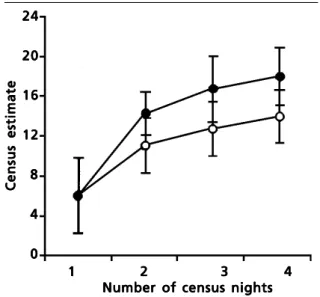
males when individual identification was included, an increase of 31.0%. Excluding poor weather nights resulted in figures of 14.6±0.80 and 19.9±0.45 respectively, an increase of 36.3%. With four nights of data, estimates obtained using only mapping data averaged (±s.e.) 14.2±0.76 males, those including individual information 18.2±0.84 males, an increase of 28.2%. Excluding poor weather nights gave figures of 15.7±0.55 and 21.6 ± 0.91 respectively, an increase of 37.6%. Thus, increasing the number of census nights and including information from recordings both increase census estimates (fig. 2).
Based on mapping data and using the 250 m rule, the total number of male Corncrakes in the study site was estimated as 24. When information on individual identity was included, this figure increased by 20.8% to 29. This number is unlikely to represent the number of males present on the study site at any one time as birds likely moved to and from the study site throughout the season. It is conservative to assume that all males arrive from migration and begin calling before 31 May. Nine (32%) males recorded on the study site were not recorded before this date, suggesting that they moved onto the study site during the season from surrounding areas. It is also conservative to assume that no males leave on migration before 1 July. Seven (24%) males were not recorded on the study site after this date, suggesting that they
Fig. 1. Diagram showing the grid used to measure habitat characteristics of Corncrake calling sites. The central dot indicates the calling site of a male Corncrake.
Fig. 1. Diagrama que muestra la rejilla uti-lizada para medir las características del hábitat de los lugares de llamada del guión de codornices. El punto central indica el lugar de llamada del macho del guión.
40 m 40 m 40 m 40 m 40 m
40
m
40
m
40
m
40
m
40
had either moved from the study area to another site or died. Assuming that males remained in the study area on the nights between that on which they were first recorded and that on which they were last recorded, it is possible to calculate the number of males present on each night; the mean number of males present on each night was 20.7±0.5 (s.e.).
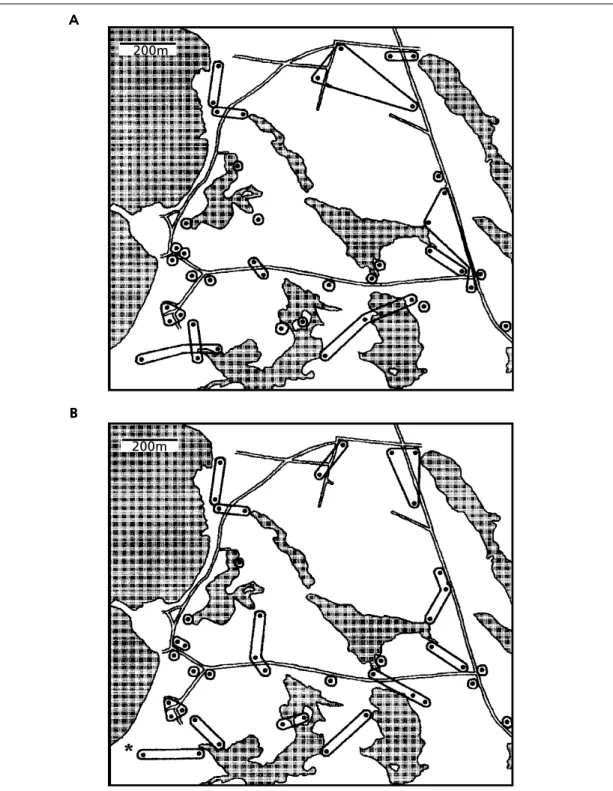
Figure 3 shows the patterns of movements between the 40 calling sites derived from: mapping data alone and mapping data in conjunction with information on individual identity. There are a number of differences between the two maps with a number of birds moving more than 250 m between sites. Distances moved by Corncrakes between calling sites are greater in some areas of the study site than in others. This seems to coincide with the amount of suitable habitat shown in figure 4. There was a significant negative correlation between the distance moved by birds following site abandonment and the percentage of usable habitat in the area surrounding the abandoned site (rs = – 0.58, n = 15, p < 0.05).
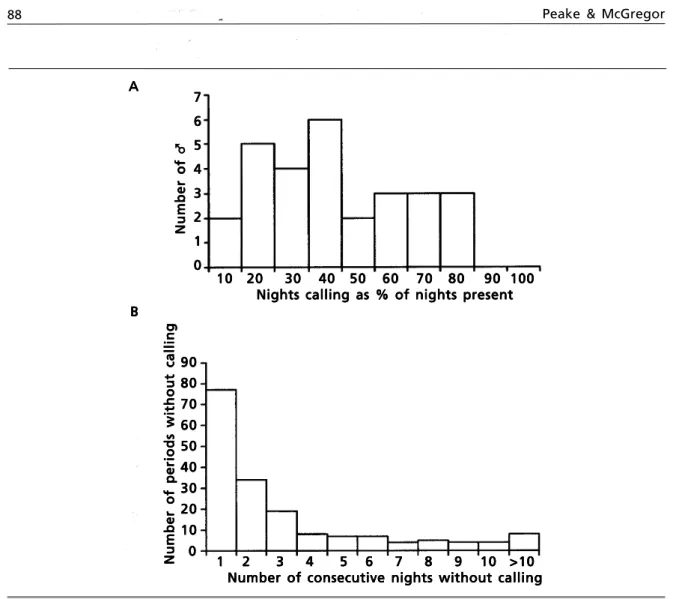
Using information on individual identity, we then investigated the radio-tracking result that males call on 75–80% of nights (STOWE & HUDSON, 1988). As we could only be certain that a male was present if he called, we assumed that if a male had previously called, became silent and subsequently re–appeared (either at the same site or at a new site) he had been present in the study area for the silent period; on average males called on 41.5% of nights (fig. 5).
Discussion
The current census method for Corncrakes appears to underestimate the true number of birds present, at least within the confines of this study. The addition of information on the identity of individuals increased census estimates by nearly 30% in all three situations tested. However, even estimates derived using vocal individuality fell short of the mean number of males present during the study period.
The main source of bias resulting in undercounting would appear to be a lower than expected incidence of calling. STOWE & HUDSON
(1988) found that radio–tagged males called on 75-80% of visits, a result backed up by later radio–tracking studies carried out on Coll, Inner Hebrides (TYLER & GREEN, 1996). Thus, on a two– night census, the probability of encountering any given male is between 0.94 and 0.96. In this study, males called on an average of 41.5% of nights, giving a probability of encounter of 0.66. With, on average, 20.7 males present and a probability of encounter of 0.66 over two nights, the expected census estimate would be 13.6 males, close to the observed two night census figure using mapping data alone of 11.8 males. This would suggest that
variation in the proportion of males in an area that call on a given night represents a significant source of bias in the census method.
The second radio–tracking result contributing to the current census method (STOWE & HUDSON, 1988) was that males rarely move more than 250 m between calling sites. Within our study area, four of 29 (13.7%) males moved distances greater than this (4–500 m). In addition, nine (32%) arrived at the study site late in the season, the assumption being that they must have arrived from migration elsewhere and moved onto the study site later. While birds that moved to and from the site may introduce bias to a census of the North Uist population, they do not represent a source of bias in the estimates made within the study site as they will not have been recorded at two sites. It is unlikely therefore that movements greater than 250 m are a major source of bias in the census estimates derived in this study.
Fig. 2. Results of various methods used to count male Corncrakes. As the number of census nights increases the census estimate derived increases. Census estimates which included information on individual identity (closed circles) are greater than those which use only mapping data (open circles).
Fig. 2. Resultados de distintos métodos uti-lizados para contar machos de guión de codornices. Si el censo nocturno se incrementa, también se incrementa la esti-ma del censo derivado. Los censos estiesti-ma- estima-dos que incluyen información de la identi-dad individual (círculos negros) son mayo-res que los que sólo utilizan datos de mapeo (círculos blancos).
24 2424 2424
20 2020 2020
16 1616 1616
12 1212 1212
8 88 88
4 44 44
0 00 00
1 11 1
1 22222 33333 44444 Number of census nights Number of census nights Number of census nights Number of census nights Number of census nights
Census
estimate
Census
estimate
Census
estimate
Census
estimate
Census
Fig. 3. The pattern of movements of Corncrake surmised from: (A) mapping data alone and (B) mapping data in conjunction with knowledge of individual identity obtained from recordings of calls. Mapping alone arrives at a total census figure of 24 whilst the inclusion of information on the identity of individuals increases this estimate to 29. One site (indicated by an asterisk on the lower map) was used at different times by two males.
Fig. 3. Patrón de movimientos del guión de codornices a partir de: (A) datos de mapeo únicamente y (B) datos de mapeo conjuntamente con el conocimiento de la identidad individual obtenida a partir de grabaciones de llamadas. Mediante el mapeo sólo se obtiene un censo total de 24, mientras que incluyendo información de la identidad de los individuos se incrementa a 29. Una localización (indicada con un asterisco en el mapa inferior) fue usada en diferentes ocasiones por dos machos.
200m
200m A
AA AA
However, the effects of the movement of individuals on census estimates may be greater in some areas than others. It appears from this study that where suitable habitat is scarce or patchily distributed, male Corncrakes move greater distances throughout the season than in areas where habitat is more homogenous. Where areas differ greatly in habitat availability or continuity, census figures may be difficult to compare directly. Perhaps more importantly, where habitat within a given site changes over time, whether for better (positive habitat management) or for worse (habitat destruction), movement rates, and hence census inaccuracy, are likely to change. This could result in trends become obscured or accentuated depending on the direction of habitat change. Having an idea of the levels of inaccuracy within and between given areas and/or years would enable this problem to be counteracted to some extent.
There are several reasons why the results of this study might differ from those achieved by radio-tracking. Radio–tracking studies carried out by STOWE & HUDSON (1988, 1991) took place in two areas, three km and 50 km south of our study site. It is possible that geographical variation in habitat between these areas and our study area may have resulted in behavioural differences between
the males in each study. This is perhaps less likely than the fact that these previous studies were carried out between eight and ten years before this study; during that time, changes in agricultural practices may have had a greater effect on habitat than subtle geographic differences.
It is also possible that radio–tracking itself affected the behaviour of male Corncrakes studied previously. There are two main sources of potential bias involved in radio–tracking studies. Firstly, the method of capturing male Corncrakes may not capture a random sample of the population. Males are usually captured using playback of calls to stimulate approach. It is possible that this procedure biases capture rates towards a certain behavioural subset of male Corncrakes, e.g. those that are more strongly territorial and thus more vocally active. Second, radio-tags themselves may have caused changes in the behaviour of males. Male Corncrakes appear only to call nocturnally while attempting to attract a mate, becoming silent at night once successful (TYLER & GREEN, 1996). Radio–tags may reduce mating opportunities, resulting in an increase in the amount of time spent calling. However, TYLER (1996) found no difference in the attraction of radio–tagged females to tagged and untagged males.
Fig. 4. Map showing the percentage cover of habitat suitable for Corncrake in 100x100 m2 squares
throughout the study area. Closed circles represent calling sites of male corncrake; lines connecting sites indicate movements between sites.
Fig. 4. Mapa que muestra el porcentaje de cobertura de hábitat disponible para el guión de codornices en cuadrículas de 100x100 m2 del área de estudio. Los círculos negros representan los sitios de llamada
Another explanation for the difference may be that some birds left the study site for short periods and later returned. Inspection of figure 5B shows that some males do indeed stop calling for periods of a week or more during the study period. While a number of these undoubtedly represent breeding attempts, some may represent temporary movements to other sites. However, in the majority of instances males become silent for only one or two nights at a time, increasing the likelihood that they remained on the study site over these periods. If the low incidence of calling found in this study is due to males leaving the
site for short periods, then movement rates of males between sites must be considerable. Although census workers counted three males calling within 1 km of the study site, the nearest area with large numbers of calling males was approximately 3 km away (R. E. Green, pers. comm.).
The level of increased census accuracy achieved by recording individual birds may not be enough to warrant issuing recording equipment to census workers. Indeed, the predictions of movement patterns based on mapping data alone often corresponded with those ascertained by the analysis of recordings (fig. 4). However, our results Fig. 5. Likelihood of calling by male Corncrakes: A. Number of nights on which males were heard to call as a percentage of nights on which they were assumed present; B. Frequency distribution of the number of consecutive nights on which males were not heard to call yet were assumed present at the study site between 5 V 95 and 27 VII 95.
Fig. 5. Probabilidad de llamada del macho de guión de codornices: A. Número de noches en que se escucharon los cantos de llamada de los machos con relación al número de noches en que se supuso que estaban presentes; B. Distribución de frecuencias del número de noches consecutivas en las que no se escucharon los cantos de llamada de los machos aunque se supuso que estaban presentes entre el 5 V 95 y 27 VII 95.
10 10 10 10
10 2020202020 3030303030 4040404040 5050505050 6060606060 7070707070 8080808080 9090909090 100100100100100 Nights calling as % of nights present Nights calling as % of nights present Nights calling as % of nights present Nights calling as % of nights present Nights calling as % of nights present
1 1 1 1
1 22222 33333 44444 55555 66666 77777 88888 99999 1010101010 >10>10>10>10>10 Number of consecutive nights without calling Number of consecutive nights without calling Number of consecutive nights without calling Number of consecutive nights without calling Number of consecutive nights without calling
suggest that the sources and extents of bias in census estimates may differ between areas, potentially making comparison difficult. The relative accuracy of a census in a given area at a given time can be assessed relatively quickly and easily using the vocal individuality technique without the need to capture or otherwise disturb individual males.
Individually distinct vocalisations can have a very direct application in the detection of breeding attempts. Results of recent studies of radio-tagged individuals suggest that males cease nocturnal calling when accompanied by a female (TYLER & GREEN, 1996) and thus that cessation of nocturnal calling gives an indication of attempted breeding. However, this method relies on the assumption that subsequent calling at a given site is produced by the previously resident male and cannot detect males that move large distances following breeding attempts. It is only possible to confirm the identity of a resident male if that male is either ringed (requiring capture on at least two occasions), radio–tagged (expensive and requires capture) or through analysis of recorded calls (requires sophisticated equipment but not capture).
Despite a growing number of studies that examine the potential of vocal individuality to provide ecological information, there is little published evidence that such techniques are used or indeed are useful in practice. This study has demonstrated that individual distinctiveness present in the calls of the Corncrake (MAY, 1994; PEAKE et al., 1998) can provide information that is of comparable accuracy to information collected by other techniques. More importantly, individually distinct calls provide an opportunity to assess relative accuracy.
Acknowledgements
TMP was supported by a CASE studentship between the BBSRC and the RSPB. Analysis equipment was funded by NERC and the Royal Society. We are grateful to Rhys Green, Ken Smith, Ken Otter and Andrew Terry for comments that improved the manuscript considerably. We are also grateful to Phil Benstead, Cath Jeffs, Alex Turner and Dave Hodson for help and hospitality during fieldwork in North Uist. Fieldwork was carried out under licence SCB:02:95 from Scottish Natural Heritage.
References
BIBBY, C. J., BURGESS, N. D. & HILL, D. A., 1992. Bird Census Techniques. Academic Press, London. COLLAR, N. J. & ANDREW, P., 1988. Birds to watch:
The ICBP World checklist of threatened birds. ICBP, London.
DAHLQUIST, F. C., SCHEMNITZ, S. D. & FLACHS, B. K.,
1990. Distinguishing individual male wild turkeys by analyzing vocalisations using a personal computer. Bioacoustics, 2: 303–316. DUFAULT, S. & WHITEHEAD, H., 1995. An assessment
of changes with time in the marking patterns used for photo–identification of individual sperm whales, Physeter macrocephalus. Marine Mammal Science, 11: 335–243.
GALEOTTI, P., 1994. Patterns of territory size and defence level in rural and urban tawny owl (Strix aluco) populations. J. Zool. (Lond.), 234: 641–658
GALEOTTI, P. & PAVAN, G., 1991. Individual recognition of male tawny owls (Strix aluco) using spectrograms of their territorial calls. Ethol. Ecol. Evol., 3: 113–126.
GIBBS, J. P. & WENNY, D.G., 1993. Song output as a population estimator: effect of male pairing status. J. Field. Ornith., 64: 316–322.
GILBERT, G., GIBBONS, D. W. & EVANS, J., 1998. Bird
Monitoring Manual: a compendium of monitoring and survey techniques for birds of conservation concern and others in the UK. RSPB/BTO/WWT/JNCC/ITE/Seabird Group, Sandy, UK.
GILBERT, G., MCGREGOR, P. K. & TYLER, G., 1994. Vocal individuality as a census tool, practical considerations illustrated by a study of two rare species. J. Field Ornith., 65: 335–348. GREEN, R. E., 1995. The decline of the Corncrake
Crex crex in Britain continues. Bird Study, 42: 66–75.
GREEN, R. E. & STOWE, T. J., 1993. The decline of the corncrake Crex crex in Britain and Ireland in relation to habitat change. J. Appl. Ecol., 30: 689–695.
HUDSON, A.V., STOWE, T. J. & ASPINALL, S. J., 1990. Status and distribution of corncrakes in Britain in 1988. British Birds, 83: 173–187.
KREBS, C. J., 1989. Ecological Methodology. Harper
and Row, New York.
MAY, L., 1994. Individually distinctive Corncrake Crex crex calls: A pilot study. Bioacoustics, 6: 25–32.
MCGREGOR, P. K. & PEAKE, T. M., 1998. The role of individual identification in conservation biology. In: Behavioural Ecology and Conservation Biology: 31–55 (T. M. Caro, Ed.). Oxford University Press, Oxford.
PEAKE, T. M., MCGREGOR, P. K., SMITH, K. W., TYLER, G., GILBERT, G. & GREEN, R. E., 1998. Individuality in Corncrake Crex crex vocalisations. Ibis, 140: 120–127.
POLLARD, E. & YATES, T. J., 1993. Monitoring butterflies for ecology and conservation. Chapman Hall, London.
SAUNDERS, P. A. & WOOLLER, R. D., 1988. Consistent individuality of voice in birds as a management tool. Emu, 88: 25–32.
SOUTHWOOD, T. R. E., 1978. Ecological Methods. Chapman Hall, London.
STOWE, T. J. & HUDSON, A. V., 1988. Corncrake studies in the western isles. RSPB Cons. Rev., 2: 38–42.
– 1991. Radio–telemetry studies of corncrakes in Great Britain. Vogelwelt, 112: 10–16. SUTHERLAND, W. J., 1996. Ecological census
techniques. Cambridge University Press, Cambridge.
TYLER, G., 1996. The ecology of the corncrake with special reference to the effect of mowing on breeding production. Ph. D. Thesis, University College Cork.