Design of Rapid Serial Visual Presentation Panel for Arabic
Readers
Mohamed Zaki Ramadan*, Ahmed Tawhid Soliman**
*(Industrial Engineering Department, King Saud University, P.O. Box 800, Riyadh, Saudi Arabia ** (Industrial Engineering Department, King Saud University, P.O. Box 800, Riyadh, Saudi Arabia
ABSTRACT
The primary objective of the Rapid Serial Visual Presentation Panel (RSVPP) was to aid in understanding the Arabic moving messages in different public places such as mosques, hospitals, factories, emergencies, malls, and markets. RSVPP is potentially useful tool for presenting important intensive information in a rapid manner. Speed of showing words in the screens, colors of fonts/backgrounds, font styles, and polarization are some important factors that may affect the reading comprehended and speed. The initial stage of the project was to study the available panels that were designed in English formats. The layout of the new configuration of the designed panel as well as the requirements for developing was made in order to make realistic recommendations considering environmental and human users as a next stage. Message speed (180, 240, and 300 words per minute (wpm)), space between words (one, two characters), and fore/background colors (red, blue, green and white on black background) were independent variables. Percent of correct response, percent of correct comprehension and preference rating were dependent responses. Results of this study recommended that moving 240 wpm with one character among words in green character/black background color was superior over the other conditions.
Keywords
:
Rapid Serial Visual Presentation, electronic panel, Arabic reader, moving messages, human errors.I.
INTRODUCTION
Computer technology provides the potential for improved ways of reading. Rapid serial visual presentation (RSVP) involves the brief display of consecutive words at a fixed location. Because this technique eliminates the need for eye movements, readers who experience difficulties executing these movements would presumably benefit from this type of display. Readers with glaucoma, retinitis pigmentosa, or other medical symptoms which limit peripheral vision constitute such a population, since peripheral vision is thought to be critical in directing readers' eye movements. RSVP is very essential because its applications in some times in severe circumstances and required fast reaction. As a result of its critical uses the choices of the word must be in simplex meaning and in high quality clearness from strips type, letters speed, font size, space between the words and letters color to give the readers higher and fast comprehension. Castelhano and Muter study [1] suggested that with the widespread application of RSVP to electronic devices with small screens is possible. Poder study [2] showed that effective size-based selection (single position "at fixation location") is proved in several cases with RSVP stimuli. Wang, et al. [3] demonstrated that residue iteration decomposition can be utilized to the Chinese language processing data recorded using the RSVP paradigm and exhibiting an extended degree of stabilization.
Recently, a study of Proaps and Bliss [4] showed that participants who read full messages in the RSVP group were more speedily reacted when reading than when reading only words meaning. Individuals reading traditional text of content words achieved higher on comprehension assessments than when reading either RSVP formats. Participants also found RSVP tasks to be more challenging and more engaging than traditional text formats. Kessler, et al. study [5] reviews behavioural, electroencephalo-graphic, and especially magnetoencephalographic findings on the cortical mechanisms underlying attentional processes that separate targets from distractors and that ensure robust target forms for goal-directed action in the rapid serial visual presentation (RSVP) task. Electrophysiological tools were concentrically employed in subjects reading from the rapid serial visual presentation (RSVP) [6]. The findings of the Kranczioch and Dhinakaran study [7] pointed out that target location and thus the entrainment period sounds to be an important influencing factor for performance in RSVP tasks, its impact is extensively lessened after no more than one second of task-relevant RSVP stimulation. Akyürek and Wolff study [8] demonstrated that extended temporal integration occurs in RSVP, and that it is under attentional control.
Smigasiewicz, et al. [9] showed that if interhemispheric inhibition is prevailed and freed,
this facilitation of one hemisphere’s task should reduce its inhibitory effect on the other hemisphere, resulting to improve the second target identification by the other hemisphere. Wirkner, et al. [10] implemented a new reactivation technique using RSVP that helps to improve implicit processing (pop out) of the most salient memories making them vulnerable to be distracted. Acqualagna and Blankertz [11] recommended that the RSVP speller does not require gaze shifts towards different target positions and can be turned on by non-spatial visual attention, therefore it can be treated as a valid paradigm in applications with patients for impaired oculomotor control. Benedetto, et al. [12] proved that Spritz’s technology might be more appropriate for very short statements. In contradicted fact is that Spritz suppresses parafoveally processing and comprehension. Furthermore, the essential reduction of eye blinks observed for Spritz might contribute to the increase of visual fatigue. Lue, et al. [13] suggested that the disruption of the facial configuration processing caused by inverted faces is relatively independent of attentional resources.
The primary objective of this study is to develop and experimentally confirmed the RSVP panel that aids in understanding the Arabic moving messages in different public places such as malls or markets. The initial stage of the study was to study the available panels that were designed in English. The layout of the new configuration of the designed panel as well as the requirements for developing was made in order to make realistic recommendations considering environment and human users. The second stage was done by using various methods of observations, logistics, and experimental design techniques to create numerous options that help improve the present system. The success of the study depended on the ability of the student to analyze the data in order to optimize the displaying panel. Different displaying types, capacities, viewing distances, and panel cost were considered. RSVP involves the brief display of consecutive words at a fixed location. Because this technique eliminates the need for eye movements, readers who experience difficulties executing these movements would presumably benefit from this type of display. This study tries to resolve the following two questions: Is RSVP with different speeds, spaces between presented words, and color of words on background affecting reading performance? How would the Arabic readers exert good performance over those factors?
II.
METHODOLGY
2.1. Participants
Seven university students are participated as volunteers. All were male, with an average age of 20 years ranging from 18 to 24 years (M = 21.2, SE
= 1.6). All participants reported normal visual acuity and normal color vision.
2.2.Materials and Apparatus
Two hundreds and forty passages from Arabic wisdoms as stimuli were presented centrally in the same spatial. A block of ten passages for each twenty-four treatments was executed randomly on the screen with five-minute breaks among blocks execution for next treatment preparation. The mean length of the passages appeared on the screen is about 5 words at any time. All passages were displayed randomly for each participant. None of the passages showed up more than once. A 750 ms blank window in between passages' presentations was considered. Texts were displayed on a 53.34 cm (diagonal) video monitor. Red, blue, green and white letters appeared on a black background. All stimuli were presented in Simplified Arabic font (size 36). This font was recommended by Ramadan et al. [14] and Ramadan [15]. The experiment was programmed and conducted using Microsoft Visual Studio 12.0 and was run on a Dell Flat Trinitron monitor with 120 Hz vertical refresh rate controlled by a Dell computer. During the experimental execution, words were presented centrally from the left to the right side of the screen character by character one at a time similar to the commercial ones.
2.3.Experimental design
This experiment employed the three-within subject design. The independent variables were message speed (180, 240, and 300 words per minute (wpm)), space between words (one, two characters), and fore/background colors (red, blue, green and white characters on black background) to ensure to be similar that ones used in commercial panels available in the local market. Those panels locally employed in airports and different shops. The message speed was well researched in English format by a study of Proaps and Bliss [4]. The dependent responses were percent of correct response, percent of correct comprehension and comfort rating.
2.4.Procedure
Participants sat approximately 50 cm from the computer screen. Each block which consisted of ten messages was initiated and ended by the participant pressing the space bar, followed by answering five short-answer questions prepared for each block in a separate hard copy written sheet as a comprehension assessment. It was included to keep participants focused on the passage content and from skipping over sentences. Also, the participant was asked to pronounce loudly the errors in passage if there is any as a percent of correct response. The participants given the following instructions: "In this experiment you will be reading passages. Please try to read with as much comprehension and speed as possible." If the participant was failed to report the passage mistakes, it was considered as an error. The errors were set randomly as five errors in each block. Participants would then give a preference rating for the format just seen. They were instructed to assign a number that appropriately transferred the extent of their like or dislike of the status. Each status was to be compared to the liking of reading from a book page, specified as a hundred. For example, if the status was liked twice as much as a book page, then the response would be two hundreds [1]. If the status was only liked half as much, the response would be fifty.
Participants initially completed twenty practice trials that contained two trials of each condition. Experimental trials were then commenced, with each participant completing a block of ten trials.
The experiment took approximately three hours to complete and each participant was tested in isolation. Participants were given a verbal description of all treatments; however, at the beginning of each treatment, they were not informed which format they would be viewing. At the beginning of each treatment, a message appeared in the center of the screen in red letters that read, `Press space key to start.’ Once a key was pressed, the computer was started to present the messages. Because words were displayed only one at a time, the option of rereading the sentence was not permitted. Words were presented within sentences at
speeds of approximately 180, 240, and 300 wpm. At the end of each block, a message would appear in the center of the screen reading `Please call the experimenter to set up the next condition,’ at which the experimenter would return to set up the next treatment.
III.
RESULTS
3.1.Percent of Correct Responses
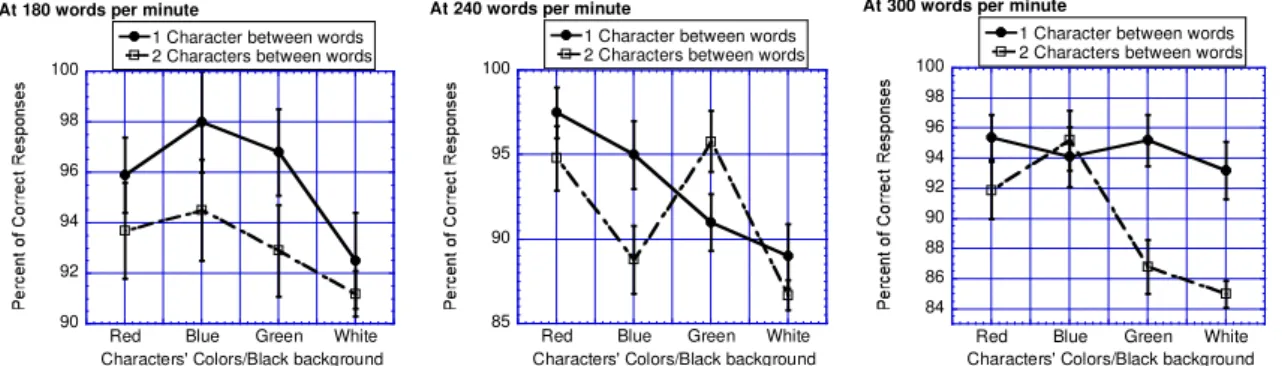
Results indicated that the following factors had significant effect on percent of correct responses: word speed, F(2,138)=3.258, p<0.041; space between words, F(1,69)=71.603, p<0.0001; and characters color, F(3,207)=14.38, p<0.001. Word speed by characters color interaction was significant, F(6,414)=4.668, p<0.0001. Word speed by space between words by characters color was significant, F(6,414)=7.733, p<0.0001.
The highest level of interaction was analyzed using simple effect technique applying separate one-way ANOVA procedures, as shown in Figure 1. At word speed of 180 wpm, the analysis showed that the participants reacted significantly less errors at space between words by 1 character and at blue and green characters, F(1,138)=15.36, p<0.0001; F(1,138) =31.186, p<0.0001, respectively, when it compared to a space of 2 characters among words.
At word speed of 240 wpm, the analysis showed that the participants reacted significantly less errors at space between words by 1 character and at red, blue, and white characters, F(1,138)=4.772, p<0.031, F(1,138)=12.267, p<0.001, F(1,138)= 5.226, p<0.024, respectively, when it compared to a space of 2 characters among words. In addition they reacted significantly less errors at space between words by 2 characters and at green characters when compared to space of 1 character between words, F(1,138)=7.933, p<0.006. At word speed of 300 wpm, the analysis showed that the participants reacted significantly less errors at space between words by 1 character at red, green characters, F(1,138)=10.691, p<0.001, F(1,138)= 13.547, p<0.0001, respectively, when it compared to a space of 2 characters among words.
90 92 94 96 98 100
Red Blue Green White
At 180 words per minute
1 Character between words 2 Characters between words
Characters' Colors/Black background
85 90 95 100
Red Blue Green White
At 240 words per minute
1 Character between words 2 Characters between words
Characters' Colors/Black background
84 86 88 90 92 94 96 98 100
At 300 words per minute
1 Character between words 2 Characters between words
3.2.Percent of Correct Comprehension
Results indicated that the following factors had significant effect on percent of correct compreh-ension: word speed, F(2,138)=8.955, p<0.0001; and characters color, F(3,207)=3.262, p<0.022. Space between words by character colors was significant, F(3,207)=5.149, p<0.002.
The highest level of interaction was analyzed using simple effect technique applying separate one-way ANOVA procedure, as shown in Figure 2. At all level of word speed, the analysis showed that the participants reacted significantly less comprehension errors at space between words by 1 character and at green characters color, F(1,418)=4.817, p<0.029, when it was compared to a space of 2 characters between words. In addition they reacted significantly less comprehension errors at space between words by 2 characters and at white characters when compared to space of 1 character between words, F(1,418)=4.509, p<0.034. In addition they reacted not significantly less comprehension errors at space between words by 1 character and at red and blue characters. As shown in Figure 3, participants reacted significantly less comprehension errors at messages speeds of 180 and 240 wpm when they reacted to messages speed of 300 wpm, p<0.0001.
80 85 90 95 100
Red Blue Green White 2 characters between words 1 character between words
Characters' Colors/Black background
Figure 2. Effect of space between words by characters/ background colors on percent of
comprehension.
80 85 90 95 100
180 240 300
Words Speed (wpm)
Figure 3. Effect of word speed on percent of comprehension.
3.3.Preference Rating
Results indicated that the following factors had significant effect on preference ratings: word speed, F(2,138)=12.85, p<0.0001; space between words, F(1,69)=31.37, p<0.0001; and characters color, F(3,207)=28.41, p<0.0001. None of the higher interaction was significant.
Figure 4.a shows the means and standard errors of the preference ratings. The participants significantly preferred to read from messages that contains one character space between words than to read from messages that contains two characters space between words, p<0.0001. Figure 4.b shows the means and standard errors of the preference ratings at the three messages speeds. Participants significantly preferred to read messages with speed of 240 wpm than in 180 wpm or in 300 wpm, p<0.0001, and p<0.0001, respectively. Figure 4.c shows the means and standard errors of the preference ratings at different characters colors. Participants significantly preferred to read green characters/black background color messages more than any other colors. In addition, there were no significant differences between red and white characters colors. However, red and white characters colors were preferred from blue character color.
0 20 40 60 80 100
1 2
Space Between Words (# of Characters) 0 20 40 60 80 100 120
180 240 300
Words Speed (wpm)
0 20 40 60 80 100
Red Blue Green White Characters' Colors/Black Background a) b) c)
VI.
DISCUSSION
&
CONCLUSION
Communications technology has exploded in the last ten years, bringing with it the problem of developing an optimal method of displaying electronic text on small screens. These screens are found on a variety of devices (e.g. cellular phones, pagers and desktop phones with screens). Many alternative formats for reading have been proposed, including: a moving window display, in which participants hit a button to produce the next words of the text, which is formatted normally otherwise; times square, which is horizontal right to-left scrolling of text; line-stepping, which is similar to times square, but includes pausing at various intervals along the sentence; sentence-by-sentence electronic presentation, in which the text is divided into sentences individually displayed; and rapid serial visual presentation (RSVP).RSVP technique has many applications in different places such as airport panels showing the time of flights, in the hospitals some of screen show the directions and in the university. A key difference between the printed page and the computer is that the computer allows dynamic presentation of text. Dynamic displays may attract attention better than static displays. RSVP is potentially useful for several reasons. It may be an efficient way to present continuous text in general primarily because with RSVP there is no need to expend cognitive processing capacity on controlling eye movements. It may be the best method of presenting text when display space is limited (e.g., on cramped consoles, multiple-window displays, or wristwatch terminals). It may be useful in teaching reading, especially to some dyslexics. It is an effective technique for searching for particular items (scanning) or for other tasks in which every word must be fixated. In the age of information explosion scanning is becoming increasingly important. It may be particularly advantageous for readers with impaired peripheral vision. Also, it can be an important tool in studying cognitive processes.
The objective of this study was to investigate several methods of reducing the difficulties experienced during the reading process in RSVP. These factors were determined by processing three various word speeds, two spaces between words, and four characters colors to black background.
A text presented in the one-character jump condition was read about 50% slower and about 40% less efficiently than that in the five- and nine-character jump conditions [17]. This inferiority effect of the one-character jump is comparable to previous result reported in Chen et al. [17]. This effect could be attributed to the fact that in one-jump condition the display needs to be advanced to bring new information enough for comprehension
processing. Therefore, participants had to read very slowly in one-character jump. To maintain a certain level of comprehension, the data of this study imply that the interference effect produced in 240 and 180 wpm were superior reading efficiency and comprehension. Also, the finding results of this study regarding character color/black background colors disagreed with those findings of by Ramadan et al. [14] and Ramadan [15]. The reason of this disagreement might be occurred because of the differences between the used presentation's modes. Most RSVP studies have acknowledged the importance of between-sentence pauses. However, most have merely added a 200 to 500 ms blank window in between sentence presentations. There is evidence that in normal page reading, a longer pause is observed at the end of the sentence. This amount of time, a reader spends at the end of a sentence can vary greatly. Instead of relying on a predetermined end-of-sentence electronic pause, the present study used 750 ms blank window in between sentence presentations. Results of this study recommended that moving 240 wpm with one character among words in green character/black background color was superior over the other conditions.
REFERENCES
[1]. M. S. Castelhano, and P. Muter, Optimizing the reading of electronic text using rapid serial visual presentation, Behaviour & Information Technology, 20(4), 2001, 237-247. DOI: 10.1080/0144929011006940 0 [2]. E. Poder, Size-based selection in rapid
serial visual presentation, Vision Research, 41, 2001, 2221–2234.
[3]. S. Wang, F. Wang, G. Ouyang, C. Zhou, The time course of semantic and syntactic processing in reading Chinese: A demonstration of using residue iteration decomposition (RIDE) in a rapid serial visual presentation (RSVP) paradigm, International Journal of Psychophysiology,
94, 2014, 120–261.
DOI:10.1016/j.ijpsycho.2014.08.646 [4]. A. B. Proaps, J.P. Bliss, The effects of text
presentation format on reading comprehension and video game performance. Computers in Human
Behavior, 36, 2014, 41-47.
[6]. W.Luo, W.Feng, W.He, N.Wang, Y.Luo, Three stages of facial expression processing: ERP study with rapid serial visual presentation. NeuroImage, 49, 2010, 1857–1867.
DOI:10.1016/j.neuroimage.2009.09.018 [7]. C.Kranczioch, and J.Dhinakaran, The role
of temporal context and expectancy in resource allocation to and perception of rapid serial events, Brain and Cognition,
81, 2013, 313-320.
http://dx.doi.org/10.1016/j.bandc.2013.01.0 01
[8]. E.G. Akyürek, and M.J. Wolff, Extended temporal integration in rapid serial visual presentation: Attentional control at Lag 1 and beyond, Acta Psychologica, 168, 2016,
50-64.http://dx.doi.org/10.1016/j.actpsy.2016.0 4.009
[9]. K. Smigasiewicz, J. Weinrich, B. Reinhardt, and R.Verleger, Deployment and release of interhemispheric inhibition in dual-stream rapid serial visual presentation, Biological Psychology, 99,
2014, 47-59.
http://dx.doi.org/10.1016/j.biopsycho.2014. 02.008
[10]. J. Wirkner, A. Low, A.O. Hamm, and M. Weymar, New learning following reactivation in the human brain: Targeting emotional memories through rapid serial visual presentation, Neurobiology of Learning and Memory 119, 2015, 63-68. http://dx.doi.org/10.1016/j.nlm.2015.01.006 [11]. L. Acqualagna, and B. Blankertz,
Gaze-independent BCI-spelling using rapid serial visual presentation (RSVP), Clinical Neurophysiology, 124, 2013, 901-908.
http://dx.doi.org/10.1016/j.clinph.2012.12.0 50
[12]. S. Benedetto, A. Carbone, M. Pedrotti, K. Le Fevre, L. Bey, and T. Baccino, Rapid serial visual presentation in reading: The case of Spritz. Computers in Human Behavior, 45, 2015, 352-358. http://dx.doi.org/10.1016/j.chb.2014.12.043 [13]. W. Luo, W. He, S. Yang, W. Feng, T. Chen, L. Wang, T. Gan, Y. Luo, Electrophysiological evidence of facial inversion with rapid serial visual presentation, Biological Psychology, 92,
2013, 395– 402.
http://dx.doi.org/10.1016/j.biopsycho.2012. 11.019
[14]. M. Ramadan, A. Mohamed, H. El-Hariry, Effects of Cathode Ray Tube Display Formats on Quality-Assurance Auditor’s Performance. Human Factors and Ergonomics in Manufacturing & Service Industries 20 (1), 2010, 61–72. DOI: 10.1002/hfm.20166
[15]. M. Ramadan, Evaluating college students’ performance of Arabic typeface style, font
size, page layout and
foreground/background color combinations of e-book materials. Journal of King Saud University – Engineering Sciences 23,
2011, 89-100.
doi:10.1016/j.jksues.2011.03.005
[16]. G. Keppel, Design and Analysis: A Research’s Handbook, second ed. Prentice-Hall, Inc., Englewood Cliffs, NJ, 1982, 246–352.