Corresponding Author: Usha Yogendra Nayak, Department of Pharmaceutics, Manipal College of Pharmaceutical Sciences, Manipal University, Karnataka, India. Mobile: +91-8202922482 E-Mail: [email protected]
102
Original Research Article
Timed Release of Valsartan from Programmable Release Capsules:
Importance of Plasticizers
Usha Yogendra Nayak*
1, Gopal Venktesh Shavi
21Department of Pharmaceutics, Manipal College of Pharmaceutical Sciences, Manipal University, Karnataka, India.
2
SPI Pharma Inc. - India Branch, Bangalore, India.
ARTICLE INFO:
Article history:
Received: 15 November 2013 Received in revised form: 23 November 2013
Accepted: 30 November 2013 Available online: 7 December 2013
Keywords: Plasticizers, Timed release, Polymeric films, Tensile strength, Dibutyl phthalate.
ABSTRACT
The objective of the present study was to evaluate the effect of different plasticizers on the ethylcellulose coatings of capsules and its timed release characteristics. Various plasticizers such as dibutyl phthalate (DBP), triacetin (TA), glycerol, triethyl citrate (TEC), polyethylene glycol-4000 and polyethylene glycol-6000 (PEG) were studied. The physicochemical properties of the casted polymeric films such as mechanical resistance, water uptake and dry weight loss were determined. Also the type and concentration of plasticizer on timed release of the capsule was studied. The drug release was found to be strongly dependent on the type of plasticizer and was in the order of GY>TA>PEG 6000>PEG 4000>TEC>DBP. Capsules coated with hydrophobic DBP (5%) showed good release with a lag time of 6 ± 0.5 h. DBP provided mechanically resistant coatings on the capsule and remained within the polymeric films without leaching upon exposure to the release media which helped in maintaining the lag time.
1. Introduction
Controlled drug release is the term refers to the delivery of the drug in vivo according to the predictable rate or at specific times or with specific release profiles. In recent years time-controlled drug release dosage forms are taken interest of many scientists. Polymeric film coatings are one of the frequently used technologies to control the drug release from tablets or capsules [1]. While coating any solid dosage form, in order obtain desired release pattern many parameters can be varied such as the type of polymer, plasticizer, amount of plasticizer and coating level etc [2].
There are different types of coatings are used such as water insoluble coatings, pH dependent and pH independent coatings. Ethylcellulose (EC) is widely used water insoluble polymer coating system in oral controlled release dosage forms [1]. Even though the type of polymer used in coating helps in controlling the release of drug, it is essential to include plasticizer along with the polymer to obtain flexible film coating and to improve the film performance. The plasticizers help in modifying the
physical properties of films and provide sufficient mechanical strength. Also it alters the brittleness of the film and sometimes the permeability of the film depending on the nature of plasticizer used [3]. Permeability in turn affects the water absorption behavior and drug release performance [4, 5]. Many compounds act as plasticizers including glycerol, poly (ethylene glycol), propylene glycol, oils, citrates, adipates, and phthalates, etc. Based on their intrinsic properties and the interaction with polymers, each plasticizer behaves differently [4].
In the present work it was planned to study the effect of different plasticizers on the EC coated timed-release dosage form. In our earlier study we developed a timed-release capsule dosage form, in which capsules were coated with EC and plasticized using dibutyl phthalate [6]. Therefore, the aim of present work was to investigate the effect of various plasticizers on the performance of EC coating films and the timed release behavior of plasticized, EC coated capsules. Valsartan, a long-acting CODEN (USA): IJPB07 ISSN: 2320-9267
Indian Journal of Pharmaceutical and Biological Research (IJPBR)
Original Research Article
103
angiotensin receptor blocker (ARB), is having a blood pressure(BP) lowering effect was used as model drug.
2. Materials and Methods
2.1
Materials
Valsartan (Val), Guar gum (GG), Cross linked polyvinylpyrrolidone (CPVP), Avicel pH 112, Magnesium stearate and Talc are obtained as gift sample from Lupin Research Park, Pune, India. Sodium alginate was procured from Sigma Aldrich, USA. Ethyl cellulose (EC) 10 cps was procured from Signet Chemical Corporation Pvt. Ltd., Mumbai, India. Dibutyl phthalate (DBP), Triacetin (TA) and Glycerol 98% purified (GY) were procured from Merck Limited, Mumbai. Triethyl citrate (TEC) was procured from HiMedia Laboratories Pvt. Ltd. Mumbai. Polyethylene glycol-4000 (PEG-4000) and Polyethylene glycol-6000 (PEG-6000) were procured from Qualigens Fine Chemicals, Mumbai. All other reagents were used of analytical grade.
2.2
Preparation of polymeric films
Thin polymeric films were prepared by casting with ethyl cellulose (95%) plasticized with 5% plasticizer (DBP, TA, TEC, GY, PEG-4000 and PEG-6000)as a 6% solution in a 50:50 v/v mixture of acetone and propan-2-ol. The mixtures were stirred for 30 min prior to casting into Teflon molds. The films were subsequently subjected to control drying for 12 h at 37°C in an oven.
2.3
Characterization of free films
I.
Mechanical properties
The thickness of the films was measured using a thickness gauge. The mechanical properties such as percent elongation, puncture strength and energy at break of the films (3×3 cm) were measured in both and wet state using a puncture test and texture analyzer (Instron® 3366-2716015, Germany). Film specimens were mounted on a film holder and the puncture probe was moved through the film at a defined speed of 0.1 mm/s.Force vs. displacement curves were recorded with a 50 N load cell.
The mechanical properties of the films (3×3 cm) containing DBP before and after exposure to 0.1 N HCl for 2 h, phosphate buffer (pH 6.8) up to 4 h, followed by phosphate buffer (pH 7.4) were also measured. Film pieces were placed into glass beakers filled with 200 ml and agitated in a horizontal shaker at 37°C and 75 rpm (Water bath shaker, Remi Equipments, Mumbai). At pre-determined time points, samples were withdrawn and mechanical properties were determined. Load versus displacement curves were recorded until rupture of the film and used to determine the mechanical properties such as puncture stress, tensile extension, energy at break and tensile strain. Young’s modulus (YM) was calculated by extending the linear portion of the stress-strain curve and dividing the difference in stress by the difference in strain [7].
II.
Water uptake and dry weight loss of cast
polymeric films
Thin, polymeric films were cut into pieces of 3×3 cm, were weighed (W0) and placed into 100 ml preheated 0.1 N HCl for 2 h followed by phosphate buffer pH 6.8, by horizontal shaking for total 10 h (37°C, 75 rpm; Water bath shaker, Remi Equipments, Mumbai). At different time points (t), samples were withdrawn, weighed [wet mass (W1)] and dried at 60°C to constant mass [dry mass (W2)]. The % water content and % dry film mass at time t were calculated using the formula, % Water content = [(W1-W2)/W1] X 100 and % dry film mass = (W2/ W0) X 100 respectively [1, 8].
2.4
Formulation
Formulation contained coated capsule body filled with swellable polymer, drug tablet and erodible tablet and closed with water soluble cap according to our previous study. Capsule size 1 was used in the study. Capsule bodies were separated from the caps and were coated with EC plasticized with 5% and 10% plasticizer (DBP, TA, TEC, GY, PEG-4000 and PEG-6000)as a 6% solution in a 50:50 v/v mixture of acetone and propan-2-ol in pharma R & D coater (Model: delux, Ideal Cures Pvt. Ltd., Mumbai, India). 200 mg of sodium alginate was weighed into the coated capsule and lightly pressed. A tablet containing valsartan (80 mg), cross PVP (6 mg) and Avicel pH 112 (12 mg), magnesium stearate and talc (1% each) was placed onto the compacted layer. An erodible tablet containing polymer guar gum (75 mg) and directly compressible lactose (69 mg) was inserted into the mouth of the capsule. The capsule body was closed with water soluble cap [6].
2.5
In vitro dissolution studies
The in vitro dissolution study of capsule device was carried out using USP Type II dissolution apparatus. The study was carried out in 900 ml of 0.1 N HCl for first 2 h, then phosphate buffer (pH 6.8) for 4 h followed by phosphate buffer (pH 7.4). The dissolution medium was maintained at 37±0.5°C and 75 rpm. The capsule assembly was tied to metallic disc was then introduced into the dissolution vessel. At pre-determined time intervals, 5 ml of sample was withdrawn and analyzed by UV-Visible spectrophotometer at 250 nm. At each time of withdrawal, 5 ml of fresh corresponding medium was replaced into the dissolution vessel.
3. Results and Discussion
3.1
Mechanical properties of thin polymeric films in the
dry state
Original Research Article
104
modulus of films (Table 1). This was caused by the plasticizationeffect and interaction with the polymer molecules.
The higher molecular weight of PEG is associated with decrease in the number of hydroxyl groups and higher molecular volume leading to decrease in the accessibility to interact with the
polymer molecules [10]. As the molecular weight of PEG was decreased and concentration of plasticizer was increased, the tensile strength was increased at breaking point [11]. Among all, the films prepared with DBP had highest modulus and mechanical strength.
Table 1: Mechanical properties of thin polymeric films in the dry state
Plasticizer (%) Energy at break (J) Tensile extension (mm) Tensile strain (mm/mm) Tensile stress (MPa) Modulus (MPa) DBP 5
10 0.0058 0.0118 0.623 1.579 0.020 0.052 0.0270 0.0176 2214.24 1628.67 TA 5
10 0.0032 0.014 0.476 1.008 0.015 0.033 0.0906 -0.7711 1962.04 1944.78 TEC 5
10 0.0010 0.0118 1.259 1.429 0.0419 0.0476 1.257 -0.009 2093.19 1775.08 GY 5
10 0.00133 11.0 0.533 11.099 0.0177 0.370 0.01808 -0.0017 1740.99 1765.00 PEG-4000 5
10 0.00362 0.00566 0.608 2.094 0.0202 0.0698 0.3224 -0.1083 2117.61 1671.09 PEG-6000 5
10 0.00579 0.0127 0.591 1.233 0.0197 0.0411 0.9384 0.1429 1927.15 1546.33
3.2
Mechanical properties of thin polymeric films in the
wet state
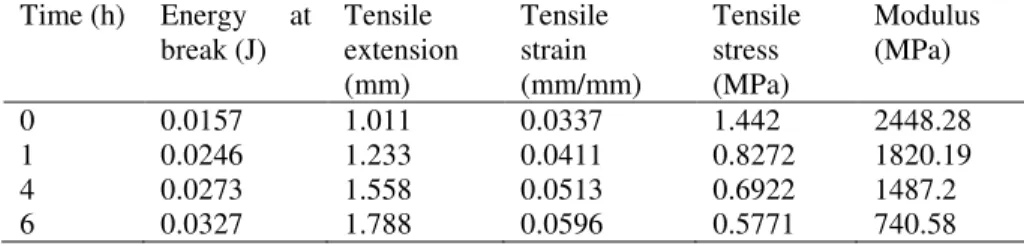
The composition of polymeric system greatly influences their mechanical properties and hence changes the percent elongation, puncture strength and energy at break of the films upon exposure to the release media. The films containing 5% DBP were exposed to dissolution medium and at different time intervals,
mechanical properties were measured (Table 2). The puncture strength of the films was declined with increasing exposure time in dissolution medium. The tensile extension was increased with decrease in modulus and tensile stress. The percent elongation was found to be 21.95, 54.10 and 76.85 for 1, 4 and 6 h respectively. The energy at break was also increased. Overall mechanical strength of DBP films was decreased on exposure to release media.
Table 2: Mechanical properties of polymeric films containing 5% DBP in the wet state
Time (h) Energy at break (J) Tensile extension (mm) Tensile strain (mm/mm) Tensile stress (MPa) Modulus (MPa) 0 1 4 6 0.0157 0.0246 0.0273 0.0327 1.011 1.233 1.558 1.788 0.0337 0.0411 0.0513 0.0596 1.442 0.8272 0.6922 0.5771 2448.28 1820.19 1487.2 740.58
3.3
Water uptake and dry weight loss of cast polymeric
films
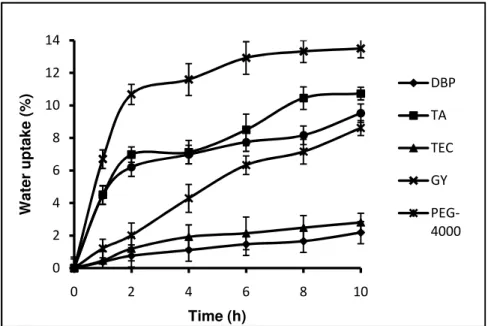
The increase in water content of films generally increases their permeability (Figure 1). Higher water uptake rates and extents were observed with hydrophilic plasticizers compared to DBP containing systems. Percentage water content was less than 2.5 in the case of DBP, whereas GY and TA absorbed more than 10%. These data were supported by the higher dissolution rate of
Original Research Article
105
Figure 1: Water contents of thin films upon exposure to dissolution mediumFigure 2: Dry weight loss of polymeric films upon exposure to dissolution medium
3.4
In vitro dissolution studies
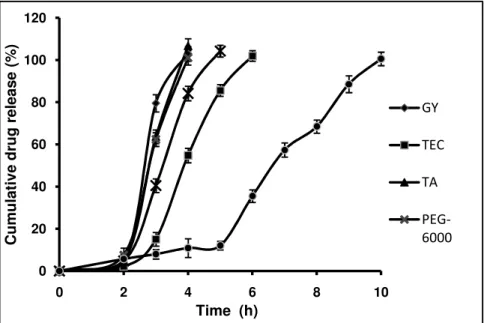
The release pattern was varied with capsules coated with EC containing different plasticizers (Fig. 3 and 4). The type of
plasticizer had a prominent effect on the resulting drug release kinetics. In all cases the release was slow in 0.1 N HCl. When plasticizer was not added, the EC film formed was brittle, and broken easily in 0.1 N HCl, the dissolution medium penetrated
0 2 4 6 8 10 12 14
0 2 4 6 8 10
W
a
te
r
u
p
ta
k
e
(
%
)
Time (h)
DBP
TA
TEC
GY
PEG-4000
0 20 40 60 80 100
0 5 10
D
ry
fi
lm
m
a
s
s
(
%
)
Time (h)
DBP
TA
TEC
Original Research Article
106
readily, giving rapid dissolution (within 30 min). Themechanical properties of the film improved as the amount of plasticizer was increased. Also better barrier film was formed and it prevented the fast penetration of the dissolution medium. Hence slower dissolution rate was observed with increase in plasticizer concentration [12].
The PEG and PG being readily water soluble create pores, allowing more rapid penetration of the dissolution medium and hence with theses coatings the lag time (time required to release 10% of drug) was 2 h. TEC showed comparatively slower
release than PEG, PG and TA, with a lag time of 3 h. The drug release was much slower initially when DBP was used, compared to other plasticizers. Capsules coated with 5% DBP showed a lag time of 6 ± 0.5 h followed by rapid release. This may be due to hydrophobic nature of the DBP. The release of drug from capsules coated with different plasticizers was in the order of GY>TA>PEG 6000>PEG 4000>TEC>DBP (Figure 3 and 4). Thus the drug release pattern may be attributed to the difference in water permeability and leach ability from the films.
Figure 3: Effect of 5% plasticizers on dissolution of capsules
Figure 4: Effect of 10% plasticizers on dissolution of capsules
0 20 40 60 80 100 120
0 2 4 6 8 10
C
u
m
u
la
ti
v
e
d
ru
g
r
e
le
a
s
e
(
%
)
Time (h)
GY
TEC
TA
PEG-6000
0 20 40 60 80 100 120 140
0 2 4 6 8 10
C
u
m
u
la
ti
v
e
d
ru
g
r
e
le
a
s
e
(
%
)
Time (h)
GY
TEC
TA
Original Research Article
107
4. Conclusion
The type and concentration of plasticizer were found to be the essential factors to be considered in designing controlled release coated systems. These affected the release of valsartan from the capsules. Capsules coated with ethyl cellulose containing 5% DBP showed optimum drug release with lag time. DBP was found to be versatile plasticizer shown to remain within the polymeric films upon exposure to the release media, assuring mechanically resistant coatings during drug release and was helpful in maintaining lag time.
Conflict of interest statement
We declare that we have no conflict ofinterest.
Acknowledgement
Authors are thankful to Lupin Research Park, Pune, India for the gift samples of valsartan and other excipients. Authors are thankful to Mr. Kishore G, Dept. of Dental Materials, Manipal College of dental Sciences, Manipal, Karnataka, India, for helping in carrying out tensile strength test.
References
1. Siepmann F., Hoffmann A., Leclercq B., Carlin B., Siepmann J., How to adjust desired drug release patterns from ethylcellulose-coated dosage forms, J. Control. Release, 2007;119: 182–89.
2. Siepmann F., Siepmann J., Walther M., MacRae R.J., Bodmeier R., Polymer blends for controlled release coatings, J. Control. Release, 2008; 125: 1–15.
3. Guo J., Effects of plasticizers on water permeation and mechanical properties of cellulose acetate antiplasticization in slightly plasticized polymer film, Drug dev. Ind. Pharm., 1993;19:13: 1541-55.
4. Lin W.J., Lee H.K., Wang D.M., The influence of plasticizers on the release of theophylline from microporous-controlled tablets, J. Control. Release, 2004; 99: 415–21.
5. Lecomte F., Siepmann J., Walther M., MacRae R.J., Bodmeier R., Polymer blends used for the aqueous coating of solid dosage forms: importance of the type of plasticizer, J. Control. Release, 2004; 99: 1– 13.
6. Nayak U.Y., Shavi G.V., Nayak Y., Averinen R.K., Mutalik S., Reddy S.M., Gupta P.D., Udupa N., Chronotherapeutic drug delivery for early morning surge in blood pressure: a programmable delivery system, J. Control. Release, 2009; 136:2: 125–31.
7. Muschert S., Siepmann F., Leclercq B., Carlin B., Siepmann J., Prediction of drug release from ethylcellulose coated pellets, J. Control. Release, 2009; 135: 71–79.
8. Nautiyal U., Sin D., Formulation and Characterization of Transdermal Patches of Losartan, Ind. J. Pharmaceut. Biol. Res., 2013; 1:1: 44-54.
9. Brahmaiah B., Sasikanth K., Nama S., Suresh P., Khan P.A., Formulation and Dissolution Study of Valsartan Immediate Release Tablets, Ind. J. Pharmaceut. Biol. Res., 2013; 1:2: 1-8.
10. Qussi B., Suess W.G., The influence of different plasticizers and polymers on the mechanical and thermal properties, porosity and drug permeability of free shellac films, Drug Dev. Ind. Pharm., 2006; 32: 403–12.
11. Honary S., Orafai H., The effect of different plasticizer molecular weights and concentrations on mechanical and thermo mechanical properties of free films, Drug Dev. Ind. Pharm., 2002; 28:6: 711–15.
12. Okarter T.U., Singla K., The effects of plasticizers on the release of metoprolol tartrate from granules coated with a polymethacrylate film, Drug Dev. Ind. Pharm., 2000; 26: 3: 323–29.
All © 2013 are reserved by Indian Journal of Pharmaceutical and Biological Research