doi: 10.1590/S1984-46702012000300001
The striking heterogeneity of the cuckoos in terms of mor-phology, behavior and DNA structure results from a long evo-lutionary history and a broad geographic distribution (SIBLEY & AHQUIST 1990, WOODBURY 1998). Terrestrial cuckoos are
gener-ally considered to be the oldest (HUGHES 2000, PAYNE 2005, POSSO
& DONATELLI 2006), occurring in the Neotropics (Crotophaginae,
Neomorphinae), Africa, Madagascar and South Asia (Centropo-dinae). The arboreal cuckoos (Cuculinae, Coccyzinae, Phaenico-phaeinae) are cosmopolitan, but are concentrated in the tropics (PAYNE 1997 2005).
Cuckoos are well known because of their eccentric re-productive behaviors, as brood parasitism and cooperative breeding, and also their terrestrial and arboreal habits (PAYNE
2005). However, despite the increased systematic research on them in recent decades (SIBLEY & AHLQUIST 1990, ARAGÓNet al.
1999, HUGHES 1996, 2000, JOHNSONet al. 2000, POSSO & DONATELLI
2001, 2006, SORENSON & PAYNE 2005), there is still no agreement
on whether terrestrial and arboreal habits emerged more than once among cuckoos.
Moreover, there are no biogeography studies from which to withdraw the historical distribution of cuckoos with reason-able confidence. CRACRAFT (1973) notes that little is known about the distribution of cuckoos, given the large geographic area
over which its members are distributed. An additional prob-lem is the small number of fossil remains and their controver-sial nature (OLSON 1985). Most have been dated to the Upper Tertiary and point to an origin in Laurasia (FEDUCCIA 1996). On
the other hand, the oldest is dated to the Paleocene in South America (BAIRD & VICKERS-RICH 1997).
Thus, we set out to perform a biogeography analysis adopting a hypothetical-deductive approach (BPA) to recon-struct some hypotheses about the early historical distribution of the cuckoos.
MATERIAL AND METHODS
We used the classification proposed by PAYNE (1997), ex-cept for the positions of Coua Linnaeus, 1766 and Carpococcyx
Temminck, 1832, which were placed in Couinae (Fig. 1), Tapera
Linnaeus, 1766 and Dromococcyx Wied, 1832 placed in Taperinae, and the Coccyzus Vieillot, 1816 placed in Cuculinae, based on the phylogenetic analysis performed by POSSO & DONATELLI (2006).
We adopted the BPA (“Brooks Parsimony Analysis”) sensu
WILEY (1988a, b) and BROOKSet al. (2001) for the biogeography
analysis. The reasons for choosing BPA are the following: a) it
Biogeography on the early distribution of cuckoos (Aves: Cuculiformes)
Sérgio R. Posso
1, 3& Reginaldo J. Donatelli
21 Laboratório de Ecologia, Filogenia e Conservação das Aves Neotropicais, DCN, Universidade Federal de Mato Grosso do Sul.
Avenida Ranulpho Marques Leal 3484, Caixa Postal 210, 79620-080 Três Lagoas, MS, Brazil.
2 Laboratório de Vertebrados, Departamento de Ciências Biológicas, Universidade Estadual Paulista. Caixa Postal 473,
17033-360 Bauru, SP, Brazil.
3 Corresponding author. E-mail: [email protected]
ABSTRACT. Cuckoos are widely distributed, but are concentrated in the tropics, where they occupy a wide range of habitats. Both terrestrial and arboreal behaviors can be found in this group, but there is no consensus on as to whether these behaviors have arisen more than once. Moreover, the historical distribution of cuckoos is poorly understood. This paper presents a biogeographyc analysis of the early history of the distribution of these birds. The analysis was per-formed by using the Principle of Parsimony based on primary and secondary “Brooks Parsimony Analysis” (BPA). Despite some exceptions, the primary BPA corroborated events of vicariance (general pattern) in the early distribution of cuck-oos and a terrestrial ancestor widespread in the Gondwana. The most parsimonious hypothesis suggests that the distri-bution of terrestrial cuckoos (basal group) is associated with the break-up of the Gondwana (Early to Mid Cretaceous), consistent with molecular data for other living birds. On the other hand, the fossil records indicate a more recent origin (Paleocene to Upper Tertiary) in the Laurasia. Nevertheless, to corroborate the fossil records, the early distribution of cuckoos would not be explained by parsimony, since additional steps on dispersion and local extinctions should be added. In addition, according to the secondary BPA, most exceptions can be explained by dispersion as the origin of the arboreal cuckoos (derived group) in South America, where they dispersed to other continents.
does not permit modifications in the cladogram of taxa (hy-pothesis “0” sensu WILEY 1988b) and absent areas are
consid-ered as non-informative; b) it is a posteriori method, i.e., it considers the Principle of Parsimony to find the most probably hypothesis, just after the establishment of the taxa/area cla-dogram (BROOKSet al. 2001); c) it comprises a
hypothetical-de-ductive model rather than an inhypothetical-de-ductive reasoning for analysis in biogeography; d) it provides a complex of speciation, dis-persal and extinction events without removing or modifying data included from previous phylogenies, at least three clades were analyzed simultaneously. This simultaneous analysis can provide a distinction between general and specific elements of distribution; e) it adoptes the cladistics biogeography paradigm, where both disjunct distribution of endemic most related taxa and the most parsimonious topologies of area/taxa cladograms are considered to perform biogeographical approaches; f) it follows the Popperian Principle of Falsification, since it only infers about dispersion or extinction after the test of falsifica-tion of both. Episodes of extincfalsifica-tion do not provide distorfalsifica-tion in a hypothesis of simple vicariance and the lack of evidence can never confirm or falsify a hypothesis.
The most parsimonious cladograms were obtained by using the PAUP 4.0b10 version (SWOFFORD 2001). The DELTRAN was adopted for character optimization in order to minimize the numbers of reversals, as recommended by WILEY (1988b).
The cladograms of POSSO & DONATELLI (2006) (Fig. 1) and
CRACRAFT (2001) (Fig. 2) were used as basis for the taxa cladogram
and the cladogram area, respectively. However, in the cladogram area, the Australian and Antarctic were omitted to simplify the analysis.
In addition, we did not make any inference about the cladogenesis among Neomorphinae, Crotophaginae and Taperinae in South America. We considered their distribution in a single event in order to make the explanation shorter in the analysis of historical biogeography. This exception demands further explanations in future papers.
RESULTS
Data matrix to the primary BPA is found in the table I and the primary most parsimonious taxa/area cladogram in the figure 2.
Data matrix to the secondary BPA included 17 charac-ters (Tab. II). According to the matrix (Tab. II) and the taxa/ area cladogram (Fig. 3), South America was considered as only two reticulated area. It regards to the fact that Neomorphinae, Crotophaginae and Taperinae are basal taxa of the 13, 14 and 15 internodes (Fig. 3). Hence, the analysis was simplified by considering them a single area and omitting the events of spe-ciation in South America.
Table I. Matrix listing the geographical distribution of cuckoos subfamilies, along with the binary codes representing the phylogenetic relationships among the subfamilies.
Area Taxa 1 2 3 4 5 6 7 8 9 10 11 12 13 14 15 16 17
Southeast Asia 1, 3, 7, 9 1 0 1 0 0 0 1 0 1 1 1 0 0 0 0 0 0
Madagascar 2,3 0 1 1 0 0 0 0 0 0 1 1 0 0 0 0 0 0
Africa 3, 7, 9 0 0 1 0 0 0 1 0 1 1 0 1 1 1 1 1 1
South America 4, 5, 6, 8 0 0 0 1 1 1 0 1 0 1 0 1 1 1 1 1 1
Table II. Matrix listing the geographical distribution of cuckoos subfamilies, along with the binary codes representing the phylogenetic relationships among the subfamilies. The areas were considered reticulated.
Area Taxa 1 2 3 4 5 6 7 8 9 10 11 12 13 14 15 16 17
Southeast Asia 1 1 1 0 0 0 0 0 0 0 0 1 1 0 0 0 0 0 0
Southeast Asia 2 3 0 0 1 0 0 0 0 0 0 1 0 1 0 0 0 0 0
Southeast Asia 3 7 0 0 0 0 0 0 1 0 0 1 0 1 1 1 1 1 0
Southeast Asia 4 9 0 0 0 0 0 0 0 0 1 1 0 1 1 1 1 1 1
Madagascar 1 2 0 1 0 0 0 0 0 0 0 1 1 0 0 0 0 0 0
Madagascar 2 3 0 0 1 0 0 0 0 0 0 1 0 1 0 0 0 0 0
Africa 1 3 0 0 1 0 0 0 0 0 0 1 0 1 0 0 0 0 0
Africa 2 7 0 0 0 0 0 0 1 0 0 1 0 1 1 1 1 1 0
Africa 3 9 0 0 0 0 0 0 0 0 1 1 0 1 1 1 1 1 1
South America 1 4, 5, 6 0 0 0 1 1 1 0 0 0 1 0 1 1 1 1 0 0
The secondary most parsimonious taxa/area cladogram is shown in figure 3.
By superimposing the taxa and area cladograms (Figs 1-3), it can be seen that vicariance is the most parsimonious dis-tribution hypothesis for the early evolution of cuckoos. Moreover, the vicariant hypothesis indicates that the initial distribution of cuckoos is explained by the disruption of Gondwana at the Early Cretaceous (Figs 4 and 5). The excep-tions are discussed below.
DISCUSSION
The early distribution of cuckoos: The Gondwanan
origin?
Some patterns of Gondwanan distribution have been suggested for many avian groups (CRACRAFT 2001), including
the most derived birds, the passerines (ERICSONet al. 2002).
CRACRAFT (2001) argued that the biogeography of many groups of Neoaves could be explained in terms of Gondwanan
pat-Figure. 1. Strict consensus cladogram (POSSO & DONATELLI 2006). 1-33: internodes; (51-100): percentages of Bootstrap analysis; spotted
terns. He did not mention cuckoos, in a previous study how-ever, he suggested same patterns of such origin for cuckoos (CRACRAFT 1973).
The hypothesis regarding the distribution of cuckoos presented here corroborates the vicariance patterns for Neoaves suggested by CRACRAFT (2001). The parsimonious hypothesis means cuckoos first emerged in Gondwana, a conclusion rein-forced by: a) the endemism of their probable closest relatives –
Opisthocomus hoazin (Statius Müller, 1776) (Opisthocomidae) in South America and turacos (Musophagidae), in Africa (HUGHES
& BAKER 1999, HUGHES 2000, LIVEZEY & ZUSI 2001); b) most basal
cuckoos (terrestrial) are distributed in the Gondwanan compo-nents (SORENSON & PAYNE 2005, POSSO & DONATELLI 2006).
Although HUGHES (2000) did not use a methodology ca-pable of testing biogeographic patterns, she suggested that the distribution of cuckoos reflects dispersion long after the break-up of Gondwana. However, given that most basal cuckoos ana-lyzed biogeographically in this study are largely terrestrial or weak fliers at best, in theory, they cannot cover medium and long distances such as crossing the Atlantic. Moreover, these cuckoos are not adapted to polar climates (NORRIS & ELDER 1982),
as evidenced by the fact that their current distribution is con-centrated in the tropics (PAYNE 2005). Thus a transition via the North Pole (sensu HUGHES 2000) is improbable. Considering these premises, it is difficult to sustain the hypothesis of trans-atlantic migration by cuckoos from the Old to the New World or migration via the Bering Strait indeed (sensu HUGHES 2000).
Except for SORENSON & PAYNE (2005), the Couinae (Fig. 1,
internode 2), shows several plesiomorphic characters (POSSO & DONATELLI 2006), generally recognized as most basal cuckoos
(HUGHES 1996, 2000, JOHNSONet al. 2000, POSSO & DONATELLI 2006).
Taxa/area cladogram suggests that this group occupied the northeast of Gondwana and its taxa separated when this part of Gondwanan mass broke up to form what is now Madagas-car (Coua) and Southeast Asia (Carpococcyx) – to which Gondwanan origin is widely acknowledged for (ARCHBOLDet al.
1982, AUDLEY-CHARLES 1984).
According to the BPA, others ancestor cuckoos split apart from Carpococcyx and Coua ancestors during the separation of Africa/South America from Madagascar/Southeast Asia, about 100 million years ago (m.y.a.) (CRACRAFT 2001). Moreover, the Centropus Illiger, 1811 (Centropodinae) ancestor, whose prob-able origin is Africa, split apart from the ancestor of Neomorphinae, Crotophaginae and arboreal cuckoos by the break up between Africa and South America, about 80 m.y.a. (CRACRAFT 2001).
One of the exceptions for the vicariance distribution is that Centropus is a widespread genus. While some species of
Centropus are found in Africa, other species inhabit the entire southern portion of Asia and northern Australia and one spe-cies, Centropus toulou (Statius Muller, 1776), is found in Mada-gascar (PAYNE 1997). According to the secondary BPA, the most
parsimonious hypothesis required to explain their current dis-tribution is the dispersion across a continuous landmass (Af-rica-Asia). Such fact is also supported considering that most basal Centropus species (terrestrial) are endemic in Africa and derived species (arboreal) in the Southeast of Asia e North of Australia (PAYNE 1997). The vicariant hypothesis also suggests
that the C. toulou transition from Africa to Madagascar occurred by dispersion across some islands between these two areas long after the break-up of Gondwana.
In any event, the parsimony suggests that the initial dis-tribution of cuckoos took place about 100 m.y.a., dating from the probable break-up of Gondwana (CRACRAFT 2001). JOHNSON Figure 2. Cladogram presenting the general pattern of
distribu-tion among cuckoos subfamilies and Gondwanaland areas (sensu
CRACRAFT 2001), except for Australia and Antarctic. (AF) Africa,
(MAD) Madagascar, (SA) Southeast Asia, (SAM) South America, (1) Carpococcyx, (2) Coua, (3) Centropus, (4) Neomorphinae, (5) Crotophaginae, (6) Taperinae, (7) Phaenicophaeinae, (8) Saurotherinae, (9) Cuculinae, (10-17) arbitrary numbers showing the relationships among taxa. The numbers in italic and under-lined represent the homoplasies.
Figure 3. Taxa/area cladogram presenting the general pattern of distribution among cuckoos subfamilies and reticulated Gondwana-land areas, except for Australia and Antarctic. (AF) Africa, (MAD) Madagascar, (SA) Southeast Asia, (SAM) South America, (1)
et al. (2000) compared molecular differentiation patterns in species of Coua with those of other cuckoos and other bird species. They concluded that Coua was the most basal of the cuckoos analyzed (Centropus and Carpococcyx are missing in their analysis) and had diverged from other cuckoos a long time ago. Moreover, while comparative studies of skulls of arboreal cuck-oos (Coccyzinae, Cuculinae, Phaenicophaeinae) show little dif-ference between the skulls of congeneric species (POSSO & DONATELLI 2006), the species of Coua, Carpococcyx and Centropus
show conspicuous skull variation, as well as most species di-versity when compared with other cuckoo genera.
According to BROOKSet al. (2001), any different hypoth-esis of taxa relationships could falsify the results from an analy-sis in biogeography. So we compare the phylogenies performed within cuckoos among each other, looking for differences be-tween cladogram topologies.
One of the few differences between molecular (SIBLEY &
AHLQUIST 1990, ARAGÓNet al. 1999, SORENSON & PAYNE 2005) and morphological data (POSSO & DONATELLI 2006) refers to the
rela-tionships between terrestrial cuckoos. In molecular studies, Crotophaginae is the most close related with terrestrial cuck-oos and Tapera and Dromococcyx are considered in the Neomorphinae. However, even in these cases, the vicariance is still the most parsimonious hypothesis from the Gondwana rupture. It only modifies the interpretation of same origin among Crotophaginae, Taperinae and arboreal cuckoos (Phaeni-cophaeinae, Saurotherinae e Cuculinae) in South America. The explanation for it would be the two distinct events of clado-genesis: one giving arises to Neomorphinae, Crotophaginae and Taperinae and other to the arboreal cuckoos. The number of steps (3) and the origin (South America) would be the same.
Except for Cuculinae and Crotophaginae, the monophyly of each subfamily of cuckoos (sensu PAYNE 1997) is not sup-ported. The strict consensus cladogram from POSSO & DONATELLI
(2006) diverges from the molecular data of SORENSON & PAYNE
(2005), and osteological data from HUGHES (2000) also
concern-ing the controversy regardconcern-ing Taperinae position (POSSO & DONATELLI 2010). Phylogenetic studies (SIBLEY & AHLQUIST 1990, ARAGÓNet al. 1999, SORENSON & PAYNE 2005) alternatively
indi-cate them to be the most close related to Neomorphinae. But even if in this case the hypothesis of distribution by vicariance is more parsimonious, and also we are not considering the cla-dogenesis events of Neotropical cuckoos that took place in South America.
Another alternative hypothesis can be found in the am-biguous relationships of Centropus (Fig. 1). In some equally most parsimonious trees, Centropus is more closely related to the Neomorphinae, Crotophaginae and arboreal cuckoos (HUGHES
2000, POSSO & DONATELLI 2010). On the other hand, some trees
indicate Centropus to be close related to Couinae (POSSO &
DONATELLI 2010), as in SIBLEY & AHLQUIST (1990) and SORENSON &
PAYNE (2005). We considered Centropus more close related to Neomorphinae, Crotophaginae and arboreal cuckoos, since it
is the most parsimonious hypothesis: a) the same historical biogeography between these taxa and the areas evolved (Africa and South America) and b) the basal Centropus species (terres-trial) are found in Africa. However, even if Centropus is consid-ered to be close to Couinae, there is not any modification in the hypothesis of distribution by vicariance. In this case, itcould only be interpreted that alternatively Centropus would have splitted from the Couinae in Southeast Asia and it would have dispersed to Africa afterwards.
In synthesis, the alternative phylogenetic hypotheses from literature do not refute the distribution by vicariance in the early evolution of cuckoos. However, it is strongly suggested that the matter requires alternative hypotheses of distribution in some particular groups without any additional steps, as mentioned above.
Hypothetical ancestor and the early age of cuckoos
The evidence of molecular data (SIBLEY & AHLQUIST 1990,
HEDGESet al. 1996, COOPER & PENNY 1997, VAN TUINENet al. 2000,
VAN TUINEN & HEDGES 2001, COOPERet al. 2001, ERICSONet al. 2002) suggests that main bird groups existing today separated in the Cretaceous, i.e., a longer time ago than indicated by the fossil record (Tertiary). JOHNSONet al. (2000) analyzed patterns of
molecular differentiation between cuckoos and other birds, and came to the conclusion that cuckoos are among the oldest bird groups alive today, as also found by WOODBURY (1998). PAYNE
(2005) analyzed the parameters used by several authors to esti-mate the age of cuckoos and did not rule out the possibility that the ancestor cuckoos lived during the Cretaceous.
The vicariance hypothesis and the basal terrestrial habit suggest that the cuckoos ancestor was terrestrial and widely distributed throughout Gondwana, where the group cladogen-eses began some 100 m.y.a. This age is in agreement with mo-lecular studies that pointed out Gondwanan as origin of modern birds, suggesting that extant avian orders diverged in the Early-Mid Cretaceous (SIBLEY & AHLQUIST 1990, HEDGES et al. 1996,
COOPER & PENNY 1997, VAN TUINENet al. 2000, VAN TUINEN & HEDGES
2001, COOPERet al. 2001, ERICSONet al. 2002).
The fact that no bird fossils are known in the Cretaceuos would be an evidence of a very young age for this group. How-ever, the fossil record just tells us about minimal age (HEADS
Laurasia (FEDUCCIA 1996). According to CRACRAFT (2001),
infer-ences based on the fossil record indicating that certain groups of birds originated in Laurasia may be mistaken, owing above all to the fact that fossils in the southern hemisphere have been insufficiently recorded or their significance has been underes-timated. It seems to happen within the cuckoos, except for the oldest fossil record from the Late Paleocene of Brazil (BAIRD & VICKERS-RICH 1997).
Early history of distribution of New World cuckoos:
South America as cradle of arboreal cuckoos?
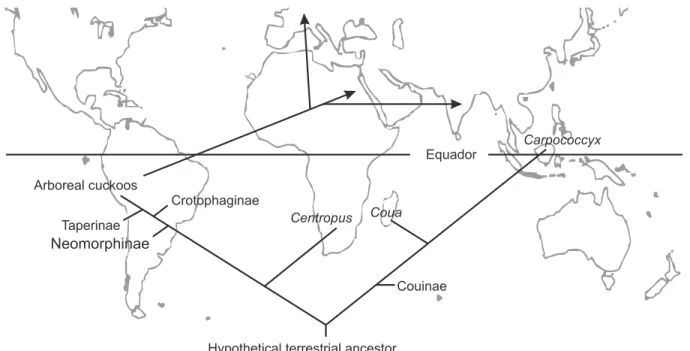
According to BPA hypothesis, terrestrial cuckoos of the Neotropics (Neomorphinae) and the intermediate terrestrial/ar-boreal Taperinae and Crotophaginae inhabited the western por-tion of Gondwana and separated from other terrestrial cuckoos when Africa and South America split apart (Figs 4 and 5). The osteological data indicate major variations among genera in each subfamily that can be indicative of a long history of cladogen-esis (POSSO & DONATELLI 2006). In addition, the phylogenetic
analy-sis based on morphological, ecological and behavioral characters (POSSO & DONATELLI 2006) shows parsimonious hypotheses for
the evolution of the following behaviors: a) the terrestrial habit is basal and emerged only once in cuckoo; b) it provides strong support to demonstrate the transition of terrestrial to arboreal to be considered Crotophaginae and Taperinae (Neotropical cuck-oos) as intermediary groups between terrestrial and arboreal cuckoos. Other studies (SIBLEY & AHLQUIST 1990, ARAGÓNet al. 1999, HUGHES 1996, 2000, JOHNSONet al. 2000, SORENSON & PAYNE 2005)
provide additional steps to the origin of the terrestrial and/or arboreal habits.
the Miocene, as suggested by HUGHES (2000), or from Europe
via Atlantic Ocean. The most parsimonious explanation indi-cates that terrestrial cuckoos already existed in South America (SA) when it joined North America (NA) through the Panama isthmus. The probable existence of a cuckoo fossil from the Late Paleocene of Brazil corroborates this hypothesis (BAIRD &
VICKERS-RICH 1997). Hence Geococcyx californianus (Lesson, 1829) (Neomorphinae) and Crotophaga sulcirostris Swainson, 1827 (Crotophaginae) must have gone to the south of NA (Nearctic region) from SA and not the other way around sensu HUGHES
(2000).
The strict consensus cladogram (Fig. 1) suggests that the transition between terrestrial/arboreal cuckoos occurred in South America, since the cuckoos, whose arboreal behaviors are ob-served (Crotophaginae and Taperinae: Fig. 1, internodes 8 and 33,) are the most basal cuckoos of the large arboreal group (in-ternode 6). In addition, literature (HUGHES 1996, 2000, PAYNE 1997,
2005) mentions these groups as intermediate in relation to the terrestrial and arboreal habits and considers arboreal only the Phaenicophaeinae, Coccyzinae and Cuculinae cuckoos. Both primary and secondary BPA indicate that the history of distribu-tion of these derived cuckoos cannot be explained by vicariance from the breakup of Gondwana. The most parsimonious hy-pothesis indicates dispersion from South America. The extinc-tion is more parsimonious only in rare events (see below).
According to the BPA hypothesis, these arboreal cuckoos split apart from each other only after the breakup of Gondwana. Which is also corroborated by the all cladistic analyses (SIBLEY
& AHLQUIST 1990, ARAGÓNet al. 1999, HUGHES 1996, 2000, JOHNSON et al. 2000, SORENSON & PAYNE 2005, POSSO & DONATELLI 2006)
where Phaenicophaeinae, Coccyzinae and Cuculinae are the most derived group of cuckoos and the osteology indicates re-cent cladogeneses by few modifications among the genera of each group (POSSO & DONATELLI 2006).
In this way, the later spread of arboreal cuckoos into the other continents probably reflects the early dispersion from South America. However, the main problem with this dispersal hypothesis from South America is the historical distribution of Phaenicophaeinae. According to secondary BPA (Fig. 3), their distribution requires two additional steps: 1) dispersion from South America to Africa/South Asia and 2) extinction in South America. They are weak fliers and migration is rare in this group (PAYNE 2005). As a result, the Phaenicophaeinae distribution remains enigmatic.
In relation to Coccyzinae (sensu PAYNE 1997), cladistic
analyses (Fig. 1) demonstrated that it is not a monophyletic group: Coccyzus is considered most close related with Cuculinae, in agreement with HUGHES (1996, 2000) and SORENSON & PAYNE
(2005). However, the other genera are considered within a monophyletic group, named Saurotherinae (Fig. 1, internode 23), for the fact that this group had origin in the Neotropical region. Additional steps are not required to explain their early distribution.
Figure 4. Hypothesis of early vicariance distribution of the cuckoos in the Early Cretaceuos.
The same origin in South America for Cuculinae (Fig. 1, internode 11) can be inferred, because Coccyzus, the most basal genus of this large group, is found in this region. The presence of other Cuculinae genera in Africa and South Asia requires two additional steps by dispersion. The hypothesis of disper-sion for the Cuculinae is also plausible, since its members show a very migratory capacity of flying (PAYNE 2005), as in the
Coccyzus and Cuculus Linnaeus, 1758 (Cuculinae) species. There are some occasional records of Coccyzus in Europe (WITHERBY
1938, AMERICAN ORNITHOLOGISTS’ UNION 1983, ELLICOTT 1983, MOORE
& ABRAHAM 1984) and of Cuculus in North America (AMERICAN
ORNITHOLOGISTS’ UNION 1983).
In synthesis, the parsimony paradigm suggests the dis-tribution of terrestrial cuckoos (basal group) by the break-up of Gondwana (Early to Mid Cretaceous) in agreement with other group of birds (CRACRAFT 2001, ERICSONet al. 2002). On the other
hand, fossil records point out to a more recent origin (Pale-ocene to Upper Tertiary) in Laurasia. Nevertheless, many addi-tional steps on dispersion and local extinctions should be added to corroborate the fossil records suggestions. It would indicate that the early distribution of cuckoos is not parsimonious or that the fossil records may be underestimating the group age and distribution.
Finally, it can be concluded that the early history of avian distribution seems to be an open question still and also an intriguing and challenging matter of research. We hope this paper will encourage ornithologists to perform further bioge-ography analyses on the enigmatic early distribution of birds.
ACKNOWLEDGMENTS
We would like to thank Richard Zusi, Kevin Mundy, and Maria F.M. e Ortiz for the English reviews of this paper. We also acknowledge the interventions made by Herculano Alvarenga, Luis F. Silveira, Nelson Bernardi, Elizabeth Hofling and other anonymous reviewers that contributed to increase the quality of this manuscript. FAPESP provided financial suppor for this research (proc. 99/08000-0).
LITERATURE CITED
AMERICAN ORNITHOLOGISTS’ UNION. 1983. Check-list of North
American birds. Washington, DC, American Ornithologist Union Press, VII+771p.
ARCHBOLD, N.W.; C.J. PIGRAM; N. RATMAN & S. HAKIM. 1982. Indonesian Permian brachiopod fauna and Gondwana-South East Asia relationships. Nature296 (1): 556-558.
AUDLEY-CHARLES, M.G. 1984. Reconstruction of eastern
Gondwa-naland. Nature306 (1): 48-50.
ARAGÓN, S.; A.P. MOLLER; J.J. SOLER & M. SOLER. 1999. Molecular phylogeny of cuckoos supports a polyphyletic origin of brood parasitism. Journal of Evolutionary Biology12 (3): 495-506. BAIRD, R.F. & P. VICKERS-RICH. 1997. Eutreptodactylus itaboraiensis
gen. et sp. nov., an early cuckoo (Aves: Cuculidae) from the Late Paleocene of Brazil. Alcheringa21 (1): 123-127. BROOKS, D.R.; M.G.P. VAN VELLER & D.A. MCLENNAN. 2001. How to
do BPA, really. Journal of Biogeography28 (1): 345-358.
COOPER, A. & D. PENNY. 1997. Mass survival of birds across the
Cretaceous-Teriary boundary: molecular evidence. Science 275 (1): 1109-1113.
COOPER, A.; C. LALUEZA-FOX; S. ANDERSON; A. RAMBAUT; J. AUSTIN &
R. WARD. 2001. Complete mitochondrial genome sequences
of two extinct moas clarify ratite evolution. Nature 409 (1): 704-707.
CRACRAFT, J. 1973. Continental drift, paleoclimatology, and evolution and biogeography of birds. Journal of Zoology 169 (1): 455-545.
CRACRAFT, J. 2001. Avian evolution, gondwana biogeography
and the Cretaceous-Tertiary mass extinction event. Proceedings of the Royal Society of London, Series B 268 (1466): 459-469.
ELLICOTT, P.W. 1983. Devonian Birds and Reptiles56 (1): 16-81.
ERICSON G.P.; L. CHRISTIDIS; A. COOPER; M. IRESTEDT; J. JACKSON; U.S.
JOHANSSON & J.A. NORMAN. 2002. A Gondwanan origin of
passerine birds supported by DNA sequences of the endemic New Zealand wrens. Proceedings of the Royal Society of London, Series B 269 (1488): 235-241.
FEDUCCIA, A. 1996. The origin and evolution of birds. New
Haven, Yale University Press I+480p.
HEADS, M. 2012. Molecular panbiogeography of the Tropics. Berkeley, University of California Press, IX+565p.
HEDGES, S.B.; P.H. PARKER; C.G. SIBLEY & S. KUMAR. 1996.
Conti-nental breakup and the ordinal diversification of birds and mammals. Nature381 (1): 226-229.
HUGHES, J.M.1996. Phylogenetic analysis of the Cuculidae (Aves, Cuculiformes) using behavioral and ecological characters. The Auk113 (1): 10-22.
HUGHES, J.M. 2000. Monophyly and phylogeny of cuckoos (Aves,
Cuculidae) inferred from osteological characters. Zoological Journal of the Linnean Society130 (2): 263-307. HUGHES, J.M. & A.J. BAKER. 1999. Phylogenetic relationships of
the enigmatic hoatzin (Opisthocomus hoazin) resolved using mitochondrial and nuclear gene sequences. Molecular Biology and Evolution 16 (9): 1300-1307.
JOHNSON, K.P.; S.M. GOODMAN & S.M. LANYON. 2000. A phylogenetic study of the Malagasy Couas with insights into cuckoo relationships. Molecular Phylogeny and Evolution14 (3): 436-444.
LIVEZEY, B.C. & R.L. ZUSI. 2001. Higher-order phylogenetics of modern Aves based on comparative anatomy. Netherlands Journal of Zoology51 (2): 179-205.
MOORE, J. & T. ABRAHAM. 1984. Red Rock observations:
1974-1984. Annual Review of the Hilbre Bird Observatory28 (1): 52-54.
NORRIS, D.J. & W.H. ELDER. 1982. Decline of the Roadrunner in
Missouri. Wilson Bulletin 94 (2): 354-355.
OLSON, S.L. 1985. The fossil record of birds, p. 79-252. In: D.S. FARNER; J.R. KING & K.C. PARKER(Eds). Avian Biology. New
York, Academic Press, VIII+256p.
PAYNE, R.B. 1997. Order Cuculiformes, Cuculidae, p. 508-607. In: J. DEL HOYO, A. ELLIOTT & J. SARGATAL (Eds). Handbook of the birds of the world. Barcelona, Lynx Editions, IV+821p. PAYNE, R.B. 2005.The cuckoos. Oxford, Oxford University Press,
I+644p.
POSSO, S.R. & R.J. DONATELLI. 2001. Cranial osteology and
systematics implications in Crotophaginae (Aves, Cuculidae). Journal of Zoological Systematics and Evolutionary Research39 (4): 247-256.
POSSO, S.R. & R.J. DONATELLI. 2006. Análise filogenética e
impli-cações sistemáticas e evolutivas nos Cuculiformes (Aves) com base na osteologia, comportamento e ecologia. Revista Bra-sileira de Zoologia23 (3): 608 629.
POSSO, S.R. & R.J. DONATELLI. 2010. When decisions on
homologous structures cause ambiguous taxa relationships: the Neomorphinae (Aves, Cuculidae) example. Brazilian Journal of Biology 70 (1): 195-204.
SIBLEY, G.C. & J.E. AHLQUIST. 1999. Phylogeny and classification of birds. New Haven, Yale University Press, I+1080p. SORENSON, M.D.; R.B. PAYNE. 2005. A molecular genetic analysis
of cuckoo phylogeny, p. 68-94. In: R.B. PAYNE (Ed.). The
cuckoos. Oxford, Oxford University Press, I+644p SWOFFORD, D.L. 2001. PAUP* – Phylogenetics Analysis Using
Parsimony (*and other methods), version 4.0b10 for 32-bit Microsoft Windows. Sunderland, Massachusetts, Sinauer Associates.
VAN TUINEN, M.; C.G. SIBLEY & S.B. HEDGES. 2000. The early history
of modern birds inferred from DNA sequences of nuclear and mitochondrial ribosomal genes. Molecular Biology and Evolution17 (3): 451-457.
VAN TUINEN, M. & S.B. HEDGES. 2001. Calibration of avian
molecular clocks. Molecular Biology and Evolution18 (2): 206-213.
WILEY, E.O. 1998a. Vicariance Biogeography. Annual Review of Ecological Systematics19 (1): 513-542.
WILEY, E.O. 1988b. Parsimony analysis and vicariance
biogeography. Systematic Zoology 37 (2):271-290. WITHERBY, H.F. 1938. The handbook of British birds (warblers
to owls). London, H.F. & G. Witherby, II+352p.
WOODBURY, C.J. 1998. Two spinal cords in birds: Novel insights
into early avian evolution. Proceedings of the Royal Society of London, Series B265 (1407): 1721-1729.