www.clim-past.net/9/2391/2013/ doi:10.5194/cp-9-2391-2013
© Author(s) 2013. CC Attribution 3.0 License.
Climate
of the Past
Re-evaluation of the age model for North Atlantic Ocean Site 982 –
arguments for a return to the original chronology
K. T. Lawrence1, I. Bailey2, and M. E. Raymo3
1Lafayette College, Department of Geology and Environmental Geosciences, 102 Van Wickle Hall,
Easton, PA 18042, USA
2National Oceanography Centre Southampton, University of Southampton, European Way, Southampton, SO14 3ZH, UK 3Lamont-Doherty Earth Observatory, P.O. Box 1000, 61 Route 9W, Palisades, NY 10964, USA
Correspondence to:K. T. Lawrence ([email protected])
Received: 23 March 2013 – Published in Clim. Past Discuss.: 29 April 2013 Revised: 20 July 2013 – Accepted: 1 October 2013 – Published: 25 October 2013
Abstract. Recently, the veracity of the published
chronol-ogy for the Pliocene section of North Atlantic Ocean Drilling Program Site 982 was called into question. Here, we ex-amine the robustness of the original age model as well as the proposed age model revision. The proposed revision is predicated on an apparent misidentification of the depth to the Gauss–Matuyama (G/M) polarity chronozone reversal boundary (2.581 Ma) based on preliminary shipboard pale-omagnetic data, and offers a new chronology that includes a hiatus between∼3.2 and 3 Ma. However, an even more
accurate shore-based, u-channel-derived polarity chronozone stratigraphy for the past ∼2.7 Ma supports the shipboard
composite stratigraphy and demonstrates that the original es-timate of the depth of the G/M reversal in the Site 982 record is correct. Thus, the main justification forwarded to support the revised chronology no longer exists. We demonstrate that the proposed revision results in a pronounced anomaly in sedimentation rates proximal to the proposed hiatus, erro-neous assignment of marine-isotope stages in the Site 982 Pliocene benthic stable oxygen isotope stratigraphy, and a markedly worse correlation of proxy records between this site and other regional paleoclimate data. We conclude that the original chronology for Site 982 is a far more accurate age model than that which arises from the published revision. We strongly recommend the use of the original chronology for all future work at Site 982.
1 Introduction
Ocean Drilling Program (ODP) Site 982 was drilled on the Rockall Plateau in the subpolar North Atlantic Ocean (58◦N,
16◦W, at 1134 m water depth) during Leg 162 (Fig. 1).
! ( ! ( ! ( ! ( ! ( ! ( ( ! 611 610 609 1313 982 984 1314 60°E 30°E 0° 0° 30°W 30°W 60°W 60°W 90°W 120°W 60°N 60°N 30°N 30°N ( !
Fig. 1.Site map showing the location of ODP Site 982, as well as other relevant North Atlantic sites.
composite splice itself, subsequently generated shore-based u-channel paleomagnetic data (Channell and Guyodo, 2004), and all available Site 982 benthic oxygen isotope (δ18O) data. We also examine how the paleoclimate data generated from these sites compare to similar records developed from sed-iments at other localities in the North Atlantic Ocean. In this note, we focus on the disputed interval that falls tween 50 and 85 m composite depth (mcd). As detailed be-low, this evaluation strongly supports the veracity of the orig-inal Pliocene Site 982 age model.
2 Splices and age models
2.1 Original splice and age model
A composite section for Site 982 was generated down to 597 mcd shipboard by splicing together spectral reflectance and GRAPE data that for the Pliocene portion of this record come from holes A and B (Fig. 3). Various age models have been assigned to this stratigraphy by correlation of its ben-thicδ18O for the past∼2.7 Ma to ODP Sites 677 (Channell
and Guyodo, 2004; Venz et al., 1999), 846 (Channell and Guyodo, 2004) and 849 (Flower et al., 2000), for the past 3.2 Ma to Deep Sea Drilling Project (DSDP) Site 607 (Venz and Hodell, 2002), and most recently for the past 5.3 Ma to the LR04 stack, following generation of additionalδ18O data between 68.09 and 160.62 mcd (Lisiecki and Raymo, 2005). The age model assigned to alkenone-derived sea surface tem-perature (SST) data from Site 982 presented in Lawrence et al. (2009) is the same one assigned to Site 982 during its in-corporation into the LR04 stack (Lisiecki and Raymo, 2005).
A M2 KM6 G10 G20 K1 104 102 100 G1 G3 G7
G11 G15G17G19 KM3 M1MG1
K2 G22 101 MG5 MG4 MG6 MG8 MG7 KM2 G14G16 98 96 99 97 G6 G2 K1
G7 G17 KM3 MG5MG7MG11
G19 100 G1 G3 G5 G11 G15 101 99 104 102 98 96 M1 MG1 M2 G14 G10
G2G6 G16G20
MG4 missing
KM4 to K1
LR04 18 O (‰PDB) 97 2 2.5 3 3.5 4 4.5 2.5 3 3.5 4 4.5 Site 982 18O (‰ PDB) 2 2.5 3 3.5 4 4.5
2400 2600 2800 3000 3200 3400 3600 3800
M2 MG4 100 104 102 98 96 G10 G2G6
G14 G16 G20
G19
M1 101
99 97
G1G3 G7
G5 G11 G17
G13 KM6 KM2 MG1 18O Site 982 (‰PDB)
(Khelifi Hole A=Green, Hole B=Pink, Hole C=Blue Hole A = Purple, Hole B = Tan) (Original B C Age (ka) 0 5 10 15 20 25 30 sedimentation rate (cm/kyr) original age model
0 5 10 15 20 25 30
2400 2600 2800 3000 3200 3400 3600 3800
Khelifi age model
sedimentation rate (cm/kyr)
( Hole A=Green, Hole B=Pink, Hole C=Blue)
)
Original Age Model
Khelifi et al. (2012) Age Model
G/M, Hole-Bship
G/M, Hole-BU
G/M, Hole-Aship
2400 2600 2800 3000 3200 3400 3600 3800
Age (ka)
Fig. 2.ODP Site 982 isotopes and sedimentation rates:(A) oxy-gen isotopes from ODP 982 (Lisiecki and Raymo, 2005; Venz and Hodell, 2002) plotted on the original age model (black) and both
the original and Khelifi et al. (2012) isotopes on rmcdsof Khelifi et
al. (2012) (colors) with associated correlations of both age mod-els with the LR04 oxygen isotope benthic stack (gray) (Lisiecki
and Raymo, 2005);(B)sedimentation rates at Site 982 estimated
from the original age model (black);(C)sedimentation rates for
holes A, B and C estimated from the age model proposed by Khelifi et al. (2012) (colors). Small black arrows and associated labels –
lower left-hand corner of(A)– indicate the position of the Gauss–
Matuyama chronozone reversal boundary from both shipboard and u-channel measurements.
2.2 Khelifi splice and age model
Guided by new benthic foraminiferal δ18O data and UK37′ SSTs generated on holes A–C, Khelifi et al. (2012) re-vised the shipboard-derived composite depths between 59.1 and 84.44 mcd to 59.17 and 85 mcd (hereafter referred to as suggested revised mcd, rmcds), based on 194 new tie
points (contrast with the four tie points used in the ship-board stratigraphy). Khelifi et al. (2012) justify the genera-tion of the rmcds on the basis that, between 55 and 72 mcd,
1.2 1.3 1.4 1.5 1.6 1.7 1.8 1.9 2
1 1.1 1.2 1.3 1.4 1.5 1.6 1.7 1.8
50 55 60 65 70 75 80 85
982 A GRAPE Density (g cm
-3)
982 B GRAPE Density (g cm
-3
)
mcd 0
20 40 60 80 100 120 140
-40 -20 0 20 40 60 80 100
50 55 60 65 70 75 80 85
982 A % Reflectance (650-700 nm)
982 B % Reflectance (650-700 nm)
mcd
splice
splice
6H-6, 97cm 7H-1, 93cm 7H-5, 145cm
6H-4, 25cm 6H-5, 97cm
2.5
2.9
3.3
3.7
4.1
4.5
Site 982
18
O (‰PDB )
Hole C
8H-1, 68cm 8H-2, 38cm
8H-3, 10cm 8H-4,113cm
8H-6, 144cm 7H-2, 105cm
7H-4, 137cm
8H-1, 21cm 8H-5, 2cm
8H-1, 137cm 8H-5, 97cm
9H-1, 101cm
Hole B-6H A-6H Hole B-7H A-7H B-8H A-8H B-9H
A
B
C
Fig. 3.Site 982 physical properties and benthic oxygen isotope data:
(A)shipboard reflectance,(B)shipboard GRAPE density and(C)
benthicδ18O data for Site 982 holes A, B and C (black, gray and
blue data, respectively) and the original shipboard splice (purple data) for the interval of the Site 982 age model in question (Ship-board Scientific Party, 1996). Black labels indicate the samples at core breaks. Dashed vertical purple lines (and labels) denote tie points used to generate the shipboard splice. Dashed vertical red lines (and labels) denote tie points used to tune Hole C GRAPE data to the GRAPE data used to generate the original splice (from Hole A/B). The splice point at Hole A-8H-1, 21 cm (69.55 mcd), is arguably the least secure tie between holes A and B in the orig-inal splice. The Hole C GRAPE data highlight, however, that no stratigraphy is missing from the original shipboard splice due to the inclusion of the tie point at 69.55 mcd. Note, no reflectance data was generated for cores 7H-9H in Hole C (Ortiz et al., 1999).
be made (i.e., data drops to background noise). Yet, inspec-tion of the data used to generate the original mcd indicates that this is not the case (Fig. 3). Plots of the composite ben-thicδ18O records on both splices are slightly different in the depth domain (Fig. 4). The expanded nature of rmcds
rela-tive to mcd reflects the very large number of tie points used by Khelifi et al. (2012), which is also responsible for the “better correlation” ofδ18O between holes in their Fig. 1. Specifically, they have effectively aligned all benthicδ18O on the orbital scale between the original shipboard tie points.
2
2.5
3
3.5
4
4.5
2
2.5
3
3.5
4
4.5
50 55 60 65 70 75 80 85 90
50 55 60 65 70 75 80 85 90
18O (‰PDB)
18
O (‰PDB)
New rmcds (Khelifi)
Original mcd
Fig. 4. Comparison of original oxygen isotope data (Venz and
Hodell, 2002) on the original mcd (purple) and the rmcds(brown) of
Khelifi et al. (2012). Note that there is not a large difference in mcd between the original and the interpretation of Khelifi et al. (2012), rather the significant difference comes in the approaches used to correlate to the LR04 stack (Lisiecki and Raymo, 2005).
All meter scale (glacial–interglacial) cycles in benthicδ18O can be recognized in the compositeδ18O data sets in both records (Fig. 2a). Owing to the large number of tie points used by the Khelifi et al. (2012) composite depth sequence, and therefore the complicated nature of any future sampling plan that would ensue from its use, we recommend that future Pliocene research at Site 982 follow the original mcd. Re-gardless, given how comparable the original mcd is to rmcds
(Fig. 4), it is not the veracity of the splice for the Pliocene that is critical to this work, but rather how it is tuned to the geological timescale (Fig. 2a).
To generate a new age model for Site 982, Khelifi et al. (2012) compressed three meter-scale benthicδ18O cycles that in the stratigraphy of the original age model were at-tributed to MIS K2, G4 and G2 into a much shorter interval, which they now assign, respectively, to MIS G20, G2 and 104. They then proposed the existence of a hiatus,∼130 kyr in duration, that spans most of the mid-Pliocene warm period (MPWP, 3.19–3.06 Ma, MIS KM4-K1). Their justification for these changes hinges on their assertion that the compos-ite depth to the Gauss–Matuyama (G/M) chronozone rever-sal identified in the original age model at 57.24 mcd (taken from Hole A) should be lower in the section, by 0.78 mcd (to match the mcd attributed to the G/M boundary identi-fied shipboard for Hole B at 58.02 mcd; 982B 6H 7W, 0 cm, 52.55 m below sea floor, m b.s.f.). This proposed alteration to the depth of the G/M boundary at Site 982 allowed Khelifi et al. (2012) to redefine isotope stages assigned to individual
δ18O cycles below 58.02 mcd. We believe that these changes are unwarranted.
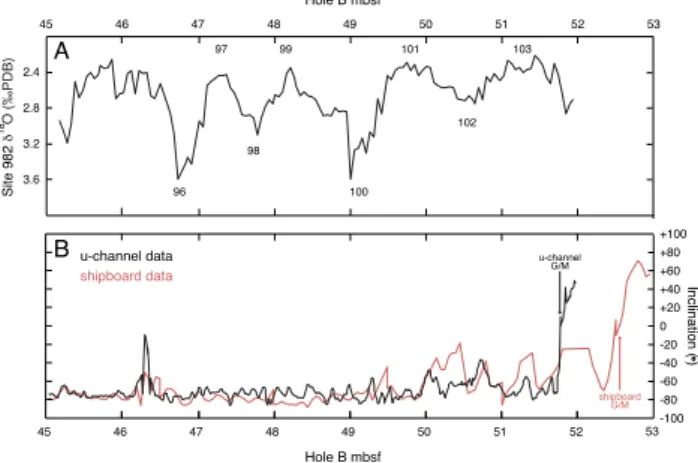
composite depth, and that the depth to the G/M boundary in the original mcd is assumed to correspond to the depth iden-tified in Hole A (50.70 m b.s.f., 982A 6H 4W, 0 cm). In fact, neither ship-determined depth to the G/M boundary in holes A and B falls in the shipboard splice. Nevertheless, Khelifi et al. (2012) argue that the shipboard inclination data used to define the G/M boundary in Hole B (Channell and Lehman, 1999) are superior to those obtained for Hole A. Accordingly, they use the shipboard-derived depth to the G/M boundary in Hole B to identify MIS 104 (2.6 Ma, LR04 age), oneδ18O cy-cle lower in the mcd than attributed in the original age model. In constructing age models for marine records, ODP ship-board polarity stratigraphies should always be considered preliminary, because stepwise alternating field demagnetiza-tion of natural remanent magnetizademagnetiza-tion (NRM) is not fea-sible during cruises; most samples are only measured with a single demagnetization step. Shipboard-derived polarity records only represent guidelines for more comprehensive post-cruise age model generation, which can include shore-based u-channel research. Fortunately, and despite the reser-vations of Khelifi et al. (2012), a comprehensive shore-based polarity stratigraphy was generated for Site 982 following the shipboard composite depths between 7 and 66 mcd that also included the analysis of the section of core in Hole B that pre-served the G/M chronozone reversal boundary (Channell and Guyodo, 2004). Following treatment of NRM on u-channel samples with alternating field demagnetization at peak fields of 80 and 70 mT and 60 to 20 mT (in 5 mT steps), the precise depth of the G/M chronozone boundary in Hole B has been identified at 57.29 mcd (51.77 m b.s.f., 982B-6H-6 at 77 cm, Channell and Guyodo, 2004; J. Channell, personal commu-nication, 2012) (Fig. 5), which compares favorably (within 5 cm) with the shipboard-derived depth of the G/M chrono-zone reversal boundary in Hole A (57.24 mcd). This depth in the original age model (= interglacial MIS 103; Channell and Guyodo, 2004) corresponds well to our understanding of the temporal relationships between the G/M chronozone reversal and records of benthicδ18O (Ohno et al., 2012) (Figs. 2, 5).
2.3 Sedimentation rates
Through the generation of a u-channel polarity stratigraphy, Channell and Guyodo (2004) confirmed that the depth of the G/M chronozone boundary in the Site 982 shipboard splice is 57.29 mcd. Through the correct application of the finalized Site 982 polarity stratigraphy, we demonstrate that the major argument forwarded by Khelifi et al. (2012) to justify a revi-sion of the Site 982 age model introduces erroneous changes to the Site 982 chronology. By using the correct depth for the G/M reversal in the Site 982 stratigraphy (at 57.29 mcd), we negate the proposed need to compress theδ18O cycles as-signed to MIS G4 and 104 in the original age model and the subsequent introduction of an∼130 kyr hiatus at 70.09 mcd. Such a hiatus would introduce unrealistic changes in sedi-mentation rates within the Pliocene portion of the Site 982
-100 -80 -60 -40 -20 0 +20 +40 +60 +80 +100
45 46 47 48 49 50 51 52 53
2.4
2.8
3.2
3.6
45 46 47 48 49 50 51 52 53
100
102 103
98
96
101 99
97
Site 982
18O (‰PDB)
Inclination (
)
Hole B mbsf
Hole B mbsf u-channel data
shipboard data
u-channel G/M
shipboard G/M A
B
Fig. 5.ODP Site 982 benthicδ18O and shipboard and u-channel-derived magnetization directions for Hole 982B, core 6H vs. me-ters below sea floor (m b.s.f.), which preserves evidence of the Gauss–Matuyama (G/M) paleomagnetochronozone reversal. Ship-board inclination data are preliminary derived after only AF demag-netization at peak fields of 25 mT (Channell and Lehman, 1999). U-channel (inclination) data are component magnetizations based on regression from alternating field demagnetization at peak fields of 80 and 70 mT and 60 to 20 mT (in 5 mT steps), as described in Channell and Guyodo (2004). Note, u-channel data were only measured on Hole B cores included in the shipboard splice. Based on the preliminary shipboard data, the G/M boundary in Hole B was identified at 52.55 m b.s.f. (red label and arrow) (982B 6H 7H, 0 cm, 58.02 m composite depth, mcd; Channell and Lehman, 1999). Subsequent post-cruise u-channel analysis has identified the precise depth of the G/M chronozone boundary in Hole B at 51.77 m b.s.f. (black label and arrow) (982B-6H-6 at 77 cm, 57.29 mcd; Channell and Guyodo, 2004), which corresponds well to our understanding of the temporal relationships between the G/M chronozone reversal
and records of benthicδ18O (i.e., peak MIS 103; Ohno et al., 2012).
stratigraphy (Fig. 2b and c). In the original assignment of glacial stages to the Site 982δ18O stratigraphy, MIS G12 is not well resolved. While MIS G12 is not readily evident in the benthicδ18O record in the original age model (Fig. 2a), it is clearly recorded in the alkenone-based SST data set for this site (Fig. 6).
Khelifi et al. (2012) argue that a hiatus proposed by Venz and Hodell (2002) to span MIS 88 to 86 demonstrates that sedimentation at Site 982 was “occasionally discontinuous”. They also suggest that Lisiecki and Raymo (2005) generated new benthic δ18O data to span this gap before incorporat-ing the benthicδ18O stratigraphy of Site 982 into the LR04 (Khelifi et al., 2012). Channell and Guyodo (2004) took the possible existence of this hiatus into consideration when they assigned glacial stage numbers to the Site 982 benthicδ18O record (see Channell and Guyodo, 2004; their Fig. 4). De-spite the suggestion of Khelifi et al. (2012), no new benthic
δ18O data were generated by Lisiecki and Raymo (2005) to bridge this gap, and the proposed hiatus is not included in the record during the incorporation of the Site 982 benthic
12 14 16 18 20 22 24 4
6 8 10 12 14 16
Mg/Ca Temperature (ºC)
Site 984 (61ºN, 24ºW)
10 12 14 16 18 20 22
ODP Site 982 (58ºN, 16ºW)
U
k'
37
Temperature (ºC)
IODP Site U1313 (41ºN, 33ºW)
Mg/CaTemperature (ºC)
Age (ka)
DSDP Site 609 (50ºN, 24ºW)
8 10 12 14 16 18
2400 2600 2800 3000 3200
3
3.5
4
3400 Age (ka)
2400 2600 2800 3000 3200 3400
100 102
104G2 G6 G10 98
96
G12
M2 KM2
LR04
18O (‰PDB)
U
k'
37
Temperature (ºC)
Or
ig
inal
,
K
helifi
G. bulloides SST N. atlantica SST A
B
C
D
E
G12
Fig. 6.Pliocene North Atlantic sea surface temperature data:(A)
ODP Site 984 Mg/Ca SST (red = G. bulloides, light gray = N
at-lantica) (Bartoli et al., 2005),(B)ODP Site 982 UK37′SST (Lawrence
et al., 2009) on the original age model (black) (Lisiecki and Raymo,
2005) and the revised age model (green) (Khelifi et al., 2012),(C)
DSDP Site 609 Mg/Ca SST (light brown) (Bartoli et al., 2005) and
revised age model (dark brown) (see Supplement), and(D)ODP
Site U1313 UK37′ SST (dark blue) (Naafs et al., 2012).(E) LR04
global benthic stack (light green) (Lisiecki and Raymo, 2005) with significant glacial marine isotope stages labeled in black.
Horizon-tal lines in(B)and(D)denote average Holocene SST for Site 982
and Site U1313.
in core photos at approximately the depth of the proposed hiatus (which falls between 49.45 and 49.50 mcd, 982C-6H-3W, 15–20 cm; Venz and Hodell, 2002). Regardless, no sed-imentological evidence exists in core photographs for the proposed hiatus inserted by Khelifi et al. (2012) at 70.19– 70.39 mcd (982C-8H-3W, 40–60 cm). Moreover, its intro-duction, which is not justified on the grounds outlined by Khelifi et al. (2012), induces unrealistic spikes in sedimenta-tion rates in the Pliocene porsedimenta-tion of the Site 982 record rela-tive to those inferred from the original age model (Fig. 2b and c). In contrast, the original age model shows much smoother variations in sedimentation rates. We acknowledge that while on longer timescales more accurate age models do not tend to be characterized by sharp changes in sedimentation rates, sedimentation rates can be progressively more variable on shorter timescales (Sadler, 1999). An additional way to ex-plore which age model is better is to employ dynamic pro-gramming, and indeed, because the Site 982δ18O record was one of the records incorporated into the LR04 stack, this ap-proach was already used to optimize the “fit” of the Site 982 original age model to the global variations in benthicδ18O.
0 20 40 60 80
0 5000
1 104
1.5 104
2400 2500 2600 2700 2800 2900 3000 3100
ODP 982 Magnetic Susceptibility
Age (ka)
0 20 40 60 80
0 5000
1 104
1.5 104
ODP 982 Magnetic Susceptibility
IRD (>150µm/g sed)
3
3.5
4
4.5
2400 2500 2600 2700 2800 2900 3000 3100
Benthic
18O (‰PDB)
Age (ka)
LR04
100 102
104 G2 G6 G10
98 96
G6
G2 100 98 96
100 98 96
104
104
Original Age Model
Kheifil Age Model
IRD (>150µm/g sed)
A
B
C
Fig. 7.Site 982 ice-rafted debris (Baumann and Huber, 1999) and magnetic susceptibility data (black) (Shipboard Scientific Party,
1996) plotted on (A)the original age model (purple) (Venz and
Hodell, 2002) and (B) the age model proposed by Khelifi et
al. (2012) (brown).(C)Benthic oxygen isotope data from the LR04
global benthic stack (Lisiecki and Raymo, 2005) (gray). The ver-tical green bar highlights the onset of major IRD deposition in the northeast North Atlantic Ocean. Significant glacial marine isotope states are labeled in black.
3 Regional data comparisons
for the Site 982 SST data set, these two time series are co-herent only in the 41 kyr band (0.89) and only at the 80 % confidence level.
IRD deposition has been shown to increase significantly during MIS G6 at 2.72 Ma in the Northeast Atlantic Ocean at ODP Site 984 (Bartoli et al., 2005), DSDP Sites 610 (Kleiven et al., 2002) and 611 (Bailey et al., 2013), and IODP Site U1314 (Hayashi et al., 2010). In concert with other nearby records, the original age model for Site 982 indicates that IRD inputs to this region increase dramatically during MIS G6 (Baumann and Huber, 1999; Shipboard Scientific Party, 1996) (Fig. 7). In contrast, the age model proposed by Khelifi et al. (2012) for Site 982 indicates that the onset of abundant IRD deposition at this site occurred from MIS G2 (2.64 Ma or 80 kyr later) (Fig. 7).
4 Conclusions
Recently, Khelifi et al. (2012) proposed a revision to both the composite splice (55–72 mcd, Shipboard Scientific Party, 1996) and the widely accepted age model (Lisiecki and Raymo, 2005) for the Pliocene stratigraphy of ODP Site 982. Here, we demonstrate that neither of the main justifications put forward by Khelifi et al. (2012) for these changes – that shipboard physical property data cannot be used reliably to generate a composite splice below 55 mcd and that ship-board identification of the depth to the Gauss–Matuyama po-larity chronozone reversal was in error – is correct. Instead, based on an inspection of the physical property data used to generate the Site 982 splice and the correct application of post-cruise, u-channel-derived inclination and declination data that follow the shipboard splice (following Channell and Guyodo, 2004), we have demonstrated the veracity of the Pliocene portion of the original Site 982 composite splice and age model. We further demonstrate that available Site 982 pa-leoceanographic data are most consistent with other regional data sets when plotted on this age model. We recommend that future use of these data and interpretation of new data sets generated for Site 982 continue to employ both the orig-inal shipboard splice (Shipboard Scientific Party, 1996) and age model for the Pliocene portion of this record published by Lisiecki and Raymo (2005).
Supplementary material related to this article is
available online at http://www.clim-past.net/9/2391/2013/ cp-9-2391-2013-supplement.pdf.
Acknowledgements. We are grateful to James Channell for pro-viding relevant information and for productive discussions, and for the data sets plotted in Fig. 5b. We thank Catherine Riihimaki for technical assistance with figures and C. Langereis, L. Lanci and D. Hodell for constructive reviews that helped to improve this manuscript. Support for this work was provided to KTL by
NSF MG&G grant OCE0623310 and MER by NSF P2C2 grant 1203320.
Edited by: D.-D. Rousseau
References
Bailey, I., Hole, G. M., Foster, G. L., Wilson, P. A., Storey, C. D., Trueman, C. N., and Raymo, M. E.: An alternative sug-gestion for the Pliocene onset of major northern hemisphere glaciation based on geochemical provenance of North Atlantic Ocean ice-rafted debris, Quaternary Sci. Rev., 75C, 181–194, doi:10.1016/j.quascirev.2013.06.004, 2013.
Bartoli, G., Sarnthein, M., Weinelt, M., Erlenkeuser, H., Garbe-Schonberg, D., and Lea, D.: Final closure of Panama and the onset of northern hemisphere glaciation, Earth Planet. Sc. Lett., 237, 33–44, 2005.
Bartoli, G., Hoenisch, B., and Zeebe, R. E.: Atmospheric
CO2 decline during the Pliocene intensification of
North-ern Hemisphere Glaciation, Paleoceanography, 26, PA4213, doi:10.1029/2010PA002055, 2011.
Baumann, K. H. and Huber, R.: Sea-Surface Gradients Between the North Atlantic and the Norwegian Sea During the Last 3.1 M.Y.: Comparison of Sites 982 and 985, in: Proceedings of the Ocean Drilling Program, Scientific Results, edited by: Raymo, M. E., Jansen, E., Blum, P., and Herbert, T. D., Vol. 162, College Sta-tion, Texas, Ocean Drilling Program, 179–190, 1999.
Bolton, C. T., Lawrence, K. T., Gibbs, S. J., Wilson, P. A., and Her-bert, T. D.: Biotic and geochemical evidence for a global lati-tudinal shift in ocean biogeochemistry and export productivity during the late Pliocene, Earth Planet. Sc. Lett., 308, 200–210, 2011.
Channell, J. E. T. and Guyodo, Y.: THe Matuyama Chronozone at ODP 982 (Rockall Bank): Evidence for Decimeter-Scale Magne-tization Lock-in Depths, in: Timescales of the Internal Geomag-netic Field, edited by: Channell, J. E. T., Kent, D. V., Lowrie, W., and Meert, J., Vol. 145, AGU Geophysical Monograph, 205–219, 2004.
Channell, J. E. T. and Lehman, B.: Magnetic stratigraphy of North Atlantic Sites 980–984, in: Proceedings of Ocean Drilling Pro-gram, Scientific Results, edited by: Raymo, M. E., Jansen, E., Blum, P., and Herbert, T. D., Vol. 162: Colege Station, Texas, Ocean Drilling Program, 113–130, 1999.
Flower, B. P., Oppo, D. W., McManus, J. F., Venz, K. A., Hodell, D. A., and Cullen, J. L.: North Atlantic intermediate to deep wa-ter circulation and chemical stratification during the past 1 Myr, Paleoceanography, 15, 388–403, 2000.
Hayashi, T., Ohno, M., Acton, G., Guyodo, Y., Evans, H. F., Kanamatsu, T., Komatsu, F., and Murakami, F.: Millennial-scale iceberg surges after intensification of Northern Hemi-sphere Glaciation, Geochem. Geophy. Geosys., Qo9Z20, doi:10.1029/2010GC003132, 2010.
Khélifi, N., Sarnthein, M., and Naafs, B. D. A.: Technical note: Late Pliocene age control and composite depths at ODP Site 982, re-visited, Clim. Past, 8, 79–87, doi:10.5194/cp-8-79-2012, 2012. Kleiven, H. F., Jansen, E., Fronval, T., and Smith, T. M.:
Lawrence, K. T., Herbert, T. D., Brown, C. M., Raymo, M. E., and Haywood, A. M.: High-amplitude variations in North Atlantic sea surface temperature during the early Pliocene warm Period, Paleoceanography, 24, PA2218, doi:10.1029/2008PA001669, 2009.
Lawrence, K. T., Sosdian, S., White, H. E., and Rosenthal, Y.: North Atlantic Climate Evolution Through the Plio-Pleistocene Cli-mate Transitions, Earth Planet. Sc. Lett., 300, 329–342, 2010. Lisiecki, L. E. and Raymo, M. E.: A Pliocene-Pleistocene stack of
57 globally distributed benthicδ18O records, Paleoceanography,
20, PA1003, doi:10.1029/2004PA001071, 2005.
Naafs, D. A., Hefter, J., Acton, G., Haug, G., Martinez-Garcia, A., Pancost, R. D., and Stein, R.: Strengthening of North Atlantic dust sources during the late Pliocene (2.7 Ma), Earth Planet. Sc. Lett., 317, 8–19, 2012.
Ohno, M., Hayashi, T., Komatsu, F., Murakami, F., Zhao, M., Guy-odo, Y., Acton, G., Evans, H. F., and Kanamatsu, T.: A de-tailed paleomagnetic record between 2.1 and 2.75 Ma at IODP Site U1314 in the North Atlantic: Geomagnetic excursions and the Gauss-Matuyama transition, Geochem. Geophy. Geosys., 13, Q12Z39, doi:10.1029/2012GC004080, 2012.
Ortiz, J. D., O’Connell, S., and Mix, A.: Data report: spectral re-flectance observations from recovered sediments, in: Proc. ODP, Sci. Results, 162: College Station, TX (Ocean Drilling Program), edited by: Raymo, M. E., Jansen, E., Blum, P., and Herbert, T. D., 259–264, doi:10.2973/odp.proc.sr.162.029.1999, 1999.
Pagani, M., Liu, Z., LaRiviere, J. P., and Ravelo, A. C.: High Earth-system climate sensitivity determined from Pliocene car-bon dioxide concentrations, Nat. Geosci., 3, 27–30, 2009. Sadler, P. M.: On the determination of sediment accumulation rates,
in: GeoResearch Forum, v. 5, edited by: Bruns, P. and Hass, H. C., Trans Tech Publications, Zurich, Switzerland, 15–40, 1999. Shipboard Scientific Party: Site 982, in: Proceedings of the Ocean
Drilling Program, Initial Reports, edited by: Jansen, E., Raymo, M. E., Blum, P., Andersen, E. S., Austin, W. E. N., Baumann, K. H., Bout-Roumazeilles, V., Carter, S. J., Channell, J. E. T., Cullen, J. L., Flower, B. P., Higgins, S. M., Hodell, D. A., Hood, J. A., Hyun, S., Ikehara, M., King, T., Larter, R., Lehman, B., Locker, S., McIntyre, K., McManus, J., Meng, L. B., O’Connell, S., Ortiz, J., Rack, F., Solheim, A., and Wei, W., Vol. 162: College Station, Texas, Ocean Drilling Program, 91–138, 1996. Sosdian, S. and Rosenthal, Y.: Deep-Sea Temperature and Ice
Vol-ume Changes Across the Pliocene-Pleistocene Climate Transi-tion, Science, 325, 306–310, 2009.