The structural molecular biology network of the State
of São Paulo, Brazil
JOÃO A.R.G. BARBOSA1, LUIS E.S. NETTO2, CHUCK S. FARAH3 SERGIO SCHENKMAN4 and ROGÉRIO MENEGHINI5
1Centro de Biologia Molecular Estrutural, Laboratório Nacional de Luz Síncrotron,
Rua Giuseppe Máximo Scolfaro, 10.000, 13084-971 Campinas, SP, Brasil
2Departamento de Genética e Processos Evolutivos, Instituto de Biociências
Universidade de São Paulo, Rua do Matão 2777, 05508-900 São Paulo, SP, Brasil
3Departamento de Bioquímica, Instituto de Química, Universidade de São Paulo,
Av. Prof. Lineu Prestes, 748, 05508-000 São Paulo, SP, Brasil
4Escola Paulista de Medicina, Universidade Federal de São Paulo,
Rua Botucatu, 862, 04023-901 São Paulo, SP, Brasil
5Centro Latino-Americano e do Caribe de Informação em Ciências da Saúde
BIREME, Rua Botucatu, 862, 04023-901 São Paulo, SP, Brasil
Manuscript received on June 13, 2005; accepted for publication on June 14, 2005; contributed byROGÉRIOMENEGHINI*ANDSERGIOSCHENKMAN*
ABSTRACT
This article describes the achievements of the Structural Molecular Biology Network (SMolBNet), a collab-orative program of structural molecular biology, centered in the State of São Paulo, Brazil, and supported by São Paulo State Funding Agency (FAPESP). It gathers twenty scientific groups and is coordinated by the scientific staff of the Center of Structural Molecular Biology, at the National Laboratory of Synchrotron Light (LNLS), in Campinas. The SMolBNet program has been aimed at 1) solving the structure of pro-teins of interest related to the research projects of the groups. In some cases, the choice has been to select proteins of unknown function or of possible novel structure obtained from the sequenced genomes of the FAPESP genomic program; 2) providing the groups with training in all the steps of the protein structure determination: gene cloning, protein expression, protein purification, protein crystallization and structure determination. Having begun in 2001, the program has been successful in both aims. Here, four groups reveal their participation in the program and describe the structural aspects of the proteins they have selected to study.
Key words:structural genomics, protein crystallography, nuclear magnetic resonance, protein structure.
INTRODUCTION
The Structural Molecular Biology Network (SMol-BNet), if envisaged as a structural genomics pro-gram, has some odd features and is therefore
en-Dedicated to the memory of Prof. Francisco Lara (1925–2004) *Member Academia Brasileira de Ciências
Correspondence to: Rogério Meneghini E-mail: [email protected]
ge-nomics” (since many investigators may be involved in SMB without using genomic data) or “structural biology” (in homage to classic structural biologists who operate with optical or electronic microscopes in the micron to millimicron scale whereas SMB deals with atomic resolution).
Structural genomics, in the strict sense, is SMB applied on the genomic scale and as such, if not explanatory, is etymologically adequate. With the advent of genomics, the annotation of thousands of known and putative genes became and continues to become available. This technological breakthrough has provided a great impulse to different fields of biology, including SMB. Before the era of large-scale genome sequencing SMB had already been experiencing enormous progress with the elucida-tion of the 3D-atomic structure of several hundred proteins thanks to the use of two modern technolo-gies: X-ray crystallography, using X-ray beam-lines of synchrotron radiation facilities, and high field nuclear magnetic resonance (NMR). In this way, a somewhat astonishing perception has come to light: the number of ways proteins may fold into defined 3D atomic structures in the universe of all proteins in the biosphere is limited. As more 3D structures of proteins were solved the rarer it became to find novel folding modes. Therefore one may envisage a future where virtually all new structures solved may be classified into a previously defined family. Although large, the number of folding topologies is probably limited to one or a few thousand (Govin-darajan et al. 1999). Furthermore, if the structure of one member of a protein family that share signifi-cant primary structure similarity is known, feasible molecular models of all the remaining members may be constructed by homology modeling.
After the advent of the genomics era, the struc-tural genomics approach was launched. In Brazil, the ONSA program (Organization for Nucleotide Sequencing and Analysis, FAPESP) was responsi-ble for the sequencing of the first plant pathogen genome, that of theXyllela fastidiosa (Xf), which
has 2900 predicted genes (Simpson et al. 2000), a significant fraction of which has no known function.
The path of structural genomics goes as follow: de-fine a criterion by which to select specific protein targets, for example proteins of unknown function and/or unknown structure. Then: (i) clone the se-lected target genes into expression vectors, (ii) ex-press the corresponding proteins in an heterologous system, (iii) purify the proteins, (iv) submit them to crystallization trials, (v) collect X-ray diffraction data usually at a synchrotron radiation facility and (vi) solve the structure. Alternatively, from step (iv) obtain a high concentration protein solution and col-lect data at an NMR facility. The latter is an attrac-tive option for those many cases in which the pro-teins are refractory to form crystals. This sequence is a funnel, for each step has a limited chance of success. Therefore, most structural genomics ef-forts adopt a high throughput approach: if one of the steps of the pipeline poses a difficult obstacle for a particular target, that target is disposed of. Hence, only a small percent of the chosen proteins have their 3D-structure resolved (typically 1-5%). Dozens of worldwide structural genomics projects are under-way. (http://www.rcsb.org/ pdb.strucgen.html).
Of course, not all SMB projects are high throughput. It is often the case that a group is inter-ested in resolving the structure of one or a few pro-teins related to a specific biological question. Here, there is no thoughtless disposal of the protein tar-gets if difficulties in the pipeline arise. The main purpose is not structuralper se; rather, solving these
structures may shed light on functional aspects of interest.
473 genes cloned, ~ 6 proteins extracted and ~ 10 synthetic peptides
396 proteins expressed
305 proteins purified
NMR
– 14 peptides solved – 2 proteins solved
X-ray Crystallography
– 114 proteins submitted to crystallization trials – 24 structures solved
14 homology models constructed 14 SAX structures
Fig. 1 – The SMolBNet pipeline showing the general achievements at the end of the fourth year.
FAPESP genomics projects.
The program was coordinated by the Center for Structural Molecular Biology (CeBiME) of the Brazilian Synchrotron Light Laboratory (LNLS), in Campinas, São Paulo, which includes several staff investigators with expertise in protein crystallo-graphy and protein NMR. The Center facili-ties include NMR spectrometers, mass spectrom-eters, light spectromspectrom-eters, protein purification and crystallization, and molecular biology laboratories, and a crystallography beamline connected to the 1.37 GeV circular electron accelerator that gener-ates synchrotron radiation. In addition, a new MAD crystallography beamline is coming up at the end of 2005. This set of facilities is unique in the southern hemisphere.
The selected groups started working in 1999, under the assistance of the CeBiME staff. Judg-ing from the results accumulated up until now we can conclude that the SMolBNet program was suc-cessful in providing an important impetus for the advancement of SMB in Brazil. The pipeline in Fig-ure 1 summarizes the current state of the program at each stage of the production pipeline. The program is intended to terminate by the end of 2006.
Among the five authors contributing to this work, four summarize here the results of their participation. JARGB is a crystallographer and a CeBiME-LNLS staff member. He reports his par-ticipation in collaborating with and training other members of the network. Not included in this re-port is his own work determining the structures of some Xf hydrolases and some hypothetical gene
products from Xanthomonas axonopodispv. citri
(Xac). CSF is a biochemist who has also chosen to
use both NMR and X-ray crystallography to study some Xac conserved hypothetical proteins and
proteins important for Xac pathogenicity. LESN
is a biochemist who has been studying functional aspects of antioxidant proteins for some years and has picked several of these proteins from Saccha-romyces cerevisiae(Sc) andXf for crystallographic
studies. SS is a biochemical parasitologist in-terested in the infectious mechanisms employed by protozoa and their insect vectors. He focused his structural investigations on proteins from the pro-tozoa Trypanosoma cruzi, Plasmodium vivax and falciparum and a protein from the insect vector Triatoma infestans, using both X-ray
CRYSTALLOGRAPHIC EFFORTS IN THE SMolBNet
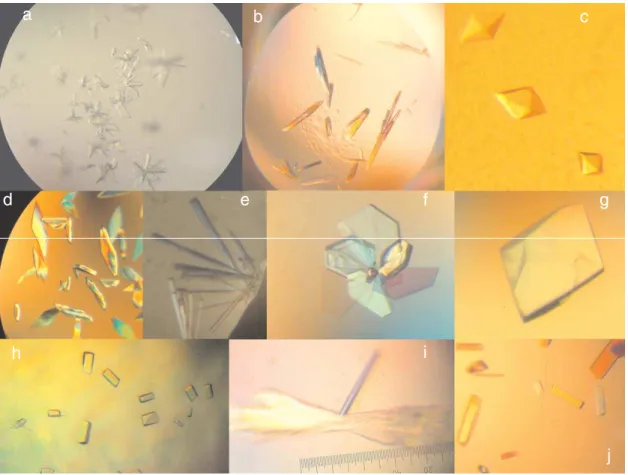
Within the SMolBNet framework, CeBiME had the challenge of working with the various groups of the network in a way as to provide the expertise neces-sary to solve peptide or protein structures. Further, this expertise should be passed to the groups, allow-ing them to gain as much independency as possible. Crystallization experiments are the first step in trying to obtain a crystallographic structure of a protein. It usually demands that enough quantities (10 mg) of high grade purified and properly folded protein are available. This procedure has a low suc-cess rate and is a tough test of the researchers’ will. The vast majority of the crystallization experiments were carried out using the hanging- or sitting-drop vapor diffusion methods. Here, the equilibration of two different solutions leads to a very slow deple-tion of water in the soludeple-tion that contains the protein and consequently concentrates it. As the protein concentrates, it tends to aggregate in an amorphous or crystalline precipitate. In Figure 2 and Table I it is possible to see the crystals obtained for sev-eral proteins. Each of these crystals demanded a unique crystallization condition and represents the mid-point to success mark in the path to structure so-lution when we consider all the pre-crystallographic work.
The next step was X-ray diffraction data col-lection at the LNLS beamline. This was a much expected part of the work because the researchers would finally be sure that their crystals would be useful to structure solution and also because they would have contact with the synchrotron in-strumentation. From this point onwards there is a clear division in the type of work carried out by the groups: until now they were working in the wet lab as molecular biologists and biochemists, now their work will be carried out on computers. Another issue is that the diffraction experiment is within the domain of physics, and while physicists and chemists might be familiar with it, biologists, who were the majority, felt uncomfortable. The stu-dents and/or PIs carried out data processing of the
oscillation images of those crystals that had inter-pretable diffraction with close and extensive super-vision. They were taught not only how to run the programs, but also the ideas behind them: notions of real and reciprocal space, the physics of diffraction, reflection’s intensities and indices, the concepts of unit cell, asymmetric unit, space group, integration, scaling, merging, etc.
Phase determination / structure solution was usually a straightforward procedure since most of the structures were solved by molecular replace-ment. The only exception was a hypothetical pro-tein (“f” in Table I) that was solved by multiwave-length anomalous dispersion (MAD). This rather interesting case demanded extra input from the par-ticular group such as growing selenium methionine protein crystals and is described in another part of this manuscript. Structure building and refinement is a procedure that still demands weeks and perhaps months of work. This was accomplished by having the people from the network coming over to the Ce-BiME for these periods of time. This part helped the students to learn about the protein databank for-mat, atom coordinates, R factor, temperature factor, electron density and many other concepts. Structure analysis would be the final step and as the groups moved towards this, it could be foreseen that dif-ficulties arose when trying to explore completely unrelated structures. Here, there is no clear path to be followed, except for comparing the structures to their homologues when they are present. In most cases some unique features of the proteins will need to be addressed, such as: why is the lysozyme (“b” in Table I) capable of working in a basic pH, what is the information that the hypothetical protein (“f”) can give about its function or what makes the infestin 4 (“j”) such a good inhibitor of blood coagulation-cascade factor XIIa.
inde-Fig. 2 – Crystals obtained by four different groups of the SMolBNet. The letters “a” to “j” correlate to the information for each individual protein presented in Table I. Their sizes vary approximately from a fewµm to one mm.
pendent of CeBiME. It is not realistic to expect that all of the groups will grow and incorporate struc-tural biology. One solution for everybody’s effort to flourish all its potential lies in new positions opened for structural biologists at the Departments to which SMolBNet groups are affiliated.
STRUCTURAL AND FUNCTIONAL ASPECTS OF PEROXIDE DETOXIFICATION PATHWAYS
The mechanisms by which cells protect themselves against the toxic effects of free radicals and related species have been the subject of study in our labo-ratory (LESN). Cells possess multiple pathways to decompose peroxides such as catalases and thiol de-pendent peroxidases, including glutathione peroxi-dases. Emphasis has been given to a new class of antioxidant enzymes named peroxiredoxins, which
includes thioredoxin peroxidases. In spite of the fact that peroxiredoxins and glutathione peroxidases have similar biochemical activity (thiol-dependent peroxidases), they do not share amino acid sequence similarity. Interestingly, however, both glutathione-dependent peroxidases and peroxiredoxins belong to the superfamily thioredoxin that comprises pro-teins possessing the thioredoxin fold characterized by a central core of four stranded mixed beta-sheet, flanked by three alpha-helices. (Copley et al. 2004). The yeastS. cerevisiae, which has been used
re-TABLE I
Name of the proteins, organism, maximum diffraction resolution and current research stage of the crystals shown from Figure 1. The letters “a” to “h” on the left of the protein’s column correspond to the letters in Figure 2.
Protein Organism Resolution (Å) Stage
a Beta-glicosidase Spodoptera 2.8 Crystallization,
frugiperda data collection
b Lysozyme Musca 1.9 Analysis
domestica
c Maltose-bindingprotein – MalE Xanthomonas ∼4.0 Crystallization,
axonopodispv. citri data collection
d Merozoite surface Plasmodiumsp. ∼10.0 Crystallization,
proteins 3α data collection
e Xac2355/SufE Xanthomonas 1.9 Refinement
axonopodispv. citri
f Hypothetical Xanthomonas 1.9 Refinement
Xac2396 axonopodispv. citri
g Molibdate-binding Xanthomonas 1.7 Refinement
protein – ModA axonopodispv. citri
h Thioredoxin Saccharomyces 2.2 Crystallization,
peroxidase III cerevisiae data collection
i Infestin 1 Triatoma infestans 2.5 Refinement
– trypsin Bos taurus
j Infestin 4 Triatoma infestans 1.8 Analysis
dundant. For example, cytosolic thioredoxin pero-xidase I (cTPxI/Tsa1/YML028W) is specifically im-portant for the defense of yeast with dysfunctional mitochondria (Demasi et al. 2001), whereas mito-chondrial thioredoxin peroxidase I (PrxI/YBL064C) is more active in conditions where yeast obtain ATP preferentially by respiration (Monteiro et al. 2002, Monteiro and Netto 2004). Finally, cytosolic thio-redoxin peroxidase II (cTPxII/Tsa2/YDR453C) ap-pears to be an important backup for cTPxI for the defense against organic peroxides, independently of the functional state of mitochondria (Munhoz and Netto 2004).
We are also studying antioxidant proteins from other organisms as a consequence of our partici-pation inX. fastidiosaGenome Project. In this
re-gard, we were able to characterize for the first time
the biochemical role of a new class of antioxidant enzymes conserved in several pathogenic bacteria: Ohr (“Organic Hydroperoxide Resistance protein) is a dithiol-dependent peroxidase (Cussiol et al. 2003).
pro-teins were obtained.
In the case of Ohr fromX. fastidiosa, several
crystals were obtained from proteins treated with different redox compounds using the hanging-drop vapor diffusion method in the presence of PEG 4000 as precipitant (Oliveira et al. 2004). The crys-tal structure was solved by molecular replacement methods and the protein possesses a homodimeric quaternary structure. Two Ohr structures were ob-tained at two different molecular proportions (16
tert-butylhydroperoxide: 1 Ohr and 1 tert
-butyl-hydroperoxide: 1 Ohr), which will be described in detail elsewhere. In summary, the protein pos-sesses two domains: the N-terminal domain com-posed of three antiparallel β strands (β1, β2 and β3) that forms aβsheet and a short helix (H1) and the C-terminal domain composed of an antiparallel βsheet (β4-β6) and threeα-helices (H2-H4). Con-trary to glutathione peroxidases and peroxiredoxins, two other classes of thiol-dependent peroxidases, Ohr does not possess the thioredoxin fold. Further-more, the mechanism by which the reactive cysteine is stabilized appeared to be different among the three classes of thiol-dependent peroxidases. Therefore, Ohr is a new class of antioxidant proteins. The reac-tive cysteine is in a sulfonate form (R-SO3H−)in the structure obtained from Ohr treated with very high doses of peroxide, indicating that these enzymes can only be inactivated by very harsh conditions (M.A. Oliveira et al., unpublished data).
Other proteins with redox properties fromS. cerevisiae also had their structures solved by our
group. One of them was glutaredoxin 2, which is the main glutathione-dependent oxidoreductase of yeast. This ubiquitously distributed enzyme is in-volved in many cellular processes including protein folding, regulation of protein activity and repair of oxidatively damaged proteins (Rietsch and Beck-with 1998). Glutaredoxin 2 structure was solved by molecular replacement using a homologous protein fromSus scrofaas a model (Discola et al. 2005).
Thioredoxin reductase is a pyridine nucleotide-di-sulfide oxidoreductase capable to reduce redox ac-tive disulfide bond of thioredoxins at the expense
of NADPH. The thioredoxin system (NADPH/thio-redoxin reductase/thio(NADPH/thio-redoxin) is involved in the re-duction of disulfide bonds in several targets. Crys-tals of thioredoxin reductase 1 fromS. cerevisiae
were obtained from proteins pretreated with H2O2, using the hanging-drop method. X-ray diffraction data were collected to a maximum resolution of 2.4 Å using a synchrotron radiation source and the structure was also solved by molecular replacement using a homologous protein fromArabidopsis tha-liana(Oliveira et al., unpublished data). Structures
of glutaredoxin 2 and thioredoxin reductase 1 are under refinement and we hope that their elucida-tion will contribute to the better understanding of their catalytic mechanisms. In summary, participa-tion in the SMolBNet was very important because it made possible the establishment of structural and functional relationships, which represented a con-siderable improvement from my previous work.
STRUCTURAL DETERMINATION OFXANTHOMONAS PROTEINS OF UNKNOWN FUNCTION
The sequencing of the genome of the citrus pathogen
Xanthomonas axonopodispv. citri(Xac) revealed
the existence of many macromolecular systems im-portant for pathogenesis (da Silva et al. 2002, Van Sluys et al. 2002, Moreira et al. 2004) and several Brazilian laboratories are studying their functions. In addition to the identification of specific proteins of interest due to their homology with those found in other organisms, theXacgenome codes for a large
number of proteins that have not yet been character-ized in any way and some for which orthologs have not yet been identified (da Silva et al. 2002). Our laboratory began its work in the SMolBNet project focusing on the determination of the structure of a number of suchXacproteins.
by which these functions are revealed. Several re-cent examples have demonstrated the feasibility of obtaining functional information through structure (for example see Bhattacharyya et al. 2002). The
Xacgenome codes for 1658 hypothetical and
con-served hypothetical proteins (da Silva et al. 2002) and we began by attacking the problem of target se-lection within this group for structural studies.
NMR – BASED ASSAY TO SCREEN TARGETS FOR STRUCTURALSTUDIES
As the success of a structural study will ultimately depend on the protein being well folded and mono-disperse, we attempted to obtain information in this respect before large-scale production and purifica-tion. To do so, we selected a set of 35 proteins based on size (79–330 residues), methionine content (>1.1% for future selenomethionine incorporation), and the absence of homologs of known function in the Protein Data Bank. Of these, 31 were success-fully expressed and 19 were found to be soluble. We selectively 15N labeled these proteins during het-erologous expression inE. coliand, in collaboration
with the protein NMR group of Centro Nacional de Ressonância Magnética Nuclear (Universidade Fed-eral do Rio de Janeiro), analyzed the bacterial lysates by rapid1H-15N HSQC NMR analysis. The chemi-cal shift dispersion, line-width and number of peaks observed in these 2-D spectra allowed us to classify these 19 soluble candidates into 3 groups – good (8 proteins), promising (6) and poor (5) in terms of “foldedness” (Galvão-Botton et al. 2003). The “good and “promising” groups became” our initial objects of study by NMR and X-ray diffraction and our progress in this respect will be outlined briefly below.
INITIALCRYSTALLIZATIONSTUDIES
Three of the “good” candidates were selected for initial crystallization trials by the sparse matrix sampling approach. Of these, two were found to form crystals. The structure of one, YaeQ (XAC2396), was determined by the multiple wave-length anomalous dispersion (MAD) technique
(Guzzo et al. 2005). The YaeQ structure, deter-mined to a resolution of 1.9 Å has no homologs in the structural databases and represents a new protein fold (C.R. Guzzo et al., unpublished data). The sec-ond protein to produce crystals, YajQ (XAC3671), diffracted only to low resolution (4 angstrons) and assays to refine the crystallization conditions are still in progress. The third (XAC1223) has so far resisted crystallization. A fourth good candidate, XAC2355, was recently submitted to crystallization tests with positive results. It diffracted to 1.9 Å at the crystallography beam line of the LNLS, initial experimental phases were calculated by molecular replacement using the recently determinedE. coli
SufE structure as an initial model (pdb 1MZG, 36% identity) and an interpretable electron density map was obtained.
INITIALNMR STUDIES
proteins destined for ubiquitination and subsequent degradation (Ilyin et al. 2000).
The XACb0070 protein structure was also solv-ed in a similar manner. This protein is a dimer in solution and has a topology similar to that of proteins of the Arc-MetJ family of DNA binding proteins (A. Gallo et al., unpublished data).
The third protein of this group, ClpS, was an uncharacterized protein at the beginning of this project but has since been characterized as an adapter protein that binds to the N-terminal domain of the ClpA chaperone ATPase that forms part of the ClpAP bacterial proteosome and its structure in complex with the ClpA N-domain has been deter-mined by others. Backbone assignments, chemical shift index analysis and H/D exchange experiments indicate that the ClpS fold topology in solution is very similar to that of the crystal structure (L.M.P. Galvão-Botton et al., unpublished data). By deter-mining the solution structure of ClpS on its own and in complex with ClpA and comparing these struc-tures with that of the ClpA-ClpS crystal we hope to identify important structural changes in ClpS which may take place upon binding.
We are now working on the determination of the structure of XAC1883, a small uncharacterized protein coded by theXac Rpf (regulation of
patho-genic factors) locus responsible for the quorum sensing response. Initial multidimensional studies on13C/15N-labelled XAC1883 are being carried out using the 500 MHz NMR spectrophotometer at the Instituto de Química at the Universidade de São Paulo.
FUTUREPROJECTS
The strategy of screening the folded state of a protein in bacterial lysates before purification was successful in identifying proteins with relatively good chances for future success in structural stud-ies, either by NMR or crystallography. While con-tinuing to work on the structure of Xac proteins
of unknown function, we plan to shift our focus in the future towards the structural analysis of pro-teins of demonstrated importance forXanthomonas
pathogenicity. Our laboratory is specifically inter-ested in understanding the molecular interactions important for the function of the type III and type IV secretion systems (Alegria et al. 2004, 2005), the regulation of quorum sensing and biofilm forma-tion by Rpf proteins and the funcforma-tions of alternative sigma factors.
STRUCTURE AND FUNCTION OF PROTEINS AND PEPTIDES INVOLVED IN HOST PARASITE
INTERACTIONS
One of the major tasks to combat parasite diseases is studying structure-functional relationships of key molecules involved in their transmission. One is Chagas disease, transmitted by the protozoan Try-panosoma cruziand its most successful insect
vec-tor,Triatoma infestans.The other is human Malaria
caused mainly by the protozoaPlasmodium vivax
andP. falciparum. Here we report some of the
re-sults we have obtained and what we have learned in participating in this network.
STRUCTURE AND FUNCTION OFTriatoma infestansPROTEINS
Triatoma infestans(Hemiptera: Reduviidae) is an
obligate haematophagous insect that transmits Try-panosoma cruzi, the agent of Chagas disease. The
insect becomes infected when it takes blood con-taining trypomastigote forms ofT. cruzi. The
try-pomastigote turns into epimastigotes, which prolif-erate in theT. infestansmidgut. As the nutrients in
the insect gut become scarce, the parasite migrates to the posterior end of the gut and transforms into metacyclic trypomastigotes, which are then elimi-nated with the feces, when the insect takes a new blood meal. These released parasites are capable of contaminating new hosts through the contact with oral and eyes mucosa, skin lesions, or through in-gestion. This complex cycle indicates that several
T. infestansmolecules must take part in the parasite
Among our studies, we have characterized a 22 kD pore forming protein, named trialysin, from saliva of T. infestans (Amino et al. 2002). This
protein contains on the N-terminus a sequence that predicts an amphipathicα-helix and its correspond-ing synthetic peptide retains cytolytic activity. Our goal has been to understand the lytic mechanism of trialysin as well as the activation mechanism. There-fore we aimed to solve the 3D structure of the pre-cursor and active forms of trialysin as well as the lytic peptides corresponding to the N-terminus of the molecule.
We were unable to generate the recombinant pro-trialysin, or the mature protein for diffraction or NMR studies. No bacterial transformants could be obtained usingE. coli as host, suggesting that the
protein was highly toxic. Removing the first amino acids from the N-terminus only yielded transfor-mants when the constructs lacked the first 52 amino acids. However, the produced protein was inactive and insoluble. We could only detect pro-trialysin expression in fusion with GST. We produced up to three mg of the GST pro-trialysin fusion from one liter of bacteria culture, but the recombinant protein was unstable. We are currently trying to express similar constructs inPichia pastoristo obtain higher
mass of soluble protein.
In parallel, we studied the lytic activity of several synthetic peptides corresponding to the N-terminus of trialysin (Martins et al. 2006). We found that although all peptides folded into α-helices in the presence of SDS or trifluoroethanol (TFE), only the ones close to the N-terminus of ma-ture trialysin were lytic toT. cruzi, E. coli,and
ery-throcytes. The most active against all these targets was the peptide named P6. It is a 32mer corre-sponding to the N-terminus of trialysin. Peptide P7, which only differs from P6 by the absence of the last five amino acids, was less active than P6, though much less hemolytic than P6. P5, lacking the first five residues of P6, was as trypanocydal as P7, but as efficient as P6 to lyse erythrocytes. To under-stand the lytic mechanism and compare the different activities of these peptides, we solved their
struc-tures by NMR. We found that they fold into similar amphipathicα-helices in 30% TFE. Based on ob-tained energy-minimized structures, we noticed the presence of a similar central domain in P5, P6 and P7 composed by the amphipathic helix, and more flexible but similar N-terminal in P6 and P7 and C-terminal domains in P6 and P5. We concluded that presence of both domains might confer stronger activity to P6.
STRUCTURE OFTRYPANOSOMAPROTEINS INVOLVED INRNA PROCESSING AND PROTEINSYNTHESIS
Trypanosomes have a unique RNA processing mechanism and translation initiation control, which therefore constitute interesting drug targets. Most of the genes are transcribed as polycystronic units that are processed bytrans-splicing and
poly-adenylation. All mRNAs receive a 30–40 nt-capped RNA derived from the splice leader gene in the 5’ ter-minal ends (Gull 2001). Both the cap structure and the enzymes involved in the cap synthesis are dif-ferent in trypanosomes as compared to mammalian enzymes. For example, a guanilyl transferase of
T. bruceihas an extra N-terminal portion (Silva et
al. 1998) that seems to carry an adenylate kinase domain. The RNA triphosphatase activity is also catalyzed by an unique enzyme (Ho and Shuman 2001). Therefore we selected as targets for struc-tural studies the RNA adenosine triphosphatase from
T. cruziandT. brucei. These enzymes have been
cloned, expressed inE. coli,purified, and
submit-ted to crystallization assays. Three conditions were found promising and are used in refinements.
Two targets were also selected for proteins in-volved in the translation initiation control of try-panosomes. One is the eukaryote translation initia-tion factor 4E ofT. brucei(TBeIF4E), which is the
might help in the analysis of this protein. TBeIF4E was cloned in pET28a, expressed, purified and sub-mitted to crystallization screenings. The other target was the eIF2αofT. brucei. It is a 419 amino acid
protein that contains an extension of ca. 120 residues in the N-terminal relative to all other known eIF2α sequences. The same extension is present inT. cruzi
andLeishmania major. The complete ORF as well
as only the N-terminal half was cloned into pET28a and the protein expressed, purified and submitted to crystallization assays.
SURFACE PROTEINS OF MEROZOITE FORMS OF Plasmodium vivax
We are also interested in the structure of merozoite surface proteins (MSP) ofPlasmodium sp, most of
them involved in the erythrocyte and reticulocyte invasion. Merozoites correspond to blood stages of thePlasmodiumspecies released by infected cells.
These studies can help understanding the biology of these organisms and designing potential agents to block its growth. We have focused on fragments of these major surface proteins, as the entire pro-teins are too large and insoluble when produced in recombinant form. We expressed fragments corre-sponding to the C-terminus of MSP3αand the N and C terminus of MSP3β based on the formation of coiled-coil structure as demonstrated (Galinski et al. 1999). Five recombinant proteins were obtained in fusion with His-tags and purified by affinity chro-matography and ion exchange. MSP3α e MSP3β have been produced in appropriate levels, purified and submitted to crystallization assays.
CONCLUSIONS AND PERSPECTIVES
We adopted as a general strategy in SmolBNet to select protein targets exclusively related to our cur-rent research lines. In a few cases we were suc-cessful; this is the case of the trialysin peptides solved by NMR and the serine protease inhibitors solved by diffraction studies. For most of the cho-sen targets we failed in obtaining structural data, although we still have promising results. Never-theless, we acquired experience in all steps of the
process: target selection, protein expression, crys-tallization, and structure resolution, and the most important achievement was to involve several stu-dents, who will keep this knowledge and experience in their scientific formation.
ACKNOWLEDGMENTS
The authors wish to thank the Heads of the SMolB-Net groups, technicians, post-doctoral, graduate and undergraduate fellows involved in the Net-work, whose names would form a long list that can-not be fitted in the space here available. Here, a few successful examples of participating groups are described, what does not mean they are the only ones. It should be noted that CeBiME members other than JARGB also helped researchers in their pre-crystallography steps, in the proteins’ biophys-ical characterization and in solving their structures by NMR spectroscopy or crystallography. It is also necessary to point out that there were a few groups of the SMolBNet that already had structural knowl-edge and in one way or another helped the other groups.
RESUMO
Esse artigo descreve realizações do Programa SMolBNet (Rede de Biologia Molecular Estrutural) do Estado de São Paulo, apoiado pela FAPESP (Fundação de Apoio à Pesquisa do Estado de São Paulo). Ele reúne vinte grupos de pesquisa e é coordenado pelos pesquisadores do Laboratório Nacional de Luz Síncrotron (LNLS), em Campinas. O Programa SMolBNet tem como metas: Elucidar a estrutura tridimensional de proteínas de inte-resse aos grupos de pesquisa componentes do Programa; Prover os grupos com treinamento em todas as etapas de determinação de estrutura: clonagem gênica, expressão de proteínas, purificação de proteínas, cristalização de proteí-nas e elucidação de suas estruturas. Tendo começado em 2001, o Programa alcançou sucesso em ambas as metas. Neste artigo, quatro dos grupos descrevem suas partici-pações, e discutem aspectos estruturais das proteínas que eles selecionaram para estudos.
proteínas, ressonância nuclear magnética, estrutura de proteínas.
REFERENCES
ALEGRIA MC, DOCENA C, KHATER L, RAMOS CH, DA SILVA AC AND FARAH CS. 2004 New protein-protein interactions identified for the regu-latory and structural components and substrates of the type III Secretion system of the phytopathogen Xanthomonas axonopodisPathovarcitri. J Bacteriol 186: 6186–6197.
ALEGRIAMC, SOUZADP, ANDRADEMO, DOCENA C, KHATER L, RAMOS CH, DA SILVA AC AND FARAH CS. 2005. Identification of new protein-protein interactions involving the products of the chromosome and plasmid-encoded type IV secretion loci of the phytopathogenXanthomonas axonopodis pv.citri. J Bacteriol 187: 2315–2325.
AMINORRM, MARTINSJP, HIRATAIY, JULIANOMA ANDSCHENKMANS. 2002. Trialysin, a novel pore-forming protein from saliva of hematophagous in-sects activated by limited proteolysis. J Biol Chem 277: 6207–6213.
BHATTACHARYYAS, HABIBI-NAZHADB, AMEGBEY G, SLUPSKYCM, YEEA, ARROWSMITHCAND WISHART DS. 2002. Identification of a novel ar-chaebacterial thioredoxin: determination of function through structure. Biochemistry 41: 4760–4770. CAMPOSITN, GUIMARÃESBG, MEDRANO FJ, TA
-NAKAASANDBARBOSAJARG. 2004. Crystal-lization, data collection and phasing of infestin 4, a factor XIIa inhibitor. Acta Crystall D 60: 2051– 2053.
COPLEYSD, NOVAKWRPANDBABBITTPC. 2004. Divergence of function in the thioredoxin supra-family: Evidence for evolution of peroxiredoxins from a thioredoxin-like ancestor. Biochemistry 43: 13981–13995.
CUSSIOL JRR, ALVES SV, OLIVEIRA MA AND NETTO LES. 2003. Organic hydroperoxide resis-tance gene encodes a thiol-dependent peroxidase. J Biol Chem 278: 11570–11578.
DASILVAACET AL. 2002. Comparison of the genomes of two Xanthomonas pathogens with differing host specificities. Nature 417: 459–463.
DEMASI APD, PEREIRA GAG AND NETTO LES. 2001. Cytosolic thioredoxin peroxidase I is essential for the antioxidant defense of yeast with dysfunc-tional mitochondria. FEBS Letters 509: 430–434. DISCOLA KF, OLIVEIRA MA, MONTEIRO-SILVA G,
BARCENA JA, PORRAS P, PADILLA A, NETTO LES ANDGUIMARÃESBG. 2005. Crystallization and preliminary X-ray diffraction analysis of glutare-doxin 2 fromSaccharomyces cerevisiaein different oxidation states. Acta Crystall F, F61: 445–447. GALINSKIMR, CORREDOR-MEDINA C, POVOAM,
CROSBYJ, INGRAVALLO PANDBARNWELLJW. 1999.Plasmodium vivaxmerozoite surface protein-3 contains coiled-coil motifs in an alanine-rich central domain. Mol Biochem Parasitol 101: 131–147. GALVÃO-BOTTON LMP, KATSUYAMA AM, GUZZO
CR, ALMEIDAFCL, FARAH CS AND VALENTE AP. 2003. High-throughput screening of structural proteomics targets using NMR. FEBS Letters 552: 207–213.
GOVINDARAJANS, RECABARRENRANDGOLDSTEIN RA. 1999. Estimating the Total Number of Protein Folds. PROTEINS: Structure, Function, and Genet-ics 35: 408–414.
GULLK. 2001. The biology of kinetoplastid parasites: insights and challenges from genomics and post-genomics. International Journal of Parasitology 31: 443–452.
GUZZOCR, NAGEM RAP, GALVÃO-BOTTON LMP, GUIMARÃESBG, MEDRANOFJ, BARBOSAJARG AND FARAH CS. 2005. Expression, purification, crystallization and preliminary X-ray analysis of YaeQ (XAC2396) from Xanthomonas axonopodis pvcitri. Acta Crystall F, F61: 493–495.
HOCKANDSHUMAN S. 2001. Trypanosoma brucei RNA triphosphatase. Antiprotozoal drug target and guide to eukaryotic phylogeny. J Biol Chem 276: 46182–46186.
ILYINGP, RIALLANDM, PIGEONC ANDGUGUEN -GUILLOUZOC. 2000. cDNA cloning and expression analysis of new members of the mammalian F-box protein family. Genomics 67: 40–47.
MARTINS RM, SFORÇA ML, AMINO R, JULIANO MA, OYAMAJR S, JULIANOL, PERTINHEZTA, SPISNIAANDSCHENKMANS. 2006. Lytic activ-ity and structural differences of amphipathic peptides derived from trialysin. Biochemistry, in press. MONTEIRO GAND NETTO LES. 2004. Glucose
re-pression of PRX1 exre-pression is mediated by Tor1p and Ras2pthrough inhibition of Msn2/4p in Sac-charomyces cerevisiae. FEMS Microbiol Lett 241: 221–228.
MONTEIRO G, PEREIRA GAG AND NETTO LES. 2002. Regulation of mitochondrial thioredoxin per-oxidase I expression by two different pathways: one dependent on cAMP and the other on heme. Free Rad Biol Med 32: 278–288.
MOREIRA LM, DE SOUZA RF, ALMEIDA JR NF, SETUBAL JC, OLIVEIRA JC, FURLAN LR, FER -ROJAAND DASILVAAC. 2004. Comparative ge-nomics analyses of citrus-associated bacteria. Annu Rev Phytopathol. 42: 163–184.
MUNHOZDCANDNETTOLES. 2004. Cytosolic thio-redoxin peroxidase I and II are important defenses of yeast against organic hydroperoxide insult. Catalases and peroxiredoxins cooperate in the decomposition of H2O2by yeast. J Biol Chem 279: 35219–35227. OLIVEIRA MA, NETTO LES, MARTIN FJM, BAR -BOSA JARG, ALVES SV, CUSSIOL JRR AND GUIMARÃESBG. 2004. Crystallization and prelim-inary X-ray diffraction analysis of an oxidized state of Ohr fromXylella fastidiosa. Acta Crystall D 60: 337–339.
OLIVEIRAMA, DISCOLAKF, ALVESSV, BARBOSA JARG, MEDRANO FJ, NETTO LES AND GUI -MARÃESBG. 2005. Crystallization and preliminary X-ray diffraction analysis of NADPH-dependent thioredoxin reductase from Saccharomyces cerevi-siae. Acta Crystall F, F61: 387–390.
RIETSCHAANDBECKWITHJ. 1998. The genetics of disulfide bond metabolism. Annu Rev Genet 32: 163–184.
SILVA E, ULLUE, KOBAYASHI R ANDTSCHUDIC. 1998. Trypanosome capping enzymes display a novel two-domain structure. Mol Cel Biol 18: 4612. SIMPSONAJGET AL. 2000. The genome sequence of the plant pathogenXylella fastidiosa. Nature 406: 151–159.