Production of Bio Oil from Coffee Residue using
Pyrolysis Process
Chaiyan Chaiya
Abstract— Coffee residue discarded from instant coffee process by Sara Lee Coffee and Tea (Thailand) was controlled the moisture under 5% by overnight drying at 120°C and then pyrolyzed for producing bio oil. The pyrolysis conditions were varied in term of particle size as 2.46 and 3.00 mm, N2 feed
were 0, 100 and 200 L/min, pyrolysis temperature were held as 300, 350, 400, 450 and 500°C. The results showed the highest bio oil volume was produced at the condition of temperature of 350°C, N2 flow on 100 l/min and particle size of 3.00 mm. This
practical condition contributed the highest yield of bio oil and charcoal was as 24.35 and 36.00, respectively. The fuel properties analysis of produced bio oil showed the heating value 33.14 MJ/kg, the viscosity of 29 cSt, the pH value of 4.22 and the flash point of 127°C while the heating value of charcoal was 26.99 MJ/kg. The results of elemental analysis showed the produced bio oil containing of C 32.38%, H 10.13% and N 2.08% by weight.
Index Terms— Coffee residue, bio-oil, pyrolysis, charcoal
I. INTRODUCTION
Because of the energy crisis in Thailand, the new choices energy was considered in many research topics. Since Thailand is the agricultural country and has a plentiful of agricultural waste, the several types of agricultural waste usually are converted to be value material such as oil or solid fuel. Many researches have been reported some materials were converted to be bio-oil such as tea residue [1] safflower seed residue [2] or rice straw [3] etc. The information from ministry of agriculture and cooperatives showed the amount of consumed coffee in Thailand was around 59,000 ton/year that was high for coffee residue also. The previous research [4] showed the production process of activated carbon from coffee residue supplied the high volume percentage of oil. That reason inspired the production of bio-oil from coffee residue too.
The coffee residue from instant coffee process was supplied from Sara Lee Coffee and Tea Company (Thailand), was prepared to proper humid conditions and pyrolyzed by using designed reactor. Some factors were studied for evaluation of the optimum pyrolysis condition, such as particle size of coffee residue, carrier gas flow [5] and pyrolysis temperature. The samples were analyzed in term of yield and fuel properties.
Manuscript received July 16, 2011; revised August 15, 2011.
Chaiyan Chaiya
Division of Chemical Engineering, Rajamangala University of Technology Krungthep, 2 Nanglinche road, Sathorn, Bangkok, 10120, Thailand (email: [email protected])
II. EXPERIMENTAL
A. Material preparation
Coffee residue discarded from instant coffee process was Supplied from Sara Lee Coffee and Tea Company (Thailand). It was dried at 120°C an overnight for humidity controlled lower than 5%. Then, dried coffee residue was sized on 2.46 and 3.00 mm. All of them were kept in desiccators.
B. Pyrolysis reactor setup
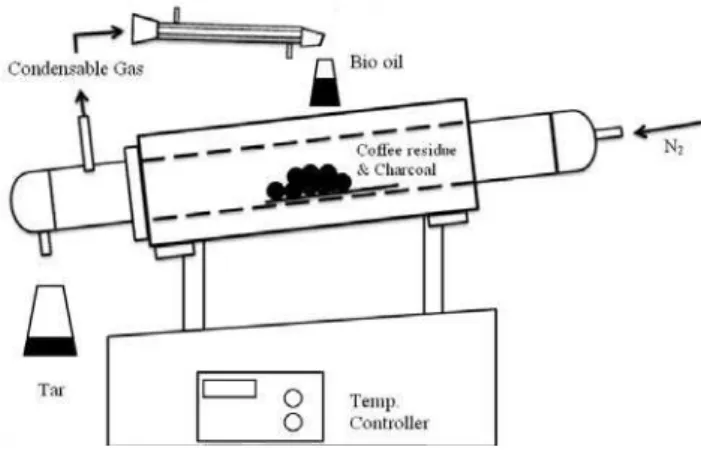
The pyrolysis reactor was designed and set up as showed in Fig.1. The column containing the coffee residue made from stainless steel No.316 and was sloped around 15° for preventing product accumulation. Nitrogen was flow into higher side of column while the tube furnace heated up to the decided temperature. The product gas was taken to condenser unit for liquid collection as called bio-oil. Moreover, this process supplied two more products such as tar (from lower side column) and charcoal (solid carbon).
Fig. 1 Pyrolysis reactor setup
C. Methodology
20 g of dried coffee residue was contained in stainless steel column. The N2 was used as carrier gas were varied on 0, 100 and 200 l/min, the pyrolysis temperature were as 300, 350, 400, 450 and 500°C. Additional, the particle size of dried coffee residue were varied as 2.46 and 3.00 mm. Each condition was controlled at constant heating rate 10°C/min and pyrolysis time for 30 min. After pyrolysis time 30 min, the nitrogen was still flowed into the column until the temperature monitor of controller showed the temperature lower than 100°C. Finally, three products were bio-oil, tar and charcoal were kept under non-humid condition and contained in brown vial for anti-UV.
Proceedings of the World Congress on Engineering and Computer Science 2011 Vol II WCECS 2011, October 19-21, 2011, San Francisco, USA
ISBN: 978-988-19251-7-6
ISSN: 2078-0958 (Print); ISSN: 2078-0966 (Online)
D. Analysis
Bio-oil from each condition was analyzed in term of yield, pH value, heating value by calorimeter, flash point by ASTM D 92, viscosity by ASTM D 445 and elemental analyzer for CHN detection.
III. RESULTSANDDISCUSSIONS
The analytical results were separated for four sections such as effect of pyrolysis temperature, effect of carrier gas flow, effect of particle size and comparison of produced bio oil with previous works.
A. Effect of Pyrolysis Temperature
The coffee residue size 3.00 mm was selected to pyrolysis process under N2 flow on 100 l/min by varying the temperature in range of 300-500°C. The results were shown in Fig.2
Fig. 2 Effect of temperature to yield
The Fig.2 showed the bio oil yield increased with pyrolysis temperature from 300 to 350°C and then slightly decreasing from 350 to 500°C. while the charcoal yield decreased with increasing in temperature. It indicated that the bio oil yield was inversely proportional with the charcoal yield. In the range of temperature 300-350°C, the thermal cracking of volatile effect to be higher forward reaction rate and higher the bio oil yield. Although pyrolysis is endothermic reaction, at the temperature higher than 350°C bio oil yield seem to be decreasing since the continuously generation of secondarythermal cracking [6]. At the secondary thermal cracking condition, some solid as charcoal were continuously pyrolyzed to be un-condensable gas that demonstrated the lower amount of bio oil and charcoal but higher amount of gas from the process. The highest bio oil yield was showed as 24.35 at the condition of temperature of 350°C, N2 flow on 100 l/min and particle size of 3.00 mm. At the same condition, the charcoal yield was 36.00 that will take to the next consideration.
B. Effect of Carrier Gas Flow
The effect of carrier gas flow was studied by varying N2 flow on 0, 100 and 200 l/min and controlling the temperature as 350°C and coffee residue size 3.00 mm in pyrolysis process.
The Fig.3 showed the highest bio oil yield was 24.35 at
the condition of N2 flow on 100 l/min. Under without carrier gas condition, the condensable gas cracked from volatile cannot leave from reactor in a short time, so it was taken to secondary thermal cracking period and changed to un-condensable gas that affect to lower bio oil yield but higher un-condensable gas. Conversely, the volatile wasn’t cracked to be condensable gas completely under condition of N2 flow on 200 l/min because of too short resident time in reactor. That condition then showed the lowest bio oil yield and the highest charcoal yield.
Fig. 3 Effect of N2 flow to yield
C. Effect of Particle Size
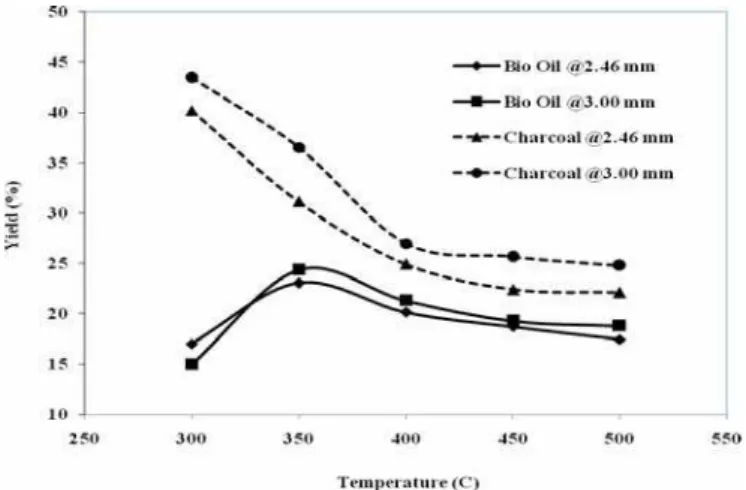
The coffee residue was separated for two particle sizes 2.46 and 3.00 mm for study the effect of particle size to bio oil production.
Fig. 4 Effect of particle size to yield
The Fig.4 showed the same trend line of bio oil and charcoal yieldbetween the 2.46 mm and 3.00 mm of coffee residue. However, the bio oil yield from size 3.00 mm was slightly higher than size 2.46 mm while the charcoal yield from size 3.00 mm higher than size 2.46 mm too. It seems that although the smaller particle has higher surface area but the tiny particle size affect the low thermal resistance too. Then the particle size 2.46 mm has more chance into secondary thermal cracking period and produce un-condensable gas. Additional, the larger size 3.00 mm plays Proceedings of the World Congress on Engineering and Computer Science 2011 Vol II
WCECS 2011, October 19-21, 2011, San Francisco, USA
ISBN: 978-988-19251-7-6
ISSN: 2078-0958 (Print); ISSN: 2078-0966 (Online)
the higher charcoal yield in each pyrolysis temperature because of its stronger structure.
D. Fuel properties characterization
The bio oil synthesized under the condition of temperature of 350°C, N2 flow on 100 l/min and particle size of 3.00 mm was analyzed the fuel properties and comparing with the other researches as shown in Table 1.
Table 1 Fuel properties of coffee residue
The Table 1 showed the viscosity and pH value of the bio oil from coffee residue is close with other works. This might be advantage point of the viscosity 29 ctS for the next application. By the way, it seems that its flash point is very higher than other bio oil types but is in range of bio diesel standard. This may be limitation of the using this bio oil as the fuel in case of the flash point at 127°C but it should be able as the filler for the fuel. Since the strange height of flash point, this bio oil was analyzed by using elemental analyzer for estimation of Carbon, Hydrogen and Nitrogen.
The results from elemental analyzer showed the very interesting composition percentage of bio oil from coffee residue related with its flash point as in Table 2.
Table 2 Elemental analysis of coffee residue
Table 2 showed the lowest Carbon composition in bio oil from coffee residue. That was only 32.38 wt% while others were in range of 69-73 wt%. If the flash points and Carbon composition percentage were considered simultaneously, it was found that these two factors were dramatic inverse trend value.
However, the compositions of bio oil from coffee residue could be estimated for the primary molecular formula by Ozlem Onay and O.Mete Kockar method. [12] This method assumed another element from Table 2 was oxygen so the elemental compositions of bio oil from coffee residue
contained C 32.38%, H 10.13%, N 2.08% and O 55.41%. Finally, the bio oil from coffee residue showed the primary molecular formula as CH3.76N0.05O1.27.
IV. CONCLUSION
The bio oil yield increased with pyrolysis temperature from 300 to 350°C and then slightly decreasing from 350 to 500°C since the condition higher than 350°C generated secondarythermal cracking. The condition of N2 flow 100
l/min made the optimum resident time of produced gas in pyrolysis reactor. It seems that particle size 3.00 mm could supplied the higher amount of bio oil than 2.46 mm. Finally, the highest bio oil yield was showed as 24.35 at the condition of temperature of 350°C, N2 flow on 100 l/min and particle size of 3.00 mm.
The bio oil has the common fuel properties comparing with the others except the viscosity that might be advantage point at 29 ctS and the flash point that might be disadvantage for using as fuel.
ACKNOWLEDGMENT
Rajamangala University of Technology Krungthep and Energy Policy and Planning Office, Ministry of Energy, Royal Thai Government
REFERENCES
[1] B. B. Uzun and et. Al. “Synthetic fuel production from tea waste: Characterization of bio-oil and bio-char”. Journal of Fuel. Sep. 2009, pp. 176-184.
[2] S. Sensoz and D. Angın. “Pyrolysis of safflower (Charthamus tinctorius L.) seed presscake in a fixed-bed reactor: Part 2. Structural characterization of pyrolysis bio-oils” Journal of Bioresource Technology. Dec. 2007, pp. 5488-5504.
[3] S. Wang, Y. and et. Al. “Separation of bio-oil by molecular distillation” Journal of Fuel Processing Technology. Feb. 2009, pp. 738-745.
[4] V. Boonamnuayvitaya and et. Al. “The Preparation and Characterization of Activated Carbon from Coffee Residue” Journal of Chemical Engineering of Japan. Vol.37, 2004, pp. 1504-1512. [5] H. J. Park and et. Al. “Effects of the operating parameters on the
production of bio-oil in the fast pyrolysis of Japanese larch”. Journal of Chemical Engineering. Dec. 2007, pp. 124-132.
[6] P.T. Williams and A.R. Reed. “Pre-Formed Activated Carbon Matting Derived from The Pyrolysis of Biomass Natural Fibre Textile Waste”.
Journal of Analytical Applied Pyrolysis. Vol.70, pp. 563-577.
[7] M. Ertas and M. H. Alma. “ Pyrolysis of laurel (Laurus nobilis L.) extraction residues in a fixed-bed reactor: Characterization of bio-oil Bio oil
Fuel
Properties Coffee residue
laurel [7]
Rape seed [8]
Soybean Water hyacinth [10]
Bio diesel [11]
Diesel
[9] [10]
Viscosity (ctS) 29 61 36 72.38 - 3.5-5.0 5
pH 4.22 3.12 3.2 - 4.8 - -
50
Flash point (°C) 127 65 75 63.00 - Not less than 120
Heating value (MJ/kg)
33.14 31.04 37.9 33.60 31 38.55-39.94 45.00
Tea waste [1] Elements (wt %) Coffee residue Laurel [7] Rapeseed [8] Soybean [9]
C 32.38 69.65 69.26 72.8 67.89
H 10.13 8.10 8.97 10.8 7.77
N 2.08 5.00 6.19 3.3 10.84
Proceedings of the World Congress on Engineering and Computer Science 2011 Vol II WCECS 2011, October 19-21, 2011, San Francisco, USA
ISBN: 978-988-19251-7-6
ISSN: 2078-0958 (Print); ISSN: 2078-0966 (Online)
and bio-char” Journal of Analytical and Applied Pyrolysis. 2010. Feb, pp. 22-29.
[8] O. Onay and O. M. Kockar. “Pyrolysis of rapeseed in a free fall reactor for production of bio-oil” Journal of Fuel. 2006. April, pp. 1921-1928.
[9] S. Sensoz and I. Kaynar. “Bio-oil production from soybean (Glycine max L.); fuel properties of Bio-oil” Journal of Industrial Crops and Products. 2005. April, pp. 100-105.
[10] S. Wanpet “Production of Bio Oil from Water hyacinth by using fast pyrolysis”. Faculty of Science, Chulalongkorn University, 2009. [11] W. F. Fassinou and et. Al. “Fatty acids composition as a means to
estimate the high heating value (HHV) of vegetable oils and biodiesel fuels”. Journal of Energy. 2009. Sep, PP. 4949-4954.
[12] O. Onay and O. M. Kockar. “Pyrolysis of rapeseed in a free fall reactor for production of bio-oil” Journal of Fuel. 2006. April, pp. 1921-1928.
Proceedings of the World Congress on Engineering and Computer Science 2011 Vol II WCECS 2011, October 19-21, 2011, San Francisco, USA
ISBN: 978-988-19251-7-6
ISSN: 2078-0958 (Print); ISSN: 2078-0966 (Online)