ARBS Annual Review of Biomedical Sciences
pdf freely available at http://arbs.biblioteca.unesp.br 2007;9:12-29
Biomolecular Information, Brain
Activity and Cognitive Functions
Alfredo Pereira Jr
1and Fábio Augusto Furlan
21 Department of Education, Institute of Biosciences, São Paulo State University (Unesp), BRAZIL 2 Faculty of Medicine and Nursing, University of Marilia, BRAZIL
Received: 23 October 2007; accepted 12 November 2007 On line on 23 November 2007
1 Correspondence
Alfredo Pereira Jr. Departmento de Educação, Instituto de Biociências, Universidade Estadual Paulista (UNESP), Campus de Rubião Jr., CEP 18618-000, Botucatu, SP, Brazil. E-mail: [email protected]
Pereira Jr A, Furlan FA. Biomolecular Information, Brain Activity and Cognitive Functions. ARBS Annu
Rev Biomed Sci 2007;9:12-29. Molecular neurobiology has provided an explanation of mechanisms supporting mental functions as learning, memory, emotion and consciousness. However, an explanatory gap remains between two levels of description: molecular mechanisms determining cellular and tissue functions, and cognitive functions. In this paper we review molecular and cellular mechanisms that determine brain activity, and then hypothetize about their relation with cognition and consciousness. The brain is conceived of as a dynamic system that exchanges information with the whole body and the environment. Three explanatory hypotheses are presented, stating that: a) brain tissue function is coordinated by macromolecules controlling ion movements, b) structured (amplitude, frequency and phase-modulated) local field potentials generated by organized ionic movement embody cognitive information patterns, and c) conscious episodes are constructed by a large-scale mechanism that uses oscillatory synchrony to integrate local field patterns.
by São Paulo State University – ISSN 1806-8774
Keywords:biomolecular information, molecular neurobiology, brain function, cognition, local field potentials
Abstract
Table of Contents
1. Introduction
2. Biomolecular Information and Brain Activity
3. On the Evolution of Molecular Mechanisms Supporting Cognition 4. Molecular Tuning of Electromagnetic Patterns
5. Ionic Dynamics
6. Cellular Cycles Modulated by Metabotropic Receptor and Neuropeptide Signaling 7. Constructing Integrated Conscious Experiences
8. Amplification Mechanisms 9. Broadcasting Mechanisms 10. Selection Mechanisms 11. Binding Mechanisms
12. Philosophical Issues in the Explanation of Consciousness 13. Concluding Remarks: Brain Activity and Conscious Cognition
1. Introduction
A large number of findings in scientific disciplines as neuropsychology, biological psychiatry, neurology, molecular neurobiology, cognitive and affective neuroscience suggest that cognition and conscious experiences depend on brain activity. Lesions of specific areas in the brain lead to specific cognitive and/ or affective deficits; imbalance of neurochemical systems lead to altered states of consciousness, and brain anesthesia produces a loss of consciousness. Although most neuroscientists and cognitive scientists agree that brain activity is necessary for cognition and consciousness, knowledge of brain science has not been regarded as sufficient to explain these phenomena.
For instance, the identification of brain areas activated during cognitive and emotional processes is not sufficient to explain the experiences (e.g., pain) supported by these areas. In order to elucidate the role of biomolecular mechanisms in the generation of mental life, we argue that they are responsible for
the tuning of cellular activity into large-scale patterns that support cognitive processes. In the
above example, the tuning of neuronal membrane activity by means of molecular effectors (e.g., neuropeptides) would define the difference between pain and pleasure.
Our reasoning assumes the existence of prototypical cognitive patterns, such as hunger, thirst, sensations of hot and cold, pain and pleasure; visual features as color, shape and movement, auditory features as tone, intensity and timbre, etc.. We adopt a view of prototypes as informational patterns emerging from the activity of a cognitive system interacting with the environment, as proposed by Rosch (1975), Lakoff (1987), Johnson (1987) and Gärdenfors (2000, 2004).
Prototypes are organized (or self-organized) into complete mental episodes by means of a non-linear combinatorial process, making room for the emergence of new properties. Emergentism is the assumption that the result of a combinatorial process can be richer than the sum of the combined elements (see Stephan, 1999) For instance, molecules are not alive, but the interaction of molecules forming a cell constitues a living system. In this example, life is conceived as an emergent property. This is the general strategy we use to explain how properties of molecules control brain activity, and how brain activity support cognitive processes.
2. Biomolecular Information and Brain Activity
Before discussing the meaning of information at the molecular level of analysis, and its possible relations with cognition, we review important aspects of biological information processing.
Proteins are biophysical agents operating as “Maxwell Demons” (Monod, 1970; Loewenstein, 1999). In open systems like the living cell, they are able to reduce entropy locally, at the cost of increasing it in their environment. In this sense, proteins are mechanisms, generated by evolution, able to keep living systems at low entropy states while obeying the Second Law of Thermodynamics. They possess the capacity of producing metabolism, the physiochemical transformations that enable and control life processes.
Two models describe the work of enzymes, the proteins that catalyze physiochemical interactions:
the lock-and-key, and the allosteric interaction models. The lock-and-key model illustrates how enzymes
interact with their substrates. It refers to a matching mechanism composed of two factors: spatial three-dimensional (3D) conformation and electrostatic field patterns. Proteins are linear chains of amino acids that fold in a self-organized manner into 3D configurations, forming spatial structures able to select other molecular interacting partners by their shape. This selection process is well depicted by the matching of lock-and-key.
arrangements of its flexible parts.
In order to store information for long periods of time, it is better to use stable macromolecules, as the DNA. To perform metabolic transformations, molecules with a flexible structure are more appropriate. Since the pioneering work of Monod et al. (1963), the flexible structure of proteins is called “allosteric”. In the original allosteric model, enzymes have a flexible structure limited to two mutually exclusive states, relaxed and tense. Enzymes in the relaxed state bind substrates more readly than those in the tense state. More recently, intermediary states have been proposed (see Changeux & Edelstein, 2005).
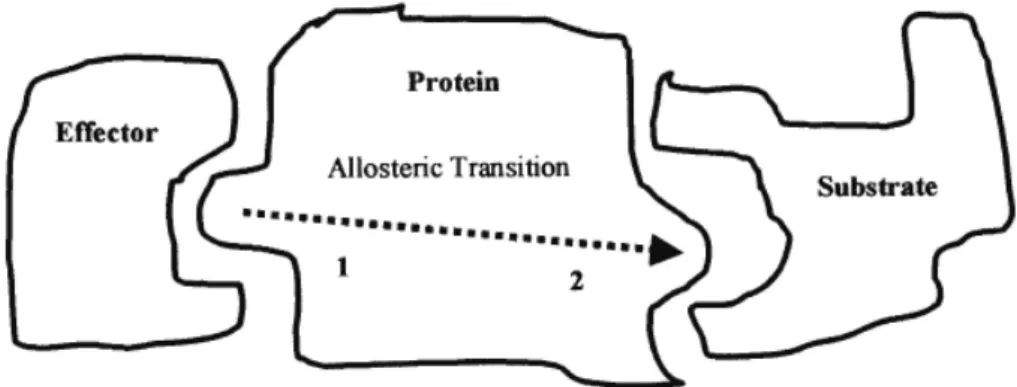
The transition between the states is determined by the interaction with other molecules, called
ligands or effectors. The lock-and-key binding of effectors with one or more active microsites of the
protein generates a transition of states. The protein can also act as an effector to produce a change in another molecule, called the substrate (Fig. 1).
Figure 1. The binding of an effector with a protein at the active site 1 causes an allosteric transition and then site 2 of the protein binds with the substrate.
The above usage of “molecular information” refers to structural properties of molecules, such as three-dimensional conformation and distribution of charges along surfaces. Although displaying a similarity with the Weaver & Shannon (1949) mathematical concept of information (which is about the quantity of information transmitted by a communication channel), molecular information has a different nature. The mathematical concept refers to a probabilistic structure relative to an abstract channel defined in the context of a system composed of a source of signals, a receiver and a code (the latter being a set of correspondence rules to match the states of the source with the states of the receiver). The molecular concept refers to an ordered physical structure that interacts with other physical structures, producing several kinds of phenomena (for a discussion of this concept, see Stonier, 1990).
In biological systems, signaling molecules are suitably positioned tocontrol cellular and tissue activity, according to the molecules’ informational properties. For instance, the displacement of calcium ions initiate the contraction of muscular fibers. Such an understanding of molecular information is provided by a cybernetic concept of information as a low energy signal (the calcium ions, in the above example) that controls (relatively) higher-energy processes (the muscle fiber contraction, in the same example).
Would such low energy signaling chains in the brain participate in cognitive processes? In order to answer this question, it is necessary to consider the role of molecular information in brain activity. The brain, as any complex system, is characterized by the occurrence of dynamic patterns and self-organizing processes (see Kelso, 1995). These patterns can be compared to a ripple that is generated by the meeting of fluxes of water and continues to exist as long as it is sustained by them.
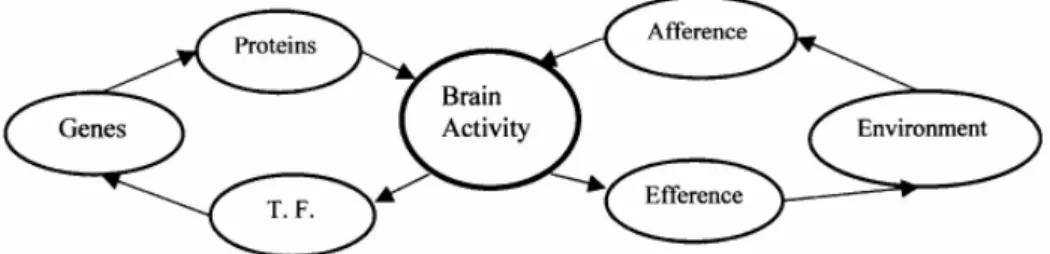
Brain activity is co-determined by several factors: genetic information, epigenetic influences, and signal exchanges with the entire body and the external environment. The latter kind of exchange is necessary for normal brain development and functioning. The important notion of neuroplasticity is related to this dynamical nature of brain activity. This term implies that the dynamic patterns of brain activity of an individual are shaped by his/her history of interactions, and that the resulting patterns of activity determine important aspects of brain structure. For instance, an animal raised with sensory deprivation does not develop functional perceptual subsystems, whereas under normal conditions the patterns of activation determine part of the architecture of the perceptual systems.
proteins to genes, and the Functional Cycle, a circular flux of efferent and afferent processes, originally proposed by von Uexküll (1957). When the functional cycle is formed, the brain motor system, besides controlling behavior, also sends signals to the perceptual system; these signals are called “efferent copy” or “corollary discharge” (see e.g. Gilbert, 2001). By means of both kinds of feedback, external and internal to the brain, an “inner world” (the Umwelt, also proposed by von Uexküll, 1957) emerges from an active functional cycle.
Figure 2. Epigenetic and Functional Cycles Meet in the Brain. The Epigenetic Cycle: genes are expressed into messenger RNA and proteins, which control brain activity. The patterns of brain activity feedback on the genes by means of transcriptional factors (T. F. in the figure), the signaling molecules that trigger gene expression. The Functional Cycle: in perceptual processes, information from the brain’s environment (the entire body and the external environment) is captured by sensors and sent to the brain; it then helps to shape brain activity. The results of brain activity control efferent processes, the action of the organism in the environment.
The above cycles involve several spatial and temporal levels of description. Genes and proteins are macromolecules. Changes in their molecular conformation occur in the temporal scale of picoseconds. The interaction with the environment is usually mapped at the macroscopic level. The entire body mediates the interaction of the brain with the environment, which can be described in the temporal scale of seconds. There are also other relations between the brain, the body and the environment that take part in processes that occur in cosmic scales. For methodological reasons, these scales will not be considered here.
The complex circuits generated by the intersection of epigenetic and functional cycles in the brain are described in more detail in the diagram shown in Fig. 3. The signaling pathways depicted in this kind of diagram are called Signal Transduction Pathways (STPs). Technical terms that appear in the diagram are explained below.
Transmission of stimuli messages from cell to cell involves more than one encoding strategy. In afferent (from stimulus to the brain) processes, the connections between sensors, thalamic relays and cortical receptors are in some cases”hardwired” (i.e., the destination of the signal is determined by a specific connection), and therefore the afferent signal (the sequence of pulses originated by the presence of the stimulus and transmitted from neuron to neuron) corresponds to a frequency code. When the channel is not hardwired, the afferent signal must carry information about its origin, corresponding to a
temporal code: as each pulse has approximately the same amplitude, information is encoded in the
relative timing of the pulses.
Stimuli messages are carried by sequences of neuronal pulses called spike trains. These pulses trigger the opening of transmitter vesicles at the axon terminal of neurons, releasing the transmitters at the synaptic cleft. The transmitters bind to receptors located in the membrane of the post-synaptic neuron. These receptors, as allosteric proteins, control molecular gates that allow the flux of ions through membranechannels.
Figure 3. Diagram of Brain Signaling Mechanisms. a) Stimulus-Derived Spike Trains trigger the release of Synaptic Molecular Effectors (Neurotransmitters, Neuromodulators and Gliotransmitters); b) Molecular Effectors bind to Membrane Receptors. One class of these receptors, called “Ionotropic”, directly controls the flux of ions across the neuronal membrane (the other class, called “Metabotropic”, only activates STPs inside the cell); c) Energy in the form of ATP, produced in mitochondria (or elsewhere) from blood glucose, is broken into ADP and cAMP and then supports the phosphorylation of proteins; d) Ionotropic Receptors are ion channels which, when activated, generate Dynamical Ionic Patterns with their respective EM fields and action potentials; e) Ionic Patterns provide intercellular communication by means of neural pulses and synaptic transmission in brain circuits. Reaching the motor system, these patterns generate overt and covert Behavioral Patterns. The motor commands are also sent to sensory Synaptic Molecular Effectors and modulate incoming stimulation; f) Ionic Patterns control the activity of Voltage-Gated Ion Channels, which control ionic activity and also activate intracellular STPs; g) Ionic Patterns, by means of calcium ions entering neurons, activate proteins from the Kinase Family and Transcriptional Factors; h) Gene Expression produces signaling molecules and their respective receptors, which maintain, amplify or inhibit the previous cycles of activity.
Both EPSPs and axonal pulses present in a neuronal population are measured by the EEG and similar tools (e.g., single-cell electrodes) that meaure brain electroactivity. Therefore, membrane receptors activated by low-energy, informational processes, are able to control higher energy processes, the EM waves recorded by the EEG, and the resulting behavior of the organism.
the corresponding electromagnetic field, also produces membrane channel vibrations (“twitching”), physically described as phonon patterns (the phonon being the quantum of energy present in molecular and ionic vibrations and in thermal agitation). Mosbacher et al. (1998, p.65) have suggested that “electrically induced motility will cause twitching during action potentials, and may have physiological consequences”.
EM activity is supported by biochemical processes that use energy from glucose to sustain the low entropy states of the cells. The phosphorylation of proteins, necessary to sustain them in active states, is a distribution of the energy obtained from blood glucose that is controlled by the family of protein kinases. The kinases are enzymes that control other proteins. They can organize cellular processes and eventually activate transcriptional factors. The activity of kinases and other proteins that transform and distribute energy in the cell can sustain or abolish the EM patterns.
In summary, molecular information in the brain controls the movements of ions across the neuronal membrane, generating EM activity (and a corollary production of microscopic vibratory patterns), supported by energy obtained from blood glucose.
3. Evolution of Molecular Mechanisms Supporting Cognition
Consciousness-generating mechanisms possibly evolved from simpler molecular processes, such as those involved in the signaling of hunger and thirst. Denton et al. (1999) propose that thirst sensations have an interoceptive origin, being a reaction not to an external stimulus (as the dry mouth) but to a change in the sodium concentration detected by molecular sensors in the blood-brain barrier. The sodium-level detection system is a rudimentary example of a signaling unit that supports cognition.
This rudimentary model of molecular interaction would approximately cover the main features of initial and intermediary (between peripheral sensors and the final cortical destination) processes in the chemical senses. A study of odor perception by Leon & Johnson (2003) illustrates perceptual processes based on molecular signaling. Olfactory signal transduction in the rat begins with the activation of a thousand of receptors in the olfactory epithelium. There are many more odorants to which the animals respond, so “it is therefore likely that most odorants are coded by a unique combination of receptors such that a unique combination of responses would describe any particular molecule (i.e., its odor – APJ/FAF). One way this could occur is by simple feature extraction in which different receptors independently recognize different parts of the same odorant molecule” (Leon & Johnson, 2003, p. 24).
The rat olfactory system is composed of groups of epithelium receptors projecting to glomeruli (dense synaptic bundles) in the bulb, which project to a small number of mitral cells, which in turn project to the olfactory cortex. Leon & Johnson (2003, p. 26) found that “each odorant stimulated a unique combination of glomerular clusters that we call modules. The modules describe a group of glomeruli in which we reliably find responses to a particular odorant feature”. Their experiments showed the possibility of predicting both the neural response from the structure of the odorant molecule and the odor perception from the neural response to the molecular structure. These findings demonstrate the existence of information transmission from the molecular structure of the olfactory stimulus to conscious content (the experienced sensation of odor). It is important to note that, according to the same authors, “if there are odorants with differences in molecular structure, but without differences in their evoked glomerular activity, then these odorants should not be discriminated” (Leon & Johnson, 2003, p. 28). Therefore, from a molecular information transmission perspective, we can only perceive the features that our neural receptors are able to discriminate.
4. Molecular Tuning of Electromagnetic Patterns
The combination of molecular informational processes with ionic transmission, integrating several cells into a functional unit, gave rise to a complex mechanism, corresponding to what is traditionally called a feature detector (FD) in visual, auditory and somatic perception studies. FDs are complex mechanisms present in perceptual neuronal networks, responding to specific characteristics of stimuli (for a more complete definition, see Bickle & Mandik, 2002). Among the important structural components of FDs is the architecture of the dendritic tree of neurons, and the pool of proteins that control the activation threshold of ion channels. Based on these properties, each FD, in each perceptual, emotional and/or cognitive modality, responds selectively to a narrow range of stimuli. The functionalsignature of a FD lies in the pattern of EM activity that it generates and/or resonates with.
In a dendritic network, when EM patterns are appropriatelytuned by the underlying molecular mechanisms, they resonate to the incoming spike trains that display a similar spatio-temporal structure, forming a local EM signature. Molecularly tuned EM patterns are good candidates to generate prototypical cognitive patterns. This view is similar to that of Phibram (1991) and Woolf (1999b) regarding the central role attributed to dendritic excitatory fields for consciousness. This view is an alternative to models based on axonal firing (see Crick & Koch, 1994).
This proposal also has affinity with the idea (Gabora, 2002) that conscious patterns derive from physical information, being amplified into subjective consciousness in the brain. We understand that such a derivation process occurs in two steps: a) molecular information controls ionic movements, inducing prototypical patterns to emerge; and b) prototypical contents are integrated, composing conscious episodes. The compositional process is based on several mechanisms discussed in the next sections, such as astroglial communication and electrical synapses providing collective oscillations, synchronization of oscillations, and calcium waves flowing in the astrocytic syncytium.
We do not agree with McFadden (2002) about the existence of a unitary conscious magnetic field, since local fields are too weak to support a whole-brain magnetic integration. On the other hand, we also disagree with the micro-consciousness hypothesis defended by Zeki (2001), since a prototypical pattern is not considered to be an isolated, self-contained experience. Zeki (2001, p.57) claims that “the primate visual brain consists of many separate, functionally specialized processing systems, each consisting of several apparently hierarchical stages or nodes…activity at each node reaches a perceptual end point at a different time…consequently, activity at each node generates a micro consciousness”. In our proposal, prototypical patterns do not become conscious until they are integrated in a conscious episode; otherwise, they remain unconscious.
In so far as consciousness is generated by molecular information and incoming spike trains modulating local EM fields, some of the properties of conscious content should be detected by techniques that measure local fields and the metabolic activity necessary to sustain them. Besides the classical evidences obtained with EEGs (e.g., event-related potentials that indicate conscious semantic processing of language), recent results with fMRI are highly relevant to this proposal. Current understanding of fMRI is that it measures arterial blood oxygen consumption reflecting increased metabolic demand that corresponds to local field activity (e.g., Logothetis & Pfeuffer, 2004). Therefore, it is expected from high-precision fMRI experiments to reveal some aspects of conscious content, a task that is beginning to be accomplished. For instance, Kamitami & Tong (2005) investigated the perception of edge orientation, an important visual feature. Using statistical algorithms to classify brain states, they found that “ensemble fMRI signals in early visual areas could reliably predict in individual trials which of eight stimulus orientations the subject was seeing” (p. 679).
5. Ionic Dynamics
The movement of ions is central to the physiology of many kinds of cells. In the brain, the flux of Sodium (Na+), Potassium (K+), Chloride (Cl-)and Calcium (Ca2+) ions is controlled by proteins located in
the neuronal membrane. While the first three ions are mainly a vehicle for energy processes (their movement across the membrane determines the electrical excitation or inhibition of the neuron), the calcium ion is mainly an informational vehicle.
A key feature of membrane physiology is that EPSPs and the corresponding axonal firings are produced mainly by the movement of Na+ and K+ in and out of the membrane, generating the electric
the interior of the postsynaptic cell, and activating intracellular processes (in the role of a “second messenger”, when it is called intracellular calcium - abbreviated iCa2+). The Ca2+ that is available in
the synaptic cleft, following a previous EPSP that opens Ca2+ channels,enters the membrane and binds
with intracellular proteins, while some of the results of iCa2+ intracellular signaling processes feedback
on the membrane.
The hypothesis of Ca2+ activity as a vehicle for consciousness was originally raised by Beck &
Eccles (1992). They raised the possibility of consciousness influencing synaptic activity by means of Ca2+ action in the axon terminal, where it contributes to the opening of vesicles and transmitter release in
the synaptic cleft. Another possible role of iCa2+ in conscious processing was discussed by Christof
Koch: “it is possible that the NCC [Neural Correlates of Consciousness – APJ/FAF] are not expressed in the spiking activity of some neurons but, perhaps, in the concentration of free, intracellular calcium ions in the postsynaptic dendrites of their target cells” (Koch, 2003, p.17).
In our proposal, the main contribution of Ca2+ dynamics for consciousness refers to its function in
the glutamatergic synapse. Glutamate (Glu) is the main excitatory transmitter in the brain. It binds to three kinds of protein receptors, called AMPA (alpha-amino-3-hydroxy-5-methyl-4-isoxazolepropionic acid), NMDA (N-methyl-d-aspartate) and metabotropic Glu receptors (Fig. 4 - the name of the first two receptors was drawn from the name of substances that bind with them).
Figure 4. The Glutamatergic Synapse. Glu released from the pre-synaptic neuron’s axon terminal spreads through synaptic space and binds to three different kinds of receptors (AMPA, NMDA and Metabotropic Glutamate Receptors – MetGR) located in the post-synaptic neuron membrane. The three kinds of receptors activate signal-transduction pathways that converge into the dendritic spine, a morphological structure that contains molecular mechanisms involved in the processing of the information transmitted by the glutamatergic synapse (adapted from Krystal el al., 1999).
The activity of the glutamatergic synapse involves:
a) Glu binding to AMPA and NMDA receptors, leading to a conformational change in the
AMPA receptor that opens the channel to Na+ entry, depolarizing the membrane and then
facilitating Ca2+ entry through NMDA and voltage-dependent calcium channels (VDCCs;
these are Ca2+ channels that are controlled exclusively by changes in the voltage of the
membrane);
b) Glu binding to G-protein-coupled metabotropic receptors, activating STPs that lead, among
other actions, to an activation of enzyme adenylyl cyclase (AC), leading to an increase in the production of cAMP (the abbreviation for cyclic adenosine monophosphate, which serves as an energy component to activate intracellular proteins supporting several functions).
Therefore, the Glu activation of post-synaptic machinery occurs either by means of Ca2+ entry in
the neuron (through NMDA and VDCC), or by the activation of metabotropic receptors and their coupled G-proteins.
entry in the post-synaptic neuron by means of a gate that in its resting state is blocked by magnesium.
The coincidence detection function of the NMDA channels refers to the opening to Ca2+ entry only
when two excitatory pulses activate at least two sites of the protein in a hundred-millisecond time window. Flohr (1995) was possibly the first author to relate Ca2+ entry in NMDA channels with
consciousness. This suggestion was based on pharmacological studies. The coincidence detection function assures the reliability of perceptions, whereas NMDA blockage by drugs such as ketamine causes perceptual distortions and hallucinations (Pereira Jr. & Johnson, 2003). In normal functioning, NMDA activity can sustain excitatory membrane activity by activating the retrograde messengers nitric oxide and arachidonic acid, which help to increase arterial blood flow (see Bliss & Collingridge, 1993).
The Ca2+ that enters through NMDA or VDCCs binds with several intracellular receptors. With
some of them (calbindin, parvalbumin; see Jones, 2001), the forms of interaction are still poorly understood. Calmodulin (CaM), the better studied Ca2+ intracellular receptor, can adopt hundreds of different
conformations, depending on the properties of the Ca2+population that binds with it (Gerstein & Krebs,
1998; Wilson & Brunger, 2000). Ca2+ interacts strongly with proteins, both as an effector and as a
substrate, to the point of being compared to a hormone (Loewenstein, 1999).
The informational capacity of Ca2+ (see, e.g., Loewenstein, 1999; Jaiswal, 2001; Carafoli, 2002;
Bast, 2004) is derived from its electronic structure. The calcium atom has 20 electrons, having an orbital distribution of 2-8-8-2. The Ca2+ loses two electrons of the outer orbital, being attracted to molecules with
a negative charge. While attracted, it can also carry information in its flexible electronic structure. The information is embodied in the distribution of electrons in the shells and sub-shells of the electronic structure.
There are two, non-exclusive possibilities for informational exchanges between macromolecules and Ca. The first one is by lock-and-key binding, as in the case of Ca2+ binding with CaM. The second
possibility is that the membrane channel transfers to the entering Ca2+ a vibratory pattern. This information
transfer would have an important function. When the incoming spike train induces the release of transmitters that promote the flow of Na+ and K+ across thousands of channels in the post-synaptic
neuron, the global EM pattern generated in the dendritic network of the neuron is likely to be chaotic (in the sense of inharmonic). The feedback of Ca2+-activated intracellular molecular mechanisms on
membrane ionotropic receptors and voltage-gated channels possibly tunes the membrane EM patterns, inducing a harmonic structure that defines thesignature pattern of the neural assembly (see Yeung et al., 2004). Such a tuning would also be related to the informational coherence formulated by Tononi et al.
(1998). In this view, the generation of prototypical cognitive patterns would depend on the tuning by intracellular feedback mechanisms such as those activated by Ca2+ entry.
6. Cellular Cycles Modulated by Metabotropic Receptor and Neuropeptide
Signaling
In this section we extend the role of tuning neural activity to metabotropic receptors exerting feedback on the membrane, and neuropeptides that bind with these receptors. Membrane metabotropic receptors are allosteric proteins activated by transmitters and modulators available in the synaptic space. These receptors do not control an ion channel, but they activate intracellular effectors forming signaling chains that control many cellular functions. Glutamatergic, as well as cholinergic (referring
to Acetylcholine) and other monoaminergic (as Dopamine and Serotonin) neurotransmitter binding
with metabotropic receptors activate intracellular STPs directed to several targets, including feedback on membrane ionotropic receptors.
These pathways - when situated in their proper neural and glial networks in the limbic system - are likely to be involved with the setting of mood, affective/emotional states, and with the action of drugs that modulate these kinds of states. For instance, it has been found that both caffeine (see Lindskog et al., 2002) and lithium (Williams et al., 2002) act on the inositol pathway, one of the signal pathways controlled by metabotropic receptors. This pathway exerts feedback on the synapse (e.g., by modulating AMPA activity and K+ channels) to control membrane activity.
an enzyme that transforms ATP into cAMP.
There are at least 11 kinds of AC enzymes in the mammalian brain. Like the NMDA protein, they have been conceived as molecular coincidence-detectors (Anholt, 1994), since they link metabotropic receptors and G-proteins to cAMP signaling pathways essential for many brain functions. AC can be activated by iCa, leading to cAMP release and activation of transcriptional factors (Alkon et al., 1998). AC1 and AC8, the two major isoforms of AC sensitive to iCa, are highly expressed in the anterior cingulate cortex. For instance, Ca2+ activation of AC in the proper brain circuits is a central component
in the generation of chronic pain (Wei et al., 2002).
The activation of metabotropic receptor STPs, leading to an increase in the activity of ACs, can also produce feedback cycles that tune membrane EM patterns, by means of feedback on ionotropic receptors (e.g., nicotinic receptors) and voltage-dependent channels (e.g., K+ channels). For instance,
citochrome oxidase (CO) is an enzyme present in mitochondria, which is important for the metabolism of the glucose carried in the blood. ATP production from CO impact on AC production of cAMP. A possible molecular factor participating in the modulation of membrane EM activity is the quantity of cAMP available in the neuron. The level of energy possibly correlates with the pattern of EM activity of the membrane. This conjecture would explain the different distribution of CO in the mitochondria of neurons in the visual cortex areas responsible for the recognition of colors (for this distribution, see Dow, 2002; Gegenfurtner & Kiper, 2003).
The activation of intracellular STPs by metabotropic receptors, besides the proposed function of supporting consciousness, also leads to gene transcription processes, production of new proteins and growth factors controlling the architecture of the dendritic tree. A classical example is the process of formation of long-term memory, elucidated in the pioneering work of Eric Kandel and associates with Aplysia (see Bailey & Kandel, 1995). Serotonin binding to a metabotropic receptor modulates an ionotropic receptor controlling Na+-K+ fluxes. The cAMP released by AC activates a kinase (Protein Kinase A)
and then transcriptional factors, leading to the disinhibition of a regulatory gene. This gene disinhibits another one, which is expressed and then produces a neural growth factor (a molecule that controls dendritic growth).
An interesting aspect of metabotropic receptor activation, in the context of a theory of consciousness, is that it can be made by sub-threshold EPSPs, i.e., membrane depolarizations that do not reach the firing threshold. An interesting experimental study demonstrated the importance of sub-threshold potentials in the development of the cortical structures necessary for perceptual feature detection in the somatosensory cortex of rats (Moore et al., 1999). The possibility of sub-threshold EPSPs producing sustained self-organizing cycles has an impact on the interpretation of neuronal data, using current techniques as single-cell electrodes. “Silent” cells (i.e., cells that are not firing during a given time interval) may in fact be participating in cognitive processing.
Another class of signaling molecules that is important for the support of conscious processing is the neuropeptide. A neuropeptide is a macromolecule produced in the brain that is smaller than a protein and has - like other hormones - the role of a biomolecular informational effector in STPs. Neuropeptides are released by the pre-synaptic neuron together with transmitters and bind with membrane receptors, then modulating the EPSP.
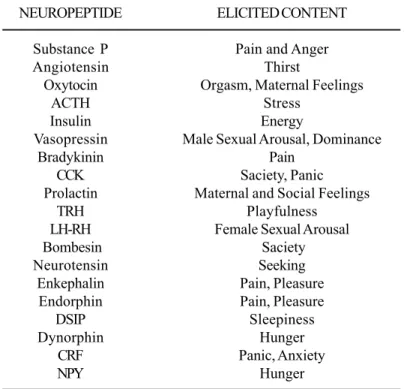
Panksepp (1998) suggested the participation of neuropeptides in the generation of affective/ emotional states and reviewed the correlations between neuropeptide molecular activity and kinds of affective/emotional experiences (Table 1). It is remarkable that the functions activated by neuropeptides are very specific, a fact that suggests that they carry information relative to a
specific content to be generated. While modulating STPs in the limbic system, neuropeptides can
contribute to generate specific kinds of membrane EM pattern signature, corresponding to affective/ emotional prototypical contents.
In summary, the biomolecular informational factors that contribute to tune local EM patterns, generating prototypical conscious contents, would include:
a) faster Ca2+ information transmission, possibly supporting perceptual processes in the
sensory neocortex;
b) metabotropic transmission, forming sustained molecular cycles of activity based on cAMP production by AC, activating several STPs that feedback on membrane activity;
Table 1. Neuropeptide modulation and affective/emotional contents: discoveries from 1935 to 1985.
NEUROPEPTIDE Substance P Angiotensin Oxytocin
ACTH Insulin Vasopressin
Bradykinin CCK Prolactin
TRH LH-RH Bombesin Neurotensin
Enkephalin Endorphin
DSIP Dynorphin
CRF NPY
ELICITED CONTENT Pain and Anger
Thirst
Orgasm, Maternal Feelings Stress
Energy
Male Sexual Arousal, Dominance Pain
Saciety, Panic Maternal and Social Feelings
Playfulness Female Sexual Arousal
Saciety Seeking Pain, Pleasure Pain, Pleasure Sleepiness
Hunger Panic, Anxiety
Hunger Adapted from Panksepp (1998).
7. Constructing Integrated Conscious Experiences
According to our hypothesis above exposed, the building-blocks of cognitive processes and conscious experiences - the prototypical contents - are related to local field EM pattern signatures, which are heavily dependent on the molecular structure of the cells.
These patterns are activated over baseline through a matching with the spatio-temporal structure of incoming spike trains. The matching function has been modeled in neural networks using Adaptive Resonance Theory, a theoretical tool that is useful for the understanding of neural mechansms underlying conscious perception and learning (see Grossberg, 1999).
Human consciousness is composed of complete episodes that dynamically combine a large number of prototypical patterns. As local fields are too weak to allow direct magnetic interaction of all regions of the brain, biological evolution led to the development of several forms of intercommunication able to produce integrated whole-brain spatio-temporal patterns.
There are several mechanisms of integration in the brain, some of them related, in the neuroscientific literature, to attention processes. Their function is both to select the local fields that participate in the composition of the conscious episode, in a hundred-millisecond time interval, and to bind the fields’ informational content into an integrated focus.
Axonal firing is, of course, the main form of long-range communication in the brain, but it has limitations. Axonal transmission it is not able to directly transmit the waveform signature of each neuron, because the firing threshold is determined by constant parameters (Edwards, 2005). In other words, the amplitude modulation that characterizes each EM signature pattern is lost in axonal transmission; only the frequency and phase information is effectively transmitted. Therefore, axonal transmission operates with a system of discrete pulses, usually described as a binary code in the artificial neural network literature.
Axonal firing is also limited by the point-to-point architecture of axon-dendrite connections. This architecture does not support the integration of distributed information, since there is not a brain center where all circuits converge. There are limited convergence zones (Damasio, 1990) that integrate brain activity regionally. Supplementary mechanisms, such as electrical synapses, astrocytic calcium waves, nitric oxide spread and hormonal signaling are likely to help to integrate local fields into a whole-brain spatio-temporal EM pattern that crosses neuro-glial tissue in several ways (carried in blood flow, crossing neuronal membranes sequentially, etc.).
field signature to other brain regions. The emission function implies that the local field has to be activated above baseline, but the excitation cannot be excessive. The balance of excitation and inhibition, essential for preserving the signal-to-noise ratio, cannot be disturbed (on the importance of the balance of excitation and inhibition for cortical function, see Marino et al., 2005).
In the next sections, we analyse the selection and integration mechanisms involved in perceptual consciousness. Other modalities of human consciousness (abstract thinking, planning the future, aesthetic and moral judgment, self-consciousness) will not be discussed here, but they can be accounted for by the consideration of higher-order relations between brain systems, specially the “executive system”, involving large brain networks connecting the hippocampus and frontal cortex with the parietal and temporal associative areas.
8. Amplification Mechanisms
The expression of a content begins with the stimulation of the respective specialized neuronal assembly by means of an afferent spike train or an endogenous brain signal that matches with the assembly’s EM signature and excites it beyond baseline. Departing from this initial excitation, recurrent
circuits, widely present in the brain, promote the amplification of the assembly’s EM signature. In recurrent
circuits, excitatory loops are formed: initial EPSPs generate spike trains that activate EPSPs in other neurons that generate spike trains that reinforce the initial EPSPs.
In the awake state, inter-neuronal communication in thalamocortical networks is boosted by tonic (i.e., pulsed) spiking provided by cholinergic activation. The dependence of amplification on cholinergic mechanism makes acetylcholine one of the major transmitters involved in conscious processing (see Perry et al., 1999).
Excitatory loops are counterbalanced by the activation of inhibitory interneurons, which are part of the selective mechanisms. Inhibitory neurons release neurotransmitter GABA (abbreviation for
gamma-aminobutyric acid) to other neurons. This transmitter and its membrane receptors contribute to inhibit
membrane activity by controlling the flux of Cl- ions.
The amplification of prototypical contents by recurrent circuits involves the following operations:
a) neuronal assembly A, which generates EPSPs corresponding to an prototypical content, sends spike trains to other assemblies B;
b) reentrant signaling (see Edelman, 1989; Damasio, 1990) - i.e., reentrant spike trains - from B to A releases transmitters that bind to membrane receptors to sustain the original EPSPs.
Therefore, a recurrent circuit neural population amplifies its EM pattern signature using recurrent circuits that activate, in each neuron belonging to the circuit, the same mechanisms involved in generating the original pattern:
a) the action of metabotropic receptors on the ionotropic ones; the effect of this activation is membrane depolarization, which also controls the opening of voltage-dependent channels; b) the action of hormones/neuropeptides and other molecular effectors sustaining the feedback
pathways;
c) Ca2+ entering on NMDA and VDCC, activating cellular STPs that feedback on the membrane.
9. Broadcasting Mechanisms
According to Freeman’s (2003) analysis of brain activity, sensory processing involves the formation
of wave packets - spatially distributed dynamical EM patterns affecting large populations of neurons.
This process can be analysed as resulting from the reciprocal broadcasting of excitatory patterns from interconnected local fields located at several brain regions. Each local field produces spike trains that modulate the assemblies with which they are connected.
Figure 5. The Astrocytic Syncytium (http://synapses.mcg.edu/). Calcium waves are induced by the binding of Glutamate (Glu) with metabotropic receptors and activation of the inositol (IP) signaling pathway in astrocytes.
by means of gliotransmitters. Calcium waves are the physiological response of astrocytes to neuronal excitation. Although being too slow to support the broadcasting of sensory signals, these waves can possibly support mechanisms of conscious short-term/working memory (Robertson, 2002).
Understanding large-scale integration in the brain requires the consideration of a combination of effects generated by cables (axons) typical of input-output systems - such as communication between basal ganglia and hippocampus, to and from polymodal cortical areas - as well as integrative mechanisms operating by means of diffusion - such as hormones carried by blood flow and calcium waves in astrocytes. The resulting portrait is composed of interference patterns of EM signatures of all the neuronal assemblies involved in the wave packet. These patterns are second-order phenomena derived from the interaction
of EM patterns. Possibly, the content of cognitive and conscious processing is correlated to such interference patterns, instead than the underlying EM patterns alone.
Two of the most important mechanisms that affect broadcasting processes and contribute to the formation of interference patterns are collectiveoscillations and synchrony (i.e., phase cross-correlation). High-frequency oscillations are based on electrical transmission through gap junctions (LeBeau et al., 2003; Bennett & Zukin, 2004). Gap junctions are regions of contact of neuron membranes (contrasting with chemical synapses). Synchrony is dependent on inhibitory neurons in the thalamocortical system (Steriade, 2005). Both mechanisms are coupled, since GABA-releasing inhibitory interneurons communicate by electrical synapses (Galaretta & Hestrin, 2001).
Both oscillations and synchrony possibly contribute to the binding of distributed neuronal activity. Singer (1990) showed the relation between oscillatory synchrony and the physiology of the NMDA receptor, one of the major players in the determination of local field signatures. Engel et al. (1992) suggested that oscillatory signals may carry a temporal code. Recently, the relation of synchrony and oscillatory activity in the propagation of local field signatures in the visual system was clarified by Samonds & Bonds: “the reliable synchrony at response onset could be driven by spatial and temporal correlation of the stimulus that is preserved through the earlier stages of the visual system. Oscillation then contributes to maintenance of the synchrony to enhance reliable transmission of the information for higher cognitive processing” (Samonds & Bonds, 2005, p. 223). Another important result is that gamma oscillations can be generated from an endogenous source (Hermann et al., 2004).
10. Selection Mechanisms
Selective mechanisms operate on the amplified and broadcasted EM patterns, to determine the participants in the interference patterns that support conscious episodes. Selection processes possibly occur in successive hierarchical steps, beginning at primary sensory areas and progressing to associative areas, including the interplay of frontal and posterior areas and inter-hemispheric rivalry.
levels, stabilizing brain-wide interference patterns, in spite of the existence of continuous changes at the lower levels of activity. Patterns that do not reach consciousness in a given moment may remain activated at lower processing levels and achieve a future cognitive impact by the priming of the system.
Opponent-processing circuits is a key mechanism present in all modalities (Schluppeck & Engel, 2002; Seymour et al., 2005; Stecker et al., 2005). Two groups of neurons in an opponent process circuit are tuned by long-term potentiation due to past learning. When stimulation disinhibits one group, homeostasis is disturbed and changes from baseline settings; after the external afferent is inactive the group returns to baseline.
The selection of patterns that dominate large-scale brain activity involves a dynamical balance of excitation and inhibition (see Marino et al., 2005). This balance is involved in the homeostasis of brain activity, habituation and shifting the focus of attention. Glutamate-GABA is the major opponent pair for the fundamental balance of excitation and inhibition. Cholinergic modulation of the network – psychologically described as attention processes - shapes the dominant focus and maintains open relays from peripheral signals. Dopamine and serotonin are higher-order controllers of large neuronal networks, influencing the balance of excitation and inhibition related to the selection of patterns. Neuropeptides such as orexin A can control sustainment via action at multiple loci in thalamocortical, corticothalamic and corticocortical circuits.
The selective processes involve large recurrent circuits such as the thalamocortical (see Jones, 2001) and the striatum-thalamo-cortical (see Gilbert, 2001) ones; e.g., the basal ganglia pathway to the thalamic reticular nucleus and the hippocampal pathway to cortical layer 1 are involved in gating tonic recurrent loop circuits.
11. Binding Mechanisms
The Binding Problem is about the explanation of how features processed in several areas of the
brain bind into integrated conscious contents. The discussion of this problem touches upon the Hard Problem of Consciousness (Chalmers, 1995, 1996), since the unity of content is a central feature of phenomenal experience.
Information integration has been proposed as a central condition for the existence of consciousness (Tononi, 2004). The binding process involves a modality of information integration that possibly goes beyond the explanatory possibilities of classical information transmission. Ordinary transmission of information occurs from a source to a receiver, but the binding problem refers to the integration of several sources without a definite receiver.
The being that experiences the conscious content is a complex self-organizing system existing in the domain of the interaction of brain, body and environment. The production of conscious content is possibly a stage in the system’s self-organizing process. Quantum theory is a good approach for this kind of system, since it overcomes the classical separation between the receiver and the source of information, replacing it by an interactive process where the reception of information by the receiver (as the act of measurement) interferes with the dynamics of the source. This interference can be understood as a special case of a broader property of quantum systems, called entanglement. It refers to the formation of dynamical correlations between spatially separated parts of a quantum system, such that the interference with one of the entangled parts immediately implies a corresponding change on the other.
Considering the limitations of the physical background of neuroscientific theories, several philosophers (see Lockwood, 1989; Herbert, 1993; Chalmers, 1996) and scientists (King, 1991,1997; Phibram, 1991; Beck & Eccles, 1992; Hameroff, 1998; Loewenstein, 1999; Woolf, 1999a; Rocha et al., 2001; John, 2001) have raised the possibility that conscious processing in the brain includes properly quantum or quantum-like mechanisms, supplementary to the classical ones.
Leading scientific journals, such as Nature and Science, have recently paid attention to experimental realizations of quantum computers, mainly the models of Ca2+-trapped quantum computation (e.g., Cirac
& Zoller, 2000; Kielpinski et al., 2002). Inducing from artificial to biological systems, it is possible that protein-trapped Ca2+ in the brain could perform quantum communication and computation supporting
consciousness (Rocha et al., 2001, 2005). While trapped in dendritic spines or astroglial gap junctions, Ca2+ ions in an active neuroglial assembly would get entangled and then interchange information.
Although the first experimental realizations of Ca2+-trapped quantum computers used ions
(see Poyatos et al., 1998; Molmer & Sorensen, 1999; Milburn et al., 2000; Zheng, 2003). These efforts approximate the ion-trap quantum computing model to biological reality, furnishing with tools for the advancement of experimental research to prove (or disprove) the existence of quantum coherence in the brain.
12. Philosophical Issues in the Explanation of Consciousness
The subjective or “first-person” experienceof each conscious being emerges from contingent conditions: the singular history of interactions of several dynamical processes and cycles of activity. The Hard Problem of Consciousness (Chalmers, 1995, 1996) refers to an explanation of subjective experiences from an objective of “third-person” perspective. As subjective experiences are singular, solving this problem would imply a scientific revolution towards the explanation of singular histories.
However, in the subjective experience of every conscious being there are common features that enable intersubjective agreement. We usually agree about the color and size of visible objects, intensity and tonality of sounds, properties of food such as tastes and odors, etc.. These are the prototypical contents (called ‘qualia’ in the philosophical literature) composing integrated conscious episodes.
Understanding how the brain encodes prototypical contents and composes conscious episodes addresses a segment of the Hard Problem. The idea of an isomorphism of brain processing mechanisms, the structure of awareness and the structure of consciousness was advanced by Chalmers’ “Principle of Structural Coherence” (Chalmers, 1995). Edelman also claims that “differences in qualia correlate with differencesin the neural structure and dynamics that underlie them. Thus,for example, olfactory neurons and their circuits differ fromretinal neurons and circuits, and such differences seem sufficientto account for differences in their respective qualia” (Edelman, 2003).
If the hypotheses presented in this essay turn out to be true, they can solve one small part of the problem, by providing a neuroscientific explanation of how the contents of consciousness are
produced and integrated in the brain. However, it does not solve the largest part of the Hard Problem,
which refers to explaining why conscious experiences exist at all, and/or explaining the subjective, first-person and intentional character of phenomenal experiences. Possible advances in this direction may be achieved by Neurophenomenology, a transdisciplinary area of study aimed to describe the structure of phenomenal experiences and to compare it with descriptions of brain activity made in the context of cognitive neuroscience (see Varela, 1996).
Dennett (1988) argued for an eliminativist position about qualia, denying that conscious experiences have “special properties”. This position limits his later proposal of “heterophenomenology” (Dennett, 1991): if there is nothing special in first-person conscious experiences, heterophenomenology is limited to exercising the “intentional stance” (Dennett, 1991, p. 76), i.e., the elaboration of hypotheses about mental states in order to explain observed behavior. Varela’s (1996) neurophenomenology seems to have broader conceptual foundations, possibly allowing a better performance in phenomenological analyses.
Although we assume, with Edelman, Dennett and Varela, a naturalist framework, in our view conscious experiences do present special properties, when compared to the rest of the natural world. Current evidence is that these special properties emerge from the multiscale, brain-centered dynamical processes and self-organizing cycles reviewed in this paper.
13. Concluding Remarks: Brain Activity and Conscious Cognition
The hypotheses presented in this essay suggest that the scientific study of consciousness should focus on brain spatio-temporal waves and interference patterns composed of local fields activated by incoming spike trains, tuned by molecular mechanisms and integrated by collective oscillations. From this standpoint, molecular neurobiology is important for consciousness research, in that it enables an improved understanding of the EM signature pattern of each specialized local field.
On the other hand, a bridge between molecular neurobiology and consciousness research implies viewing neurobiological findings from a new perspective. Besides the biological role of molecular signals, the cognitive/affective content that they elicit in the brain should also be considered.
14. Acknowledgments
Gene Johnson, for his contribution to the first version of this manuscript; CNPq and FAPESP (Brazilian funding institutions) for financial support.
15. References
Alkon DL, Nelson TJ, Zhao W, Cavallaro S. Time domains of neuronal Ca2+ signaling and associative
memory: steps through a calexcitin, ryanodine receptor, K+ channel cascade. Trends Neurosci
1998;21:529-37.
Anholt RR. Signal integration in the nervous system: adenylate cyclases as molecular coincidence detectors. Trends Neurosci 1994;17:37-41.
Bailey CH, Kandel ER. Molecular and Structural Mechanisms Underlying Long-Term Memory. In: Gazzaniga M, editor. The cognitive neurosciences. Cambridge: MIT Press, 1995.
Bast F. Ca2+: An ion of biological cybernetics..World Wide Web (URL: http://www.bbc.co.uk/dna/h2g2/
brunel/A2417654). (November, 2007).
Beck F, Eccles JC. Quantum aspects of brain activity and the role of consciousness. Proc Natl Acad Sci USA 1992; 89:11357-61.
Bennett MV, Zukin RS. Electrical coupling and neuronal synchronization in the mammalian brain. Neuron 2004;41:495-511.
Bickle J, Mandik, P. The Philosophy of Neuroscience. In: Zalta EN, editor The Stanford encyclopedia of Philosophy (Winter 2002 Edition), World Wide Web (URL:<http://plato.stanford.edu/archives/win2002/ entries/neuroscience/>). (November, 2007).
Bliss TVP, Collingridge GL. A synaptic model of memory: long-term potentiation in the hippocampus. Nature 1993;361:31-9.
Carafoli E. Calcium signaling: a tale for all seasons. Proc Natl Acad. Sci USA 2002;99:1115-22. Chalmers D. Facing up to the problem of consciousness. J Conscious. Studies 1995;2:200-19. Chalmers D. The conscious mind. New York: Oxford University Press, 1996.
Changeux JP, Edelstein SJ. Allosteric mechanisms of signal transduction. Science 2005;308:424-8. Cirac JI, Zoller P. A Scalable quantum computer with ions in an array of microtraps. Nature 2000;404:579-81. Crick F, Koch C. Some further ideas regarding the neuronal basis of awareness. In: Koch C, Davis JL,
editors. Large-scale neuronal theories of the brain. Cambridge: MIT Press, 1994.
Damasio AR. Time-locked Multiregional retroactivation: a systems-level proposal for the neural substrates of recall and recognition. In: Eimas PD, Galdurba AM, editors. Neurobiology of cognition. Cambridge: The MIT Press,1990.
Dennett D. Quining qualia. In: Marcel A, Bisiach E, editors. Consciousness in modern science. Oxford: Oxford University Press, 1988.
Dennett D. Consciousness explained. Boston: Little Brown, 1991.
Denton D, Shade R, Zamarippa F, Egan G, Blair J, McKinley M, Lancaster J, Fox P. Neuroimaging of genesis and satiation of thirst and an interoceptor-driven theory of origins of primary consciousness. Proc Natl Acad Sci USA 1999;96:5304-9.
Dow BM. Orientation and color columns in monkey visual cortex. Cereb Cortex 2002;12:1005-15. Edelman GM. The remembered present: a biological theory of consciousness. New York: Basic Books, 1989. Edelman GM. Naturalizing consciousness: a theoretical framework. Proc Natl Acad Sci USA
2003;100:5520-4.
Edwards JCW. Is consciousness only a property of individual cells? J Conscious Stud 2005;12:60-76. Engel AK, Konig P, Schillen TB, Singer W. Temporal coding in the visual cortex: new vistas on integration
in the nervous system. Trends Neurosci 1992;15:218-26.
Flohr H. Sensations and brain processes. Behav Brain Res 1995;71:157-61.
Freeman WJ. The wave packet: an action potential for the 21st century. J Integr Neurosci. 2003;2:3-30. Gabora L. Amplifying phenomenal information: toward a fundamental theory of consciousness. J Conscious
Stud 2002;9:3-29.
Galaretta M, Hestrin S. Electrical synapses between GABA-releasing interneurons. Nat Rev Neurosci 2001;2:425-33.
Gärdenfors P. Conceptual spaces: the geometry of thought. Cambridge: MIT Press, 2000.
Gegenfurtner KR, Kiper DC. Color vision. Annu Rev Neurosci 2003; 26:181-206.
Gerstein M, Krebs W. A database of molecular motions. Nucl Acids Res 1998;26:4280-90. Gilbert PFC. An outline of brain function. Cogn Brain Res 2001;12:61-74.
Grossberg S. The link between learning, attention and consciousness. Conscious Cogn 1999;8:1-44. Hameroff S. ‘Funda-Mentality’: is the conscious mind subtly linked to a basic level of the universe?
Trends Cogn Sci 1998;2:119-24.
Herbert N. Elemental mind: human consciousness and the new physics. New York: Dutton/Penguin, 1993.
Hermann CS, Lenz D, Junge S, Busch NA, Maess B. Memory-matches evoke human gamma-responses. BMC Neurosci 2004;5:13.
Jaiswal JK. Calcium: how and why? J. Biosci 2001;26:357-63.
John ER. A field theory of consciousness. Conscious Cogn 2001;10:184-213.
Johnson M. The body in the mind: the bodly basis of meaning, imagination and reason. Chicago: University of Chicago Press, 1987.
Jones EG. The thalamic matrix and thalamocortical synchrony. Trends Neurosci 2001;24:595-601. Kamitami Y, Tong F. Decoding the visual and subjective contents of the human brain. Nat Neurosci.
2005;8:679-85.
Kelso JAS. Dynamic patterns: the self-organization of brain and behavior. Cambridge: The MIT Press, 1995.
Kielpinski D, Monroe C, Wineland DJ. Architecture for a large-scale ion-trap quantum computer. Nature 2002;417:709-11.
King C. Fractal and chaotic dynamics in nervous systems. Progr Neurobiol 1991; 36:279-308. King C. Quantum mechanics, chaos and the conscious brain. J Mind Behav 1997;18:155-70. Koch C. The quest for consciousness: a neurobiological approach. Englewood: Roberts Publ, 2003. Krystal JH, Belger A, D’Souza C, Anand A, Charney D, Aghanian GK, Mogghadam R. Therapeutic implications
of the hyperglutamatergic effects of nmda antagonists. Neuropsychoph. 1999;21:S133-57. Lakoff G. Women, fire and dangerous things. Chicago: University of Chicago Press, 1987.
Lebeau FE, Traub RD, Monver H, Whittington MA, Buhl EH. The role of electrical signaling via gap junctions in the generation of fast network oscillations. Brain Res Bull 2003;62:3-13.
Leon M, Johnson BA. Olfactory coding in the mammalian olfactory bulb. Brain Res Rev 2003;42:23-32. Lindskog M, Svenningson P, Pozzi L, Kim Y, Fienberg AA, Bibb JA, Fredholm BB, Nairn AC, Greengard P, Fisone G. Involvement of DARPP-32 phosphorylation in the stimulant action of caffeine. Nature 2002;418:774-8.
Lockwood M. Mind, brain and the quantum: the compound “I”. Cambridge: Basil Blackwell,1989. Loëwenstein WR. The touchstone of life: molecular information, cell communication and the foundations
of life. New York: Oxford University Press, 1999.
Logothetis NK, Pfeuffer J. On the nature of the BOLD fMRI contrast mechanism. Magn Reson Imaging 2004;22:1517-31.
Marino J, Schummers J, Lyon DC, Schwabe L, Beck O, Wiesing P, Obermeyer K, Sur M. Invariant computations in local cortical networks with balanced excitation and inhibition. Nat Neurosci 2005;8:194-201.
McFadden J. Synchronous firing and its influence on the brain’s electromagnetic field: evidence for an electromagnetic field theory of consciousness. J Conscious Stud 2002;9:23-50.
Milburn GJ, Schneider S, James DFV. Ion trap quantum computing with warm ions. Fortsch Phys 2000;48:801-10.
Mölmer K, Sörensen A. Multiparticle entanglement of hot trapped ions. Phys Rev Lett 1999;82:1835-8. Monod J, Changeux JP, Jacob F. Allosteric proteins and cellular control systems. J Mol Biol 1963;6:306-29. Monod J. Le hasard et la nécessité. Paris: Ed. Seuil, 1970.
Moore CI, Nelson SB, Sur M. Dynamics of neuronal processing in rat somatosensory cortex. Trends Neurosci. 1999;22:513-20.
Mosbacher J, Langer M, Horber JK, Sachs F. Voltage-dependent membrane displacements measured by atomic force microscopy. J Gen Physiol 1998;111:65-74.
Panagopoulos DJ, Karabarbounis A, Margaritis LH. Mechanism for action of electromagnetic fields on cells. Biochem Biophys Res Commun 2002;298:95-102.
Perea G, Araque A. Synaptic regulation of the astrocyte calcium signal. J Neural Transm 2005;112:127–35. Pereira Jr A, Johnson G. Toward an explanation of the genesis of ketamine-induced perceptual distortions
and hallucinations. Brain Mind 2003;4:307-26.
Perry E, Walker M, Grace J, Perry R. Acetylcholine in mind: a neurotransmitter correlate of consciousness? Trends Neurosci 1999;22:273-80.
Phibram K. Brain and perception: holonomy and structure in figural processing. Hiilsdale: Lawrence Erlbaum Ed., 1991.
Poyatos JF, Cirac JI, Zoller P. Quantum gates with “hot” trapped ions. Phys Rev Lett 1998;81:1322-5. Robertson JM. The Astrocentric hypothesis: proposed role of astrocytes in consciousness and memory
formation. J. Physiol Paris 2002;96:251-5.
Rocha AF, Pereira Jr A, Coutinho FA. NMDA channel and consciousness: from signal coincidence detection to quantum computing. Progr Neurobiol 2001;6:555-73.
Rocha AF, Massad E, Pereira Jr A. The brain: from fuzzy grammar to quantum computing. Berlin: Springer, 2005.
Rosch E. Cognitive representations of semantic categories. J Exp Psychol Gen 1975;104:192-233. Samonds JM, Bonds AB. Gamma oscillation maintains stimulus structure-dependent synchronization in
cat visual cortex. J Neurophysiol 2005;93:223-36.
Schluppeck D, Engel SA. Color opponent neurons in V1: a review and model reconciling results from imaging and single-unit recording. J Vision 2002;2:480-92.
Seymour B, O’Doherty JP, Koltzemburg M, Wiech K, Frackowiak R, Friston K, Dolan R. Opponent appetitive-aversive neural processes underlie predictive learning of pain relief. Nat Neurosci 2005;8:1234-40.
Singer W. Search for coherence: a basic principle of cortical self-organization. Concious Neurosci 1990;1:1-26. Stecker GC, Harrington IA, Middlebrooks JC. Location coding by opponent neural populations in the
auditory cortex. Plos Biol 2005;3:e78. World Wide Web (URL: http://biology.plosjournals.org/perlserv/ ?request=cite-builder&doi=10.1371/journal.pbio.0030078).
Stephan A. Varieties of emergentism. Evol Cogn 1999;5:49-59.
Steriade M. Sleep, epilepsy and thalamic reticular inhibitory neurons. Trends Neurosci 2005;28:317-24. Stonier T. Information and the internal structure of the universe. London: Springer, 1990.
Tononi G, Edelman GM, Sporns O. Complexity and coherency: integrating information in the brain. Trends Cogn Sci 1998;12:474-84.
Tononi G. An information integration theory of consciousness. BMC Neurosci. 2004;5:42-64.
Varela FJ. Neurophenomenology: a methodological remedy for the hard problem. J Conscious Stud 1996;3:330-49.
von Uexküll J. A Stroll through the worlds of animals and men. In: Schiller CH, editors. Instinctive behavior. New York: International Universities Press, 1957.
Weaver W, Shannon CE. The mathematical theory of communication. Urbana: University of Illinois Press, 1949
Wei F, Qiu CS, Kim SJ, Muglia L, Maas JW, Pineda VV, Xu HM, Chen ZF, Storm DR, Muglia LJ, Zhuo M. Genetic elimination of behavioral sensitization in mice lacking calmodulin-stimulated adenylyl cyclases. Neuron 2002;36:713-26.
Williams RSB, Cheng L, Mudge AW, Harwood AJ. A common mechanism of action for three mood-stabilizing drugs. Nature 2002;417:292-5.
Wilson MA, Brunger AT. The 1.0 a crystal structure of Ca2+-bound calmodulin: an analysis of disorder and implications for functionally relevant plasticity. J Mol Biol 2000;301:1237-65.
Woolf NJ. Cholinergic correlates of consciousness: from mind to molecules. Trends Neurosci. 1999a;22:540-1.
Woolf NJ. Dendritic encoding: an alternative to temporal synaptic coding of conscious experience. Conscious Cogn. 1999b;8:574-96.
Yeung LC, Shouval HZ, Blais BS, Cooper LN. Synaptic homeostasis and input selectivity follow from a calcium-dependent plasticity model. Proc Natl Acad Sci 2004;101:14943–8.
Zeki S. Localization and globalization in conscious vision. Ann Rev Neurosci 2001;24:57-86.