Summary
To evaluate the impact of two predominant management types (mowing vs. tilling) in olive groves on plant diversity, we have surveyed olive groves at ten localities in the surroundings of Šibenik (Dalmatia, Croatia). Among the surveyed groves, 12 were managed by tilling and 11 were managed by mowing. Altogether 323 taxa from 207 genera and 58 families were recorded. h e families with the highest numbers of taxa were Fabaceae,Poaceae, Cichoriaceae and Asteraceae. Mowed olive groves were signii cantly richer in l ora (280 taxa) in relation to the tilled ones (181 taxa), with 138 taxa in common to the both management types. An analysis of the life forms showed the domination of therophytes (54.18%) and the phytogeographycal analysis showed that the most frequent l oral element was Mediterranean (46.13%). Mowed olive groves almost exclusively contained endemic and endangered species while the invasive alien plant taxa were recorded mostly in the tilled olive groves. Mowing seems as much better management practice from the standpoint of the nature conservation. Based on its l oristic composition and richness, tillage seems to completely remove the nursing ef ect that olive groves can provide for the dry grasslands listed in the Annex I of the Habitat Directive, which are otherwise, in open spaces without grazing exposed to disappearing through the process of secondary succession.
Key words
Mediterranean habitats, mowing, tillage, conservation, Croatia
Possible Implications of Two
Management Types in Olive Groves on
Plant Diversity
Tanja RADIĆ LAKOŠ
1Milenko MILOVIĆ
2 ( )Sven D. JELASKA
31 Šibenik College, Trg Andrije Hebranga 11, HR-22000 Šibenik, Croatia 2 Medical and Chemical School, Ante Šupuka bb, HR-22000 Šibenik, Croatia
e-mail: [email protected]
3 Department of Botany, Division of Biology, Faculty of Science, University of Zagreb, Marulićev trg 20/2, HR-10000 Zagreb, Croatia
Introduction
Olive (Olea europaea L.) is one of the main crops in the Mediterranean area, with great economic importance particu-larly in Greece, Italy and Spain (Orlandi et al., 2004; Allen et al., 2006; Davy et al., 2007) as well as in Croatia (Šimunović, 2005). Row crops and grassland vegetation that develops in the olive groves contributes signii cantly to the overall biological and land-scape diversity of the Mediterranean area (Siebert, 2005; Allen et al., 2006; Cardenas et al., 2006; Davy et al., 2007; Duarte et al., 2008; Maccherini et al., 2013). h e vegetation in the ecosys-tem of the olive groves ensures stable conditions for the devel-opment of diverse animal habitats (Siebert, 2005; Allen et al., 2006; Stroosnijder et al., 2008). Unfortunately, in recent times, many small producers have abandoned the traditional way of cultivating olives, while olive groves are raised under more in-tensive management making systematic use of artii cial fertiliz-ers and pesticides and with more intensive weed control and soil management. h is leads to a number of negative consequences: reduction of biodiversity, soil pollution with pesticides, ero-sion etc. (Duarte et al., 2008; Stroosnijder et al., 2008). All this has endangered biodiversity of Mediterranean basin known as one of the World’s biodiversity hotspots (Mayers et al., 2000). A recent analysis made by Nikolić et al. (2008) and Jelaska et al. (2010) has coni rmed Croatian coastal part as integral part of Mediterranean basin with its high biodiversity value. Olive groves have been very important constituent of that biodiversity in the past, when they were maintained by grazing or mowing. h at way, olive groves actually provided nursing ef ect to the Mediterranean grasslands that are today listed on the Annex I of the Habitat Directive (e.g. Eastern sub-Mediterranean dry grass-lands (Scorzonero villosae-Chrysopogonetalia grylli Horvatić et Horvat in Horvatić 1963) – NATURA2000 code 62A0, Council of Europe, 1992), as a consequence of overall abandonment of raising livestock.
On the Croatian coast, including the Šibenik-Knin County olive growing and vine growing have an exceptionally long tradi-tion (Friganović, 1976; Šimunović, 2005). h e meanings of olive growing and area under olive trees have changed throughout his-tory, and in the last i t een years, there was an upward trend in the number of fruit trees and the portion of olive groves in the total cultivated land (Tomić and Vranješ, 2006). Unfortunately, there is an increase in the share of new plantations with a more intensive way of farming, and a reduction in the share of small olive groves with a traditional method of cultivation. As a result of their particular plantation characteristics and farming prac-tices, traditional plantations have potentially the highest biodi-versity and landscape value, and the least negative ef ects on the environment. But in the whole Mediterranean area these planta-tions are also the least viable in economic terms and hence most vulnerable to abandonment (Duarte et al., 2006).
In Croatia there has been paid no special attention to the research of the l ora of olive groves so far. Single data can be found in the works of authors who have explored the l ora and vegetation of the localities in the Croatian coastal area. In the analysis of vegetation surrounding the Dubrovnik, Birač (1973) records a grassland community Gastridio-Brachypodietum ramosi Horvatić (1962) 1963 in olive groves, and in the review of the grassland vegetation on the island of Šipan, Hećimović
(1984) noted olive groves as habitats of several communities of the order h ero-Brachypodietalia Braun-Blanquet 1931 (1936): Oryzopsetum miliaceae Horvatić (1956) 1958 ex Birač 1973, Brachypodio ramosi-Cymbopogonetum hirti Horvatić 1961, Gastridio ventricosi-Brachypodietum ramosi Horvatić 1963 and Trifolio cherleri-Brachypodietum rupestris Hodak 1975. In the survey of the vegetation of the island of Murter, Pandža (2003) lists olive groves, among others, as habitats in which occurs a weed vegetation on moderately humid and moderately nitrii ed soils with root crops ass. Tribulo-Amaranthetum Hodak 1962 ex Pandža et al. 2005 (class. Stellarietea mediae R. Tx. Lohm et Preising in R. Tx. 1950).
In a small number of l oristic works, along with plant spe-cies in the lists of l ora, “olive groves” are listed as a separate type of habitat (Regula-Bevilacqua and Jurković Bevilacqua, 1980; Hećimović and Hećimović, 1986, 1987). In remaining, majority of papers, olive groves are included within the widely accepted types of habitats such as “vineyards and olive groves” (Milović, 2002; Pandža, 1998; Pandža and Milović, 2008); “olive groves and orchards“ (Hećimović, 1981), “cultivated surfaces“ (Milović and Pandža, 2010), “i elds“ and “cultures“ (Domac, 1955). h erefore, from the above works, it is not possible to ex-tract the number of taxa and species composition of the l ora of olive groves as a specii c type of habitat. In presenting the l ora of the island of Rava, Pandža and Milović (2008) specii cally set aside olive groves as important habitats for endangered plants from the orchid family (Orchidaceae).
h e principle aim of our study was to investigate the l oris-tic composition of olive groves in the Šibenik area, with special emphasis on comparing two predominant management types (i.e. mowing vs. tilling) and their inl uence on plant diversity. Additional aim was to estimate importance of olive groves as habitat types for conservation of plant diversity across the coast-al area of Croatia.
Researched area
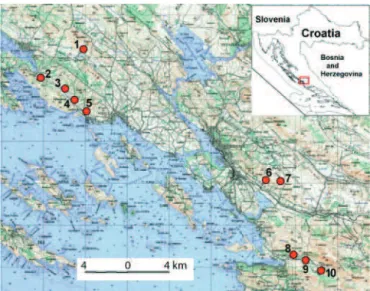
h e survey of the l ora of olive groves was conducted in the wider area of Tribunj, Dazlina, Donje polje and Grebaštica, in the coastal area of the Šibenik-Knin county, South Croatia (Figure 1). h e relief of this area is characterized by a plateau developed on Paleogenic and Cretaceous limestone, whose continuity is broken by limestone hills and dolomite-l ysh valleys (Mamužić et al., 1966). Soils suitable for agricultural production are scarce: the limestone plateau is represented by shallow and skeletal red soil (“terra rossa“), while deeper soils with a greater capacity for water are found in the valleys, where they were made by the de-teriorating of sot er rock, marl and dolomite (Friganović, 1976; Kranjec, 1958).
Regarding the phytogeographical position (Trinajstić, 1998), the researched area completely belongs to the Eumediterranean zone characterized by the zonal evergreen forest association Fraxino orni-Quercetum ilicis Horvatić (1956) 1958.
Material and methods
Field researches of the l oristic composition of olive groves have begun in the fall of 2007 and were completed in the summer of 2009. h e study was conducted on 23 olive groves situated on ten localities in the wider area of Šibenik (Figure 1, Table 1). h e investigated olive groves are privately owned, they have small surfaces (an average of 2000 m2), with no irrigation system and low use of fertilizers and pesticides. Most of the olive groves are either in direct contact or in close proximity to the surrounding natural vegetation, which facilitates the immigration of plants from their natural habitats. According to these characteristics these are olive groves with a predominantly traditional way of cultivation, with the main dif erence in the treatment of soil and ground vegetation: in 11 olive groves the ground layer vegetation between the trees is periodically mowed, while 12 olive groves are periodically tilled by a mini rotary tillers. Management types were designated based on visual inspection and information from the groves owners where available. Physiognomy of the devel-oped ground layer vegetation among the two designated types was so striking dif erent, that we are sure that a-priori classi-i catclassi-ion was correct even for groves where we couldn’t contact the owners. Eight groves were surveyed throughout complete vegetation season from March till October (marked with aster-isk in Table 1), while the rest were visited two or three times in March and June.
h e taxa were identii ed by the following keys and books: Horvatić and Trinajstić (1967), Tutin et al. (1968–1980, 1993); Trinajstić (1975–1986), Pignatti (1982), Domac (1994). Nomenclature follows Nikolić (2014). h e taxa are listed in an alphabetical order of families, genera and species. For each taxon a numeric mark that indicates whether it was found in tilled (1) and / or in a mowed olive grove (2) are given.
Raunkier’s life forms were assigned to taxa based on Pignatti (1982) and marked with the standard abbreviations in the l ora list before the name of the species: Ch (Chamaephyta), G (Geophyta), H (Hemicryptophyta), P (Phanerophyta) and T (h erophyta). If more than one life form was quoted for a single taxon, the most appropriate one was chosen considering i eld observations in the studied area.
h e classii cation of taxa according to chorological types was adjusted according to Horvatić (1963) and Horvatić et al. (1967/1968). For species that are not listed in these two sources, data from Pignatti (1982) and Fournier (1961) was used and ad-justed to basic groups. h e belonging of a species to a certain l oral element in the l ora list has been indicated by the respec-tive abbreviation: Mediterranean plants (MED), South-European plants (SEU), European plants (EU), Eurasian plants (EUAS), Circum-Holarctic plants (CIHO), Widespread plants (WSP) and Cultivated and Adventitious plants (CUAD).
Species considered to be endemic according to Nikoli (2013) are denoted with the abbreviation “end“ in the l ora list. h e endangered status of species was used as categorized
in Nikolić and Topić (2005) and Nikolić (2013) and marked by standard abbreviations, pointing out their degree of threat: CR-Critically Endangered, EN-Endangered, VU-Vulnerable, NT-Near h reatened. h e lower categories of endargement like LC-Low Figure 1. The area of Šibenik with the position of localities of surveyed olive groves: 1-Dazlina, 2-Ivinj, 3-Ivinj draga, 4-Sovje, 5-Tribunj, 6-Donje polje, 7-Bikarac, 8-Grebaštica, 9-Konoba, 10-Brnjača
Table 1. List of the researched olive groves with their size, management practice and name of locality (shown in Figure 1). Groves marked with asterisk (*) were surveyed throughout complete vegetation season. Coordinates corresponds to Bessel ellipsoid, Gauss-Krüger projection (Transverse Mercator), 5th
zone
No. Coordinates of the olive groves
Surface (m2)
Managed practice
Locality
1 x=5555568; y=4850145 2500 mowing Ivinj 2 x=5555620; y=4850354 5000 tilling Ivinj *3 x=5558103; y=4849112 2200 mowing Ivinj draga *4 x=5558581; y=4848831 1400 mowing Ivinj draga *5 x=5558039; y=4849082 1500 tilling Ivinj draga *6 x=5558682, y=4848701 1100 tilling Ivinj draga 7 x=5556600; y=4849628 2500 tilling Ivinj draga *8 x=5559094; y=4847462 1400 mowing Sovje
9 x=5558928; y=4848794 2000 mowing Sovje 10 x=5558984; y=4848763 3000 tilling Sovje 11 x=5560270; y=4846697 2500 mowing Tribunj *12 x=5560053; y=4846721 1000 tilling Tribunj *13 x=5561760; y=4852533 1400 mowing Dazlina *14 x=5561420; y=4652824 2000 tilling Dazlina
Concern and DD-Data Dei cient have not been analyzed in this paper. Taxa protected by the Nature Protection Act (Anonymus, 2013a) and listed in the Ordinance on Designating Wild Taxa Protected (Anonymous, 2013b) are denoted as “spr“-strictly pro-tected. Species considered to be invasive alien species according to Boršić et al. (2008) are denoted with the abbreviation “IAS“.
For comparison of plant assemblage between surveyed groves with presence/absence data, we have employed PCoA (Principal Coordinate Analyses) analyses based on square complement of Jaccard index of similarity as a distance measure using PrCoord and CANOCO 4.5 sot ware (ter Braak and Šmilauer, 2002; Lepš and Šmilauer, 2003) on complete sample, and cluster analyses with “complete linkage” as agglomerative method with City-block (Manhattan) distances, for building dendrogram in Statistica 8.0 sot ware (StatSot ) for eight groves (four mowed and four tilled) for which we had data collected throughout complete vegetation season.
Results
Flora analysis
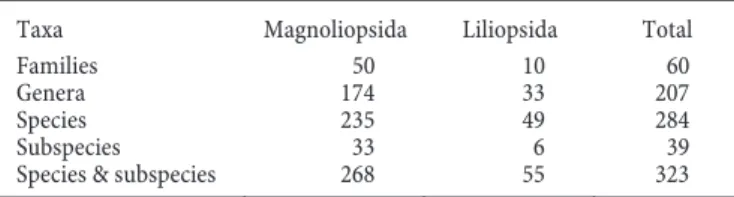
On the 23 studied olive groves 323 taxa of higher plants orig-inating in 207 genera and 60 families were observed (Table 2), with dominance of Magnoliopsida (83% of taxa) in comparison to Liliopsida (17% of taxa). On 11 mowed olive groves 280 taxa were found, while l ora on the 12 tilled olive groves consisted of 181 taxa (Appendix 1). Two management types shared 138 taxa (42.73% of all taxa), while l ora unique to mowed groves was much richer (142 taxa; 43.96%) than that found only in tilled groves (43 taxa; 13.31%).
h e most abundant families in the l ora of the olive groves (Table 3) were Fabaceae (12.38%), Poaceae (10.53%), Cichoriaceae (8.05%) and Asteraceae (6.81%), without signii cant dif erenc-es in percentagerenc-es when compared between management typerenc-es, while absolute number of observed taxa was much higher in mowed groves in all four most abundant families. h e families Chenopodiaceae and Amaranthaceae are almost exclusively represented in the l ora of the tilled olive groves, which is ex-pected because these families contain weed and ruderal species. On the other hand, Cichoriaceae and Lamiaceae are somewhat more frequent in the l ora of the mowed olive groves, while Caryophyllaceae, Euphorbiaceae and Geraniaceae are slightly more frequent in the l ora of the tilled olive groves (Table 3).
Life form spectra (Table 4), with the highest share of thero-phytes (54.18%) and hemicryptothero-phytes (25.70%), coni rmed their ai liation to the Mediterranean area. However, distinct dif er-ences can be observed between two management types, where in tilled groves there is higher share of therophytes (67.96% vs. 51.79% in mowed) and lower share of hemycryptophytes (19.89% vs. 26.79% in mowed).
Mediterranean l oral element as most frequent (46.13%), followed by South-European (20.43%) was expected (Table 5). Floral elements in the l ora of the mowed and tilled olive groves showed signii cant dif erences between mowed and tilled olive groves as a consequence of a stronger anthropogenic inl uence on the tilled olive groves. h erefore, in tilled olive groves there is a reduced share of Mediterranean plants (33.15% vs 50.36% in mowed), and an increased share of widespread plants (30.39% vs 15.36% in mowed) as well as cultivated and adventitious plants (4.42% vs 0.71% in mowed).
Five plant species having status of invasive ones were recorded (1.55% of all taxa), with just two of them being recorded also in the mowed groves (Table 6). Endemic taxa (7) were found only in the mowed olive groves: Aurinia sinuata, Carduus microp-terus ssp. micropterus, Centaurea spinosociliata ssp. cristata, Chaerophyllum coloratum, Ophrys x l avicans, Tanacetum cin-erariifolium and Trifolium dalmaticum.
Out of eight threatened taxa i.e. Delphinum peregrinum (EN); Ophrys bertolonii, O. sphegodes ssp. atrata and Trifolium
Taxa Magnoliopsida Liliopsida Total
Families 50 10 60
Genera 174 33 207
Species 235 49 284
Subspecies 33 6 39
Species & subspecies 268 55 323 Table 2. Taxonomical analysis of the olive groves l ora of the Šibenik area
Families Flora of all olive groves (N=23) Flora of tilled groves (N=12) Flora of mowed groves (N=11)
No. of taxa % No. of taxa % No. of taxa %
Fabaceae 40 12.38 21 11.60 36 12.86
Poaceae 34 10.53 22 12.15 32 11.43
Cichoriaceae 26 8.05 11 6.08 23 8.21
Asteraceae 22 6.81 13 7.18 20 7.14
Brassicaceae 17 5.26 11 6.08 15 5.36
Caryophyllaceae 17 5.26 13 7.18 15 5.36
Lamiaceae 17 5.26 5 2.76 16 5.71
Scrophulariaceae 12 3.72 7 3.87 10 3.57
Apiaceae 11 3.41 6 3.31 10 3.57
Geraniaceae 10 3.10 7 3.87 7 2.50
Rosaceae 10 3.10 5 2.76 9 3.21
Euphorbiaceae 8 2.48 6 3.31 4 1.43
Chenopodiaceae 6 1.86 6 3.31 1 0.36
Other families 93 28.79 48 26.52 82 29.29
Total 323 100.00 181 100.00 280 100.00
resupinatum (VU); Aegilops neglecta, Centaurea spinosociliata ssp. cristata, Chaerophyllumcoloratum and Scandix pecten-ven-eris (NT) found in mowed groves, only two (T. resupinatum, S. pecten-veneris) were found also in tilled groves. Out of twelve strictly protected taxa, just one (Trifolium resupinatum) were found both in mowed and tilled groves, while reminaing eleven were found exclusively in mowed olive groves.
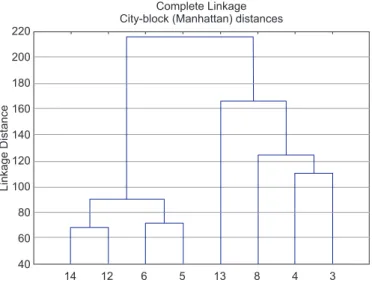
Results of the PCoA analyses (Figure 2) has shown that olive groves with dif erent management practices are dif erentiated from each other. Four mowed and four tilled groves that are positioned to the upper part of the biplot are those which were sampled throughout whole vegetation season (March – October). h ose remained grouped within same management practice at er cluster analyses (Figure 3) showing signii cant dif erences in species assemblages.
Figure 2. PCoA biplot of all sampled olive groves (with square complement of Jaccard index of similarity as a distance measure) on first two ordinal axes (1st axis explaining 9.6% and 2nd axis further 8.2% of variation). Squares – mowed olive groves; circles – tilled olive groves (numerical labels of groves corresponds to those in Table 1).
Life form Flora of all olive groves Mowed groves (N=11) Tilled groves (N=12)
No. of taxa % No. of taxa % No. of taxa %
Chamaephyta 19 5.88 18 6.43 4 2.21
Geophyta 26 8.05 24 8.57 10 5.52
Hemicryptophyta 83 25.70 75 26.79 36 19.89
Phanerophyta 20 6.19 18 6.43 8 4.42
Therophyta 175 54.18 145 51.79 123 67.96
Total 323 100.00 280 100.00 181 100.00
Floral elements Flora of all olive groves (N=23) Mowed groves (N=11) Tilled groves (N=12)
No. of taxa % No. of taxa % No. of taxa %
Cult. & Adventitious 9 2.79 2 0.71 8 4.42
Circum-Holarctic 1 0.31 1 0.36 0 0.00
European 7 2.17 7 2.50 3 1.66
Eurasian 29 8.98 26 9.29 20 11.05
Mediterranean 149 46.13 141 50.36 60 33.15
South-European 66 20.43 60 21.43 35 19.34
Widespread 62 19.20 43 15.36 55 30.39
Total 323 100.00 280 100.00 181 100.00
Category Flora of all olive groves Flora of mowed groves Flora of tilled groves No. of taxa % of total flora (323) No. of taxa % of total flora (280) No. of taxa % of total flora (181)
Endemic 7 2.17 7 2.50 0 0.00
Threatened 8 2.48 8 2.86 2 1.10
Strictly protected 12 3.72 12 4.29 1 0.55
Invasive Alien Sp 5 1.55 2 0.71 5 2.76
Table 4. h e life forms spectra of the l ora of the surveyed olive groves
Table 5. h e share of l oral elements in the l ora of the surveyed olive groves
Figure 3. Dendrogram of cluster analyses of presence/ absence data on vascular plant species in eight olive groves (numerical labels of groves corresponds to those in Table 1). Left cluster consisted of tilled, and right one of mowed groves.
Discussion and conclusion
Flora of the studied olive groves is very rich (323 of taxa) and represents a share of as much as 30% of the total l ora of the wider Šibenik area (1075 of taxa; Milović, 2002). High rich-ness of the vascular l ora in olive groves have been recorded in other parts of the Mediterranean (Huqu et al., 2009; Maccherini et al., 2013; Perrini et al., 2014), coni rming importance of olive groves as habitats important for plant diversity conservation (and hence the overall diversity).
As expected, by the number of taxa, the mowed olive groves (280) were considerably richer than the tilled olive groves (181). Periodic mowing of the ground layer in olive groves, prevents their overgrowth, and favors the development of dif erent types of dry Mediterranean grasslands that are rich in species (Hećimović, 1984; Pandža, 2003). On the other hand, in the tilled olive groves the ground layer vegetation is periodically completely removed, which reduces the total number of taxa. Nevertheless, this re-search shows that even in tilled olive groves, without the use of herbicides or with their limited use, a rich weed l ora can devel-op. In contrast, Uremis (2005) lists only 92 taxa for olive groves with an intensive form of treatment and the systemic use of pes-ticides, in the area of the Province of Hatay in Turkey.
h e most abundant families in the l ora of the olive groves (Table 3) are almost identical to the percentages of these families in the total l ora of the Šibenik area (Milović, 2002). h ese fami-lies are also most prevalent in the l ora of ancient olive groves of Apulia in Southern Italy (Perrino et al., 2014), weed l ora of the olive groves in the province of Hatay in Turkey (Uremis, 2005) and weed l ora of olive groves in Albania (Huqi et al., 2009) as well as in the agrestal and ruderal l ora of the southern Spain (Pujadas Salva and Hernandez Bermejo, 1988). h ese families are rich in thermophilous species whose dispersal is signii cantly
facilitated by the humans. As it is, their presence indicates the Mediterranean character of the climate, as well as the strong and long-lasting anthropogenic impact. In general, there are no sig-nii cant dif erences in the prevalence of certain families in the l ora of the tilled olive groves in comparison with the mowed olive groves l ora (Table 3).
As expected, therophytes are the dominant life form in the l ora of the olive groves (54.18%; Table 4), which is a general characteristic of the l ora in areas with a Mediterranean climate (Horvat, 1949). On the other hand, therophytes are a reliable in-dicator of anthropogenic impact. h erefore, researchers of the urban l ora note a correlation between an increased share of thero-phytes in the l ora of habitats and parts of the city with higher anthropogenic impacts (Chronopoulos and Christodoulakis, 2003; Hruska, 1993/1994). For weed l ora in the olive groves with an intensive form of treatment Uremis (2005) states that the share of therophytes is over 70%. h erophytes, as reliable in-dicators of anthropogenic inl uence, are also coni rmed by this study, according to which their share in l ora of tilled olive groves (stronger anthropogenic inl uence) is signii cantly higher than in mowed olive groves (67.96% vs 51.79%). On the other hand, in the l ora of the tilled olive groves, compared to mowed, there is a reduced share of all other life forms, particularly hemicryp-tophytes (19.89% vs 26.79%).
As expected, in the l ora of all surveyed olive groves, the most frequent l oral elements were Mediterranean (46.3%) followed by South-European (20.43%) and widespread plants (19.2%, Table 3). h ese three l oral elements are also the most frequent in the total l ora of the wider Šibenik area (Milović, 2002). h e domi-nant presence of plants of Mediterranean l oral element is re-corded in the l ora of olive groves in Albania (Huqi et al., 2009) and Italy (Perrino et al., 2014) as well. h ere is a surprisingly low proportion of cultivated and adventitious plants, whose share, even in the l ora of the tilled olive groves, is about half (4.42%) the share in the l ora of the wider Šibenik area (8.09%; Milović, 2002). It can be assumed that this group of plants, in the Šibenik area, is more related to agricultural i elds with other cultures and/or ruderal habitats.
Only i ve plant species (1.55% of total number of taxa) with invasive status according to Boršić et al. (2008) were recorded. As expected, invasive alien species are more prevalent in tilled than in mowed olive groves (2.76% vs 0.71%). Tilled groves have higher level of disturbance that facilitate the presence of inva-sive species (Walter et al., 2005; Vilá et al., 2007; Nikolić et al., 2013), while in the mowed groves there is a signii cantly greater competition from native grassland species. Conyza sumatren-sis and Diplotaxis erucoides are frequent on tilled olive groves, but they are quite rare on mowed olive groves. Both species are common throughout the Šibenik area, in arable land (vine-yards) and in ruderal habitats by the settlements and along the roads. Invasive species Amaranthus albus and A. retrol exus were found only in the tilled olive groves where they come within the weed community Tribulo-Amaranthetum. Neophyte Bidens subalternans is rare in the l ora of the researched olive groves (found in two of the twelve plowed olive groves), but is observed as very widespread in ruderal habitats throughout the Šibenik area. h is research indicates that the l ora of small olive groves with a traditional form of treatment shows a certain degree of 220
200
180
160
140
120
100
80
60
40
Linkage D
istance
14 12 6 5 13 8 4 3
resistance to the penetration of new invasive species. Although the number of invasive alien species in the olive groves of the Šibenik area is not worrisome, the possible immigration of new species should be monitored in order to promptly take steps to suppress their spread. All above observed and discussed dif-ferences in olive groves were supported with the multivariate analyses (Figure 2 and 3).
Because of the abandonment of traditional farming and the lack of mowing and grazing, once large areas under dry Mediterranean grasslands gradually disappear and are overrun by thickets and forests (Ljubičić et al., 2008; Maccherini et al., 2013), so these types of habitats, with many grassland species, are among the most vulnerable in the Croatian area. It is there-fore an even greater importance of small family olive groves which are maintained by mowing or grazing as refuges for the preservation of endangered habitat types and species. In recent years, because of the increased use of herbicides in arable land, as well as in tilled olive groves, some weed species are becoming increasingly rare (e.g. Scandix pecten-veneris, Calendula arven-sis, Chenopodium album, C. strictum, Papaver rhoeas, Trigonela esculenta, Urtica urens).
Complete lack of endemic plants, and just two endangered plant found in tilled groves, compared to seven endemic and eight endangered plants in mowed ones, further coni rmed that mowing is much better management practice from the stand-point of nature conservation. Tillage completely removes nurs-ing ef ect that olive groves can provide for the dry grasslands listed in the Annex I of the Habitat Directive, which are other-wise, in open spaces without grazing exposed to disappearing through the process of secondary succession.
In the Šibenik area and throughout the Croatian coast a tra-ditional way of growing olives, which yield less crops than those in intensively managed groves, but contributes to the mainte-nance of biological and landscape diversity and has the least ad-verse ef ect on the environment (including less erosion), should be encouraged.
Refere nces
Allen H. D., Randall E., Amable G. S., Devereux J. (2006). h e impact of changing olive cultivation practices on the ground l ora of olive groves in the Messara and Psiloritis Regions, Crete, Greece. Land Degrad Develop 17: 249-273
Anonymus (2013a). Zakon o zaštiti prirode. NN 80/2013 Anonymus (2013b). Pravilnik o strogo zaštićenim vrstama. NN
144/2013, Prilog I
Bertović S. (1975). Prilog poznavanju odnosa klime i vegetacije u Hrvatskoj. Prir Istraž 41, JAZU, Zagreb
Birač V. (1973). Vegetacija Srđa i okolice Dubrovačke rijeke. Acta Bot Croat 32: 135-170
Boršić I., Milović M., Dujmović I., Bogdanović S., Cigić P., Rešetnik I., Nikolić T., Mitić B. (2008). Preliminary check-list of invasive alien plant species (IAS) in Croatia. Nat Croat 17(2): 55–71 Cardenas M., Ruano F., Garcia P., Pascual F., Campos M. (2006).
Impact of agricultural management on spider populations in the canopy of olive trees. Biol Control 38: 188-195
Chronopoulos G., Christodoulakis D. (2003). h e l ora of the city of Patras (W Greece): An analysis relative to the city’s spatial structure and habitat types. Bot Chron 16: 115-124
Council of Europe (1992). Council Directive 92/43/EEC of 21 May 1992 on the conservation of natural habitats and of wild fauna and l ora. Available at: http://eur-lex.europa.eu/LexUriServ/ LexUriServ.do?uri=CONSLEG:1992L0043:20070101:EN:PDF, Accessed online March 26th, 2014.
Domac R. (1955). Flora otoka Visa. Acta Pharm Jug 5: 3-42 Domac R. (1994). Flora Hrvatske. Školska knjiga, Zagreb Davy C. M., Russo D., Fenton M. B. (2007). Use of native
wood-lands and traditional olive groves by foraging bats on a
Mediterranean island: consequences for conservation. Journal of Zoology 273: 397-405
Duarte F., Jones N., Fleskens L. (2008). Traditional olive orchards on sloping land: Sustainability or abandonment? Journal of Environmental Management 89: 86-98.
Fournier P. (1961). Les quatre l ores da la France. Editions Paul Leghevalier, Paris
Friganović M. (1976). Geografske osnove položaja i razvoja Šibenika. Šibenik – spomen zbornik o 900. obljetnici. Muzej grada Šibenika, Posebna izdanja 1: 13-25
Hećimović M. (1981). Prikaz i analiza l ore otoka Šipana. Acta Bot Croat 40: 205-227
Hećimović M. (1984). Grassland vegetation of the island of Šipan. Acta Bot Croat 43: 161-166
Hećimović M., Hećimović S. (1986). Prikaz i analiza l ore otoka Lopuda. Acta Bot Croat 45: 119-135
Hećimović M., Hećimović S. (1987). Flora otoka Koločepa. Acta Bot Croat 46: 189-205
Horvat I. (1949). Nauka o biljnim zajednicama. Nakladni zavod Hrvatske, Zagreb
Horvatić S. (1963). Vegetacijska karta otoka Paga s općim pregle-dom vegetacijskih jedinica Hrvatskog primorja. JAZU, Odjel za prirodne nauke, Zagreb.
Horvatić S., Trinajstić I., eds. (1967-1981). Analitička l ora Jugoslavije 1. Šumarski fakultet - Sveučilišna naklada Liber, Zagreb
Horvatić S., Ilijanić I., Marković-Gospodarić LJ. (1967/1968). Biljni pokrov okoline Senja. Senjski zbornik, 298-321
Hruska K. (1993/94). Ecosistema urbano italiano: approccio compa-rative allo studio della componente vegetale. Allionia 32:105-112 Huqi B., Dhima K., Vasilakoglou I., Keco R., Salaku F. (2009).
Weed l ora and weed management in established olive groves in Albania. Weed Biol Manag 9: 276–285
Jelaska S. D., Nikolić T., Šerić Jelaska L., Kušan V., Peternel H., Gužvica G., Major Z. (2010). Terrestrial biodiversity analyses in Dalmatia (Croatia): A complementary approach using diversity and rarity. Environ Manage 45(3): 616-625
Kranjec V. (1958). Prilog geologiji područja Šibenik-Vinišće. Geološki vjesnik 12: 37-48
Lepš J., Šmilauer P. (2003). Multivariate Analysis Of Ecological Data Using Canoco. Cambridge University Press, Cambridge
Ljubičić I., Britvec M., Kutnjak H., Salopek Z., Jelaska S. D. (2008). Mapping vegetation succession of pastures on rocky soils using GIS; a case-study on the island of Pag. Cereal Res Comm 36, Suppl. 5, Part 1: 359-362
Maccherini S., Santi E., Bonini I., Amici V., Pruscini S., Palazzo D., Selva F. C. (2013). h e impact of land abandonment on the plant diversity of olive groves. Biodivers Conserv 22 (13-14): 3067-3083
Mamužić P., Borović I., Korolija B. (1966). SFRJ – osnovna geološka karta 1:100000, tumač za list Šibenik. Institut za geološka istraživanja, Zagreb
Milović M. (2002). h e l ora of Šibenik and its surroundings. Nat Croat 11(2): 171-223
Milović M., Pandža M. (2010). Vaskularna l ora otoka Ista i Škarde s pripadajućim otočićima i hridima (Vascular l ora of the Island of Ist and the Island of Škarda with adjacent islets and rocks). In: Otoci Ist i Škarda (J Faričić, ed), Sveučilište u Zadru, Zadar, 149-186
Nikolić T., ed. (2014). Flora Croatica baza podataka / Flora Croatica Database. On-Line URL: http://hirc.botanic.hr/fcd. Botanički zavod s Botaničkim vrtom, Prirodoslovno-matematički fakultet, Sveučilište u Zagrebu, Accessed online March 26th, 2014 Nikolić T., Topić J., ur. (2005). Crvena knjiga vaskularne l ore
Hrvatske. Ministarstvo kulture. Državni zavod za zaštitu pri-rode, Republika Hrvatska
Nikolić T., Antonić O., Alegro A. L., Dobrović I., Bogdanović S., Liber Z., Rešetnik I. (2008). Plant species diversity of Adriatic islands: an introductory survey. Plant Biosystems 142 (3): 435-445
Nikolić T., Mitić B., Milašinović B., Jelaska S.D. (2013) Invasive alien plants in Croatia as a threat to biodiversity of South-Eastern Europe: distributional patterns and range size. CR Biol 336(2):109-121
Orlandi F., Garcia-Mozo H., Vazquez Ezquerra L., Romano B., Dominguez E., Galan C., Fornaciari M. (2004). Phenological olive chilling requirements in Umbria (Italy) and Andalusia (Spain). Plant Biosyst 138(2): 111-116
Pandža M. (1998). Flora of the island of Zlarin. Nat Croat 7(1): 59-78
Pandža M. (2003). Vegetacija otoka Murtera. Dissertacija. Botanički zavod, Prirodoslovno-matematički fakultet, Sveučilište u Zagrebu, Zagreb
Pandža M., Milović M. (2008): Flora otoka Rave te okolnih otočića i hridi / Flora of the island of Rava and surrounding islets and rocks. In: Otok Rava (J Faričić, ed.), Sveučilište u Zadru, Zadar, 225-264
Perrino E. V., Ladisa G., Calabrese G. (2014): Flora and plant genetic resources of ancient olive groves of Apulia (Southern Italy). Genet Resour Crop Evol 61(1): 23-53
Pignatti S., ed. (1982). Flora D’Italia 1-3. Edagricole, Bologna Pujadas Salva A., Hernandez Bermejo J.E. (1988): Floristic
compo-sition and agricultural importance of weeds in southern Spain. Weed Res 28(3): 175-180
Regula-Bevilacqua Lj., Jurković-Bevilacqua B. (1980). Prilog l ori otoka Mljeta. Acta Bot Croat 39: 175-184
Siebert S.F. (2005). Traditional agriculture and the conservation of biological diversity in Crete, Greece. Int J Agr Sustain 2(2): 109-117
Stroosnijder L., Mansinho M. I., Palese A. M. (2008). OLIVERO: the project analysing the future of olive production systems on sloping land in the Mediterranean basin. J Environ Manage 89(2): 75-85
Šimunović V. (2005): Stanje maslinarstva i uljarstva u Republici Hrvatskoj. Pomologia Croatica 11(1-2): 69-78
Ter Braak C. J. F., Šmilauer P. (2002). CANOCO Reference Manual and CanoDraw for Windows User’s Guide: Sot ware for Canonical Community Ordination (Version 4.5). Microcomputer Power, Ithaca, New York
Tomić F., Vranješ M. (2006). Plan navodnjavanja za područje Šibensko-kninske županije. Zavod za melioracije Agronomskog fakulteta Sveučilišta u Zagrebu i Gradevinsko-arhitektonski fakultet Sveučilišta u Splitu, Zagreb i Split
Trinajstić I. (ed.) (1975-1986). Analitička l ora Jugoslavije 2. Šumarski fakultet Sveučilišta u Zagrebu - Sveučilišna naklada Liber, Zagreb
Trinajstić I. (1998). Fitogeografsko raščlanjenje klimazonalne šumske vegetacije Hrvatske. Šumarski list 122(9–10): 407–421 Tutin T. G., Burges N. A., Chater A. O., Edmondson J. R., Heywood
V. H., Moore D. M., Valentine D. H., Walters S. M., Webb D. A., eds. (1993). Flora Europaea 1 (2nd edn.). University Press, Cambridge
Tutin T. G., Heywood V. H., Burges N. A., Moore D. M., Valentine D. H., Walters S. M., Webb D. A., eds. (1968-1980). Flora Europaea 2-5. University Press, Cambridge
Uremis I. (2005). Determination of Weed Species and h eir Frequency and Density in Olive Groves in Hatay Province of Turkey. Pakistan J Biol Sci 8(1): 164-167
Vilà M., Joan P., Xavier F. (2007) Regional assesment of plant inva-sions across dif erent habitat types. J Veg Sci 18(1):35-42 Walter J., Essl F., Englisch T., Kiehn M. (2005) Neophytes in
Austria: Habitat preferences and ecological ef ects. In: Nentwig W., Bacher S., Cock M., Dietz H.J., Gigon A., Wittenberg R. (eds) Biological Invasions – From Ecology to Control. Neobiota 6, Berlin, pp 13-25
Appendix 1. Floristic list of the surveyed olive groves.
(management practice: 1-tilling, 2-mowing; life form: Ch (Chamaephyta), G (Geophyta), H (Hemicryptophyta), P (Phanerophyta) and T (h erophyta); chorological types (l oral element): Mediterranean plants (MED), South-European plants (SEU), European plants (EU), Eurasian plants (EUAS), Circum-Holarctic plants (CIHO), Widespread plants (WSP) and Cultivated and Adventitious plants (CUAD); endemic – “end“; endan-gered status: CR (Critically Endanendan-gered), EN (Endanendan-gered), VU (Vulnerable), NT (Near h reatened); “spr“- strictly protected; invasive alien species – “IAS“).
Magnoliophytina
Magnoliopsida Amaranthaceae
T Amaranthus albus L.; 1; CUAD; IAS
T Amaranthus graecizans L.; 1; WSP T Amaranthus retrol exus L.; 1; CUAD; IAS
Anacardiaceae
P Pistacia lentiscus L.; 2; MED P Pistacia terebinthus L.; 2; MED Apiaceae
H Chaerophyllum coloratum L.; 2; MED; end; NT; spr
H Daucus carota L. ssp. carota; 1, 2; SEU H Eryngium amethystinum L.; 1, 2; MED H Eryngium campestre L.; 1; MED H Foeniculum vulgare Mill.; 1, 2; MED T Orlaya grandil ora (L.) Hof m.; 2; SEU T Scandix pecten-veneris L.; 1, 2; WSP; NT
T Tordylium apulum L.; 1, 2; MED T Tordylium maximum L.; 2; EUAS T Tordylium oi cinale L.; 2; MED T Torilis nodosa (L.) Gaertn.; 2; MED Araliaceae
P Hedera helix L.; 2; EU Aristolochiaceae
Asteraceae
H Achillea millefolium L.; 1; WSP T Anthemis arvensis L.; 1, 2; WSP T Anthemis segetalis Ten.; 1, 2; MED H Aster linosyris (L.) Bernh.; 2; SEU T Bidens subalternans DC.; 1; CUAD; IAS
T Calendula arvensis L.; 1, 2; SEU
H Carduus micropterus (Borbás) Teyber ssp. micropterus; 2; MED; end; spr
H Carduus pycnocephalus L.; 1, 2; MED H Carlina corymbosa L. ssp. corymbosa; 2; MED
H Centaurea spinosociliata Seenusssp. cristata (Bertol.) Dostál;
2;MED; end; NT; spr
T Conyza sumatrensis (Retz.) E.Walker; 1, 2; CUAD; IAS
T Crupina crupinastrum (Moris) Vis.; 1, 2; SEU H Dittrichia viscosa (L.) Greuter; 1, 2; MED T Filago pyramidata L.; 1, 2; SEU
Ch Helichrysum italicum (Roth) G. Don ssp. italicum; 2; MED H Inula conyza DC.; 2; SEU
T Pallenis spinosa (L.) Cass.; 1, 2; MED H Picnomon acarna (L.) Cass.; 2; MED T Senecio vulgaris L.; 1, 2; WSP
Ch Tanacetum cinerariifolium (Trevir.) Sch.Bip.; 2; MED; end; spr T Tyrimnus leucographus (L.) Cass.; 2; MED
Boraginaceae
T Anchusa cretica Mill.; 2; MED T Echium plantagineum L.; 1, 2; MED T Heliotropium europaeum L.; 1; MED T Lithospermum arvense L.; 1, 2; EUAS T Myosotis ramosissima Rochel; 2; EUAS Brassicaceae
Ch Aethionema saxatile (L.) R. Br.; 2; SEU T Alyssum alyssoides (L.) L.; 1, 2; SEU T Alyssum campestre (L.) L.; 1, 2; MED H Arabis hirsuta (L.) Scop.; 2; WSP
H Aurinia sinuata (L.) Griseb.; 2; MED; end; spr Ch Brassica oleracea L.; 1; CUAD
T Capsella rubella Reut.; 1, 2; MED T Cardamine hirsuta L.; 1, 2; WSP T Clypeola jonthlaspi L.; 2; MED
T Diplotaxis erucoides (L.) DC.; 1, 2; MED; IAS
T Diplotaxis muralis (L.) DC.; 1, 2; WSP H Diplotaxis tenuifolia (L.) DC.; 1, 2; WSP
T Erophila verna (L.) Chevall. ssp. praecox (Steven) Walters; 1, 2; WSP
T Hornungia petraea (L.) Rchb.; 2; WSP H Lepidium graminifolium L.; 2; SEU T Raphanus sativus L.; 1; CUAD T h laspi perfoliatum L.; 1, 2; EUAS Campanulaceae
H Campanula rapunculus L.; 2; EUAS T Legousia hybrida (L.) Delarbre; 1, 2; SEU Caprifoliaceae
P Lonicera etrusca Santi; 2; MED Caryophyllaceae
T Arenaria serpyllifolia L. ssp. leptoclados (Reichenb.) Guss.; 1, 2; EUAS
T Arenaria serpyllifolia L. ssp. serpyllifolia; 1, 2; WSP
T Cerastium brachypetalum Pers. ssp. roeseri (Bois. et Heldr.) Nyman; 1; SEU
T Cerastium glomeratum h uill.; 1; WSP
T Cerastium pumilum Curtis ssp. glutinosum (Fries) Jalas; 1, 2; WSP
T Cerastium semidecandrum L.; 1, 2; SEU H Herniaria incana Lam.; 2; SEU
T Holosteum umbellatum L. ssp. umbellatum; 1, 2; EUAS T Minuartia hybrida (Vill.) Schischkin in Komarov; 1, 2; EUAS T Minuartia mediterranea (Link.) K. Maly; 1, 2; MED
T Petrorhagia prolifera (L.) P. W. Ball et Heywood; 1, 2; EUAS H Petrorhagia saxifraga (L.) Link; 2; SEU
H Silene latifolia Poir.; 2; MED
H Silene vulgaris (Moench) Garcke ssp. angustifolia Hayek; 1, 2; MED
T Stellaria media (L.) Vill.; 1, 2; WSP T Stellaria pallida (Dumort) Piré; 1, 2; EUAS T Velezia rigida L.; 2; MED
Chenopodiaceae
T Atriplex patula L.; 1; WSP
H Beta vulgaris L. ssp. vulgaris; 1;MED T Chenopodium album L.; 1, 2; WSP T Chenopodium strictum Roth; 1; WSP T Chenopodium vulvaria L.; 1; SEU T Polycnemum majus A. Braun; 1; SEU Cichoriaceae
H Chondrilla juncea L.; 1, 2; EUAS T Crepis foetida L. ssp. foetida; 1, 2; SEU T Crepis neglecta L.; 1, 2; MED
T Crepis sancta (L.) Babc.; 1, 2; MED
T Crepis vesicaria L. ssp. taraxacifolia (h uill.) h ell.; 2; SEU T Crepis vesicaria L. ssp. vesicaria; 2; SEU
T Crepis zacintha (L.) Babc.; 2; MED
T Hedypnois cretica (L.) Dum.Cours.; 2; MED
H Hieracium praealtum Vill. ex Gochnat ssp. bauhinii (Besser) Petunn.; 2; EUAS
H Hypochoeris cretensis (L.) Bory et Chaub.; 2; MED H Hypochoeris radicata L.; 2; SEU
H Lactuca serriola L.; 1; WSP
H Lactuca viminea (L.) J. et C.Presl; 2; SEU H Leontodon crispus L.; 2; SEU
H Leontodon tuberosus L.; 2; MED H Picris hieracioides L.; 1, 2; EUAS H Reichardia picroides (L.) Roth; 1, 2; MED T Rhagadiolus stellatus (L.) Gaertn.; 1; MED H Scolymus hispanicus L.; 1, 2; MED H Scorzonera laciniata L.; 2; WSP
T Sonchus asper (L.) Hill ssp. glaucescens (Jord.) Ball; 1; MED T Sonchus oleraceus L.; 1; WSP
T Sonchus tenerrimus L.; 1, 2; MED
T Taraxacum laevigatum auct. croat.; 2; SEU H Tragopogon porrifolius L.; 2; MED
H Urospermum dalechampii (L.) Scop. ex F.W.Schmidt; 2; MED T Urospermum picroides (L.) Scop. ex F.W.Schmidt; 2; MED Cistaceae
Ch Fumana ericifolia Wallr.; 2; MED Clusiaceae
Convulvulaceae
H Convolvulus althaeoides L. ssp. tenuissimus (Sibth. et Sm.) Stace; 1, 2; MED
G Convolvulus arvensis L.; 1, 2; WSP H Convolvulus cantabrica L.; 2; SEU Crassulaceae
Ch Sedum ochroleucum Chaix; 2; SEU Ch Sedum sexangulare L.; 2; SEU Dipsacaceae
H Cephalaria leucantha (L.) Roem. et Schult.; 2; MED T Lomelosia brachiata (Sm.) Greuter et Burdet; 2; MED Euphorbiaceae
T Chrozophora tinctoria (L.) A. Juss.; 1; MED T Euphorbia chamaesyce L.; 1; SEU
T Euphorbia falcata L.; 1, 2; SEU Ch Euphorbia fragifera Jan; 2; MED T Euphorbia helioscopia L.; 1, 2; WSP T Euphorbia peplus L.; 1; WSP Ch Euphorbia spinosa L.; 2; MED T Mercurialis annua L.; 1; WSP Fabaceae
H Anthyllis vulneraria L. ssp. praepropera (A. Kerner) Bornm.; 2; MED
Ch Argyrolobium zanonii (Turra) P. W. Ball; 2; MED H Bituminaria bituminosa (L.) Stirton; 1, 2; MED
P Coronilla emerus L. ssp. emeroides Boiss. et Spruner; 2; MED T Coronilla scorpioides (L.) Koch; 1, 2; MED
H Coronilla varia L.; 1, 2; EU
Ch Dorycnium hirsutum (L.) Ser.; 2; MED T Hippocrepis bil ora Spreng.; 2; MED T Hippocrepis ciliata Willd.; 1; MED T Lathyrus cicera L.; 1, 2; MED H Lathyrus latifolius L.; 1, 2; SEU
T Lens nigricans (M. Bieb.) Godr.; 2; MED T Medicago coronata (L.) Bartal.; 1, 2; MED T Medicago littoralis Rohde ex Loisel.; 2; MED T Medicago lupulina L.; 2; WSP
T Medicago minima (L.) Bartal.; 1, 2; WSP T Medicago orbicularis (L.) Bartal.; 1, 2; MED T Medicago rigidula (L.) All.; 2; MED H Medicago sativa L.; 1, 2; WSP
T Onobrychis caput-galli (L.) Lam.; 2; MED H Ononis pusilla L.; 1; SEU
T Ononis reclinata L.; 2; MED T Scorpiurus muricatus L.; 1; MED
T Securigera securidaca (L.) Degen et Dörl .; 1, 2; MED P Spartium junceum L.; 2; MED
T Trifolium angustifolium L.; 2; MED T Trifolium campestre Schreber; 1, 2; WSP T Trifolium dalmaticum Vis.; 2; MED; end; spr T Trifolium resupinatum L.; 1, 2; MED; VU; spr
T Trifolium scabrum L.; 2; MED T Trifolium stellatum L.; 2; MED T Trifolium tomentosum L.; 2; MED T Trigonella esculenta Willd.; 1, 2; MED T Trigonella monspeliaca L.; 1, 2; MED T Vicia angustifolia L. ssp. angustifolia; 1, 2; EU T Vicia faba L.; 1; CUAD
T Vicia hybrida L.; 1, 2; MED
T Vicia narbonensis L.; 1, 2; MED T Vicia peregrina L.; 2; SEU
T Vicia villosa Roth ssp. varia (Host) Corb.; 2; MED Fumariaceae
T Fumaria oi cinalis L.; 1, 2; WSP T Fumaria parvil ora Lam.; 1; WSP Geraniaceae
T Erodium ciconium (L.) Ľ Hér.; 1, 2; MED T Erodium cicutarium (L.) Ľ Hér.; 1, 2; WSP T Erodium malacoides (L.) Ľ Hér.; 1; MED T Geranium columbinum L.; 2; EUAS T Geranium dissectum L.; 2; WSP
T Geranium molle L. ssp. brutium (Gasparr.) Graebn.; 1, 2; MED T Geranium molle L. ssp. molle; 1; WSP
T Geranium purpureum Vill.; 2; SEU T Geranium rotundifolium L.; 2; EUAS
G Geranium tuberosum L. ssp. tuberosum; 1; EUAS Lamiaceae
T Acinos arvensis (Lam.) Dandy; 2; EU T Ajuga chamaepitys (L.) Schreb.; 1, 2; MED H Calamintha nepetoides Jord.; 2; SEU H Clinopodium vulgare L.; 2; WSP T Lamium amplexicaule L.; 1, 2; EUAS H Marrubium incanum Desr.; 2; MED H Mentha longifolia (L.) Huds.; 1; WSP
Ch Micromeria juliana (L.) Benth. ex Rchb.; 2; MED H Origanum heracleoticum L.; 2; MED H Origanum vulgare L.; 2; EUAS
H Salvia bertolonii Vis.; 2; MED H Salvia verbenaca L.; 2;
Ch Satureja montana L. ssp. variegata (Host) P. W. Ball; 1, 2; MED H Stachys thirkei K.Koch; 2; MED
Ch Teucrium chamaedrys L.; 2; SEU
Ch Teucrium polium L. ssp. capitatum (L.) Arcang.; 2; MED H h ymus longicaulis C.Presl; 2
Linaceae
H Linum bienne Mill.; 2; MED Ch Linum tenuifolium L.; 2; SEU Malvaceae
T Althaea hirsuta L.; 1, 2; SEU H Malva sylvestris L.; 1; WSP Oleaceae
P Phillyrea latifolia L.; 2; MED Papaveraceae
T Papaver rhoeas L.; 1, 2; WSP
T Papaver strigosum (Boenn.) Schur; 1, 2; MED Plantaginaceae
H Plantago lanceolata L.; 1, 2; WSP Plumbaginaceae
Ch Plumbago europaea L.; 1, 2; MED Polygalaceae
H Polygala nicaeensis Risso ex Koch ssp. mediterranea Chodat; 2; MED
Polygonaceae
T Fallopia convolvulus (L.) Á.Löve; 1; WSP T Polygonum aviculare L.; 1, 2; WSP H Rumex pulcher L. ssp. pulcher; 1, 2; SEU Portulacaceae
Primulaceae
T Anagallis arvensis L.; 1, 2; WSP T Anagallis coerulea Schreb.; 1, 2; WSP
T Asterolinon linum-stellatum (L.) Duby; 2; MED G Cyclamen hederifolium Aiton; 2; SEU
Ranunculaceae
G Anemone hortensis L.; 2; MED P Clematis l ammula L.;1, 2; MED
T Delphinium peregrinum L.; 2; SEU; EN; spr
T Nigella damascena L.; 2; MED
G Ranunculus i caria L. ssp. calthifolius (Rchb.) Arcang.; 2; EU Resedaceae
H Reseda lutea L.; 1, 2; WSP H Reseda phyteuma L.; 1, 2; SEU Rhamnaceae
P Paliurus spina-christi Mill.; 1, 2; MED Rosaceae
H Agrimonia eupatoria L.; 2; CIHO H Potentilla australis Krašan; 2; MED G Potentilla recta L.; 1, 2; EUAS P Prunus cerasifera Ehrh.; 1; CUAD
P Prunus dulcis (Mill.) D. A. Webb; 2; CUAD P Prunus mahaleb L.; 2; SEU
P Rosa canina L.; 1, 2; WSP P Rubus caesius L.; 2; EUAS
P Rubus heteromorphus Ripart ex Genev.; 1, 2; MED H Sanguisorba minor Scop. ssp. muricata Briq.; 1, 2; SEU Rubiaceae
T Galium aparine L.; 1, 2; WSP P Rubia peregrina L.; 2; MED T Sherardia arvensis L.; 1, 2; WSP T Valantia muralis L.; 2; MED Santalaceae
P Osyris alba L.; 1, 2; MED Saxifragaceae
T Saxifraga tridactylites L.; 1, 2; MED Scrophulariaceae
T Euphrasia rostkoviana Hayne; 2; EU T Kickxia spuria (L.) Dumort.; 1; EUAS
H Linaria angustissima (Loisel.) Borbás; 1, 2; SEU T Linaria simplex (Willd.) DC.; 1; MED
T Misopates orontium (L.) Raf.; 1, 2; EUAS T Odontites lutea (L.) Clairv.; 2; SEU T Verbascum orientale (L.) All.; 2; MED H Verbascum pulverulentum Vill.; 2; SEU H Verbascum sinuatum L.; 2; MED T Veronica cymbalaria Bodard; 1, 2; SEU T Veronica hederifolia L.; 1, 2; EUAS T Veronica polita Fr.; 1, 2; EUAS Solanaceae
T Solanum villosum Mill.; 1, 2; SEU h eligonaceae
T h eligonum cynocrambe L.; 1, 2; SEU Ulmaceae
P Ulmus minor Miller; 1; WSP Urticaceae
T Urtica urens L.; 1; WSP Valerinaceae
T Valerianella discoidea (L.) Loisel.; 2; MED
T Valerianella echinata (L.) DC.; 2; MED T Valerianella locusta (L.) Laterrade; 2; MED
T Valerianella muricata (Stiven ex M. Bieb.) J.W.Loudon; 1, 2; MED
T Valerianella pumila (L.) DC.; 2; MED Verbenaceae
H Verbena oi cinalis L.; 1; WSP Violaceae
T Viola arvensis Murray;1, 2; WSP T Viola kitaibeliana Schultes; 1, 2; MED Vitaceae
P Vitis vinifera L.; 1, 2; WSP Zygophyllaceae
T Tribulus terrestris L.; 1, 2; SEU
LILIOPSIDA
Amaryllidaceae
G Allium ampeloprasum L.; 1, 2; MED G Allium carinatum L.; 1, 2; EU G Allium roseum L.; 1, 2; MED G Allium subhirsutum L.; 2; MED Araceae
G Arum italicum Mill.; 2; MED
H Biarum tenuifolium (L.) Schott; 2; MED Asparagaceae
G Asparagus acutifolius L.; 1, 2; MED Colchicaceae
G Colchicum hungaricum Janka; 2; MED Cyperaceae
H Carex distachya Desf.; 2; MED
G Carex l acca Schreb. ssp. serrulata (Biv.) Greuter; 2; MED Iridaceae
G Hermodactylus tuberosus (L.) Mill.; 2; MED Liliaceae
G Muscari comosum (L.) Mill.; 1, 2; SEU G Muscari neglectum Guss. ex Ten.; 1, 2; MED G Ornithogalum collinum Guss.; 2; SEU
G Ornithogalum refractum Kit. ex Schltr.; 2; SEU Ch Ruscus aculeatus L.; 2; MED
Orchidaceae
G Ophrys bertolonii Moretti; 2; SEU; VU; spr
G Ophrys scolopax Cav. ssp. cornuta (Steven) E.G.Camus; 2; MED; spr
G Ophrys sphegodes Millerssp. atrata (Lindley) E. Mayer; 2; MED;
VU; spr
G Ophrys x l avicans Vis.; 2; MED; end; spr Poaceae
T Aegilops geniculata Roth; 2; MED
T Aegilops neglecta Req. ex Bertol.; 2; MED; NT
T Aegilops triuncialis L.; 1, 2; MED T Avena barbata Pott ex Link; 1, 2; WSP T Avena sterilis L.; 1, 2; SEU
T Brachypodium distachyon (L.) P.Beauv.; 2; MED H Brachypodium retusum (Pers.) P.Beauv.; 2; MED H Bromus erectus Huds.; 2; WSP
H Cleistogenes serotina (L.) Keng; 2; SEU G Cynodon dactylon (L.) Pers.; 1; WSP T Cynosurus echinatus L.; 1, 2; SEU
H Dactylis glomerata L. ssp. glomerata; 1, 2; EUAS
H Dactylis glomerata L. ssp. hispanica (Roth) Nyman; 1, 2; MED T Dasypyrum villosum (L.) P.Candargy; 1, 2; SEU
T Desmazeria rigida (L.) Tutin; 2; MED H Dichanthium ischaemum (L.) Roberty; 2; SEU G Elymus repens (L.) Gould; 1, 2; WSP
T Hordeum murinum L. ssp. leporinum (Link) Arcang.; 1, 2; MED H Lolium perenne L.; 1, 2; EU
T Lolium rigidum Gaudin ssp. rigidum; 1, 2; SEU
T Lophochloa cristata (L.) Hyl.; 1, 2; WSP H Melica ciliata L.; 2; EUAS
T Phleum echinatum Host; 2; MED
T Phleum subulatum (Savi) Asch. et Graebn.; 1, 2; MED T Poa annua L.; 1, 2; WSP
H Poa bulbosa L.; 1, 2; EUAS
T Setaria viridis (L.) P.Beauv.; 1; EUAS H Stipa bromoides (L.) Dörl .; 2; MED T Vulpia ciliata Dumort.; 1, 2; SEU Smilacaceae
P Smilax aspera L.; 2; MED