Formulating Guidelines for Effective Implementation of Green
Building Scheme of the Urban Local Bodies
Ar. Namrata Amarjeet Mahal*, Prof. Swati Kotulkar Pai**
* Masters student, Rachana Sansad’s Project Management Institute, Mumbai
** Head of the Department, Rachana Sansad’s Project Management Institute, Mumbai
ABSTRACT
The long-term benefits of green buildings are known at all levels of Government; hence efforts have been taken to promote and incentivize National Green Building Rating System- GRIHA (Green Rating for Integrated Habitat Assessment). Presently, the GRIHA footprint is approximately 29 million square meters, which is less as compared to the pace of development in India. Having said that and presuming the existence of implementation challenges, this research study was conceptualized, primarily with the objective to understand the existing green building policies incentivizing GRIHA, the implementation challenges associated with it and finally formulating guidelines for effective implementation of green building scheme of the ULB (Urban Local Body). The research study based on primary information collated from 71 stakeholders and secondary sources, was concluded with the understanding that the following four components (i) Information Management (ii) Human Resource Management (iii) Knowledge Management (iv) Incentive model & outreach and its detailing as elaborated in the paper is of paramount importance for effective implementation of the green building scheme at the ULB level.
Keywords
–
Green building scheme, Indian context, Implementation guidelines, National green building rating system, Urban local body.I.
INTRODUCTION
Green buildings encourage design & resource optimization, water & energy conservation,
efficient fixtures & equipment’s, selection of low embodied energy materials heath & wellbeing of the occupants, which in turn reduces the detrimental impact on the environment [1]. Having known the long-term benefits of green buildings, at all levels of Government, efforts have been taken to endorse and incentive National Green Building Rating System which is GRIHA (Green Rating for Integrated Habitat Assessment). GRIHA was conceptualized by TERI (The Energy and Resources Institute) in the year 2005, and MNRE (Ministry of New and Renewable Energy) GoI (Government of India) adopted it as the national rating system in the year 2007. Since then onwards, ULBs (Urban Local Bodies) have incentivized the rating system, using various instruments like discount in the premium amount and property tax, fast track environment clearance and so on. However, if we look at the GRIHA footprint at national level, it is approximately 29 million square meters [2], which
may appear proportionately lower, when compared to the pace of development in the country. Having said that and presuming the existence of implementation challenges, this research study delves deeper into the subject. Moreover, given that in any administrative structure, local municipalities, play a key role, having different formal responsibilities and accountability for outcomes [3]. The research was thus focused on urban local bodies.
II.
OBJECTIVE
AND
METHODOLOGY
ADOPTED
FOR
THE
RESEARCH
STUDY
2.1 ObjectiveThe primary objective of the research study was to understand the existing green building policies incentivizing national green building rating system while enlisting & analyzing the implementation challenges that exist within the municipality and outside the municipality which may deal with developers, builders, architects, engineers, owners and other relevant stakeholders.
2.2 Methodology
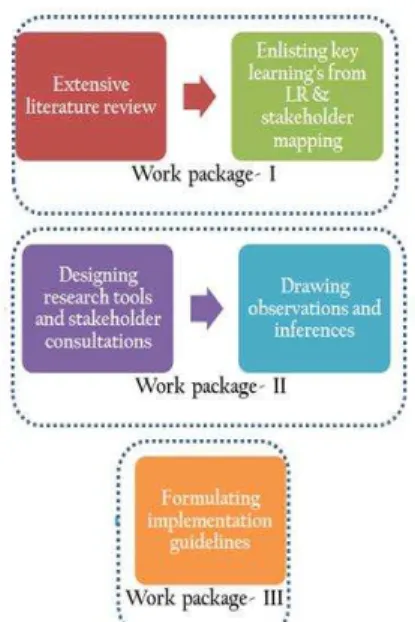
The methodology that was adopted to accomplish the aforementioned objectives included extensive literature review, stakeholder mapping, designing of research tools like questionnaire, structured & semi structured interviews for the
identified stakeholders, shortlisting one ULB based on the impact factor assessment, data collation, analysis and finally articulating the guidelines for effective implementation of the green building scheme of the ULBs. In a nut shell the study was
broadly divided into three work packages as presented below in Fig. 1.
Figure 1 Schematic representation of the methodology adopted for the research study
III.
LEARNINGS
FROM
LITERATURE
REVIEW
3.1 Introduction
A robust literature review was undertaken to understand the subject and its associated aspects in more depths, which included the National green building rating system, government policies and notifications incentivizing the rating system, environmental and financial benefit of adopting green building principles and concepts, international rating systems, key areas for successful implementation of any green building scheme and lastly the barriers.
3.2 National Green Building Rating System- GRIHA
Buildings consume about 40% of global energy, 25% of global water, 40% of global resources, whereas they emit approximately 1/3 of GHG (Green House Gases) emissions [4]. In addition, building activities contribute an estimate 50 % of world’s air pollution, 42 % of its greenhouse gases, 50 % of all water pollution and 48 % of all solid waste [5]. Realizing the need of the hour and having known the status of the growing & projected population in India and the urban agglomeration putting pressure on the already crunched resources, TERI had conceptualized GRIHA rating system for addressing the key challenges of the built environment. GRIHA is a rating tool which facilitates designing, construction and maintenance of the built environment and in turn measures the greenness of the constructed built
environment in line with the nationally accepted benchmarks like NBC (National Building Code) and ECBC (Energy Conservation Building Code). The robust scientific method adopted for developing the context specific rating system and the integration of the national codes, compelled MNRE, GoI to adopt
the rating system as the ‘National Rating System for Green Buildings in India’. Also, globally in many organizations, sustainability is at the forefront, along with the government’s commitment to promote energy and environmental stewardship [6]. The rating system, thus assists in acting as a guiding instrument in achieving these interrelated objectives in a smarter way.
3.3 Government policies and notifications incentivizing GRIHA
In India, the rating system has been incentivized by many municipalities which can be broadly categorized under the following three heads:
3.3.1 Additional FSI/FAR (Floor space index/floor area ratio) incentive
In this incentive model, the municipalities/departments offer free of cost or at extra fees, an additional floor space index to minimum GRIHA 4 star projects and above. Presently this is being offered by:
Government of West Bengal, Department of Municipal Affairs
Jaipur Development Authority
NOIDA and Greater NOIDA
Department of Housing and Urban Development, Government of Punjab
3.3.2 Monetary incentive
The monetary/financial incentives are presently being offered only by two municipalities in India, wherein rebate is offered on the premium amount that is paid by the developers and the property tax paid by the occupants.
PCMC (Pimpri Chinchwad Municipal Corporation)
PMC (Pune Municipal Corporation)
3.3.3 State adoption
Government of Sikkim has adopted GRIHA for all the Government and semi-Government structures.
3.4 Environmental and financial benefit of adopting green building principles and concepts
and the incentives that are being offered by different municipalities, there are both, environmental as well as financial benefits for adopting green building principles. The construction projects are considered successful only if completed on time, within the allocated finance and to a quality desired by the client. However, apart from the above-mentioned indicators, due to social, cultural, technological and climatic changes in recent times, aspects like health & safety and environmental performance have also become a domineering aspect for project management and performance [7].
The Ganga Skies residential project by Ganga Developers, near Vallabh Nagar, Pimpri is the first green building project in the jurisdiction of PCMC, which has been awarded final GRIHA star rating. Upon incorporating green building principles at the right stages of the design, planning and implementation, the project could achieve 8% reduction in the project cost [8]. In addition, given that the project has received a 3-star rating from GRIHA Council, the project was eligible for a 30% discount in the premium amount that was paid initially to the corporation., As per the incentive scheme of the corporation, even the occupants of the flats were entitled for a 5% discount in the property tax [9]. The environmental benefits achieved by the project are as enlisted below [2]:
30 % reduction in energy from GRIHA energy benchmark.
25 % reduction in building water consumption
40 % reduction in landscape water consumption
More than 50% of the living areas are day-lighted
More than 40% fly-ash used in block work
10kW renewable energy generated on site through solar
3.5 International rating systems and the key areas identified for successful
implementation of any green building scheme
Across the globe, rating systems have been one of the key instruments in quantifying and managing the non-renewable resources to quite an extent. Like the Indian rating system, the international rating systems have also given
weightages to different aspects of green building like building design, energy, water, site management, materials, pollution, indoor air quality, innovation and so on. Depending on the status of the resources and/or severity of the issue in that country the weightages have been modified to suit the regional context. Similarly, there are certain components in the rating system which are mandatory to be followed by the project proponent. Whereas, some components are voluntary and could be adopted to achieve maximum score/status under the rating system.
3.6 Key drivers and barriers
From the extensive literature review the following areas were identified as the key to the development of any green building scheme:
Policy packages should be targeted, consistent and coordinated at all levels.
Private sector involvement is crucial.
markets for energy and resource efficient technologies, skills and building materials should be developed.
Innovative financing instruments should be formulated.
Environmental consciousness needs to be given due significance.
Having identified the key drivers for the green building movement, the challenges/barriers that exist to certain degree were also enlisted as mentioned below [10]:
No appropriate and well explained definition for green construction
Poor implementation of codes and standards
Lack of awareness about green buildings and weak value proposition
No standardization of alternative materials and technologies
IV.
STAKEHOLDER
MAPPING,
IMPACT
FACTOR
ASSESSMENT
AND
DESIGNING
OF
RESEARCH
TOOLS
4.1 Stakeholder mappingWhile undertaking a detailed literature review, key stakeholders were also identified parallelly as mentioned in Fig.2.
4.2 Impact factor assessment
An impact factor assessment was carried out to shortlist one ULB for in depth study of the green building scheme, the processes followed and the implementation challenges existing within the municipality and related to other concern stakeholders as well. As seen in Fig. 3, on the Y axis the number of projects registered under the scheme has been plotted, whereas on the X axis the number of years of existence of the green building scheme in the respective jurisdiction has been marked. In
Maharashtra, PCMC, at present has the highest number of green building projects registered i.e 58 projects [11]. Also, the existence of the policy is close to 5 years as seen in the figure. Thus, PCMC was shortlisted for the in-depth study.
4.3 Designing of research tools
The stakeholders identified were categorized into four groups, the specific objective for collecting information and the identified tool for facilitating interactions has been elaborated below:
Figure 3 Impact factor matrix for existing green building schemes in India
Source: http://www.grihaindia.org/index.php?option=com_fabrik&view=list&listid=3&t=library
4.3.1 Category I: Municipality officials
Specific objective for interaction: - To understand the support extended by the municipal corporation while implementing the green building scheme.
Research tool: - Structured Interview
4.3.2 Category II: Developers, Builders, Owners and Consultants
Specific objective for interaction: - To understand the expectations of the stakeholders from the Municipal Corporation and the existing green building scheme of the municipality.
Research tool: - Questionnaire
4.3.3 Category III: Key organizations like CREDAI (Confederation of Real Estate Developers Association of India), IIA (Indian Institute of Architects) and AESA (Architects, Engineers and Surveyors Association)
Specific objective for interaction: - To understand the level of involvement of these key organizations
while formulating and implementing the green building scheme in the region.
Research tool: - Semi structured discussion
4.3.4 Category IV: Citizens/Residents of the city Specific objective for interaction: - To understand the level of awareness among the citizens on various aspects in general and particularly about the green building scheme of the municipal corporation.
Research tool: - Telephonic interview
V.
COLLATION
OF
DATA
VARIABLES
AND
ANALYSIS
5.1 Data Collection
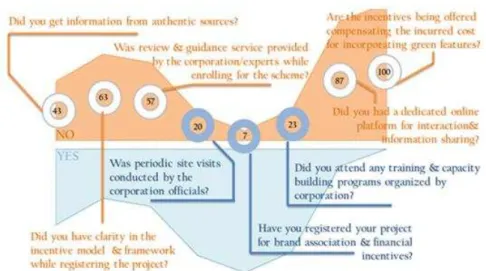
Figure 4 Responses received from Category II: Developers, Builders, Owners and Consultants
Similarly, the data collected through telephonic interviews have been graphically illustrated below
in Fig. 5. The key question asked was do you know the following in your city?
Figure 5 Responses received from citizens
5.2 Data Analysis
The data collected was further categorized into four sections as mentioned below and evaluated to identify the key gaps/challenges, the reasons for the existence of the gap and the suggestive recommendations has also been given.
Source of information
Resource person
Training and capacity building
Incentive model and outreach
5.2.1 Source of Information
With respect to source of information, the first most authentic source for information dissemination is the government official website. In case of PCMC, a
dedicated webpage was created. However, the website needs to be updated with the following information:
Government notification
Process to be followed at PCMC & GRIHA
Key stages/milestones of the project
GRIHA registered/rated project details
Contact details of the officials and so on.
FAQs (Frequently Asked Questions)
namely IT and Environment Department of PCMC. The suggestive recommendations to address the above were as follows:
Webpage updation activity could be outsourced to a third party /private IT company for regular modifications and maintenance.
If incase municipality budget does not permit outsourcing of the job and/or for the security of the information/data misuse, an internal mechanism could be established for sending monthly updates to the IT department of the municipality for publicizing it through their website.
5.2.2 Resource person
In Environment Department of PCMC there are 24 staff members and in the Building Permission Department there are 144 staff members including the engineers and the administrative staff. Despite good staff strength, the concern raised was municipality staff is not easily approachable and
GRIHA representatives’ visit to the municipality for handholding was limited.
The identified reasons for the perceived concerns were:
Municipality staff is over loaded with work. During consultations with the municipality officials it was revealed that the AutoDCR software is very easy to work with and due to which the building approval process has become faster [12]. Further, on an average, one Junior Engineer gets around 10 to 12 building proposals for scrutiny in a month. Thus, the staff being over loaded with work is a subjective reason and can be challenged.
The other identified reason was lack of knowledge about the subject and the limited visits of the GRIHA representative are as per the agreement between the GRIHA Council and PCMC.
The suggestive recommendations to the above concerns were as follows:
PCMC can consider appointing more staff or make the best use of the existing staff strength with appropriate work allotments. Also, appropriate resource allocation and extending the external experts network could be explored.
More regular capacity and training building programs could be organized to address the concern of limited knowledge.
The requirement of GRIHA representative could be decided based on consultative process with the relevant stakeholders.
5.2.3 Training and capacity building
Organizing training and capacity building programs for various stakeholders is one of the key
aspects for achieving the desired impact of the green building scheme in the region. Despite its need and significance, there were approximately 5 training programs organized till date. The lower number of programs were due to prior commitments of the municipality and limited budget for organizing such kind of training cum capacity building programs. The suggestive recommendations were:
In the annual budget, provisions should be made to include expenses related to organizing training programs and developing resource materials for different categories of stakeholders.
Furthermore, it should be made compulsory for the municipality staff to undertake such training programs annually or bi-annually depending upon the share of responsibility in implementing the green building scheme.
5.2.4 Incentive model and outreach
One of the most prominent expectations of the stakeholder category II, was that the need to formulate the incentives in a better way, to attract more projects. The same should be proportionate enough to compensate the cost incurred for incorporating green features in their projects. Thus, it could be deduced that the incentive model, could be one of the reasons for such less registered projects in the region. In addition, the uncertainty of the release of financial incentives was another focus of concern, given the ambiguity of the timelines in the government notification as well as on the website. The identified reason for the aforementioned concerns were:
Weak value proposition- Green building makes financial sense as well is not effectively communicated across the fraternity.
Lack of knowledge and awareness resulting into lower penetration of understanding of the corresponding benefits.
Inadequate information provided in the government notification and municipality website.
The suggestive recommendations proposed were as follows:
The incentives offered do not seem to be lucrative enough due to weak value proposition and lack of awareness. Therefore, the following incentives could be offered in combination to make it more appealing.
o Discount in the premium amount o Discount in the property tax o Additional free FSI/FAR
o Fast track clearance from building permission
department
o Free training programs/guidance
electronic media for wider penetration of the subject and to raise the awareness levels.
Other print & online media like magazines, peer reviewed journals, Facebook, Instagram and so on could also be effectively used to enhance the outreach.
The government notification should clearly mention the processes, timelines, penalty clauses and other relevant information that may be required by the project proponent for enhanced decision making and to avoid any ambiguity that may erupt in future due to lack of authentic information.
VI.
INFERENCES
AND
IMPLEMENTATION
GUIDELINES
FOR
GREEN
BUILDING
SCHEME
OF
THE
URBAN
LOCAL
BODY.
6.1 InferencesUpon evaluating the data collated, it can be concluded that the following four key components are imperative while formulating the implementation guidelines for effective realization of the green building scheme of the municipality. 1. Information Management (Authentic sources of
information): - Having authentic sources for information dissemination like government notification, official website, municipality staff and open sources like print & electronic media. 2. Human Resource Management: -Specific day
and time slot for interaction with the municipality staff and GRIHA representation as well as extended network of resource professionals like GRIHA certified evaluators and trainers of the region.
3. Knowledge Management (Training and capacity building program): - Planning annual training calendar and developing resource/reference materials in the interest of public.
4. Incentive model and outreach strategy: - Combination of incentives to make it more lucrative. The same should be complimented with an impactful publicity and outreach strategy to ensure greater incursion of the scheme in the jurisdiction.
6.2 Implementation guidelines
The proposed implementation guidelines have been broadly divided into five key sections as mentioned below:
Section I: Green Building Scheme of the ULB
Section II: Procedures, milestones and organizational structure
Section III: Project feasibility, design and construction
Section IV: Post construction
Section V: Training & capacity building
6.2.1 Section I: Green Building Scheme of the ULB
The green building scheme of the ULB should clearly highlight the priorities/intention of the ULB for introducing the scheme in their jurisdiction,
through ‘Government Notification’. Also, the
variant of the rating system being incentivized as a city-wide strategy to achieve sustainable development goals should be clearly mentioned in
the municipality’s policy and government
notification [13]. A very clear distinction about the mandatory clauses and the priorities, should be done and communicated to all including government officials of different departments and citizens. Furthermore, the following points should be clearly mentioned in the government notification:
Mandatory and city priorities to be achieved through this initiative/GR
Procedures to enroll and avail the benefits of the incentive scheme
Fees to be paid to the corporation for availing the benefits of the scheme, if any
Noncompliance criteria and penalty clause to ensure compliance with the scheme
Details of the Departments in charge should be mentioned.
Formulation of an Environment Cell to ensure smooth implementation of the scheme in the jurisdiction.
6.2.2 Section II: Procedures, milestones and organizational structure
Figure 6 Proposed organizational structure
The procedures, milestones, organizational structures and other relevant information should be showcased on the official website of the municipality. The vast information may be categorized and prioritized depending on the budget, space availability on the domain and any other factor of relevance.
6.2.3 Section III: Project feasibility, design and construction
The project proponent should undertake a project feasibility assessment to ensure that the mandatory criteria of DCR & GRIHA are met, even before the project is been registered under the green building scheme of the ULB. Technical guidance should be provided timely by the experts from the ULB & GRIHA Council. Three mandatory site visits should be undertaken jointly by the ULB & GRIHA Council to ensure (i) Site management (ii) Building compliance (iii) Systems and equipment’s. GRIHA certified professionals may be included as a part of the project team to have ease of implementation, preparation of submittals and compliance with GRIHA. In addition, it is also suggested that specific time slots for interaction with the real estate developers and practicing architects
should be announced. The certified GRIHA trainer’s
contact details could also be available on the
corporation’s website. So, in case, the municipality staff is not approachable or available, the project proponent can have preliminary discussion with the certified professionals of GRIHA available in the region.
6.2.4 Section IV: Post construction
The Environment Cell and GRIHA Council team should work together to measure and verify the components on site. Only after which the occupancy certificate and associated incentives should be released. The third-party evaluation by a BEE (Bureau of Energy Efficiency) certified auditor
should be conducted after 75% of the occupancy of the project to get the Final Certification from GRIHA Council and the incentives to be released thereafter. Periodic evaluation should be done to get the certificate renewed from the Council.
6.2.5 Section V: Training and capacity building
Specific awareness, training and capacity building programs should be organized regularly by the ULB & GRIHA Council. For instance:
For municipality staff: -
Three day detailed technical program at least once in two years. (Compulsory)
One-day training cum awareness program at least once in a year. (Voluntary)
For other stakeholders: -
Two day detailed technical program at least once in a year.
One-day training cum awareness program at least once in six months.
VII.
CONCLUSION
ACKNOWLEDGEMENTS
The authors would like to thank Rachana
Sansad’s Project Management Institute for
encouraging this research study under the Master’s Degree course in Architecture with specialization in Construction Management. Also, a special thanks to Ar. Aditi Phansalkar for reviewing the research paper.
REFERENCES
[1]. Patle, Geeridhari, Vaidehi A. Dakwale, and R. V. Ralegaonkar. n.d. "Design of Green Building: A Case Study for Composite Climate." International Journal of Engineering Research and Applications 1(2): 388-393.
[2]. GRIHA, Council.2007. Accessed May 28, 2016.
[3]. http://www.grihaindia.org/?t=home&#&ho me
[4]. Gustafson, Sara, and Elin Wihlborg. 2016. "Reflecting on Collaborative Networking and the Roles of Municipalities in Local Sustainable Development." The International Journal of Sustainability Policy and Practice 12(2): 13–23.
[5]. UNEP, SBCI. 2009. Buildings and Climate Change. Summary for Decision Makers, Paris: United Nations Environment Programme.
[6]. Gupta, Abhinandan R. . 2013. "Green Building Material And Technology Green Accreditation Tools Analysis." Paripex - Indian Journal of Research 2(3): 158-160. [7]. Sparkling, Anthony E. 2012. "Cost
Justification for Investing in LEED Projects." McNair Scholars Research Journal 4(1).
[8]. Muhammad, Bima Abubakar, Tafida Adamu, and Baba Dorothy Ladi. 2015. "Appraisal of Construction Project Procurement Policies in Nigeria."
American Journal of Engineering Research
4(3): 19–24.
[9]. Council, Administrative Staff College of India and Natural Resources Defense. 2014. Greener Construction Saves Money:Incentives for Energy Efficient Buildings across India. Issue Brief, ASCI and NRDC.
[10]. PCMC. n.d. Pimpri Chinchwad Municipal
Corporation. Accessed April 2016.
http://www.pcmcindia.gov.in/marathi/inde x.php.
[11]. Dodge, Data and Analytics. 2016. World Green Building Trends 2016:Developing Markets Accelerate Global Green Growth.
Smart Market Report, Dodge Data & Analytics.
[12]. Corporation, Pimpri Chinchwad Municipal. 2013-14. Environmental Status Report .
ESR Report, Pimpri : PCMC.
[13]. Human Settlement Management Institute, Housing and Urban Development Corporation. n.d. Auto DCR Building Permission System at PCMC. Pune: State Institute of Urban Development, YASHADA.
[14]. Mahal, Namrata, and Aditi Phansalkar. 2016. "Accelerating green building growth with old & new policy instruments."
International Journal of Engineering