Heterogeneous Coupling between
Interdependent Lattices Promotes the
Cooperation in the Prisoner
’
s Dilemma Game
Cheng-Yi Xia1,2*, Xiao-Kun Meng1,2, Zhen Wang3*
1Tianjin Key Laboratory of Intelligence Computing and Novel Software Technology, Tianjin University of Technology, Tianjin 300384, China,2Key Laboratory of Computer Vision and System (Ministry of Education), Tianjin University of Technology, Tianjin 300384, China,3Interdisciplinary Graduate School of Engineering Sciences, Kyushu University, Fukuoka, 816-8580, Japan
*[email protected](CX),[email protected](ZW)
Abstract
In the research realm of game theory, interdependent networks have extended the content of spatial reciprocity, which needs the suitable coupling between networks. However, thus far, the vast majority of existing works just assume that the coupling strength between net-works is symmetric. This hypothesis, to some extent, seems inconsistent with the ubiqui-tous observation of heterogeneity. Here, we study how the heterogeneous coupling strength, which characterizes the interdependency of utility between corresponding players of both networks, affects the evolution of cooperation in the prisoner’s dilemma game with two types of coupling schemes (symmetric and asymmetric ones). Compared with the tradi-tional case, we show that heterogeneous coupling greatly promotes the collective coopera-tion. The symmetric scheme seems much better than the asymmetric case. Moreover, the role of varying amplitude of coupling strength is also studied on these two interdependent ways. Current findings are helpful for us to understand the evolution of cooperation within many real-world systems, in particular for the interconnected and interrelated systems.
Introduction
Cooperation behavior is ubiquitous among social individuals ranging from micro-organisms to animals and human beings [1,2], which, however, seems inconsistent with the prediction of Darwinian theory [3]. To resolve this issue, evolutionary game theory has become one of key paradigms behind many scientific disciplines [4,5]. Borrowing from the analysis methods of statistical physics [6] and network science [7–11], network reciprocity is amongst the most well-known mechanisms that may sustain cooperation in evolutionary games [12]. That is to say, when players are arranged on the spatially structured topology and interact only with their direct neighbors, cooperation can survive by means of forming compact clusters, which mini-mizes the exploitation and protect those cooperative individuals located within the interior of such clusters [13]. After this seminal discovery, the role of spatial topology and its various a11111
OPEN ACCESS
Citation:Xia C-Y, Meng X-K, Wang Z (2015) Heterogeneous Coupling between Interdependent Lattices Promotes the Cooperation in the Prisoner’s Dilemma Game. PLoS ONE 10(6): e0129542. doi:10.1371/journal.pone.0129542
Academic Editor:Luo-Luo Jiang, Wenzhou University, CHINA
Received:March 19, 2015
Accepted:May 11, 2015
Published:June 23, 2015
Copyright:© 2015 Xia et al. This is an open access article distributed under the terms of theCreative Commons Attribution License, which permits unrestricted use, distribution, and reproduction in any medium, provided the original author and source are credited.
Data Availability Statement:All relevant data are within the paper and its Supporting Information files.
underlying promotion mechanisms in evolutionary games have been intensively explored [14– 17]. Typical examples include complex networks [18–22], the presence of mobile agents [23– 26], the diversity between players [27–31], reward and punishment [32–37], co-evolutionary scenarios [38–44], to name but a few.
In spite of great accumulated progress, huge quantities of existing works simply assume that players have only interactions with others in the same network, which is actually inconsistent with the empirical observations. In reality, individuals are simultaneously the elements of more than one network in most, yet not all, natural and engineering systems [45,46], and it thus becomes instructive going beyond the traditional isolated network theory and proposing a novel framework. The interdependent networks, defined as the combination class of interre-lated networks in a nontrivial way, recently become a fundamental tool to quantitatively describe the interaction among networks as well as between these constituents [47]. This archi-tecture is actually suggested in the research of network robustness, where even seemingly irrele-vant changes in one network can have catastrophic and very much unexpected consequence in another network [48–50]. Along this way, interdependent network has become a hot topic of general interest, is extensively employed to study diverse subjects upon them, such as disease spreading and immunization [51–53], random walk [54,55], traffic [56,57], voting dynamics [58,59] as well as the emergency and promotion of cooperation [60,61].
With regard to game models on interdependent networks, the dynamic process between dif-ferent networks are mainly coupled via utility function and strategy information transition [62]. In the pioneering work, Jin et al. proposed a fashion of symmetric utility: individual utility is composed of its own payoff and that of its counterpart from another network, which is con-trolled by coupling strength [63]. It is interestingly unveiled that cooperation will simulta-neously be promoted below a critical threshold, but above which the phenomenon of
symmetry breaking (namely, cooperation level is unequal again) takes place, which is induced by asynchronous expansion between heterogeneous strategy couples of both networks. Resort-ing to importance of synchronization across networks, another recent report [64] shows that simultaneous formation of correlated cooperator clusters on interdependent networks can enhance cooperation to a completely dominated level, which enriches the context of traditional network reciprocity. Besides, the utility function is further extended to biased coupling way [65], partially inter-correlated fashion as well as co-evolution between coupling strength and imitation ability [66]. While for information coupling, it can be assumed that individual deci-sion depends on not only the payoff advantage of a neighbor but also how popular the adapting strategy in the network of its counterpart [67]. Furthermore, Attila and Perc also displayed that the excess correlation of players between two networks can promote the cooperation to an extremely high level [68]. Meanwhile, Jiang and Perc investigated the impact of external links between networks on the cooperation behavior, in which external links lie between a lattice and complex network (e.g., random or scale-free network), and the results revealed that an intermediate interdependence optimally facilitates the spreading of cooperative behaviour between groups [69].
If we look back upon the above-mentioned literatures, however, we can find a common characteristic: the coupling strength between networks is always homogeneous, irrespective of coupling fashion. While in the realistic life, heterogeneity plays a significant role in human behavior, even including the individual decision-making process [70]. An interesting question thus takes place: if there exists the heterogeneous coupling strength within the framework of interdependent networks, how does it affect the spatial reciprocity of cooperation? Aiming to answer this question, here we consider the heterogeneous coupling in interdependent net-worked games. It is unambiguously unveiled that increasing heterogeneity is beneficial for the dominance of cooperation yet may impede cooperation in some special conditions.
Heterogeneous Coupling Promotes the Cooperation. . .
Methods and Models
We consider an evolutionary prisoner’s dilemma game that is characterized with the tempta-tion to defectT=b(the highest payoff received by a defector if playing against a cooperator), reward for mutual cooperationR= 1, and the punishment for mutual defectionPas well as the sucker’s payoffS(the lowest payoff received by a cooperator if playing against a defector) equaling 0. As a standard practice, 1<b2 ensures a proper payoff ranking (T>R>PS) and captures the essential social dilemma between individual and common interests [13]. The players are staged on two square lattices, each of sizeL×L, where initially each playerxis des-ignated either as a cooperator (sx=C) or defector (sx=D) with the equal probability. Based on direct interactions with nearest neighbors, playerxcan obtain its accumulated payoffπx. Due to the interdependence between networks, individual utilities used to determine fitness are determined by itself and its parterx0from another network (i.e., via external links between cor-responding players), in the modeUx=πx+α×πx0. The parameter 0α1 represents the cou-pling strength (or the strength of external links), and consequentially, the larger its value, the higher the potential increase of utility of two players that are connected by the external link.
It is worth mentioning that the interdependence of two networks does not allow strategies to be transferred across networks. The game is thus iterated forward in accordance with the Monte Carlo simulation procedure comprising the following elementary steps. First, a ran-domly selected playerxacquires its utilityUxby playing the game with its nearest neighbors and taking into account also the potential addition to the utility stemming from the possible external link. Next, one randomly chosen neighboryalso acquires its utilityUyin the same way. Lastly, playerxattempts to adopt the strategysyfrom playerywith a probability deter-mined by the Fermi function
Wðsy !sxÞ ¼
1 1þexp½ðU
x UyÞ=K
; ð1Þ
whereK= 0.1 quantifies the uncertainty related to the strategy adoption process [71]. During one full Monte Carlo step, each player on both networks has a chance to adopt one of the neighboring strategies once on average.
To incorporate individual heterogeneity into the coupling strengthα, we can express the coupling strengthαas follows
a¼Aw; ð2Þ
whereχdenotes a uniformly distributed number in the interval [−1,1], and
R1
1Awdw¼0 ensures that the average value of coupling strength across both networks is zero. The tunable parameterAthus dictates the amplitude of coupling strength. Obviously,A= 0 decouples both networks and renders the traditional case to be recovered. The larger the value ofAis, the stronger the heterogeneity of interdependency is. To mimick the realistic cases,Eq (2)can be divided into two cases as illustrated: thefirst case is the symmetric coupling (caseI) that means the coupling strength between playerxand its partnerx0is the same (i.e.,
αx=αx0); another one is the asymmetric coupling (caseII), which is denoted asαx6¼αx0(namely, the random number χis different forxandx0).
The results of Monte Carlo simulations presented below were obtained fromL= 200 to 400 lattices. The key quantity, the fraction of cooperators FC, was determined within the last 104
Simulation Results
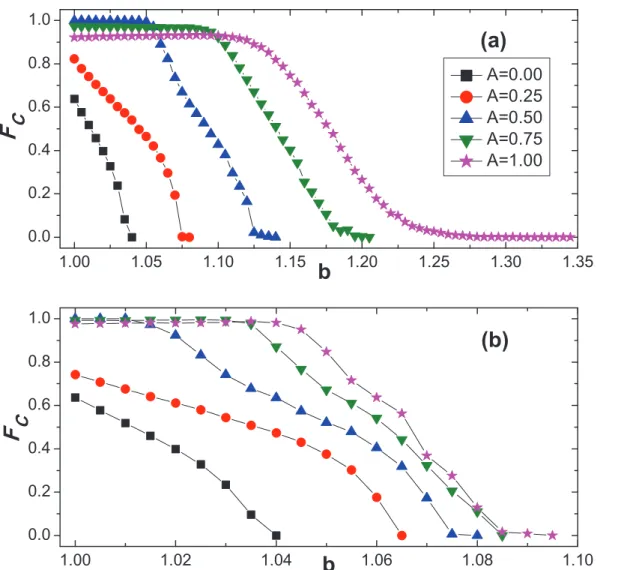
To begin with, we examine how cooperation varies under the heterogeneous interdependency or coupling strengthA.Fig 1depicts the fraction of cooperators (FC) as a dependence onbfor
different values ofA. Compared with the traditional uncoupled case (namely,A= 0), it is clear that the increment ofAwill totally promote cooperation, irrespective of symmetric or asym-metric coupling. Moreover, the critical valuebC, indicating the disappearance of cooperation, also enhances withAincreasing. Since the largerAdenotes stronger interdependence heteroge-neity between networks, the observations suggest the consideration of both heterogeneous coupling promotes the evolution of cooperation, which further extends the content of interde-pendent network reciprocity [64].
Except for the joint advancement of cooperation level, we can also capture some difference for both heterogeneous coupling schemes. Compared with the caseII, it is explicit that the Fig 1. Stationary fraction of cooperators in the whole population (FC) as a function of defection parameter (b) under different amplitude of
coupling strength (A). On the top panel (a), corresponding players on two networks always have the same coupling strength which is taken from the interval [−A,A] according toEq (2), and the cooperation can be greatly promoted asAincreases; On the bottom panel (b), corresponding players on two networks hold distinct coupling strengths which are independently derived fromEq (2), and the cooperation is also promoted but the enhancement level is much smaller than that in the top panel. Other parameters are set to beL= 200 andK= 0.1.
doi:10.1371/journal.pone.0129542.g001
elevation effect of caseIis more pronounced, which means that cooperation becomes more robust and cooperators can resist the exploitation of defectors better. Under caseI, the cou-pling strength between corresponding partners is symmetric, and the symmetric utility can eas-ily render the corresponding agents to attain the consensus strategy. On the contrary, in case II, the interdependency values between each pair of players are independently taken from the
uniform interval [-A, A], and the utility will be asymmetrically calculated and it is difficult to arrive at the coordination state.
To further understand the origin of cooperation created by this type of interdependency, we explore the dynamical evolution of fraction of cooperation on two interdependent networks. Fig 2presents the time course of cooperation fraction (FC) and the percentage of cooperative
pairs (fCC). Here, the cooperative pair (CC) means that a player at one lattice is a cooperator and the corresponding partner on the other lattice is also a cooperator. Similarly, we can define the cooperator-defector pair (CD, it means that a player on one lattice is a cooperator and cor-responding partner is a defector on the other lattice) and defector-defector pair (DD, it points out that two matching players are both defectors on these two networks). Among them, the left three panels [from Fig2a–2c] characterize the evolution ofFCandfCCunder caseI. We can clearly observe that, on one hand, the dynamical evolution of fraction of cooperators (FC) for two lattices can almost keep strictly consistent at each MCS step since the utility calculation of an individual equally considers the contribution from the payoff of corresponding partner; on the other hand, the evolutionary trend of FCis qualitatively in step with that offCC. In fact, we can also record the evolution of fraction of other strategy pairs (i.e.,fCDorfDD) during the Monte Carlo simulation (althoughfCDandfDDare not shown here), and find that only the evo-lution offCCdominates the cooperative behaviors on these two interdependent networks. In addition, there is also a subtle phenomenon to be noted that an optimal amplitudeAexists here for the smaller defection parameterb= 1.05, andA= 0.5 leads to the highest fraction of cooperators which well agrees with the result inFig 1.
At the same time, the right three panels [from Fig2d–2f] illustrate the dynamical evolution of cooperation under the caseII. Here, any pair of partners on two lattices will asymmetrically integrate the payoff from the opposite one into the fitness computation of focal player, and the fraction of cooperators (FC) cannot completely fall into step with each other. However, the
qualitative tendency is always kept to be consistent for FCon two lattices, and thus the total
fraction of cooperators will be obtained by averaging the fraction of cooperators on these two lattices as described inFig 1. Again, it is also shown that the dynamical evolution ofFCcan qualitatively hold the same behavior as the fraction of cooperative pairsfCC. These results indi-cate that the evolution of cooperation between these two interdependent lattices is dictated by the CC strategy pairs.
Fig 2. Time evolution of fraction of cooperators and cooperative pairs between two interdependent networks.The left three panels (a, b, c) depict the time course of evolution under the caseI, where the corresponding players hold the same interdependency taken from the interval [−1,1] (i.e.,A= 1) according toEq (2). Panel (a) and (b) denote the fraction of cooperators on the upper lattice and lower one, respectively, and panel (c) represents the fraction of cooperative pairs which means the corresponding players are both cooperators on these two lattices. While for the caseIIin which each individual takes the interdependency value between−1 and 1, the right three panels, from panel (d) to (f), describe the time evolution of corresponding quantities. The defection parameterbis fixed to beb= 1.05, other parameters are set to beL= 200 andK= 0.1.
doi:10.1371/journal.pone.0129542.g002
two lines of panels describe the evolutionary patterns where the coupling strength is set to be same for corresponding players on two interdependent lattices, that is, caseI. It is explicitly observed that the cooperation can be further elevated when compared to the caseII, and an interesting phenomenon different from the caseIIis that the optimalAexists whenA>0 var-ies, and the current result is again consistent with the above-mentioned results. In the same manner,A= 0 leads to two independent traditional lattices.
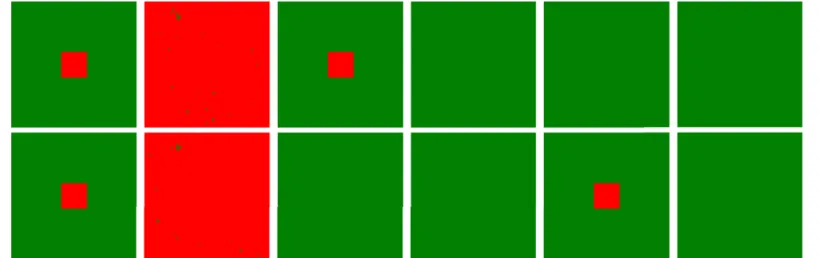
In order to highlight the role of cooperative pairs (CC) in the evolution of cooperation on interdependent networks, we delineate the characteristic patterns at the last time step for differ-ent initial distribution of cooperators and defectors in Figs4and5. Unlike the traditional setup, each player can take theCorDstrategy with the identical possibility, here 40 × 40 play-ers at the heart areas are cooperators at the upper and/or lower lattice and the rest ones are defectors. InFig 4, the corresponding players between two lattices hold the same coupling strength mutually, and we can observe that the cooperation can persist only if the players in Fig 3. Characteristic patterns between cooperators and defectors on two interdependent lattices at MCS = 50000 whenAis changed from 0 to 1.0. The panels for the first two rows denote the distribution of cooperators and defectors for the upper lattice and lower lattice in the caseII; while the bottom two rows of panels represent the evolutionary patterns of players for the caseI. In all these panels, red dots stand for cooperators and green dots represent defectors. From these figures, it is clearly shown that the fraction of cooperators is largely enhanced asAincreases, meanwhile the cooperative pairs (C-C type coupling way) have the predominant advantage and dominate the evolutionary behavior on interdependent lattices. In particular, the designating way of the coupling strength between players on interdependent lattices can also affect the evolution of cooperation. The simulation parameters are set as follows: MCS = 50000,b= 1.05,L= 200 andK= 0.1, andAis varied from 0 to 1.0 with the step length 0.25 (from the left panels to the right ones).
Fig 4. For a specific initial setup, characteristic patterns between cooperators and defectors on two interdependent lattices at MCS = 1 and MCS = 50000 under case I.In all panels, red dots represent cooperators and green dot denote defectors. For the left four panels, central cooperators are initially set on upper and lower lattices at the same time; only cooperators exist on the center of upper lattices in the middle four panels; while cooperators merely exist on the center of lower lattices in the right four panels. However, the coupling strength for each pair of players on two lattices is set to be equal, in which the coupling strength is taken fromEq (2). It is clearly indicated that cooperative pairs support the emergence of cooperation on interdependent networks. From left to right, the only difference lies that initial conditions are set as different parameter deployments between cooperators and defectors. The simulation parameters are set as follows: MCS = 50000,b= 1.05,L= 200,K= 0.1 andA= 0.5.
doi:10.1371/journal.pone.0129542.g004
Fig 5. For a specific initial setup, the characteristic patterns between cooperators and defectors on two interdependent lattices at MCS = 1 and MCS = 50000 under case II.In all panels, red dots represent cooperators and green dot denote defectors. For the left four panels, central cooperators are initially set on upper and lower lattices at the same time; only cooperators exist on the center of upper lattices in the middle four panels; while only cooperators exist on the center of lower lattices in the right four panels. Here, the coupling strength for each player is independently assigned fromEq (2). Likewise, the coupling of C-C type setup facilitate the evolution of cooperation on interdependent networks, and only that the fraction of cooperators is slightly less than that under thecase I. The simulation parameters are still set to be: MCS = 50000,b= 1.05,L= 200,K= 0.1 andA= 0.5.
doi:10.1371/journal.pone.0129542.g005
the central areas are both set to be cooperators on these two lattices, as shown in the left four panels. While for the middle or right four panels, it can be seen that the defectors will take over the whole system when only central players at the upper or lower lattice are set to be coopera-tors. Thus, the coupling between cooperators on these two interdependent lattices is the key to the evolution of cooperation. Similar phenomena can be identified inFig 5where correspond-ing agents independently take the value of couplcorrespond-ing strength fromEq (2), and again validates the fact that the cooperative pairs (CC pairs) facilitate the cooperation behavior. The only dif-ference is that the cooperation level under this case is much lower that that in caseI.
Additionally, we investigate the effect of amplitude of coupling strength (A) on the coopera-tion at a fixed defeccoopera-tion parameter. InFig 6, the fraction of cooperators (FC) is plotted as a
function ofAwhenbis set to be 1.05. It is indicated that the cooperation can be promoted ifA
is beyond a specific critical threshold (Ac). In reality, the coupling strength will be very small and can only integrate a very low percentage of payoff of corresponding player into the fitness value ifAis less thanAc, at this time the cooperation cannot be promoted and the full defection is arrived at. However, whenAtranscends overAc, the cooperation level can be greatly elevated for two types of coupling schemes with increasingA. An interesting phenomenon is found that the highest fraction of cooperator emerges atA0.5 under the caseI, where the full coopera-tion is almost reached within the whole populacoopera-tion. Nevertheless, FCwill continue to expand
for the second coupling mechanism whenAadds up to the maximum (A= 1), that is, there is no optimal effect concerning the cooperation. It is also worthy to be remarked that at any given value ofA, the level of cooperation for the first fitness evaluation method (caseI) will always be higher than that under the second scheme (caseII). For this reason, the corresponding players Fig 6. Relationship between the fraction of cooperators and the amplitude of coupling strength at a fixed defection parameter.In the whole, the tendency is that the cooperation will be elevated asA
increases. However, under the symmetric case (i.e., caseI), the optimal amplitude of coupling strength exists, but the asymmetric scenario (caseII) leads to the monotonic variation of cooperation as coupling strength grows. The parameter setup is still set to be: MCS = 50000,b= 1.05,L= 200 andK= 0.1.
on two interdependent lattices own the same coupling strength and resulting cooperative pairs with large coupling values may exist, which will greatly facilitate the evolution of cooperation. The current simulation again points out the origin of cooperation on the interdependent cir-cumstances, and adding the payoff from the corresponding one on the other lattice into the utility estimation for the focal player on the one lattice is conducive to shedding some lights on the emergence and persistence of cooperation.
Conclusions and Discussions
To summarize, the impact of network interdependency, which is quantified and characterized by the coupling between the payoff of corresponding partners on two interdependent lattices, on the evolution of cooperation in the spatial prisoner’s dilemma game is studied here in detail. In the current setup, we calculate an individual fitness by combing his/her own payoff on one lattice and the payoff from the corresponding partner on the other one, that is, the players will be virtually interrelated with or dependent on each other through the evaluation of fitness. However, the coupling strength is not a constant among player within the whole population, which is often assumed for most works regarding interdependent networked game at present, but uniformly taken from a specific interval [−A,A] according toEq (2). Furthermore, we
con-sider two different coupling schemes for the players on these two interdependent lattices. The first case is that the corresponding players on two lattices are hypothesized to hold the equal coupling strength (caseI—the symmetric case) which is a random value between−AandA; In the second case, each player in the system independently and stochastically takes the value based onEq (2), that is, the corresponding partners on two lattices may hold a completely dif-ferent coupling strength (caseII—the asymmetric case). Extensive simulations indicate that the interdependency or the coupling between players on two lattices can largely enhance the cooperation level within the whole population. Meanwhile, characteristic snapshots and cluster analysis point out that the cooperative pairs between corresponding partners on two lattices drives the evolution of cooperation. In addition, the symmetric coupling strength setup (caseI) leads to the higher cooperation when compared to the asymmetric (caseII), that is, the asym-metric coupling loses the evolutionary advantage. Our results convincingly demonstrated that the emergence or persistence of cooperation within many real-world systems can be accounted for by the interdependency between meta-populations or sub-systems, which deserves to be deeply explored in the future.
Author Contributions
Conceived and designed the experiments: CYX ZW. Performed the experiments: CYX XKM ZW. Analyzed the data: CYX XKM ZW. Contributed reagents/materials/analysis tools: CYX ZW. Wrote the paper: CYX ZW.
References
1. Maynard Smith J (1982) Evolution and the Theory of Games. Cambridge, UK: Cambridge Uni versity. 2. Axelrod R (2006) The Evolution of Cooperation( Basic Books; New York).
3. Darwin C (1859) The Origin of Species. Cambrige, MA: Harward University Press (Reprinted, 1964). 4. Gintis H (2000) Game Theory Evolving. Princeton, NJ: Princeton University Press.
5. Nowak MA (2006) Evolutionary Dynamics: Exploring the equations of life. Cambrige, MA: Harvard Uni-verstiy Press.
6. Castellano C, Fortunato S, Loreto V (2009) Statistical physics of social dynamics. Rev Mod Phys 81: 591–646. doi:10.1103/RevModPhys.81.591
7. Albert R, Barabsi AL (2002) Statistical mechanics of complex networks. Rev Mod Phys 74: 47–97. doi:
10.1103/RevModPhys.74.47
8. Boccaletti S, Latora V, Moreno Y, Chavezf M, Hwang DU (2006) Complex networks: structure and dynamics. Phys Rep 424: 175–308. doi:10.1016/j.physrep.2005.10.009
9. Li X, Shi Y, Wei M, Li J (2014) On a conjecture about tricyclic graphs with maximal energy. MATCH Commun Math Comput Chem 72: 183–214.
10. Ji S, Li X, Shi Y (2013) The extremal matching energy of bicyclic graphs. MATCH Commun Math Com-put Chem 70: 697–706.
11. Li X, Li Y, Shi Y, Gutman I (2013) Note on the HOMO-LUMO index of graphs. MATCH Commun Math Comput Chem 70: 85–96.
12. Nowak MA (2006) Five rules for the evolution of cooperation. Science 314: 1560–1563. doi:10.1126/ science.1133755PMID:17158317
13. Nowak MA, May RM. Evolutionary games and spatial chaos, Nature 1992; 359: 826–829. doi:10. 1038/359826a0
14. Hauert C, Doebeli M (2004) Spatial structure often inhibits the evolution of cooperation in the snowdrift game. Nature 428: 643–646. doi:10.1038/nature02360PMID:15074318
15. Sysi-Aho M, Saramäki J, Kertész J, Kaski K. Spatial snowdrift game with myopic agents. Eur Phys J B 2005; 44: 129–135. doi:10.1140/epjb/e2005-00108-5
16. Szabó G, Fáth G (2007). Evolutionary games on graphs, Phys Rep 446: 97–216. doi:10.1016/j. physrep.2007.04.004
17. Roca CP, Cuesta JA, Sánchez A (2009) Evolutionary game theory: Temporal and spatial effects beyond replicator dynamics. Phys Life Rev 6: 208–249. doi:10.1016/j.plrev.2009.08.001PMID:
20416850
18. Abramson G, Kuperman M (2001) Social games in a social network. Phys Rev E 63:030901(R). doi:
10.1103/PhysRevE.63.030901
19. Tomassini M, Luthi L, Giacobini M (2006) Hawks and doves on small-world networks. Phys Rev E 73: 016132. doi:10.1103/PhysRevE.73.016132
20. Santos FC, Pacheco JM (2005) Scale-free networks provide a unifying framework for the emergence of cooperation. Phys Rev Lett 95: 098104. doi:10.1103/PhysRevLett.95.098104PMID:16197256
21. Gómez-Gardeñes J, Campillo M, Moreno Y, Floría LM (2007) Dynamical organization of cooperation in complex networks. Phys Rev Lett 98: 108103. doi:10.1103/PhysRevLett.98.108103PMID:17358570
22. Xia CY, Meloni S, Perc M, Moreno Y (2015) Dynamic instability of cooperation due to diverse activity patterns in evolutionary social dilemmas. EPL 109: 58002. doi:10.1209/0295-5075/109/58002
23. Vainstein MH, Silva ATC, Arenzon JJ (2007) Does mobility decrease cooperation? J Theor Biol 244: 722C728. doi:10.1016/j.jtbi.2006.09.012
24. Helbing D, Yu W (2009) The outbreak of cooperation among success-driven individuals under noisy conditions. Proc Natl Acad Sci USA 106: 3680–3685. doi:10.1073/pnas.0811503106PMID:
19237576
25. Roca CP, Helbing D (2011) Emergence of social cohesion in a model society of greedy, mobile individ-uals. Proc Natl Acad Sci USA 108: 11370–11374. doi:10.1073/pnas.1101044108PMID:21709245
26. Xia CY, Meloni S, Moreno Y (2012) Effects of environmental knowledge on cooperation and agglomer-ation in spatial PGG games. Adv Compl Sys 15: 1250056. doi:10.1142/S0219525912500567
27. Santos FC, Santos MD, Pacheco JM (2008) Social diversity promotes the emergence of cooperation in public goods games. Nature 454: 213–216. doi:10.1038/nature06940PMID:18615084
28. Perc M, Szolnoki A (2008) Social diversity and promotion of cooperation in the spatial prisoner’s dilemma game. Phys Rev E 77: 011904. doi:10.1103/PhysRevE.77.011904
29. Szabó G and Szolnoki A (2009) Cooperation in spatial prisoner’s dilemma with two types of players for increasing number of neighbors. Phys Rev E 79: 016106. doi:10.1103/PhysRevE.79.016106
30. Droz M, Szwabiński J, Szabó G (2009) Motion of influential players can support cooperation in Prison-ers Dilemma. Eur Phys J B 71: 579–585. doi:10.1140/epjb/e2009-00160-1
31. Zhu CJ, Sun SW, Wang L, Ding S, Wang J, Xia CY (2014) Promotion of cooperation due to diversity of players in the spatial public goods game with increasing neighborhood size. Physic A 406: 145–154. doi:10.1016/j.physa.2014.03.035
32. Sigmund K, Hauert C, Nowak MA (2001) Reward and punishment. Proc Natl Acad Sci USA 98: 10757–10762. doi:10.1073/pnas.161155698PMID:11553811
34. Jiménez R, Lugo H, Cuesta JA, Sánchez A (2008) Emergence and resilience of cooperation in the spa-tial prisoner’s dilemma via a reward mechanism. J Thero Bio 250: 475–483. doi:10.1016/j.jtbi.2007.10. 010
35. Gneezy A, Fessler DMT (2012) Conflict, sticks and carrots: war increases prosocial punishments and rewards. Proc R Soc B 279: 219–223. doi:10.1098/rspb.2011.0805PMID:21653590
36. Szolnoki A, Perc M (2010) Reward and cooperation in the spatial public goods game. EPL 92: 38003. doi:10.1209/0295-5075/92/38003
37. Wang Z, Xia CY, Meloni S, Zhou CS, Moreno Y (2013) Impact of social punishment on cooperative behaviors in complex networks. Sci Rep 3: 3095. doi:10.1038/srep03095PMID:24172838
38. Perc M, Szolnoki A (2010) Coevolutionary games-A mini review. BioSystems 99: 109–125. doi:10. 1016/j.biosystems.2009.10.003PMID:19837129
39. Tanimoto J (2009) Promotion of cooperation through co-evolution of networks and strategy in a 2 × 2 game. Physica A 388: 953–960. doi:10.1016/j.physa.2008.11.023
40. Ebel H, Bornholdt S (2002) Coevolutionary games on networks. Phys Rev E 66: 056118. doi:10.1103/ PhysRevE.66.056118
41. Perc M, Szolnoki A (2008) Coevolution of teaching activity promotes cooperation. New J Phys 10: 043036 doi:10.1088/1367-2630/10/4/043036
42. Fu F, Wang L, Nowak MA, Hauert C (2009) Evolutionary dynamics on graphs: Efficient method for weak selection. Phys Rev E 79: 046707. doi:10.1103/PhysRevE.79.046707
43. Wang L, Wang J, Guo BH, Ding S, Li YK, Xia CY (2014) Effects of benefit-inspired network coevolution on spatial reciprocity in the prisoners dilemma game. Chaos, Solitons & Fractals 66, 9–16 doi:10. 1016/j.chaos.2014.04.011
44. Zimmermann MG, Eguíluz VM, San Miguel M (2004) Coevolution of dynamical states and interactions in dynamic networks. Phys Rev E 69: 065102(R). doi:10.1103/PhysRevE.69.065102
45. Boccaletti S, Bianconi G, Criado R, Genio C-I, Gómez-Gardeñs J, Romance M, et al (2014) The struc-ture and dynamics of multiplayer networks. Phys Rep 544: 1–122. doi:10.1016/j.physrep.2014.07.001
46. Kivelä M, Arenas A, Barthelemy M, Gleeson LP, Moreno Y (2014) Multilayer networks. J Complex Net-works 2: 203–271. doi:10.1093/comnet/cnu016
47. Gao J, Buldyrev SV, Stanley HE, Havlin S (2012) Networks formed from interdependent networks. Nat Phys 8: 40–48. doi:10.1038/nphys2180
48. Buldyrev SV, Parshani R, Paul G, Stanley HE, Havlin S (2010) Catastrophic cascade of failures in inter-dependent networks. Nature 464: 1025–1028. doi:10.1038/nature08932PMID:20393559
49. Baxter GJ, Dorogovtsev SN, Goltsev AV, Mendes JFF (2012) Avalanche collapse of interdependent networks. Phys Rev Lett 109: 248701. doi:10.1103/PhysRevLett.109.248701PMID:23368399
50. Huang X, Gao J, Buldyrev SV, Havlin S, Stanley HE (2011) Robustness of interdependent networks under targeted attack. Phys Rev E 83: 065101. doi:10.1103/PhysRevE.83.065101
51. Granell C, Gmez S, Arenas A (2013) Dynamical interplay between awareness and epidemic spreading in multiplex networks. Phys Rev Lett 111 (12): 128701. doi:10.1103/PhysRevLett.111.128701PMID:
24093306
52. Sanz J, Xia CY, Meloni S, Moreno Y (2014) Dynamics of interacting diseases. Phys Rev X 4(4): 041005.
53. Son SW, Bizhani G, Christensen C, Grassberger P, Paczuski M (2012) Percolation theory on interde-pendent networks based on epidemic spreading. EPL 97 (1): 16006. doi:10.1209/0295-5075/97/ 16006
54. Romance M, Sola L, Flores J, Garcia E, Del Amo AG, Criado R (2014) A perron-frobenius theory for block matrices associating to multiplex networks. arXiv preprint: 1411.7557.
55. De Domenico M, Solé-Ribalta A, Gómez S, Arenas A (2013) Random walks on multiplex networks. arXiv preprint: 1306.0519.
56. Tang L, Wang X, Liu H (2012) Community detection via heterogeneous interaction analysis. Data Min Knowl Discov 25 (1): 1–33. doi:10.1007/s10618-011-0231-0
57. Ansari A, Koenigsberg O, Stahl F (2011) Modeling multiple relationships in social networks. J Marketing Res 48: 713–728. doi:10.1509/jmkr.48.4.713
58. Masuda N (2014) Voter model on the two-clique graph. arXiv preprint: 1403.4763.
59. Stark HU, Tessone CJ, Schweitzer F (2008) Decelerating microdynamics can accelerate macrody namics in the voter model. Phys Rev Lett 101: 018701. doi:10.1103/PhysRevLett.101.018701PMID:
18764160
60. Xia CY, Miao Q, Wang J, Ding S (2014). Evolution of cooperation in the travelers dilemma game on two coupled lattices. Applied Mathematics and Computation 246: 389–398. doi:10.1016/j.amc.2014.08. 006
61. Meng XK, Xia CY, Gao ZK, Wang L, Sun SW (2015) Spatial prisoners’dilemma games with increasing neighborhood size and individual diversity on two interdepdendent lattics. Phys Lett A 379: 767–773. doi:10.1016/j.physleta.2014.12.051
62. Gómez-Gardeñs J, Gracia-Lázaro C, Floría LM, Moreno Y (2012) Evolutionary dynamics on in terde-pendent populations. Phys Rev E 86: 056113. doi:10.1103/PhysRevE.86.056113
63. Jin Q, Wang L, Xia C-Y, Wang Z (2014) Spontaneous symmetry breaking in interdependent networked game. Sci Rep 4: 4095. doi:10.1038/srep04095PMID:24526076
64. Wang Z, Szolnoki A, Perc M (2013) Interdependent network reciprocity in evolutionary games. Sci Rep 3: 1183. doi:10.1038/srep01183PMID:23378915
65. Wang Z, Szolnoki A, Perc M (2012) Evolution of public cooperation on interdependent networks: The impact of biased utility functions. EPL 97: 48001. doi:10.1209/0295-5075/97/48001
66. Wang Z, Szolnoki A, Perc M (2013) Optimal interdependence between networks for the evolution of cooperation. Sci Rep 3: 2470. doi:10.1038/srep02470PMID:23959086
67. Wang Z, Szolnoki A, Perc M (2014) Self-organization towards optimally interdependent networks by means of coevolution. New J Phys 16: 033041. doi:10.1088/1367-2630/16/3/033041
68. Szolnoki A, Perc M (2013) Information sharing promotes prosocial behaviour. New J Phys 15: 053010. doi:10.1088/1367-2630/15/5/053010
69. Jiang LL, Perc M (2013) Spreading of cooperative behaviour across interdependent groups. Sci Rep 3: 2483. doi:10.1038/srep02483PMID:23963495
70. Perc M, Wang Z (2010) Heterogeneous aspirations promote cooperation in the prisoners dilemma game. PLoS ONE 5: e15117. doi:10.1371/journal.pone.0015117PMID:21151898