15 Karbandi et al
Evidence Based Care Journal
http://ebcj.mums.ac.ir/
Effect of Educational Program on the
Burden of Family Caregivers of
Hemodialysis Patients
Mansoureh Ashghali Farahani, Golnar Ghane, Naime Sydfatemi, Hamid Hagani
The online version of this article can be found at
http://ebcj.mums.ac.ir/article_6703_960.html
Evidence Based Care Journal 2016 06:07 originally published
online 01 April 2016
! " # $ "#
#
% &
! " # $ "#
#
Downloaded from http://ebcj.mums.ac.ir/ at Mashhad University of Medical Sciences on April 01, 2016
Original Article
Effect of Educational Program on the Burden of Family
Caregivers of Hemodialysis Patients
4
, Hamid Hagani
3
, Naime Sydfatemi
2
, *Golnar Ghane
1
Mansoureh Ashghali Farahani
Received: 07/02/2016 Accepted: 01/04/2016
Abstract
Background: Studies suggest that family caregivers of hemodialysis patients experience a high level of burden, which could lead to numerous physical and psychological problems. Despite the need for adequate training and support, these caregivers are mostly neglected, and few studies have been performed in this regard.
Aim: to evaluate the effect of educational programs on the home care of hemodialysis patients and burden of their family caregivers.
Method: This randomized controlled clinical trial was conducted on 76 caregivers of hemodialysis patients referred to Shahid Hasheminejad Hemodialysis Center of Tehran, Iran in 2015. Subjects were divided into two groups of intervention and control (n=38). The intervention group received four training sessions on the home care of hemodialysis patients for two weeks, and the control group received routine care. Data were collected using the Caregiver Burden Inventory (CBI) at the beginning and six weeks after the intervention. Data analysis was performed in SPSS V.21 using Chi-square, Fisher’s exact test, independent and paired T-test, and Mann-Whitney U test.
Results: In this study, no significant difference was observed between the two groups in terms of demographic characteristics. At the baseline, mean score of caregiver burden in the intervention and control groups was 88.5±11.7 and 84.9±15.1, respectively, and no significant difference was observed between the groups in this regard (P=0.30). Six weeks after the intervention, the results of independent T-test revealed a significant difference between the mean scores of caregiver burden in the intervention (58.7±6.6) and control groups (87.8±11.7) (P<0.001). Moreover, the results of paired T-test indicated that the mean score of caregiver burden reduced in the intervention group, while it increased in the control group.
Implications for Practice: According to the results of this study, use of an educational program for
family caregivers could be effective in reducing their burden and other problems associated with the home care of hemodialysis patients. Therefore, it is suggested that educational managers of medical centers encourage the healthcare personnel to apply such programs in order to improve the health of caregivers.
Keywords: Burden of care,Educational program, Family caregivers, Hemodialysis patients
1. Nursing Care Research Center, Associate professor of Nursing, School of Nursing and Midwifery, Iran University of Medical Sciences, Tehran, Iran
2. MS in Nursing, School of Nursing and Midwifery, Iran University of Medical Sciences, Tehran, Iran
3. Nursing Care Research Center, Associate professor of Nursing, School of Nursing and Midwifery, Iran University of Medical Sciences, Tehran, Iran
4. Instructor of Biostatistics, School of Public Health, Iran University of Medical Sciences, Tehran, Iran * Corresponding author, Email: [email protected]
Downloaded from http://ebcj.mums.ac.ir/ at Mashhad University of Medical Sciences on April 01, 2016
Introduction
Chronic renal failure (CRF) is defined as the irreversible loss of kidney function, which is one of the most common diseases around the world. According to statistics, 2-3% of the global population and 10% of the people in the United States are diagnosed with CRF, and the annual incidence rate of this disease in the United States has been estimated at 336.2 people per one million population (1). The prevalence of CRF is on the rise in developing countries. In Iran, the prevalence of CRF has increased from 238 cases per million in 2000 to 354 cases per million in 2006 (2). Current treatment methods available for CRF include hemodialysis, peritoneal dialysis, and kidney transplantation. In Iran, 47.7% of all CRF patients receive hemodialysis, and 25,934 patients were reported to undergo chronic hemodialysis in 2013 (1, 3).
Although the widespread availability of hemodialysis saves and prolongs the lives of thousands of patients with end-stage renal disease (ESRD), these patients suffer from numerous complications (4, 5). ESRD leads to significant changes in the life of the patients and their families. The need for frequent hemodialysis and the associated health problems constantly lower the energy of the patients -(6). Furthermore, hemodialysis patients are likely to experience severe disability, loss of function, and dependency on caregivers. Therefore, these patients need the adequate support of others, especially family caregivers, who are directly involved in their care (7, 8).
Chronic illness of a family member and the associated economic and psychosocial consequences largely influence the lifestyle of the family members. Studies suggest that family caregivers of patients with chronic diseases experience substantial physical and emotional distress, as well as several psychological symptoms, such as depression, anxiety, anger, despair, and feelings of guilt and shame (9-12). Also as an important phenomenon, the role of family caregivers affects the quality of life of millions of people and is considered a major community health issue. So that family caregivers are at the risk of developing different diseases and are occasionally referred to as “hidden patients” (9, 13).
According to the literature, family caregivers play a pivotal role in the care of patients and are under tremendous physical and psychological pressure (14-17). In a recent study, Abbasi et al. (2011) investigated the burden of the caregivers of hemodialysis patients and reported that 74.2% of these individuals experienced severe burden caused by patient care (18). It was also stated that the burden of the caregivers increases with the worsening condition of the patient over time, and caregivers will experience more physical and psychological problems, such as social isolation and disruption in family relationships, which might eventually prevent proper patient care (9, 11, 19).
Since hemodialysis patients refer to dialysis centers to receive treatment, healthcare professionals are responsible for the care of these patients in medical settings, while this responsibility undertake lies upon family caregivers at home. Therefore, family caregivers need to be sufficiently informed on the proper home care of patients and management of hemodialysis complications (20, 21). Nevertheless, previous studies have reported that these caregivers often have deficient knowledge and skills regarding patient care, as well as lack of social support. Patients become more disabled with disease progression, and caregivers are confronted with more complex caring needs. Such example is the need for adequate information about patient care at home (21, 22).
In the study by Isenberg and Trisolini (2008), most of the families of hemodialysis patients complained of lack of sufficient information about the disease, management of the symptoms, and home care of patients. Accordingly, the most important information in this regard revolved around the dietary plan and medication therapy of the patients (20). On the same note, the findings of Belasco et al. (2006) indicated that 70% of the caregivers of hemodialysis patients were concerned about two major issues: care and treatment problems (i.e., hemodialysis complications) and conformity with home care responsibilities (8).
With the increasing needs of patients, the burden of caregivers also increases, and these individuals may experience potential changes in their lifestyle. Such examples are limitation in daily activities and impaired professional or family life, which could give rise to anger, anxiety, and inability to fulfill patient care responsibilities (8, 23, 24). Despite the aforementioned problems, caregivers of hemodialysis patients are mostly neglected, and few interventional studies are available on the alleviation of the burden of the caregivers of these patients.
Downloaded from http://ebcj.mums.ac.ir/ at Mashhad University of Medical Sciences on April 01, 2016
reducing the burden of caregivers (21). In another research, Khorami-Markani et al. (2015) assessed the effect of a family-centered educational program on the home care knowledge of caregivers of patients receiving chronic hemodialysis (25). Furthermore, the review study performed by Tong et al. (2008) emphasized the necessity of educational interventions to support patient caregivers (26). For the first time in Iran, this study aimed to evaluate the effect of educational programs (home care of hemodialysis patients and prevention of the associated complications) on the burden of the family caregivers of hemodialysis patients.
Methods
This randomized controlled clinical trial was conducted on 76 family caregivers of hemodialysis patients referred to Shahid Hasheminejad Hemodialysis Center of Tehran, Iran during February-August 2015. Participants were equally divided into two groups of intervention and control (n=38). Due to the lack of similar studies, we determined the sample size based on a pilot study performed on 16 caregivers that were equally placed in two groups of eight. After administering the Caregiver Burden Inventory (CBI), four training sessions were held for one group similar to the pilot study, and after one month, CBI was administered again to both pilot groups. According to the results, mean score of caregiver burden in the intervention group reduced from 83.5±12.4 to 63.2±14.2, while it had no significant change in the control group (84.6±13.2 vs. 81.01±12.6). Afterwards, using different parameters (β=0.1, α=0.01, μ1=81.01, μ2=63.2, S1=12.6, and S2=14.2), 18 subjects were allocated to each study group. Considering the possible sample loss and in order to have higher confidence, we doubled the sample size and placed 38 subjects in each group using comparison of means of two population's formula.
Inclusion criteria of the study for the family caregivers were as follows: 1) immediate relatives/family
age of ! " # $ % &
family conflicts and 8) not being a healthcare worker.
Inclusion criteria for the patients in this study were receiving regular hemodialysis for at least two months (three times a week for 3-4 hours per session), no history of kidney transplantation, and having a family caregiver for home care. Exclusion criteria of the study were as follows: 1) lack of cooperation by the caregiver (i.e., failure to attend the
# # # # ' ( () & ) )
" # "
training sessions and 6) candidacy of the patient for kidney transplantation.
Data were collected using a two-part questionnaire. The first section of the questionnaire included the demographic characteristics of hemodialysis patients and family caregivers (age, gender, marital status, education level, employment status, type of family relationship with the patient, financial status, known physical illnesses, family size, duration of disease, duration of regular hemodialysis, history of kidney transplantation, membership in dialysis associations, active insurance coverage, and type of insurance). In the second section of the questionnaire, we used the Persian version of CBI. CBI consists of 24 items divided into five subscales, including time dependence (items 1-5), developmental burden (items 6-10), physical burden (items 11-14), social burden (items 15-19), and emotional burden (items 20-24). All items are scored based on a five-point Likert scale (never=1, almost always=5). Total score of CBI ranges between 24-120, and higher scores are interpreted as severe caregiver burden. Moreover, scores between 24-39, 40-71, and 72-120 are classified as low, moderate and severe burden, respectively (21, 27). CBI was first translated into Persian by Abbasi et al., and the validity and reliability of this scale were confirmed via content validity and internal consistency (Cronbach's alpha=0.90) (18).
In this study, CBI was translated again into Persian, and content validity of the questionnaire was confirmed by 10 nursing professors. Also before starting the present study in a pilot study on 30 caregivers of hemodialysis patients, the Cronbach's alpha of CBI was determined at 0.92. However, collected data of the pilot study were not used in the final analysis.
Downloaded from http://ebcj.mums.ac.ir/ at Mashhad University of Medical Sciences on April 01, 2016
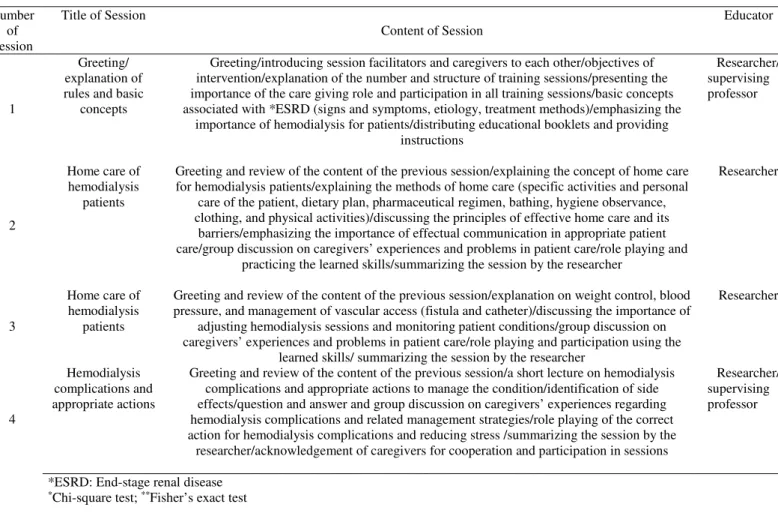
After obtaining approval for conducting the study, the first researcher referred to the dialysis center and selected all the patients who met the inclusion criteria via interviews and review of medical records. Afterwards, the researcher contacted the main caregivers of the patients via telephone to assess their eligibility and give details on the objectives of the study. It was explained to the caregivers that if they agreed to participate, they would have to stay in the study for two months and will be asked to complete the questionnaires twice. All the selected caregivers were invited to attend a session in the hall of the dialysis center in order to complete the data collection tools and after a while, they were invited to attend a few educational sessions. In the next step, caregivers of the patients who referred to the dialysis center on even or odd days of the week were randomly assigned to the intervention or control groups by coin flip. In total, 38 caregivers were allocated to the intervention group, who were divided into five subgroups of 5-8, and participants in each subgroup were assigned four training sessions on the home care of hemodialysis patients. The sessions were held twice a week at the educational hall of the dialysis center during two consecutive weeks, and each session lasted for nearly an hour. Each session consisted of a short PowerPoint-based lecture, group discussion, question and answer, and role playing. Additionally, the caregivers were provided with the contact number of the researcher for relevant consultation or enquiry (Table 1).
*ESRD: End-stage renal disease
*Chi-square test; **Fisher’s exact test
Six weeks after the last educational session, all the subjects in the intervention and control groups were invited to attend a session in the educational hall of the dialysis center to complete the selected questionnaires. In this study, participants in the control group received routine training in the dialysis center, which was mainly presented in the form of educational pamphlets.
Study protocol was approved by the Ethics Committee of Iran University of Medical Sciences (Grant No. 93-D-105-6175). Moreover, the required permit was obtained from the authorities of the
Table 1. Outline of educational sessions
Educator Content of Session
Title of Session Number of Session Researcher/ supervising professor Greeting/introducing session facilitators and caregivers to each other/objectives of
intervention/explanation of the number and structure of training sessions/presenting the importance of the care giving role and participation in all training sessions/basic concepts associated with *ESRD (signs and symptoms, etiology, treatment methods)/emphasizing the
importance of hemodialysis for patients/distributing educational booklets and providing instructions
Greeting/ explanation of rules and basic
concepts 1
Researcher Greeting and review of the content of the previous session/explaining the concept of home care
for hemodialysis patients/explaining the methods of home care (specific activities and personal care of the patient, dietary plan, pharmaceutical regimen, bathing, hygiene observance, clothing, and physical activities)/discussing the principles of effective home care and its
barriers/emphasizing the importance of effectual communication in appropriate patient care/group discussion on caregivers’ experiences and problems in patient care/role playing and
practicing the learned skills/summarizing the session by the researcher Home care of
hemodialysis patients 2
Researcher Greeting and review of the content of the previous session/explanation on weight control, blood
pressure, and management of vascular access (fistula and catheter)/discussing the importance of adjusting hemodialysis sessions and monitoring patient conditions/group discussion on caregivers’ experiences and problems in patient care/role playing and participation using the
learned skills/ summarizing the session by the researcher Home care of
hemodialysis patients 3 Researcher/ supervising professor Greeting and review of the content of the previous session/a short lecture on hemodialysis
complications and appropriate actions to manage the condition/identification of side effects/question and answer and group discussion on caregivers’ experiences regarding hemodialysis complications and related management strategies/role playing of the correct action for hemodialysis complications and reducing stress /summarizing the session by the
researcher/acknowledgement of caregivers for cooperation and participation in sessions Hemodialysis
Downloaded from http://ebcj.mums.ac.ir/ at Mashhad University of Medical Sciences on April 01, 2016
university and Shahid Hasheminejad dialysis center. Objectives of the study were explained to all the patients and caregivers, and participation in the study was voluntary. Written informed consent was obtained from all the participants, and they were assured of anonymity and confidentiality of their information. Participants were allowed to withdraw from the study at any time . To observe the study ethics, caregivers in the control group also received the educational booklet after the final evaluation after the last assessment.
Data analysis was performed in SPSS V.21 using descriptive (mean, standard deviation, frequency, and percentage) and inferential statistics (Chi-square test, independent-samples and paired T-test, Mann-Whitney U test, and Fisher’s exact test) to compare the variables. In this study, P value of less than 0.05 was considered significant.
Assessed for eligibility (n= 100)
Excluded (n= 24)
♦ Not meeting inclusion criteria (n= 10)
♦ Declined to participate (n= 14)
Analyzed (n= 38) Lost to follow-up (n= 0)
Allocated to the intervention group (n= 38)
♦Received educational program in this study (n= 38)
- Lost to follow-up (n= 0) Allocated to the control group (n= 38)
♦Received routine training in center (n= 38)
Analyzed (n= 38)
Allocation
Analysis Follow-Up
Randomized (n=76)
Enrollment
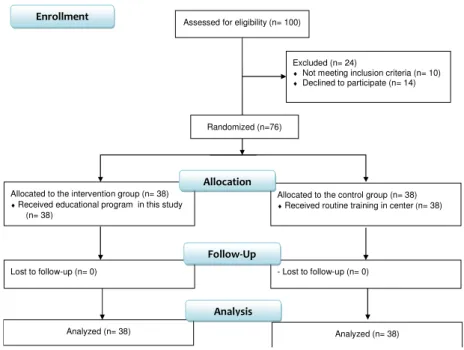
Figure 1. Flow diagram of study
Results
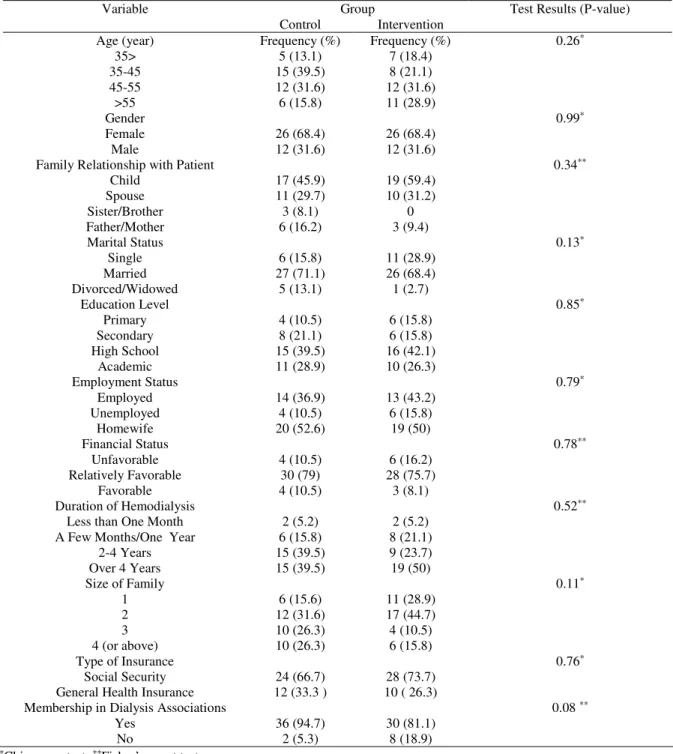
According to the results of Chi-square and Fisher’s exact test, there was no significant difference between the study groups in terms of demographic characteristics. Mean age of the caregivers in the intervention and control groups was 46.5±10.8 and 44.2±8.5 years, respectively. In total, 68.4% of the family caregivers in both groups were female. No physical disorders were present in 30 caregivers in the intervention group (78.9%) and 29 patients (76.3%) in the control group, which encompassed the majority of the participants.
The results of Mann-Whitney U test indicated that 35 patients in the intervention group (92.2%) and 25 patients in the control group (65.8%) had low or very low capability to perform personal tasks, which encompassed the majority of the hemodialysis patients. According to the results of Fisher’s exact test, there was no significant difference between the participants in terms of the history of hemodialysis, while 30 patients in the intervention group (78.9%) and 28 patients (73.7%) in the control group had been receiving regular hemodialysis for more than two years (Table 2).
At the baseline, mean score of the caregiver burden in the intervention and control groups was 88.5±11.7 and 84.9±15.1, respectively, and no significant difference was observed between the groups in this regard (P=0.30). Six weeks after the intervention, the results of independent T-test revealed a significant difference between the mean scores of caregiver burden in the intervention (58.7±6.6) and control groups (87.8±11.7), while this value was observed to decrease in the intervention group (P<0.001).
Downloaded from http://ebcj.mums.ac.ir/ at Mashhad University of Medical Sciences on April 01, 2016
hand, mean scores of caregiver burden in the control group were 84.9±15.1 and 87.8±11.7 at the baseline and end of the study, respectively, and the results of paired T-test indicated that this value had a significant increase in the control group (P<0.001) (Table 3).
Table 2. Frequency of demographic variables in two groups of caregivers
Variable Group Test Results (P-value) Control Intervention
Age (year) Frequency (%) Frequency (%) 0.26*
35> 5 (13.1) 7 (18.4) 35-45 15 (39.5) 8 (21.1) 45-55 12 (31.6) 12 (31.6)
>55 6 (15.8) 11 (28.9)
Gender 0.99*
Female 26 (68.4) 26 (68.4) Male 12 (31.6) 12 (31.6)
Family Relationship with Patient 0.34**
Child 17 (45.9) 19 (59.4) Spouse 11 (29.7) 10 (31.2) Sister/Brother 3 (8.1) 0 Father/Mother 6 (16.2) 3 (9.4)
Marital Status 0.13*
Single 6 (15.8) 11 (28.9) Married 27 (71.1) 26 (68.4) Divorced/Widowed 5 (13.1) 1 (2.7)
Education Level 0.85*
Primary 4 (10.5) 6 (15.8) Secondary 8 (21.1) 6 (15.8) High School 15 (39.5) 16 (42.1)
Academic 11 (28.9) 10 (26.3)
Employment Status 0.79*
Employed 14 (36.9) 13 (43.2) Unemployed 4 (10.5) 6 (15.8)
Homewife 20 (52.6) 19 (50)
Financial Status 0.78**
Unfavorable 4 (10.5) 6 (16.2) Relatively Favorable 30 (79) 28 (75.7)
Favorable 4 (10.5) 3 (8.1)
Duration of Hemodialysis 0.52**
Less than One Month 2 (5.2) 2 (5.2) A Few Months/One Year 6 (15.8) 8 (21.1)
2-4 Years 15 (39.5) 9 (23.7) Over 4 Years 15 (39.5) 19 (50)
Size of Family 0.11*
1 6 (15.6) 11 (28.9) 2 12 (31.6) 17 (44.7) 3 10 (26.3) 4 (10.5) 4 (or above) 10 (26.3) 6 (15.8)
Type of Insurance 0.76*
Social Security 24 (66.7) 28 (73.7) General Health Insurance 12 (33.3 ) 10 ( 26.3)
Membership in Dialysis Associations 0.08 **
Yes 36 (94.7) 30 (81.1) No 2 (5.3) 8 (18.9) Fisher’s exact test
**
square test;
-Chi
*
In total, 0%, 15.8%, and 84.2% of the caregivers in the control group and 0%, 10.5%, and 89.5% of the caregivers in the intervention group experienced low, moderate and severe burden before the intervention, respectively (P=0.49). However, at the end of the study, rates of low, moderate and severe burden in the intervention group reduced to 0%, 94.7%, and 5.3%, respectively, while they had no significant change in the control group (P<0.001).
Downloaded from http://ebcj.mums.ac.ir/ at Mashhad University of Medical Sciences on April 01, 2016
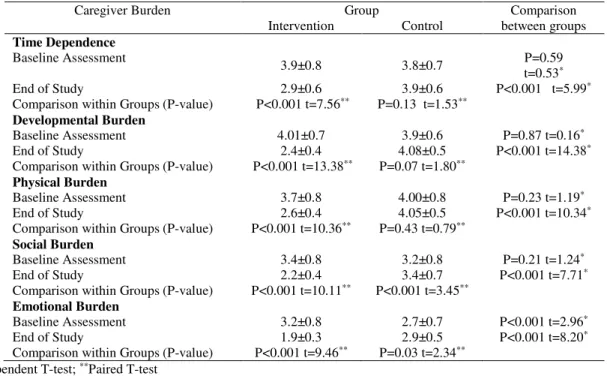
exception of the “emotional burden” domain. However, mean scores of the experimental group reduced in all CBI domains after the intervention, and all the domains were significantly different in the two groups at the end of the study (P<0.001) (Table 4).
Table 3. Comparison of mean scores of caregiver burden in study groups before and after intervention
Caregiver Burden Group Independent T-test Results Intervention Control
Baseline Assessment
88.5±11.7 84.9±15.1 t=1.02 Df=74 P=0.30 End of Study
58.7±6.6 87.8±11.7 t=13.2 Df=74 P<0.001 Paired T-test Results t=13.9 Df=37
P<0.001
t=3.3 Df=37 P<0.001
Table 4. Comparison of mean scores of *CBI domains in study groups before and after intervention
Caregiver Burden Group Comparison between groups Intervention Control
Time Dependence
Baseline Assessment
3.9±0.8 3.8±0.7 P=0.59 t=0.53*
End of Study 2.9±0.6 3.9±0.6 P<0.001 t=5.99*
Comparison within Groups (P-value) P<0.001 t=7.56** P=0.13 t=1.53**
Developmental Burden
Baseline Assessment 4.01±0.7 3.9±0.6 P=0.87 t=0.16*
End of Study 2.4±0.4 4.08±0.5 P<0.001 t=14.38*
Comparison within Groups (P-value) P<0.001 t=13.38** P=0.07 t=1.80**
Physical Burden
Baseline Assessment 3.7±0.8 4.00±0.8 P=0.23 t=1.19*
End of Study 2.6±0.4 4.05±0.5 P<0.001 t=10.34*
Comparison within Groups (P-value) P<0.001 t=10.36** P=0.43 t=0.79**
Social Burden
Baseline Assessment 3.4±0.8 3.2±0.8 P=0.21 t=1.24*
End of Study 2.2±0.4 3.4±0.7 P<0.001 t=7.71*
Comparison within Groups (P-value) P<0.001 t=10.11** P<0.001 t=3.45**
Emotional Burden
Baseline Assessment 3.2±0.8 2.7±0.7 P<0.001 t=2.96*
End of Study 1.9±0.3 2.9±0.5 P<0.001 t=8.20*
Comparison within Groups (P-value) P<0.001 t=9.46** P=0.03 t=2.34** *Independent T-test; **Paired T-test
Discussion
In the present study, we evaluated the effect of educational programs on the burden of the family caregivers of hemodialysis patients. According to our findings, adequate knowledge and learning regarding the home care of hemodialysis patients could decrease the burden of caregivers significantly. In accordance with previous studies, this finding confirms the importance of training in the support of family caregivers of patients with chronic diseases, such as those undergoing regular hemodialysis (23, 26, 28).
Family caregivers not only should take care of themselves, but they also have to meet the caring needs of patients simultaneously. Consequently, these caregivers may experience high levels of physical, emotional, financial and social burden, which largely influence their lifestyle (16, 17, 21). At the beginning of the current study, more than 80% of the family caregivers demonstrated symptoms of severe burden. This finding is consistent with some of the previous studies investigating the burden of the caregivers of hemodialysis patients (16-18, 21).
Downloaded from http://ebcj.mums.ac.ir/ at Mashhad University of Medical Sciences on April 01, 2016
Most of the caregivers in the present study were female, who were the daughters or spouses of the hemodialysis patients; this was consistent with the previous studies in this regard (15-17, 21). Evidence suggests that most of the caregivers of patients with chronic diseases in Asian families are female (30). According to the study by Mollaoğlu et al. (2013), female family caregivers are usually more sentimental and sensitive to the caring needs of patients and compared to men, have greater ability in the management of problems and establishment of an intimate relationship with the patient (21).
At the beginning of the present study, no significant difference was observed between the two groups in different domain of CBI, with the exception of the “emotional burden” domain, which had a higher score in the intervention group. Moreover, participants in both groups achieved the highest scores in CBI domains of developmental burden, physical burden, and time dependence. However, in the study by Abbasi et al. (2011), the caregivers had higher scores in the domains of emotional, social, and developmental burden, respectively (18). Mean age of the participants in the study by Abbasi et al. was 42.2±13 years, while it was 45.4±9.6 years in the current study. Therefore, this inconsistency could be attributed to the different age of the caregivers, which was relatively higher in our study. Previous studies have also indicated that the scores of CBI increased in the domains of physical burden, developmental burden and time dependence with age, whereas the scores of emotional burden domain reduced with the age of the caregiver (21).
Care giving might be associated with feelings of compassion, love and intimacy in relationships. This role also helps the caregiver to find meaning in life (31). However, greater caring needs of the patient and caregiver, along with the inadequate knowledge and skills of the caregiver, are among the main risk factors to increase the burden of caregivers (18, 23). According to the literature, burden of family caregivers not only leads to physical complaints, but it may also bring about feelings of guilt, disappointment, loneliness, depression, anger, stress, and lack of freedom, all of which could result in severe psychological problems (11, 18, 21, 23, 29).
In accordance with previous studies (20, 21, 23), the results of the present study confirmed that family caregivers often have no appropriate training and need to be supported. It is also noteworthy that limited studies are available in the literature in this regard. In their research, Mollaoğlu et al. (2013) investigated the effect of educational programs on the burden of caregivers and reported that these programs were effective in reducing the severity of caregiver burden (21). In another study, Khorami-Markani et al. (2015) evaluated the effect of a family-centered educational program on the home care knowledge of caregivers and proposed positive results (25).
Several studies have been performed on the caregivers of patients with cancer, diabetes, and cardiac and mental disorders. According to their findings, training of these caregivers could significantly decrease their burden and increase their self-esteem, perceived health, and quality of life, which eventually enhanced the quality of patient care (11, 32-35). For instance, the findings of Etemadifar et al. (2014) and Navidian et al. (2012) indicated that supportive educative group interventions and psychoeducational programs (similar to those implemented in the current study) were more effective in reducing the burden of caregivers, enhancing their perceived health, and improving patient care (36, 37).
In another study, Tong et al. (2013) claimed that in addition to the related knowledge and skills, caregivers of hemodialysis patients required counseling, empathy and psychological support in order to cope with their care giving role (28). In this regard, the results obtained by Isenberg and Trisolini (2008) indicated that group discussions and sharing experiences among caregivers were effective in providing empathy and psychological support for these individuals (20). In the current study, in addition to group discussions, we applied role playing in the home care training of the caregivers, and participants were allowed to contact the researcher in case of the need for consultation. Therefore, it is possible that the use of different education methods, such as role playing, group discussion, question and answer, and phone consultation, were beneficial in increasing the caring skills and decreasing the burden of caregivers.
Downloaded from http://ebcj.mums.ac.ir/ at Mashhad University of Medical Sciences on April 01, 2016
period, due to which the findings of the study could not be generalized. Therefore, replication of similar studies on larger sample sizes with longer periods of follow-up is recommended.
Implications for Practice
According to the results of this study, application of home care training programs could be effective in reducing the burden of the family caregivers of hemodialysis patients. Currently, few educational programs are available for family caregivers in the healthcare system of Iran, and caregivers of hemodialysis patients are completely neglected. Therefore, education managers of medical centers are expected to adopt effective strategies in order to integrate related educational programs, such as the intervention implemented in the present study. Moreover, appropriate training of family caregivers should be considered in the educational programs of patients with chronic diseases, including CRF and hemodialysis patients. It is also recommended that the importance of education and empowering programs for family caregivers be emphasized in nursing curricula. Authors of the current research recommend the replication of similar studies on larger sample sizes with longer periods of follow-up in order to achieve more accurate results.
Acknowledgments
This article was extracted from the master's thesis of the author approved by Iran University of Medical Sciences (No. 94-01-28-25834). This study was registered at the Iranian Registry for Clinical Trials (code: IRCT138809032769N1). Hereby, we extend our gratitude to the Research Deputy of Iran University of Medical Sciences for the financial support of this study. We would also like to thank the authorities of Shahid Hasheminejad Hemodialysis Center and all the family caregivers for assisting us in this research project.
Conflict of interest
The authors declare that there is no conflict of interest.
References
1. Mousavi SS, Soleimani A, Mousavi MB. Epidemiology of End-Stage Renal Disease in Iran:A
& ( * # + , - . ( / ' 0!1$-702.
2. Aghighi M, Mahdavi-Mazdeh M, Zamyadi M, Heidary Rouchi A, Rajolani H, Nourozi S. Changing Epidemiology of End-Stage Renal Disease in Last 10 Years in Iran. Iran J Kidney
- ( //1 ' 0 1 -6.
3. Arefzadeh A, Lessanpezeshki M, Seifi S. The Cost of Hemodialysis in Iran. Saudi J Kidney Dis
. ( //1 /' 0 /$-11.
4. Smeltzer SCC, Bare BG, Hinkle JL, Cheever KH. Brunner & Suddarth's Textbook of Medical-Surgical Nu 0 2 3 4 3 % / (
5. Bağ E, Mollaoğlu M. The Evaluation of Self‐Care and Self‐Efficacy in Patients undergoing
5 ( + 6& 7 8 ( / / !' 0!/ -10.
6. Ayoub AM, Hijjazi KH. Quality of Life in Dialysis Patients from the United Arab Emirates.
+97:( / /' 0 /!(
7. Belasco AG, Sesso R. Burden and Quality of Life of Caregivers for Hemodialysis Patients. Am
+ , - ( // 1' 0 / -12.
8. Belasco A, Barbosa D, Bettencourt AR, Diccini S, Sesso R. Quality of Life of Family Caregivers of Elderly Patients on Hemodialysis and Peritoneal Dialysis. Am J Kidney Dis.
//! '! 01 -63.
9. Mollaoglu M. Perceived Social Support, Anxiety, and Self‐Care among Patients Receiving
5 ( - 4 ( //! ' 0 -55.
10. Low J, Smith G, Burns A, Jones L. The Impact of End-Stage Kidney Disease (ESKD) on
7 8 0 ; 2 # < & ( =-. # ( // ' 0!$-79.
11.Vaghee S, Salarhaji A, Asgharipour N, Chamanzari H. Effects of Psychoeducation on Stigma in Family Caregivers of Patients with Schizophrenia: A Clinical Trial. Evidence Based Care.
/ ' 0! -76. (Persain)
Downloaded from http://ebcj.mums.ac.ir/ at Mashhad University of Medical Sciences on April 01, 2016
8 & & 5 < > ? ( 6& @ 7 ( / ' 0 -32.
(Persain)
13. Palma E, Simonetti V, Franchelli P, Pavone D, Cicolini G. An Observational Study of Family Caregivers' Quality of Life Caring for Patients With a Stoma. Gastroenterology Nursing.
/ ' 011-104.
14. Alnazly EK. Burden and Coping Strategies among Jordanian Caregivers of Patients undergoing Hemo ( 5 A ( / /' 0 -7.
15. Bayoumi MM. Subjective Burden on Family Carers of Hemodialysis Patients. OJNeph.
/ ' 0$/-80.
16. Suri RS, Larive B, Garg AX, Hall YN, Pierratos A, Chertow GM, et al. Burden on Caregivers as Perceived by Hemodialysis Patients in the Frequent Hemodialysis Network (FHN) Trials.
= - . ( / !'$ 0 !-22.
17. Mashayekhi F, Pilevarzadeh M, Rafati F. The Assessment of Caregiver Burden in Caregivers of Hemodialysis Patients. Mate * ( / $' 0 -6.
18. Abbasi a, Asayesh h, Rahmani h, Shariati a, Hosseini sA, Rouhi g, et al. The Burden on Cargivers from Hemodialysis Patients and Related Factors. Journal Of Research Development
=# 4 : ( / ' 0 !-33. (Persain)
19. Chang HY, Chiou CJ, Chen NS. Impact of Mental Health and Caregiver Burden on Family
7 & B 8 5 ( ; C C ( / / /' 0 !$-71.
20. Isenberg KB, Trisolini M. Information Needs and Roles For Family Members of Dialysis
8 ( - 4 . ( // $' 0 /-7.
21. Mollaoglu M, Kayatas M, Yurugen B. Effects on Caregiver Burden of Education Related to Home Care in Patients undergoing Hemodialysis. Hemodialysis International.
/ $' 0 -20.
22. Hudson P, Quinn K, Kristjanson L, Thomas T, Braithwaite M, Fisher J, et al. Evaluation of a Psycho-Educational Group Programme for Family Caregivers in Home-Based Palliative Care.
8 : ( // ' 0 $/-80.
23. Aydede SK, Komenda P, Djurdjev O, Levin A. Chronic Kidney Disease and Support
8 & " 5 7 * & 0 ; * < & ( @:7 = ( / ' 0 (
24. Alvarez-Ude F, Valdes C, Estebanez C, Rebollo P, Group FS. Health-Related Quality of Life of Family Caregivers of Dialysis Patients. J Neph ( // $'! 0 -50.
25. khorami markani a, saheli s, sakhaei s, khalkhali hr. Assesment The Effect of Family Centered Care Educational Program on Home Care Knowledge among Caregivers of Patients with Chronic Renal Failure under Hemodialysis. Journal of Nursing and Midwifery Urmia
? & : * ( / ' 0 !-94. (Persian)
26. Tong A, Sainsbury P, Craig JC. Support Interventions for Caregivers of People with Chronic
, - 0 ; * < & ( = - . ( // ' 0 1!/-5.
27. Valer DB, Aires M, Fengler FL, Paskulin LMG. Adaptation and Validation of the Caregiver Burden Inventory for Use with Caregivers of Elderly Individuals. Rev Lat Am Enfermagem.
/ ' 0 /-8.
28. Tong A, Palmer S, Manns B, Craig JC, Ruospo M, Gargano L, et al. The Beliefs and Expectations of Patients and Caregivers about Home Hemodialysis: An interview study. Bmj
> ( / ' 0 // (
29. Rioux JP, Narayanan R, Chan CT. Caregiver Burden among Nocturnal Home Hemodialysis
8 ( 5 A ( / !' 0 -9.
30. Jadhav B, Dhavale H, Dere S, Dadarwala D. Psychiatric Morbidity, Quality of life and
7 & @# 8 # 5 ( : + -D 8 ? &( / $'! 0$ (
31. Gauthier A, Vignola A, Calvo A, Cavallo E, Moglia C, Sellitti L, et al. A Longitudinal Study on Quality of life and Depression in ALS Patient-Caregiver Couples. Neurology.
//$ ! ' 01 -6.
Downloaded from http://ebcj.mums.ac.ir/ at Mashhad University of Medical Sciences on April 01, 2016
33. Chen HM, Huang MF, Yeh YC, Huang WH, Chen CS. Effectiveness of Coping Strategies Intervention on Caregiver Burden among Caregivers of Elderly Patients with Dementia.
8 ( / ' 0 /-5.
34. Khanjari S, Seyedfatemi N, Borji S, Haghani H. Effect of Coping Skills Training on Quality
2 8 7 2 #% ( 5 ( / 1' 0 -25. (Persian)
35. Mudzi W. Impact of Caregiver Education on Stroke Survivors and Their Caregivers:A Thesis Submitted to The Faculty of Health Sciences, University of the Witwatersrand,Wits Institutional Repository on DSpace.2010, 1-337.
36. Etemadifar S, Bahrami M, Shahriari M, Farsani AK. The Effectiveness of a Supportive Educative Group Intervention on Family Caregiver Burden of Patients with Heart Failure.
A + =# : < ( / 1' 0 $-23.
37. Navidian A, Kermansaravi F, Rigi SN. The Effectiveness of a Group Psycho-Educational Program on Family Caregiver Burden of Patients with Mental Disorders. BMC Res Notes.