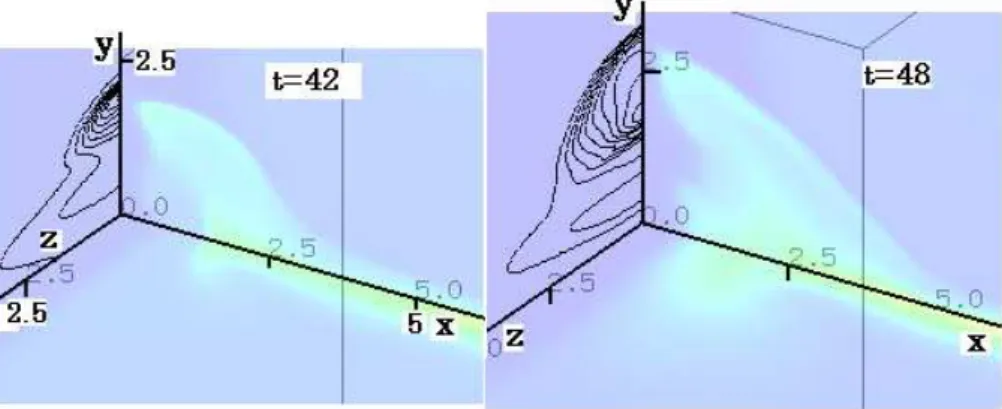
M. Ugai
Research Center for Space and Cosmic Evolution, Ehime University, Matsuyama 790-8577, Japan
Received: 6 August 2008 – Revised: 17 September 2008 – Accepted: 20 October 2008 – Published: 2 December 2008
Abstract.The fast reconnection mechanism, involving slow shocks and Alfv´enic fast plasma jets, is most responsible for the explosive conversion of magnetic energy associated with geomagnetic substorms and solar flares. In this pa-per, the spontaneous fast reconnection model is applied to well-known phenomena of substorms. When the east-west width of the tail current sheet becomes 3–4 times larger than its north-south thickness, the fast reconnection mechanism can fully be established, which may lead to substorm onset. The resulting Alfv´enic jet can exactly explain, both quali-tatively and quantiquali-tatively, the in-situ satellite observations of the traveling compression regions (TCRs) associated with large-scale plasmoids propagating down the tail. Also, the earthward fast reconnection jet causes drastic magnetic field dipolarization, so that the sheet current ahead of the mag-netic loop of closed field lines suddenly turns its direction toward the loop footpoint and a large-scale current wedge is formed according to the growth of field-aligned currents. It is demonstrated that an MHD generator arises ahead of the magnetic loop and drives the current wedge to distinctly en-hance the current density in a pair of thin layers of the loop footpoint, giving rise to drastic heating in the form of two ribbons.
Keywords. Magnetospheric physics (Storms and sub-storms) – Solar physics, astrophysics, and astronomy (Flares and mass ejections) – Space plasma physics (Magnetic re-connection)
1 Introduction
The fast reconnection mechanism, involving Alfv´enic plasma jets, must be most responsible for flare phenomena in space plasmas (Shibata, 1999; Sharma et al., 2008). Then, question is how the fast reconnection mechanism can be re-Correspondence to:M. Ugai
alized as an eventual solution of MHD equations in high-temperature plasmas of extremely large magnetic Reynolds number. A possible fast reconnection configuration was first proposed by Petschek (1964) on the basis of two-dimensional (2-D) steady MHD equations, and it was supposed that the diffusion region size would be controlled by external bound-ary conditions. Hence, most of the theoretical studies have been directed to looking for such a fast reconnection solution that can be realized without significant influence of plasma resistivity (Vasyliunas, 1975; Priest and Forbes, 1986).
On the other hand, it was demonstrated for the first time that the fast reconnection mechanism can be realized when a localized resistivity is applied (Ugai and Tsuda, 1977). Hence, we have proposed the spontaneous fast reconnec-tion model and demonstrated by 2-D and three-dimensional (3-D) simulations that the fast reconnection mechanism can be realized as an eventual solution of MHD equations by the nonlinear instability due to positive feedback between current-driven anomalous resistivities and global reconnec-tion flows (Ugai, 1984, 1999; Ugai and Zheng, 2005). In fact, if there is no effective resistivity, extreme current sheet thinning occurs because of nonlinear pinch effects (Ugai, 1986, 2008b), which may cause anomalous resistivities due to current-driven microturbulences (Lui, 2001). Since the fast reconnection evolution is so poweful, we have called this process “spontaneous reconnection”, but it might also be called “undriven reconnection” (Daughton et al., 2006).
3876 M. Ugai: Substorm onset by the fast reconnection mechanism
Fig. 1. Magnetic field and plasma flow configuration for the uni-form resistivity model withη=0.001.
Fig. 2.Magnetic field and plasma flow configuration for the anoma-lous resistivity model (Eq. 4) withVC=12, where the velocity scale is the same as in Fig. 1.
2 Simulation modeling
The compressible MHD equations are
Dρ/Dt= −ρ∇ ·u, ρDu/Dt= −∇P +J×B,
∂B/∂t− ∇ ×(u×B)= −∇ ×(ηJ), (1) ρDe/Dt= −P∇ ·u+ηJ2,
J= ∇ ×B/µ0, ∇ ·B=0,
whereD/Dt≡∂/∂t+u·∇; the gas law, P=(γ−1)ρe, is as-sumed [eis the internal energy per unit mass, andγ is the specific heat ratio withγ=5/3 assumed here (an adiabatic case)], as is Ohm’s law,E+u×B=ηJ(ηmay be an effective resistivity).
An antiparallel magnetic field B=[Bx(y),0,0] is
ini-tially assumed as: Bx(y)=sin(πy/2) for 0<y<1; Bx=1
for 1<y<4;Bx=cos[(y−4)π/1.2]for 4<y<4.6;Bx=0 for
Fig. 3. Magnetic field and plasma flow configurations for the anomalous resistivity model (Eq. 4) withVC=12 in an open sys-tem; in the upper panel, the plasmoid is shown by the isosurface of plasma pressure.
y>4.6; also, Bx(y)=−Bx(−y) for y<0. Fluid velocity
u=(0,0,0), and plasma pressureP (y)satisfies the pressure-balance condition,
P +Bx2=1+β0, (2) whereβ0is the ratio of the plasma pressure to the magnetic pressure in the ambient magnetic field region 1<y<4, so that P (y=0)=1+β0 initially (β0=0.15 is taken throughout the present studies). Also, plasma densityρinitially satisfies ρ=P /(1+β0). (3) The normalization of quantities, based on the initial quan-tities, is self-evident: Distances are normalized by the cur-rent sheet half-thicknessd0,BbyBx0,P byP0=Bx20/(2µ0); also, ρ by ρi=ρ(y=0), u by VAx0(=Bx0/√µ0ρi), time t by d0/VAx0. The Alfv´en velocity in the ambient
mag-netic field region (1<y<4) is given byVAe=VAx0/√ρe∼2.7
[ρe=β0/(1+β0)], and the normalized temperature is given by T=P /ρ=1+β0. Here, the conventional symmetry boundary conditions are assumed on thez=0,x=0 andy=0 planes. Hence, the computational region can be restricted to the first quadrant only and taken to be a rectangular box, 0≤x≤Lx, 0≤y≤Ly, and 0≤z≤Lz.
The effective resistivity for the Ohm’s law (normalized by µ0d0VAx0) should be provided by current-driven anomalous
resistivities in space plasmas and may be assumed as, ηD(r, t )=kd[Vd(r, t )−VC] forVd > VC,
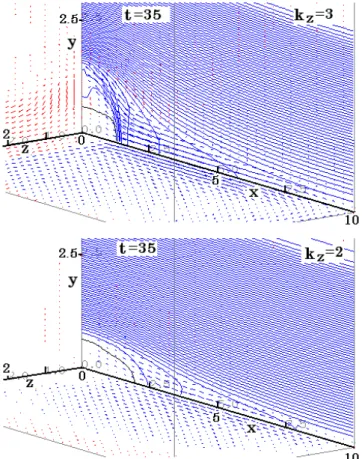
Fig. 4.Magnetic field and plasma flow configuration for the anoma-lous resistivity model (Eq. 4) withVC=4 for the caseskz=2 and 3 in Eq. (5).
whereVd(r, t )= |J(r, t )/ρ(r, t )|is the relative electron-ion
drift velocity andVCthe threshold (here,kd=0.003 is taken).
In order to disturb the initial configuration, a localized re-sistivity is assumed atx=dx,
η(r)=η0exp[−[(x−dx)/ kx]2−(|y |/ ky)3−(|z|/ kz)3],(5)
which provides a seed of magnetic reconnection. Here, we take η0=0.02 and kx=ky=0.8. This reconnection
distur-bance is imposed only in the initial time range 0<t <4, and the resitivity model will be assumed fort >4.
The numerical procedure for solving the full MHD equa-tions is simple and the same as in our earliest papers (Ugai, 1988, 2008b). Throughout our reconnection studies, the nu-merical parameters have been carefully chosen, so that the numerical resistivity is much smaller than the physical resis-tivity (Ugai, 2008b). Here, the mesh sizes are taken to be
△x=0.04,△y=0.015, and△z=0.1 or△z=0.05.
3 Spontaneous fast reconnection model
If there is no dissipation mechanism (effective resistivity), initiated by the reconnection disturbance (Eq. 5), drastic cur-rent sheet thinning occurs, leading to extreme increase in
Fig. 5. ISEE 3 magnetic field observations taken in the north lobe of the tail atx=−73RE in GSM coordinates (after Slavin et al., 1993).
the current density (Ugai, 1986, 2008b). If there is an ef-fective resistivity, the current density increase around the X point may be suppressed, and magnetic reconnection builds up. We have demonstrated that the reconnection process is strongly influenced by the resistivity model (Ugai, 1992). For the Spitzer resistivity model, the resistivity becomes re-duced at the X point because of the temperature increase by the reconnection, so that the associated reconnection is less effective than that for the uniform resistivity model (Ugai, 1992; Ugai and Zheng, 2005).
First, let us take the uniform resistivity model withkz=5
and dx=Lx=10 in Eq. (5) (△z=0.1), and the symmetry
boundary condition is imposed on thex=10 plane. In this case, no explicit numerical dissipation term is needed, and magnetic reconnection starts immediately fort >4. Figure 1 shows the resulting magnetic field and plasma flow config-uration and indicates that no effective reconnection occurs. In what follows, some numerical dissipations must be intro-duced for the fast reconnection mechanism, and the associ-ated numerical resistivity ηN can be estimated by
examin-ing the numerical reconnection with zero physical resistivity. Then, we find that it works like a uniform resistivity with ηN∼0.0005 for the present parameter values (Ugai, 2008b).
For the anomalous resistivity model (Eq. 4) withVC=12,
3878 M. Ugai: Substorm onset by the fast reconnection mechanism
Fig. 6. Temporal variations of magnetic fields observed by virtual satellites located in the magnetic field (low-β) region, whereBx, By andBzin the simulation coordinates correspond to−Bx,−Bzand −By, respectively, in GSM coordinates.
On the other hand, if the outflow jet can freely flow in an open system, a large-scale plasmoid is formed ahead of the jet and propagates along the magnetic field (Ugai, 1989, 1995). Hence, when thex=Lx=20 plane is assumed to be
the free boundary withdx=0 in Eq. (5), Fig. 3 shows the
re-sulting 3-D plasmoid structure, inside which the plasma pres-sure is notably enhanced (Ugai and Zheng, 2005). Note that unlike the conventional plasmoid magnetic field lines are not necessarily closed inside the plasmoid, since this plasmoid is driven and sustained by the Alfv´enic fast reconnection jet.
The fast reconnection mechanism can fully be realized when thezdirectional current sheet width is 3–4 times larger than itsydirectional thickness (Ugai, 2007a). Hence, it may be instructive to see the reconnection processes forkz≤3 in
Eq. (5) with the other conditions being the same as in Fig. 2 except thatVC=4 in Eq. (4) and△z=0.05. Figure 4 shows
the resulting configurations; forkz=2, no effective
reconnec-tion occurs, since the outflow jet can hardly be accelerated. Forkz=3, the reconnection jet is considerably accelerated
but soon redued before it attains the Alfv´en velocity. For these cases, the ambient magnetized plasma cannot effec-tively collapse into the X region, so that the fast reconnection mechanism cannot be realized (Ugai, 2008b).
If a thin current sheet of sufficiently large scale is formed, initiated by a reconnection disturbacne, current sheet thin-ning drastically occurs to distinctly enhance the current den-sity. For simulation studies, the enhanced currents may be suppressed by effective physical and/or numerical resistiv-ities. Hence, in performing reconnection simulations, it is essential to relevantly choose the parameter values so that the numerical resistivity is much smaller than the physi-cal resistivity. Throughout our MHD simulations, the nu-merical resistivity, estimated to be ∼0.0005, is found to be much smaller than the physical (anomalous) resistivity (Ugai, 2008b).
Fig. 7.Current flow lines starting from the segment, 2.16<x<2.72 aty=0.27 andz=13 for the case ofkz=7 in Eq. (5).
4 Applications to substorms and flares
The spontaneous fast reconnection model may be applied to well-known phenomena observed in geomagnetic substorms and solar flares. Since many distinct phenomena character-izing substorms and flares are associated with macroscopoic quantities, they should be explained by MHD equations.
4.1 Traveling compression regions
It is well known by satellite observations that according to substorm onset a large-scale plasmoid is formed and prop-agates down the geomagnetic tail, and as a clear evidence of substorm, the so-called traveling compression regions (TCRs) are observed. Slavin and his colleague have system-atically studied TCR events for many years, and Fig. 5 shows the typical observed magnetic field variations, which indicate the pulse-like compression of the earthward (Bx) field
com-ponent as well as the northward to the southward tilting of the Bzfield component (Slavin et al., 1993). This TCR signature,
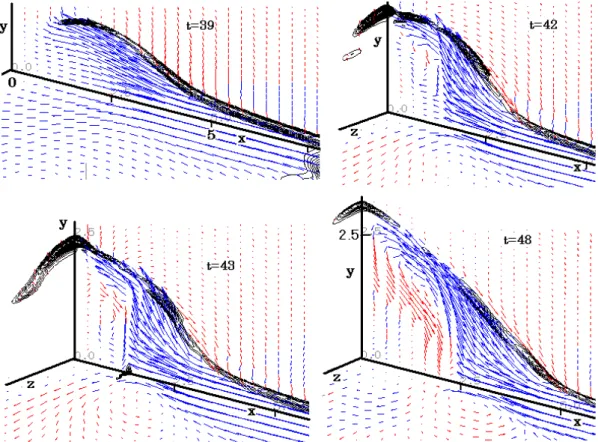
Fig. 8.Plasma flow vectors and distributions of the joule heatingηJ2.
The spontaneous fast reocnnection model in an open sys-tem (Fig. 3) can readily be applied to the TCR signatures (Ugai and Zheng, 2006a, b), so that Fig. 6 shows the tempo-ral behaviors of the magnetic field components observed by a virtual satellite located in the ambient magnetic field (lobe) region in the simulation box (Fig. 3). We readily see that the temporal field variations observed by the virtual satellite are, both qualitatively and quantitatively, in good agreement with the TCR signatures. We hence conclude that the TCR obser-vations provide a definite evidence that the fast reconection mechanism is in fact realized in the tail current sheet during substorms.
4.2 Substorm current wedge
If the fast reconnection builds up somewhere in the magneto-tail, it should extend in both the earthward and tailward direc-tions. In fact, in association with substorms, distinct plasma processes are observed in the near-Earth magnetotail, such as strong earthward jet and magnetic field dipolarization. In particular, it has long been believed that the near-Earth tail sheet current is suddenly disrupted so that a large-scale cur-rent wedge evolves and links the tail sheet curcur-rent to the au-roral electrojet through field-aligned currents (McPherron et al., 1973). Since there have been many observational evi-dences supporting this idea, it is essential for substorm
stud-ies to clarify the physical mechanism of current wedge evo-lution.
For this long-standing question, we take dx=Lx=10 in
Eq. (5), and the symmetry boundary condition is imposed on thex=Lxboundary for the resistivity model (Eq. 4) with VC=12 (Ugai and Kondoh, 2006; Ugai, 2007a). We then find
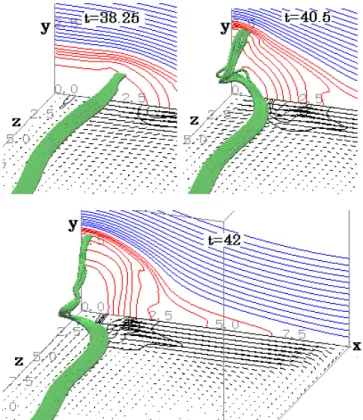
that when the fast reconnection jet collides with the magnetic loop of closed field lines, field-aligned currents suddenly ap-pear because of drastic increase in the sheared fieldBzinside
the loop, leading to drastic evolution of the current wedge. Figure 7 typically shows the current flow lines for the case of kz=7 in Eq. (5) and indicates that the current, initially
flow-ing into the current sheet, suddenly turns its direction toward the loop footpoint, where currents are locally concentrated and intensified.
3880 M. Ugai: Substorm onset by the fast reconnection mechanism
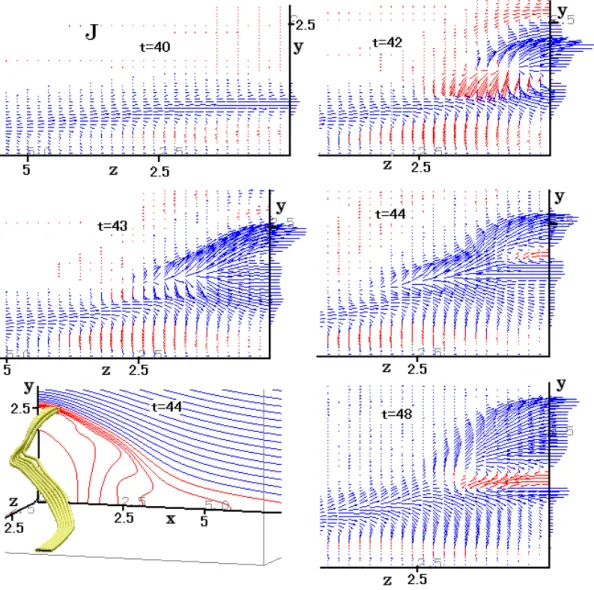
Fig. 9.Current density vectors at different times in the chromosphere (x=0). In the left bottom, the current wedge formation is shown.
to model the solar surface and examine the basic effects of the current wedge evolution.
4.3 Two-ribbon flares
The solar surface may be modeled as follows (Ugai, 2007b, 2008a): Plasma densityρinitially satisfies
ρ(x, y)= {R0exp[−(x/0.4)4] +1}P (y)/(1+β0), (6) whereR0=100 is taken, and thex=0 plane corresponds to the chromosphere, and the corona is for x≫0.4. Also, in addition to the resistivity model (4), we may take another anomalous resistivity model
ηJ(r, t )=kj[|J(r, t )| −JC]n for|J|> JC.
=0 for|J|< JC, (7)
wheren=2,JC=3 andkj=0.0001 are assumed. Hence, we
may generally take the resistivity model,
η=ηS+ηD+ηJ, (8)
whereηS=ηC(T /T0)−1.5is the Spitzer resistivity (T=P /ρ is the temperature andT0=1+β0the initial coronal tempera-ture; also,ηC=0.0000001 is assumed). The other conditions
are taken to be quite the same as in Sect. 4.2.
Fig. 10.Temperature distributions in the corona and in the chromosphere (x=0) by contour lines at different times.
chromosphere may enhance the temperature. Hence, Fig. 10 shows the temperature distributions and indicates that the chromospheric temperature becomes more than 20 times its initial value.
We see from Fig. 10 that the chromospheric temperature is suddenly enhanced in the shape of two ribbons (due to symmetry boundaries), and the chromospheric region of en-hanced temperature becomes wider and shifts upward with time. Also, the flare loop of high temperature expands out-ward in the corona, and the significant chromospheric evap-oration occurs (Fig. 8) because of the pressure enhancement in the chromosphere. These features are consistent with the well-known morphological features of two-ribbon flares.
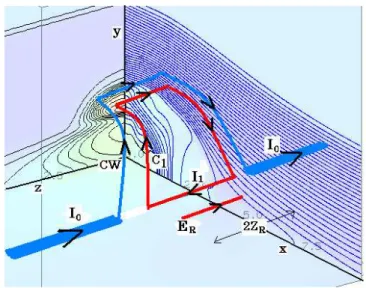
Then, an important question is how the current wedge can build up. In this respect, we find that there is an MHD gen-erator ahead of the magnetic loop, whereE·J∼u·(J×B)<0. Figure 11 shows the current flow lines that pass through the generator region and indicates that a generator current cir-cuit is formed. We hence conclude that the MHD genertor ahead of the magnetic loop drives the current wedge. Also, global MHD simulations have suggested that the magnetic field dipolarization and the generation of sheared fields in-side the loop are fundamental for the current wedge evolu-tion (Raeder and McPherron, 1998; Janhunen and Palmroth, 2001). Hence, Fig. 12 shows the magnetic field lines that pass through the spatial points on they-directional line at x=0 andz=1.5. We in fact see that when the fast reconnec-tion jet collides with the loop at timet∼42, the field lines inside the loop are distinctly sheared, giving rise to field-aligned currents to form the current wedge (Fig. 11).
5 Summary and discussion
Any theoretical model responsible for geomagnetic sub-storms must relevantly explain the well-known basic fea-tures that have been clarified by observations. Hence, the spontaneous fast reconnection model is applied to substorms and flares. It is demonstrated that the in-situ satellite
ob-Fig. 11. (a)Current flow lines, denoted byC1, that pass through the
generator region ahead of the loop top, and in(b)the current wedge (CW) that is formed simultaneously is also shown.
3882 M. Ugai: Substorm onset by the fast reconnection mechanism
Fig. 12.Magnetic field lines that pass through the spatial points on they-directional line atx=0 andz=1.5.
loop of closed field lines to cause drastic evolution of mag-netospheric current wedge (Ugai and Kondoh, 2006; Ugai, 2007a). Recently, it is shown that satellite observations of earthward fast flows can well be explained by this theoreti-cal model (Kondoh and Ugai, 2008). Regarding solar flares, it is shown that the chromospheric temperature is suddenly enhanced in the shape of two ribbons, and the resulting coro-nal flare loop is expanding outward; also, the definite chro-mospheric evaporation occurs because of the distinct joule heating in the chromosphere (Ugai, 2007b, 2008a). These are consistent with the well-known morphological features of two-ribbon flares.
Figure 13 schematically shows how the current wedge is driven by the MHD generator ahead of the magnetic loop. Although the complicated ionospheric boundary conditions are not pertinently considered, the underlying physical mech-anism shown in Fig. 13 should be applicable to geomagnetic susbtorms. For instance, the MHD generator ahead of the loop will be crucial for sustaining field-aligned electric fields to accelerate nonthermal particles, although particle accel-erations cannot be treated by MHD equations. Apparently,
Fig. 13. Schematic drawing of the current circuitC1, connected
to the MHD generator ahead of the loop top; here,ER(∼−u×B) is the reconnection electric field, 2ZRis the extent where the fast reconnection proceeds,I0is the initial coronal sheet current, and
some part ofI0becomes the current wedge,CW.
there are many similarities in the basic physics between solar flares and geomagentic substorms, so that we may conclude that both flares and substorms result from the same physical mechanism, i. e., the fast reconnection mechanism.
Acknowledgements. This work was supported by Grant-in-Aids for Creative Scientific Research “The Basic Study of Space Weather Prediction” (17GS0208, Head Investigator: K. Shibata) from the Ministry of Education in Japan, Mitsubishi Foundation, RISH of Kyoto University, and Solar-Terrestrial Environment Laboratory of Nagoya University.
Topical Editor R. Nakamura thanks two anonymous referees for their help in evaluating this paper.
References
Daughton, W., Scudder, J., and Karimabadi, H.: Fully kinetic sim-ulations of undriven magnetic reconnection with open boundary conditions, Phys. Plasmas, 13, 072101, 2006.
Isobe, H., Miyagoshi, T., Shibata, K., and Yokoyama, T.: Filamen-tary structure on the sun from the magnetic Rayleigh-Taylor in-stability, Nature, 434, 478–481, 2005.
Janhunen, P. and Palmroth, M.: Some observational phenomena are well reproduced by our global MHD while others are not: Re-marks on what, why and how, Adv. Space Res., 28, 1685–1691, 2001.
Karlicky, M.: Electron beam bombardment of the chromosphere in a flare loop with electric currents, Astron. Astrophys., 298, 913– 916, 1995.
425–439, 1964.
Priest, E. R. and Forbes, T. G.: New models for fast steady state magnetic reconnection, J. Geophys. Res., 91, 5579–5588, 1986. Raeder, J.: Global magnetohydrodynamics – A tutorial, in: Space
Plasma Simulation, edited by: Buchner, J., Dum, C., and Scholer, M., Lecture Notes in Physics, 615, 212–246, 2003.
Raeder, J. and McPherron, R. L.: Global MHD simulations of the substorm current wedge and dipolarization, in: Substorms-4, p. 343–348, 1998.
Sharma, A. S., Nakamura, R., Runov, A., et al.: Transient and lo-calized processes in the magnetotail: Review, Ann. Geophys., 26, 955–1006, 2008,
http://www.ann-geophys.net/26/955/2008/.
Shibata, K.: Evidence of Magnetic Reconnection in Solar Flares and a Unified Model of Flares, Astrophys. Space Sci., 264, 129– 144, 1999.
Slavin, J. A., Smith, M. F., Mazur, E. L., et al.: ISEE 3 observations of traveling compression regions in the Earth’s magnetotail, J. Geophys. Res., 98, 15 425–15 446, 1993.
Ugai, M.: Self-consistent development of fast magnetic reconnec-tion with anomalous plasma resistivity, Plasma Phys. Controlled Fusion, 26, 1549–1563, 1984.
Ugai, M.: Global dynamics and rapid collapse of an isolated current-sheet system enclosed by free boundaries, Phys. Fluids, 29, 3659–3667, 1986.
Ugai, M.: MHD simulations of fast reconnection spontaneously de-veloping in a current sheet, Computer Phys. Commun., 49, 185– 192, 1988.
2008a.
Ugai, M.: The evolution of fast reconnection in a three-dimensional current sheet system, Phys. Plasmas, 15, 082306, 2008b. Ugai, M. and Tsuda, T.: Magnetic field-line reconnexion by
local-ized enhancement of resistivity. Part 1. Evolution in a compress-ible MHD fluid, J. Plasma Phys., 17, 337–356, 1977.
Ugai, M. and Zheng, L.: Conditions for the fast reconnection mech-anism in three dimensions, Phys. Plasmas, 12, 092312, 2005. Ugai, M. and Zheng, L.: Modeling of traveling compression regions
in the Earth’s magnetotail by the spontaneous fast reconnection model, Phys. Plasmas, 3, 032901, 2006a.
Ugai, M. and Zheng, L.: Parametric studies on traveling compres-sion regions observed in the Earth’s magnetotail, Phys. Plasmas, 13, 062906, 2006b.
Ugai, M. and Kondoh, K.: Evolution of magnetospheric current wedge by the spontaneous fast reconnection model, Phys. Plas-mas, 13, 102903, 2006.
Uzdensky, D. A.: Petschek-like reconnection with current-driven anomalous resistivity and its application to solar flares, Astro-phys. J., 587, 450–457, 2003.
Vasyliunas, V. M.: Theoretical models of magnetic field line merg-ing, Rev. Geophys. Space Phys., 13, 303–336, 1975.