*Corresponding author, : [email protected]; +386 31612529; *Cankarjeva cesta 5, SI – 1370 Logatec, Slovenia
*
MODULATION OF MOTORIC PROCESSES ON
THE BASIS OF TAIJIQUAN MOVEMENT PRINCIPLES
Jernej Sever*
Center premik Ltd. Ljubljana, Slovenia
DOI: 10.7906/indecs.12.4.4 Regular article
Received: 24 October 2014. Accepted: 28 October 2014.
ABSTRACT
Taijiquan (TJQ) is a Chinese martial art, in the West known primarily as a stand-alone version of moving meditation, which was developed mainly on the experience of martial art. The main goal of TJQ as a martial art is to control the opponent’s balance with as little force as possible and can be described with the well-known metaphor that “4 ounce can defeat 1000 ounce.” This metaphor usually stands for a special effect in TJQ, called fajing. To understand the basic movement principles of TJQ we have to analyse the experience itself. On the basis of first- person analysis, we designed a number of pilot and one extensive study. In this article we will present an intervention method that uses TJQ movement principles to modulate motoric (MM) process and produces the fajing effect – which usually takes years of proper exercise – in just 15 to 20 minutes. A pilot study was designed to measure the influence of MM method on our movement. The participants had to use each arm to work on a different task. They used one arm to move the computer mouse and the cursor on the computer screen trying to catch the marker on the screen as fast and as accurately as possible. The other arm was interfered with constant steady movement forward-backward in the lateral direction. We measured the accuracy and speed of movement before and after the intervention. It turned out that the participants were more accurate in performing their task after the MM intervention than before it. Before the intervention the accuracy was 0,443 ± 0,058 and after the intervention it improved to 0,498 ± 0,053, p < 0,01. The participants could follow the disturbances much more easily after the MM intervention, they could concentrate more on their task and they were better in using their arms separately.
KEY WORDS
taijiquan, motoric processes, embodiment, intervention, learning
CLASSIFICATION
306
INTRODUCTION: ANALYSING COMPLEX EXPERINCE OF TJQ
Taijiquan (TJQ) is a Chinese martial art, in the West known primarily as a stand-alone version of moving meditation, which includes slow and controlled movements, usually practised through defined exercise sequence, known as a TJQ form. TJQ uses a special kind of movement principles, which are different from every-day movement. The step in TJQ compared with ordinary slow step provides a longer stand on one leg, an increased range of motion leg joints, longer operation times and co-activation of isometric muscles [1]. Different research papers have shown that TJQ gait can be effective in improving flexibility, and can contribute to better static balance [2]. The TJQ exercise can reduce fear and the possibility of falling in older people [3]. Although quite some research papers deal with some of the consequences of the TJQ exercise, they are usually not concentrated on understanding the basic principles of TJQ.
The stand-alone version of TJQ was developed primarily on the experience of martial art. The main goal of TJQ as martial art was to control our own and the opponent’s balance and is trained through exercise in pairs. The basis of the exercise in pairs is keeping constant contact with the fighting partner. By pushing, pulling and reflecting the participant tries to manipulate the relationship between the centre of mass (COM) and the base of support (BOS) of his or her fighting partner [4]. The ideal of effectiveness in TJQ is to control the opponent’s balance with as little force as possible and can be described with the well-known metaphor that “4 ounce can defeat 1000 ounce” [5, 6]. This metaphor usually stands for a special effect in TJQ called fajing. We talk about fajing effect when we prepare our partner to lose balance, or to bounce to maintain their balance, with very little force on our part. To achieve the fajing effect all the basic principles of TJQ should be fulfilled.
307 PHENOMENOLOGICAL RESEARCH OF TJQ AND FORMING THE EXPERIMENTS
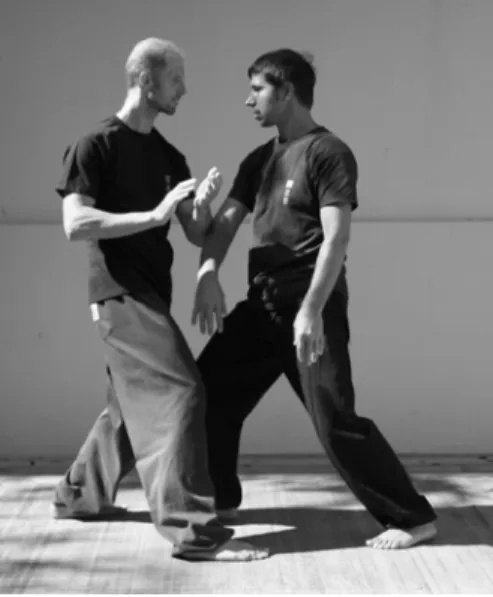
To design proper experiments we had to understand the TJQ experience on the level of the first person. We used phenomenological approach [9]. The method we used in describing the TJQ experience is similar to descriptive experience sampling method, which was introduced by Hurlburt and Heavey [10]. In this method, the participant must, at random intervals, freeze current experience and write down a brief description of experiences into a notebook. By analyzing TJQ, freezing occurs based on the perception of muscle tension or stiffness of the body that happens in the process of interaction between fighting partners. Because we focused mainly on sensoric awareness and interaction with the partner, we called this type of research first- person situational analysis.
Figure 1.First person analysis in TJQ.
Based on the first-person analysis, we designed a number of pilot studies and an extensive one. We used an innovative method for measuring the stability after the sudden release of horizontal forces, which enabled us to observe physical reactions in a controlled environment. Loading and sudden release of the load produced similar situation that we face in contact with a partner. We have developed a special method to modulate the motoric processes (MM method). A pilot study on the effects of MM method, also called a JMV method [8], will be presented in this paper. On the basis of this method we have managed to produce the fajing effect in 15 to 20 minutes.
TJQ PRINCIPLES OF BODY STABILITY
308
amplitudes [8]. We can conclude that TJQ-G used a different movement strategy and consequently produced lover forces on the ground. Less intensive response can also mean that the TJQ-G can regain conscious control over the movement faster than the CO-G. The TJQ-G reacted according to the basic TJQ principles.
DISTAL MOBILITY AND MODELLING OF MOTORIC PROCESS
At the level of proximal stability the results revealed yet another important difference. There is a big difference in the ratio of intensity of Fz response in the case of arms and shoulders release. TJQ-G group had a much better relationship between the response at the level of shoulders and arms than the CO-G. Fz amplitude for arms release amounts just 70 % of the shoulder release amplitude. For the CO-G the figure is 92% [8]. Based on these differences we can conclude that the CO-G had almost the same response after the shoulder and arms release. The participants from CO-G were not able to use additional joints in the case of arm loading to compensate the sudden release. TJQ-G therefore proved to have better mobility of the distal joints.
These results indicate another basic principle of TJQ movement. When we move, we have to keep our body straight, to produce less intensive reactions after disturbances, and we have to keep our arms as free as possible to move. In TJQ classical literature we can find many descriptions and metaphors that deal with the relationships between the arms and the torso. This is one of them:
“Drape the shoulders and sink the elbows; Rise the back and relax the chest” [6; p.50]
To master TJQ principles TJQ students usually need years of proper exercise. But because of the complexity of movement principles and different interpretations it is quite possible that they will miss the described goal. On the basis of the first- person analysis of TJQ experience we expected that we could design a new method which would at least temporarily produce the desired effects. MM method uses TJQ learning principles and movements and brings them into controlled environment, where the participant has constant feedback. With manipulation of muscle coordination, muscle stiffness and muscle synergies we try to achieve a state described with the metaphor “drape the shoulders and sink the elbows”. Following this goal the MM method produced fajing effect in just 20 minutes. The effect was temporal and was usually lost after some trials. That means that participants have not learned a new way of movement, they just got the right experience. On the basis of this experience the learning process can be more efficient and faster. The MM method can give us new experience of movement and can help in learning processes. To understand the influence of MM method on our motoric patterns, we designed a pilot study.
THE PILOT STUDY: HOW DOES MM METHOD INFLUENCE OUR
MOTORIC PATTERNS
EXPERIMENT SETUP
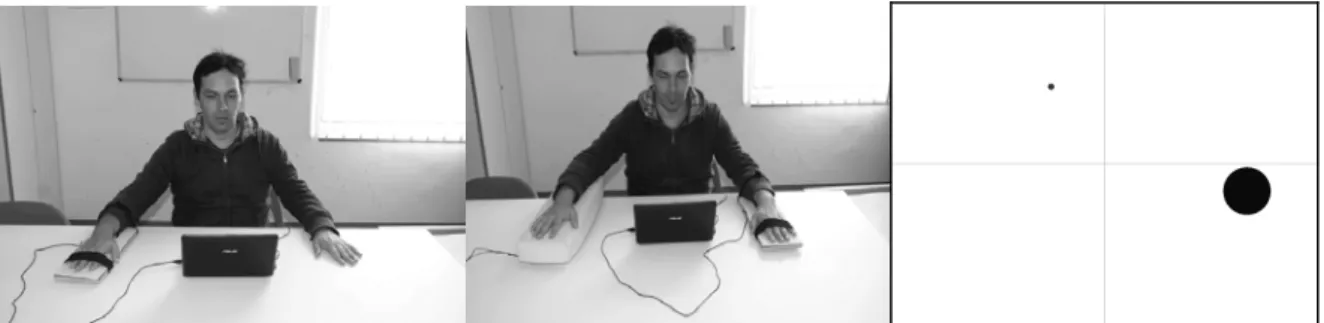
309 installed a computer mouse in a moving plate and with elastic belts immobilize the arm from the elbow to the wrist (Figure 2.). The designed task was composed of thirty circles of three different sizes. We started with large circles, continued with smaller ones and concluded with the smallest circles. The circles occurred randomly on the screen. To complete the task, the participant had to move the mouse cursor inside the circle as fast and as accurately as possible, and he had to keep the cursor inside the circle for 3 second. Then another circle appeared. The participant finished the task when they hit all 30 circles.
Figure 2. Experiment design, first protocol (left), second protocol (middle), large circle task on computer screen (right).
The study consisted of two separate protocols. In the first protocol we tried to determine the effects of the MM method on the accuracy and speed of the cursor on the hand where we preformed MM intervention. In the second task, we disturbed the hand where we performed intervention with a constant steady movement forward - backward in the lateral direction, and the participant performed the accuracy test with the opposite arm. The speed and the accuracy of movement was calculated with TheraWii program. In the pilot study, five participants – two women and three men – participated in both protocols. The tasks were done before and after the intervention.
THE INTERVENTION PROCESS – THE MOTORIC PROCESSES MODULATION METHOD
The basic components of the MM method are established on the basis of first person analysis of TJQ experience and on the basis of understanding the basic principles of TJQ movement. To achieve the desired goal “drape your shoulders” we included also other known approaches to MM method, especially Feldenkreis and PNF (proprioceptive neuromuscular facilitation stretching) approach. We can expose the main components of MM method in four main areas: 1) Partial local elimination of the need to resist gravity forces (in our case relaxing elbows on the vibration plate and keeping the participant’s torso straight),
2) Gentle vibration in the range between 2 and 7 Hz with a medium-sized amplitude (1 cm – 3 cm), 3) Using a vibration plate to move the relaxed part of the body, in our case the arm, in different directions, with smooth circular or linear movement. The movement can be done manually or mechanically,
4) Relax and extend principle. Extending one muscle or chains of muscles to slight stiffness, relaxing the muscle with self- awareness or with PNF method, and further extend the muscle or muscle chains.
310
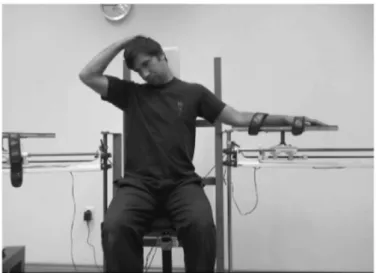
arm further until the participant feels a new tension (Figure 3). We increased the distance for three to five times in each direction. The MM method can be done also with a computer regulated movement. In this case extension of muscle is carried out until the value on the force sensor exceeds the predetermined value. After the relaxation, the distance is increased automatically until the force sensor value is exceeded. The vibration process is a constant part of the MM method. In the last phase of intervention we performed a slow in smooth movement of the arm in different directions. In our case the intervention was carried out for 15 minutes.
Figure 3. Modulation of motoric process on the basis of MM method.
DATA ANALYSIS
The program TheraWii calculates different values that relate to the motion of the cursor before successfully completing the task. In our case, we focus on two figures: the average speed of movement (V), whose calculation is based on the distance and the time that the indicator needs to achieve the goal, and accuracy (U), which is calculated on the basis of the relationship between the calculated shortest path and actual travelled distance between cursor position and its targeted circle. We used the program to calculate the average value for each of ten tasks and for each size of the circle. On the basis of the calculated averages for each person and each size of the circle, we compared the values before and after the intervention. We calculated the standard deviation. The statistical significance was measured with the two-way t-test. In the results of the main comparison (Table 1) 300 measurements before and after the intervention were included. In addition, we calculated the correlation between speed and efficiency values before and after the MM method intervention. Because we were interested in the difference between the speed and efficiency of large and small circles, we calculated the average value for small and large circles and then compared them.
RESULTS
311 The accuracy of movement could also affect the speed, but it does not show a statistically significant difference between the speeds before and after the intervention (Table 1). In both protocols the speed remained fairly similar. When we compare the accuracy of movement for large and small circles we can see that the only difference that is near statistical significance
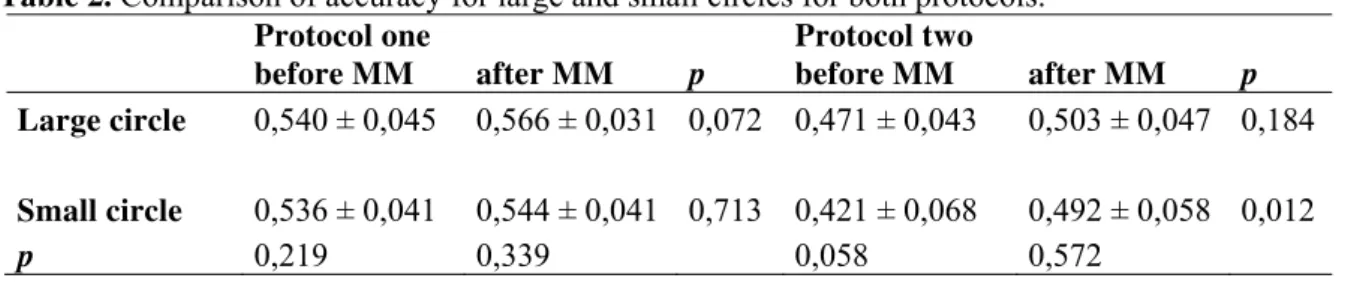
p = 0,058, is in the case of second protocol before the MM intervention (Table 2). The movement is much less accurate in the case of small circle when the task is more difficult. On the other side there is almost no difference between accuracy at the level of big and small circles after the MM intervention, the values are 0,503 ± 0,047 and 0,492 ± 0,058, p = 0,572 (Table 2).
Table 1. Comparison of accuracy and speed before and after the MM intervention for both protocols.
Protocol one p Protocol two p
before MM after MM before MM after MM
Accuracy 0,539 ± 0,042 0,548±0,04 0,379 0,443±0,058 0,498±0,053 0,000 Speed 0,612 ± 0,077 0,615±0,09 0,871 0,608±0,091 0,604±0,077 0,864
Table 2. Comparison of accuracy for large and small circles for both protocols. Protocol one
before MM after MM p
Protocol two
before MM after MM p
Large circle 0,540 ± 0,045 0,566 ± 0,031 0,072 0,471 ± 0,043 0,503 ± 0,047 0,184
Small circle 0,536 ± 0,041 0,544 ± 0,041 0,713 0,421 ± 0,068 0,492 ± 0,058 0,012
p 0,219 0,339 0,058 0,572
CONCLUSION
312
With the pilot study we showed to some extend that MM method can temporarily change our motoric patterns, can produce a fajing effect in a very short time, and enables using both arms separately more easily. Because the effect of MM method is lost after some time, it cannot substitute the slow motoric learning process. To learn new motoric skills several proper repetitions are needed. The MM method can help us get the right experiences and include them in our learning. The method is not limited only to understanding the TJQ, but can also help us influence or change our every-day motoric patterns.
REFERENCES
[1] Wu, G.; Liu, W.; Hitt, J. and Millon, D.: Spatial, Temporal and Muscle Action Patterns of Tai Chi Gait.
Journal of Electromyography and Kinesiology 14(3), 343-354, 2004, http://dx.doi.org/10.1016/j.jelekin.2003.09.002,
[2] Ding, H.Y. and Hui, X.Y.: The Effect of Tai Chi Intervention on Balance in Older Males. Jurnal of Sport and Health Science 1(1), 57-60, 2012,
http://dx.doi.org/10.1016/j.jshs.2012.03.001,
[3] Strawberry, K. and Gatts, M.H.W.: How Tai Chi Improves Balance: Biomechanics of Recovery to a Walking slip in Impaired Seniors.
Gait & Posture 25(2), 205-214, 2006,
http://dx.doi.org/10.1016/j.gaitpost.2006.03.011,
[4] Sever, J.: Empirične in fenomenološke razsežnosti utelešenja in umeščenosti v okolje v tradiciji Taiji quana. In Slovenian.
Analiza – Ljubljana, 43-57, 2012/2013,
[5] Ching, M.C.: Cheng Tzu's Thirteen Treatises on T'ai Chi Ch'uan. Blue Snake Books, 1992,
[6] Wile, D.: Lost T'ai-chi Classics from the Late Ch'ing Dynasty. State University of New York Press, Albany, 1996,
[7] Clark, A.: Mindware: An Introduction to the Philosphy of Cognitive Science. Oxford University Press, New York and Oxford, 1998,
[8] Sever, J.: Framing Taijiquan Experience.
Proceedings of the 17th International Multiconference, Information Society -IS 2014, Volume C, Ljubljana, 61-65, 2014,
[9] Sokolowski, R.: Introduction to Phenomenology. Cambridge University Press, Cambridge, 2008,
[10]Hurlburt, R.T. and Heavey, C.L.: Exploring Inner Experience. Amsterdam, 2006,
http://dx.doi.org/10.1075/aicr.64,
[11]Sever, J. and Šarabon, N.: The impact of sudden relief forces in the horizontal direction on the stability of the Taijiquan. In Slovenian.
313
MODULACIJA MOTORI
Č
KIH PROCESA NA TEMELJU
PRINCIPA POKRETA TAIJIQUAN
J. Sever Center premik d.o.o.
Ljubljana, Slovenija
SAŽETAK
Taijiquan (TJQ) je kineska borilačka vještina, na Zapadu poznata prvenstveno kao samostalna verzija pokretne meditacije koja je razvijena pretežno na iskustvu borilačkih vještina. Glavni cilj vještine TJQ kao borilačke vještine je kontroliranje protivnikove ravnoteže minimalnom potrebnom silom i metaforički se iskazuje kao „4 unce mogu pobijediti 1000 unci“. Ova metafora uobičajeno se odnosi na fajing, posebni efekt u metodi TJQ. Za razumijevanje osnovnih principa kretanja metode TJQ moramo posebno analizirati iskustvo. Temeljem analize prvog lica postavljeno je više pilot studija i jedna ekstenzivna studija. U ovom radu priakzujemo metodu intervencije koja koristi principe kretanja metode TJQ za moduliranje motoričkih procesa te generira efekt fajing unutar 15 do 20 minuta iako je za to uobičajeno potrebno višegodišnje pravilno vježbanje. Pilot studija dizajnirana je tako da mjeri utjecaj moduliranja motoričkih procesa na naše kretanje. Sudionici su trebali koristiti obje ruke za provođenje različitih zadataka. Koristili su jednu ruku za pomicanje računalnog miša a time i kurzora ne zaslonu računala kako bi uhvatili marker na ekranu što brže i točnije. Druga ruka je bila pod utjecajem stalnog i jednolikog, lateralnog gibanja naprijed-natrag. Mjerili smo točnost i brzinu pomaka prije i poslije utjecaja. Pokazalo se kako su sudionici bili točniji u obavljanju zadataka nakon intervencije moduliranjem motoričkih procesa nego prije njega. Prije intervencije točnost je iznosila 0,443 ± 0,058 a nakon intervencije porasla je na 0,498 ± 0,053, p < 0,01. Nakon intervencije moduliranjem motoričkih procesa sudionici su mogli znatno laganije pratiti utjecaje lateralnih pomaka, mogli su se bolje koncentrirati na zadatke i bolje koristiti pojedinu ruku.
KLJUČNE RIJEČI