129
The themes in the sanctuary decoration at Markov Manastir (Christ Emmanuel, Virgin Orans, Descent of the Holy Spirit on the Apostles), whose peculiar iconographic elements re-veal the mysteries of the Holy Trinity and the archpriesthood of Christ in the liturgical and theological context of the four-teenth century, are discussed in this paper. The remains of the text in the leitourgikon held by Christ the Archpriest have been re-examined. It seems plausible to assume that the in-scription or a part of it referred to the opening dialogue of the anaphora. The iconographic peculiarities of individual items carried in the Great Entrance procession, modelled according to the structure of the archieratical Divine liturgy, have been reconsidered. It has been established that the way in which the large aër was carried, and its place in the procession escort-ing the Eucharistic gifts – which was very close to the holy of-ferings – followed the iconographic tradition of the Heavenly Liturgy in the dome, while the evidence for its shape and size can be found in a somewhat later liturgical source – the Patri-archal liturgical Diataxis of Dimitrios Gemistos.
Keywords: the church of St Demetrios at Markov Manastir, Great Entrance, Christ the Great Archpriest, aër, leitourgikon, iconography, Late Byzantine painting.
Christ as the Great Archpriest
In the fourteenth century, the role of Christ as a bishop was particularly highlighted in Eucharistic themes.1 The impetus for this type of iconography came from the apostolic tradition2 and liturgical interpreta-tions according to which the bishop, while performing the Eucharist, was an “image of Christ”.3 According to Symeon of Thessalonike, the symbolic manifestation of Christ is achieved not only through the bishop’s ordina-tion but also through the symbolism of his vestments.4 Christ’s patriarchal attire is a novel iconographic feature that appeared in the Palaiologan period5 and it is believed to have been associated with the powerful influence of the Patriarchate of Constantinople in the religious and politi-cal life of the Byzantine Empire at that time.6
The earliest image of Christ the Great Archpriest consecrating and blessing the Holy Gifts was designed in the sanctuary of Lesnovo (ca. 1342), immediately below the Communion of the Apostles (fig. 1).7 The image of
1 D. Vojvodić, O likovima starozavetnih prvosveštenika u vizan-tijskom zidnom slikarstvu s kraja XIII veka, ZRVI 37 (1998) 149–150.
2 Cf. The Epistle to the Hebrews (7, 1–3) and Psalm 109:4. V. J. Lécuyer, Le sacredoce dans la mystère du Christ, Paris 1957, 9–20; E. Čarnić, Arhijerej po redu Melhisedekovu, Bogoslovlje 17 (1973) 17–43; 18 (1974) 17–46.
3 V. the liturgical commentaries of Nicholas Cabasilas, cf. I. Bi-zau, L’ autel eucharistique dans la mystique sacramentelle et liturgique de Saint Nicolas Cabasilas, in: L’ espace liturgique: ses éléments constitutifs et leur sens, ed. C. Braga, Roma 2006, 71–76; and Symeon of Thessalo-nike, PG 155, col. 709A; R. Bornert, Les commentaires byzantins de la Divine Liturgie du VIIe au XVe siecle, Paris 1966, 213, 253; W. T. Wood-fin, The embodied icon: liturgical vestments and sacramental power in Byzantium, Oxford – New York 2012, 116 –117.
4 PG 155, col. 709A. Cf. Woodfin, Embodied icons, 117, 191–200. 5 Woodfin, op. cit., 187.
6 T. Papamastorakēs, Η μορφή του Χριστού Μεγάλου Αρχιερέα, Deltion ChAE 17 (1993–1994) 69–76.
7 In addition to this, the earliest portrayal of Christ the Arch-priest as an individual figure has been preserved in the diaconicon of Lesnovo, cf. S. Gabelić, ManastirLesnovo. Istorija i slikarstvo, Beo-grad 1998, 67–68. The idea of Christ’s priesthood and his sacrifice is to be found in the prothesis of the church of Psača, where Christ the priest is depicted, v. S. Cvetkovski, Liturgiska služba na Grigo-rie od Nisa pred Hristos jerej od crkvata vo Psača, Zbornik muzeja na Makedonija, srednovekovna umetnost 3 (Skopje 2001) 95–106, draw.
To picture and to perform.
The image of the Eucharistic Liturgy
at Markov Manastir (II)*
Marka Tomić Djurić**
Institute for Balkan studies, Serbian Academy of Sciences and Arts
UDC 75.046.3:271.22-528(497.7 Markov Manastir) 271.22-31-144.894
DOI 10.2298/ZOG1539129T Оригиналан научни рад
* The paper is a result of research on the project Medieval heritage of the Balkans: institutions and culture (177003) supported by the Ministry of Education, Science and Technological Development of Serbia.
This paper is a continuation of an article published under the same title in the previous issue of Zograf. In the meantime, several papers relevant to individual thematic segments that were dealt with in the first part have been published. For the Great Entrance in the Liturgy of St John Chrysostom based on more recent liturgical sourc-es, v. R. F. Taft, S. Parenti, Storia della liturgia di s. Giovanni Crisos-tomo, volume II: Il Grande Ingresso, edizione italiana rivista, ampliata e aggiornata (AK 10), Grottaferrata 2014 (this book was inaccessible to us). The liturgical context of the aër and its relationship with the painted decoration of the sanctuary is discussed on the example of the Thessaloniki epitaphios by R. Betancourt, The Thessaloniki epi-taphios: notes on use and context, Greek, Roman and Byzantine Stud-ies 55 (2015) 489–535. Kh. Andreev, Nadpisi s liturgien proizkhod ot oltarnoto prostranstvo na t͡sŭrkvata „Sv. Pet”r“ pri s. Berende, Pa-laeobulgarica/Starobŭlgaristika 39/2 (2015) 51–56 brings the inscrip-tion of the prayers of the offering of the holy gifts on the scroll of St Basil the Great in St Peter’s church in the village of Berende (the second quarter of the fourteenth century); it is also an extension to the list of Bulgarian and Serbian ecclesiastical buildings in which this inscription can be found.
130
Christ the Great Archpriest would also become part of the scenes of the Heavenly Liturgy depicted in the sanctuaries of two churches in Mistra: the prothesis of the Virgin Peri-bleptos (1350–1380; fig. 2) and the southeast chapel of St Sophia (1350 and 1365).8 At the same time, these were the earliest examples of the Heavenly Liturgy which include the image of Christ as the Great Archpriest.9 The liturgical
1, fig. 2. On the iconography of Christ as the Priest, which emerged in the eleventh and twelfth centuries, v. P. Kostovska, Ikonografskata predstava na Isus Hristos “Velik Arhijerej” vo vizantiskata umetnost od XI do XIV vek, Balkanoslavika 22–24 (1995–1997) 40–43; A. Lidov,
Khristos-svi͡ashchennik v ikonograficheskikh programmakh XI–XII ve-kov, Vizantiĭskiĭ vremennik 55 (1994) 187–192. For the representa-tion of Christ the Great Archpriest in the Communion of the Apostles in the fourteenth century, v. Papamastorakēs, op. cit., 67; I. Đorđević,
Zidno slikarstvo srpske vlastele u doba Nemanjića, Beograd 1994, 138, 147, figs. 14–15; V. J. Đurić, Ravanički živopis i liturgija, in: Manastir Ravanica (1381–1981). Spomenica o šestoj stogodišnjici, Beograd 1981, 53–60, 62–64; T. Starodubcev, Pričešće apostola u Ravanici, Zograf 24 (1995) 54, n. 14; Kostovska, op. cit., 45–46.
8 For the dating of the Virgin Peribleptos v. G. Babić, Liturgijske teme na freskama u Bogorodičinoj crkvi u Peći, in: Arhiepiskop Danilo II i njegovo doba, Beograd 1991, 379. For the dating of St Sophia, v. M. Chatzi-dakis, Mystras. The medieval city and the castle, Athens 1985, 69. The de-piction of the Heavenly Liturgy in both churches has been discussed by S. Dufrenne, Les programmes iconographiques des églises byzantines de Mistra, Paris 1970, draw. XVIIIa; M. Emmanuel, Some notes on the icono-graphic programmes of two Mystra churches: Peribleptos and Hagia Sophia,
in: Drevnerusskoe iskusstvo. Khudozhestvenaia zhizn’ Pskova i iskusstvo ͡ pozdnevizantiĭskoĭ ėpokhi, Moskva 2008, 458–462, 466–467.
9 T. Starodubcev, Predstava Nebeske liturgije u kupoli – prilog proučavanju, in: Treća jugoslovenska konferencija vizantologa, Beo-grad –Kruševac 2002, 391, n. 38, draws our attention to the possibility that the earliest representation of the Heavenly Liturgy with Christ the Great Archpriest may be identified in the skete of St Peter of Koriša (ca. 1220? ca. 1345?). With the exception of Ravanica, the poor state of preservation of the examples of the Heavenly Liturgy in the dome offers insufficient visual evidence for the identification of the figure standing by the Heavenly altar as Christ the Great Archpriest, cf. ibid.,
393–397. During the fourteenth century, this iconographic theme was not limited only to monumental painting. Cf. panagiarion from Xero-potamou monastery, Mount Athos, v. I. Kalavrezou, Byzantine icons in steatite, Vienna 1985, I, 204–205; II, pl. 64, no. 131; Θησαυροὶ τοῦ Ἀγίου Ὄρους, Thessaloniki 1997, 324–325, no. 9. 5.
idea of Christ as the bishop “who offers and is offered”10 is fully embodied in the sanctuary of the church of the Virgin in Modrište in Macedonia (1360–1380). Christ, as
10 “Προσφέρων και προσφερόμενος…” cf. Nicolas Cabasilas, Explication de la Divine liturgie, trad. S. Salaville, Paris 1967, XLIX, 15–16, 280 (PG 150, 477C).
Fig. 1. Lesnovo, Christ the Great Archpriest, (photo: I. M. Djordjević)
131
the ideal priest dressed in a festive sakkos, is depicted inthe second register in the sanctuary as serving the Holy Liturgy over Christ the sacrificial Lamb, while the most prominent bishops of the Church are con-celebrating.11 A very interesting example of this theme was painted in the late fourteenth century in the church of St Stephen at Soleto (Salento, Apulia), where the sanctuary apse fea-tures an image of Σοφία ο λόγος του Θεοῦ blessing the Holy Gifts.12 In the iconographic programme of this south Italian church, the symbolic representation of the Divine Wisdom as Christ the Pre-Eternal Logos, which was at that time typical of the Balkans, was endowed with an expli -citly Eucharistic meaning.13 The clerical character of Christ Emmanuel is indicated by the motif of epitrachelion, decorated and crossed on the chest according to the Latin tradition.14 Although it is symbolic in character, the image of Christ serving the liturgy in front of the Old Testament tabernacle in the sanctuary of the church of the Trans-figuration in the monastery of Zarzma in Georgia (mid-fourteenth century), clearly shows the (mid-fourteenth-century iconographic tendency to highlight those elements of the image of Christ which identify Him as a bishop.15
The group of scenes that are thematically closest to the fresco in Markov Manastir certainly include the Great Entrance in the monastery of St Phanourios at Valsamo-nero on Crete, painted in the apse of the narthex, i.e. the chapel dedicated to the monastery’s patron saint (1431; fig. 3).16 This is the only depiction of the Great Entrance
11 S. Cvetkovski, Crkva Svete Bogorodice u selu Modrištu, Zo-graf 35 (2011) 199–203, draw. 3, fig. 5–7.
12 M. Berger, Le peintures de l’ abside de S. Stefano à Soleto: Une illustration de l’ anaphore en Terre de Otrante à la fin du XIVe siècle, Mélanges de l’École française de Rome, Moyen Age, Temps Modernes, 94/1 (1982) 124–134, fig. 1.
13 Berger, op. cit., 134, 162 has suggested that Historia Ecclesias-tica, a widespread collection of liturgical commentaries by Germanos, the eighth-century Patriarch of Constantinople, provided a source for visual representations. For the Eucharistic meaning of the image of Lo-gos the Wisdom of God in the sanctuary, v. I. Đorđević, Darovi Svetog duha u proskomidiji Bogorodičine crkve u Morači, in: idem, Studije srp-ske srednjovekovne umetnosti, Beograd 2008, 193–194, 197–198.
14 Berger, op. cit., 132–134.
15 L. M. Evseeva, Dve simvolicheskie kompozit͡sii v rospisi XIV v. monastyri͡a Zarzma, Vizantiĭskiĭ vremenik 43 (1982) 134–146.
16 M. Chatzēdаkēs, Τοιχογραφίες στὴν Κρήτη, Krētika Chro-nika 6 (1952) 72–75; K. D. Kalokyrēs, Αι Βυζαντιναί τοιχογραφίαι της Κρήτης, Athens 1957, 97; K. Gallas, K. Wessel, M. Borboudakis,
By-which incorporates the image of Christ the Great Arch-priest. Dressed in a festive patriarchal sakkos, Christ is greeting a single angelic procession of deacons and priests bringing the Holy Gifts in front of the altar; his right hand is raised in blessing, while the left holds a leitourgikon.17 The depiction of Christ the Great Archpriest greeting the Holy Gifts in the Pantanassa in Mistra should also be mentioned as an example, though it dates from the seven-teenth century.18
Similar liturgical role is fulfilled by Christ the Great Archpriest in the sanctuary apse in Markov Manastir (fig. 4). The represented moment of the liturgy is precisely de-fined by the text inscribed on the open leitourgikon (figs. 5 and 6). Its poor state of preservation does not allow for an easy identification, though some fragments can still be considered a reliable hint. The fragment of the word at the end of the first line on the leitourgikon’s second page, “..esti..”, is such an example (figs. 5 and 6). It corre-sponds to the word pri;estiE from the Trinitarian greeting of the celebrant: bl(a)g(o)d(y)tq g(ospod)a b(og)a na[ego J(s) ou(sa) h(ri)s(t)a i l}bvi b(og)a i wca i pri;estiE s(ve)t(a)
go d(ou)ha. boudi sq vsymi vami. (The grace of our Lord
Jesus Christ and the love of God the Father and the com-munion of the Holy Spirit be with you all).19 This
liturgi-zantinisches Kreta, Munich 1983, 62, 118, 126–127, 139, 143, 262, 280, 313–321, 394, 397, 410, figs. 95, 110–111, 275–281; M. Bissinger, Kreta.
Byzantinische Wandmalerei, Munich 1995, 122, 181, 231.
17 I. Spatharakis, Representations of the Great Entrance in Crete, in: idem, Studies in Byzantine manuscript illumination and iconogra-phy, London 1996, 300–301.
18 It has already been suggested that the seventeenth century frescoes repeated the programme of the fifteenth century mural deco-ration, cf. M. Aspra-Vardavakē, M. Emmanouēl, Η Μονή της Παντά-νασσας στον Μυστρά, Athens 2005, 63, fig. 23.
19 Cited after a fourteenth century leitourgikon from Dečani, No. 123 (1395), fol. 54b. Cf. also Dečani, No. 124 (late fourteenth cen-tury), fol. 13a; Dečani, No. 125 (late fourteenth cencen-tury), fol. 29b. The digitized copies of the mentioned manuscripts are held by the De-partment of Archaeography of the National Library of Serbia. V. also other Serbian fourteenth century liturgical manuscripts containing this prayer: Serbian Liturgical Scroll of Hilandar (No. 3/II, Т 708), Serbian Service book No. 315, Т376) and Ćorović 7 (University Library in Bel-grade), published in: A. Jevtić, Hristos nova Pasha: Božanstvena liturgi-ja, I, Beograd–Trebinje 2007, 439, 457, 462, 476. The opening dialogue of the anaphora can also be found in a Serbian liturgical source that belongs to an older pre-Philothean liturgical tradition; this is namely the Sinaitic manuscript Sin. Slav. 40/ 0+N (the second half of the four-teenth century), v. N. Glibetić, The oldest Sinai sources of the Byzantine
Fig. 4. Markov Manastir, apse, Christ the Great Archpriest Fig. 3. St Phanourios at Valsamonero, The Great Entrance
132
cal unit, followed by the response of the laity in the form of short exclamations, makes part of the preanaphoral dialogue.20 The letter t in the next row, shortly followed by the letters d и a, may have belonged to the following words of the prayer: ... s(ve)t(a)go d(ou)ha. The last letter in the same row – presumably y or b, as well as the trian-gular shape resembling the letter d at the place of what is supposed to be the third letter in the next row, could have been belonged to the word boudi. However, the preserved fragments of individual letters and words on the first page do not show such a clear picture. The latter v at the begin-ning of the last row could be the remnant of the word l} bvi, whereas the fragments of the letter that follows, the bowl and the serif starting from the upper horizontal line of the letter, which was certainly drawn along the upper line of the inscription, might suggest the letter b, which stands at the beginning of the word b(og)a. (fig. 5). Finally, the individual letters in the partially preserved opening word of the prayer (b0 m (or l)<g> or <t> s (or o) d e (or s) t. ), may be brought in relation with the expected for-mula bl(a)g(o)d(y)tq, though this cannot be claimed with certainty. The fact that in liturgical manuscripts the word
bl(a)g(o)d(y)tq most commonly appears in an abbreviated
form – blg©tq21diminishes the probability of the suggested assumption because the remaining letters in the first row do not seem to suggest the continuation of the blessing that reads g(ospod)a b(og)a na[ego. Nevertheless, the avail-able space on the two pages of the leitourgikon indicates that the suggested reading could have been written with-out abbreviations.
Divine liturgy in cyrillic. Sin. Slav. 38/N, Sin. Slav. 39/N and Sin. Slav. 40/O+N, Bollettino della Badia greca di Grottaferrata, 10 (2013) 123, 136. Cf. L. Mirković, Pravoslavna liturgika ili Nauka o bogosluženju Pravoslavne istočne crkve II (Svete tajne i molitvoslovlja), Beograd 1982, 91. The possibility that the open leitourgikon may have born the prayer for the ruler has been proposed by Ch. Walter, Art and ritual of the Byzantine church, London 1982, 220, n. 302 but we can’t agree that this was the case. It is evidenced by the word pious, blago;qstiv which is written with q and not with e, cf. Đ. Daničić, Rječnik iz književnih sta-rina srpskih, I, Beograd 1863, 49.
20 R. Taft, The dialogue before the Anaphora in the Byzantine eucha-ristic liturgy. I: The opening greetings, OCP 52 (1986) 299–324, esp. 309–316; Mirković, op. cit., 91–93; Taft, Parenti, Il Grande Ingresso, 621–624.
21 Cf. Dečani, No. 124; Dečani, No. 125.
Hence, this is a formula of blessing which is used to “invoke all three persons of the Holy Trinity for vari-ous reasons: God the Son for blessing, God the Father for love, the Holy Spirit for the Communion” and to prepare the hearts of the faithful for the upcoming consecration of the Holy Gifts.22 The opening greeting is one of the Eucharistic formulae in the Byzantine patriarchal and ar-chieratical Divine liturgy.23 The patriarch utters it loud-ly, giving the blessing to the congregation.24 The same rule can be found in the rubric of Serbian arkhieratika
(činovnik).25 If the suggested reconstruction of the in-scription is correct, we are dealing with a unique example of the initial anaphora blessing in Serbian and Byzantine wall painting.26 Another similar example from the second half of the fifteenth century is known. The collective re-sponse closing the dialogue before the anaphora (dostoino
i pravedno e%st&)27 is written out on the scroll of St Peter of
Alexandria (who appears in two scenes: the Vision of St
22 On the epiclesis, v. M. Zheltov, The moment of eucharistic consecration in Byzantine thought, in: Issues in eucharistic praying, ed. M. E. Johnson, Collegeville 2010, 263–306.
23 Taft, The dialogue before the Anaphora, 304–305. Cf. M. Zheltov, Arkhiereĭskiĭ chin Bozhestvennoĭ liturgii: istorii͡a, osobennosti, so otnoshenie s ordinarnym (“iereĭskim”) chinom, Bogoslovskiĭ sbornik 11 (Мoskva 2003) 227.
24 Cf. Archieraticon of Dimitrios Gemistos (ca. 1380), v. A. A. Dmitrievskiĭ A. A., Opisanie liturgicheskih rukopiseĭ, khrani͡ashchikhsi͡a v bibliotekakh Pravoslavnogo Vostoka, II, Euchologion, Kiev 1901, 312.
25 V. Dečani No. 126, fol. 82 recto-verso.
26 Unlike the early Byzantine and modern periods, the ru-brics in numerous Byzantine liturgical manuscripts, with the excep-tion of the rule for the utterance of the blessing (ἐκφώνησις), do not highlight the instruction according to which the celebrant is to turn towards the west and give the blessing to the congregation, v. Taft,
The Dialogue before the Anaphora I, 304–305. According to the Ser-bian leitourgikon of Dečani, No. 125 (fol. 29b, 30a), the priest was to bow after the first dialogue of the anaphora prayer, while stand-ing next to the altar (W stranQ s (ve)tQE trapezQ poklan]Et se). Cf. Mirković, op. cit., 91.
27 R. Taft, The dialogue before the Anaphora in the Byzantine eucharistic liturgy. III: “Let us give thanks to the Lord-it is fitting and right”, OCP 55 (1989) 64–66, 69–73.
Fig. 6. Markov Manastir, inscription on the leitourgikon (drawing: M. Tomić Djurić)
133
Peter of Alexandria and the Melismos) in the church of StDemetrios in the Boboshevo monastery in Bulgaria.28 The painters of Markov Manastir could have found a close iconographic (though not thematic) parallel – an image of Christ as the Great Archpriest who blesses and consecrates the Holy Gifts – in the nearby monastery of Lesnovo (fig. 1).29 As the meaning of the priest’s blessing is associated with the involvement of the Holy Spirit in the consecration of bread and wine into the Body and Blood of Jesus Christ, it is possible to establish a relationship between this scene and those which depict the moment of the epiclesis.30 It is, therefore, important to note that in Markov Manastir the Descent of the Holy Spirit upon the Apostles, as a festive scene traditionally charged with Eucharistic liturgical meaning, was placed above the Holy Table, i.e. on the southern section of the sanctuary vault.31 In order to fully understand the conceptual and thematic programme of the sanctuary apse it is important to draw attention to the following fact: the unique text of the blessing with the invocation of each person of the Holy Trinity that may be inscribed on the leitourgikon held by Christ the Great Archpriest, as well as the rarely depicted motif of a dove in a segment of heaven in the Descent of the Holy Spirit, which is a condensed iconographic sym-bol for the Holy Trinity, are pictorial and verbal references to the mystery of the Holy Trinity in the theological and
28 My attention was drawn to this example by the colleague Hristo Andreev, to whom I extend my gratitude. For the inscription and its liturgical source, v. Кh. Andreev, Addenda et corrigenda kŭm prouchavanii͠ata na tri kirilski nadpisa ot Dragalevskii͠a manastir “Sv. Bogorodica Vitoshka” i Poganovskii͠a manastir “Sv. Ĭovan Bogoslov”, Pa-laeobulgarica/Starobŭgaristika 37 (2013) 32–33.
29 Gabelić, Lesnovo, 67–68. On the role of a priestly blessing in the Eucharistic consecration in the liturgical commentaries of Symeon of Thessalonike, v. PG 155, 736–737. Note that the epiclesis could be represented through different iconographic forms, as an angel-priest carrying the paten and the chalice; surrounded by angel-deacons with
rhipidia in the composition of the Great Entrance. Such examples, dated to the fourteenth and fifteenth centuries can be found in several churches on the Peloponnesus and Crete: St George at Foutia (Pelo-ponnesus), Holy Trinity at Agia Trias, St Anthony in the monastery of Vrontisi and St Phanourios in the monastery of Valsamonero (Crete), cf. V. Kepetzē, Ο ναός του Αγίου Γεοργίου στα Φούτια της Επιδαύρου Λι-μηράς και ιδιόμορφη περάσταση από τη Θεία Λειτουργία, in: Αντίφωνον στον καθηγητή Ν. Β. Δρανδάκη, Thessalonikē 1994, 508–530; I. Spatha-rakis, Byzantine wall paintings of Crete, I: Rethymnon province, London 1999, 30–34. C. Jolivet-Levy, Images des pratiques eucharistiques dans les monuments byzantins du Moyen Age, in: Pratiques de l’ eucharistie dans les Eglises d’Orient et d’Occident (Antiquite et Moyen Age), I, eds. N. Beriou, B. Caseau, D. Rigaux, Paris 2009, 192–193 sees an anti-Latin element in the aforementioned iconography, rooted in the distinctions between the Byzantine and Latin Eucharistic rite, which has not implied the Invocation of the Holy Spirit during the consecration of the Holy Gifts. The iconographic reference to the invocation of the Holy Spirit during the epiclesis can be found in the sanctuary of Peribleptos in Mis-tra, where the Ancient of Days with the representation of the Holy Spi-rit overhangs the image of Christ as the Great Archpriest in the Heav-enly Liturgy, cf. Emmanuel, Some notes, 458.
30 Mirković, op. cit., 92; Zheltov, The moment of eucharistic consecration, 263–306.
31 The liturgical anamnesis of the Descent of the Holy Spirit in the form of tongues of fire is clearly outlined in the epiclesis of the ear-liest Eucharistic liturgy, the Jerusalem liturgy of James, cf. F. E. Bright-man, Liturgies, eastern and western, I, Eastern liturgies, Oxford 1896 (reprinted 1965), 53. 29–31. Later, the practice of reading the troparion
of the Pentecost after the invocation of the Holy Spirit was established at the liturgies of St Basil the Great and St John Chrysostom, cf. J. Goar,
Εὐχολόγιονsive rituale graecorum, Venice 1730, 62.
liturgical context of the fourteenth century.32 Based on the theological decision of the Council of 1156/1157 that the entire Trinity – the Father, the Son and the Holy Spi-rit, receives the sacrifice of the Eucharist,33 the Palamite theology describes the being of God as the triad essence– hypostasis–energy.34 According to St Gregory Palamas, “the energies originate in the divine nature, but the divine nature is three-hypostatic and the energy manifests itself always personally: From the Father, through the Son, in the Spirit”.35
In conclusion it must be said that although se veral arguments based on the iconographic and program-matic features of the sanctuary support the suggested re-construction of the inscription, the preserved fragments of individual letters and words on the first page of the
leitourgikon do not allow to accept it with certainity. In other words, it is impossible to reliably know whether the depiction of Christ the Archpriest accompanied with an appropriate inscription on the leitourgikon represents merely the moment of greeting and blessing the proces-sions with the Eucharistic gifts or it also suggests the opening dialogue of the anaphora, one of the Eucharistic formulae that followed in the sequence of the presbyteral and pontifical liturgy.
***
Painted in the sanctuary, the Eucharistic themes related to Christ the Great Archpriest rendered in fresco were primarily intended for the clergy. Therefore, it is im-portant to mention the example of liturgical cloths – ca-tapetasma of the nun Jefimija of Hilandar (1399) whose iconographic content conveys the ritual of the Divine Lit-urgy, which takes place in the sanctuary.36 The curtain in the Royal Doors with the figure of Christ, dressed in the patriarchal sakkos and surrounded with St Basil the Great and St John Chrysostom as concelebrants, whose scrolls feature prayers related to the Holy Eucharist, unites the image of Christ as the Great Archpriest and High Priest with the representation of the officiating bishops.37 Nev-ertheless, the example of the catapetasma of the nun Jefimija, whose liturgical function was related to the litur-gical practice of an Athonite monastic community, reveals an analogy between the fresco and the liturgical cloth. The learned commissioners of the fresco programme in the church of St Demetrios in Markov Manastir must have been aware of the strong impression made on all those present in the church by the figure of Christ the Great Archpriest, visible through the open Royal Doors during
32 The complex theme concerning the liturgical celebration of the Holy Trinity in the context of the Late Byzantine sanctuary pro-gramme is beyond the scope of this paper.
33 G. Babić, Les discussion christologiques et le décor des églises byzantines au XIIe siècle. Les évêques officiant devant l’Hétimasie et
de-vant l’Amnos, Frühmittelalterliche Studien 2 (1968) 368–386.
34 J. Meyendorff, The Holy Trinity in Palamite theology, in: idem, M. A. Fahey, Trinitarian theology East and West, Brookline 1977, 25–43.
35 Ibid., 38, n. 29.
36 L. Mirković, Crkveni umetnički vez, Beograd 1940, 10–11, fig. 1; S. Smolčić-Makuljević, Hilandarska katapetazma monahinje Je-fimije: ikonografija i bogoslužbena funkcija, in: Osam vekova Hilandara, Beograd 2000, 693–701.
134
the Cherubic Hymn. The theological idea of a bishop as an ‘icon’ of Christ would become visually highlighted dur-ing the Great Entrance, when the celebrant, with a chalice in his hands, stood in front of the Royal Doors facing the believers. The religious feelings of the congregation were anticipated and intensified by making the central section of the painted decoration of the sanctuary’s first register partially visible only in selected moments during the Holy Eucharist. By unifying the Heavenly and Earthly Great Entrance in Markov Manastir, the eschatological dimen-sion of the Holy Eucharist, which is performed simultane-ously in the historical moment and the eternal Kingdom of God, is visually highlighted.38 Still, one should also re-member that, though liturgical rubrics prescribe the clos-ing of the Royal Doors after the Great Entrance, the text inscribed on the painted leitourgikon corresponds to the opening dialogue of the anaphora, which consists of the celebrant’s greetings and the responses of the laity. Hence, though the celebrant was visually inaccessible to belie vers, the connection between them was achieved through the laity’s vocal participation in the liturgy. By establishing a spatial and visual barrier, the altar screen augments the effect of liturgical text during the Eucharistic rite.39
38 Cf. the same issue discussed on the example of Western altar screens, v. Ј. Е. Jung, Seeing through screens. The gothic choir enclosure as frame, in: Threshold of the sacred. Architectural, art-historical, liturgi-cal and theologiliturgi-cal perspectives on religious screens, East and West, ed. S. E. J. Gerstel, Washington 2006, 185–214.
39 Cf. ibid., 193.
Christ the Great Archpriest and the painted
decoration of the sanctuary:
Christ Emmanuel and the Virgin
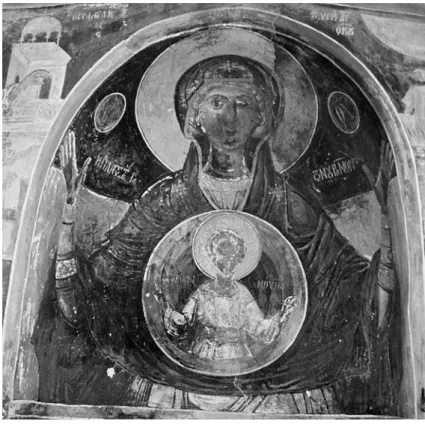
The theological idea of Christ as an archpriest was also expressed through the vertical arrangement of scenes in the painted decoration of the sanctuary apse.40 The im-ages of Christ Emmanuel, the Virgin and the Communion of the Apostles are united in a conceptually and themati-cally harmonious whole with the iconographic ensemble in the lowest register of the sanctuary, the central section of which is occupied by Christ the Great Archpriest. In the iconographic programme of the apse, Christ’s archpriest-hood was highlighted through the reminiscence of the Saviour’s Incarnation and the act of instituting the Eucha-rist.41 The two forms of the Communion of the Apostles in the central register of the apse do not significantly depart from the usual iconographic scheme of the scene in Palaiologan art. However, the same does not apply to the depictions of Christ Emmanuel and the Holy Virgin. The semi-dome of the sanctuary apse is adorned with the bust of Christ Emmanuel in a segment of heaven and, be-low it, the standing figure of the Virgin Orans, Μ(ΗΤ) ΗΡ, between the archangels Michael, Ο ΑΡΧ(ΑΓΓΕΛ) ΜΗΧ(ΑΗΛ), and Gabriel (fig. 7).42 The Infant God is de-picted against the blue background representing the sky, blessing with his both hands. The most interesting detail in the image of Christ Emmanuel is his robe: a light-col-oured, almost white tunic with golden yellow trimmings around the neck and on the sleeves; the shoulders are adorned with straps of the same colour whose ends form a belt below the chest.43
The white vestment of the Infant God bears refer-ence to Christ’s death and entombment. This detail in the iconography of Christ symbolizes the shroud (sindon) in 40 On this aspect of the monumental painted decoration in the second half of the fourteenth century, cf. Đurić, Ravanički živopis i liturgija, 62, n. 61.
41 Markov manastir, Sveti Dimitrija: crteži na freski, Skopje 2012, 6–7. Cf. Vojvodić, O likovima starozavetnih prvosveštenika, 136, 138.
42 Markov manastir, Sveti Dimitrija: crteži na freski, 6. A simi-lar arrangement can be observed in Gračanica, v. B. Todić, Gračanica,
Slikarstvo, Beograd–Priština 1988, 80, figs. 31, 32.
43 The infant Christ is dressed in a peculiar white garment in several iconographic themes: Christ Anapeson cf. B. Todić, Anapeson. Iconographie et signification du thème, Byzantion 64/1(1994) 154–157, 162–163; numerous representations of the Virgin with the Child, cf. G. Babić, Epiteti Bogorodice koju dete grli, Zbornik za likovne umetnosti Matice srpske 21 (1985) 261–174; M. Tatić-Đurić, Ikonografija Bogo-rodice Strasne. Nastanak dogme i simbola, in: eadem, Studije o Bogo-rodici, Beograd 2009, 293–298; and occasionally in the Presentation of Christ in the Temple, cf. H. Maguire, The iconography of Symeon with the Christ child in Byzantine art, DOP 34–35 (1980–81) 261–269. The elements of the peculiar costume of the Christ Child in the context of Christ’s priesthood have been discussed by A. Lidov, Obraz “Khrista arkhierei͡a” v ikonograficheskoĭ programme Sofii okhridskoĭ, Zograf 17 (1986) 5–19. The vestment of Christ Emmanuel at Markov Manastir finds a close analogy in the fresco showing the Mother of God with the Child on the western façade of the church of the Virgin Hodegetria at the Patriarchate of Peć above the entrance that leads from the narthex into the interior of the church. Vesna Milanović has interpreted the representation in the Eucharistic liturgical context, as Christ Amnos, cf. eadem, O fresci na ulazu u Bogorodičinu crkvu arhiepiskopa Danila II u Peći, Zograf 30 (2004–2005) 160, n. 94. The same hypothesis was put forward earlier by M. Tatić-Đurić, Bogorodica u delu Danila II, in:
Arhiepiskop Danilo II i njegovo doba, Beograd 1991, 407.
135
which his body was wrapped for the entombment.44 Thesame idea is expressed by the troparionThe noble Joseph, performed at the liturgy after the Great Entrance, while placing the Holy Gifts upon the altar.45 In his descrip-tion of the pontifical consecradescrip-tion of a church, Syme-on, archbishop of Thessalonike (1416/1417–1429) paid a special attention to the design and symbolism of the bishop’s vestments for that occasion.46 According to his interpretation, vestments made of white linen reflect the shroud in which Christ was wrapped for the entomb-ment, whereas the bishop’s walk to the Holy Table sym-bolically represents Christ’s burial.47 Three straps are wrapped around the shroud – two over the shoulders and a third below the chest, in honour and glory of the Holy Trinity.48 In previous research, the commentary of Symeon of Thessalonike on liturgical rules in the By-zantine church has been considered a reliable source for the interpretation of the mentioned elements of Christ’s vestments as signs of his “high priestly” nature.49 Fur-thermore, the meaning of the specific iconography of Christ draws attention to another aspect of mystagogical interpretations of the Great Entrance, related to its fu-nerary symbolism.50 Relying on an approach based on the comparison of the liturgy with events from the life of Jesus Christ, liturgists associated the transfer of the Holy Gifts from the prothesis into the sanctuary with the Pas-sion of Christ – the Entry into Jerusalem and the road to Golgotha, which ended by laying the Holy Gifts upon the Holy Table – Christ’s entombment.51
According to the common iconographic practice, Christ Emmanuel in the sanctuary was to be depicted dressed in a chiton and a himation, with a clavus on the right shoulder, no matter whether the Infant God was shown as a bust or was accompanied by the Virgin. The iconographic tradition of the seat of the Ohrid
Arch-44 Todić, Anapeson. 154–155.
45 Brightmann, Liturgies Eastern and Western, I, 379; Taft, Great Entrance, 212, 218.
46 PG 155, 309–310.
47 Ἐπάνω δὲ τούτων περιβάλλεται ἀπὸ τῶν ὥμων σινδόνα λευκὴν, διήκουσαν ἄχρι τῶν ποδῶν, εἰς τύπον τοῦ Χριστοῦ τῆς επὶ τῷ ταφῳ σινδόνας, PG 155, 309 C.
48 Καὶ τριςὶ ζώναις περιζώννυται τὴν σινδόνα εἰς δόξαν τῆς Τριάδος, ibid.
49 Lidov, Obraz “ Khrista arhierei͡a”, 5–19, 6; Walter, Art and ritual, 194, n. 144; Todić, Anapeson, 154 does not support that conclu-sion.
50 Taft, The Great Entrance, 8, 63, n. 44, 45, 212, 217–219, 245– 248; V. J. Boycheva, L’ aer dans la liturgie orthodoxe et son iconographie du XIIIe siecle jusque dans l’art post-byzantin, CA 51 (2003) 170.
51 V. the interpretations of the Church fathers: Theodore of Mopsuestia (388–392), v. F. J. Reine, The eucharistic doctrine and litur-gy of the mystagogical catecheses of Theodore of Mopsuestia, Washington
1942; Germanos, Patriarch of Constantinople (715–730), v. St. Germa-nus of Constantinople, On the Divine liturgy, ed. J. Meyendorff, Crest-wood – New York 1984, 86–87, and Nicolas Cabasilas, Explication de la Divine liturgie, 162–164 (PG 150, 420C). Cf. R. Taft, In the Bridegroom’s absence: The paschal triduum in the Byzantine vhurch, in:idem, Liturgy in Byzantium and beyond, Aldershot 1996, 90, n. 83; idem, The liturgy of the Great Church. An initial synthesis of structure and interpretation on the eve of Iconoclasm, DOP 34–35 (1980–1981) 55, 62–66, 72–75. The explicit reference to funeral symbolism is evident in the fresco of the Great Entrance at the Virgin Peribleptos, Mistra, which bears the inscription of the hymn sung during the Great Entrance on the Holy Saturday, cf. Emmanuel, Some notes, 462.
bishopric stands out from the common practice. In the programme of the sanctuary at the cathedral of St Sophia (1037–1056), the idea of Christ as an archpriest is ex-pressed through a befitting image of Christ Emmanuel dressed in the shroud wrapped with straps and incor-porated into a depiction of the Enthroned Virgin Mary with the Christ Child.52 This specific iconographic com-ponent played an important role in the shaping of the considerably later pictorial programme of the sanctuary at the church of the Virgin of the Hospital (Bogorodica Bolnička) in Ohrid (ca. 1368). Christ Emmanuel in a medallion on the breasts of the Virgin Mary, shown as a bust-figure in the conch of the apse, has a white tunic with a border around the neck and straps on the shoul-ders and below the chest (fig. 8).53 In this iconographic embodiment of the Infant God, one can observe the clo-sest analogy to the image of Christ in Markov Manastir. The observed similarities between the two frescoes are further supported by the research of Vojislav Djurić and Gojko Subotić, which shows that the painter of the older layer of frescoes in the church of the Virgin of the Hos-pital later took part in painting the church of St Deme-trios at Markov Manastir.54 This rare iconography of the Infant God was repeated by the sixteenth-century painter Onouphrios in the Prilep region, in two frescoes of the Virgin “Wider than the Heavens” with Christ Emmanuel in a medallion painted in the conchs of the sanctuary ap-ses in the churches of the Transfiguration and St Nicholas at the monastery Zrze (fig. 9).55
52 The iconographic analogies are discusses in Lidov, Obraz “Khrista arhierei͡a”, 5–19, esp. 6; Walter, Art and ritual, 194, n. 144; A. W. Epstein, The political content of the painting of Saint Sophia at Ohrid, JÖB 28 (1980) 315–329.
53 For a description of the fresco, albeit without any reference to the iconographic feature of Christ Emmanuel, v. C. Grozdanov,
Ohridsko zidno slikarstvo XIV veka, Beograd 1980, 144–145, fig. 123. For the date of the construction and decoration of the church, v. G. Subotić, Sveti Konstantin i Jelena u Ohridu, Beograd 1971, 36–41.
54 Subotić, op. cit., 36–41 cites unpublished research results of Vojislav Đurić.
55 B. Babić, Fresko-živopis slikara Onufrija na zidovima crka-va prilepskog kraja, ZLUMS 16 (1980) 271–272 sqq; Z. Rasolkoska--Nikolovska, Manastirot Zrze so crkvata Preobraženie i Sveti Nikola, in:
Spomenici za srednovekovnata i ponovata istorija na Makedonija, ed. V. Mošin, IV, Skopje 1981, 408–409, 420–421, 426–427.
136
Two interesting examples of Christ Emmanuel dressed in a white tunic with straps across the chest and around the waist can be found in the church of the Holy Trinity at Sopoćani (1264/1265). The infant God, placed in a medallion on the breasts of the half-length figure of the Holy Virgin at the top of the niche in the east wall of the prothesis, wears a sakkos over a white tunic with an or-nament on each sleeve and; the sleeves of the sakkos are trimmed with pale ochre fabric adorned with dark red tendril-like ornaments. Over the sakkos, red straps are wrapped along the shoulders and they most probably form a belt below Christ’s chest (fig. 10). This peculiar icono-graphic detail was probably intended to highlight the theo-logical idea of Christ as the High Priest.56 A similar con-ceptual and thematic ensemble was painted at Sopoćani, in the niche in the east wall of the chapel of St Simeon Nemanja. It includes a half-length figure of the Virgin of the Sign, and, underneath, a depiction of Christ as the sac-rificial Lamb surrounded by angel-deacons. Christ Em-manuel in a medallion on the breasts of the Virgin Mary wears an ochre tunic with red straps on the shoulders which are probably wrapped as a belt below the chest.57 In a slightly later example, showing the Virgin with a bust of Christ Emmanuel in an unusual cup, painted in the apse of the church of St Alypius in Kastoria (1420s), the episco-pal attire of the Infant God bears a direct reference to the archpriesthood of the Incarnate Son of God.58
56 M. Tatić-Đurić, Ikona Bogorodice Znamenja, Zbornik za likovne umetnosti 13 (1977) 18, fig. 7; B. Živković, Sopoćani. Crteži fre-saka, Beograd 1984, 30; V. J. Đurić, Sopoćani, Beograd 1991, 153.
57 Živković, op. cit., 32. Cf. Đurić, op. cit., 143–144.
58 E. Tsigaridas, Η χρονολόγηση των τοιχογραφιών του ναού του Αγίου Αλυπίου Καστοριάς, in: Ευφρόσυνον, Αφιέρωμα στον Μανό-λη Χατζηδακή, II, Athens 1991, 649, fig. 351, dated the frescoes to the last decades of the fourteenth century. Cf. also Tatić-Đurić, Ikona Bo-gorodice Znamenja, 5, n. 2. V. also M. Paissidou, Jesus Christ Emmanuel – priest. Interpretation of a 14th century depiction at Castoria, Izkustvo-vedski cheteni͠͠a, Sofii͠͠a 2007, 156–160, 610.
Symeon of Thessalonike’s text on the ritual of the consecration of a church further prescribes that a bish-op should cover his hands with cloth – like cuffs united with the shroud: Καὶ ἐν ταῖς χερςὶ δὲ ὁμοίως. μανδύλια περιτίθεται, ὡς μανίκια ἡνωμένα τῆ σινδόνι.59 The bor-der on the ends of the sleeves of Christ Emmanuel in the semi-dome of the apse at Markov Manastir corresponds to the cloth – cuffs described by Archbishop Symeon. This detail is not common in the iconography of the In-fant God dressed in a white tunic, but it is not very rare, either.60 This element of Christ’s vestment could also be compared to loria, i.e. the bands at the end of the sleeves of the sticharion, symbolizing the fetters that bound Christ in his Passion.61
Beneath the image of Christ Emmanuel, there is a monumental figure of the Virgin praying (fig. 7).62 On the right side of her halo there is a red medallion, which is a typical way of framing customary sigla of the Mother of God.63 A same medallion must have been depicted on the left wall, which is now damaged. Under her feet, traces of a purple suppedion can be observed, overpainted with a wooden pedestal. She has a blue robe with ochre stripes and a red maphorion. Before proceeding to an analysis of the image, we will briefly present some observations con-cerning its present state of preservation, which has not been a subject of scholarly attention. Several elements are noteworthy: the white circle next to Christ’s hands and on the right side of his halo, a white stain formed by the ir-regular quadrangular shape on the right side of the Vir-gin’s halo which resembles a white cloth, as well as the
59 PG 155, 309C.
60 The cuff band can be found in the aforesaid representation of the Virgin with the Child in the niche of the prothesis at Sopoćani, cf. Tatić-Đurić, Ikona Bogorodice Znamenja, 18, fig. 7; cf. Đurić,
Sopoćani, 134.
61 For the interpretations of Patriarch Germanos and Symeon of Thessalonike, v. Woodfin, Embodied icon, 15, n. 42.
62 On the popularity of this iconographic type of the Virgin Mary in the sanctuary programmes of Late Byzantine monumental decoration, v. R. Ousterhout, The Virgin of the Chora. An image and its contents, in: The sacred image: East and West, eds. L. Brubaker, R. Ousterhout, Urbana 1995, 91–109.
63 View the representations of the Virgin in the apses of tree fourteenth-century churches in the territory of the Ohrid Archbisho-pric: the Virgin of the Hospital, Ohrid; St George in Rečica and the chapel dedicated to St Gregory the Theologian, in the church of Virgin Peribleptos, Ohrid, cf. C. Grozdanov, G. Subotić, Crkva svetog Đorđa u Rečici kod Ohrida, Zograf12 (1981), fig. 4; Grozdanov, Ohridsko zidno slikarstvo, 138, draw. 36, fig. 122.
Fig. 9. St Nicholas at the monastery Zrze, The Virgin with Christ Emmanuel, (photo: T. Starodubcev)
137
unusual arrangement of colours on her clothes. The bluecolour of the dress extends over a half of the back side of the red maphorion, and, in the upper section, on the sur-face of the fabric between the neck and the waist, making it difficult to distinguish the boundaries of the two gar-ments. Furthermore, it is observed that the blue colour on the maphorion extends with the same width and signifi-cantly lesser intensity on both sides of the dress, falling on the suppedion. One gets the impression that the described blue surfaces belong to the same entity. Accordingly, the image of the Virgin Mary in the apse must have originally been different. The figure of the Virgin certainly extended up to the top of the conch, as evidenced by the preserved remains of her original halo and two medallions with the sigla around the halo and the hands of Christ Emmanuel. Parts of dress from the original image of the Virgin Mary – a white handkerchief on the right side of the new halo and a part of the red maphorion with fringes below her arms and next to the wings of both archangels – resur-faced over the new fresco layer. The artists most prob-ably painted the new scene in the secco technique, and that was the reason why the original layer resurfaced over time.64 This also explains the vague colour transitions in the dress of the Virgin, where the blue colour of her robe in the original image prevails on a great part of the surface occupied by the red maphorion on the new layer. Accord-ingly, based on the fresco’s present state of preservation, it may be concluded that the original concept of painted decoration in the conch of the apse included a monu-mental figure of the Virgin Orans, standing on a purple
suppedion. The traces of the original maphorion show that it reached the half height of the bowing archangels’ halos, which suggests two possibilities. First, it may be as-sumed that the adorant archangels were not foreseen in the original concept of the scene because the outstretched maphorion did not leave enough space in the conch of the apse for another two figures to be depicted. However, it is indeed possible that the archangels accompanied the Virgin in the original painting; in that case, their heads and the front part of the body must have covered a part of her maphorion. We may assume that the dimensions of the Virgin Mary’s figure were the main reason why the original, iconographically rather common solution of the apse scene was given up. This concept resulted in a huge scene extending too high, whose proportions were in discord with the size relations among individual figures and scenes in the sanctuary. In order to mitigate this, the painter may have subsequently decided to place a half-length figure of Christ Emmanuel in the semi-dome of the apse, thereby shortening the space available for the new figure of the Virgin.
In some rare details of dress, this image departs from common depictions of the Virgin Mary in the sanc-tuary apse. The lower part of her dress is adorned with a rare motif of three vertical golden yellow stripes. They are placed in the middle and on the edges of her dress, extending from the waist to the bottom hem.65 Although
64 Cf. additionally painted portraits of two rulers in Gračanica, executed in the secco technique (ca. 1321), v. D. Vojvodić, Doslikani vladarski portreti u Gračanici, Niš i Vizantija 7 (2009) 251–265; Todić,
Gračanica, pl. XXVII.
65 N. P. Kondakov, Ikonografii͡a Bogomateri, I, Sankt-Peterburg 1914, 19, 25, 32, 35, 64–67, 86–90, 170, 177, 191, figs. 5, 9–14, 46, 49,
this is an element that does not belong to the usual set of motifs associated with depictions of the Virgin in the apse, the painters of Markov Manastir could have relied on ear-lier examples that show this interesting iconographic de-tail, such as the fresco showing the Virgin with Christ, Archbishop Danilo II and St Nicholas on the western fa-cade of the church of the Virgin Hodegetria at the Patri-archate of Peć;66 or the Virgin in the conch of the apse in Lesnovo.67 The painter of Markov Manastir employed the same iconography in one of his earlier works – the depic-tion of the Virgin in the apse of the church of St George at Rečica near Ohrid.68The mentioned motif of the Vir-gin Mary’s dress highlights the episcopal insignia known as the potamoi (ποταμοί, ‘rivers’).69 In bishop’s attire, this ornament symbolizes the blessing of God.70 In the work of the Late Byzantine liturgist Symeon of Thessalonike, the symbolism of these ‘rivers of blessing’ is rooted in the words from the Gospel (Jn 7:38) “Whoever believes in me, as Scripture has said, rivers of living water will flow from within them.”71 In the context of the programmatic and iconographic concept of the sanctuary at Markov Ma-nastir it is noteworthy that this extract from John’s Gospel was read on the feast of Pentecost.72 As we learn from the
typikon of the Serbian Archbishop Nikodim (1319), the Homily of St. John Chrysostom which contains the inter-pretation of the “river of the Water of Life”, was also read during the Matins of the same feast.73 A detailed interpre-tation of the liturgical insignia in the dress of the Virgin Mary is offered by Vesna Milanović,74 who rightly empha-sizes the importance of pneumatological and Christologi-cal aspects, or the association between the symbolism of Christ’s blood and the Holy Spirit.75 There is yet another iconographic detail which deepens the Eucharistic
mean-59, 60, 63, 67, 68, 70, 94–95, 97–98, 100, 103, 107, pl. I, has already drawn attention to the images of the Mother of God which contain the motif of the vertical bands on her tunic and date from the period be-fore the Iconoclasm.
66 Milanović, O fresci na ulazu u Bogorodičinu crkvu, 144, 160, fig. 1.
67 Gabelić, Lesnovo, 66, fig. 13.
68 Grozdanov, Subotić, Crkva svetog Đorđa u Rečici, 74. 69 Ornamental vertical bands (clavi)appeared already in secu-lar tunics of late antiquity. According to abundant liturgical sources, since the twelfth century, these ornamental stripes (potamoi) were strictly associated with episcopal vestments. V. T. Papas, Liturgische Gewänder, in: RbK, V, Stuttgart 1993, 744; V. J. Djurić, Les docteurs de l’Église, in: Ευφρόσυνον, Αφιέρωμα στον Μανόλη Χατζιδάκη, I, Athens 1991, 133; Woodfin, Embodied icon, 15.
70 On the origin and the meaning of the potamoi on episcopal sticharia, v. A. A. Dmitrievskiĭ, Stavlennik, Kiev 1904, 262, 288–289, 322–324; L. Mirković, Pravoslavna liturgika I, Beograd 19823, 125.
71 PG 155, col. 256C, 712C; St. Symeon of Thessalonika, The liturgical commentaries, ed. S. Hawkes-Teeples, Toronto 2011, 103, 173.
72 Djurić, Les docteurs de l’Eglise, 133–135.
73 PG 59, 283–288; Tipik arhiepiskopa Nikodima, II, ed. Đ. Trifunović, Beograd 2007, 165a, 165b; L. Mirković, Heortologija, Beo-grad 1961, 232–233.
74 Milanović, O fresci na ulazu u Bogorodičinu crkvu, 157–160. 75 In Historia Ecclesiastica, St Germanos interpreted the pota-moi on the bishop’s sticharion as the image of “the blood which flowed from the side of Christ”, St. Germanus of Constantinople on the Divine liturgy, 66–67. According to Symeon, Archbishop of Thessalonike the
138
ing of the image of the Virgin. The white handkerchief,76 stuck at the waist on the right side of the Virgin’s robe, may be interpreted as the encheirion, a towel carried at the waist by the clergy during the liturgy and used to wipe the hands.77 During the further development, this ecclesiasti-cal insignia took the form of the epigonation. It symbo-lizes the lention – a linen cloth wrapped around Christ’s waist at the Last Supper when washing the disciples’ feet. In the surviving written sources, the encheirion and epigo-nation are mentioned as episcopal insignia.78 The sym-bolism and the function of the towel stuck at the Virgin’s waist highlight the Mother of God’s relationship with both the historical New Testament sacrifice and the liturgical, Eucharistic sacrifice.79
Through the language of iconography, the symbo-lism related to rituals performed by the clergy unites the images of Christ Emmanuel in the conch of the apse and Christ the archpriest in the lowest register.80 The Eucha-ristic and ecclesiological symbolism of these peculiar de-tails of the Virgin’s dress, which highlights the idea of the Virgin as a symbol of the Church, also confirms that vari-ous elements in the sanctuary apse of Markov Manastir
76 On the motif of the handkerchief in the iconography of the Virgin, v. I. М. Djordjević, M. Marković, On the dialogue relation-ship between the Virgin and Christ in eastern Christian Art. Apropos of the discovery of the figures of the Virgin Mediatrix and Christ in the naos of Lesnovo, Zograf 28 (2000–2001) 44–47. Various aspects of the handkerchief as an attribute of the Virgin have been also discussed by Milanović, O fresci na ulazu u Bogorodičinu crkvu, 160–161; A. Lidov,
The priesthood of the Virgin in Byzantine iconography, XX Congrès international d’études byzantines, Pré-actes, III, Communications li-bres, Paris 2001, 427; idem, Svi͡ashchenstvo Bogomateri v vizantiĭskoĭ ikonografii: Illi͡ustrat͡sii͡a teksta ili obraz-paradigma, in: Drevnerusskoe iskusstvo. Idei͡a i obraz. Opyty izuchenii͡a vizantiĭskogo i drevnerusskogo iskusstva, ed. Ė. S. Smirnova, Moskva 2009, 207–211.
77 Ch. Walter, Pictures of clergy in the Theodore psalter, REB 31 (1973) 231–232, fig. 3; idem, Art and ritual, 21–22; Mirković, Pravo-slavna liturgika, 129–130. The earliest representations of the encheiri-on appeared in the miniature paintings of the Menologion of Basil II (979–984), cf. N. Thierry, Le costume épiscopal byzantin du IXe au XIIIe
siècle d’après les peintures dates (miniatures, fresques), REB 24 (1966) 310–315. The liturgical use of a linen cloth is evidenced in a fresco from the church of Faras, Nubia (1003–1036) which shows a local bish-op and the Virgin with the Child holding a white linen cloth in their hands. Another example from the same period can be found in the first basilica of San Clemente in Rome. This is an image of St. Clement as a celebrant with an encheirion in his hands, cf. Lidov, Svi͡ashchenstvo Bogomateri, 209, fig. 19–20. Cf. also L. Rodley, Hallaç Manastir. A cave monastery in Byzantine Cappadocia, JÖB 32 (1982–1983) fig. 8.
78 T. Papas, Studien zur Geschichte der Messgewander im by-zantinischer Ritus, Munich 1965, 131; Woodfin, Embodied icon, 17–18. 79 Very few eleventh and twelfth century depictions of this white linen cloth in Eucharistic themes have come down to us. The most distinctive iconographic feature of the icon from Mount Sinai showing the Communion of the Apostles is the handkerchief in Christ’s hands, while in the church of the Virgin Forbiotissa, Assinou, Cyprus, the handkerchief is laid on the Holy Table. The same white linen cloth is also depicted on the Holy Table in the Last Supper in the crypt of the monastery of Hosios Loukas in Phokis, cf. Lidov, Svi͡ashchenstvo Bogomateri, 210, figs. 21–23; A. Cutler, J.-M. Spieser, Byzance médiéval 700–1204, Paris 1996, 276, fig. 223. Cf. Milanović, O fresci na ulazu u Bogorodičinu crkvu, 161.
80 These theological and liturgical meanings could also be expressed using condensed iconographic idioms, most commonly on liturgical objects. By placing a half-length figure of Christ the Great Archpriest on one side and a half-figure of Christ Emmanuel on the other side of two rhipidia from 1594, kept in the monastery of St John Prodromos near Serres, Byzantine artists established a connection be-tween iconography and liturgical practice, cf. National museum of his-tory. Catalogue, ed. R. Rousseva, Sofia, 2006, 127, no. 126.
are mutually related within a common thematic frame-work.81 The comparison between the Mother of God and the Church and the theme of receiving the blessing of Christ’s archpriesthood was expressed through meta-phors in hymnography and homiletic poetry dedicated to the Virgin Mary. For example, Epiphanius of Cyprus referred to Theotokos as “the priest and the altar at the same time, who offers to us Christ the bread of heaven for the redemption of sins.”82 The words of Patriarch Tara-sios († 806), who called the Holy Virgin “the ministrant of the Archpriest”, belong to the same liturgical context.83 George of Nikomedeia used a poetical motif: “Temple of God, she enters the temple” to refer to Mary as a temple.84 The sermons of John of Damascus and Andrew of Crete offer an interesting perspective for the analysis of the meaning of the figure of the Virgin in the apse of Mar-kov Manastir. They describe Mary as a link between the priestly lineage of Israel and the priesthood of her Son.85
The meaning of the discussed iconographic themes in the sanctuary, which is rooted in the ecclesiological postulates and Eucharistic theology also, highlights the importance of the episcopal ministry. The iconographic content of the frescoes conveys the idea of bishops as the bearers of Chris’s pontifical blessing.
Liturgical objects in the Great Entrance
The design, the way of handling and the place of the large ecclesiastical liturgical cloth carried by two concel-ebrants in the angelic procession of the Great Entrance on the south side of the sanctuary apse has been attrac-ting the attention of researchers, raising numerous issues related to the iconographic and liturgical content of the scene (fig. 11).86 The comparison with representations of81 M. J. Milliner, The Virgin of the Passion. Development, dis-semination, and afterlife of a Byzantine icon type, Princeton 2011 (un-published PhD thesis), 115–129, explores the association of Mary and the Temple and the idea of Mary as a priest in several textual sources: Protoevangelium of James, the Gospel of Luke (2: 22–38) and the earli-est Life of the Virgin. The author’s observation also includes poetical motifs referring to Mary as a priest. For a discussion of the Eucharistic elements and priestly implications in the Byzantine iconography of the Mother of God, v. Lidov, Svi͡ashchenstvo Bogomateri, 195–218.
82 PG 43, col. 497A. 83 PG 98, col. 1500B. 84 PG 97, 803.
85 PG 96, 669A (John of Damascus, Sermon one on the Nativ-ity); PG 97, 812B (Andrew of Crete: Sermon one on the Nativity). Cf. also. Milliner, op. cit., 124–125.
86 The identification of the large liturgical veil has been a mat-ter of dispute. It is on the basis of the Diataxis of Demetrios Gemistos that Lazar Mirković put forward the hypothesis that two angel-deacons are holding the omophorion, v. L. Mirković, Ž. Tatić, Markov manas-tir, Beograd 1925, 31–34, figs. 34–37; L. Mirković, Da li se freske Mar-kova manastira mogu tumačiti žitijem sv. Vasilija Novoga, Starinar 12 (1961) 281, figs. 71–75. According to the patriarchal ordo of the Great Church, written about 1380, the procession is led by a deacon bearing the trikerion and omophorion of the patriarch, v. PG 155, 236 A-B, 724, 728 A-B; Dmitrievskiĭ, Opisanie liturgicheskih rukopiseĭ, 310–311; Taft,
139
the aër, which frequently appear in the scenes showingthe Melismos surrounded by officiating bishops and the Heavenly Liturgy,87 clearly shows that the type of fabric
301, fig. 11. The colour photograph of the fresco has been published in C. Ranoutsaki, Die Kunst der Späten Palailogenzeit auf Kreta. Kloster Brontisi im Spannungsfeld zwischen Konstantinopel und Venedig, Leiden 2011, fig. 120. For this element of the bishop’s attire, v. R. F. Taft, S. J.,
Toward the origins of the small omophorion, in: Ecclesiam aedificans. A 70 éves Keresztes Szilárd püspök köszéntése, ed. I. Ivancsó, Nyíregyháza 2002, 25–37; Woodfin, Embodied icon, 15–16. Cf. also Omophorion, in: Byzantine antiquities. Works of art from the fourth to the fifteenth centuries of the Moscow Kremlin museums. Catalogue, Moscow 2013, 466, cat. no. 102 (A. S. Petrov). An opposite interpretation has been offered by J. D. Stefanescu, L’illustration des liturgies dans l’art de By-zance et de l’Orient, Brussels 1936, 75, 189 –190, who has identified the painted decoration in the southern section of the apse as the Epitaphios
Procession at the Holy Saturday Orthros. Although Taft, The Great Entrance, 206, n. 96 shares Stefanescu’s opinion, he suggests that the frescoes might be a result of the confusion of rites: the Great Entrance and the Epitaphios Procession. C. Grozdanov, Iz ikonografije Markovog manastira, Zograf 11 (1980) 83–85, leaves no doubt that the frescoes show the Great Entrance, though he doesn’t make any further refe -rence to the depicted liturgical textile. According to Spatharakis, Repre-sentations of the Great Entrance in Crete, 299, the angel-deacons carry the aër on their heads and, accordingly, the fresco is a depiction of the Great Entrance. Such a conclusion is further supported by the inclu-sion of the Eucharistic gifts in the scene. The same interpretation is offered by Starodubcev, Predstava Nebeske liturgije u kupoli, 392.
87 Boycheva, L’ aer dans la liturgie orthodoxe, 175. Cf. H. Schilb, Byzantine identity and its patrons. Embroidered aeres and epitaphioi of
depicted in those scenes is the same as that in our exam-ple.88 Unlike the scene in Markov Manastir, in other ex-amples of the ceremonial aër, the symbolism of passion inherent in the Great Entrance is emphasized by the dead body of Christ.89 However, though the development of figural decoration on aërs can be traced back to the late thirteenth century, purely ornamental decoration or a plain-coloured background with a cross in the centre per-sisted until the end of the fifteenth century.90 This is also confirmed by the pictorial practice. The large aër with the representation of Christ’s dead body became a mandatory element of the iconography of the Heavenly Liturgy of the sixteenth century.91
Liturgical sources prescribe more than one way in which the aër is to be carried, depending on its size. The
Diataxis of Philotheos Kokkinos describes a medium--sized aër that can be carried in two ways bya deacon in the procession of the Great Entrance. While preparing for the transfer of the Eucharistic gifts from the prothesis into the sanctuary, the priest puts the aër upon the deacon’s left shoulder (τῷ ἀριστερῷ ὢμῳ τοῦ διακόνου). Further in the text it is indicated that the aër can also be laid across
the Palaiologan and post-Byzantine periods, Bloomington2009 (unpub-lished PhD thesis) 20–55.
88 Spatharakis, Representations of the Great Entrance in Crete, 299 argues that the aër in Markov Manastir belongs to an older type of this liturgical veil, lacking figural decoration. Ranoutsaki, Die Kunst, 88. 89 Cf. the representations of the aër in the Virgin Peribleptos, Mistra; Vrontisi monastery, Crete, v. Spatharakis, Representations of the Great Entrance in Crete, 299; Ranoutsaki, Die Kunst, 80–81; and in the church of St Nicholas at Ramaća, v. Starodubcev, Predstava Nebeske li-turgije u kupoli, 394, 401. Symeon, Archbishop of Thessalonike informs us that in accord with the symbolism of Christ’s shroud, the aër could very often bear the image of the dead Christ, v. PG 155, 288A, 728B; cf. St. Symeon of Thessalonika, The liturgical commentaries, 127. For fur-ther discussion on the subject, v. also Mirković, Crkveni umetnički vez, 13–14; idem, Dve srpske plaštanice iz XIV stoleća u Hilandaru, Glasnik Skopskog naučnog društva 11 (1932)116–117. Mirković has pointed out that these liturgical veils were carried in the pontifical Divine Li-turgy since the fourteenth century.
90 E. g. the angel-deacon in the Great Entrance at Valsamonero (1431). The aër on his head is red with an ochre cross in the central section of the cloth, v. Spatharakis, Representations of the Great Entran-ce in Crete, 301, fig. 12; Ranoutsaki, Die Kunst, fig. 120.
91 Boycheva, L’ aer dans la liturgie orthodoxe, 173–176; N. Gki-oles, Οι τοιχογραφίες του καθολικού της Μονής Διονυσίου στο `Αγιο `Ορος, Athens 2009, 15. Cf. Schilb, Byzantine identity and its patrons,
57; Spatharakis, Representations of the Great Entrance in Crete, 299.
Fig. 11. Markov Manastir, angel-deacons with an aër
140
both shoulders: the priest takes the aër from “the deacon’s shoulders” (ἀπὸ τῶν ὢμων τοῦ διακόνου) to cover with it
the Eucharistic gifts on the Holy Table.92 Additional in-formation regarding the design and handling of these li-turgical textiles is provided by depictions of the Heavenly Liturgy. In Gračanica (1321; fig. 12) the church of the Vir-gin Hodegeria at the Patriarchate of Peć (before 1337; fig. 13) and Dečani (before 1345; fig. 14) angel-deacons with the aër across their left shoulder are either greeting the procession of the Great Entrance or they are a part of it.93 The aërs on the back of angel-deacons in the church of St Nicholas in the monastery of Great Lavra (Mount Athos, 1560) and the katholikon of Dochiariou (Mount Athos, 1568) actually lie across their shoulders.94 Although they date from a later period, it is still possible that these fres-coes reflect an older Athonite liturgical practice. A similar liturgical context may also be established for the preserved examples of Byzantine liturgical textiles, such as the Thes-saloniki Epitaphios (ca. 1300).95 The evidence that the
aër could have been handled differently can be found in a fifteenth-century euchologion from the Great Lavra. Ac-cording to it, the aër should hang from the forehead of the deacon to his back (ἀπὸ τοῦ μετώπου ἒως τῶν νώτων
92 P. N. Τrempelas, Ἁι τρεῖς λειτουργίαι κατὰ τοὺς ἐν Ἀθήναις κώδικας, Athens 1935, 10. Serbian leitourgika follow Greek sources. According to them, the priest lays the aër on the deacon’s left shoulder (polgaEtq na lyvomq ramy dJakonou), v. Dečani No. 125, fol. 25b.
93 For the Heavenly Liturgy in Gračanica, v. A. L. Town sley, Eucharistic doctrine and liturgy in late Byzantine painting, Oriens christianus 58 (1974) 148–150, fig. 15; Todić, Gračanica, figs. 7–9; Ch. Kōnstantinidē, Ο Μελισμός. Οι συλλειτουργούντες ιεράρχες και οι άγγελοι-διάκονοι μπροστά στην Άγια Τράπεζα με τα Τιμία Δώρα ή τον Ευχαριστιακό Χριστό, Thessalonikē 2008, 119. For the same scene in the church of the Virgin at the Patriarchate of Peć, v. G. Babić, Liturgij-ske teme na freskama Bogorodičine crkve u Peći, in: Arhiepiskop Danilo II i njegovo doba, Beograd 1991, 378–382 figs. 1–3. For Dečani, v. M. Marković, Program živopisa u kupoli, in: Zidno slikarstvo manastira Dečana. Građa i studije, Beograd 1995, fig. 2. The iconography of scenes in all of the three churches is described by Starodubcev, Pred-stava Nebeske liturgije u kupoli, 386–388.
94 G. Millet, Monuments de l’Athos I. Les peintures, Paris 1927, pls. 118. 2, 218. 2, 219. 3, 232. 2.
95 Betancourt, The Thessaloniki epitaphios, 503–520. Fig. 13. The church of the Virgin Hodegetria, Patriarchat of Peć, Heavenly Liturgy, angel-deacon with an aër