Departmentt. of Physics, Aristotle University of Thessaloniki,
GR - 54124, GREECE
Received 2 July 2013; Revised 4 September 2013; Accepted 25 September 2013
___________________________________________________________________________________________
Abstract
In the present paper, we have studied the complex dynamics of a system of two nonlinear neuronal cells, coupled by a gap junction, which is modelled as a linear variable resistor. The two coupled cells are oscillators of the FitzHugh-Nagumo type. The first cell, the “ImK-cell” is a voltage driven cell, while the second, the “RaLa-cell” is a current driven cell. We have examined the dynamics of the coupled system in the case of bidirectional coupling. An independent voltage source gives the external stimulation. We have examined three different cases (AC, DC, AC plus DC) of the external signal. In each case we have different dynamics. Action potentials, chaotic and periodic oscillations are observed.
Keywords:
Nonlinear oscillators, FitzHugh-Nagumo, neuronal cells, gap junction, action potential, chaos, bidirectional coupling. __________________________________________________________________________________________
1. Introduction
Electric circuits with a nonlinear resistor, which is characterized by a smooth cubic υ-i characteristic, have emerged as a simple, yet powerful experimental and analytical tool in studying chaotic behavior in nonlinear dynamics. Among the electrical oscillators that have been studied, the FitzHugh – Nagumo type oscillator [1, 2] is very important, because can simulate neuron cells. The system of two FitzHugh-Nagumo cells coupled with gap junctions, specialized intercellural pathways between adjoining cells, [3], is the simplest possible system simulating two coupled neuron cells via an electric synapse [4]. As introduced by Fitzhugh [1], his model for a spiking neuron is a two dimensional reduction of the Hodgkin – Huxley equations [5]. A qualitative description of the single neuron activity is given, according to FitzHugh, by the system of coupled nonlinear differential equations.
(
)
3 1
γ x x y z
3
1
x α βy
γ x τ y τ = − + + =− − + d d d d (1)
The variable x describes the potential difference across the neural membrane and y can be considered as a
combination of the different ion channel conductivities, present in the Hodgkin-Huxley model. The control parameter z of the FitzHugh system describes the intensity of the stimulating current. Nagumo et al. [2] proposed an electronic simulator of the model of FitzHugh using a tunnel diode as the nonlinear element.
The FitzHugh model of nonlinear differential equations (1) can be simulated by a different nonlinear electric circuit, [6], using a nonlinear resistor, (Fig.1), with a smooth cubic i−v characteristic given by the following equation (2).
3
2 0 N
1 1 υ
i g(υ) υ
ρ 3 V
= =−
−
(2)
where ρ and
V
0 are normalization parameters. Byintro-ducing new, normalized variables
t
τ
LC
=
, 0 υ x V= , L
0 ρi
y V
= , S
0
ρi
z V
= ,
and applying Kirchhoff’s laws we get the state equations (1), where
0
E R 1 L
α , β and γ
V ρ ρ C
= = = .
______________
* E-mail address: [email protected]
ISSN: 1791-2377 © 2013 Kavala Institute of Technology. All rights reserved.
Fig. 1. The electronic simulator of the model of FitzHugh, proposed by Kyprianidis et al [6].
Rajasekar and Lakshmanan proposed a slightly different form of FitzHugh model [7,8] given by the following state equations, which are of Bonhoeffer – van der Pol type,
(
)
3
dx 1
= x x y + z
dτ 3
dy
c x a by dτ − − = + − (3)
The study of Eqs.(3) revealed the existence of chaotic behavior, following the period doubling route to chaos, and devil’s staircases. The nonlinear differential equations (3) can be also simulated by a nonlinear electric circuit, using a nonlinear resistor with a smooth cubic i−v characteristic. The nonlinear electric circuit is shown in Fig.3. The smooth cubic i−v characteristic of the nonlinear resistor of the circuit of Fig.3 is given by the same equation (2), as before.
By introducing new, normalized variables,
t τ ρC = , 0 υ x V
= , L
0 ρi y
V
= , and S
0 ρi
z V
= ,
and applying Kirchhoff’s laws we get state equations (3),
where 0 E a V = , R b ρ = , and
2
ρ
C
c
L
=
.In the general case, the driving current source has the following form iS = IDC+ I cos20 πf tS including a DC plus a sinusoidal term of frequency fS, so
DC 0
z = B + B cos2πft,
where the normalized frequency f will be f =ρCfS.
Fig. 2. The nonlinear electric circuit simulating Eqs.(3).
The topology of the circuits of Fig.1 and Fig.2 is exactly the same, proving the equivalence of equations (1) and (3). The circuit of Fig.2 is a current-driven neuron-cell and we call it “RaLa-cell”.
2. The FitzHugh – Nagumo Type Circuit Driven by a Voltage Source
In the circuits of Figs.1 and 2, the driving source is a current source. But in most cases, circuits are driven by voltage sources. In this section, we will study the circuit of Fig.2 driven by a voltage source, as it is shown in Fig.3
Fig. 3. The circuit of Fig.2 driven by a voltage source.
The smooth cubic i−v characteristic of the nonlinear resistor of the circuit of Fig.3 remains the same as before. By
introducing the normalized time
t
τ ρC
= and the normalized
variables
0 υ x
V
= , L
0 ρi
y V
= , S
S 0 ρυ u
R V
= and applying
Kirhhoff’s laws, we get the following normalized state equations
(
)
(
)
3
dx 1
x 1 ε x y u
dτ 3
dy
c x a by dτ = − − − + = + −
(4) where 0 E a V = , R b ρ = , 2 ρ C c L= , and
S
ρ ε
R
= .
In the general case, the driving voltage source has the following form
S DC m S
υ =V +V cos2πf t (5)
including a DC plus a sinusoidal term of frequency fS, so
DC 0
u=U +U cos 2πfτ (6)
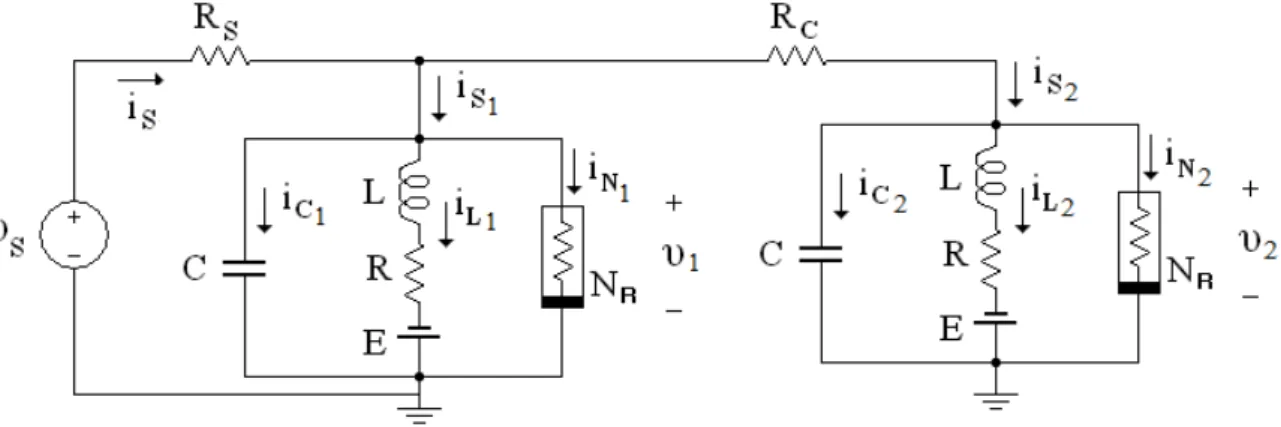
Fig.4. An “ImK-cell” and a “RaLa-cell” coupled via a gap junction (RC).
DC DC S 0
ρ
V
U
R V
=
and m0 S 0
ρ
V
U
R V
=
. (7)The circuit of Fig.3 is a voltage driven neuron-cell and we call it “ImK-cell”.
3. The Coupled System
By coupling the circuits of Figures 2 and 3 via a linear resistor RC, we get the system of Fig.4. The two sub-circuits have identical circuit elements, L, R, C, E and NR. The linear resistor RC simulates the gap junction between the two neuron−cells [3, 4].
By introducing the normalized time
t τ
ρC
= and the
normalized variables j j 0
υ
x
V
=
, j Lj0
ρi y
V
= , j = 1,2, S
S 0 ρυ u =
R V
and applying Kirhhoff’s laws, we get the following normalized state equations for the system of Fig. 4.
(
)
(
)
(
)
(
)
(
)
3 11 1 1 1 2
2
1 1
3 2
2 2 2 1 2
2
2 2
dx 1
= x 1 ε x y ξ x x + u
dt 3
dy
= c x + a by dt
dx 1
= x x y +ξ x x
dt 3
dy
= c x + a by dt − − − − − − − − − −
(8) where C ρ ξ R= is the coupling factor, while
2
0
E R ρ C
a = , b = , c =
V ρ L
and u is given by Eqs.(6) and (7).
3.1. The system is driven by an AC voltage source
In this case, the constant values of the parameters of the
system are a = 0.7, b = 0.8, c = 0.1, ε = 0.150, f = 0.16, and
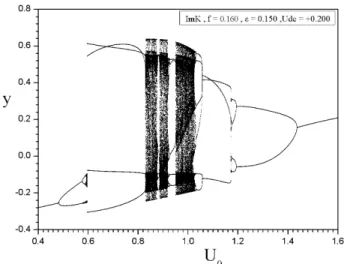
UDC = 0.0. The bifurcation diagram of the complex dynamics
of the “ImK-cell”, as the normalized amplitude of the
voltage source is varied, is shown in Fig. 5.
Fig. 5. The bifurcation diagram of the “ImK-cell” as the normalized amplitude of the voltage source is varied. It is a chaotic bubble.
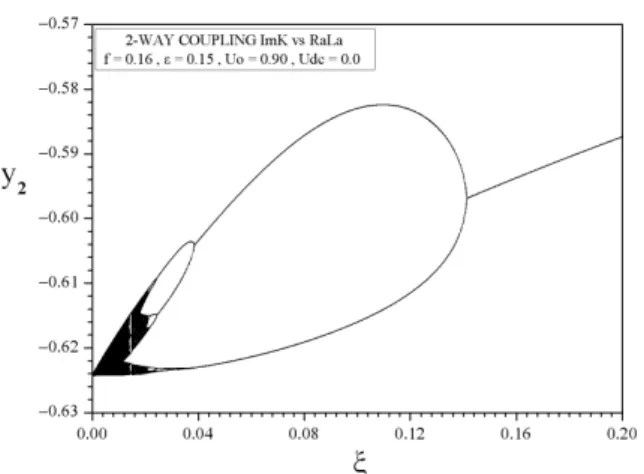
Choosing U0 = 0.9, corresponding to a chaotic state, the simulation results of state equations (8) give the following bifurcation diagrams versus the coupling factor ξ.
Fig. 6. Bifurcation diagram, y1 vs. ξ, of the coupling system, under an
Fig. 7. Bifurcation diagram, y2 vs. ξ, of the coupling system, under an
AC stimulation with U0 = 0.9.
Starting from a chaotic state, the system undergoes a reverse period doubling cascade, as the coupling factor ξ is increased. So, depending on the value of ξ, the system can be in a chaotic or in a periodic state. The gap junction controls the flow of energy between the two neuron cells and suppresses the chaotic state of the system.
3.2. The system is driven by a DC voltage source
When the neuronal cells “ImK” and “RaLa” are uncoupled and stimulated by a low value DC signal, they create an action potential waveform, which converges to a fixed point, as we can see in Figs.8 and 9. As the value of the DC signal is increased, a Hopf bifurcation is observed and the neuronal cells give a periodic response. For the “ImK−cell” the Hopf bifurcation is observed for UDC = 0.29287, while for the
“RaLa−cell” the Hopf bifurcation is observed for BDC = 0.33233, when the parameters of the system are a = 0.7, b = 0.8, c = 0.1 and ε = 0.150.
Fig. 8. Action potential waveform by an “ImK−cell” for UDC = 0.250.
Fig. 9. Action potential waveform by a “RaLa−cell” for BDC = 0.250.
Fig. 10. A periodic response of an “ImK−cell” for UDC = 0.300.
Fig. 11. A periodic response of a “RaLa−cell” for BDC = 0.350.
Fig. 12. The bifurcation diagram of the “ImK−cell” before, (UDC = 0.200), the Hopf bifurcation threshold.
Fig. 13. The bifurcation diagram of the “ImK−cell” after, (UDC = 0.300),
the Hopf bifurcation threshold.
In the case of the coupled system of Fig.4, for UDC = 0.250 and ξ = 0.01, the waveforms of the state variables x1, (black), and x2, (red), are shown in Fig.14. Both, they converge to a fixed point, as well as when UDC = 0.300, (Fig.15).
Fig. 14. The waveforms of the state variables x1, (black), and x2, (red),
for UDC = 0.250 and ξ = 0.01. Both, they converge to a fixed point.
Fig. 15. The waveforms of the state variables x1, (black), and x2, (red),
for UDC = 0.300 and ξ = 0.01. Both, they converge to a fixed point.
In Figs.16 and 17, the responses of the coupled cells are shown, for UDC = 0.350 and ξ = 0.01. They are periodic.
Fig. 16. Periodic response of the “ImK−cell” for UDC = 0.350 and
ξ = 0.01.
Fig. 17. The response of the coupled “RaLa−cell” for UDC = 0.350 and
ξ = 0.01. (a) Transients are present. (b) Transients have been removed, and a periodic response is shown, the steady state of the cell.
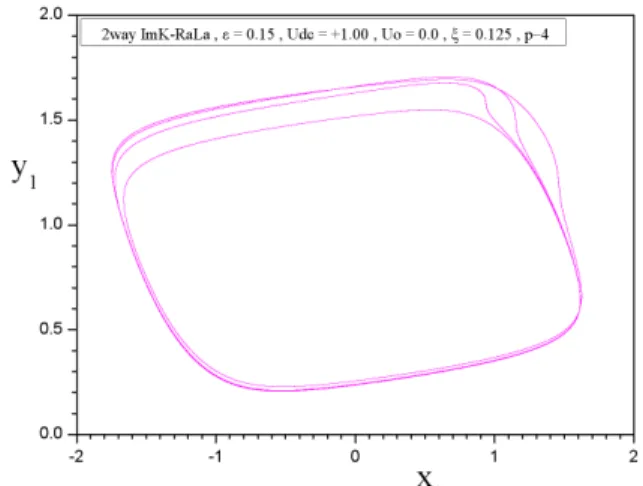
The dynamics of the system remains unchanged, as the value of the DC component is increased up to UDC = 1.00. So, the next step is to increase the value of the coupling factor ξ. For ξ=0.074, the phase portrait y1 vs. x1 is shown in Fig.18. It is a limit cycle. For ξ=0.075, a period doubling is observed (Fig.19).
Fig. 18. Phase portrait of the coupled “ImK−cell” for UDC = +1.00
and ξ=0.074.
Fig. 19. Phase portrait of the coupled “ImK−cell” for UDC= +1.00 and ξ=0.075. A period doubling is observed.
As ξ is increased, the system follows a period adding scenario, as we can observe in Figs.20-22. For ξ=0.12739, the phase portrait of the coupled “Rala-cell”, for
DC
U = +1.00, is shown in Fig.23. It is an attractor of high
periodicity. In the limit, as periodicity tends to “infinity”, a transition to period-1 is observed for ξ=0.12740 (Fig.24).
Fig. 20. Phase portrait of the coupled “ImK−cell” for UDC= +1.00
and ξ=0.120. A period−3 limit cycle is observed.
Fig. 21. Phase portrait of the coupled “ImK−cell” for UDC= +1.00
and ξ=0.125. A period−4 limit cycle is observed.
Fig. 22. Phase portrait of the coupled “ImK−cell” for UDC= +1.00
Fig. 23. The phase portrait of the coupled “Rala−cell”, for
DC
U = +1.00, and ξ =0.12739. High periodicity.
Fig. 24. The phase portrait of the coupled “Rala−cell”,
forUDC = +1.00, and ξ =0.12740. Period−1.
The bifurcation diagram, y1 vs. ξ, for UDC= +1.00, is
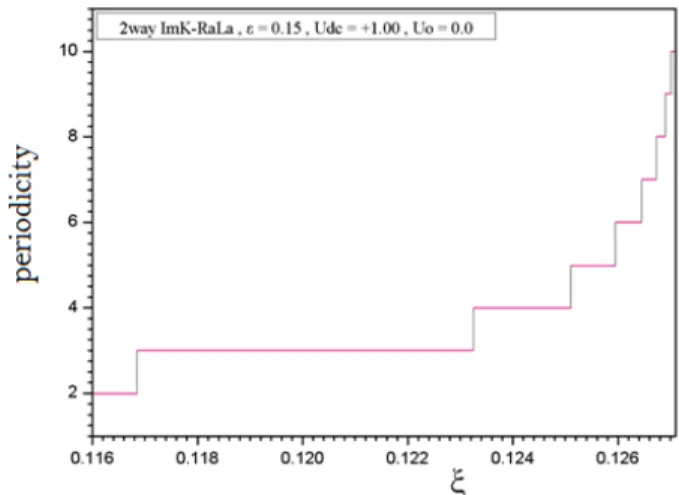
shown in Fig.25, while the diagram of periodicity vs. ξ is shown in Fig.26, for up period−10. A staircase is formating, without chaos or quasiperiodicity between two nearby stairs.
Fig. 25. Bifurcation diagram, 1
y vs. ξ, forUDC= +1.00.
Fig. 26. Periodicity vs. ξ forUDC= +1.00. A staircase is observed.
3.3. The system is driven by a DC plus an AC source
In the case of the combined stimulation of the system by a DC plus an AC voltage source, the dynamics show a more complex behavior, because each component, DC and AC, results to different dynamics, as the coupling factor ξ is varied. We will present some results, which show the necessity of an extended study.
3.3.1.The case UDC= +0.300
For UDC= +0.300, U0 =0.0 and ξ = 0.01, the system
converges to a fixed point (Fig.15). If U0 ≠0.0 the
dynamics are quite different. For U0=0.35, and f = 0.16,
the bifurcation diagrams versus the coupling factor are shown in Figs.27 and 28. We can observe the chaotic behavior of the system, while ξ < 0.014. For ξ > 0.014, the system converges to a period−1 limit cycle.
Fig. 27. Bifurcation diagram, x1 vs. ξ, for UDC = +0.300, U0 =0.35
Fig. 28. Bifurcation diagram, x2 vs. ξ, forUDC = +0.300, U0 =0.35
and f =0.16.
Fig. 29. Phase portrait, y1 vs. x1, of the “ImK−cell”, forUDC = +0.300,
0
U =0.35, f =0.16 and ξ = 0.012.
Fig. 30. Phase portrait, y2 vs. x2, of the “RaLa−cell”, for
DC
U = +0.300, U0 =0.35, f =0.16 and ξ = 0.012.
For U0 =0.4, the system presents the same dynamics,
as before, while the transition from chaos to period–1 is
observed for a higher value of the coupling factor, ξ = 0.0161, as it is shown in Figs.31 and 32.
Fig. 31. Bifurcation diagram, x1 vs. ξ, for UDC = +0.300, U0 =0.4
and f =0.16.
Fig. 32. Bifurcation diagram,
2
x vs. ξ, for UDC = +0.300, U0 =0.4 and f =0.16.
ForU0 =0.5, the system remains in a periodic state for
all values of the coupling factor. Starting from period–4, we observe a transition to period–1, for ξ = 0.099 (Figs.33 and 34).
Fig. 33. Bifurcation diagram, y1 vs. ξ, for UDC = +0.300, U0 =0.5
Fig. 34. Bifurcation diagram, y2 vs. ξ, for UDC = +0.300, U0 =0.5
and f =0.16.
ForU0 =0.7, chaotic behavior is also observed in a
short regime, and, as the coupling factor is increased, the system follows a reverse period doubling up to period–1 (Figs.35 and 36). It is important to notice, that the two coupled cells have the same dynamics for any value of ξ.
Fig. 35. Bifurcation diagram, 1
y vs. ξ, for UDC = +0.300, U0 =0.7 and f =0.16.
Fig. 36. Bifurcation diagram, y2 vs. ξ, for UDC = +0.300, U0 =0.7 and f =0.16.
Fig. 37. Bifurcation diagram, y1 vs. ξ, for UDC = +0.300, U0 =0.75
and f =0.16.
Fig. 38. Bifurcation diagram, y2 vs. ξ, for UDC = +0.300, U0 =0.75
and f =0.16.
Fig. 39. Bifurcation diagram, y1 vs. ξ, for UDC = +0.300, U0 =0.8
Fig.40. Bifurcation diagram, y1 vs. ξ, for UDC = +0.300, U0 =0.9
and f =0.16.
3.3.2. The case UDC= +1.00
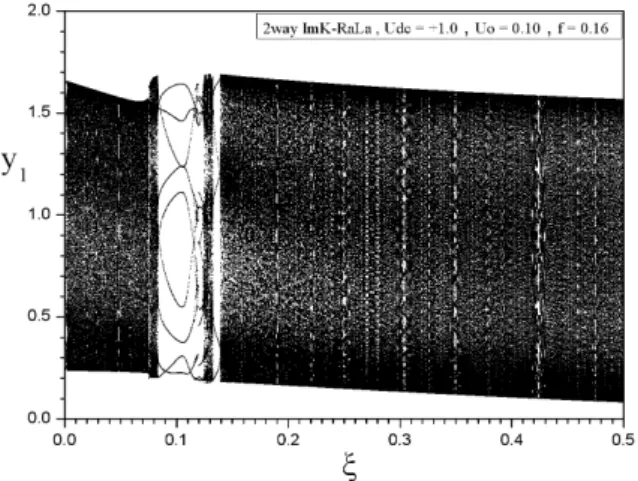
As the value of the DC component of the input signal is increased, more extended chaotic regimes are observed. In the case of UDC = +1.00, for low values of the amplitude of the AC component of the input signal, the system remains, mainly, in chaotic state, even for high values of ξ, as we can observe in the bifurcation diagrams of Figures 41−43.
Fig. 41. Bifurcation diagram, y1 vs. ξ, for UDC = +1.00, U0 =0.1
and f =0.16.
Fig. 42. Bifurcation diagram, y1 vs. ξ, for UDC = +1.00, U0 =0.2 and f =0.16.
Fig. 43. Bifurcation diagram, y1 vs. ξ, for UDC = +1.00, U0 =0.4 and f =0.16.
Τhe first wide periodic windows are observed for
0
U =0.5, but they are of high periodicity (p−9, p−15), as it
is shown in Fig.44.
Fig. 44. Bifurcation diagram, y1 vs. ξ, for UDC = +1.00, U0 =0.5
and f =0.16.
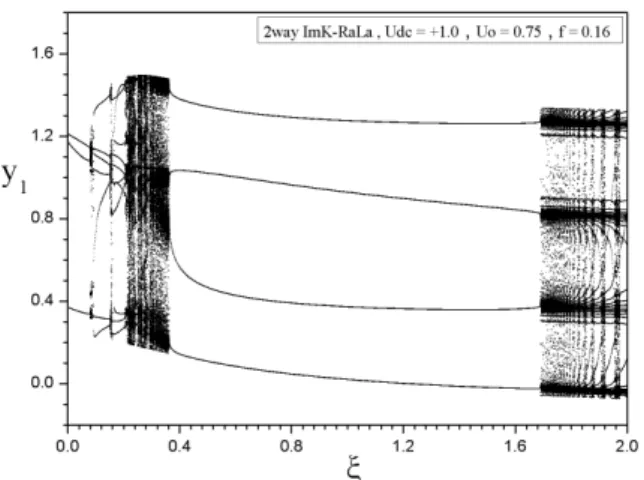
As the amplitude U0 is increased, the number of periodic windows are also increased (Figs.45, 46), so the system can choose its final state, periodic or chaotic. But its periodic state will be of high periodicity, no period−1.
Fig. 45. Bifurcation diagram, y1 vs. ξ, for UDC = +1.00, U0 =0.7
Fig. 46. Bifurcation diagram, y1 vs. ξ, for UDC = +1.00, U0 =0.75 and f =0.16.
4. Conclusions
In the present paper, we have studied the complex dynamics of a system of two nonlinear neuronal cells, coupled by a gap junction, which is modelled as a linear variable resistor. The two coupled cells are oscillators of the FitzHugh−Nagumo type. The first cell, the “ImK−cell” is a
system follows a period adding route up to a certain value of the coupling factor, ξ = 0.12740, where a transition from “infinite” periodicity to a period−1 state is observed. The combined stimulation by a DC plus an AC voltage signals drives the system to chaotic states mainly. For low values of the DC signal, UDC = +0.30, and U0≥ 0.70, a reverse period doubling sequence is observed, as the coupling factor is increased. For UDC = +1.00, chaotic behavior is the main dynamics of the system. Some periodic windows in the bifurcation diagrams are observed for higher values of the amplitude of the AC external signal.
______________________________
References
1. R. FitzHugh, Biophys. J. 1, 445 (1961).
2. J. Nagumo, S. Arimoto, and S. Yoshizawa, Proc. IRE 50, 2061 (1962).
3. W. Jiang, D. Bin, and K. M. Tsang, Chaos Solitons & Fractals 22, 469 (2004).
4. M. Aqil, K-S. Hong, and M-Y. Jeong, Commun. Nonlinear Sci. Numer. Simlat. 17, 1615 (2012).
5. A. L. Hodgkin and A. F. Huxley, J. Physiol. 117, 500 (1952). 6. I. M. Kyprianidis, V. Papachristou, I. N. Stouboulos and Ch. K.
Volos, WSEAS Trans. Syst. 11, 516 (2012).
![Fig. 1. The electronic simulator of the model of FitzHugh, proposed by Kyprianidis et al [6]](https://thumb-eu.123doks.com/thumbv2/123dok_br/17198965.242744/2.892.101.381.90.271/fig-electronic-simulator-model-fitzhugh-proposed-kyprianidis-et.webp)