Submitted 29 July 2015 Accepted 14 September 2015 Published8 October 2015
Corresponding author
Anna K. Simonsen, [email protected]
Academic editor
David Day
Additional Information and Declarations can be found on page 14
DOI10.7717/peerj.1291
Copyright
2015 Simonsen et al.
Distributed under
Creative Commons CC-BY 4.0
OPEN ACCESS
Short-term fertilizer application alters
phenotypic traits of symbiotic nitrogen
fixing bacteria
Anna K. Simonsen1, Shery Han1, Phil Rekret1,2, Christine S. Rentschler1,
Katy D. Heath3and John R. Stinchcombe1,4
1Department of Ecology and Evolutionary Biology, University of Toronto, Toronto, Canada 2Department of Integrative Biology, University of Guelph, Guelph, Canada
3Department of Plant Biology, University of Illinois at Urbana-Champaign, Urbana, IL,
United States of America
4Centre for the Analysis of Genome Evolution and Function, University of Toronto, Toronto,
Canada
ABSTRACT
Fertilizer application is a common anthropogenic alteration to terrestrial systems. Increased nutrient input can impact soil microbial diversity or function directly through altered soil environments, or indirectly through plant-microbe feedbacks, with potentially important effects on ecologically-important plant-associated mutualists. We investigated the impacts of plant fertilizer, containing all common macro and micronutrients on symbiotic nitrogen-fixing bacteria (rhizobia), a group of bacteria that are important for plant productivity and ecosystem function. We collected rhizobia nodule isolates from natural field soil that was treated with slow-release plant fertilizer over a single growing season and compared phenotypic traits related to free-living growth and host partner quality in these isolates to those of rhizobia from unfertilized soils. Through a series of single inoculation assays in controlled glasshouse conditions, we found that isolates from fertilized field soil provided legume hosts with higher mutualistic benefits. Through growth assays on media containing variable plant fertilizer concentrations, we found that plant fertilizer was generally beneficial for rhizobia growth. Rhizobia isolated from fertilized field soil had higher growth rates in the presence of plant fertilizer compared to isolates from unfertilized field soil, indicating that plant fertilizer application favoured rhizobia isolates with higher abilities to utilize fertilizer for free-living growth. We found a positive correlation between growth responses to fertilizer and mutualism benefits among isolates from fertilized field soil, demonstrating that variable plant fertilizer induces context-dependent genetic correlations, potentially changing the evolutionary trajectory of either trait through increased trait dependencies. Our study shows that short-term application is sufficient to alter the composition of rhizobia isolates in the population or community, either directly though changes in the soil chemistry or indirectly through altered host legume feedbacks, and is potentially a strong selective agent acting on natural rhizobia populations.
Subjects Ecology, Evolutionary Studies, Microbiology, Plant Science, Soil Science
INTRODUCTION
One of the largest human impacts on terrestrial ecosystems has been the widespread application of fertilizer for agricultural purposes. Ecosystem processes are well known to be altered by fertilizer input, including biogeochemical cycles (nitrogen and phosphorus), greenhouse gas emissions (Smith & Conen, 2004) and plant diversity and productivity. Soil bacteria and fungi have a major role in mediating terrestrial ecosystem processes (Van Der Heijden, Bardgett & Van Straalen, 2008;Wall & Moore, 1999) and increasing evidence has shown that soil fertilization affects microbial diversity, abundance and function (Marschner, Kandeler & Marschner, 2003;Sarathchandra et al., 2001;Sessitsch et al., 2001;
Yu et al., 2015). Increasing evidence of correlated spatial and temporal shifts in community composition of soil microbes and plants due to complex direct and indirect feedbacks (Kardol et al., 2007;Bever, Platt & Morton, 2012) also suggest that fertilizer application can alter complex feedbacks between belowground and aboveground ecological processes. To date, the majority of studies measure microbial traits at an aggregated level—the entire population or community. Despite the potential for rapid evolutionary response to selective pressures from anthropogenic activity, few studies have measured individual-level phenotypes to investigate shifts in the mean trait value between populations experiencing different selective environments—an important step in documenting evolutionary responses (but seeWeese et al., 2015). In this study, we measured various phenotypic traits at the individual/isolate level to examine whether fertilizer application causes shifts in traits of rhizobia, a functionally important bacterial group that play a major role in nitrogen cycling and plant growth through biological nitrogen-fixation.
Legumes, like most terrestrial plants, are nitrogen limited in most environments. Rhizobia fix atmospheric nitrogen and make it available to leguminous host plants through a mutualistic symbiotic association. While it is now common knowledge that legumes (and all other plants) respond to nutrient addition, the effects of fertilizer on rhizobia are not as well understood. Previous studies have firmly established that legumes suppress associations with rhizobia as plant-available nitrogen increases (Streeter & Wong, 1988;
Variation in traits is a ubiquitous property among rhizobia strains and has important consequences for understanding the impacts of ecological and evolutionary processes of altered soil environments on indigenous rhizobia populations. Nutrient addition could act directly on trait variation related to free-living vigour or growth by selecting traits that can tolerate higher ranges of nutrient input. Nutrient addition could also select traits related to mutualistic association as a result of altered host feedback responses. For example, long term nitrogen addition has been shown to reduce the mutualistic benefit of rhizobia isolates towards their legume hosts (Weese et al., 2015), an evolutionary response that could be caused by various mechanisms, including reduced selective pressure from legumes to maintain beneficial partners (Kiers, Hutton & Denison, 2007). Phenotypic changes in traits related to fertilizer tolerance or mutualism benefit could also occur as a result of selection on genetically correlated traits. For example, if traits related to fertilizer tolerance during free-living stages are genetically correlated with mutualism benefit traits through linkage- disequilibrium, changes in mutualism benefit could occur indirectly as a result of selection acting on free-living growth and persistence in the soil (Sachs, Russell & Hollowell, 2011). Conversely, if selection alters mutualism benefit traits, a genetic correlation would indirectly alter traits related to fertilizer tolerance during free-living growth. Therefore, genetic correlations between traits related to free-living growth and mutualism benefit are important in identifying additional evolutionary pathways that result in phenotypic changes in either trait.
In this study, we use a variety of approaches to investigate the effects of plant fertilizer (containing all macro and micro-nutrients) on phenotypic traits relevant for fitness of nitrogen-fixing rhizobia symbionts using a legume common to agriculturally disturbed systems,Medicago lupulina. We first applied fertilizer over a single growing season and then tested for community-level differences between fertilized and unfertilized soils onM. lupulina performance using whole-soil inoculations in the glasshouse. Next we disentangled the effects of rhizobia populations from those of the rest of the soil community by culturing rhizobia isolates and comparing and correlatingin vitro
free-living growth and mutualism benefit (i.e., host partner quality) of individual rhizobia isolates from either fertilized or unfertilized field soil. We further evaluated if isolates from fertilized or unfertilized field soil differed in their plastic responses toin vitrogrowth assays containing variable fertilizer concentrations.
METHODS
Natural history of study system
The field experiment was conducted in a recently disturbed old field habitat with dense populations of the legumeMedicago lupulinagrowing in the Koffler Scientific Reserve (www.ksr.utoronto.ca, 44.0300◦N, 79.5275◦W) in Southern Ontario, Canada.M. lupulina
symbiotic bacteria infect plant roots and induce nodule formation. During nodule formation betweenMedicagoandEnsifer, a portion of rhizobia cells differentiate into specialized cells that fix atmospheric nitrogen (Oke & Long, 1999). When plant seed set occurs in August and September, nodule plant tissue begins to senesce, releasing rhizobia cells into the soil—the undifferentiated fraction of the cells survive in a free-living state until the following growing season (Hirsch, 1996).
Testing for field fertilizer treatment on host performance using whole-soil inoculations
We randomly positioned 16 plots (0.25×0.25 m) over two largeM. lupulinapopulation sites at the Koffler Scientific Reserve (44.0300◦N, 79.5275◦W). Within each population, half of the plots were randomly selected for fertilizer application. We applied 1 tbsp. (13 g) of Osmocote Miracle-Grow slow release fertilizer beads containing macro and micronutrients (in an N:P:K ratio of 19:6:12; Micromax®by Scotts brand) over each plot in the early spring (May). WhenMedicago lupulinaplants seeded and began to senesce by mid-August, soil was sampled at each plot and stored at 4◦C for further experimentation.
We initially tested for differential mutualistic effects of fertilized and unfertilized field soil on host plants by inoculating potted plants with whole soils in the glasshouse. We included three host genotypes (Cote-d’Or, France [FR]; Nebraska, USA [US] and Ontario, Canada [CA]; USDA germplasm repository: P1 234953-96i-SA19792, P1 215243-93i-53416, W6 4578-99i-2044) and a slow-release fertilizer application (same as field treatment) to determine whether the effects of field soil treatments were consistent across host genotype and fertilizer environment. In total, our design included field fertilizer treatment, glasshouse fertilizer treatment and host genotype in a full factorial design (i.e., 2 Field fertilizer treatments×8 plots per field fertilizer treatment×2 glasshouse fertilizer treatments per field plot×3 plant genotypes per pot×5 replicate pots=480 total plants).
Each pot contained steam sanitized low nutrient soil (1:4; turface:sunshine mix #2) and a band of field soil applied (30 ml volume) at mid-depth and covered with a layer of autoclaved sand. To reduce effects on host performance as a result of chemical differences between fertilized and unfertilized field soil (as opposed to differences driven by microbial communities), we added autoclaved soil from the opposing field treatment to each pot in equal proportion. The opposing soil was prepared by autoclaving a soil mixture containing a subset of soil from all plots that received the same fertilizer treatment. For example, pots assigned with the unfertilized field soil treatment received 15 ml of unfertilized field soil from a given plot and 15 ml of autoclaved soil from all other fertilized field plots. We also added 10 control pots (which received 15 ml of autoclaved soil sample from each field treatment).
Prior to planting, seeds were scarified, sterilized in commercial bleach, stratified in the dark on 1.5% agar at 4◦C and pre-germinated at 22◦C for 12 h for radicle growth.
biomass for each plant and haphazardly selected 15–20 nodules for dried preservation in tubes containing Drierite desiccant (Somasegaran & Hoben, 1994). Dried nodules were weighed to obtain a mean nodule mass measurement and stored at 4◦C in desiccant tubes for further experimentation. Plant performance was measured using plant biomass, which has been found to be strongly positively correlated with fruit and seed production in previous glasshouse experiments onMedicago lupulinain similar growing conditions (see
Simonsen, Chow & Stinchcombe, 2014). Control plants showed significantly lower amounts of nodulation (11.2 nodules/plant) compared to experimental plants (127.2 nodules/plant;
t=8.6196,p<0.0001), indicating that any low-level contamination that occurred is unlikely to explain experimental inoculation treatments.
We tested for field fertilizer treatments using a generalized linear mixed model on plant biomass, nodule size (log-transformed, PROC MIXED dist=Gaussian; SAS institute v9.3) and nodule number (PROC GLIMMIX, dist=Poisson). Our model included field fertilizer treatment, greenhouse fertilizer treatment, host genotype, block, final plant density in each pot (since some mortality occurred during the experiment), field site and harvest date as fixed effects, and pot and plot as random effects.
Testing for field fertilizer treatment on host performance using single-isolate inoculations
We obtained individual rhizobia isolates using preserved nodules from the whole-soil inoculation and used them in a single-isolate inoculation experiment to provide a measure of each isolate’s mutualistic benefit towards its host and thus disentangle whole-soil effects from the rhizobia community on host traits. A preserved nodule was randomly selected from each unfertilized plant in the whole-soil inoculation experiment (described above), rehydrated in sterile water, and subcultured on Tryptone-Yeast (TY) agar media (Somasegaran & Hoben, 1994) until clean isolates were obtained. Field soil treatments that received the additional glasshouse fertilizer application were excluded from the rhizobia isolation procedure. A total of 191 isolates were successfully cultured (101 from unfertilized and 90 from fertilized field plots).
We determined the field fertilizer effect on all measures of host performance using a generalized linear mixed model (PROC GLIMMIX, dist=over-dispersed Poisson for fruit and flower production; SAS institute v9.3). Field fertilizer treatment, genotype of origin host (where preserved nodule was obtained), origin field site, greenhouse block and harvest date were included as fixed effects, while field sample plot (of original field soil sample) was included as a random factor. We tested for isolate effects using a log-likelihood ratio test between the full mixed model containing isolate and reduced model excluding the isolate term.
Testing for field fertilizer treatment on rhizobia isolate growth We selected a random sub-set of isolates from each field fertilizer treatment forin vitro
growth assays—31 from fertilized field soil (n[CA]=8,n[FR] =7,n[US] =16 from
each host genotype) and 27 isolates from unfertilized field soil (n[CA]=8,n[FR] =11, n[US]=8. Isolates were grown in TY media containing three different plant fertilizer
concentrations: no fertilizer (control), 0.25 tbsp. of fertilizer/500 ml media (low) and 0.5 tbsp. of fertilizer/500 ml media (high). All media was prepared using sterile filtered stock fertilizer solutions containing the same slow release fertilizer brand that was applied in the field plots (5 tbsp. of dissolved fertilizer per liter of distilled water). In total, our
in vitroassay evaluated 58 isolates over 3 nutrient conditions with 8 replicates for each [isolate]*[fertilizer media] treatment combination.
We conducted the growth assays in 96 well plates, each containing 150 uL of liquid media and initially inoculated with 10 uL of diluted cell culture, grown initially in standard TY media for 36–48 h (OD600=0.1, roughly 106cells/ml). Initial cell density
measurements were taken immediately following inoculation and at 36 h. Each plate assayed 4 isolates in all 3 media treatments (n=8 wells/isolate in each media treatment), and 8 additional un-inoculated wells containing blank TY media. Isolates were randomly assigned over 6 trials and cell density was estimated by measuring optical density(OD600).
We found no indication of contamination in un-inoculated controls (as indicated by unchanging optical density measurements during growth assays and a lack of cell growth when subsequently cultured on TY agar plates).
We evaluated the effect of field fertilization on optical density after 36 h using a generalized linear model (PROC MIXED, dist=Gaussian) containing field fertilizer, media fertilizer, origin host genotype and origin site as fixed effects. Optical density at initial inoculation was included as a covariate to account for any absorbance differences caused by fertilizer media treatment and initial inoculation. Isolate, trial, plate and field sample plot were included as random effects. We tested for isolate effects as above.
Testing for associations between rhizobia growth and mutualism benefit traits
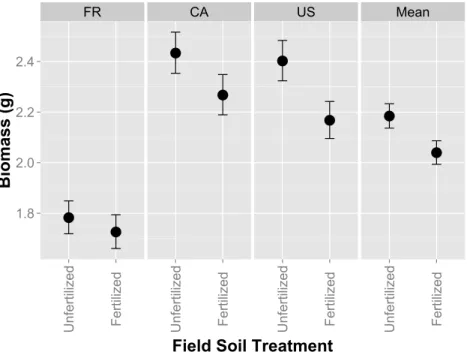
Figure 1 Host performance in whole-soil inoculations that have been fertilized or unfertilized in the field.Aboveground biomass (g) inMedicago lupulina when three plant genotypes (FR, CA and US) were inoculated with whole soil from field plots that were either fertilized with nutrients containing all conventional macro and micronutrients or remained unfertilized. Mean values for each field soil treatment combine glasshouse fertilized and glasshouse unfertilized treatments. Error bars represent standard errors.
lsmeans were obtained from [fertilizer media]*[isolate] term (PROC MIXED, dist=
Gaussian). Additionally, we calculated a growth plasticity index as the ratio of growth response in fertilizer and no fertilizer after 36 h for each isolate (see ‘tolerance index’ in
Thrall et al., 2009): [ODhigh,36 h−ODhigh,initial]/(ODcontrol,36 h−ODcontrol,initial] and [ODlow,36 h−ODintermedite,initial]/(ODcontrol,36 h−ODcontrol,initial], where ‘control’, ‘low’
and ‘high’ refer to fertilizer concentration. For isolate means in host performance, total fruit and flower production was modelled by block, harvest date and isolate as fixed effects and lsmeans were obtained from the isolate term (PROC GLIMMIX, dist=over-dispersed Poisson). We tested for associations betweenin vitrogrowth assays and mutualistic benefit using a general linear model, with host performance as the response and cell density, field fertilizer treatment and host genotype as predictors. We repeated the model for each type of growth assay (cell density count in control, low and high nutrient and the growth plasticity index).
RESULTS
Hosts performance in field soil inoculations
Plant biomass was larger when hosts were grown in unfertilized field soil compared to fertilized field soil (Fig. 1;F1,418=471,p=0.0306;Table S1). Expectedly plants were
larger when fertilizer was applied to pots in the greenhouse (F1,418=121.36,p<0.0001;
Figure 2 Host partner quality of rhizobia isolates from fertilized or unfertilized field soil using single-strain inoculations.Host partner quality, measured by plant fitness (total fruit and flower production), on the US plant genotype exposed to single-isolate inoculations of rhizobia isolated from fertilized or unfertilized treatments. FR, CA and US are host genotypes the isolates were originally cultured from. Mean values for each field soil treatment combine all isolates from every host genotype. Error bars represent standard errors.
p<0.0001). However, host genotype and greenhouse fertilizer application did not alter rank effects of field fertilizer treatment, as indicated by a lack of interactive effects between the field and greenhouse fertilizer treatment (F1,418=0.7595,p=0.7595;Table S1) and
between field fertilizer and host genotype (F2,418=0.56,p=0.5714). Nodule number and
mean nodule size was 3.49% and 15.28% larger in fertilized field soil, but not significantly so (F1,272=2.73,p=0.0997;F1,13.11=2.71,p=0.1232 resp.). Generally, these results
indicate that the higher host performance in unfertilized field soil was consistent across host genotypes and greenhouse fertilizer treatments.
Hosts performance in single isolate inoculations
Full model results are presented inTable S2. In contrast to whole-soil inoculation effects, plants had higher performance (measured by fruit and flower production) when inoculated with isolates originating from fertilized field soil (Fig. 2;F1,152=4.35,
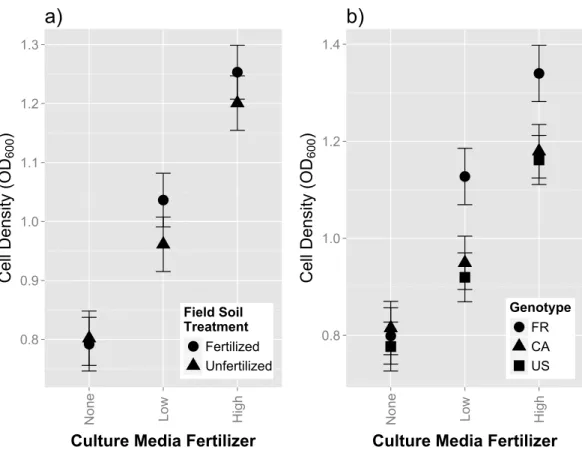
Figure 3 In vitrogrowth assays of rhizobia isolates in variable concentrations of fertilizer.Cell density, (measured by optical density at 600 nm), of single isolate rhizobia cultures grown in liquid media (after 36 h of growth) containing increasing concentrations of plant fertilizer. (A) Growth responses between isolates originally from fertilized and unfertilized field soil (B) Growth responses between isolates originally cultured from different host genotypes (FR, CA and US). Error bars represent standard errors.
results indicate that isolates isolated from unfertilized field soil provided lower mutualism benefits to their host compared to isolates from fertilized field soil.
Strain growth assays on differing media fertilizer concentrations We found no main effect of field fertilization on strain growth in culture (F1,1118=1.14,
p=0.2862;Table S3). Media fertilizer had a consistent and positive effect on rhizobia growth, causing intermediate cell density at low fertilizer concentrations, and high cell density counts at high media fertilizer concentrations (Fig. 3A,3BandTable S3). We also found significant differences in growth among isolates (χ2=408.2,p<0.0001;Table S3). Isolates originating from fertilized field soil exhibited the highest increase in growth as fertilizer media content increased, as indicated by a significant overall effect of [field fertilizer]∗[media fertilizer] (Fig. 3A;
F2,1114=4.08;p=0.0172;Table S3). Host genotype
origin also affected growth reaction norms, with isolates from FR hosts exhibiting the highest increase in growth across media fertilizer concentrations (Fig. 3B;F4,1114=9.40;
Figure 4 Genetic correlations between host partner quality and free-living growth of rhizobia isolates from fertilized and unfertilized field soil.Genetic correlation between host partner quality (measured as plant fitness using total fruit and flower production) and growth responses in rhizobia using growth plasticity indices calculated from (A) low media fertilizer concentrations and (B) high media fertilizer concentrations. Plasticity indices are the ratio of growth responses in fertilizer vs. no fertilizer after 36 h. Individual points are trait means calculated within each field and media fertilizer treatment for each rhizobia isolate.
Correlations between free-living growth and mutualistic benefit We did not detect any broad association patterns between mutualistic benefit (measured by host performance) and cell growth measures using cell density estimates in any media fertilizer treatment (indicated by no significant main effect of cell density; seeTable S4), nor did we detect any field fertilizer treatment specific associations between host performance and cell density estimated in any fertilizer culture media (indicated by no significant cell density*field fertilizer interaction; seeTable S4). However, the low fertilizer growth plasticity index (the ratio of growth responses in low fertilizer vs. no fertilizer after 36 h) did show field treatment specific reaction norms, exhibiting a positive correlation between traits in the presence of field fertilizer and a negative correlation in unfertilized treatments (Fig. 4A; field fertilizer*growth plasticity index;F1,43=6.25,p=0.0163 in
Table S4). The high fertilizer growth plasticity index (the ratio of growth responses in high fertilizer vs. no fertilizer after 36 h) trended in similar but non-significant reaction norm patterns (Fig. 4BandTable S4).
DISCUSSION
shows that plant fertilizer changes host partner quality (as defined by host biomass, flower or fruit production) and free-living growth responses as well as environmentally dependent associations between these traits, demonstrating that long-term nutrient application across multiple years is not required to observe shifts in ecologically relevant phenotypic traits of symbiotic rhizobia populations.
Growth responses of rhizobia to plant fertilizer
Our data show that, even after a single season of fertilizer application, isolates from fertilized field soil grew faster than isolates from unfertilized field soil when the growing media contained the original plant fertilizer used on field soil. These results suggests that field fertilizer application caused a community shift or within-species evolutionary change, favouring lineages or genotypes (or even alleles at specific genes) that are more capable of utilizing higher dosages of plant fertilizer for growth in the free-living state (in the soil or in culture) in more nutrient-rich conditions. Given that rhizobia isolates from both field soil treatments responded positively to fertilizer in agar media, indicating that plant fertilizer provide nutrients that ordinarily limit free-living growth, our data support the hypothesis that fertilizer affected rhizobia fitness components related to free-living persistence in the soil. However, we cannot exclude the possibility that fertilizer application affected symbiosis fitness components, favouring rhizobia isolates that are competitive for
Medicagonodulation, thus gaining higher fitness through host feedbacks.
We found no preliminary evidence of a fitness trade-off for growth in higher fertilizer—rhizobia from fertilized field soil did not have lower growth rates than rhizobia from unfertilized field on control media containing no plant nutrients supplement (Fig. 3A). However, previous empirical studies have found fitness costs (affecting free-living persistence) to adaptation to salt (Thrall et al., 2009) and metal (Porter & Rice, 2012) in soil. It is possible that the fitness costs observed for higher metal and salt concentrations occurs because these factors are generally detrimental to rhizobia growth and may require physiological trade-offs for survival (i.e., minimizing uptake of harmful elements while maintaining acquisition of beneficial elements). A lack of a fitness cost observed in our experiment may be because plant fertilizer stimulates growth and thus does not require physiological trade-offs to survive in low or high nutrient conditions.
To our knowledge, this is the first study to provide evidence that plant fertilizer (containing all macro and micro nutrients) is directly beneficial for rhizobia growth and favours isolates that have higher growth response to fertilizer.
Mutualism benefit responses of rhizobia to plant fertilizer
in the initial whole-soil inoculations. In contrast,Weese et al. (2015)found the host partner quality decreased as a result of long term addition of nitrogen. We explored the possibility that the increase in host partner quality observed in our study may be due to a positive ge-netic correlation with free-living tolerance to fertilizer (i.e., isolates with higher mutualism benefit were observed due to a positive trait correlation with fertilizer tolerance). While we did detect a positive genetic correlation between host partner quality and plasticity in growth response to fertilizer, the direction of the correlation only occurred in fertilized field soil, being more strongly positive in the presence of fertilizer. The application of field fertilizer may have induced a positive correlation due to environment specific expression of genes that had pleiotropic effects on free-living growth and mutualism benefit traits, and may explain why both traits changed in our study. Generally, our data show that growth responses to fertilizer and mutualism benefit are not independent, and that the presence of fertilizer alters the degree of trait dependency for traits relevant to rhizobia fitness.
Another possible mechanism for increased host partner quality is that different host feedback dynamics occurred in our experiment compared toWeese et al. (2015). The addition of fertilizer containing excessive nitrogen (as the case withWeese et al., 2015) typically supresses associations with rhizobia, which is expected to alter host feedback dynamics by reducing fitness benefits towards beneficial symbiotic rhizobia. However, different host feedback dynamics may be induced if fertilizer contains increasing concentrations of all other macro macronutrients (i.e., N, P and K). For example, an increased nitrogen and phosphorus supply can increase symbiotic associations with beneficial rhizobia partners, which would then actually increase fitness benefits towards beneficial rhizobia partners.
Alternatively, fertilizer input in our experiment could have reduced selective pressure from plant feedbacks, which would cause host partner quality traits to increase by drift. However, replicated randomized plots allowed us to ascribe any differences among fertilizer types to the treatments we applied, making drift a less likely explanation. Furthermore, drift is expected to randomly exacerbate plot level differences between rhizobia populations, but plot had no explanatory effect in either host partner quality orin vitrogrowth traits in our study.
highlight the challenge of focusing on individual taxa for inferring processes on complex non-additive effects of microbial communities on plant-microbe interactions, plant productivity and fitness.
Host origin affects rhizobia traits
Legume hosts have an important influence on rhizobia fitness in soils. The particular host genotype and species also has an influence on rhizobia abundance and composition (Coelho et al., 2009). Our experiment further shows that the origin of the host genotype is also associated with colony growth phenotypes of individual rhizobia, regardless of the fertilizer treatment applied on the field soil (Fig. 3B). Specifically, we found that isolates from hosts originating from France (i.e., FR) had a larger response to growth on fertilized agar media compared to isolates obtained from hosts from Canada and United States. Interestingly, the French host performed the poorest in initial whole soil inoculation (Fig. 1). Isolates from the French host genotype also trended towards providing the highest mean mutualism benefit (Fig. 2). Our results suggest that the host genotype or the host genotype reaction to the soil affected the assemblage of symbiotic interacting rhizobia during the whole soil inoculation. Generally, these results are consistent with previous studies (Coelho et al., 2009;Heath & Tiffin, 2009;Lafay & Burdon, 2001;Hoque, Broadhurst & Thrall, 2011), which have found that host genotypes have strong effects on the assemblage of rhizobia isolates inhabiting the nodules and, therefore, subsequent effects on the genetic composition of the soil communities after plant senescence.
CONCLUSION
Our experiments have shown that short-term application of plant fertilizer can select isolates that differ in phenotypic traits related toin vitrovigour and legume symbiosis, and together with fertilization responses in culture, suggest that the shift in growth responses was a result of a direct response to fertilizer application. However, the underlying causes of the observed increase in mutualism benefit as a result of fertilizer application will require further investigation with larger sub-samples of isolates, as the observed changes in trait values can still potentially be explained by altered host feedback responses. Our study importantly shows that fertilizer causes environment specific dependency between phenotypic traits, indicating that changes in growth and mutualism benefit traits will not act independently in response to fertilizer. Our findings support the emerging literature demonstrating that host genotypes, nutrient environments, and their interaction alter the phenotypic composition of natural rhizobia populations and, more generally, contributes to the nascent synthesis demonstrating important implications of anthropogenic disturbances on important mutualistic species interactions (Ratcliff, Kadam & Denison, 2008;Porter & Simms, 2014).
ACKNOWLEDGEMENT
ADDITIONAL INFORMATION AND DECLARATIONS
Funding
Funding was provided by NSERC Canada and CFI. The funders had no role in study design, data collection and analysis, decision to publish, or preparation of the manuscript.
Grant Disclosures
The following grant information was disclosed by the authors: NSERC Canada and CFI.
Competing Interests
The authors declare there are no competing interests.
Author Contributions
• Anna K. Simonsen conceived and designed the experiments, analyzed the data, wrote
the paper, prepared figures and/or tables, reviewed drafts of the paper.
• Shery Han, Phil Rekret and Christine S. Rentschler conceived and designed the
experiments, performed the experiments, reviewed drafts of the paper.
• Katy D. Heath conceived and designed the experiments, reviewed drafts of the paper.
• John R. Stinchcombe conceived and designed the experiments, contributed reagents/materials/analysis tools, reviewed drafts of the paper.
Data Availability
The following information was supplied regarding data availability: Figshare:http://figshare.com/s/8e48d1ea544511e5a31306ec4bbcf141.
Supplemental Information
Supplemental information for this article can be found online athttp://dx.doi.org/ 10.7717/peerj.1291#supplemental-information.
REFERENCES
Asimi S, Gianinazzi-Pearson V, Gianinazzi S. 1980.Influence of increasing soil phosphorus levels on interactions between vesicular-arbuscular mycorrhizae and Rhizobium in soybeans. Canadian Journal of Botany58:2200–2205DOI 10.1139/b80-253.
Barrett LG, Bever JD, Bissett A, Thrall PH. 2015. Partner diversity and identity impacts on plant productivity in Acacia–rhizobial interactions.Journal of Ecology103:130–142
DOI 10.1111/1365-2745.12336.
Bever JD, Platt TG, Morton ER. 2012.Microbial population and community dynamics on plant roots and their feedbacks on plant communities.Annual Review of Microbiology66:266–283
DOI 10.1146/annurev-micro-092611-150107.
signal molecules by direct binding.Proceedings of the National Academy of Sciences of the United States of America109:13859–13864DOI 10.1073/pnas.1205171109.
Bromfield ESP, Tambong JT, Cloutier S, Pr´evost D, Laguerre G, Van Berkum P, Thi TVT, Assabgui R, Barran LR. 2010.Ensifer, Phyllobacterium and Rhizobium species occupy nodules of Medicago sativa (alfalfa) and Melilotus alba (sweet clover) grown at a Canadian site without a history of cultivation.Microbiology156:505–520DOI 10.1099/mic.0.034058-0.
Carroll BJ, GresshoffPM. 1983.Nitrate inhibition of nodulation and nitrogen fixation in white clover.Zeitschrift f¨ur Pflanzenphysiologie110:77–88DOI 10.1016/S0044-328X(83)80218-9. Coelho MR, Marriel IE, Jenkins SN, Lanyon CV, Seldin L, O’Donnell AG. 2009.Molecular
detection and quantification of nifH gene sequences in the rhizosphere of sorghum (Sorghum bicolor) sown with two levels of nitrogen fertilizer.Applied Soil Ecology42:48–53
DOI 10.1016/j.apsoil.2009.01.010.
Gates C, Wilson J. 1974.The interaction of nitrogen and phosphorus on the growth, nutrient status and nodulation of Stylosanthes humilis HBK (Townsville Stylo).Plant and Soil 41:325–333DOI 10.1007/BF00017260.
Germida JJ. 1988.Growth of indigenous Rhizobium leguminosarum and Rhizobium meliloti in soils amended with organic nutrients.Applied and Environmental Microbiology54:257–263. Heath KD, Tiffin P. 2009.Stabilizing mechanisms in a legume-rhizobium mutualism.Evolution
63:652–662DOI 10.1111/j.1558-5646.2008.00582.x.
Hirsch PR. 1996.Population dynamics of indigenous and genetically modified rhizobia in the field.New Phytologist133:159–171DOI 10.1111/j.1469-8137.1996.tb04351.x.
Hoque MS, Broadhurst LM, Thrall PH. 2011.Genetic characterization of root-nodule bacteria associated with Acacia salicina and A. stenophylla (Mimosaceae) across south-eastern Australia.International Journal of Systematic and Evolutionary Microbiology 61:299–309
DOI 10.1099/ijs.0.021014-0.
Imsande J. 1986.Inhibition of nodule development in soybean by nitrate or reduced nitrogen. Journal of Experimental Botany37:348–355DOI 10.1093/jxb/37.3.348.
Israel DW. 1987.Investigation of the role of phosphorus in symbiotic dinitrogen fixation.Plant Physiology84:835–840DOI 10.1104/pp.84.3.835.
Kardol P, Cornips NJ, Van Kempen MM, Bakx-Schotman JT, Van der Putten WH. 2007.
Microbe-mediated plant-soil feedback causes historical contingency effects in plant community assembly.Ecological Monographs77:147–162DOI 10.1890/06-0502.
Kiers ET, Hutton MG, Denison RF. 2007.Human selection and the relaxation of legume defences against ineffective rhizobia.Proceedings of the Royal Society B: Biological Sciences274:3119–3126
DOI 10.1098/rspb.2007.1187.
Lafay B, Burdon JJ. 2001.Small-subunit rRNA genotyping of rhizobia nodulating Australian Acacia spp.Applied and Environmental Microbiology67:396–402DOI 10.1128/AEM.67.1.396-402.2001.
Marschner P, Kandeler E, Marschner B. 2003.Structure and function of the soil microbial community in a long-term fertilizer experiment.Soil Biology and Biochemistry35:453–461
DOI 10.1016/S0038-0717(02)00297-3.
O’hara GW, Boonkerd N, Dilworth MJ. 1988.Mineral constraints to nitrogen fixation.Plant and Soil108:93–110DOI 10.1007/BF02370104.
Porter SS, Rice KJ. 2012.Tradeoffs, spatial heterogeneity, and the maintenance of microbial diversity.Evolution67:599–608DOI 10.1111/j.1558-5646.2012.01788.x.
Porter SS, Simms EL. 2014. Selection for cheating across disparate environments in the legume-rhizobium mutualism.Ecology Letters17:1121–1129DOI 10.1111/ele.12318. Pr´evost D, Bromfield ES. 2003.Diversity of symbiotic rhizobia resident in Canadian soils.
Canadian Journal of Soil Science83:311–319DOI 10.4141/S01-066.
RatcliffWC, Kadam SV, Denison RF. 2008.Poly-3-hydroxybutyrate (PHB) supports survival and reproduction in starving rhizobia.FEMS Microbiology Ecology 65:391–399
DOI 10.1111/j.1574-6941.2008.00544.x.
Sachs JL, Russell JE, Hollowell AC. 2011.Evolutionary instability of symbiotic function in Bradyrhizobium japonicum.PLoS ONE6:e26370DOI 10.1371/journal.pone.0026370. Sarathchandra S, Ghani A, Yeates G, Burch G, Cox N. 2001.Effect of nitrogen and phosphate
fertilisers on microbial and nematode diversity in pasture soils.Soil Biology and Biochemistry 33:953–964DOI 10.1016/S0038-0717(00)00245-5.
Sessitsch A, Weilharter A, Gerzabek MH, Kirchmann H, Kandeler E. 2001.Microbial population structures in soil particle size fractions of a long-term fertilizer field experiment.Applied and Environmental Microbiology67:4215–4224DOI 10.1128/AEM.67.9.4215-4224.2001.
Simonsen AK, Chow T, Stinchcombe JR. 2014.Reduced plant competition among kin can be explained by Jensen’s inequality.Ecology and Evolution4:4454–4466DOI 10.1002/ece3.1312. Smith K, Conen F. 2004.Impacts of land management on fluxes of trace greenhouse gases.Soil
Use and Management20:255–263DOI 10.1079/SUM2004238.
Somasegaran P, Hoben HJ. 1994. Handbook for rhizobia: methods in legume-Rhizobium technology. New York: Springer-Verlag, 510.
Streeter J, Wong PP. 1988.Inhibition of legume nodule formation andN2 fixation by nitrate.
Critical Reviews in Plant Sciences7:1–23DOI 10.1080/07352688809382257.
Thrall PH, Broadhurst LM, Hoque MS, Bagnall DJ. 2009.Diversity and salt tolerance of native Acacia rhizobia isolated from saline and non-saline soils.Austral Ecology34:950–963
DOI 10.1111/j.1442-9993.2009.01998.x.
Thrall PH, Slattery JF, Broadhurst LM, Bickford S. 2007.Geographic patterns of symbiont abundance and adaptation in native Australian Acacia–rhizobia interactions.Journal of Ecology 95:1110–1122DOI 10.1111/j.1365-2745.2007.01278.x.
Van Der Heijden MG, Bardgett RD, Van Straalen NM. 2008.The unseen majority: soil microbes as drivers of plant diversity and productivity in terrestrial ecosystems.Ecology Letters11:296–310
DOI 10.1111/j.1461-0248.2007.01139.x.
Wall DH, Moore JC. 1999.Interactions underground: soil biodiversity, mutualism, and ecosystem processes.BioScience49:109–117DOI 10.2307/1313536.
Weese DJ, Heath KD, Dentinger B, Lau JA. 2015.Long-term nitrogen addition causes the evolution of less cooperative mutualists.Evolution69:631–642DOI 10.1111/evo.12594. Yan J, Han XZ, Ji ZJ, Li Y, Wang ET, Xie ZH, Chen WF. 2014.Abundance and diversity of
soybean-nodulating rhizobia in black soil are impacted by land use and crop management. Applied and Environmental Microbiology80:5394–5402DOI 10.1128/AEM.01135-14.