____________________________
Corresponding author: Ahmad Reza Golparvar, Department of Agronomy and Plant Breeding, Khorasgan (Isfahan) Branch, Islamic Azad University, P.O.Box: 81595-158, Isfahan, Iran, e-mail :[email protected]
UDC 575:635.652 DOI: 10.2298/GENSR1202279G
Original scientific paper
MULTIVARIATE ANALYSIS AND DETERMINATION OF THE BEST INDIRECT SELECTION CRITERIA TO GENETIC IMPROVEMENT THE
BIOLOGICAL NITROGEN FIXATION ABILITY IN COMMON BEAN GENOTYPES (PHASEOLUS VULGARIS L.)
Ahmad Reza GOLPARVAR
Department of Agronomy and Plant Breeding, Khorasgan (Isfahan) Branch, Islamic Azad University, Isfahan, Iran
Golparvar A.R. (2012): Multivariate analysis and determination of the best indirect selection criteria to genetic improvement the biological nitrogen fixation ability in common bean genotypes (Phaseolus vulgaris L.). Genetika, Vol 44, No. 2, 279 - 284.
percent of total nitrogen of shoot, number of nodule per plant and biological yield accounted for 92.3 percent of variation exist in percent of nitrogen fixation. Path analysis indicated that these traits have direct and positive effect on percent of nitrogen fixation. Hence, these traits are promising indirect selection criteria for genetic improvement of nitrogen fixation capability in common bean genotypes especially in early generations.
Key words: common bean, hierarchical cluster analysis, multivariate linear regression, nitrogen fixation, nodulation
INTRODUCTION
Biological nitrogen fixation is one of the most important sources for production approximately 65% of nitrogen used in agriculture (THOMASet al., 1997). Indirect selection in early generation through traits correlated with seed yield and biological nitrogen fixation is important strategy in common bean breeding.
Correlation coefficient analyses help researchers to distinguish significant relationship between traits. Step-wise regression can reduce effect of non-important traits in regression model, in this way traits accounted for considerable variations of dependent variable are determined (AGRAMA, 1996). Path analyses that present by Li (1956) have been extensively used for segregating correlation between yield and its components in field crops. Path analysis is used to determine the amount of direct and indirect effects of the variables on the dependent variable (ULUKANet al., 2003).
MILLER et al. (1986) found that nodule weight and nodule number plant-1 are the best effective criteria for genetic improvement of biological nitrogen fixation in spotted bean, while pod number plant-1 has been proposed for this purpose in common bean genotypes (ALI et al., 2000). ATTEWAL and BLISS (1985) reported higher seed yield in common bean genotypes having higher amount of biological nitrogen fixation.
GHASEMI et al. (2005) emphasized on traits nodule number plant-1, nodule weight, pod number plant-1 and pod weight as the most important criteria for breeding biological nitrogen fixation in common bean cultivars.
ULUKAN et al. (2003) reported positive and significant relationships between biological yield with plant height, pod number plant-1 and grain number pod -1
in faba bean genotypes. The total coefficient of determination was found as 63.6% in the regression model for biological yield as dependent variable. Direct effects of plant height, pod number plant-1 and grain number pod-1 upon biological yield were positive. These traits determined as selection criteria for genetic improvement of biological yield.
MATERIALS AND METHODS
The study was carried out at the experimental fields of the department of agronomy and plant breeding, faculty of agriculture, Islamic Azad University, Khorasgan branch, Isfahan, Iran during 2009-2010. Sixty four common bean genotypes were selected from the Karadj gene bank. Seeds from each genotype were sown in 3m long rows.
The field experiment was established as the randomized complete block design. Experiment envolve two separated augmented design. In one of them seeds were inoculated with Rhizobium legominosarum biovar phaseoli isolate L-109 as check for another (GULERet al., 2001; KATIYAR and SINGH, 1990). In this way, trait biological nitrogen fixation is estimated by using nitrogen-difference method proposed by TAMIMI (2002). Isolate L-109 had been recognized as the compatible isolate with Iranian common bean genotypes in this province at the basis of results given from previous study (GHASEMIet al., 2005).
Measurements of investigated traits were done on ten normal plants, which have been randomly chosen from the middle-row of each plot. The following measurements were achieved on; seed yield plant-1, seed number pod-1, pod number plant-1, pod yield plant-1, 100-seed weight, biological yield, harvest index, nodule number plant-1 in 50% flowering, total nitrogen of shoot and biological nitrogen fixation. Biological nitrogen fixation was calculated using the formula suggested by
TAMIMI (2002).
Relationships between traits investigated using simple correlation coefficients. Step-wise regression analysis was achieved for determination of the best model which accounted for variation exist in biological nitrogen fixation as dependent variable. Path analysis based on the method given by DEWEY and LU
(1959) was done on the traits entered to regression model. The cluster analysis based on ward’s method was also used to classify the traits and determine the effective criteria for genetic improvement of biological nitrigen fixation. Data analysis was done by using softwares SAS and SPSS.
RESULTS AND DISCUSSION
Correlation analysis revealed that all the traits except seed number pod-1 have positive and significant relationship with biological nitrogen fixation. Step-wise regression analysis for biological nitrogen fixation as dependent variable and other traits as independent variables (Table 1) indicated that traits total nitrogen of shoot, nodule number plant-1 and biological yield accounted for 92.3% of variation exist in biological nitrogen fixation. Amongst, trait total nitrogen of shoot accounted for 60% of variation of biological nitrogen fixation.
al. (2005), YADEGARI (2003) and AMINI et al. (2004) reported similar results for these traits.
Table 1. Step-wise regression for biological nitrogen fixation (dependent variable) in Common bean genotypes
Variable b(1) S.E R
2
t Prob
Total nitrogen of shoot (%) 0.516 1.083 0.600 4.415 0.000
Nodule number plant-1 0.325 0.403 0.762 4.002 0.000
Biological yield (gr) 0.218 2.231 0.923 2.392 0.000
Intercept -42.214 7.503 -4.956 0.013
(1): b values have been tested relative to zero.
Table 2.Path analysis for biological nitrogen fixation in Common bean genotypes
Variable (1) (2) (3) Sum of effects
(1) Total nitrogen of shoot (%) 0.651 0.157 0.051 0.860
(2) Nodule number plant-1 0.220 0.417 -0.051 0.638
(3) Biological yield (gr) 0.072 -0.073 0.549 0.550
Residual effects 0.214
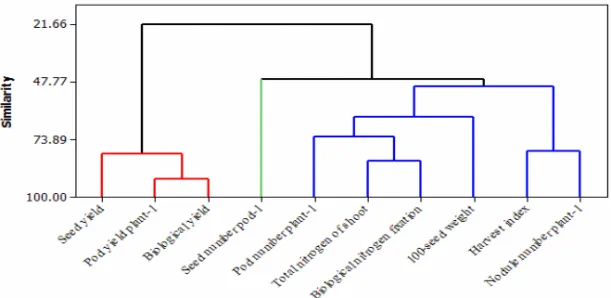
The dendrogram obtained from cluster analysis (Figure 1) showed relative consistency between the result of classify traits given by using two multivariate methods. The similar findings were obtained from other researches (ABDOLLAHI et al., 2009; BARRONet al., 1999; GHASEMIet al., 2005; TADESSE and BEKELE, 2001).
In conclusion, we can suggest indirect selection in early generations via traits that have the highest direct effect on dependent variables. These traits usually determine by means of statistical procedure like correlation, regression and path analysis. In this research, revealed that traits total nitrogen of shoot, nodule number plant-1 and biological yield are the best indirect selection criteria for genetic improvement of biological nitrogen fixation in common bean genotypes.
Received May 18th
, 2012 Accepted July 07th
, 2012
REFERENCES
ABDOLLAHI, A., M. KHODDAMBASHI and A.M. REZAIE (2009): Factor analysis of phenological and morphological traits in common bean,’’ Proc. 4th
crop science Symp, Shahrekord University Press. Pp: 169-174.
AGRAMA H.A.S (1996): Sequential path analysis of grain yield and it’s components in maize. Plant Breed. 115: 343-346.
ALI, A., S. SHEIKH, S. HUSSAIN, I.A. QAMAR and B. RODIAR KHAN (2000): Breeding food and forage legumes for enhancement of nitrogen fixation. Science Vision., 6(1): 49-57.
AMINI, A., M.R., GHANADHA and S. ABDEMISHANI (2004): Genetic diversity and correlation between traits in common bean (Phaseolus vulgaris L.). Iranian. J. Agric. Sci., 33: 605-617 (In Persian). ATTEWELL, J. and F.A. BLISS (1985): Host plant characteristics of common bean lines selected using
indirect measures of N2 fixation. p. 3-9. In H. J. Evans, P. J. Bottomley and W. E. Newton (ed.) Nitrogen Fixation Research Progress. Martinus Nijhoff Publishers, Boston.
BARRON, J.E., D.W. PASINI, D.D. DAVIS and P.H. STUTHMAN GRAHAM (1999): Response to selection for seed yield and nitrogen (N2) fixation in Common bean (Phaseolus vulgaris L.). Field. Crops. Research., 62:119-128.
DEWEY, D.R. and K.H. LU (1959): A correlation and path-coefficient analysis of components of crested wheat-grass seed production. Agron. J., 51: 515-518.
GHASEMI-PIRBALOUTI A., I., ALLAHDADI and GH.R. AKBARI (2005): Evaluation of yield and its components in common bean cultivars inoculated with Rhizobium legominosarum. Final report of research. Tehran University. pp:85. (In Persian).
GULER, M, M.S., ADAK and H. ULUKAN (2001): Determining relationships among yield and some yield components using path coefficient analysis in chickpea (Cicer arietinum L.). European J. Agron.,14: 161-166.
KATIYAR, R.P. and A.K. SINGH (1990): Path coefficient studies for yield and yield components in faba bean (Vicia faba L.). Febis newsletter., 12-14.
LI, C.C (1956): The concept of path analysis and it’s impact on population genetics. Biometrics., 12: 190-210.
MILLER, J.C., K.W., ZARY and G.C.J. FERNANDEZ (1986): Inheritance of nitrogen fixation efficiency in cowpea. Euphytica., 35:551-560.
TAMIMI, S.M (2002): Genetics diversity and symbiotic effectiveness of rhizobia isolated from root nodules of common bean (Phaseolus vulgaris L.) grown in the soils of the Jordan valley. App. Soil. Eco., 19: 183-190.
THOMAS, J., W., HOPPER and T.S. RAMASUBRAMANIAN (1997): Molecular biology tools to enhance biological nitrogen fixation by legumes. p. 39-56. In O.P. Rupela, C. Johansen and D.F. Herridge (ed.) Extending Nitrogen Fixation Research to Farmers’ Fields. ICRISAT, Patancheru, India.
ULUKAN, H., M., GULER and S. KESKIN (2003): A path coefficient analysis some yield and yield components in faba bean (Vicia faba L.) genotypes. Pak. J. Bio. Sci., 6 (23): 1951-1955.
YADEGARI, M. (2003): Inoculation of soy bean cultivars with Rhizobium japonicum for assessment of its effect on yield and yield components. M.Sc Thesis, Submitted to Tehran University, pp: 135. (In Persian).
ANALIZA MULTIVARIJANSE I UTVR ]IVANJE NAJBOLJEG INDIREKTNOG KRITERIJUMA SELEKCIJE NA GENETI KO POBOLJŠANJE SPOSOBNOSTI BIOLOŠKE FIKSACIJE AZOTA KOD
RAZLI ITIH GENOTIPOVA PASULJA (PHASEOLUS VULGARIS L.)
Ahmad Reza GOLPARVAR
Odelenje za poljoprivredu i oplemenjivanje biljaka, Khorasgan (Isfahan) Ogranak, Islamic Azad University, Isfahan, Iran
Da bi se utvrdili najbolji indirektni kriterijumi selekccije na geneti ko poboljšanj sposobnosti biološke fiksacije azota, šesdeset etiri genotipa pasulja (Phaseolus vulgaris L.) su gajena u dva ista slu ajna blok sistema. Inokulacija biljaka je vršena bakterijom Rhizobium legominosarum izolata L-109 biovarieteta Phaseoli samo u jednom blok sistemu dok je drugi blok sistem bio kontrola. Analiza korelacije je okazala pozitivnu i visoko zna ajnu zavisnost ve ine ispitivanih osobina i procenta biološke fiksacije azota. Stepenasta regresija je pokazala da se osobina procenta ukupnog azota biljke, broj nodula po biljci i biološki prinos se pripisuju sa 92.3 % variranju koje postoji u procentu fiksacije azota. Pat analiza ukazuje da te osobine te osobine pozitivno I direktno zavisse od fiksacije azota. Zaklju eno je da su te osobine obe avaju i indirektni kriterijumi sselekcije na geneti ko poboljšanje fiksacije azota genotipova pasulja (Phaseolus vulgaris L.), posebno u ranim generacijama.
Primljeno 18. V. 2012.